Overview
The center of mass is a fundamental concept in mechanics that represents the average position of all the mass in a system. This point behaves as if all the mass of the system were concentrated there, allowing complex multi-body systems to be analyzed using simplified single-particle dynamics. For the MCAT, understanding center of mass is essential because it bridges kinematics, dynamics, and conservation principles—three pillars of Physics tested extensively on the exam. The center of mass concept applies to everything from analyzing human gait and balance in biological systems to understanding collision dynamics and rotational motion.
On the MCAT, center of mass Physics appears in multiple contexts: translational motion of systems, stability and equilibrium problems, collision analysis, and biomechanical applications relevant to human physiology. Questions may present scenarios involving athletes, falling objects, or interacting bodies where identifying the motion of the center of mass simplifies problem-solving dramatically. The AAMC frequently tests whether students can distinguish between the motion of individual parts of a system versus the motion of the system as a whole.
Mastering center of mass provides the foundation for understanding more advanced topics including torque, rotational dynamics, angular momentum, and conservation laws. It connects directly to Newton's laws by demonstrating that the net external force on a system determines the acceleration of its center of mass, regardless of internal forces or the complexity of the system's internal motion. This unifying principle makes center of mass one of the most powerful problem-solving tools in mechanics and a high-yield topic for efficient MCAT preparation.
Learning Objectives
- [ ] Define center of mass using accurate Physics terminology
- [ ] Explain why center of mass matters for the MCAT
- [ ] Apply center of mass to exam-style questions
- [ ] Identify common mistakes related to center of mass
- [ ] Connect center of mass to related Physics concepts
- [ ] Calculate the position of center of mass for discrete and continuous mass distributions
- [ ] Predict the motion of a system's center of mass using conservation of momentum
- [ ] Analyze stability and equilibrium conditions using center of mass principles
Prerequisites
- Vector addition and components: Center of mass calculations require decomposing positions into x, y, and z components and combining them vectorially
- Newton's laws of motion: Understanding how forces affect motion is essential for analyzing center of mass dynamics
- Basic kinematics: Position, velocity, and acceleration concepts apply directly to center of mass motion
- Conservation of momentum: The center of mass velocity is directly related to total system momentum
- Basic algebra and weighted averages: Center of mass calculations are fundamentally weighted average computations
Why This Topic Matters
Clinical and Real-World Significance
Center of mass principles are fundamental to understanding human biomechanics, balance, and locomotion. Physical therapists analyze center of mass position to assess fall risk in elderly patients and design rehabilitation protocols. Athletes and coaches use center of mass concepts to optimize performance in activities like high jumping (where the body can clear a bar while the center of mass passes beneath it), gymnastics, and diving. Medical devices such as prosthetic limbs must be designed with proper mass distribution to maintain natural center of mass positioning during gait.
MCAT Exam Statistics
Center of mass appears in approximately 3-5% of Physics passages on the MCAT, with questions distributed across both passage-based and discrete formats. The topic most commonly appears integrated with:
- Collision problems (elastic and inelastic)
- Conservation of momentum scenarios
- Equilibrium and stability questions
- Biomechanics passages involving human movement
- Rotational motion and torque problems
Common Exam Presentations
MCAT passages frequently present center of mass concepts through:
- Biomechanical scenarios: Analysis of human posture, balance, or athletic movements
- Collision experiments: Two or more objects interacting with questions about system motion
- Stability problems: Objects on inclines, tipping scenarios, or balance beam situations
- Projectile motion: Systems that break apart mid-flight with questions about trajectory
- Astronomical contexts: Binary star systems or planetary motion (less common but possible)
Core Concepts
Definition and Mathematical Formulation
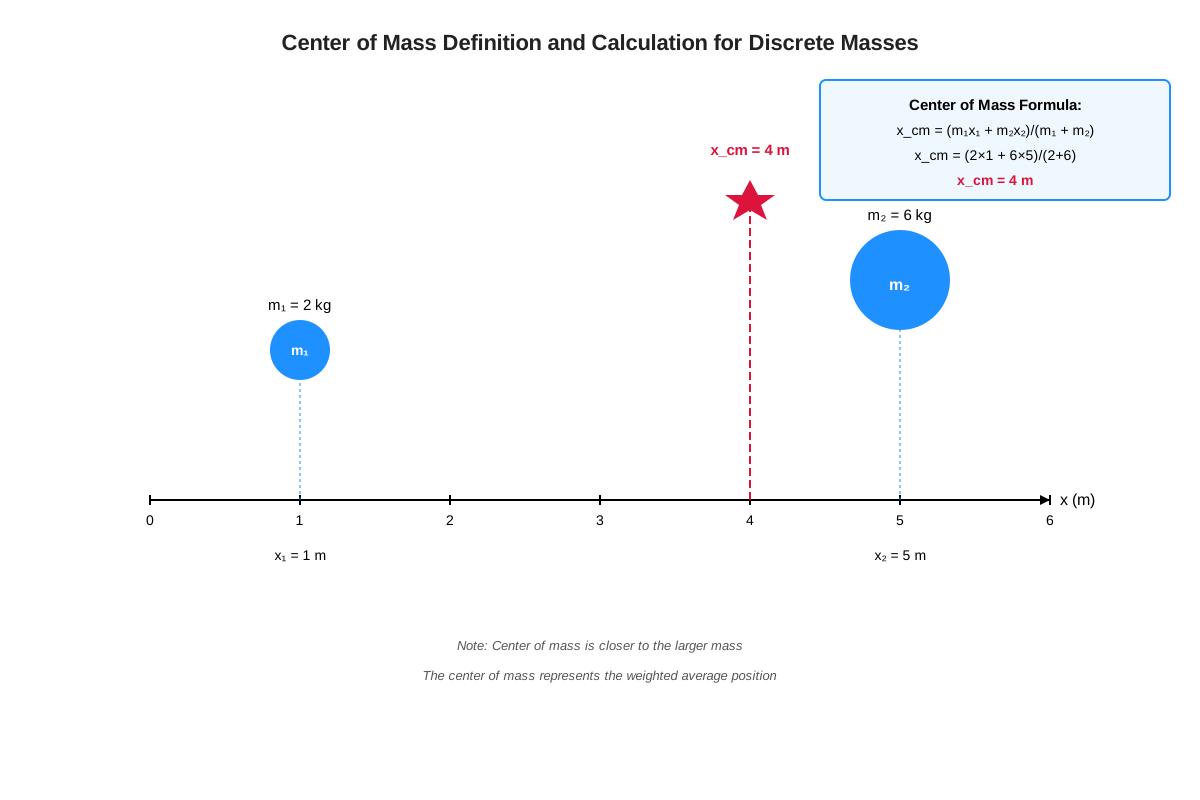
The center of mass (COM) is the point in a system or object where the weighted relative position of the distributed mass sums to zero. Mathematically, for a system of discrete particles, the position of the center of mass is given by:
r_cm = (Σ m_i * r_i) / M_totalWhere:
- r_cm is the position vector of the center of mass
- m_i is the mass of the ith particle
- r_i is the position vector of the ith particle
- M_total is the total mass of the system (Σ m_i)
For two-dimensional problems, this separates into x and y components:
x_cm = (Σ m_i * x_i) / M_total
y_cm = (Σ m_i * y_i) / M_total
This formula represents a weighted average of positions, where masses serve as the weighting factors. Objects with more mass contribute more heavily to the center of mass position.
Center of Mass for Common Geometric Shapes
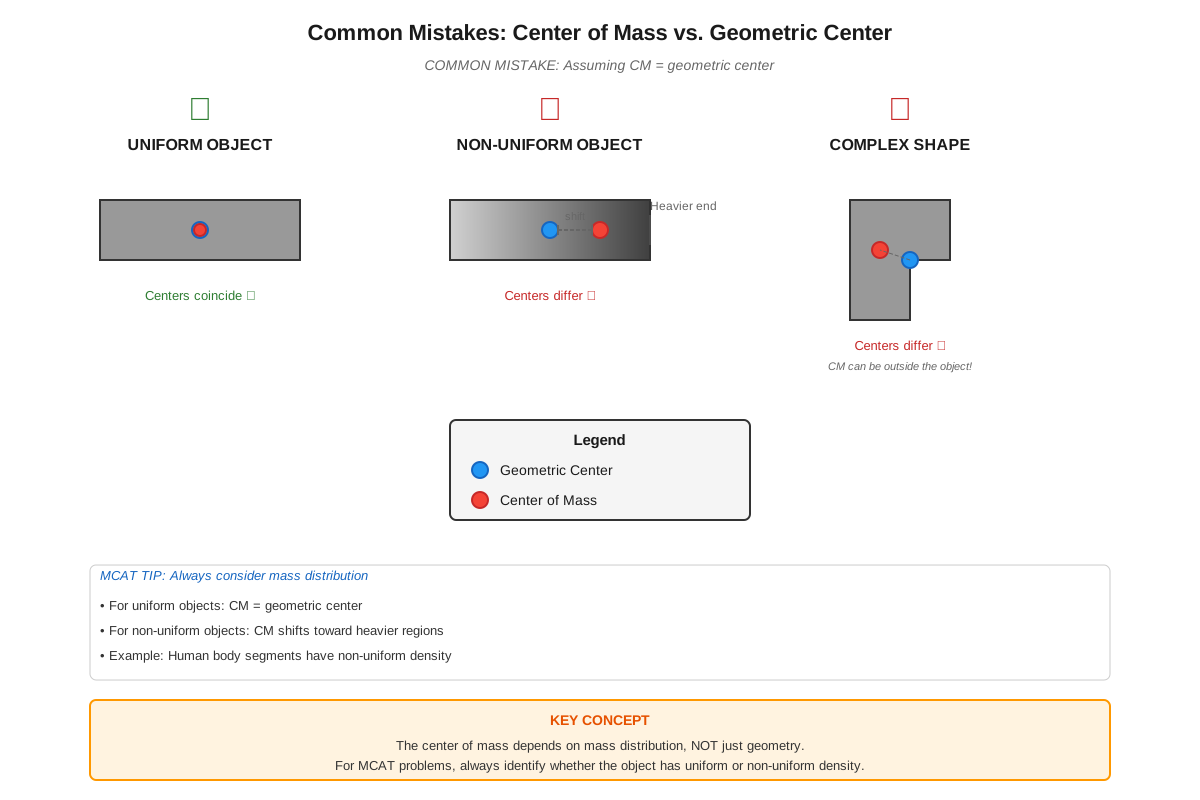
For uniform objects (constant density), the center of mass coincides with the geometric center:
| Shape | Center of Mass Location |
|---|---|
| Uniform rod | Midpoint of the rod |
| Rectangular plate | Intersection of diagonals |
| Circular disk | Geometric center |
| Sphere | Geometric center |
| Triangle | Intersection of medians (centroid) |
| Irregular shape | Must calculate using integration or discrete summation |
For non-uniform objects or systems of separate objects, the center of mass shifts toward regions of greater mass density. This principle explains why a hammer's center of mass is located near the head rather than at the geometric center of the entire tool.
Motion of the Center of Mass
The velocity and acceleration of the center of mass follow directly from differentiating the position:
v_cm = (Σ m_i * v_i) / M_total
a_cm = (Σ m_i * a_i) / M_total = F_net_external / M_total
This last equation reveals a crucial principle: the center of mass of a system moves as if all the mass were concentrated at that point and all external forces were applied there. This is a direct consequence of Newton's second law applied to systems.
Internal vs. External Forces
A critical distinction for MCAT problem-solving is that internal forces (forces between parts of the system) cannot change the motion of the center of mass. Only external forces affect center of mass motion. This principle explains several counterintuitive phenomena:
- A person standing on a frictionless surface cannot change their center of mass position by moving their arms or legs
- In an isolated system (no external forces), the center of mass moves with constant velocity
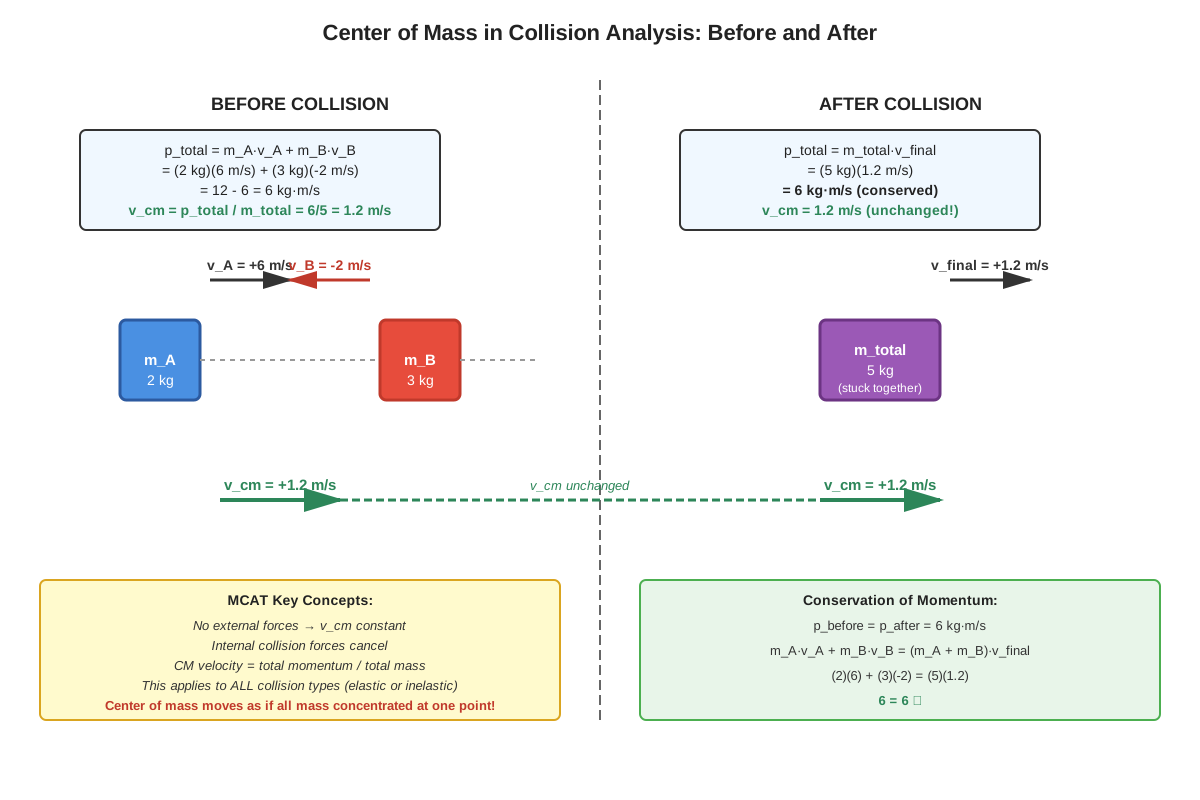
- During collisions, regardless of how objects deform or bounce, the center of mass continues with unchanged velocity if no external forces act
Center of Mass and Conservation of Momentum
The total momentum of a system equals the momentum of the center of mass:
P_total = M_total * v_cmThis relationship makes center of mass analysis the preferred approach for collision problems. When momentum is conserved (no external forces or external forces sum to zero), the center of mass velocity remains constant before, during, and after the collision.
Stability and Equilibrium
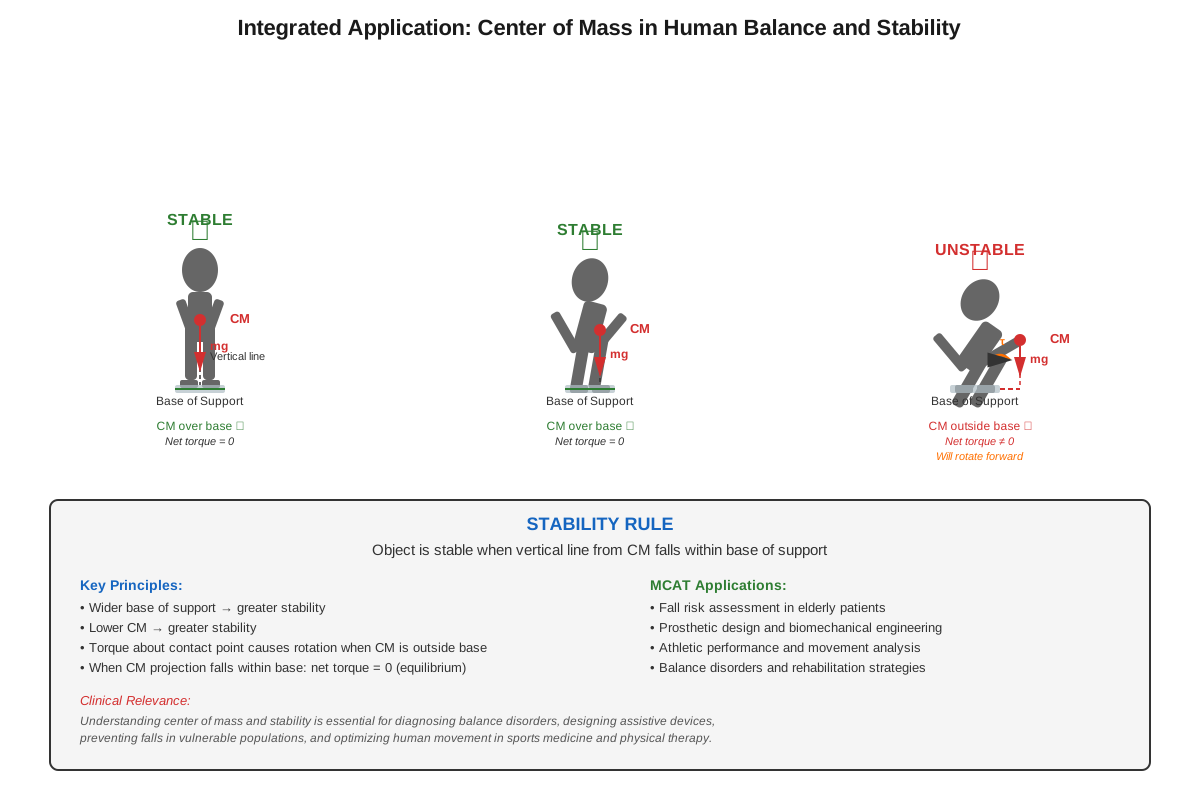
An object's stability depends on the relationship between its center of mass and its base of support:
- Stable equilibrium: Center of mass is low and positioned over the base of support; tipping the object raises the center of mass
- Unstable equilibrium: Center of mass is high; small displacements lower the center of mass, causing continued tipping
- Neutral equilibrium: Center of mass height remains constant during displacement
For an object to remain upright, a vertical line through its center of mass must pass through its base of support. This principle explains why:
- Leaning towers eventually fall when the COM shifts beyond the base
- Tightrope walkers use balance poles to adjust their system's center of mass
- Pregnant women often lean backward to keep their center of mass over their feet
Systems with Changing Mass
For systems where mass is ejected or added (rockets, conveyor belts), the center of mass analysis becomes more complex. However, the fundamental principle remains: the center of mass of the total system (including ejected material) follows predictable motion based on external forces alone.
Concept Relationships
The center of mass concept serves as a central hub connecting multiple areas of mechanics:
Newton's Laws → Center of Mass Motion: Newton's second law (F = ma) applies to the center of mass of any system, where F represents the net external force and a represents the center of mass acceleration. This connection allows complex multi-body problems to be simplified into single-particle dynamics.
Center of Mass → Conservation of Momentum: The total momentum of a system equals M_total × v_cm. When momentum is conserved, the center of mass velocity remains constant, providing a powerful constraint for solving collision and explosion problems.
Center of Mass → Rotational Motion: Objects rotate about their center of mass when no external torques act about that point. The parallel axis theorem connects moments of inertia about different axes to the center of mass location.
Center of Mass → Energy Conservation: In collision problems, kinetic energy can be partitioned into translational energy of the center of mass and internal kinetic energy relative to the center of mass. This decomposition clarifies energy transformations in elastic and inelastic collisions.
Equilibrium Conditions → Center of Mass: For static equilibrium, the net force must be zero (preventing center of mass acceleration) AND the net torque about any point must be zero (preventing rotation). The center of mass location determines whether an object will tip or remain stable.
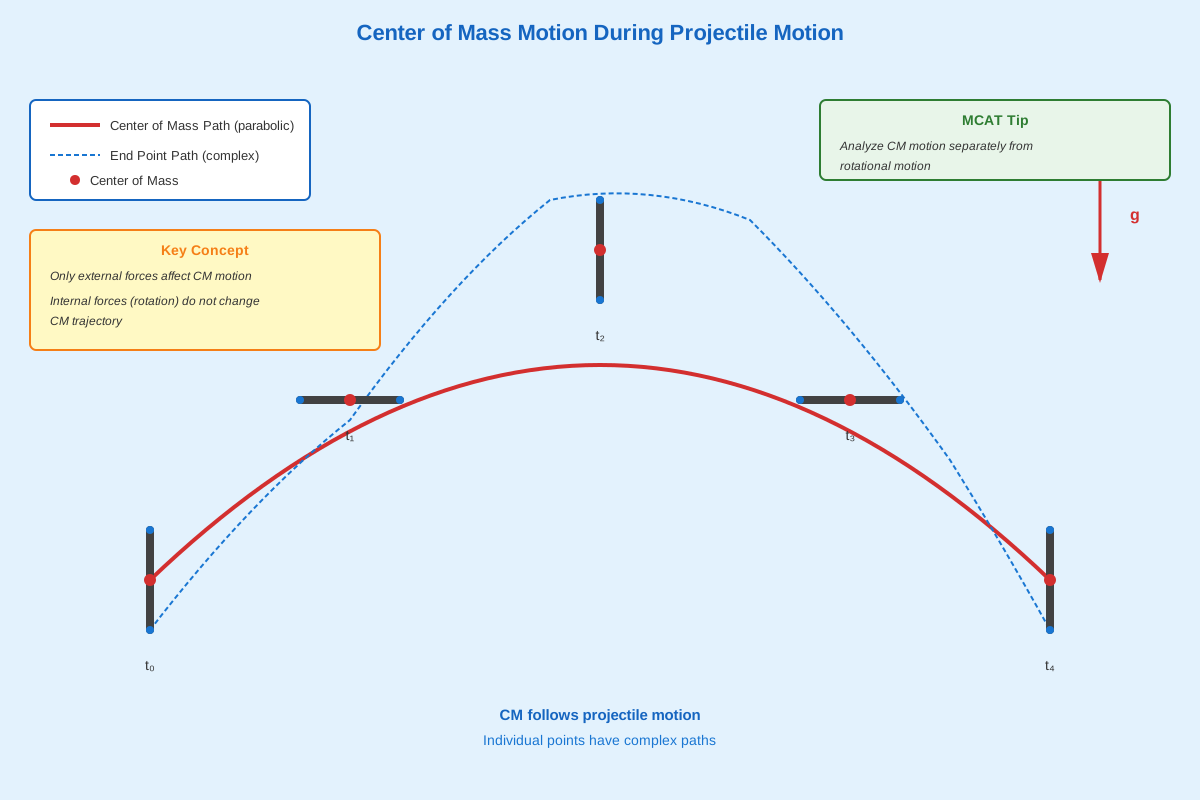
Projectile Motion → Center of Mass: When an object breaks apart mid-flight, each piece follows its own parabolic path, but the center of mass continues along the original trajectory as if the breakup never occurred (assuming no external forces besides gravity).
High-Yield Facts
⭐ The center of mass of a system moves as if all external forces were applied to the total mass concentrated at that point: F_external = M_total × a_cm
⭐ Internal forces cannot change the motion of the center of mass: Only external forces affect COM motion, making isolated system analysis straightforward
⭐ For uniform density objects, the center of mass coincides with the geometric center: This simplifies calculations for regular shapes
⭐ When momentum is conserved, the center of mass velocity remains constant: This provides a powerful constraint in collision problems
⭐ The center of mass can lie outside the physical object: Examples include hollow spheres, rings, and boomerangs
- The center of mass position is calculated as a weighted average: x_cm = (Σ m_i × x_i) / M_total
- For a two-particle system, the center of mass lies on the line connecting the particles, closer to the more massive particle
- An object remains stable when a vertical line through its center of mass passes through its base of support
- During projectile motion, the center of mass follows a parabolic path regardless of rotation or internal motion
- The total momentum of a system equals the momentum of its center of mass: P_total = M_total × v_cm
- In the absence of external forces, the center of mass of a system moves with constant velocity (Newton's first law applied to systems)
- For continuous mass distributions, the center of mass requires integration: x_cm = (∫ x dm) / M_total
- The center of mass of a system of particles is independent of the choice of coordinate system origin
Quick check — test yourself on Center of mass so far.
Try Flashcards →Common Misconceptions
Misconception: The center of mass must always be located within the physical boundaries of an object.
Correction: The center of mass can lie outside the object itself. A ring's center of mass is at its geometric center (empty space). A boomerang's center of mass lies in the air between its arms. This is mathematically possible because the center of mass represents a weighted average position.
Misconception: Internal forces (like muscles contracting) can change the center of mass position of an isolated system.
Correction: Internal forces always come in action-reaction pairs that cancel when considering the system as a whole. A person on a frictionless surface cannot change their center of mass position by moving their limbs, though they can change their body configuration. Only external forces can accelerate the center of mass.
Misconception: The center of mass and center of gravity are always the same point.
Correction: The center of gravity is the point where gravitational force effectively acts. In uniform gravitational fields (like near Earth's surface), these coincide. However, in non-uniform fields (like a very tall object in space), the center of gravity differs slightly from the center of mass because gravitational force varies with position.
Misconception: When an object breaks apart during projectile motion, the pieces follow unpredictable paths.
Correction: While individual pieces may follow different trajectories depending on how they separate, the center of mass of the system continues along the original parabolic path as if the breakup never occurred (assuming air resistance is negligible). This is a direct consequence of momentum conservation.
Misconception: Heavier objects always have their center of mass at their geometric center.
Correction: Only objects with uniform density have their center of mass at the geometric center. A hammer, baseball bat, or any object with non-uniform mass distribution has its center of mass shifted toward the denser region. Mass distribution, not total mass, determines center of mass location.
Misconception: The center of mass velocity equals the average of individual particle velocities.
Correction: The center of mass velocity is a weighted average where masses serve as weights: v_cm = (Σ m_i × v_i) / M_total. A small fast-moving particle contributes less to v_cm than a large slow-moving particle. Simple arithmetic averaging only works when all masses are equal.
Worked Examples
Example 1: Two-Particle System
Problem: Two ice skaters stand on frictionless ice. Skater A has mass 60 kg and stands at position x = 0 m. Skater B has mass 40 kg and stands at position x = 5 m. They push off each other, and afterward, skater A moves at 2 m/s to the left. What is the velocity of skater B, and where is the center of mass of the system?
Solution:
Step 1: Calculate the initial center of mass position.
x_cm = (m_A × x_A + m_B × x_B) / (m_A + m_B)
x_cm = (60 kg × 0 m + 40 kg × 5 m) / (60 kg + 40 kg)
x_cm = 200 kg·m / 100 kg = 2 m
Step 2: Recognize that the ice is frictionless, so no external horizontal forces act on the system. Therefore, the center of mass velocity remains constant. Initially, both skaters are at rest, so:
v_cm,initial = 0 m/sStep 3: Since v_cm remains zero, apply the center of mass velocity equation after the push:
v_cm = (m_A × v_A + m_B × v_B) / (m_A + m_B) = 0Taking leftward as negative:
0 = (60 kg × (-2 m/s) + 40 kg × v_B) / 100 kg
0 = -120 kg·m/s + 40 kg × v_B
v_B = 120 kg·m/s / 40 kg = 3 m/s (to the right)
Step 4: The center of mass position remains at x = 2 m because v_cm = 0 (it doesn't move).
Key Insight: This problem demonstrates that internal forces (the push between skaters) cannot change the center of mass motion. The center of mass remains stationary despite both skaters moving because momentum is conserved in this isolated system.
Example 2: Stability Analysis
Problem: A uniform rectangular block has dimensions 10 cm wide and 30 cm tall. It sits on a table that is slowly tilted. At what angle will the block begin to tip over?
Solution:
Step 1: Identify that the center of mass of a uniform rectangular block is at its geometric center: 5 cm from either side and 15 cm from the bottom.
Step 2: The block will tip when the vertical line through the center of mass passes beyond the edge of the base. At the critical angle, this line passes exactly through the pivot point (the edge of the block's base).
Step 3: Draw a diagram (described): When tilted at angle θ, the center of mass is displaced horizontally from the block's center. The block tips when this horizontal displacement equals half the base width.
Step 4: Use geometry. The center of mass is 15 cm above the base and 5 cm from the edge horizontally when upright. At the tipping angle:
tan(θ) = (horizontal distance to edge) / (vertical height)
tan(θ) = 5 cm / 15 cm = 1/3
θ = arctan(1/3) ≈ 18.4°
Key Insight: Wider bases and lower centers of mass increase stability. This principle explains why SUVs (high center of mass) are more prone to rollover than sports cars (low center of mass), and why tightrope walkers carry long poles (increases the effective base width and lowers the system's center of mass).
Exam Strategy
Approaching MCAT Questions
When encountering center of mass MCAT questions, follow this systematic approach:
- Identify the system: Clearly define what objects are included in your system. The choice affects which forces are internal versus external.
- Check for external forces: Determine whether external forces act on the system. If not, the center of mass moves with constant velocity (momentum conservation).
- Use symmetry: For uniform objects with geometric symmetry, the center of mass is at the geometric center—this saves calculation time.
- Apply weighted averages: Remember that center of mass calculations are weighted averages where masses are the weights.
Trigger Words and Phrases
Watch for these exam triggers that signal center of mass concepts:
- "Frictionless surface" → suggests isolated system where COM velocity is constant
- "Explodes" or "breaks apart" → COM continues original trajectory
- "Uniform density" → COM at geometric center
- "System of particles" → requires COM calculation or analysis
- "Stability" or "tipping" → analyze COM position relative to base
- "Collision" → COM velocity remains constant if no external forces
- "Internal forces" → cannot affect COM motion
Process of Elimination Tips
- Eliminate answers where COM moves without external forces: If a question describes an isolated system, any answer showing COM acceleration is incorrect.
- Eliminate answers placing COM outside the range of particle positions: For a system of particles, the COM must lie within the spatial range bounded by the particles (though not necessarily within a physical object).
- Eliminate answers that violate symmetry: If an object has symmetry and uniform density, the COM must lie on all symmetry axes.
- Check dimensional consistency: COM position has units of length, COM velocity has units of length/time, etc.
Time Allocation
For discrete questions on center of mass: allocate 60-90 seconds. These typically involve straightforward calculations or conceptual understanding.
For passage-based questions: allocate 90-120 seconds per question. These often require integrating center of mass concepts with other mechanics principles like energy conservation or rotational motion.
If a calculation appears complex, check whether symmetry or conceptual reasoning can eliminate answers without full computation.
Memory Techniques
Mnemonics
"MICE" for Center of Mass Motion:
- Momentum determines COM velocity (P = M × v_cm)
- Internal forces don't affect COM motion
- Constant velocity when no external forces
- External forces cause COM acceleration
"STABLE" for Equilibrium Analysis:
- Support base must be under COM
- Tipping occurs when COM line exits base
- Angle increases risk (tilting)
- Broader base increases stability
- Lower COM increases stability
- Equilibrium requires both force and torque balance
Visualization Strategies
The Balance Point Method: Visualize the center of mass as the balance point where you could support the entire system on a single finger. For two objects, imagine a seesaw—the fulcrum position that balances them is the center of mass.
The Weighted Average Map: When calculating COM position, visualize pulling the center point toward heavier masses. The COM always lies closer to larger masses, proportional to the mass ratio.
The Trajectory Tracker: For projectile problems involving breakup, visualize a glowing dot at the center of mass that continues smoothly along the parabolic path while the pieces scatter around it.
Acronyms
COM-FORCE: Center Of Mass follows Force Outside, Rejects Changes from Exchanges (internal)
Summary
The center of mass represents the weighted average position of mass in a system and serves as a powerful simplification tool in mechanics. For the MCAT, understanding that the center of mass moves according to Newton's second law applied to the total system mass and net external force is essential. Internal forces, regardless of their magnitude or complexity, cannot change center of mass motion—only external forces matter. This principle makes center of mass analysis the preferred approach for collision problems, explosion scenarios, and any situation involving multiple interacting objects. The center of mass velocity is directly related to total system momentum (P = M_total × v_cm), making momentum conservation problems straightforward when viewed from the COM perspective. For stability analysis, objects remain upright when a vertical line through the center of mass passes through the base of support, with wider bases and lower centers of mass providing greater stability. Mastering center of mass calculations (weighted averages for discrete systems), recognizing when COM analysis simplifies problems, and understanding the relationship between COM motion and conservation laws will enable efficient and accurate problem-solving on MCAT Physics questions.
Key Takeaways
- The center of mass moves as if all mass were concentrated there with all external forces applied at that point: F_external = M_total × a_cm
- Internal forces cannot change the center of mass motion; only external forces affect COM acceleration
- Center of mass velocity relates directly to total momentum: P_total = M_total × v_cm, making momentum conservation problems straightforward
- For uniform density objects, the center of mass coincides with the geometric center, simplifying calculations
- Stability requires that a vertical line through the center of mass passes through the base of support
- In isolated systems (no external forces), the center of mass moves with constant velocity regardless of internal interactions
- Center of mass calculations are weighted averages where masses serve as the weighting factors: x_cm = (Σ m_i × x_i) / M_total
Related Topics
Momentum and Collisions: Center of mass analysis is fundamental to solving collision problems efficiently. Understanding COM motion provides the framework for analyzing both elastic and inelastic collisions, where momentum conservation determines the final state of the system.
Rotational Dynamics: Objects rotate about their center of mass when free from external torques. The parallel axis theorem connects moments of inertia about different axes to the center of mass location, making COM understanding essential for rotational motion problems.
Torque and Equilibrium: Static equilibrium requires both zero net force (no COM acceleration) and zero net torque (no rotation). Analyzing whether objects tip or remain stable depends critically on center of mass position relative to support points.
Energy Conservation in Systems: Kinetic energy can be partitioned into translational energy of the center of mass and internal kinetic energy. This decomposition clarifies energy transformations in collisions and helps distinguish elastic from inelastic processes.
Biomechanics and Human Movement: Understanding how the human body's center of mass shifts during walking, running, and jumping is essential for analyzing gait, balance, and athletic performance—topics that appear in MCAT passages integrating physics with biological systems.
Practice CTA
Now that you've mastered the core concepts of center of mass, it's time to solidify your understanding through active practice. Work through the practice questions and flashcards to test your ability to apply these principles under exam conditions. Focus especially on problems involving momentum conservation, stability analysis, and multi-body systems—these represent the highest-yield applications for the MCAT. Remember that center of mass problems often appear integrated with other mechanics concepts, so practice identifying when COM analysis provides the most efficient solution path. Your ability to quickly recognize center of mass scenarios and apply the appropriate principles will significantly improve your performance on test day. Keep pushing forward—mastery comes through deliberate practice!
Sign up free to keep reading
Create a free AnvayaPrep account to finish this MCAT guide on Center of mass — plus flashcards and practice questions.