Overview
Momentum is a fundamental concept in Mechanics that describes the quantity of motion possessed by an object. As a vector quantity combining both mass and velocity, momentum provides a powerful framework for analyzing collisions, explosions, and any scenario involving moving objects. Understanding momentum is essential for success on the MCAT Physics section, where it frequently appears in both discrete questions and passage-based problems involving biological systems, medical devices, and experimental setups.
The principle of momentum conservation stands as one of the most important laws in physics, applicable to everything from molecular collisions in biochemistry to the biomechanics of human movement. On the MCAT, momentum questions often integrate with other physics concepts such as energy, forces, and Newton's laws, requiring students to synthesize multiple principles simultaneously. The topic appears regularly in questions about collisions between objects, recoil phenomena, and center of mass motion—all scenarios that can be modeled in biological and medical contexts.
Mastering Momentum Physics provides the foundation for understanding impulse, collisions (elastic and inelastic), and the relationship between force and time. This topic connects directly to Newton's laws of motion, energy conservation, and kinematics, forming an essential bridge between basic mechanics and more complex physical systems. For MCAT success, students must not only memorize formulas but also develop intuition about when momentum is conserved, how to apply vector addition principles, and how to recognize momentum-related scenarios in experimental passages.
Learning Objectives
- [ ] Define Momentum using accurate Physics terminology
- [ ] Explain why Momentum matters for the MCAT
- [ ] Apply Momentum to exam-style questions
- [ ] Identify common mistakes related to Momentum
- [ ] Connect Momentum to related Physics concepts
- [ ] Calculate momentum in multi-object systems and apply conservation principles
- [ ] Distinguish between elastic and inelastic collisions using momentum and energy principles
- [ ] Analyze impulse-momentum relationships and their applications in biological contexts
- [ ] Solve two-dimensional collision problems using vector components
Prerequisites
- Newton's Laws of Motion: Essential for understanding how forces relate to changes in momentum and why momentum is conserved in isolated systems
- Kinematics and Velocity: Required to calculate momentum since velocity is a component of the momentum equation
- Vector Addition and Components: Necessary for solving momentum problems in two dimensions and understanding momentum as a vector quantity
- Mass and Inertia Concepts: Fundamental to understanding how different objects carry different amounts of momentum at the same velocity
- Basic Algebra and Equation Manipulation: Needed to solve conservation of momentum equations with multiple unknowns
Why This Topic Matters
Momentum concepts appear frequently in real-world medical and biological scenarios. The cardiovascular system relies on momentum principles when blood flows through vessels and encounters changes in vessel diameter or bifurcations. Medical imaging techniques like Doppler ultrasound depend on momentum transfer between sound waves and moving blood cells. Understanding momentum helps explain injury mechanisms in trauma medicine, where the momentum of projectiles or vehicles determines tissue damage severity. Even at the molecular level, momentum conservation governs particle collisions in mass spectrometry and other analytical techniques used in medical research.
On the MCAT, momentum appears in approximately 2-4 questions per exam, representing roughly 3-5% of the Physics section. Questions typically fall into three categories: discrete calculations requiring direct application of conservation laws, passage-based problems involving experimental apparatus or collision scenarios, and integrated questions combining momentum with energy or force concepts. The AAMC frequently tests momentum in contexts involving carts on tracks, pendulums, ballistic scenarios, and center of mass motion.
Momentum questions commonly appear in passages describing experimental setups where objects collide or separate, such as studies of particle detectors, biomechanical analyses of human movement, or investigations of molecular collision dynamics. The MCAT favors questions that require conceptual understanding over pure calculation, often asking students to predict outcomes, compare scenarios, or identify which physical principles apply. Recognizing momentum conservation as the appropriate tool for solving a problem—especially when forces are unknown or complex—represents a critical skill that distinguishes high-scoring students.
Core Concepts
Definition and Mathematical Formulation
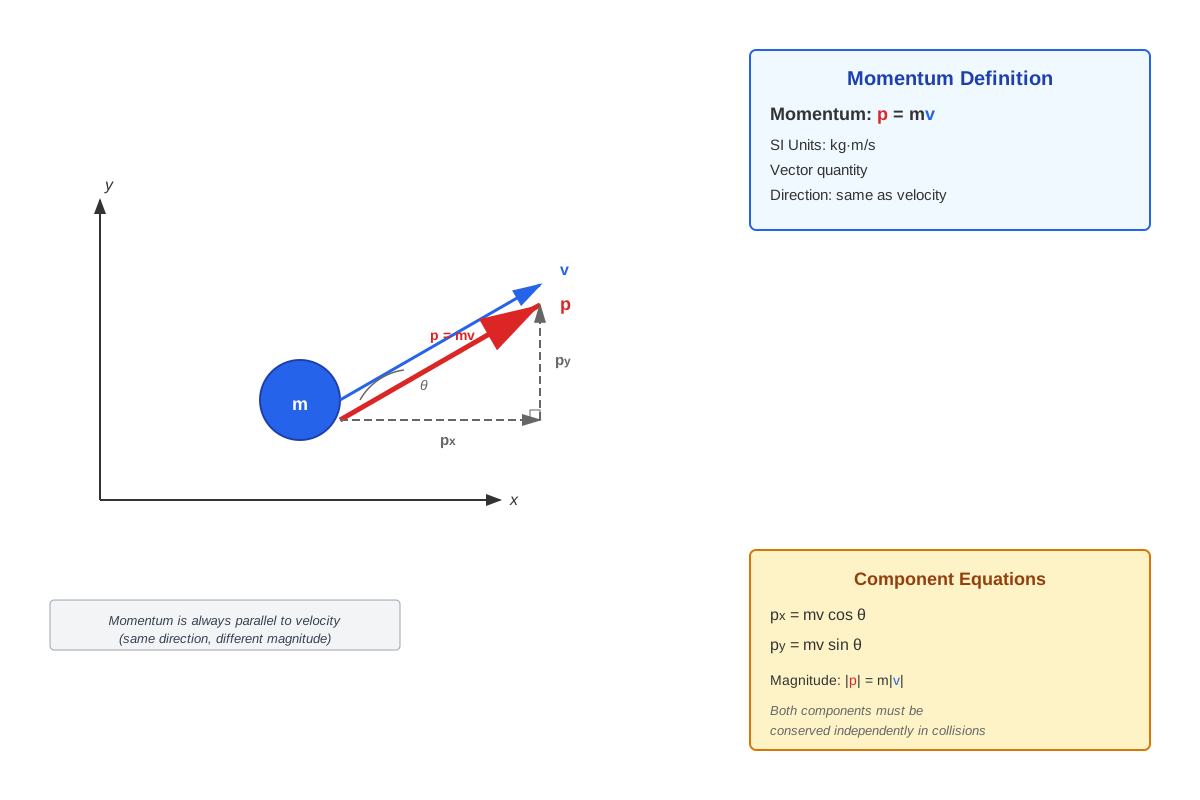
Momentum (symbol: p) is defined as the product of an object's mass and velocity. Mathematically:
p = mvwhere m represents mass (in kilograms) and v represents velocity (in meters per second). Since velocity is a vector quantity, momentum is also a vector, possessing both magnitude and direction. The SI unit for momentum is kg⋅m/s, though this unit has no special name. The direction of an object's momentum vector always matches the direction of its velocity vector.
For systems containing multiple objects, the total momentum equals the vector sum of individual momenta:
p_total = p₁ + p₂ + p₃ + ... = m₁v₁ + m₂v₂ + m₃v₃ + ...This additive property becomes crucial when analyzing collisions and explosions involving multiple bodies.
Conservation of Momentum
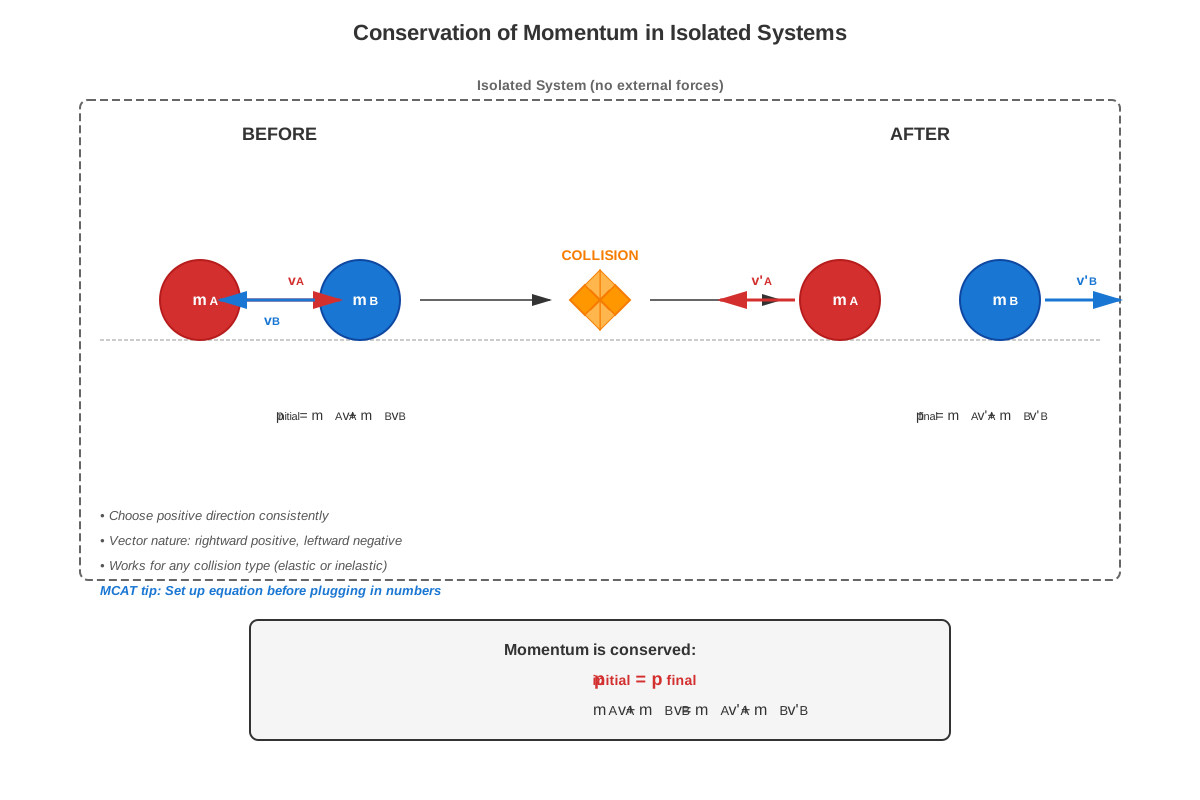
The law of conservation of momentum states that the total momentum of an isolated system remains constant when no external forces act on the system. This principle derives directly from Newton's third law and represents one of the most powerful problem-solving tools in physics.
Mathematically, for a collision or interaction between objects:
p_initial = p_final
m₁v₁ᵢ + m₂v₂ᵢ = m₁v₁f + m₂v₂f
The subscripts i and f denote initial and final states, respectively. This equation applies regardless of the collision type (elastic or inelastic) and regardless of whether kinetic energy is conserved.
Key conditions for momentum conservation:
- The system must be isolated (no external forces)
- Internal forces between objects can be any magnitude
- The time interval considered must include the entire interaction
- Friction, air resistance, and other external forces must be negligible or absent
Impulse and the Impulse-Momentum Theorem
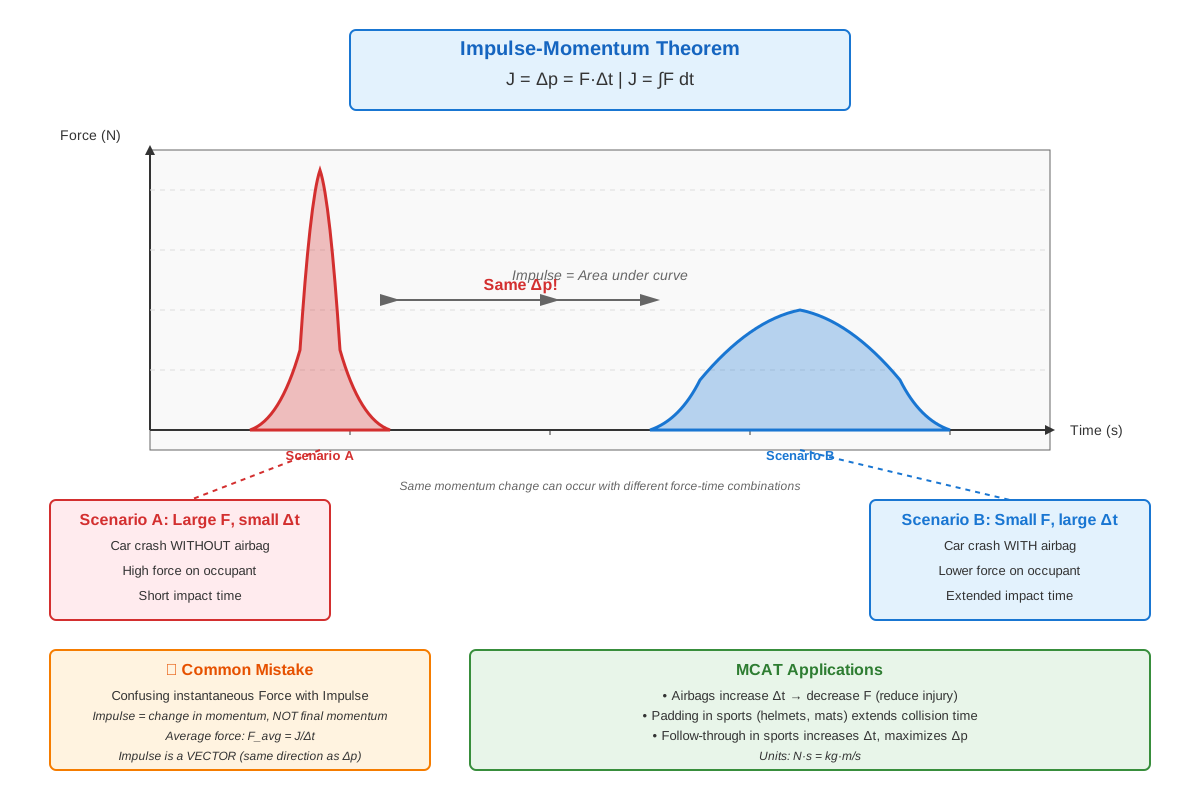
Impulse (symbol: J) represents the change in momentum caused by a force acting over a time interval. The impulse-momentum theorem states:
J = Δp = FΔtwhere F represents the average force and Δt represents the time interval during which the force acts. This relationship reveals that the same momentum change can result from either a large force acting briefly or a small force acting over a longer duration.
The impulse-momentum theorem derives from Newton's second law. Since F = ma and a = Δv/Δt:
F = m(Δv/Δt)
FΔt = mΔv = Δp
This concept explains why airbags and crumple zones in vehicles reduce injury—they increase the collision time, thereby decreasing the average force experienced by occupants while the momentum change remains constant.
Types of Collisions
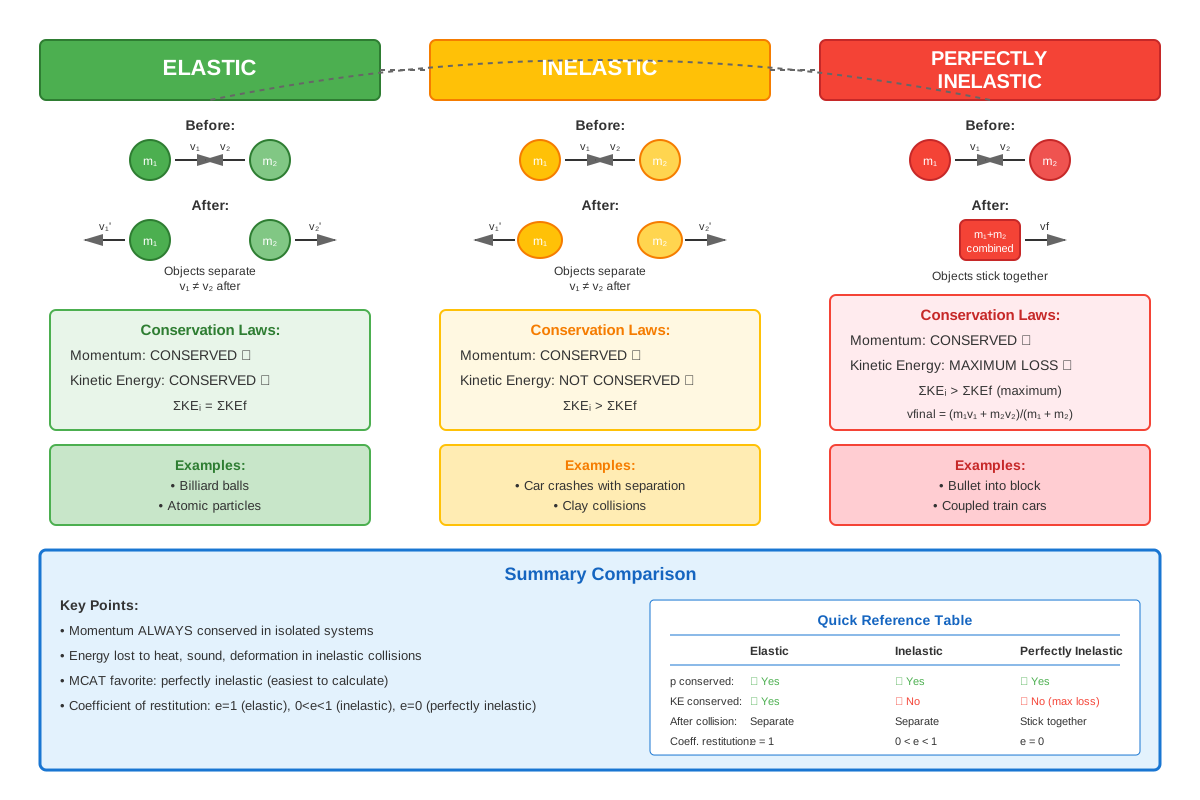
Collisions are classified based on whether kinetic energy is conserved:
| Collision Type | Momentum Conserved? | Kinetic Energy Conserved? | Objects After Collision |
|---|---|---|---|
| Elastic | Yes | Yes | Separate, maintain identity |
| Inelastic | Yes | No (some converted to heat/deformation) | Separate, maintain identity |
| Perfectly Inelastic | Yes | No (maximum KE loss) | Stick together, move as one |
Elastic collisions occur when objects bounce off each other without permanent deformation or heat generation. These are idealizations rarely achieved perfectly in macroscopic systems but closely approximated by collisions between hard spheres or atomic particles. Both momentum and kinetic energy conservation equations apply:
m₁v₁ᵢ + m₂v₂ᵢ = m₁v₁f + m₂v₂f
½m₁v₁ᵢ² + ½m₂v₂ᵢ² = ½m₁v₁f² + ½m₂v₂f²
Inelastic collisions involve some kinetic energy conversion to other forms (heat, sound, deformation). Momentum remains conserved, but the kinetic energy equation does not apply. Most real-world collisions are inelastic to some degree.
Perfectly inelastic collisions represent the extreme case where objects stick together after impact, moving with a common final velocity:
m₁v₁ᵢ + m₂v₂ᵢ = (m₁ + m₂)vfThis type produces the maximum possible kinetic energy loss while still conserving momentum.
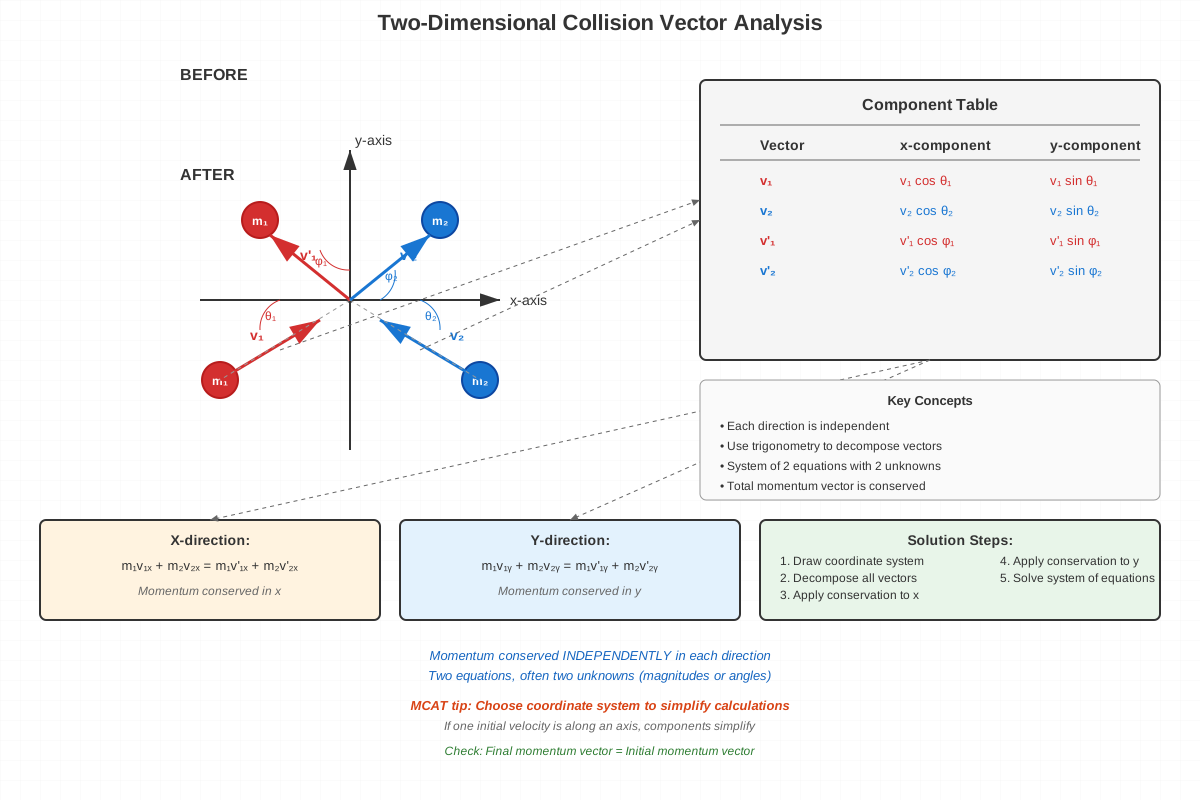
Two-Dimensional Momentum Problems
When collisions occur in two dimensions, momentum conservation applies independently to each coordinate direction:
p_x,initial = p_x,final
p_y,initial = p_y,final
Solving these problems requires:
- Establishing a coordinate system
- Breaking velocity vectors into x and y components
- Applying conservation separately to each direction
- Using vector addition to find resultant velocities
Two-dimensional problems frequently appear on the MCAT in contexts involving projectile motion, particle scattering, or objects colliding at angles.
Center of Mass and Momentum
The center of mass of a system moves according to the total momentum and total mass:
v_cm = p_total / m_totalWhen no external forces act on a system, the center of mass velocity remains constant, even if internal forces cause individual objects to change their motions. This principle explains why a person cannot change their center of mass motion while airborne—internal forces (muscle contractions) cannot affect the trajectory once external support is removed.
Relationship Between Force and Momentum
Newton's second law, originally formulated in terms of momentum, states:
F = dp/dtThe net force on an object equals the rate of change of its momentum. For constant mass systems, this reduces to the familiar F = ma. However, the momentum formulation proves more general and applies to variable mass systems like rockets expelling fuel.
Concept Relationships
The core concepts within momentum form an interconnected web of principles. Momentum itself serves as the foundation, defined through the product of mass and velocity. This definition immediately connects momentum to kinematics (through velocity) and to inertia (through mass). The conservation of momentum principle emerges as the central organizing concept, applicable to all collision scenarios and deriving from Newton's third law.
Impulse represents the bridge between momentum and forces, showing how force applied over time produces momentum changes. This relationship connects directly to Newton's second law and explains why the same momentum change can result from different force-time combinations. The impulse-momentum theorem enables analysis of situations where forces vary with time or are difficult to measure directly.
The classification of collisions (elastic, inelastic, perfectly inelastic) depends on whether kinetic energy is conserved alongside momentum. This creates a connection between momentum concepts and energy conservation principles. Elastic collisions require both conservation laws, while inelastic collisions demonstrate that momentum conservation is more fundamental—it applies even when energy transforms between forms.
Two-dimensional momentum problems extend the basic principles by incorporating vector addition and component analysis. These problems connect momentum to trigonometry and coordinate systems, requiring students to apply conservation independently to perpendicular directions.
The center of mass concept unifies momentum with the motion of extended systems, showing how total momentum determines the motion of the system's balance point. This connects to Newton's laws by demonstrating that external forces affect center of mass motion while internal forces cannot.
Relationship map:
- Mass + Velocity → Momentum (definition)
- Momentum + Isolated System → Conservation of Momentum (fundamental principle)
- Force + Time → Impulse → Change in Momentum (impulse-momentum theorem)
- Conservation of Momentum + Energy Conservation → Elastic Collisions
- Conservation of Momentum + Energy Loss → Inelastic Collisions
- Momentum Components → Two-Dimensional Analysis
- Total Momentum + Total Mass → Center of Mass Motion
High-Yield Facts
⭐ Momentum is always conserved in isolated systems, regardless of whether kinetic energy is conserved
⭐ The impulse-momentum theorem (FΔt = Δp) explains why increasing collision time decreases force for the same momentum change
⭐ In perfectly inelastic collisions, objects stick together and move with a common final velocity
⭐ Momentum is a vector quantity; direction matters and must be accounted for using positive/negative signs or components
⭐ Elastic collisions conserve both momentum and kinetic energy; inelastic collisions conserve only momentum
- The SI unit for momentum is kg⋅m/s (no special name exists for this unit)
- In two-dimensional collisions, momentum conservation applies independently to x and y directions
- The center of mass velocity of an isolated system remains constant even when internal forces cause individual object motions to change
- Newton's second law in its original form states F = dp/dt (force equals rate of change of momentum)
- When two objects of equal mass undergo a head-on elastic collision, they exchange velocities
- Momentum conservation derives from Newton's third law (action-reaction pairs produce zero net force on the system)
- Recoil phenomena (guns, rockets) demonstrate momentum conservation with initial total momentum of zero
- The coefficient of restitution (ratio of relative velocities after and before collision) equals 1 for elastic collisions and 0 for perfectly inelastic collisions
Quick check — test yourself on Momentum so far.
Try Flashcards →Common Misconceptions
Misconception: Momentum is always conserved in every situation.
Correction: Momentum is conserved only in isolated systems where no external forces act. When friction, gravity, or other external forces are present, momentum is not conserved. Always check whether the system is truly isolated before applying conservation principles.
Misconception: Heavier objects always have more momentum than lighter objects.
Correction: Momentum depends on both mass and velocity (p = mv). A light object moving at high velocity can have more momentum than a heavy object moving slowly. For example, a bullet has less mass than a baseball but can have much greater momentum due to its high velocity.
Misconception: Kinetic energy and momentum are conserved in the same types of collisions.
Correction: Momentum is conserved in all collisions within isolated systems, but kinetic energy is conserved only in elastic collisions. Most real-world collisions are inelastic, meaning momentum is conserved but some kinetic energy converts to heat, sound, or deformation energy.
Misconception: In a collision between a moving object and a stationary object, the stationary object gains all the momentum.
Correction: The total momentum of the system is conserved, meaning the sum of momenta before equals the sum after. The moving object typically retains some momentum after collision (unless it's a perfectly inelastic collision where both objects move together). The momentum distribution depends on the masses and collision type.
Misconception: Impulse and momentum are the same thing.
Correction: Impulse equals the change in momentum (J = Δp), not momentum itself. Impulse represents the effect of a force acting over time, while momentum represents the quantity of motion an object possesses at any instant. An object can have momentum without experiencing impulse if no forces act on it.
Misconception: When objects stick together in a collision, momentum is not conserved because kinetic energy is lost.
Correction: Momentum conservation is independent of energy conservation. In perfectly inelastic collisions where objects stick together, momentum is still conserved even though kinetic energy decreases. The "lost" kinetic energy converts to other forms (heat, deformation) but doesn't affect momentum conservation.
Misconception: The direction of momentum doesn't matter in calculations.
Correction: Momentum is a vector quantity, so direction is crucial. In one-dimensional problems, use positive and negative signs to indicate direction. In two-dimensional problems, break momentum into components. Failing to account for direction leads to incorrect answers, especially when objects move in opposite directions.
Worked Examples
Example 1: Perfectly Inelastic Collision
Problem: A 1200 kg car traveling east at 15 m/s collides with a 1800 kg truck traveling west at 10 m/s. The vehicles lock together after the collision. What is the velocity of the combined wreckage immediately after collision?
Solution:
Step 1: Identify the collision type and applicable principles.
This is a perfectly inelastic collision (vehicles lock together), so momentum is conserved but kinetic energy is not. We'll use conservation of momentum.
Step 2: Establish a coordinate system and assign signs.
Let east be positive (+) and west be negative (−).
- Car: m₁ = 1200 kg, v₁ᵢ = +15 m/s
- Truck: m₂ = 1800 kg, v₂ᵢ = −10 m/s (negative because westward)
Step 3: Apply conservation of momentum.
p_initial = p_final
m₁v₁ᵢ + m₂v₂ᵢ = (m₁ + m₂)vf
Step 4: Substitute values and solve.
(1200 kg)(+15 m/s) + (1800 kg)(−10 m/s) = (1200 kg + 1800 kg)vf
18,000 kg⋅m/s − 18,000 kg⋅m/s = 3000 kg × vf
0 = 3000 kg × vf
vf = 0 m/sAnswer: The combined wreckage is stationary immediately after collision (velocity = 0 m/s).
Conceptual insight: The initial momenta were equal in magnitude but opposite in direction, resulting in zero total momentum. After collision, the combined mass must also have zero momentum, meaning zero velocity. This demonstrates that momentum is a vector quantity where direction matters critically.
Example 2: Impulse and Force Calculation
Problem: A 0.15 kg baseball traveling at 40 m/s is caught by a catcher. If the ball comes to rest in the catcher's mitt in 0.050 seconds, what average force does the mitt exert on the ball?
Solution:
Step 1: Identify the relevant principle.
We need to find force given a momentum change and time interval, so we'll use the impulse-momentum theorem: J = FΔt = Δp
Step 2: Calculate the change in momentum.
Δp = pf − pᵢ = mvf − mvᵢ
Δp = (0.15 kg)(0 m/s) − (0.15 kg)(40 m/s)
Δp = 0 − 6.0 kg⋅m/s = −6.0 kg⋅m/s
The negative sign indicates the momentum change is opposite to the initial motion direction.
Step 3: Apply the impulse-momentum theorem.
FΔt = Δp
F = Δp/Δt
F = (−6.0 kg⋅m/s)/(0.050 s)
F = −120 NAnswer: The mitt exerts an average force of 120 N on the ball in the direction opposite to the ball's initial motion (the negative sign indicates direction).
Conceptual insight: This problem demonstrates why catchers pull their hands back when catching—increasing Δt decreases the force required to produce the same momentum change. If the ball stopped in 0.010 s instead, the force would be 600 N, five times greater. This principle applies to airbags, crumple zones, and padding in protective equipment.
MCAT connection: This type of problem frequently appears in passages about injury prevention, sports biomechanics, or safety equipment design. The MCAT may ask students to compare forces in different scenarios or explain why certain safety features are effective.
Exam Strategy
When approaching MCAT momentum questions, first determine whether the system is isolated. Look for phrases like "frictionless surface," "in space," "no external forces," or "neglect air resistance"—these signal that momentum conservation applies. If external forces are present, momentum conservation may not be the appropriate tool.
Trigger words and phrases to recognize:
- "Collide," "impact," "strike" → Consider momentum conservation
- "Stick together," "lock together," "couple" → Perfectly inelastic collision
- "Bounce off," "rebound," "elastic" → Elastic collision (conserve both momentum and energy)
- "Explode," "separate," "recoil" → Momentum conservation with initial momentum often zero
- "Force applied for time interval" → Use impulse-momentum theorem
- "Airbag," "crumple zone," "padding" → Impulse-momentum relationship (increasing time decreases force)
Process-of-elimination strategies:
- Check units: Momentum answers must have units of kg⋅m/s or equivalent. Eliminate options with incorrect units.
- Verify direction: If the question involves one-dimensional motion, check whether the answer's sign (positive/negative) makes physical sense given the initial conditions.
- Apply limiting cases: For collision problems, consider extreme scenarios. If one mass is much larger than the other, the larger mass should barely change velocity while the smaller mass changes dramatically.
- Energy vs. momentum: If answer choices suggest both momentum and energy are conserved, verify the collision type. Only elastic collisions conserve both; inelastic collisions conserve only momentum.
- Magnitude checks: In perfectly inelastic collisions, the final velocity must be between the initial velocities (or less than both if they're in the same direction). Eliminate answers outside this range.
Time allocation advice:
Momentum calculations typically require 60-90 seconds for discrete questions. For passage-based questions, spend 30-45 seconds identifying the relevant principle (conservation, impulse-momentum theorem, collision type) before beginning calculations. If a problem requires solving simultaneous equations (common in elastic collisions), budget 2-3 minutes. Don't get bogged down in algebraic manipulation—if the algebra becomes complex, check whether you've chosen the most efficient approach or whether the question asks for a conceptual answer rather than a numerical one.
Exam Tip: The MCAT frequently tests whether students know when to apply momentum conservation versus energy conservation. If you can identify the collision type and system boundaries quickly, you'll save valuable time and avoid common traps.
Memory Techniques
Momentum Conservation Mnemonic: "Isolated Systems Preserve Momentum"
- Isolated: No external forces
- Systems: Consider all objects together
- Preserve: Momentum stays constant
- Momentum: p_initial = p_final
Collision Type Memory Aid: "Elastic Everything Endures"
- Elastic collisions: Energy and momentum both Endure (are conserved)
- Inelastic collisions: Incomplete energy conservation (only momentum conserved)
- Perfectly inelastic: Particles Pair up (stick together)
Impulse-Momentum Visualization: Picture a car crash. The "impulse" is the collision event itself (force over time), while the "momentum change" is the difference between the car's motion before and after. Airbags work by stretching out the impulse (increasing Δt), which decreases the force for the same momentum change. Visualize the equation as: Force × Time = Change in Motion (FΔt = Δp).
Vector Direction Memory: Use the acronym "SIGN" for one-dimensional problems:
- Set up coordinate system first
- Identify positive direction
- Give signs to all velocities
- Negate opposite directions
Two-Dimensional Momentum: Remember "X-rays and Y-rays don't interact" to recall that x and y components of momentum are conserved independently. Solve each direction separately, then combine using vector addition.
Summary
Momentum represents the quantity of motion possessed by an object, defined as the product of mass and velocity (p = mv). As a vector quantity, momentum requires careful attention to direction in all calculations. The law of conservation of momentum—stating that total momentum remains constant in isolated systems—provides a powerful tool for analyzing collisions, explosions, and interactions between objects. This principle applies universally, regardless of whether kinetic energy is conserved, making it more fundamental than energy conservation in collision scenarios. The impulse-momentum theorem (J = FΔt = Δp) connects forces to momentum changes, explaining phenomena from airbag effectiveness to recoil mechanisms. Collisions are classified as elastic (both momentum and energy conserved), inelastic (only momentum conserved), or perfectly inelastic (objects stick together, only momentum conserved). For MCAT success, students must recognize when systems are isolated, correctly apply vector principles, distinguish between collision types, and understand the relationship between impulse and momentum. Mastery requires both computational facility with conservation equations and conceptual understanding of when and why momentum principles apply.
Key Takeaways
- Momentum (p = mv) is a vector quantity that combines mass and velocity; its conservation in isolated systems is one of physics' most fundamental principles
- Momentum is conserved in all collisions within isolated systems, but kinetic energy is conserved only in elastic collisions—this distinction is critical for problem-solving
- The impulse-momentum theorem (FΔt = Δp) explains why increasing collision time decreases force, underlying safety features like airbags and crumple zones
- In perfectly inelastic collisions, objects stick together and move with a common final velocity calculated using momentum conservation
- Two-dimensional momentum problems require independent application of conservation to x and y components, followed by vector addition
- Always establish a coordinate system and assign directional signs (positive/negative) before solving one-dimensional momentum problems
- The center of mass of an isolated system moves with constant velocity determined by total momentum divided by total mass, regardless of internal forces
Related Topics
Impulse and Collisions in Detail: Building on basic momentum concepts, this topic explores the mathematical treatment of various collision scenarios, coefficient of restitution, and advanced two-dimensional problems. Mastering momentum provides the foundation for understanding these more complex interactions.
Energy Conservation and Work: While momentum conservation applies to isolated systems, energy conservation provides complementary insights into collision dynamics. Understanding both principles enables complete analysis of elastic collisions and explains energy transformations in inelastic collisions.
Rotational Momentum (Angular Momentum): The rotational analog of linear momentum, angular momentum (L = Iω), follows similar conservation principles. Mastering linear momentum concepts transfers directly to understanding rotational systems.
Newton's Laws Applications: Momentum concepts derive from and reinforce Newton's laws, particularly the second law (F = dp/dt) and third law (action-reaction pairs that conserve momentum). Deeper exploration of these connections strengthens overall mechanics understanding.
Center of Mass and System Dynamics: Advanced treatment of center of mass motion, including calculations for continuous mass distributions and applications to biological systems, builds on the momentum-center of mass relationship introduced here.
Practice CTA
Now that you've mastered the core concepts of momentum, it's time to solidify your understanding through active practice. Attempt the practice questions and flashcards to test your ability to recognize momentum scenarios, apply conservation principles, and avoid common pitfalls. Remember, the MCAT rewards not just knowledge but also the ability to apply concepts quickly and accurately under time pressure. Each practice problem you solve strengthens your pattern recognition and builds the confidence you need for test day. Focus especially on identifying when momentum conservation applies and distinguishing between collision types—these skills will serve you well across multiple physics topics. You've built a strong foundation; now reinforce it through deliberate practice!
Sign up free to keep reading
Create a free AnvayaPrep account to finish this MCAT guide on Momentum — plus flashcards and practice questions.