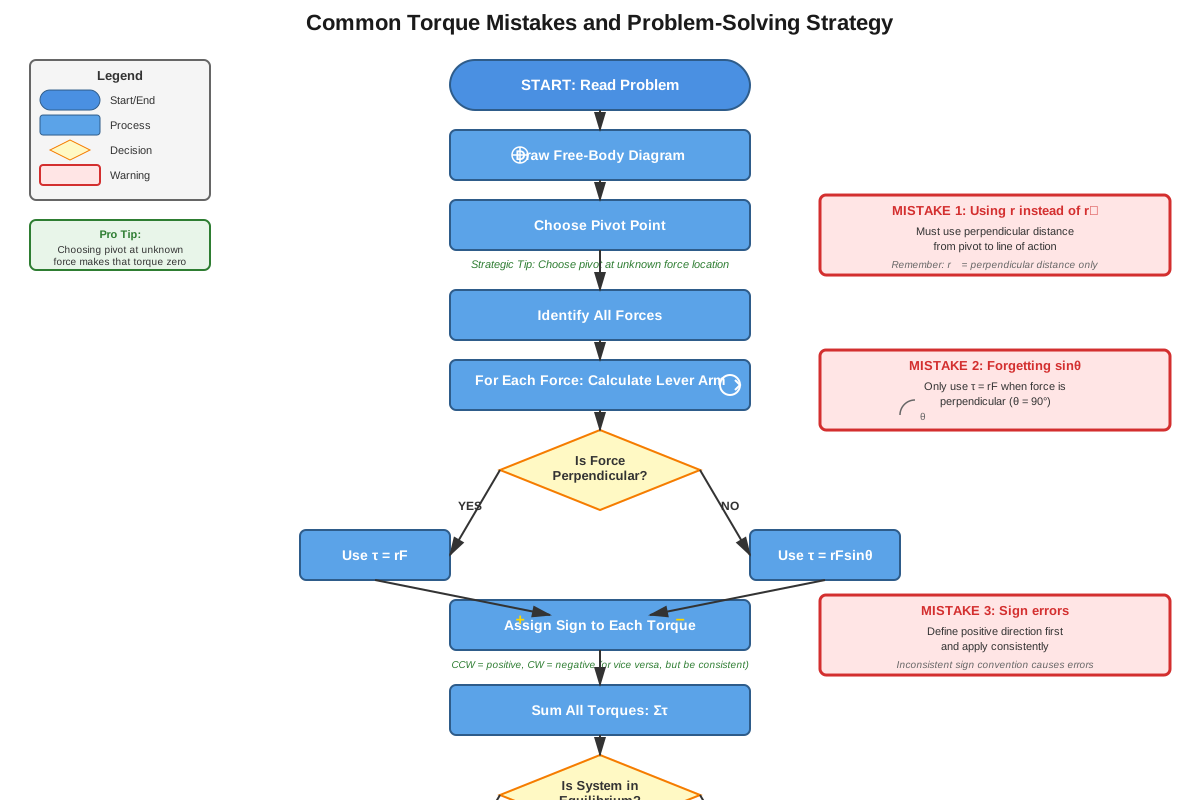
Overview
Torque is a fundamental concept in mechanics that describes the rotational equivalent of force. While linear force causes objects to accelerate in a straight line, torque causes objects to undergo angular acceleration—to rotate or spin. Understanding torque is essential for analyzing any system involving rotation, from the biomechanics of joints and muscles in the human body to the operation of mechanical devices and tools. On the MCAT, torque appears frequently in Physics passages involving levers, equilibrium problems, and biomechanical scenarios such as muscle function and joint stability.
The concept of torque bridges several important areas of physics tested on the MCAT. It connects translational motion (forces and linear acceleration) with rotational motion (angular velocity and angular acceleration). Torque problems often require students to apply vector analysis, understand equilibrium conditions, and integrate knowledge of forces, distances, and angles. The MCAT particularly favors questions that combine torque with center of mass, equilibrium, and mechanical advantage—concepts that appear in both physical and biological contexts.
Mastering torque is critical not only for direct physics questions but also for understanding biological systems. The human musculoskeletal system operates through a series of levers where muscles apply torques to bones, rotating them about joints. Questions involving muscle mechanics, joint stability, and biomechanical advantage frequently appear in MCAT passages that integrate physics with biology and physiology. A solid understanding of torque physics enables students to approach these interdisciplinary questions with confidence and analytical precision.
Learning Objectives
- [ ] Define Torque using accurate Physics terminology
- [ ] Explain why Torque matters for the MCAT
- [ ] Apply Torque to exam-style questions
- [ ] Identify common mistakes related to Torque
- [ ] Connect Torque to related Physics concepts
- [ ] Calculate torque magnitude and determine its direction using the right-hand rule
- [ ] Analyze static and dynamic equilibrium problems involving multiple torques
- [ ] Apply torque concepts to biomechanical systems including levers and muscle-joint interactions
Prerequisites
- Vector components and vector addition: Torque is a vector quantity requiring decomposition of forces and understanding of directional components
- Newton's Laws of Motion: Torque is the rotational analog of force, and understanding F = ma provides the foundation for understanding τ = Iα
- Trigonometry (sine, cosine, tangent): Essential for calculating the perpendicular component of force and the lever arm in torque calculations
- Force and equilibrium: Torque problems often involve equilibrium conditions where net force and net torque both equal zero
- Units and dimensional analysis: Understanding SI units and converting between different unit systems is necessary for solving quantitative torque problems
Why This Topic Matters
Clinical and Real-World Significance
Torque is fundamental to understanding human biomechanics and musculoskeletal function. Every time a muscle contracts to move a limb, it generates torque about a joint. Physical therapists, orthopedic surgeons, and sports medicine specialists routinely apply torque principles when analyzing joint function, designing rehabilitation protocols, and evaluating injury mechanisms. For example, understanding why the Achilles tendon can generate such large forces involves recognizing the small lever arm it has relative to the ankle joint—requiring greater force to produce the necessary torque for walking and running.
Beyond medicine, torque principles govern the operation of tools, machines, and everyday objects. Wrenches, door handles, steering wheels, and seesaws all function based on torque. The design of prosthetic limbs, surgical instruments, and assistive devices requires careful consideration of torque to ensure proper function and mechanical advantage.
MCAT Exam Statistics
Torque appears in approximately 3-5% of MCAT Physics questions, making it a medium-yield topic that students cannot afford to ignore. Questions involving torque most commonly appear in:
- Passage-based questions involving experimental setups with rotating systems or equilibrium scenarios
- Discrete questions testing direct calculation of torque or application of equilibrium conditions
- Interdisciplinary passages combining physics with biology, particularly in musculoskeletal contexts
- Graph interpretation questions showing relationships between force, distance, and rotational motion
The MCAT frequently tests torque in the context of static equilibrium (objects at rest with balanced torques) and simple machines (levers, pulleys). Questions often require students to identify which forces contribute to rotation, calculate net torque, or determine conditions for equilibrium. The exam particularly favors scenarios where students must recognize that only the perpendicular component of force contributes to torque.
Core Concepts
Definition and Mathematical Expression of Torque
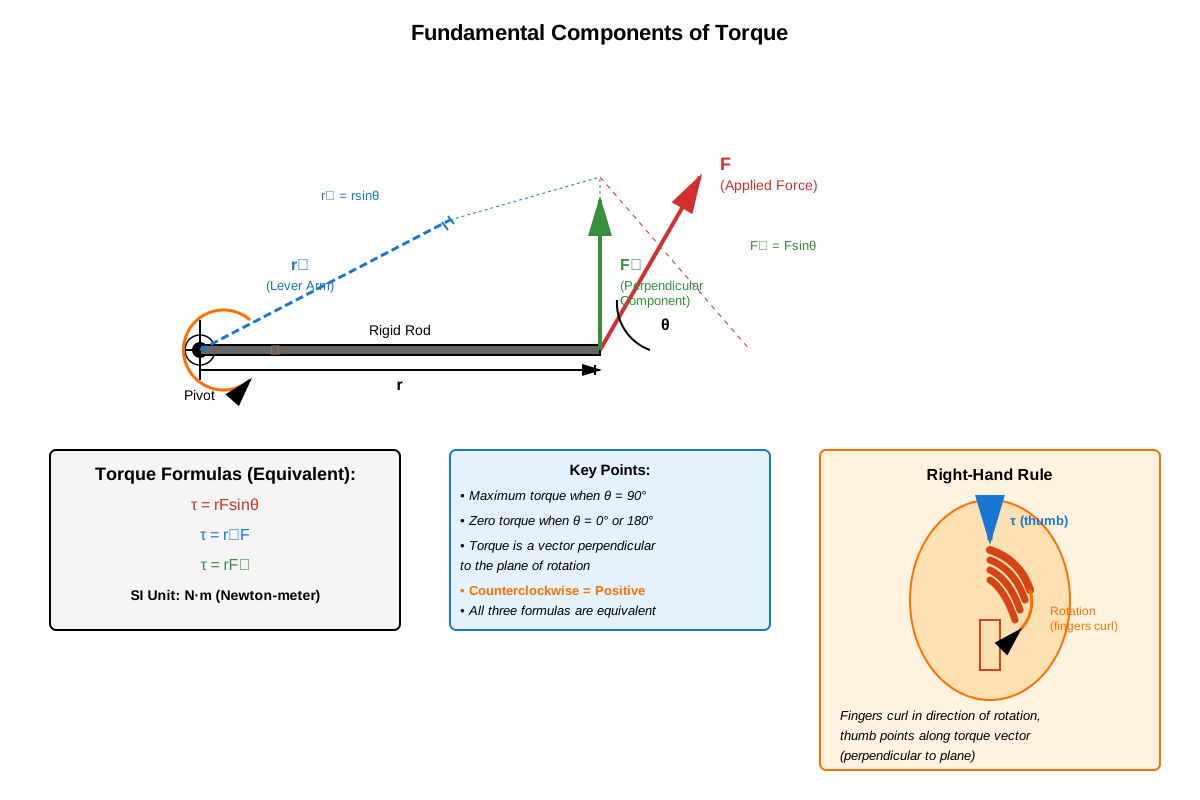
Torque (represented by the Greek letter τ or sometimes T) is defined as the rotational effect produced by a force applied at a distance from an axis of rotation. Mathematically, torque is the cross product of the position vector and the force vector:
τ = r × FFor MCAT purposes, the magnitude of torque is most commonly expressed as:
τ = rF sin(θ)where:
- τ is torque (measured in Newton-meters, N·m)
- r is the distance from the axis of rotation to the point where force is applied (in meters)
- F is the magnitude of the applied force (in Newtons)
- θ is the angle between the position vector r and the force vector F
An alternative and often more intuitive formulation uses the lever arm or moment arm (r⊥):
τ = r⊥Fwhere r⊥ = r sin(θ) represents the perpendicular distance from the axis of rotation to the line of action of the force. This formulation emphasizes that only the component of force perpendicular to the position vector contributes to torque.
Direction and Sign Convention
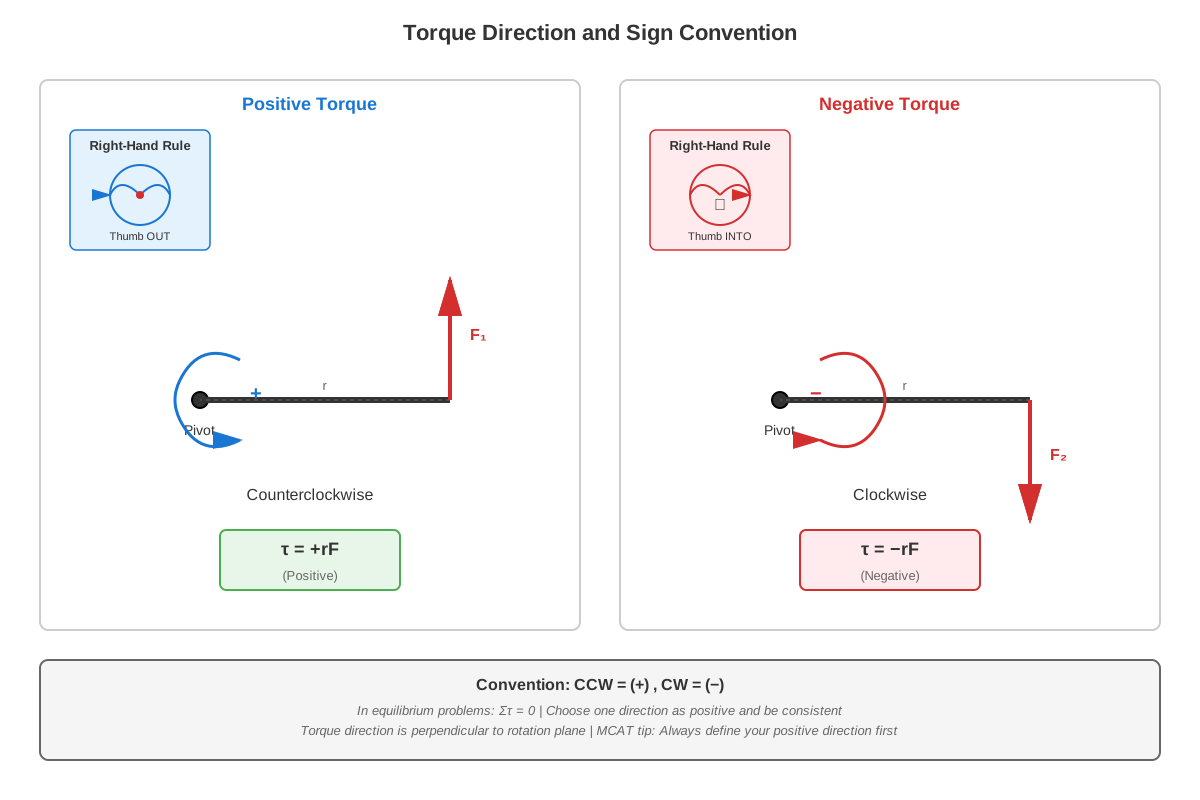
Torque is a vector quantity with both magnitude and direction. The direction of the torque vector is perpendicular to the plane containing both the position vector and the force vector, determined by the right-hand rule: point the fingers of your right hand in the direction of r, curl them toward F, and your thumb points in the direction of the torque vector.
For MCAT purposes, a simplified sign convention is typically used:
- Counterclockwise rotation is assigned positive torque (+τ)
- Clockwise rotation is assigned negative torque (-τ)
This convention allows for straightforward calculation of net torque by algebraically summing individual torques with their appropriate signs.
Conditions for Equilibrium
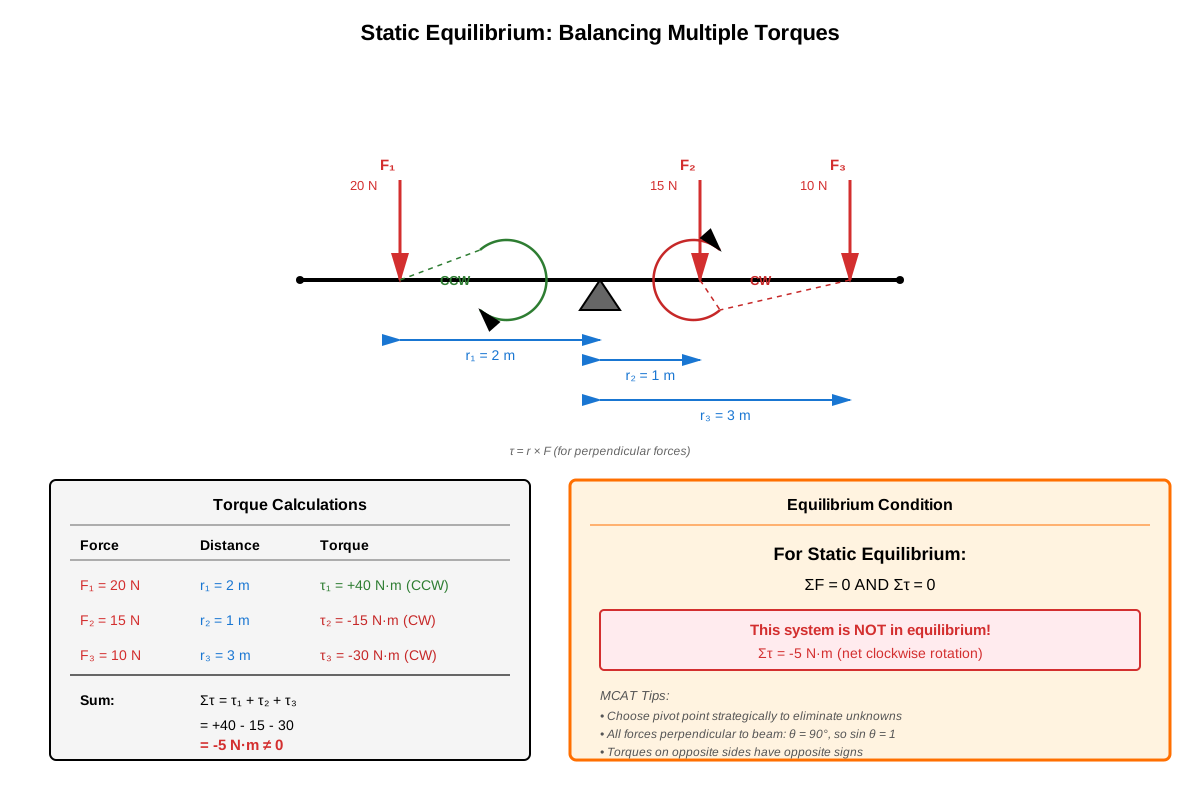
An object is in static equilibrium when it experiences no net force and no net torque. This requires two conditions to be satisfied simultaneously:
- Translational equilibrium: ΣF = 0 (vector sum of all forces equals zero)
- Rotational equilibrium: Στ = 0 (algebraic sum of all torques equals zero)
For rotational equilibrium specifically:
Στ = τ₁ + τ₂ + τ₃ + ... = 0This means that the sum of clockwise torques must equal the sum of counterclockwise torques. Many MCAT problems involve finding unknown forces or distances by applying this equilibrium condition.
Exam Tip: When solving equilibrium problems, you can choose any point as the axis of rotation. Strategically choosing the axis where an unknown force acts eliminates that force from the torque equation (since r = 0 at that point), simplifying calculations.
Factors Affecting Torque Magnitude
Three factors determine the magnitude of torque produced by a force:
- Magnitude of the applied force (F): Greater force produces greater torque (direct proportionality)
- Distance from the axis of rotation (r): Greater distance produces greater torque (direct proportionality)
- Angle of force application (θ): Maximum torque occurs when force is applied perpendicular to the position vector (θ = 90°, sin(θ) = 1); zero torque occurs when force is applied parallel to the position vector (θ = 0° or 180°, sin(θ) = 0)
| Factor | Effect on Torque | Example |
|---|---|---|
| Increase force (F) | Increases τ proportionally | Pushing harder on a wrench handle |
| Increase distance (r) | Increases τ proportionally | Using a longer wrench for more leverage |
| Optimize angle (θ → 90°) | Increases τ to maximum | Pushing perpendicular to a door (not toward hinges) |
| Force through axis (r = 0) | Zero torque | Pushing directly on door hinges produces no rotation |
Torque and Angular Acceleration
Just as force causes linear acceleration (F = ma), torque causes angular acceleration (α):
τ = Iαwhere:
- τ is net torque (N·m)
- I is moment of inertia (kg·m²), the rotational analog of mass
- α is angular acceleration (rad/s²)
This relationship, derived from Newton's Second Law applied to rotational motion, shows that torque is the cause of changes in rotational motion. A larger moment of inertia (more mass distributed farther from the axis) requires greater torque to achieve the same angular acceleration.
Lever Systems and Mechanical Advantage
A lever is a rigid object that rotates about a fixed point called the fulcrum. Levers are classified into three classes based on the relative positions of the fulcrum, effort force, and load (resistance force):
Class 1 Lever: Fulcrum between effort and load (examples: seesaw, crowbar, scissors)
- Can provide mechanical advantage depending on relative distances
- Changes direction of applied force
Class 2 Lever: Load between fulcrum and effort (examples: wheelbarrow, nutcracker, bottle opener)
- Always provides mechanical advantage (effort arm longer than load arm)
- Does not change direction of force
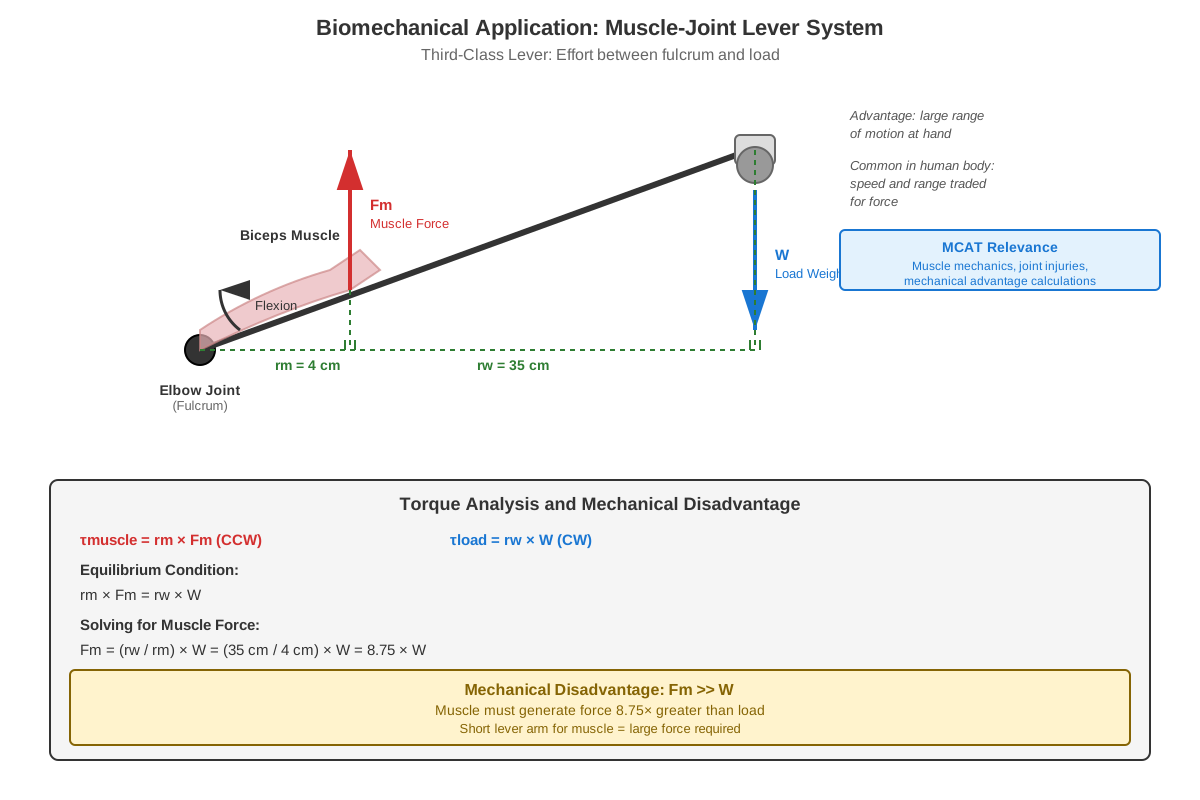
Class 3 Lever: Effort between fulcrum and load (examples: tweezers, fishing rod, human forearm)
- Provides mechanical disadvantage (requires more force than load)
- Provides advantage in speed and range of motion
The mechanical advantage (MA) of a lever is the ratio of output force to input force, which equals the ratio of the lever arms:
MA = F_out/F_in = r_in/r_outIn equilibrium, the torque from the effort force equals the torque from the load:
r_effort × F_effort = r_load × F_loadBiomechanical Applications
The human musculoskeletal system operates through a series of lever systems. Most skeletal muscles act as Class 3 levers, where the muscle insertion (effort) is between the joint (fulcrum) and the center of mass of the limb or external load (resistance). This arrangement sacrifices mechanical advantage for increased range and speed of motion.
For example, the biceps brachii muscle inserts on the radius approximately 5 cm from the elbow joint, while the center of mass of the forearm and hand is approximately 15-20 cm from the joint. This means the biceps must generate 3-4 times the force of the load to maintain equilibrium—a mechanical disadvantage. However, this arrangement allows the hand to move through a large arc with relatively small muscle contraction, enabling fine motor control and rapid movements.
Concept Relationships
Torque serves as a central connecting concept between translational and rotational mechanics. The relationship begins with force, the fundamental cause of motion in linear systems. When force is applied at a distance from an axis of rotation, it produces torque, which is the rotational analog of force. Just as force causes linear acceleration according to F = ma, torque causes angular acceleration according to τ = Iα.
The concept of equilibrium integrates both translational and rotational considerations. For complete static equilibrium, both ΣF = 0 (no net force) and Στ = 0 (no net torque) must be satisfied. This connection is crucial for analyzing structures, bridges, and biological systems like the human skeleton.
Torque connects directly to work and energy in rotational systems. Just as work in linear motion equals force times displacement (W = Fd), rotational work equals torque times angular displacement (W = τθ). This relationship extends to power in rotational systems (P = τω, where ω is angular velocity).
The concept of lever arm or moment arm connects torque to trigonometry and vector decomposition. Understanding that only the perpendicular component of force contributes to torque requires decomposing force vectors using sine and cosine functions.
In biomechanical contexts, torque connects to muscle physiology, joint mechanics, and center of mass. The effectiveness of muscle contraction depends not only on the force generated but also on the angle of muscle insertion and the distance from the joint—both factors in torque production.
Conceptual Flow: Force → Applied at distance from axis → Produces Torque → Causes Angular Acceleration → Results in Rotational Motion → Can perform Rotational Work → Governed by Equilibrium Conditions
High-Yield Facts
⭐ Torque is calculated as τ = rF sin(θ), where θ is the angle between the position vector and force vector
⭐ Only the component of force perpendicular to the position vector contributes to torque; parallel forces produce zero torque
⭐ For rotational equilibrium, the sum of clockwise torques must equal the sum of counterclockwise torques (Στ = 0)
⭐ Torque is maximized when force is applied perpendicular to the lever arm (θ = 90°, sin(θ) = 1)
⭐ The SI unit of torque is the Newton-meter (N·m), which is dimensionally equivalent to but distinct from the Joule
- Counterclockwise torques are conventionally positive; clockwise torques are conventionally negative
- The axis of rotation can be chosen arbitrarily when solving equilibrium problems; strategic choice simplifies calculations
- Increasing the distance from the axis of rotation increases torque proportionally (this is why wrenches have long handles)
- Most human skeletal muscles operate as Class 3 levers, sacrificing mechanical advantage for range of motion and speed
- When multiple torques act on a system, net torque determines angular acceleration: τ_net = Iα
- Forces acting through the axis of rotation (r = 0) produce no torque regardless of magnitude
- In equilibrium problems, the location of the axis of rotation does not affect whether equilibrium exists, only the calculation method
Quick check — test yourself on Torque so far.
Try Flashcards →Common Misconceptions
Misconception: Torque and work are the same because they have the same units (N·m).
Correction: Although both are measured in N·m, torque is a vector quantity describing rotational effect, while work is a scalar quantity describing energy transfer. Torque multiplied by angular displacement (in radians) gives rotational work: W = τθ. The units are dimensionally equivalent but represent different physical quantities.
Misconception: A larger force always produces more torque.
Correction: Torque depends on three factors: force magnitude, distance from axis, and angle of application. A smaller force applied farther from the axis or at a better angle can produce more torque than a larger force applied closer or at a poor angle. This is why a long wrench provides mechanical advantage.
Misconception: All forces acting on an object contribute to torque about a given axis.
Correction: Only forces that have a perpendicular component relative to the position vector contribute to torque. Forces directed through the axis of rotation (r = 0) or parallel to the position vector (sin(θ) = 0) produce zero torque. This is why pushing directly toward door hinges doesn't open the door.
Misconception: The axis of rotation must be at the center of mass of an object.
Correction: The axis of rotation can be located anywhere, and for problem-solving purposes, can be chosen strategically. Objects can rotate about any point, and the choice of axis is often made to simplify calculations by eliminating unknown forces from the torque equation.
Misconception: If an object is in rotational equilibrium, it must be stationary.
Correction: Rotational equilibrium (Στ = 0) means zero angular acceleration, not zero angular velocity. An object can rotate at constant angular velocity while in rotational equilibrium. Similarly, static equilibrium requires both zero net force and zero net torque, meaning the object is both at rest and not rotating.
Misconception: Mechanical advantage always means less force is required.
Correction: Mechanical advantage greater than 1 means less input force is required to balance a load, but mechanical advantage less than 1 (mechanical disadvantage) means more force is required. Class 3 levers, including most human muscles, have mechanical advantage less than 1, requiring greater muscle force than the load being moved.
Worked Examples
Example 1: Equilibrium of a Beam
Problem: A uniform beam of length 4.0 m and mass 20 kg is supported at its left end by a hinge and at a point 3.0 m from the left end by a vertical cable. What is the tension in the cable?
Solution:
Step 1: Identify the forces and their locations.
- Weight of beam: W = mg = (20 kg)(10 m/s²) = 200 N, acting downward at the center of mass (2.0 m from left end)
- Tension in cable: T (unknown), acting upward at 3.0 m from left end
- Reaction force at hinge: R (unknown), acting at the left end (0 m from left end)
Step 2: Choose the axis of rotation strategically.
Choose the hinge (left end) as the axis. This eliminates the reaction force from the torque equation since r = 0 at that point.
Step 3: Calculate torques about the chosen axis.
- Torque from weight: τ_W = -r_W × W = -(2.0 m)(200 N) = -400 N·m (clockwise, negative)
- Torque from tension: τ_T = +r_T × T = +(3.0 m)(T) = +3.0T N·m (counterclockwise, positive)
- Torque from hinge reaction: τ_R = 0 (r = 0)
Step 4: Apply rotational equilibrium condition.
Στ = 0
τ_T + τ_W = 0
3.0T - 400 = 0
3.0T = 400
T = 133 N
Answer: The tension in the cable is approximately 133 N.
Key Concepts Applied: This problem demonstrates strategic choice of axis to eliminate unknowns, identification of the center of mass as the point of action for weight, and application of the rotational equilibrium condition. The sign convention (counterclockwise positive, clockwise negative) ensures correct algebraic summation.
Example 2: Torque and Muscle Mechanics
Problem: The biceps muscle inserts on the radius 5.0 cm from the elbow joint. A person holds a 50 N weight in their hand with their forearm horizontal. The center of mass of the 20 N forearm is 15 cm from the elbow, and the weight is held 35 cm from the elbow. The biceps pulls vertically upward. What force must the biceps generate to maintain this position?
Solution:
Step 1: Identify the system and forces.
- Axis of rotation: elbow joint
- Force from biceps: F_b (unknown), acting upward at 5.0 cm = 0.05 m from elbow
- Weight of forearm: W_f = 20 N, acting downward at 15 cm = 0.15 m from elbow
- Weight held in hand: W_h = 50 N, acting downward at 35 cm = 0.35 m from elbow
Step 2: Determine the angle of force application.
All forces act vertically (either up or down), and the forearm is horizontal. Therefore, all forces are perpendicular to the position vectors (θ = 90°, sin(θ) = 1).
Step 3: Calculate torques about the elbow.
- Torque from biceps: τ_b = +r_b × F_b = +(0.05 m)(F_b) = +0.05F_b N·m (counterclockwise, positive)
- Torque from forearm weight: τ_f = -r_f × W_f = -(0.15 m)(20 N) = -3.0 N·m (clockwise, negative)
- Torque from hand weight: τ_h = -r_h × W_h = -(0.35 m)(50 N) = -17.5 N·m (clockwise, negative)
Step 4: Apply rotational equilibrium.
Στ = 0
τ_b + τ_f + τ_h = 0
0.05F_b - 3.0 - 17.5 = 0
0.05F_b = 20.5
F_b = 410 N
Answer: The biceps must generate 410 N of force to maintain equilibrium.
Analysis: Notice that the biceps must generate 410 N to support a total load of only 70 N (20 N + 50 N). This represents a mechanical disadvantage of approximately 6:1, typical of Class 3 levers. The muscle must generate much more force than the load because it acts at a much shorter distance from the fulcrum. This arrangement sacrifices force efficiency for range of motion and speed—the hand can move through a large arc with relatively small muscle contraction.
Key Concepts Applied: This problem illustrates biomechanical lever systems, the concept of mechanical disadvantage in Class 3 levers, the importance of lever arm length in determining required force, and the practical application of torque equilibrium to human physiology.
Exam Strategy
Approaching MCAT Torque Questions
Step 1: Identify the type of problem
- Is it an equilibrium problem (Στ = 0) or a dynamics problem (τ = Iα)?
- Are you solving for force, distance, angle, or equilibrium conditions?
Step 2: Draw a clear diagram
- Mark the axis of rotation explicitly
- Draw all forces as vectors at their points of application
- Label all distances from the axis
- Indicate angles between position vectors and forces
Step 3: Choose your axis strategically
- Select an axis that eliminates the most unknowns (forces acting at r = 0 produce no torque)
- For equilibrium problems, choosing the axis where an unknown force acts simplifies calculations
Step 4: Identify which forces contribute to torque
- Forces through the axis: no torque (r = 0)
- Forces parallel to position vector: no torque (sin(θ) = 0)
- Only perpendicular components contribute: use r⊥ or F⊥
Step 5: Assign signs consistently
- Establish counterclockwise as positive, clockwise as negative (or vice versa, but be consistent)
- Apply signs before algebraic summation
Trigger Words and Phrases
Watch for these terms that signal torque problems:
- "Rotates about," "pivots at," "hinged at" → identifies axis of rotation
- "Equilibrium," "balanced," "stationary" → Στ = 0
- "Lever," "seesaw," "beam," "rod" → lever system analysis
- "Perpendicular distance," "moment arm," "lever arm" → use r⊥ formulation
- "Mechanical advantage" → ratio of lever arms or forces
- "Joint," "muscle insertion," "limb" → biomechanical lever system
Process of Elimination Tips
- Eliminate answers with wrong units: Torque must be in N·m (or equivalent), not Joules or Newtons alone
- Check limiting cases: If distance approaches zero, torque should approach zero; if angle is 0° or 180°, torque should be zero
- Verify sign/direction: Counterclockwise and clockwise torques should have opposite signs
- Test proportionality: Doubling force or distance should double torque (if angle is constant)
- Assess reasonableness: In biomechanical problems, muscle forces typically exceed loads due to mechanical disadvantage
Time Allocation
- Simple calculation problems (given F, r, θ, find τ): 30-45 seconds
- Equilibrium problems (multiple torques, solve for unknown): 60-90 seconds
- Passage-based problems (extract information, apply concepts): 90-120 seconds
- Complex biomechanical scenarios: 90-120 seconds
Exam Tip: If a problem seems algebraically complex, check whether you've chosen the optimal axis of rotation. Repositioning the axis to eliminate unknowns can transform a difficult problem into a straightforward one.
Memory Techniques
Mnemonics
"FRED" for Torque Factors:
- Force magnitude
- Radius (distance from axis)
- Effective angle (perpendicular component)
- Direction (clockwise vs. counterclockwise)
"CCW-P" for Sign Convention:
- CounterClockWise is Positive
"SAFE" for Equilibrium Conditions:
- Sum of forces = 0 (ΣF = 0)
- And
- Forces' torques = 0 (Στ = 0)
- Equilibrium achieved
Visualization Strategies
The Door Analogy: Visualize opening a door to remember torque principles:
- Pushing far from hinges (large r) → easy to open (large torque)
- Pushing close to hinges (small r) → hard to open (small torque)
- Pushing perpendicular to door (θ = 90°) → easiest (maximum torque)
- Pushing toward hinges (θ = 0°) → impossible (zero torque)
The Seesaw Method: For equilibrium problems, visualize a seesaw:
- Heavy weight close to fulcrum can balance light weight far from fulcrum
- Balance occurs when (weight × distance) on left equals (weight × distance) on right
- This reinforces that torque depends on both force and distance
The Wrench Principle: Remember that mechanics use long wrenches for tight bolts:
- Longer wrench (larger r) → more torque with same force
- This reinforces the direct proportionality between r and τ
Acronyms
"PERPENDICULAR" - Remember that only the PERPendicular component of force contributes to torque, and PERPendicular application (90°) gives maximum torque.
Summary
Torque is the rotational analog of force, quantifying the tendency of a force to cause rotation about an axis. Calculated as τ = rF sin(θ), torque depends on the magnitude of applied force, the distance from the axis of rotation, and the angle of force application. Maximum torque occurs when force is applied perpendicularly to the lever arm (θ = 90°), while forces directed through the axis or parallel to the position vector produce zero torque. For rotational equilibrium, the sum of all torques must equal zero (Στ = 0), meaning clockwise and counterclockwise torques balance. This principle is fundamental to analyzing levers, beams, and biomechanical systems. The human musculoskeletal system operates primarily through Class 3 levers, where muscles insert between joints (fulcrums) and loads, creating mechanical disadvantage but enabling large range of motion and speed. Understanding torque requires integrating concepts of force, vectors, trigonometry, and equilibrium, making it a central connecting concept in mechanics. For MCAT success, students must master torque calculations, recognize when forces contribute to rotation, strategically choose axes to simplify problems, and apply equilibrium conditions to both physical and biological systems.
Key Takeaways
- Torque (τ = rF sin(θ)) is the rotational effect of a force applied at a distance from an axis, with maximum effect when force is perpendicular to the lever arm
- Only the perpendicular component of force contributes to torque; forces through the axis or parallel to the position vector produce zero torque
- Rotational equilibrium requires Στ = 0, where the sum of clockwise torques equals the sum of counterclockwise torques
- Strategic choice of the axis of rotation can eliminate unknown forces from calculations, simplifying equilibrium problems
- Most human muscles operate as Class 3 levers with mechanical disadvantage, requiring greater force than the load but providing advantages in speed and range of motion
- Torque is measured in N·m and is dimensionally equivalent to but conceptually distinct from work (Joules)
- Increasing either the applied force or the distance from the axis increases torque proportionally, explaining why tools like wrenches have long handles
Related Topics
Angular Momentum: Building on torque, angular momentum (L = Iω) describes the quantity of rotational motion, and torque represents the rate of change of angular momentum (τ = dL/dt), analogous to how force relates to linear momentum.
Rotational Kinetic Energy: Objects in rotational motion possess kinetic energy (KE_rot = ½Iω²), and torque performs work to change this energy, connecting torque to energy concepts.
Moment of Inertia: The rotational analog of mass, moment of inertia determines how torque produces angular acceleration (τ = Iα) and depends on mass distribution relative to the axis of rotation.
Center of Mass and Center of Gravity: Understanding where an object's weight effectively acts is crucial for calculating gravitational torque in equilibrium problems.
Simple Machines: Levers, pulleys, and inclined planes all involve torque principles and mechanical advantage, extending torque concepts to practical devices.
Biomechanics and Muscle Physiology: The force-generating capacity of muscles, combined with their insertion points and angles, determines the torques they can produce about joints, integrating physics with biology.
Mastering torque provides the foundation for understanding all rotational motion in physics and enables analysis of complex biomechanical systems that appear frequently in interdisciplinary MCAT passages.
Practice CTA
Now that you've mastered the core concepts of torque, it's time to solidify your understanding through active practice. Attempt the practice questions and work through the flashcards to reinforce the high-yield facts and relationships you've learned. Focus particularly on equilibrium problems and biomechanical applications, as these represent the most common MCAT question types. Remember that torque problems often appear more complex than they are—strategic thinking about axis selection and force components will help you approach them efficiently. Each practice problem you solve strengthens your pattern recognition and builds the confidence you need for test day. You've built a strong conceptual foundation; now apply it to achieve mastery!
Sign up free to keep reading
Create a free AnvayaPrep account to finish this MCAT guide on Torque — plus flashcards and practice questions.