Overview
Conservation of energy is one of the most fundamental and powerful principles in Physics, stating that the total energy of an isolated system remains constant over time—energy can neither be created nor destroyed, only transformed from one form to another. This principle serves as a cornerstone of Mechanics and extends throughout all domains of physics tested on the MCAT. Understanding energy conservation allows students to solve complex mechanical problems efficiently by tracking energy transformations rather than analyzing forces at every instant, making it an indispensable problem-solving tool for exam success.
For the MCAT, conservation of energy appears frequently across multiple contexts: projectile motion, pendulum systems, spring mechanics, thermodynamics, and even biochemical pathways in the biological sciences. The MCAT tests not only computational facility with energy equations but also conceptual understanding of when and how energy transforms between kinetic, potential, thermal, and other forms. Questions often present complex scenarios where force-based approaches would be cumbersome, but energy methods yield elegant solutions in seconds—a critical advantage under timed exam conditions.
This topic connects intimately with work, power, momentum, and thermodynamics within Physics, while also bridging to biological energetics (ATP hydrolysis, metabolic pathways) and chemical reactions (bond energies, enthalpy). Mastering conservation of energy provides a unified framework for understanding physical and biological systems, making it one of the highest-yield topics for maximizing MCAT performance across multiple sections.
Learning Objectives
- [ ] Define Conservation of energy using accurate Physics terminology
- [ ] Explain why Conservation of energy matters for the MCAT
- [ ] Apply Conservation of energy to exam-style questions
- [ ] Identify common mistakes related to Conservation of energy
- [ ] Connect Conservation of energy to related Physics concepts
- [ ] Distinguish between conservative and non-conservative forces and their effects on mechanical energy
- [ ] Calculate energy transformations in multi-step mechanical systems involving kinetic, gravitational potential, and elastic potential energy
- [ ] Analyze energy dissipation scenarios and determine when conservation of mechanical energy applies versus when total energy conservation requires accounting for thermal energy
Prerequisites
- Work and Energy: Understanding that work transfers energy to or from a system; essential for comprehending how energy changes form
- Kinetic Energy (KE = ½mv²): Familiarity with energy of motion; required to track energy transformations involving moving objects
- Gravitational Potential Energy (PE = mgh): Knowledge of position-dependent energy in gravitational fields; necessary for analyzing vertical motion problems
- Elastic Potential Energy (PE = ½kx²): Understanding energy stored in springs; needed for spring-mass system problems
- Basic Algebra and Equation Manipulation: Ability to solve multi-variable equations; critical for setting up and solving energy conservation equations
Why This Topic Matters
Clinical and Real-World Significance
Energy conservation principles govern countless physiological and medical phenomena. The human cardiovascular system demonstrates energy conservation as the heart converts chemical energy (ATP) into kinetic energy of blood flow and gravitational potential energy when pumping blood upward against gravity. Understanding energy transformations helps explain why blood pressure differs at various body heights and why patients experience orthostatic hypotension when standing quickly. Biomechanics of human movement—walking, running, jumping—relies on efficient energy transfer between gravitational potential, kinetic, and elastic potential energy stored in tendons. Medical devices like defibrillators store electrical potential energy in capacitors before delivering it as a therapeutic shock, exemplifying controlled energy transformation.
MCAT Exam Statistics
Conservation of energy appears in approximately 15-20% of Physics passages and discrete questions on the MCAT, making it one of the most frequently tested topics. Questions typically appear as:
- Calculation problems: Determining final velocities, heights, or spring compressions using energy conservation
- Conceptual questions: Identifying which energy forms are present or how energy distributes in a system
- Passage-based applications: Analyzing experimental setups, biomechanical systems, or novel devices through energy frameworks
- Interdisciplinary integration: Connecting mechanical energy to thermodynamics, biochemical energetics, or physiological systems
The MCAT particularly favors questions that combine energy conservation with other concepts (circular motion, inclined planes, pendulums) or require students to recognize when energy is conserved versus dissipated. Multi-step problems involving several energy transformations are common, testing both computational accuracy and conceptual clarity.
Common Exam Appearances
Energy conservation frequently appears in passages describing: pendulum experiments measuring gravitational acceleration; roller coaster or projectile motion scenarios; spring-mass oscillators; biomechanical analyses of human or animal locomotion; and medical devices involving energy storage or transfer. Discrete questions often present straightforward scenarios (object sliding down ramps, balls thrown vertically) where energy methods provide the fastest solution path.
Core Concepts
The Principle of Energy Conservation
Conservation of energy states that the total energy of an isolated system remains constant throughout any process. Mathematically, this fundamental principle is expressed as:
E_total,initial = E_total,finalor equivalently:
ΔE_total = 0An isolated system experiences no net energy transfer with its surroundings—no work done by external forces and no heat transfer. In such systems, energy may transform between various forms (kinetic, potential, thermal, chemical, etc.), but the sum remains invariant. This principle emerges from deep symmetries in physical laws and has never been observed to fail in any physical process.
For MCAT purposes, most problems involve mechanical energy conservation, a special case where only kinetic and potential energies are considered, with the implicit assumption that no energy converts to thermal or other non-mechanical forms.
Mechanical Energy and Its Forms
Mechanical energy (E_mech) comprises the sum of kinetic and potential energies in a system:
E_mech = KE + PEKinetic Energy (KE) represents energy of motion:
KE = ½mv²where m is mass (kg) and v is speed (m/s). Kinetic energy is always positive (since v² ≥ 0) and increases with the square of velocity—doubling speed quadruples kinetic energy.
Potential Energy (PE) represents stored energy due to position or configuration. The two most important forms for the MCAT are:
Gravitational Potential Energy:
PE_grav = mghwhere m is mass (kg), g is gravitational acceleration (9.8 m/s² or ~10 m/s² for MCAT calculations), and h is height above a reference point (m). The reference point (where PE = 0) is arbitrary; only changes in height matter physically.
Elastic Potential Energy:
PE_elastic = ½kx²where k is the spring constant (N/m) measuring spring stiffness, and x is displacement from equilibrium position (m).
Conservative vs. Non-Conservative Forces
The applicability of mechanical energy conservation depends critically on the types of forces acting on a system.
Conservative forces are forces for which the work done depends only on initial and final positions, not on the path taken. Equivalently, the work done by a conservative force around any closed path is zero. Examples include:
- Gravitational force
- Elastic spring force
- Electrostatic force
When only conservative forces act, mechanical energy is conserved:
KE_i + PE_i = KE_f + PE_fNon-conservative forces are forces for which work depends on the path taken. The primary example is friction (kinetic or air resistance). Non-conservative forces typically convert mechanical energy into thermal energy (heat), causing mechanical energy to decrease:
E_mech,initial = E_mech,final + E_thermalor equivalently:
KE_i + PE_i = KE_f + PE_f + W_frictionwhere W_friction represents energy dissipated as heat (always positive in magnitude when representing energy loss).
The Work-Energy Theorem Connection
The work-energy theorem states that the net work done on an object equals its change in kinetic energy:
W_net = ΔKEThis theorem connects intimately with energy conservation. When conservative forces do work, they transfer energy between kinetic and potential forms without changing total mechanical energy. When non-conservative forces do work, they change the total mechanical energy of the system.
For a system with both conservative and non-conservative forces:
W_conservative + W_non-conservative = ΔKESince W_conservative = -ΔPE (work done by conservative forces equals negative change in potential energy), we can rearrange:
W_non-conservative = ΔKE + ΔPE = ΔE_mechThis relationship shows that non-conservative work equals the change in mechanical energy—when W_non-conservative = 0, mechanical energy is conserved.
Problem-Solving Strategy Using Energy Conservation
The systematic approach to energy conservation problems follows these steps:
- Define the system: Identify what objects are included and whether the system is isolated
- Choose reference points: Select where PE = 0 (for gravitational problems) or equilibrium position (for spring problems)
- Identify initial and final states: Determine positions, velocities, and configurations at these moments
- List all energy forms present: At both initial and final states (KE, PE_grav, PE_elastic)
- Determine if mechanical energy is conserved: Check whether only conservative forces do work
- Write the energy equation: Set initial total energy equal to final total energy (plus any dissipated energy if applicable)
- Solve algebraically: Isolate the unknown variable before substituting numbers
Energy Conservation in Common MCAT Scenarios
| Scenario | Initial Energy | Final Energy | Key Insight |
|---|---|---|---|
| Object dropped from height h | PE = mgh, KE = 0 | PE = 0, KE = ½mv² | v = √(2gh) regardless of mass |
| Object thrown upward with v₀ | KE = ½mv₀², PE = 0 | KE = 0, PE = mgh_max | h_max = v₀²/(2g) |
| Pendulum at maximum displacement | PE = mgh, KE = 0 | PE = 0, KE = ½mv² | v_bottom = √(2gh) |
| Spring compressed then released | PE = ½kx², KE = 0 | PE = 0, KE = ½mv² | v = x√(k/m) |
| Object sliding down frictionless ramp | PE = mgh, KE = 0 | PE = 0, KE = ½mv² | Final velocity independent of ramp angle |
| Object sliding with friction | PE + KE initial | PE + KE final + μmgd | Must account for thermal energy |
Energy Diagrams and Transformations
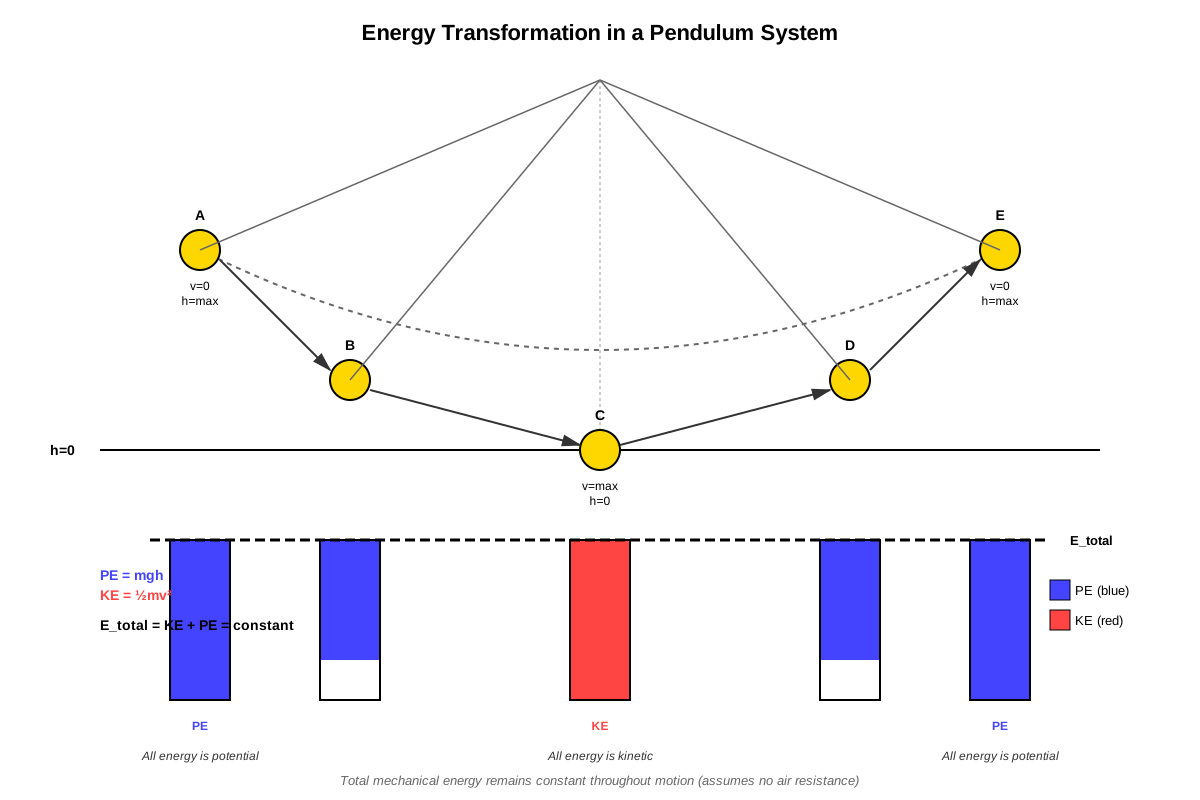
Visualizing energy transformations helps conceptual understanding. Consider a pendulum:
- At maximum height (endpoints): All energy is gravitational potential (PE_max, KE = 0)
- At lowest point (equilibrium): All energy is kinetic (KE_max, PE = 0)
- At intermediate positions: Energy is partially kinetic and partially potential (KE + PE = constant)
The total mechanical energy remains constant throughout the swing (assuming negligible air resistance), but energy continuously transforms between kinetic and potential forms. This transformation is reversible and cyclic.
For a mass-spring system:
- At maximum compression/extension: All energy is elastic potential (PE_elastic,max, KE = 0)
- At equilibrium position: All energy is kinetic (KE_max, PE_elastic = 0)
- At intermediate positions: Energy is partially kinetic and partially elastic potential
Multi-Step Energy Transformations
MCAT problems often involve multiple energy transformations in sequence. Consider a mass attached to a compressed spring on a table that launches the mass, which then slides up a frictionless ramp:
Step 1 (spring compressed): E = ½kx²
Step 2 (spring releases, mass leaves spring): E = ½mv₁²
Step 3 (mass reaches height h on ramp): E = mgh
Since mechanical energy is conserved throughout (frictionless):
½kx² = ½mv₁² = mghThis allows solving for any unknown (final height, launch velocity, required spring compression) given the others.
Concept Relationships
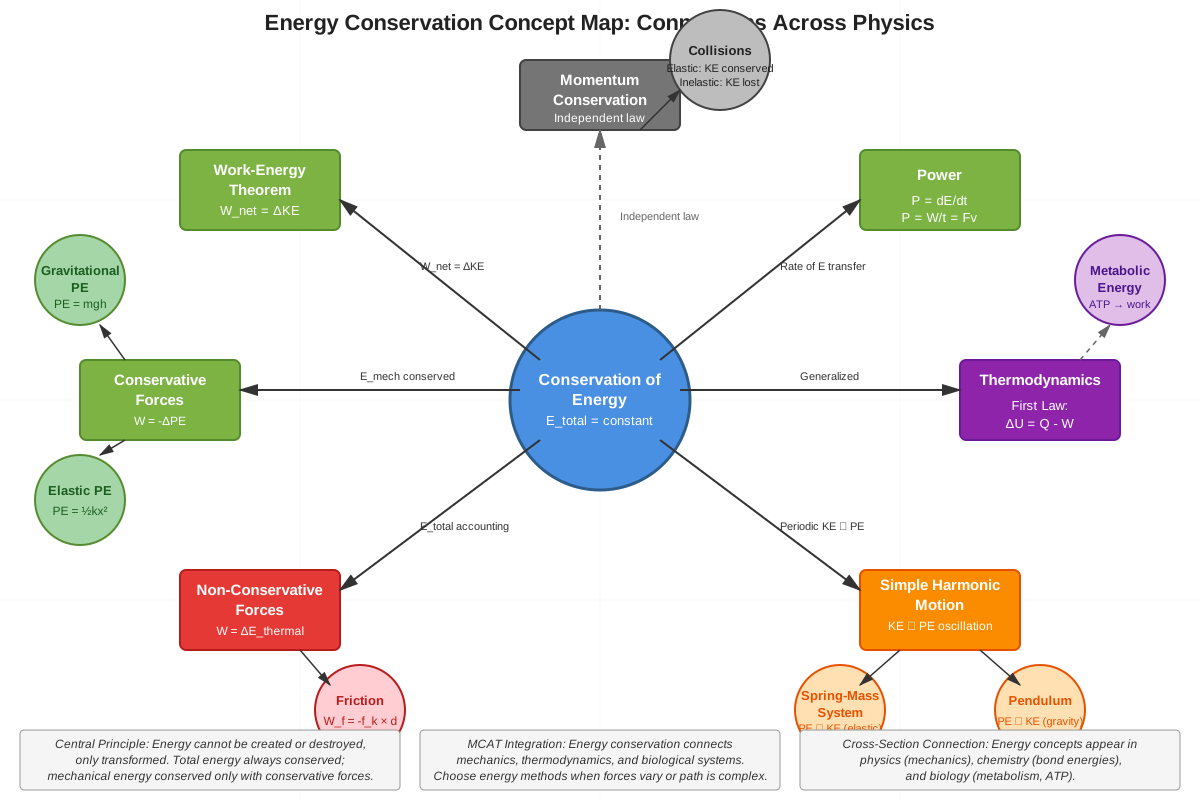
Conservation of energy serves as a unifying principle connecting multiple mechanics concepts. Work represents the mechanism by which energy transfers between objects or converts between forms—when a force does work on an object, it changes the object's energy. Conservative forces (gravity, springs, electrostatic) are associated with potential energies; the work they do equals the negative change in their corresponding potential energy. Non-conservative forces (friction, air resistance) convert mechanical energy to thermal energy, which is why mechanical energy decreases in their presence but total energy remains conserved.
Kinematics and dynamics (Newton's laws) provide alternative approaches to the same problems that energy methods solve. While kinematics tracks position, velocity, and acceleration through time, and dynamics analyzes forces and accelerations, energy conservation often provides a more direct path to solutions by relating initial and final states without requiring analysis of intermediate motion. For example, finding the speed of an object after falling a certain height requires multiple kinematic equations but only one energy equation.
Power extends energy concepts by introducing the time rate of energy transfer: P = W/t = ΔE/t. Understanding energy conservation is prerequisite to analyzing power in mechanical systems. Momentum conservation represents a parallel conservation principle; while energy conservation applies universally, momentum conservation requires absence of external forces. Some problems require both principles simultaneously (collisions where you need to find both final velocities and energy dissipated).
The relationship map flows as:
Forces → do Work → causing Energy Transfer → governed by Conservation of Energy → which can be analyzed using Kinetic Energy + Potential Energy → with Power describing the rate of energy transfer → and connections to Thermodynamics (first law: ΔU = Q - W) extending energy conservation to include heat transfer.
Quick check — test yourself on Conservation of energy so far.
Try Flashcards →High-Yield Facts
⭐ Total energy of an isolated system is always conserved; energy can transform between forms but cannot be created or destroyed
⭐ Mechanical energy (KE + PE) is conserved only when exclusively conservative forces (gravity, springs, electrostatic) do work
⭐ When friction or air resistance acts, mechanical energy decreases by the amount converted to thermal energy: E_mech,initial = E_mech,final + E_thermal
⭐ For an object falling from height h: final velocity v = √(2gh), independent of mass and path taken
⭐ For a spring-mass system: maximum kinetic energy equals maximum elastic potential energy: ½mv²_max = ½kx²_max
- Gravitational potential energy depends on height above an arbitrary reference point; only changes in height have physical meaning
- Kinetic energy depends on speed squared (v²), so doubling speed quadruples kinetic energy
- In pendulum motion, maximum speed occurs at the lowest point where all energy is kinetic
- Energy has units of Joules (J) where 1 J = 1 kg⋅m²/s² = 1 N⋅m
- Conservative forces have associated potential energies; non-conservative forces do not
- The work done by gravity on an object depends only on vertical displacement, not horizontal motion
- In elastic collisions, both momentum and kinetic energy are conserved; in inelastic collisions, only momentum is conserved
- Energy conservation applies to rotational motion: total energy includes rotational kinetic energy (½Iω²) in addition to translational kinetic energy
Common Misconceptions
Misconception: Energy is conserved in all situations, so mechanical energy never changes.
Correction: Total energy is always conserved, but mechanical energy (KE + PE) is conserved only when non-conservative forces like friction are absent or do no work. When friction acts, mechanical energy converts to thermal energy, decreasing the mechanical energy while maintaining total energy conservation.
Misconception: Heavier objects fall faster and therefore have more kinetic energy when reaching the ground from the same height.
Correction: In the absence of air resistance, all objects fall with the same acceleration (g) and reach the same final velocity when dropped from the same height: v = √(2gh). While heavier objects have more kinetic energy (KE = ½mv²) due to greater mass, they reach the same speed as lighter objects. The mass cancels when using energy conservation: mgh = ½mv² → v = √(2gh).
Misconception: Potential energy is an absolute quantity that an object "has" at a given position.
Correction: Potential energy is always defined relative to an arbitrary reference point where PE = 0. Only changes in potential energy (ΔPE) have physical meaning. Different choices of reference point yield different PE values but identical ΔPE values and identical physical predictions. For gravitational PE, we typically choose ground level or the lowest point in the problem as the reference.
Misconception: When a spring is compressed or stretched, the potential energy stored is proportional to the displacement (PE = kx).
Correction: Elastic potential energy is proportional to the square of displacement: PE = ½kx². This quadratic relationship means doubling the compression quadruples the stored energy. The factor of ½ arises because the spring force increases linearly with displacement (F = kx), so the average force during compression is ½kx.
Misconception: Energy conservation can only be applied to the beginning and end of motion, not to intermediate points.
Correction: Energy conservation applies at every instant and between any two points in time. You can write energy equations comparing any two states of the system, not just initial and final. This flexibility is particularly useful in multi-step problems where analyzing intermediate states helps solve for unknowns.
Misconception: If an object returns to its starting height, it must have the same kinetic energy as initially, regardless of friction.
Correction: Without friction, an object returning to its starting height will indeed have the same kinetic energy (and speed) as initially. However, if friction acts during the motion, mechanical energy is dissipated as heat, so the object will have less kinetic energy when returning to the original height. The gravitational potential energy is the same, but total mechanical energy has decreased.
Worked Examples
Example 1: Projectile Motion Using Energy Conservation
Problem: A 2.0 kg ball is thrown vertically upward with an initial speed of 15 m/s from ground level. Using energy conservation, determine: (a) the maximum height reached, and (b) the speed when the ball is at a height of 8.0 m on the way up. Neglect air resistance and use g = 10 m/s².
Solution:
(a) Finding maximum height
Step 1: Define the system and reference point
- System: ball + Earth
- Reference point: ground level (PE = 0 at h = 0)
Step 2: Identify initial and final states
- Initial state: ground level, moving upward at v₀ = 15 m/s
- Final state: maximum height h_max, instantaneously at rest (v = 0)
Step 3: List energy forms
- Initial: KE_i = ½mv₀², PE_i = 0
- Final: KE_f = 0, PE_f = mgh_max
Step 4: Apply energy conservation (no friction, so mechanical energy conserved)
KE_i + PE_i = KE_f + PE_f
½mv₀² + 0 = 0 + mgh_max
Step 5: Solve for h_max
½v₀² = gh_max
h_max = v₀²/(2g) = (15 m/s)²/(2 × 10 m/s²) = 225/20 = 11.25 mNote: The mass cancels out, confirming that maximum height depends only on initial speed and gravitational acceleration, not on mass.
(b) Finding speed at h = 8.0 m
Step 1: Identify states
- Initial state: ground level, v₀ = 15 m/s
- Final state: h = 8.0 m, speed = v (unknown)
Step 2: Apply energy conservation
½mv₀² + 0 = ½mv² + mghStep 3: Solve for v (mass cancels)
½v₀² = ½v² + gh
v² = v₀² - 2gh = (15)² - 2(10)(8.0) = 225 - 160 = 65 m²/s²
v = √65 ≈ 8.1 m/s
Key Insight: This problem demonstrates how energy conservation provides direct solutions without requiring time-dependent kinematic equations. The same speed (8.1 m/s) would occur at h = 8.0 m on the way down, illustrating the path-independence of energy conservation.
Example 2: Spring-Mass System with Friction
Problem: A 0.50 kg block is pressed against a horizontal spring (k = 200 N/m), compressing it by 0.15 m. The block is released and slides across a surface with coefficient of kinetic friction μ_k = 0.20. How far does the block travel from the release point before coming to rest? Use g = 10 m/s².
Solution:
Step 1: Define system and identify energy transformations
- System: block + spring + Earth
- Energy transformation: elastic PE → kinetic energy → thermal energy (due to friction)
Step 2: Identify states
- Initial: spring compressed x = 0.15 m, block at rest (v = 0)
- Final: spring at equilibrium, block at rest (v = 0), distance d from release point
Step 3: List all energy forms
- Initial: PE_elastic = ½kx², KE = 0, PE_grav = 0 (horizontal motion)
- Final: PE_elastic = 0, KE = 0, PE_grav = 0
- Energy dissipated by friction: E_thermal = f_k × d = μ_k mg × d
Step 4: Apply energy conservation (total energy conserved, but mechanical energy not conserved)
E_initial = E_final + E_thermal
½kx² = 0 + μ_k mgd
Step 5: Solve for d
d = kx²/(2μ_k mg)
d = (200 N/m)(0.15 m)²/[2(0.20)(0.50 kg)(10 m/s²)]
d = (200)(0.0225)/(2 × 0.20 × 0.50 × 10)
d = 4.5/2.0 = 2.25 m
Key Insight: This problem requires recognizing that mechanical energy is not conserved due to friction, but total energy is conserved when accounting for thermal energy. The initial elastic potential energy equals the work done against friction. Notice that the block's maximum kinetic energy (occurring when leaving the spring) doesn't need to be calculated explicitly—energy conservation allows us to relate initial and final states directly.
Extension: If asked for the maximum speed of the block, we would apply energy conservation between the initial state and the moment the block leaves the spring (where all elastic PE converts to KE):
½kx² = ½mv²_max
v_max = x√(k/m) = 0.15√(200/0.50) = 0.15√400 = 0.15 × 20 = 3.0 m/s
Exam Strategy
Recognizing Energy Conservation Problems
MCAT questions suitable for energy methods typically involve:
- Trigger phrases: "initial speed," "final height," "maximum compression," "comes to rest," "released from rest"
- Vertical motion: Objects thrown upward, dropped, or moving on ramps
- Springs: Compression, extension, or oscillation scenarios
- Pendulums: Swinging motion, maximum displacement
- Absence of time: When the problem doesn't ask "how long" or "when," energy methods are often faster than kinematics
Systematic Approach
- Quickly assess whether mechanical energy is conserved: Look for friction, air resistance, or other dissipative forces. If absent, mechanical energy is conserved; if present, account for energy dissipation.
- Choose the easiest reference point: For gravitational PE, select the lowest point in the problem or ground level. This often makes one of your PE terms zero, simplifying algebra.
- Write the energy equation before plugging in numbers: Algebraic manipulation is faster and less error-prone when done symbolically. Often variables cancel (like mass), simplifying calculations.
- Check units: Energy must be in Joules. If given mass in grams, convert to kg. If given height in cm, convert to m.
Process of Elimination Tips
- Eliminate answers with wrong units: Energy must have units of Joules (kg⋅m²/s²), not N, m/s, or other units
- Use limiting cases: If a problem involves mass and your answer depends on mass, check if that makes physical sense. For free fall problems, final velocity shouldn't depend on mass—if an answer choice includes mass, eliminate it.
- Check energy relationships: Doubling height doubles PE (linear relationship), but doubling speed quadruples KE (quadratic relationship). Use this to eliminate inconsistent answers.
- Energy cannot be negative: Total kinetic energy and elastic potential energy are always positive. Gravitational PE can be negative if below the reference point, but this is rare in MCAT problems.
Time Management
Energy conservation problems typically take 60-90 seconds when approached efficiently:
- 0-15 seconds: Read and identify the scenario, determine if mechanical energy is conserved
- 15-30 seconds: Write the energy equation symbolically
- 30-60 seconds: Solve algebraically and substitute values
- 60-90 seconds: Calculate and verify answer reasonableness
If a problem seems to require more than 90 seconds, consider whether you've chosen the optimal approach or if there's a conceptual shortcut you're missing.
Memory Techniques
Energy Conservation Mnemonic: "KEPT"
Kinetic + Elastic + Potential (gravitational) = Total (mechanical energy)
Remember: KEPT constant when only conservative forces act.
Conservative Forces Mnemonic: "GES"
Gravity, Elastic (springs), electroStatic
These three forces are conservative and have associated potential energies.
Energy Equation Template: "I = F + D"
Initial energy = Final energy + Dissipated energy
This reminds you to account for energy lost to friction/heat when mechanical energy isn't conserved.
Visualization Strategy: Energy Bar Charts
Mentally draw vertical bars representing KE, PE_grav, and PE_elastic at initial and final states:
Initial State:        Final State:
|----| KE            |--------| KE
|    | PE_grav       |        | PE_grav
|----| PE_elastic    |        | PE_elastic
The total height of bars should be equal (if no friction) or decrease (if friction present). This visual helps identify which energy forms are present and how they transform.
Spring Energy Reminder: "Half-K-X-Squared"
Elastic PE = ½kx² (not kx!)
Verbally rehearsing "half-K-X-squared" helps avoid the common error of forgetting the ½ or the square.
Free Fall Speed Formula: "Square Root of Two-G-H"
v = √(2gh)
This formula appears so frequently that memorizing it as a phrase speeds up problem-solving. Remember it applies to any object falling height h, regardless of mass or path.
Summary
Conservation of energy stands as one of physics' most powerful and universal principles, asserting that total energy in an isolated system remains constant while transforming between various forms. For MCAT purposes, mechanical energy conservation—the sum of kinetic and potential energies remaining constant—provides an elegant and efficient method for solving a wide range of mechanics problems involving motion, springs, and gravitational fields. The key distinction lies between scenarios with only conservative forces (gravity, springs, electrostatic), where mechanical energy is conserved, and those involving non-conservative forces like friction, where mechanical energy converts to thermal energy but total energy remains conserved. Mastery requires recognizing when to apply energy methods, correctly identifying all energy forms present in initial and final states, choosing appropriate reference points, and systematically writing energy equations that relate these states. The mathematical simplicity of energy conservation—often reducing complex motion to a single equation—makes it indispensable for efficient MCAT problem-solving, particularly when combined with understanding of how energy concepts connect to work, power, and thermodynamics across the physical and biological sciences.
Key Takeaways
- Total energy is always conserved in isolated systems; mechanical energy (KE + PE) is conserved only when exclusively conservative forces act
- Energy conservation provides a powerful alternative to force-based and kinematic approaches, often yielding faster solutions by relating initial and final states directly
- The three primary mechanical energy forms for MCAT are kinetic (½mv²), gravitational potential (mgh), and elastic potential (½kx²)
- Non-conservative forces like friction convert mechanical energy to thermal energy: E_mech,initial = E_mech,final + E_thermal
- Mass often cancels in energy equations for free fall and projectile motion, confirming that final velocities depend only on height changes and initial speeds, not mass
- Choosing strategic reference points (where PE = 0) simplifies calculations by eliminating terms from energy equations
- Energy conservation connects broadly across MCAT topics: from mechanics to thermodynamics to biochemical energetics, making it a high-yield unifying principle
Related Topics
Work and Power: Understanding how forces transfer energy (work) and the rate of energy transfer (power) builds directly on energy conservation principles and provides complementary problem-solving approaches.
Simple Harmonic Motion: Springs and pendulums exhibit oscillatory motion where energy continuously transforms between kinetic and potential forms, with total mechanical energy remaining constant in ideal systems.
Momentum and Collisions: While energy conservation applies universally, momentum conservation provides additional constraints in collision problems; distinguishing elastic collisions (both conserved) from inelastic collisions (only momentum conserved) requires energy analysis.
Thermodynamics: The first law of thermodynamics (ΔU = Q - W) extends energy conservation to include heat transfer and internal energy, connecting mechanical energy concepts to thermal physics.
Rotational Motion: Energy conservation applies to rotating systems by including rotational kinetic energy (½Iω²) alongside translational kinetic energy, enabling analysis of rolling objects and rotating systems.
Fluid Dynamics: Bernoulli's equation represents energy conservation for flowing fluids, relating pressure, kinetic energy per volume, and gravitational potential energy per volume.
Practice CTA
Now that you've mastered the fundamental principles and problem-solving strategies for conservation of energy, it's time to solidify your understanding through active practice. Work through the accompanying practice questions, which mirror authentic MCAT scenarios and difficulty levels. Focus on applying the systematic approach outlined in this guide: identify whether mechanical energy is conserved, list all energy forms at initial and final states, write symbolic equations before calculating, and verify your answers make physical sense. Use the flashcards to reinforce high-yield facts and formulas until they become automatic. Remember, energy conservation is one of the highest-yield topics on the MCAT—investing time now in deliberate practice will pay dividends on test day. You've got this!
Sign up free to keep reading
Create a free AnvayaPrep account to finish this MCAT guide on Conservation of energy — plus flashcards and practice questions.