Overview
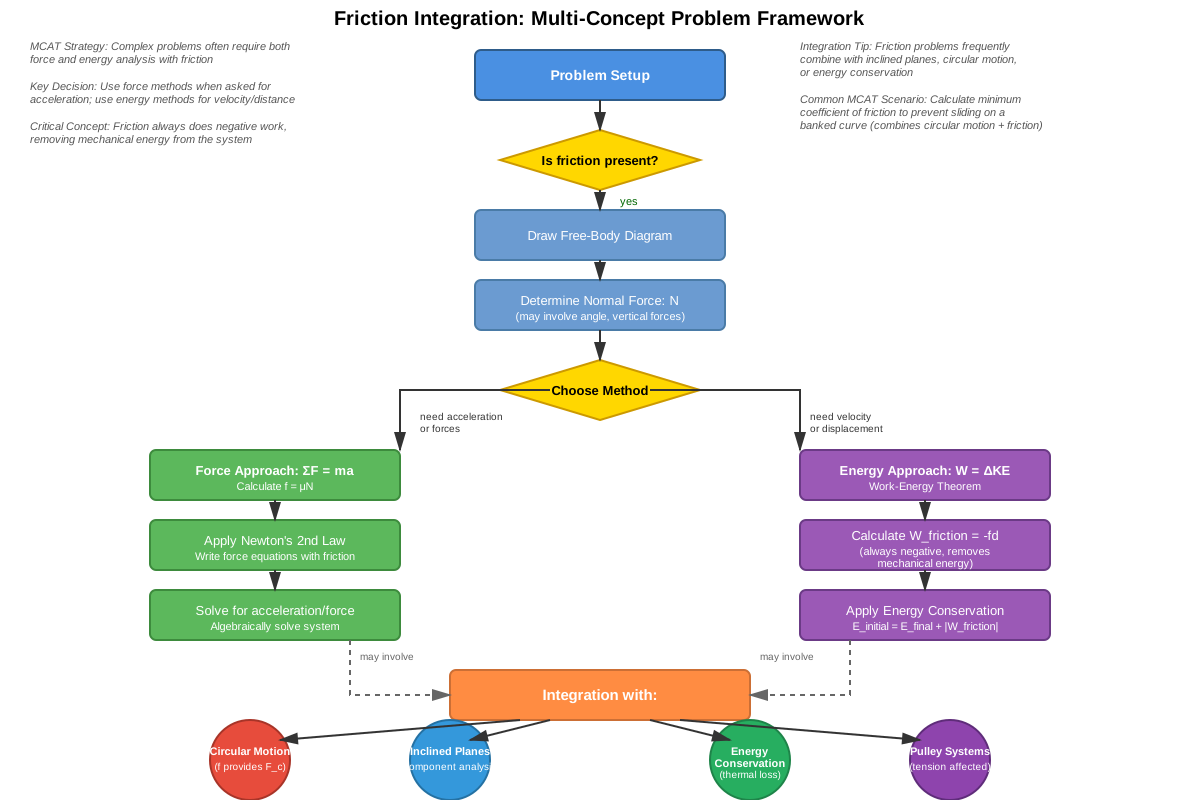
Friction is a fundamental force in Mechanics that opposes the relative motion between two surfaces in contact. This resistive force plays a critical role in countless physical scenarios, from a block sliding down an inclined plane to the biomechanics of joint movement in the human body. Understanding friction is essential for MCAT success because it appears frequently in both standalone questions and passage-based problems, often integrated with Newton's laws, energy conservation, and circular motion concepts. The MCAT tests not only computational skills involving friction but also conceptual understanding of when friction acts, in what direction, and how it affects system dynamics.
For the MCAT Physics section, friction represents a medium-difficulty topic that bridges pure theoretical mechanics with practical applications. Questions may present scenarios involving objects on surfaces, pulley systems with friction, or biological contexts such as blood flow resistance or joint articulation. The ability to correctly identify friction forces, distinguish between static and kinetic friction, and incorporate these forces into free-body diagrams and force equations is crucial for solving complex multi-step problems that commonly appear on test day.
Mastery of Friction Physics connects directly to broader concepts in mechanics including Newton's laws of motion, work and energy, momentum, and rotational dynamics. Friction often determines whether objects remain at rest or begin moving, affects the acceleration of systems, and converts mechanical energy into thermal energy. This topic serves as a practical application of force analysis and demonstrates how real-world constraints modify idealized physics scenarios, making it an excellent testing ground for critical thinking and problem-solving skills that the MCAT emphasizes.
Learning Objectives
- [ ] Define Friction using accurate Physics terminology
- [ ] Explain why Friction matters for the MCAT
- [ ] Apply Friction to exam-style questions
- [ ] Identify common mistakes related to Friction
- [ ] Connect Friction to related Physics concepts
- [ ] Distinguish between static and kinetic friction quantitatively and qualitatively
- [ ] Construct accurate free-body diagrams incorporating friction forces
- [ ] Calculate the coefficient of friction from experimental or problem data
- [ ] Predict the direction and magnitude of friction forces in multi-body systems
Prerequisites
- Newton's Laws of Motion: Friction forces must be incorporated into force balance equations using Newton's second law (F = ma)
- Free-Body Diagrams: Proper identification and representation of friction forces requires systematic diagramming skills
- Vector Components: Friction problems on inclined planes require decomposing forces into parallel and perpendicular components
- Normal Force Concept: The magnitude of friction depends directly on the normal force between surfaces
- Basic Trigonometry: Calculating components of forces on inclined surfaces requires sine and cosine functions
Why This Topic Matters
Friction appears in approximately 5-8% of MCAT Physics questions, making it a medium-yield topic that students cannot afford to ignore. The concept frequently appears in passage-based questions where experimental data about coefficients of friction must be interpreted, or in standalone questions testing conceptual understanding of when friction acts and how it affects motion. The MCAT particularly favors questions that combine friction with other mechanics concepts, such as calculating the minimum coefficient of static friction needed to prevent sliding on a banked curve or determining energy dissipation due to friction in a system.
From a clinical and real-world perspective, friction governs numerous biological and medical phenomena. Synovial fluid in joints reduces friction to prevent cartilage damage, making joint movement possible with minimal energy expenditure. Blood flow through vessels encounters frictional resistance that affects blood pressure and cardiovascular function. Physical therapy interventions often manipulate friction forces to facilitate or resist patient movement during rehabilitation. Understanding friction helps explain why certain prosthetic materials are chosen over others and why surgical instruments require specific surface treatments.
The MCAT commonly presents friction in several contexts: objects on horizontal or inclined surfaces (testing static versus kinetic friction), pulley systems where friction affects tension, circular motion scenarios where friction provides centripetal force, and energy problems where friction dissipates mechanical energy. Passages may describe experiments measuring coefficients of friction or present biological scenarios involving frictional forces in physiological systems. The ability to quickly identify the type of friction acting and set up correct equations distinguishes high-scoring students from those who struggle with mechanics.
Core Concepts
Definition and Nature of Friction
Friction is a contact force that opposes the relative motion or attempted motion between two surfaces in contact. Unlike gravitational or electromagnetic forces that can act at a distance, friction requires direct physical contact between objects. At the microscopic level, friction arises from electromagnetic interactions between atoms and molecules at the surface interface, along with mechanical interlocking of surface irregularities. The friction force always acts parallel to the contact surface and opposite to the direction of motion or intended motion.
The magnitude of friction depends on two primary factors: the nature of the surfaces in contact (characterized by the coefficient of friction) and the normal force pressing the surfaces together. Importantly, friction is generally independent of the contact area between surfaces and independent of the relative velocity for kinetic friction (though this is an approximation that breaks down at very high speeds). This counterintuitive independence from area explains why a block experiences the same friction whether resting on its large face or small edge, assuming the normal force remains constant.
Static Friction
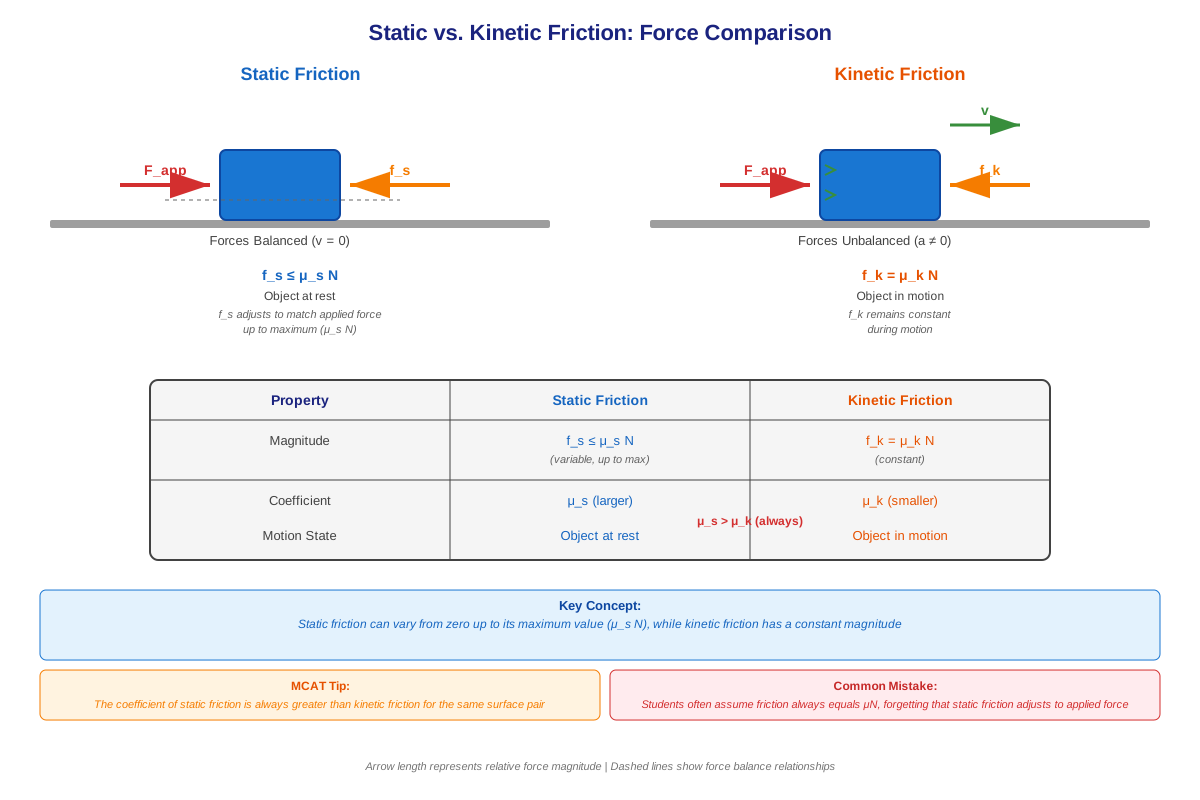
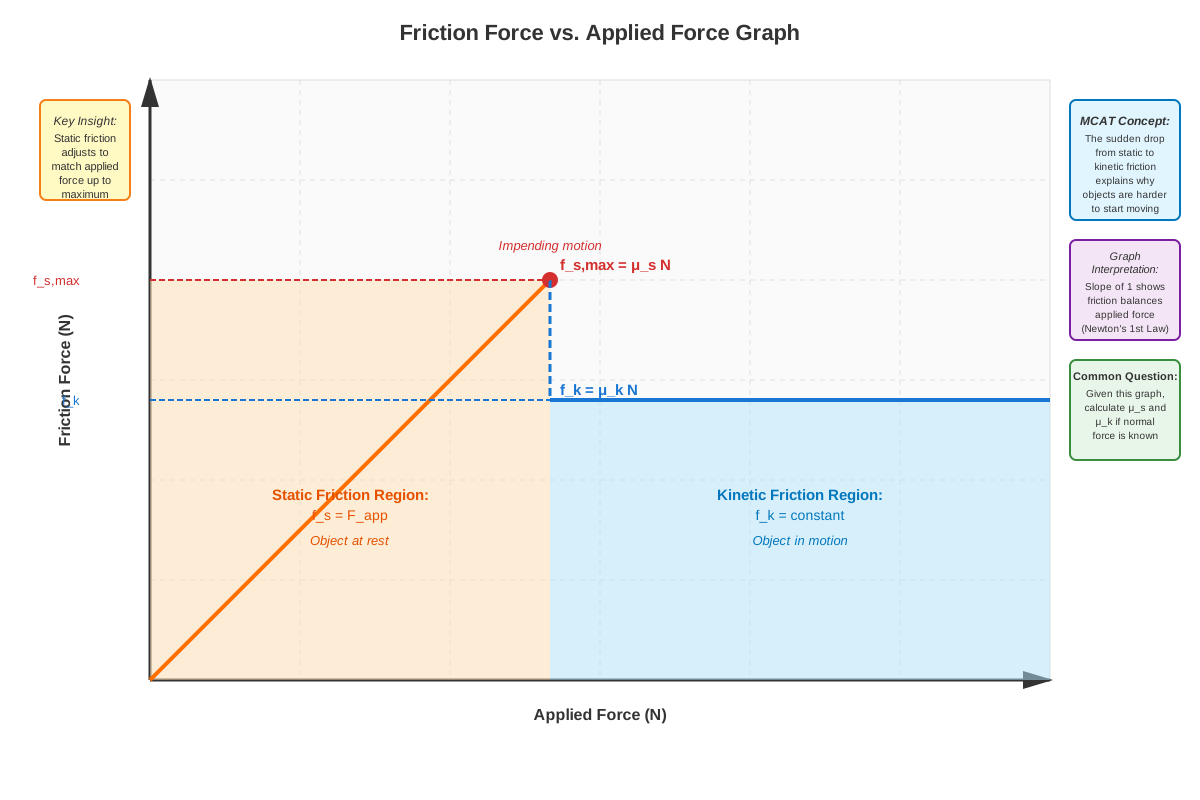
Static friction (f_s) is the frictional force that acts on objects at rest relative to each other, preventing motion from initiating. This force is self-adjusting, meaning it automatically matches the applied force up to a maximum value. When a small horizontal force is applied to a stationary block on a table, static friction increases to exactly balance that force, keeping the block at rest. As the applied force increases, static friction increases proportionally until reaching its maximum value.
The maximum static friction force is given by:
f_s,max = μ_s × NWhere μ_s is the coefficient of static friction (a dimensionless constant depending on the surface materials) and N is the normal force. The actual static friction force at any moment satisfies:
f_s ≤ μ_s × NThe inequality is crucial: static friction can be any value from zero up to the maximum, depending on what's needed to prevent motion. Once the applied force exceeds f_s,max, the object begins to move and kinetic friction takes over. The coefficient of static friction is typically larger than the coefficient of kinetic friction for the same material pair, meaning it's harder to start motion than to maintain it.
Kinetic Friction
Kinetic friction (f_k), also called dynamic friction, acts on objects that are sliding relative to each other. Unlike static friction, kinetic friction has a constant magnitude (for a given normal force) that doesn't depend on the applied force or the speed of motion (within typical speed ranges). The kinetic friction force is calculated as:
f_k = μ_k × NWhere μ_k is the coefficient of kinetic friction. The direction of kinetic friction always opposes the direction of relative motion. For example, if a block slides to the right across a table, kinetic friction acts to the left on the block (and to the right on the table, by Newton's third law).
The transition from static to kinetic friction explains common experiences: it requires more force to start pushing a heavy box than to keep it moving. Once motion begins, the friction force actually decreases from f_s,max to f_k, which can cause sudden acceleration if the applied force remains constant. This transition point is critical for MCAT problems asking about threshold conditions for motion.
Coefficients of Friction
The coefficient of friction (μ) is a dimensionless parameter characterizing the interaction between two specific materials. Values typically range from near 0 (very slippery, like ice on ice) to above 1 (very rough, like rubber on dry concrete). The coefficient depends on:
- Material composition of both surfaces
- Surface roughness and texture
- Presence of lubricants or contaminants
- Temperature (though usually assumed constant on the MCAT)
| Surface Pair | μ_s (Static) | μ_k (Kinetic) |
|---|---|---|
| Steel on steel | 0.74 | 0.57 |
| Wood on wood | 0.50 | 0.30 |
| Rubber on dry concrete | 1.00 | 0.80 |
| Ice on ice | 0.10 | 0.03 |
| Teflon on Teflon | 0.04 | 0.04 |
| Synovial joints | 0.01 | 0.003 |
Note that μ_s > μ_k for most material pairs, and both coefficients are independent of surface area and normal force. These values are not typically provided as memorization items for the MCAT, but understanding their relative magnitudes and the relationship between static and kinetic coefficients is essential.
Friction on Inclined Planes
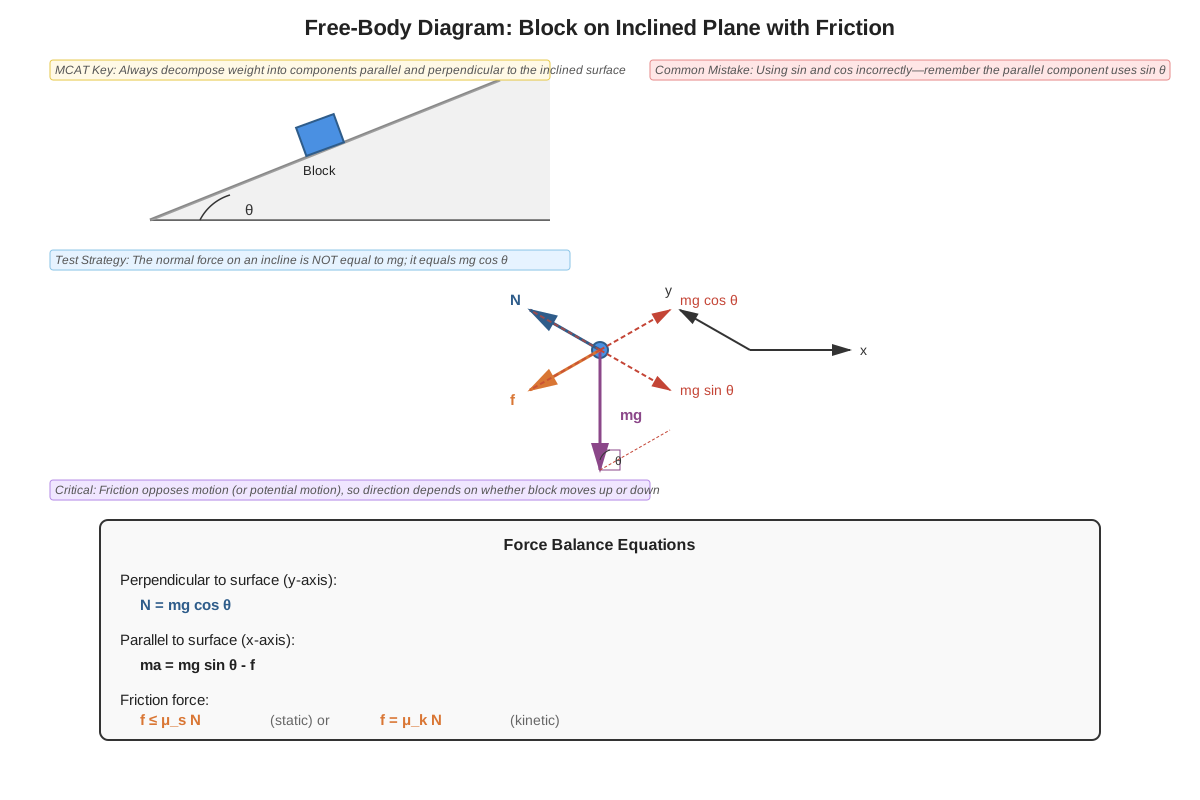
When an object rests on an inclined plane, friction acts parallel to the surface, opposing any tendency to slide down. The normal force on an incline equals the component of weight perpendicular to the surface (N = mg cos θ, where θ is the angle of inclination), not the full weight. The component of weight parallel to the surface (mg sin θ) attempts to pull the object down the incline.
For an object at rest on an incline, static friction must balance the parallel component of weight:
f_s = mg sin θ (when at rest)The object remains stationary as long as mg sin θ ≤ μ_s × mg cos θ, which simplifies to:
tan θ ≤ μ_sThis relationship reveals that the critical angle θ_c at which an object just begins to slide is given by tan θ_c = μ_s. This provides a practical method for measuring the coefficient of static friction: gradually increase the incline angle until the object starts sliding, then calculate μ_s = tan θ_c.
For an object sliding down an incline with kinetic friction, the net force parallel to the surface is:
F_net = mg sin θ - μ_k mg cos θ = maThis yields acceleration:
a = g(sin θ - μ_k cos θ)Friction and Energy
Friction is a non-conservative force, meaning it dissipates mechanical energy from a system, converting it to thermal energy. When an object slides a distance d against friction force f_k, the work done by friction is:
W_friction = -f_k × d = -μ_k N dThe negative sign indicates that friction removes energy from the system. This energy loss must be accounted for in energy conservation problems. The total mechanical energy (kinetic plus potential) decreases by exactly the amount of work done against friction:
ΔE_mechanical = W_frictionOr equivalently:
(KE_f + PE_f) = (KE_i + PE_i) - μ_k N dThis energy dissipation distinguishes friction problems from frictionless idealized scenarios and often provides an alternative solution method to force-based approaches.
Friction in Circular Motion
In circular motion scenarios, friction can provide the centripetal force necessary to maintain circular motion. For a car turning on a flat road, static friction between tires and road provides the inward force:
f_s = m v²/rThe maximum speed before skidding occurs when static friction reaches its maximum value:
μ_s N = m v²_max/rFor a car on a flat surface, N = mg, so:
v_max = √(μ_s g r)This relationship explains why cars can navigate curves at higher speeds on dry roads (high μ_s) than on icy roads (low μ_s), and why larger radius curves allow higher speeds. On banked curves, the normal force component can provide some centripetal force, reducing the required friction.
Concept Relationships
The concepts within friction form a hierarchical structure: the fundamental definition of friction as a contact force opposing motion leads to the distinction between static and kinetic friction, which differ in their mathematical descriptions and physical behaviors. Static friction (self-adjusting, up to a maximum) → transitions to → kinetic friction (constant magnitude) when the applied force exceeds the static friction threshold. Both types depend on the coefficient of friction and normal force, creating the relationship: surface properties + normal force → determine friction magnitude.
Friction connects intimately with Newton's laws: friction forces must be included in free-body diagrams and force summations (ΣF = ma), making Newton's second law the primary tool for solving friction problems. The normal force, which determines friction magnitude, is itself found by applying Newton's laws perpendicular to surfaces. This creates the relationship: Newton's laws → determine normal force → determines friction force → affects net force → determines acceleration.
Energy concepts provide an alternative framework: friction as a non-conservative force → dissipates mechanical energy → requires modified energy conservation equations. This connects friction to thermodynamics, as the "lost" mechanical energy becomes thermal energy, increasing the temperature of the surfaces. The work-energy theorem bridges force-based and energy-based approaches: work done against friction → equals change in mechanical energy.
Friction extends to rotational motion through the concept of torque: friction forces applied at a distance from a rotation axis create torques that can cause angular acceleration or prevent rotation. This connects linear friction concepts to rotational dynamics. In circular motion, friction provides centripetal force, linking friction to uniform circular motion and centripetal acceleration concepts.
Quick check — test yourself on Friction so far.
Try Flashcards →High-Yield Facts
⭐ Static friction is self-adjusting and can range from zero to μ_s × N, while kinetic friction has constant magnitude μ_k × N
⭐ The coefficient of static friction is typically greater than the coefficient of kinetic friction for the same material pair (μ_s > μ_k)
⭐ Friction force is independent of contact area and independent of velocity (for typical speeds)
⭐ The direction of friction always opposes relative motion or attempted motion between surfaces
⭐ On an inclined plane, the critical angle for sliding is given by tan θ_c = μ_s
- Friction depends on the normal force, not the weight (these differ on inclined planes or in accelerating systems)
- Maximum static friction represents the threshold between static and kinetic regimes
- Friction converts mechanical energy to thermal energy at a rate equal to f_k × v (power dissipation)
- In circular motion on a flat surface, the maximum speed is v_max = √(μ_s g r)
- Friction forces always act parallel to the contact surface, never perpendicular
- The work done by friction over distance d is W = -μ_k N d (negative because it opposes motion)
- Friction can act in the direction of motion (e.g., friction on a car's drive wheels propels the car forward)
- Rolling friction is typically much smaller than sliding friction, which is why wheels are advantageous
Common Misconceptions
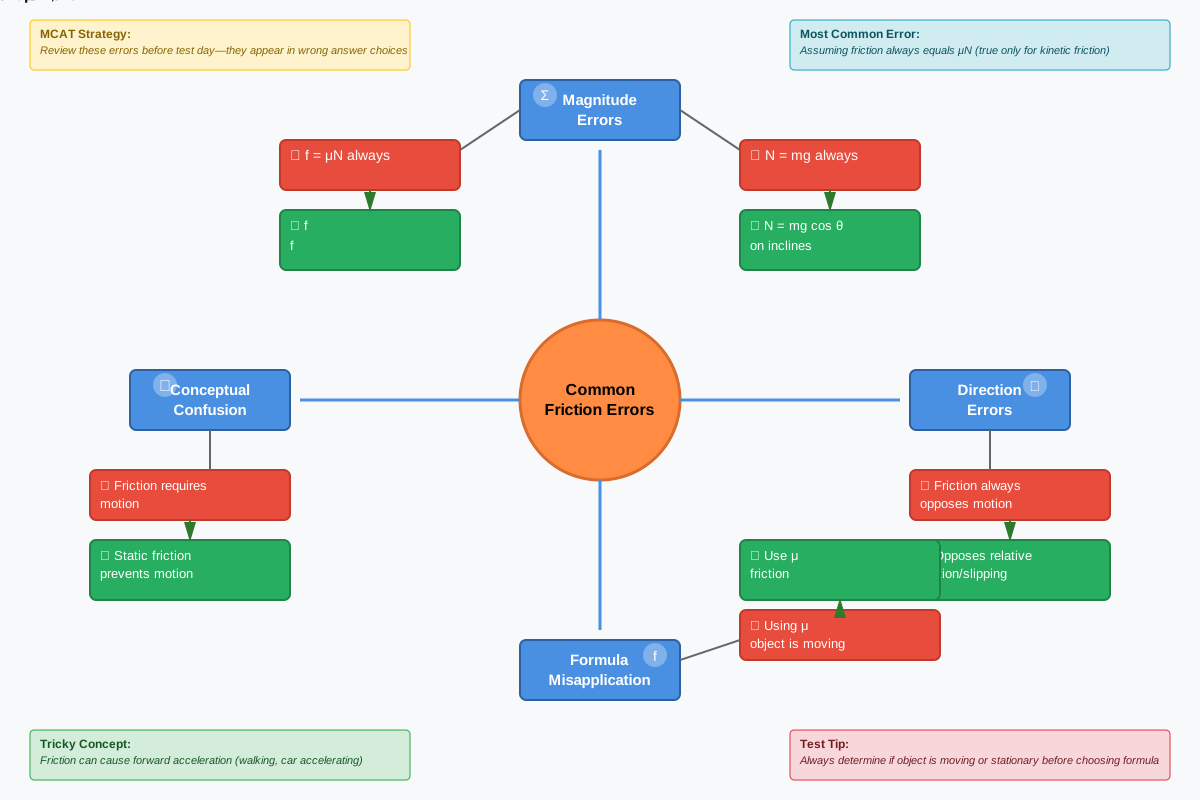
Misconception: Friction always opposes motion and acts backward on moving objects.
Correction: Friction opposes relative motion between surfaces. For a car accelerating forward, friction on the drive wheels acts forward (in the direction of motion) because the wheels would slip backward relative to the road without friction. Friction opposes the relative motion that would occur without it, not necessarily the motion of the object.
Misconception: Heavier objects always experience more friction force.
Correction: While heavier objects have larger normal forces and thus larger maximum friction forces, the actual friction force depends on what's needed to oppose motion (for static friction) or equals μ_k N (for kinetic friction). A heavy object at rest on a horizontal surface with no applied force experiences zero friction, despite its large weight.
Misconception: Friction force equals μN in all situations.
Correction: The equation f = μN gives the maximum static friction (f_s,max = μ_s N) or the kinetic friction when sliding occurs (f_k = μ_k N). The actual static friction force can be any value from zero up to this maximum, adjusting to match the applied force until the maximum is reached.
Misconception: Increasing the contact area between surfaces increases friction.
Correction: For solid surfaces, friction is independent of contact area. A block experiences the same friction whether resting on its large face or small edge (assuming the same normal force). This counterintuitive result occurs because although larger area provides more contact points, the force per unit area (pressure) decreases proportionally, leaving the total friction unchanged.
Misconception: Friction always decreases the acceleration of objects.
Correction: Friction can increase acceleration in certain scenarios. For a block on an accelerating truck bed, friction accelerates the block forward to match the truck's motion. For a car accelerating from rest, friction propels it forward. Friction opposes relative motion between surfaces, which may mean accelerating an object rather than decelerating it.
Misconception: The coefficient of friction can exceed 1.0, which seems impossible for a "coefficient."
Correction: Unlike many coefficients in physics that represent ratios of similar quantities, the coefficient of friction relates force parallel to a surface (friction) to force perpendicular to it (normal force). There's no physical constraint requiring μ < 1. Values above 1 simply mean the maximum friction force can exceed the normal force, which occurs for very rough surfaces like rubber on dry concrete.
Misconception: On an inclined plane, the normal force equals the weight (mg).
Correction: The normal force on an incline equals the component of weight perpendicular to the surface: N = mg cos θ, not mg. This reduced normal force means friction forces are smaller on inclines than on horizontal surfaces, which is why objects slide more easily on slopes.
Worked Examples
Example 1: Static Friction Threshold
Problem: A 5.0 kg wooden block rests on a horizontal wooden table (μ_s = 0.50, μ_k = 0.30). A horizontal force F is gradually increased from zero. (a) What is the maximum static friction force? (b) What applied force is required to just start the block moving? (c) If the applied force is 20 N, what is the actual friction force?
Solution:
(a) First, identify the normal force. On a horizontal surface with no vertical acceleration:
- ΣF_y = 0
- N - mg = 0
- N = mg = (5.0 kg)(10 m/s²) = 50 N
The maximum static friction is:
- f_s,max = μ_s N = (0.50)(50 N) = 25 N
(b) The block just starts moving when the applied force equals maximum static friction:
- F = f_s,max = 25 N
(c) Since the applied force (20 N) is less than f_s,max (25 N), the block remains stationary and static friction adjusts to balance the applied force:
- f_s = F = 20 N
The friction force equals the applied force, not the maximum possible static friction, because static friction is self-adjusting.
Key Concepts: This problem demonstrates that static friction varies from zero to its maximum value, distinguishes between maximum and actual static friction, and shows the importance of comparing applied forces to the static friction threshold.
Example 2: Inclined Plane with Friction
Problem: A 2.0 kg block is placed on an incline at angle θ = 30° to the horizontal. The coefficient of static friction is μ_s = 0.40 and kinetic friction is μ_k = 0.25. (a) Does the block remain at rest or slide down? (b) If it slides, what is its acceleration?
Solution:
(a) First, determine if the block remains at rest by comparing the parallel component of weight to maximum static friction.
Components of weight:
- Parallel to incline: mg sin θ = (2.0 kg)(10 m/s²)(sin 30°) = (20 N)(0.50) = 10 N
- Perpendicular to incline: mg cos θ = (2.0 kg)(10 m/s²)(cos 30°) = (20 N)(0.866) = 17.3 N
Normal force (perpendicular force balance):
- N = mg cos θ = 17.3 N
Maximum static friction:
- f_s,max = μ_s N = (0.40)(17.3 N) = 6.9 N
Since the parallel component of weight (10 N) exceeds maximum static friction (6.9 N), the block slides down.
(b) Once sliding, kinetic friction acts:
- f_k = μ_k N = (0.25)(17.3 N) = 4.3 N
Net force parallel to incline (taking down-slope as positive):
- ΣF = mg sin θ - f_k = 10 N - 4.3 N = 5.7 N
Acceleration:
- a = ΣF/m = 5.7 N / 2.0 kg = 2.85 m/s² down the incline
Alternatively, using the formula a = g(sin θ - μ_k cos θ):
- a = (10 m/s²)[sin 30° - (0.25)(cos 30°)]
- a = (10 m/s²)[0.50 - (0.25)(0.866)]
- a = (10 m/s²)[0.50 - 0.217] = 2.83 m/s² (slight difference due to rounding)
Key Concepts: This problem requires comparing forces to determine if motion occurs, properly identifying normal force on an incline, and applying Newton's second law with both gravitational and friction components.
Example 3: Friction and Energy
Problem: A 3.0 kg block slides across a horizontal floor with initial speed 8.0 m/s and comes to rest after traveling 10 m. What is the coefficient of kinetic friction between block and floor?
Solution:
Method 1 (Energy approach):
Initial kinetic energy:
- KE_i = ½mv² = ½(3.0 kg)(8.0 m/s)² = 96 J
Final kinetic energy:
- KE_f = 0 J (at rest)
Work done by friction:
- W_friction = ΔKE = KE_f - KE_i = 0 - 96 J = -96 J
But also:
- W_friction = -f_k × d = -μ_k N d = -μ_k mg d
Setting these equal:
- -μ_k mg d = -96 J
- μ_k (3.0 kg)(10 m/s²)(10 m) = 96 J
- μ_k (300 N·m) = 96 J
- μ_k = 96/300 = 0.32
Method 2 (Kinematics and forces):
Using kinematics to find acceleration:
- v² = v₀² + 2ad
- 0 = (8.0 m/s)² + 2a(10 m)
- a = -64/20 = -3.2 m/s²
The negative acceleration is caused by friction:
- ΣF = ma
- -f_k = ma
- -μ_k mg = ma
- μ_k = -a/g = -(-3.2 m/s²)/(10 m/s²) = 0.32
Key Concepts: This problem demonstrates two equivalent approaches (energy and force-based), shows how friction dissipates kinetic energy, and illustrates determining coefficients from experimental data—a common MCAT scenario.
Exam Strategy
When approaching Friction MCAT questions, begin by identifying whether the object is at rest (static friction) or moving (kinetic friction). This fundamental distinction determines which equations apply. For static situations, remember that friction is self-adjusting up to a maximum, so check whether the applied force exceeds f_s,max before assuming motion occurs. Many incorrect answer choices exploit the misconception that static friction always equals μ_s N.
Trigger words to watch for include "just begins to move" (indicating maximum static friction), "slides" or "moving" (kinetic friction), "at rest" (static friction, possibly less than maximum), and "coefficient of friction" (signals you'll need to use μ in calculations). Phrases like "frictionless surface" or "negligible friction" tell you to ignore friction entirely, simplifying the problem significantly.
For inclined plane problems, immediately draw a tilted coordinate system aligned with the plane (x-axis parallel to surface, y-axis perpendicular). This choice makes force components simpler: weight has components mg sin θ (parallel) and mg cos θ (perpendicular), while friction and normal force align with axes. Students who use horizontal/vertical coordinates make the problem unnecessarily complex.
Process-of-elimination strategies: eliminate answers where friction acts perpendicular to surfaces (friction is always parallel), where friction acts in the direction of relative motion (it opposes relative motion), or where friction depends on surface area or speed (usually independent of both). If a question asks for maximum speed in circular motion and an answer doesn't include the coefficient of friction, eliminate it—friction provides the centripetal force.
Time allocation: straightforward friction problems (finding friction force given μ and N) should take 30-45 seconds. Multi-step problems involving inclines or energy typically require 60-90 seconds. If a problem seems to require more than 2 minutes, look for a conceptual shortcut or alternative approach. Energy methods often provide faster solutions than force-based approaches when distances are given.
For passage-based questions, carefully note whether the passage provides coefficients of friction, describes experimental methods for measuring them, or presents data tables. Often the passage contains information that eliminates the need for complex calculations. Watch for graphs showing friction force versus applied force—the slope of the linear region gives the coefficient of friction.
Memory Techniques
Mnemonic for friction direction: "Friction Fights Future motion" - Friction opposes the relative motion that would occur without it, not necessarily the current motion.
Mnemonic for coefficient relationship: "Static Starts Stronger" - The coefficient of static friction (μ_s) is greater than kinetic (μ_k), meaning it's harder to start motion than maintain it.
Visualization for static friction: Picture static friction as a variable-strength spring that stretches as you push, providing increasing resistance up to a breaking point (f_s,max). Once it "breaks," it becomes kinetic friction with constant resistance. This mental model captures the self-adjusting nature of static friction.
Acronym for inclined plane components: "PANS" - Parallel component uses Sine (mg sin θ), Perpendicular (Normal) uses Cosine (mg cos θ). The "A" reminds you these are components of weight, and "N" reminds you the perpendicular component equals the Normal force.
Memory aid for friction independence: "NAAS" - Friction is Not Affected by Area or Speed (in typical conditions). This counterintuitive fact appears frequently on the MCAT.
Conceptual anchor for energy: Remember that friction is the "energy thief" - it always removes mechanical energy from a system, converting it to heat. If mechanical energy increases in a problem, friction cannot be responsible. This helps eliminate wrong answers quickly.
Summary
Friction is a contact force opposing relative motion between surfaces, manifesting as static friction (self-adjusting up to μ_s N) for stationary objects and kinetic friction (constant at μ_k N) for sliding objects. The coefficient of static friction exceeds the coefficient of kinetic friction for most material pairs, explaining why initiating motion requires more force than maintaining it. Friction forces depend on the normal force and surface properties but are independent of contact area and velocity under typical conditions. On inclined planes, the normal force equals mg cos θ, reducing friction compared to horizontal surfaces and creating a critical angle (tan θ_c = μ_s) at which objects begin sliding. As a non-conservative force, friction dissipates mechanical energy at a rate of f_k × d, requiring modified energy conservation equations. In circular motion, friction can provide centripetal force with maximum speed v_max = √(μ_s g r). Mastery requires distinguishing friction types, constructing accurate free-body diagrams, applying Newton's laws with friction components, and recognizing when energy methods provide more efficient solutions than force-based approaches.
Key Takeaways
- Static friction is self-adjusting (0 ≤ f_s ≤ μ_s N) while kinetic friction is constant (f_k = μ_k N), with μ_s > μ_k for most surfaces
- Friction always acts parallel to contact surfaces and opposes relative motion between surfaces, not necessarily opposing the object's motion
- Friction is independent of contact area and velocity (for typical speeds), depending only on the coefficient of friction and normal force
- On inclined planes, use N = mg cos θ and recognize that the critical sliding angle satisfies tan θ_c = μ_s
- Friction dissipates mechanical energy as thermal energy, requiring energy conservation equations to include the work term W_friction = -μ_k N d
- In circular motion problems, friction provides centripetal force, limiting maximum speed to v_max = √(μ_s g r) on flat surfaces
- Always draw free-body diagrams with friction parallel to surfaces and check whether static friction reaches its maximum before assuming motion occurs
Related Topics
Newton's Laws of Motion: Friction forces must be incorporated into force summations and free-body diagrams when applying F = ma. Mastering friction deepens understanding of how real forces affect motion beyond idealized frictionless scenarios.
Work and Energy: Friction as a non-conservative force introduces energy dissipation into mechanical systems, connecting to thermodynamics and distinguishing conservative from non-conservative forces in energy conservation problems.
Inclined Planes and Force Components: Friction problems on inclines require decomposing weight into components, reinforcing vector analysis skills and connecting to projectile motion and other component-based problems.
Circular Motion: Friction providing centripetal force links linear friction concepts to rotational dynamics, banked curves, and uniform circular motion—topics that frequently appear together on the MCAT.
Rotational Dynamics: Friction forces applied at distances from rotation axes create torques, extending friction concepts to angular acceleration, rolling motion, and rotational equilibrium problems.
Practice CTA
Now that you've mastered the core concepts of friction, it's time to solidify your understanding through active practice. Work through the practice questions to test your ability to apply friction concepts in various contexts, from straightforward calculations to complex multi-step problems. Use the flashcards to reinforce high-yield facts and relationships, ensuring rapid recall on test day. Remember, friction appears in approximately 5-8% of MCAT Physics questions—your investment in mastering this topic will pay dividends across multiple questions on exam day. Approach each practice problem systematically: identify the friction type, draw a free-body diagram, and choose between force-based and energy-based approaches. You've got this!
Sign up free to keep reading
Create a free AnvayaPrep account to finish this MCAT guide on Friction — plus flashcards and practice questions.