Overview
Inclined planes represent one of the fundamental applications of Newtonian mechanics that appears consistently on the MCAT. An inclined plane is a flat surface tilted at an angle to the horizontal, and understanding how forces act on objects placed on such surfaces is essential for mastering mechanics concepts tested on the exam. The physics of inclined planes requires students to decompose forces into components, apply Newton's laws in rotated coordinate systems, and analyze the interplay between gravitational force, normal force, and friction.
The importance of inclined planes for the MCAT extends beyond simple force calculations. This topic serves as a bridge connecting multiple high-yield concepts including vector decomposition, Newton's laws, work and energy, and friction. Questions involving inclined planes frequently appear in both discrete questions and passage-based formats, often embedded within biomechanical contexts such as analyzing muscle forces during movement on slopes, understanding wheelchair ramps in accessibility contexts, or examining the mechanics of surgical tables. Mastery of this topic demonstrates a student's ability to apply fundamental physics principles to complex, real-world scenarios.
Within the broader framework of Physics tested on the MCAT, inclined planes exemplify how coordinate system selection and vector analysis enable problem-solving in non-standard orientations. This topic reinforces the principle that physical laws remain constant regardless of reference frame, while the mathematical representation adapts to simplify calculations. Students who thoroughly understand inclined plane mechanics develop transferable skills applicable to rotational motion, projectile motion, and other scenarios requiring strategic coordinate system choices.
Learning Objectives
- [ ] Define inclined planes using accurate Physics terminology
- [ ] Explain why inclined planes matters for the MCAT
- [ ] Apply inclined planes to exam-style questions
- [ ] Identify common mistakes related to inclined planes
- [ ] Connect inclined planes to related Physics concepts
- [ ] Decompose gravitational force into components parallel and perpendicular to an inclined surface
- [ ] Calculate the acceleration of objects on frictionless and friction-containing inclined planes
- [ ] Determine the minimum coefficient of friction required to prevent sliding on an incline
- [ ] Apply energy conservation principles to solve inclined plane problems efficiently
Prerequisites
- Vector addition and decomposition: Essential for breaking gravitational force into components along and perpendicular to the inclined surface
- Newton's three laws of motion: Foundation for analyzing forces and predicting motion on inclined planes
- Free body diagrams: Critical skill for visualizing all forces acting on an object in the inclined plane system
- Trigonometric functions (sine, cosine, tangent): Required for calculating force components based on the angle of inclination
- Friction concepts (static and kinetic): Necessary for analyzing realistic scenarios where surfaces resist motion
- Work and energy principles: Enables alternative solution methods using conservation of energy rather than force analysis
Why This Topic Matters
Inclined plane problems appear on the MCAT with moderate frequency, typically comprising 1-3 questions per exam either as discrete items or embedded within passages. These questions test fundamental mechanics understanding while requiring multi-step problem-solving that distinguishes high-scoring students from average performers. The MCAT particularly favors inclined plane scenarios because they efficiently assess multiple competencies: vector decomposition, force analysis, friction application, and energy conservation.
From a clinical and real-world perspective, inclined planes model numerous biomechanical situations relevant to medicine. Physical therapists design rehabilitation protocols considering the forces patients experience when walking on inclined surfaces. Orthopedic surgeons must understand the stress distribution on joints during activities involving slopes. Accessibility standards for medical facilities incorporate inclined plane physics to ensure safe ramp angles for patients with mobility limitations. Emergency medicine scenarios involving vehicle accidents on hills require understanding of the forces that contributed to the incident.
In MCAT passages, inclined planes commonly appear in contexts such as: biomechanical analysis of gait on slopes, experimental apparatus involving sliding blocks or carts, analysis of transportation systems (conveyor belts, ramps), and sports medicine scenarios examining forces during skiing or cycling. The topic frequently connects to other testable concepts including pulley systems, conservation of energy, and circular motion, making it a high-yield area for integrated problem-solving.
Core Concepts
Definition and Geometry of Inclined Planes
An inclined plane is a flat supporting surface positioned at an angle θ (theta) relative to the horizontal ground. This simple machine reduces the force required to elevate an object by increasing the distance over which the force acts. The angle of inclination θ is measured from the horizontal surface to the inclined surface, ranging from 0° (flat ground) to 90° (vertical wall). The length of the inclined surface is the hypotenuse of the right triangle formed, while the height represents the vertical rise.
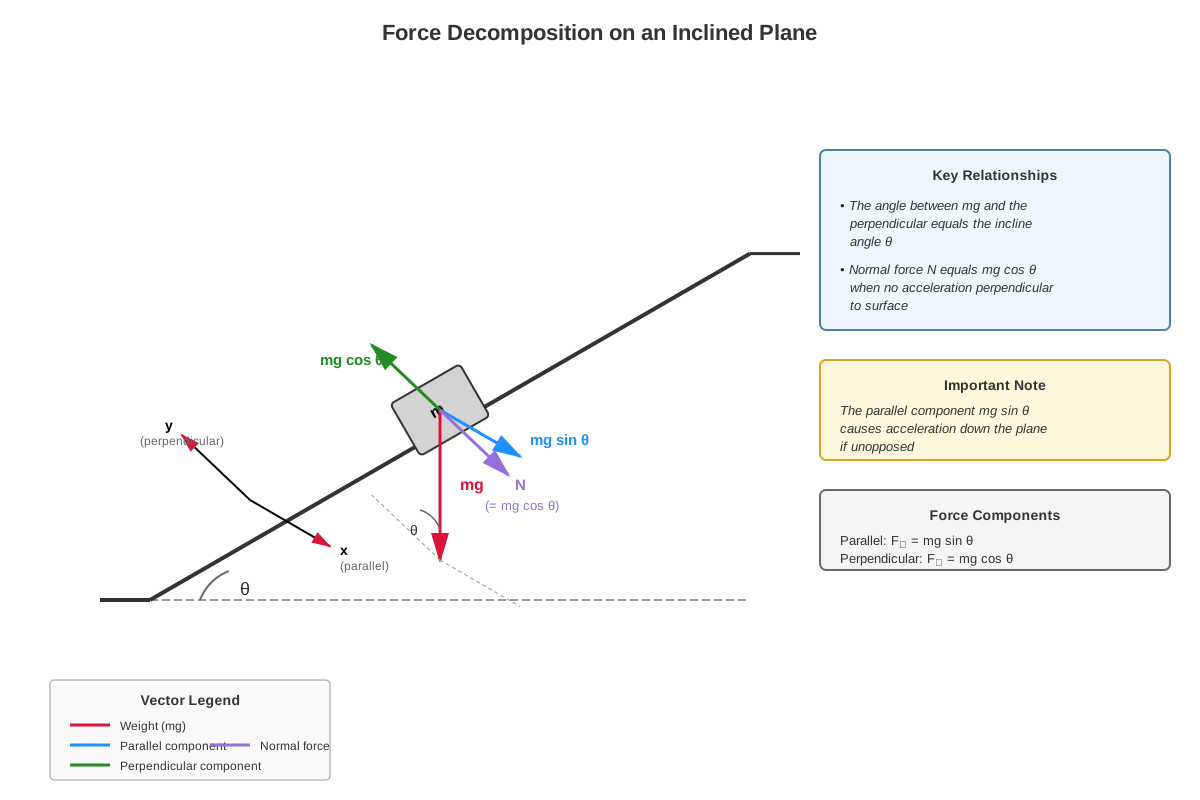
The coordinate system for analyzing inclined planes typically rotates to align one axis parallel to the surface (x-axis) and the other perpendicular to the surface (y-axis). This strategic choice simplifies calculations because motion, when it occurs, happens along the inclined surface rather than at an angle to it. Understanding this rotated reference frame is crucial for MCAT success, as it demonstrates conceptual flexibility in applying Newton's laws.
Force Decomposition on Inclined Planes
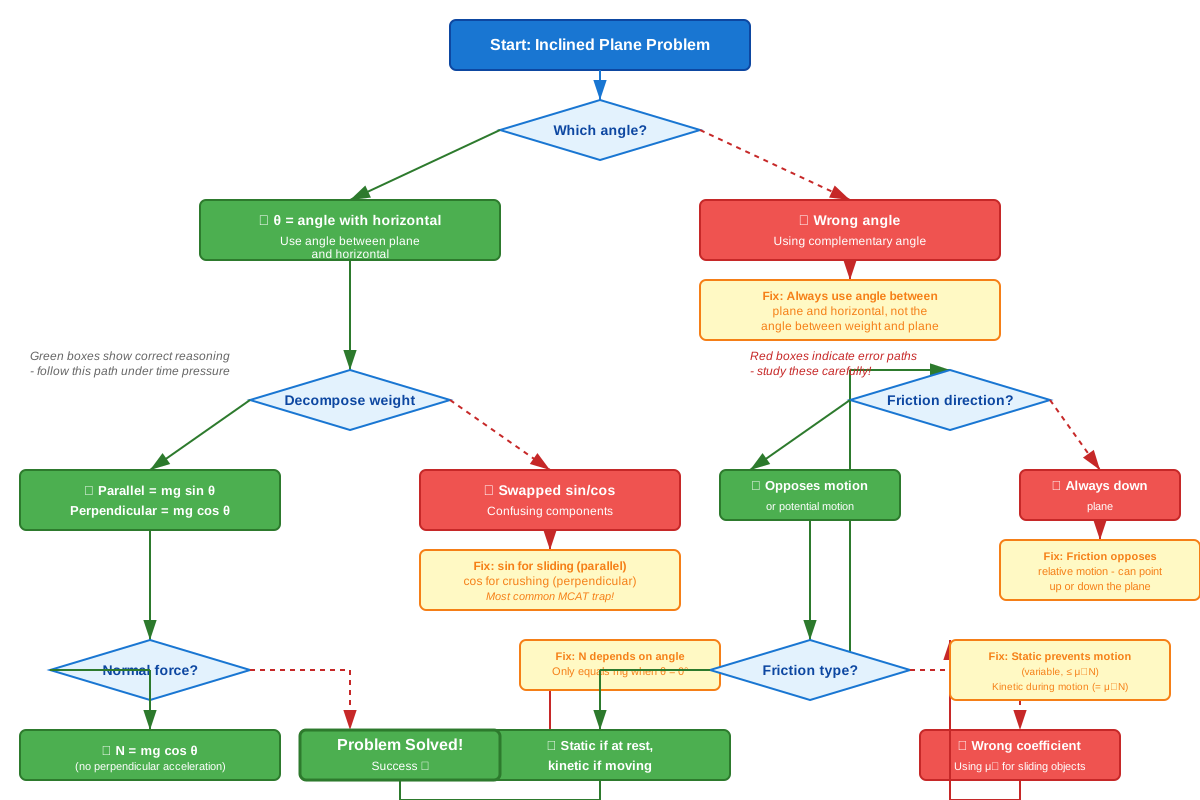
The gravitational force acting on an object of mass m on an inclined plane is F_gravity = mg, directed vertically downward toward Earth's center. This force must be decomposed into two components relative to the inclined surface:
- Parallel component (F_parallel): The component of gravitational force acting down the slope, calculated as F_parallel = mg sin θ
- Perpendicular component (F_perpendicular): The component of gravitational force pressing into the surface, calculated as F_perpendicular = mg cos θ
The trigonometric relationships derive from the geometry of the force triangle. When the incline angle θ is measured from the horizontal, the angle between the gravitational force vector and the perpendicular-to-surface direction also equals θ. This geometric relationship is frequently tested and commonly confused by students who incorrectly swap sine and cosine functions.
Normal Force on Inclined Planes
The normal force (F_N) is the contact force exerted by the surface perpendicular to its plane. On an inclined plane without additional vertical forces, the normal force equals the perpendicular component of gravity: F_N = mg cos θ. This differs from horizontal surfaces where F_N = mg. The normal force decreases as the angle of inclination increases, reaching zero at θ = 90° (vertical surface where contact would be lost).
The normal force is critical for calculating frictional forces, as friction depends on the normal force magnitude. Understanding that normal force varies with incline angle is essential for predicting when objects will slide or remain stationary on slopes of different steepness.
Friction on Inclined Planes
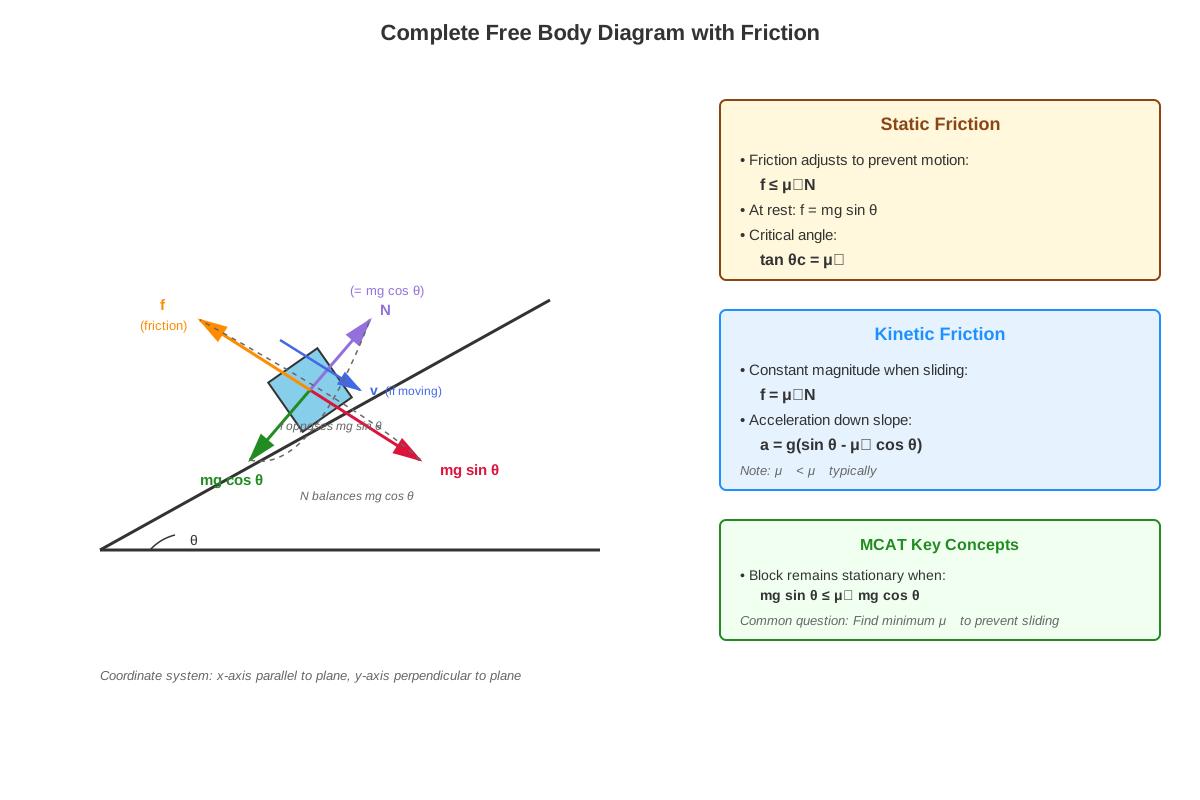
Friction opposes motion or potential motion along the inclined surface. Two types of friction apply:
- Static friction (f_s): Prevents motion when the object is at rest; ranges from zero up to a maximum value f_s,max = μ_s F_N, where μ_s is the coefficient of static friction
- Kinetic friction (f_k): Opposes motion when the object is sliding; has constant magnitude f_k = μ_k F_N, where μ_k is the coefficient of kinetic friction
For an object to remain stationary on an incline, static friction must balance the parallel component of gravity: f_s = mg sin θ. This is possible only when mg sin θ ≤ μ_s mg cos θ, which simplifies to tan θ ≤ μ_s. This relationship defines the critical angle: the maximum incline angle at which an object remains stationary.
Motion Analysis: Frictionless Inclined Planes
On a frictionless inclined plane, only two forces act on an object: gravitational force (decomposed into components) and normal force. Applying Newton's second law parallel to the surface:
ΣF_parallel = ma
mg sin θ = ma
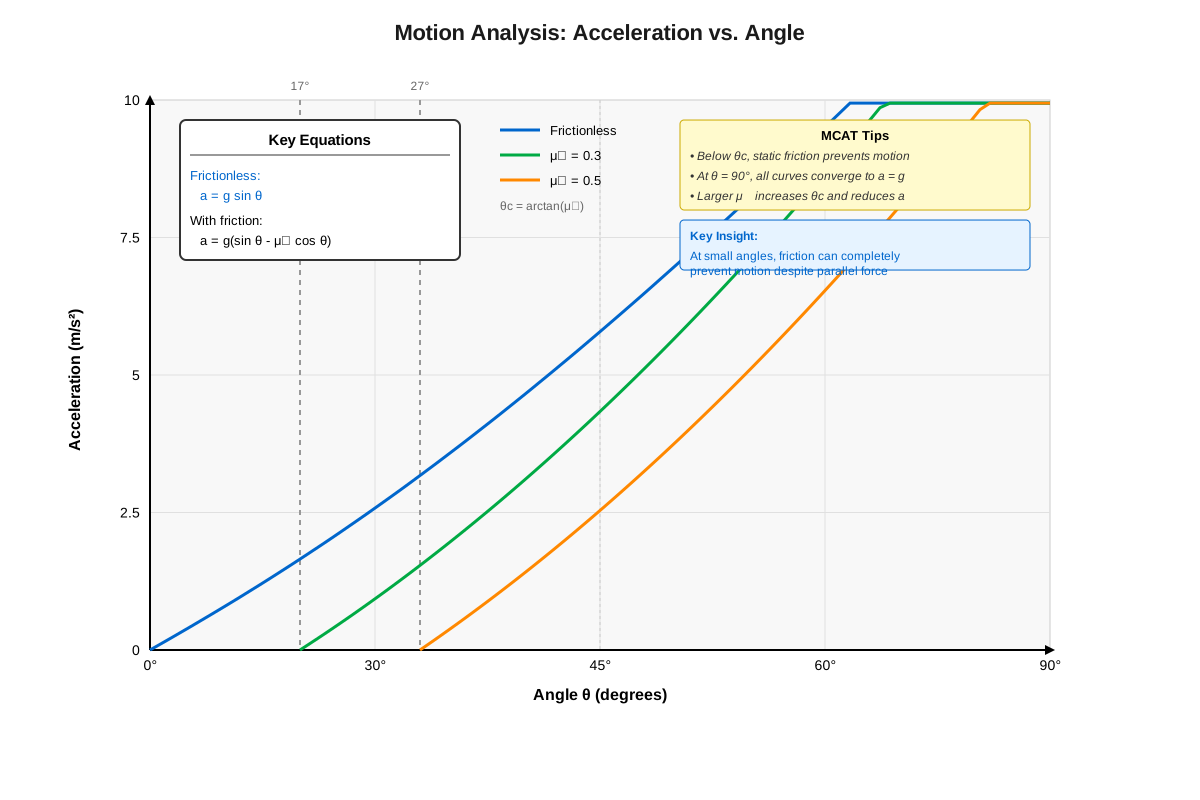
a = g sin θ
The acceleration down a frictionless incline depends only on the gravitational acceleration g and the angle θ, independent of the object's mass. This counterintuitive result—that all objects accelerate identically down a frictionless incline regardless of mass—parallels Galileo's famous demonstration that objects fall at the same rate in vacuum.
Motion Analysis: Inclined Planes with Friction
When friction is present, the net force parallel to the surface must account for the frictional force opposing motion:
ΣF_parallel = ma
mg sin θ - f_k = ma
mg sin θ - μ_k mg cos θ = ma
a = g(sin θ - μ_k cos θ)
The acceleration is reduced compared to the frictionless case. If sin θ < μ_k cos θ, the acceleration becomes negative, indicating the object would decelerate if already moving, or remain stationary if initially at rest.
Energy Approach to Inclined Plane Problems
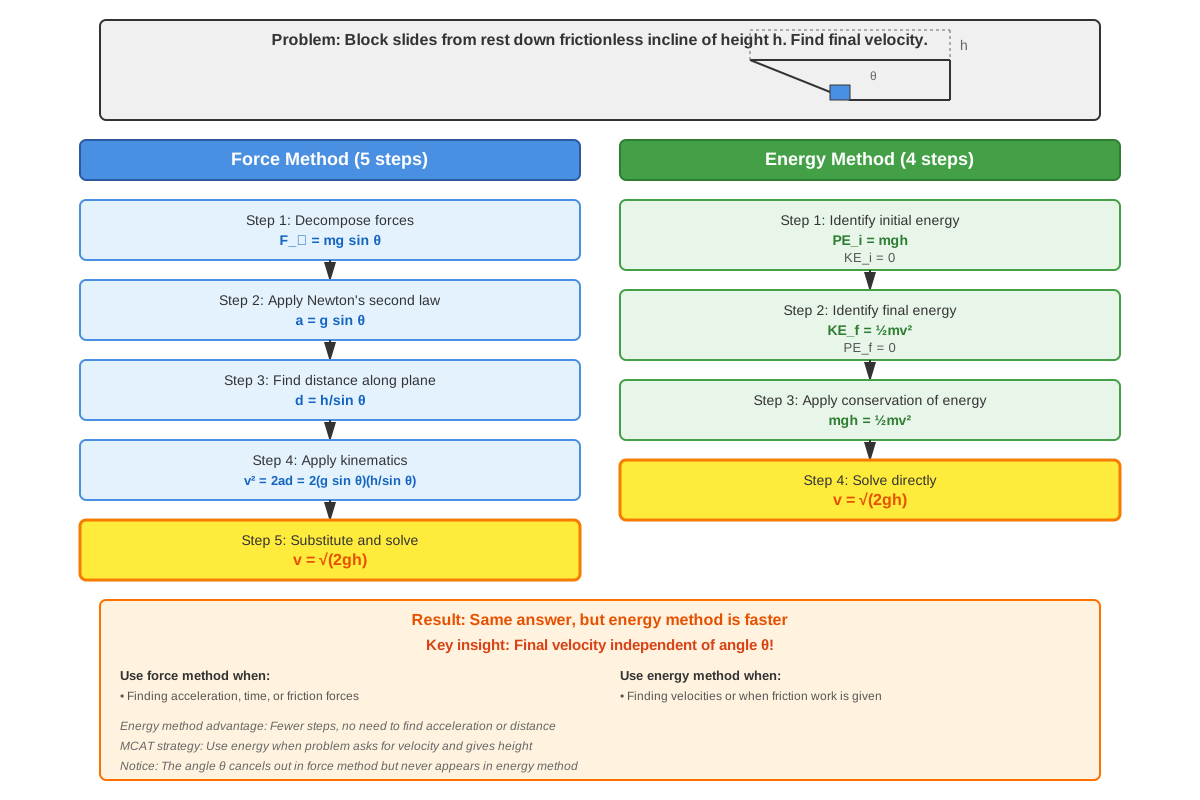
Conservation of energy provides an alternative, often more efficient method for solving inclined plane problems. For an object sliding down an incline from height h:
Initial energy: E_i = mgh (gravitational potential energy)
Final energy: E_f = (1/2)mv² (kinetic energy)
Without friction: mgh = (1/2)mv², yielding v = √(2gh)
With friction: mgh = (1/2)mv² + W_friction, where W_friction = f_k × d = μ_k mg cos θ × (h/sin θ)
The energy method is particularly valuable when the question asks for final velocity rather than acceleration, or when the path involves varying angles.
Comparison Table: Key Relationships
| Scenario | Normal Force | Net Force Parallel | Acceleration | Condition for Motion |
|---|---|---|---|---|
| Frictionless incline | mg cos θ | mg sin θ | g sin θ | Always slides (θ > 0°) |
| Static friction, at rest | mg cos θ | 0 | 0 | tan θ ≤ μ_s |
| Kinetic friction, sliding | mg cos θ | mg sin θ - μ_k mg cos θ | g(sin θ - μ_k cos θ) | tan θ > μ_k |
| Critical angle | mg cos θ | mg sin θ = μ_s mg cos θ | 0 | tan θ = μ_s |
Concept Relationships
The physics of inclined planes integrates multiple foundational mechanics concepts into a unified framework. Vector decomposition serves as the entry point, enabling the transformation of gravitational force into components aligned with the chosen coordinate system. This decomposition directly feeds into Newton's second law application, where the sum of forces in each direction determines the object's acceleration.
Friction concepts build upon the normal force calculation, creating a dependent relationship: F_N = mg cos θ → f = μF_N. This chain demonstrates how geometric factors (angle θ) influence force magnitudes through trigonometric relationships, which then determine whether motion occurs. The critical angle concept emerges from setting the parallel gravitational component equal to maximum static friction, representing the boundary condition between static and kinetic scenarios.
The relationship map flows as follows:
Incline angle θ → Force decomposition (mg sin θ, mg cos θ) → Normal force calculation → Friction force determination → Net force analysis → Acceleration prediction → Kinematics application → Final state determination
Alternatively, the energy pathway provides: Initial height h → Gravitational potential energy (mgh) → Energy transformation → Work done by friction → Final kinetic energy → Final velocity
These parallel approaches (force-based and energy-based) connect to broader physics principles: the force method links to dynamics and kinematics, while the energy method connects to thermodynamics (energy dissipation through friction) and conservation laws. Understanding both pathways and recognizing when each is more efficient represents advanced mastery essential for MCAT success.
Quick check — test yourself on Inclined planes so far.
Try Flashcards →High-Yield Facts
⭐ The parallel component of gravitational force on an incline is F_parallel = mg sin θ, while the perpendicular component is F_perpendicular = mg cos θ
⭐ The normal force on an incline equals mg cos θ, not mg, and decreases as the angle increases
⭐ Acceleration down a frictionless incline is a = g sin θ, independent of the object's mass
⭐ The critical angle for an object to remain stationary satisfies tan θ = μ_s, where μ_s is the coefficient of static friction
⭐ With kinetic friction, acceleration down an incline is a = g(sin θ - μ_k cos θ)
- At θ = 0° (horizontal surface), sin θ = 0 and cos θ = 1, recovering standard horizontal surface equations
- At θ = 90° (vertical surface), sin θ = 1 and cos θ = 0, recovering free fall with a = g
- The work done by gravity moving an object down an incline depends only on the vertical height change, not the path length
- Friction always opposes the direction of motion (or potential motion), acting up the incline when an object slides down
- Two objects with different masses but identical friction coefficients will have the same acceleration down an incline
- The mechanical advantage of an inclined plane is the ratio of the length of the slope to its height, reducing required force at the cost of increased distance
Common Misconceptions
Misconception: The normal force always equals mg.
Correction: The normal force equals mg only on horizontal surfaces. On an incline, F_N = mg cos θ, which is always less than mg for any angle greater than 0°. The normal force represents only the component of gravitational force perpendicular to the surface.
Misconception: Heavier objects accelerate faster down inclined planes.
Correction: On frictionless inclines, all objects accelerate at a = g sin θ regardless of mass. Even with friction, a = g(sin θ - μ_k cos θ) is independent of mass because both gravitational force and friction are proportional to mass, causing mass to cancel in the acceleration equation.
Misconception: The parallel component of gravity is mg cos θ and the perpendicular component is mg sin θ.
Correction: This reverses the correct relationships. The parallel component (along the slope) is mg sin θ, and the perpendicular component (into the surface) is mg cos θ. Remember that as angle increases, the parallel component should increase (sin θ increases) while the perpendicular component decreases (cos θ decreases).
Misconception: Friction always equals μF_N.
Correction: This equation gives the magnitude of kinetic friction or the maximum static friction. Actual static friction adjusts to match the applied force up to this maximum value. An object at rest on an incline experiences static friction equal to mg sin θ (if this is less than μ_s mg cos θ), not necessarily the maximum possible static friction.
Misconception: The angle in force decomposition is always the incline angle θ.
Correction: While the incline angle θ appears in the force component equations, the geometric angle between the gravitational force vector and the perpendicular-to-surface direction happens to equal θ due to complementary angles in the force triangle. Understanding the geometry prevents errors when dealing with additional forces or modified scenarios.
Misconception: Energy methods and force methods always give different answers.
Correction: Both approaches are valid and must yield identical results when applied correctly. Energy methods are often more efficient for finding final velocities, while force methods are necessary for determining accelerations or forces at specific moments. Choosing the appropriate method improves problem-solving efficiency.
Worked Examples
Example 1: Determining Minimum Coefficient of Static Friction
Problem: A 5.0 kg block rests on an inclined plane at an angle of 30° above the horizontal. What is the minimum coefficient of static friction required to prevent the block from sliding?
Solution:
Step 1: Identify the condition for static equilibrium. The block remains stationary when static friction balances the parallel component of gravity:
f_s = mg sin θ
Step 2: Recognize that the maximum static friction is:
f_s,max = μ_s F_N = μ_s mg cos θ
Step 3: For the block to remain stationary, the required friction must not exceed the maximum:
mg sin θ ≤ μ_s mg cos θ
Step 4: Simplify by dividing both sides by mg cos θ:
tan θ ≤ μ_s
Step 5: Calculate the minimum coefficient:
μ_s,min = tan 30° = 0.577
Answer: The minimum coefficient of static friction is 0.577 (or approximately 0.58).
Key insight: Notice that the mass canceled out completely, demonstrating that the critical angle and minimum friction coefficient are independent of the object's mass. This problem directly tests the high-yield relationship tan θ = μ_s at the critical angle.
Example 2: Calculating Velocity Using Energy Conservation
Problem: A 2.0 kg block slides from rest down a 5.0 m long inclined plane that makes a 37° angle with the horizontal. The coefficient of kinetic friction between the block and plane is 0.20. What is the block's velocity at the bottom of the incline?
Solution:
Step 1: Determine the vertical height using trigonometry:
h = L sin θ = 5.0 m × sin 37° = 5.0 m × 0.60 = 3.0 m
Step 2: Calculate initial gravitational potential energy:
PE_i = mgh = 2.0 kg × 10 m/s² × 3.0 m = 60 J
Step 3: Calculate work done by friction. First find the normal force:
F_N = mg cos θ = 2.0 kg × 10 m/s² × cos 37° = 2.0 × 10 × 0.80 = 16 N
Step 4: Calculate friction force and work done by friction:
f_k = μ_k F_N = 0.20 × 16 N = 3.2 N
W_friction = -f_k × d = -3.2 N × 5.0 m = -16 J
(Negative because friction opposes motion)
Step 5: Apply conservation of energy:
PE_i + W_friction = KE_f
60 J - 16 J = (1/2)mv²
44 J = (1/2)(2.0 kg)v²
44 = v²
v = 6.6 m/s
Answer: The block's velocity at the bottom is 6.6 m/s.
Key insight: The energy method efficiently handles this problem without requiring acceleration calculations or kinematic equations. Using g = 10 m/s² and the common angle 37° (sin 37° ≈ 0.6, cos 37° ≈ 0.8) simplifies calculations, as the MCAT often employs these values. This problem integrates multiple concepts: trigonometry, energy conservation, friction, and work.
Exam Strategy
When approaching inclined plane questions on the MCAT, immediately identify whether the problem asks for acceleration, velocity, force, or a critical condition (like minimum friction coefficient). This determines whether a force-based or energy-based approach is more efficient. Questions asking for final velocity typically favor energy methods, while those asking for acceleration or instantaneous forces require force analysis.
Trigger words and phrases to recognize:
- "Slides down" or "accelerates down" → indicates motion, use kinetic friction
- "Remains at rest" or "on the verge of sliding" → indicates static friction at maximum
- "Frictionless" or "smooth surface" → simplifies to a = g sin θ
- "What minimum coefficient" → set up critical angle condition tan θ = μ_s
- "Final velocity" or "speed at the bottom" → consider energy conservation method
Process-of-elimination strategies:
- Eliminate answer choices where acceleration or velocity increases with mass (should be independent)
- Eliminate options where normal force equals mg on an incline (should be mg cos θ)
- For critical angle problems, eliminate coefficients that don't match tan θ
- Check dimensional analysis: accelerations should have units m/s², forces should have units N
- Verify that friction forces are less than or equal to μF_N
Time allocation: Allocate 60-90 seconds for straightforward inclined plane calculations, and up to 2 minutes for complex scenarios involving multiple steps or passage integration. If a problem requires extensive calculation, check whether the energy method provides a shortcut. Draw a quick free body diagram (10-15 seconds) to organize forces before writing equations—this prevents sign errors and missed forces.
Common trap answers: Watch for options that use mg instead of mg cos θ for normal force, swap sine and cosine in force components, or forget to account for friction in energy calculations. The MCAT frequently includes distractor answers representing these common errors.
Memory Techniques
Mnemonic for force components: "Slide Sin, Press Cos"
- The component that causes Sliding (parallel) uses Sin θ
- The component that Presses into surface (perpendicular) uses Cos θ
Visualization strategy: Picture the incline angle increasing from 0° to 90°. As the angle increases:
- The parallel component (mg sin θ) increases from 0 to mg (makes sense: more sliding tendency)
- The perpendicular component (mg cos θ) decreases from mg to 0 (makes sense: less pressing into surface)
- This mental animation helps verify which component uses which trig function
Acronym for problem-solving steps: "FEND"
- Forces: Draw free body diagram with all forces
- Equations: Write Newton's second law for each direction
- Numbers: Substitute known values
- Determine: Solve for the unknown
Critical angle memory aid: "TAN makes it STAND"
- At the critical angle, tan θ = μ_s determines whether the object will stand still or slide
Energy method reminder: "WIPE" the energy
- Work done by friction Is Potential Energy lost minus kinetic energy gained
- W_friction = PE_initial - KE_final (when starting from rest)
Summary
Inclined planes represent a fundamental application of Newtonian mechanics requiring strategic coordinate system selection and vector decomposition. The gravitational force mg must be resolved into parallel (mg sin θ) and perpendicular (mg cos θ) components relative to the inclined surface. The normal force equals mg cos θ, decreasing as angle increases, which directly affects friction calculations. On frictionless inclines, acceleration equals g sin θ regardless of mass, while friction reduces this to g(sin θ - μ_k cos θ). The critical angle for static equilibrium satisfies tan θ = μ_s. Energy conservation provides an efficient alternative approach, particularly for determining final velocities, where initial potential energy mgh transforms into kinetic energy and work done against friction. Mastery requires understanding both force-based and energy-based solution methods, recognizing when each is appropriate, and avoiding common errors such as confusing sine and cosine components or assuming normal force always equals mg. Success on MCAT inclined plane questions demands facility with trigonometry, free body diagrams, Newton's laws, friction concepts, and energy conservation, making this topic an excellent integrator of fundamental mechanics principles.
Key Takeaways
- The parallel component of gravity on an incline is mg sin θ (causes sliding), while the perpendicular component is mg cos θ (determines normal force)
- Normal force on an incline equals mg cos θ, not mg, and this reduced normal force decreases friction proportionally
- Acceleration down an incline is independent of mass: a = g sin θ (frictionless) or a = g(sin θ - μ_k cos θ) (with friction)
- The critical angle for static equilibrium satisfies tan θ = μ_s, providing a direct relationship between angle and friction coefficient
- Energy methods often provide more efficient solutions than force methods when final velocity is requested, avoiding intermediate acceleration and kinematics calculations
- Free body diagrams with rotated coordinate systems (parallel and perpendicular to surface) are essential for organizing forces and preventing sign errors
- All inclined plane relationships reduce to familiar horizontal or vertical motion equations at θ = 0° and θ = 90°, providing useful checks for formula validity
Related Topics
Pulley Systems and Atwood Machines: Combines inclined planes with tension forces and connected objects, requiring simultaneous equation solving and constraint analysis for systems where multiple objects interact.
Work, Energy, and Power: Expands the energy approach to inclined planes by introducing power calculations, non-conservative forces, and mechanical efficiency concepts applicable to real machines.
Rotational Motion on Inclines: Extends inclined plane analysis to rolling objects (spheres, cylinders, hoops) where rotational kinetic energy and moment of inertia become relevant, testing deeper mechanics understanding.
Projectile Motion: Shares vector decomposition strategies with inclined planes but applies them to objects moving through air, connecting trajectory analysis with force component methods.
Biomechanics and Forces in the Body: Applies inclined plane principles to analyze forces on joints during activities on slopes, muscle force requirements, and stability analysis relevant to clinical scenarios.
Practice CTA
Now that you've mastered the core concepts of inclined planes, reinforce your understanding by attempting the practice questions and flashcards designed specifically for this topic. These resources will help you identify any remaining gaps in your knowledge and build the problem-solving speed essential for MCAT success. Remember, physics mastery comes through active problem-solving, not passive reading—challenge yourself with increasingly complex scenarios to develop the flexibility and confidence needed on test day. You've built a strong foundation; now apply it!
Sign up free to keep reading
Create a free AnvayaPrep account to finish this MCAT guide on Inclined planes — plus flashcards and practice questions.