Overview
Projectile motion is a fundamental concept in Mechanics that describes the two-dimensional motion of objects moving under the influence of gravity alone, after being launched with an initial velocity. This topic represents a critical application of kinematics principles where horizontal and vertical motions are analyzed independently yet simultaneously. On the MCAT, projectile motion appears regularly in the Physics section, testing students' ability to decompose complex motion into manageable components, apply kinematic equations correctly, and interpret graphical representations of motion. Understanding projectile motion requires synthesizing knowledge of vectors, kinematics, and Newton's laws into a coherent problem-solving framework.
The significance of projectile motion for the MCAT extends beyond simple trajectory calculations. This topic frequently appears in passage-based questions that integrate physics concepts with experimental design, data interpretation, and real-world applications. Students must demonstrate proficiency in recognizing when projectile motion principles apply, selecting appropriate equations, and reasoning through multi-step problems under time pressure. The MCAT often embeds projectile motion within biological or medical contexts—such as analyzing the trajectory of blood ejected from the heart, understanding the motion of medical equipment, or interpreting biomechanical movements.
Within the broader landscape of Physics on the MCAT, projectile motion serves as a bridge between one-dimensional kinematics and more complex mechanical systems. It reinforces the principle of vector decomposition, demonstrates the independence of perpendicular motion components, and provides a concrete application of constant acceleration equations. Mastery of this topic strengthens problem-solving skills applicable to energy conservation, momentum, and rotational motion questions that appear elsewhere on the exam.
Learning Objectives
- [ ] Define projectile motion using accurate Physics terminology
- [ ] Explain why projectile motion matters for the MCAT
- [ ] Apply projectile motion to exam-style questions
- [ ] Identify common mistakes related to projectile motion
- [ ] Connect projectile motion to related Physics concepts
- [ ] Decompose initial velocity vectors into horizontal and vertical components using trigonometry
- [ ] Calculate maximum height, range, and time of flight for projectiles launched at various angles
- [ ] Analyze projectile motion graphs (position vs. time, velocity vs. time) and extract quantitative information
- [ ] Predict how changes in launch angle, initial velocity, or gravitational acceleration affect trajectory characteristics
Prerequisites
- Vector addition and decomposition: Essential for breaking initial velocity into horizontal and vertical components that can be analyzed independently
- One-dimensional kinematics equations: The foundation for analyzing both horizontal (constant velocity) and vertical (constant acceleration) motion components
- Trigonometric functions (sine, cosine, tangent): Required to resolve velocity vectors and calculate components at various launch angles
- Newton's laws of motion: Provides the conceptual framework for understanding why horizontal velocity remains constant while vertical velocity changes
- Basic algebra and equation manipulation: Necessary for deriving relationships between trajectory parameters and solving multi-step problems
Why This Topic Matters
Projectile motion has direct relevance to numerous biological and medical phenomena that may appear in MCAT passages. The cardiovascular system provides a prime example: blood ejected from the left ventricle follows a parabolic path through the aortic arch, and understanding this trajectory helps explain optimal valve positioning and flow dynamics. In orthopedics and sports medicine, analyzing the motion of limbs, thrown objects, or jumping athletes requires projectile motion principles. Respiratory physiology involves projectile-like motion of expelled particles during coughing or sneezing, which has implications for disease transmission—a topic of increasing medical relevance.
From an exam statistics perspective, projectile motion appears in approximately 2-4 questions per MCAT administration, either as discrete questions or embedded within passages. These questions typically test at the application and analysis levels of Bloom's taxonomy, requiring students to go beyond simple recall. The MCAT favors questions that combine projectile motion with other concepts: energy conservation (comparing kinetic and potential energy at different trajectory points), momentum (analyzing collisions involving projectiles), or experimental design (evaluating methods to measure trajectory parameters).
Common passage contexts include: biomechanical studies of human or animal movement, physics experiments involving launched objects with data tables or graphs, medical device design (such as surgical instruments or drug delivery systems), and sports science research. The exam frequently presents non-standard scenarios—projectiles launched from elevated positions, motion on inclined planes, or situations requiring students to recognize when air resistance makes projectile motion approximations invalid. Success requires both conceptual understanding and efficient problem-solving strategies.
Core Concepts
Definition and Fundamental Principles
Projectile motion describes the two-dimensional motion of an object that is launched into the air and moves under the influence of gravity alone, with no propulsion or air resistance after launch. The defining characteristic is that the only force acting on the projectile after launch is the gravitational force, resulting in a constant downward acceleration of magnitude g (approximately 9.8 m/s² on Earth). This creates a characteristic parabolic trajectory that can be analyzed by treating horizontal and vertical motions as independent components.
The independence of perpendicular motion components is the cornerstone principle: horizontal motion occurs at constant velocity (zero acceleration), while vertical motion experiences constant downward acceleration due to gravity. These two motions happen simultaneously but can be analyzed separately using different kinematic equations. The time variable links the two components—both horizontal and vertical displacements occur over the same time interval.
Vector Decomposition and Initial Conditions
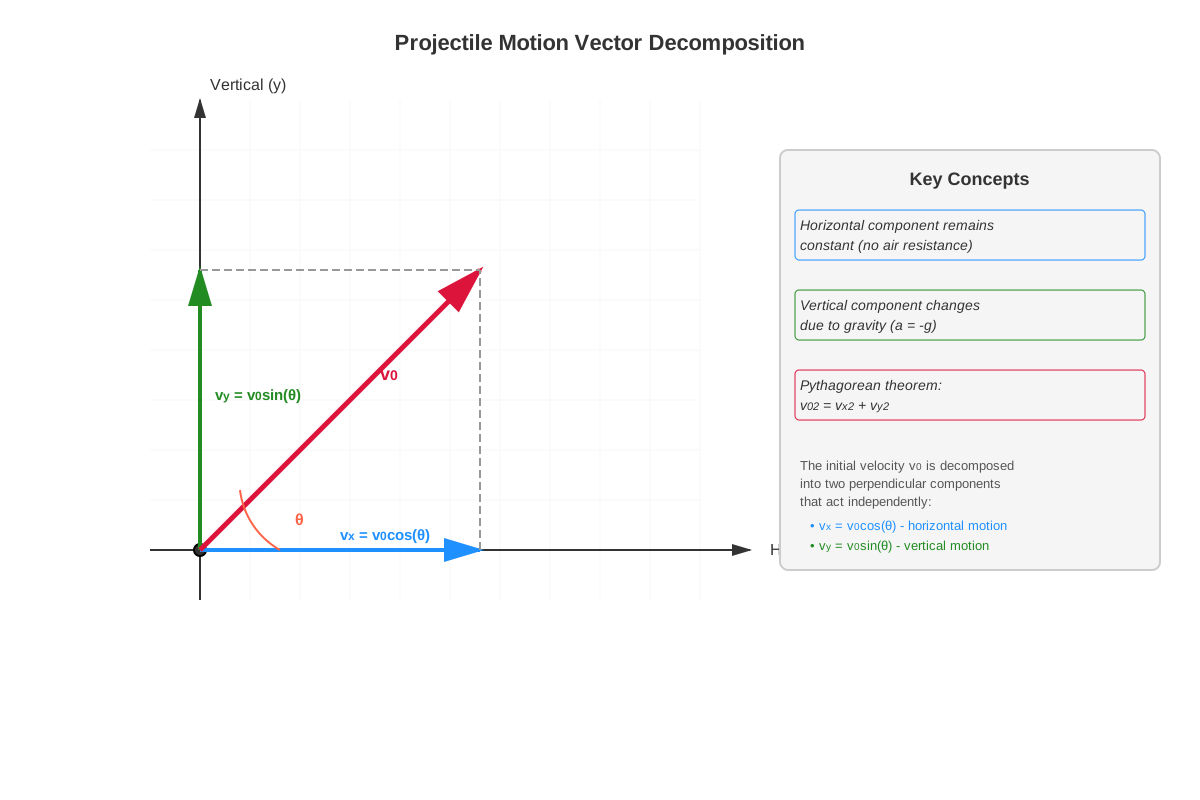
When a projectile is launched at an angle θ above the horizontal with initial speed v₀, the initial velocity must be decomposed into components:
v₀ₓ = v₀ cos(θ)  (horizontal component)
v₀ᵧ = v₀ sin(θ)  (vertical component)
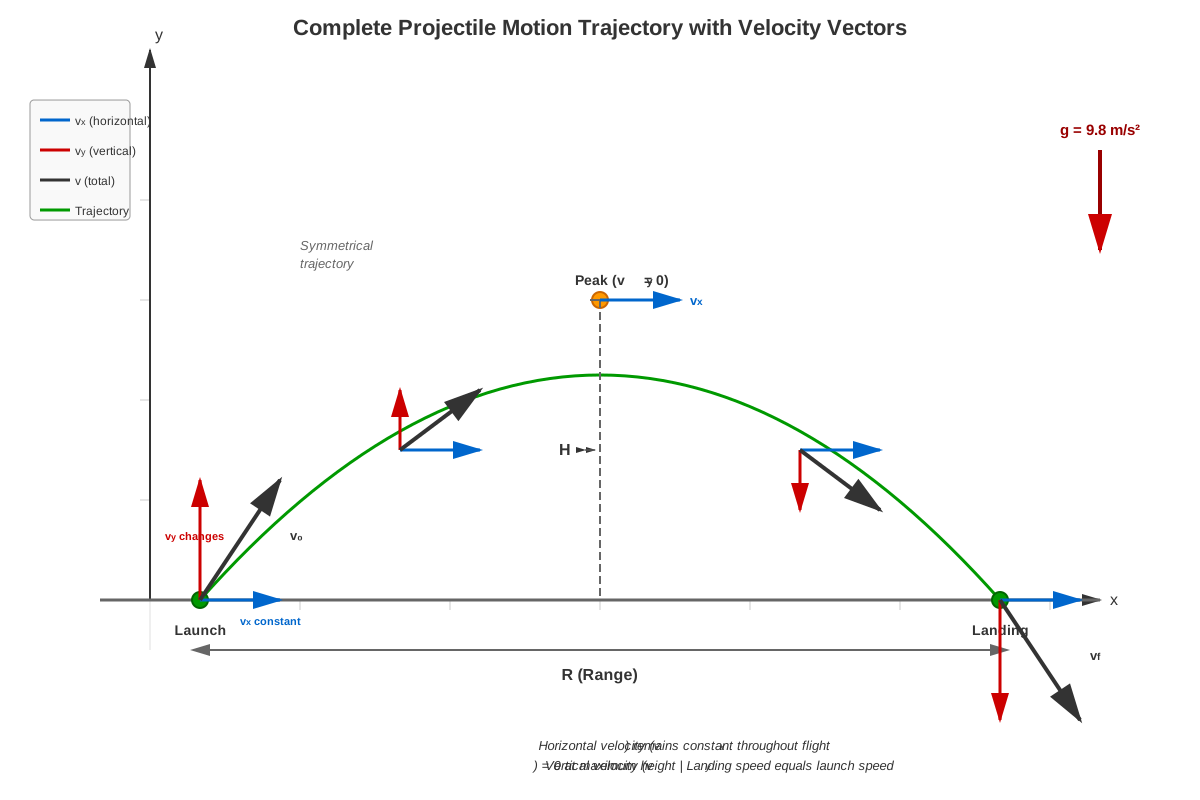
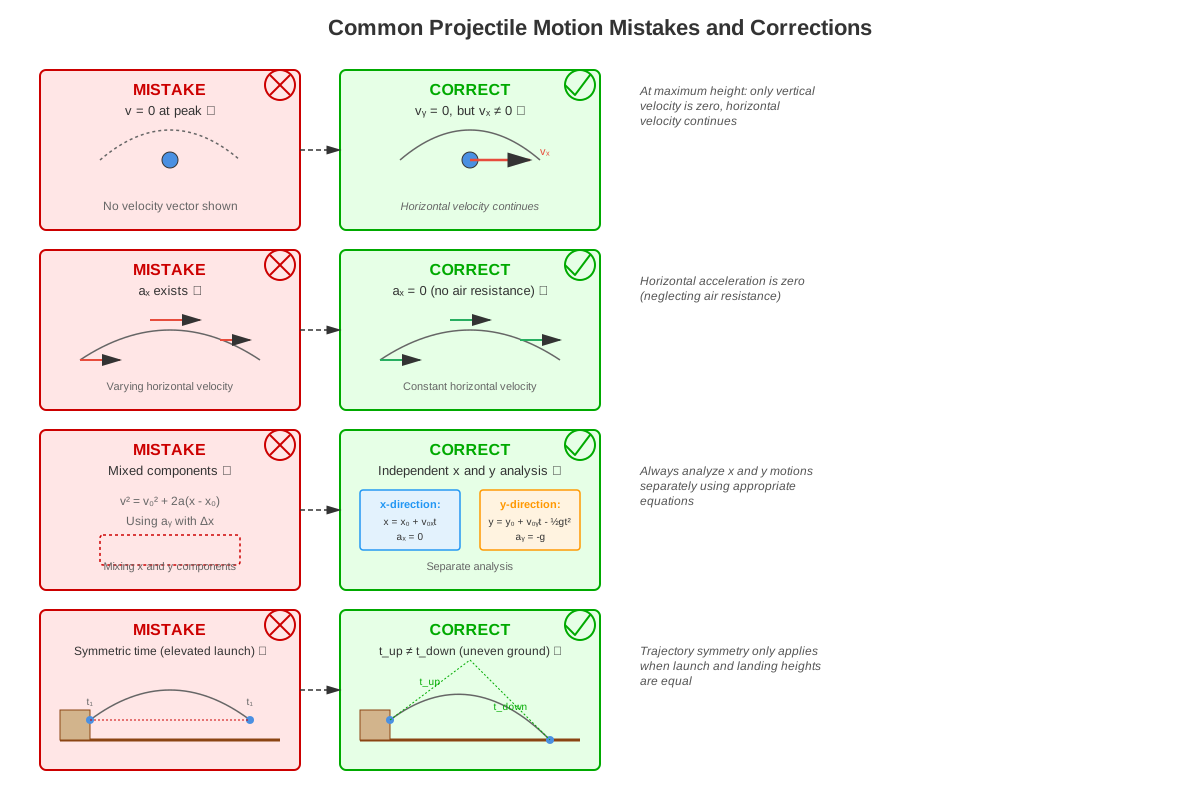
The horizontal component v₀ₓ remains constant throughout the flight because there is no horizontal acceleration (assuming negligible air resistance). The vertical component v₀ᵧ changes continuously due to gravitational acceleration. At the highest point of the trajectory, the vertical velocity becomes zero (vᵧ = 0), while the horizontal velocity remains v₀ₓ.
Kinematic Equations for Projectile Motion
The horizontal motion follows constant-velocity kinematics:
x = v₀ₓt = v₀ cos(θ) · t
vₓ = v₀ₓ = constant
The vertical motion follows constant-acceleration kinematics with a = -g (taking upward as positive):
y = v₀ᵧt - ½gt² = v₀ sin(θ) · t - ½gt²
vᵧ = v₀ᵧ - gt = v₀ sin(θ) - gt
vᵧ² = v₀ᵧ² - 2gy
These equations allow calculation of position and velocity components at any time during flight. The total velocity at any instant has magnitude v = √(vₓ² + vᵧ²) and direction tan⁻¹(vᵧ/vₓ) relative to the horizontal.
Trajectory Characteristics
Maximum height (H) occurs when the vertical velocity becomes zero. Setting vᵧ = 0 in the velocity equation and solving for time gives t = v₀ sin(θ)/g. Substituting this time into the vertical position equation yields:
H = (v₀ sin(θ))² / (2g) = v₀² sin²(θ) / (2g)Maximum height depends on the square of the initial vertical velocity component and is inversely proportional to gravitational acceleration.
Time of flight (T) for a projectile launched and landing at the same height is found by setting y = 0 in the position equation:
T = 2v₀ sin(θ) / gThis is exactly twice the time to reach maximum height, reflecting the symmetry of parabolic trajectories.
Range (R) is the horizontal distance traveled during the time of flight:
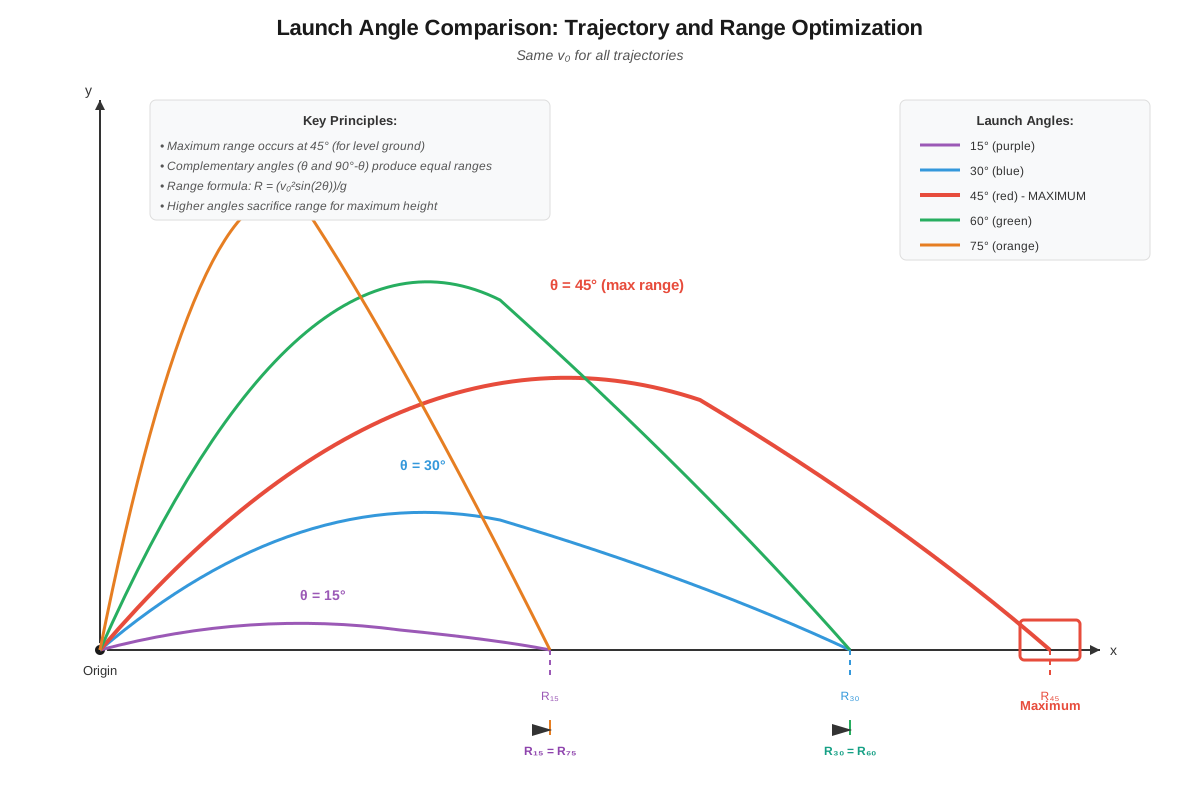
R = v₀ₓ · T = v₀ cos(θ) · (2v₀ sin(θ) / g) = v₀² sin(2θ) / gUsing the trigonometric identity 2sin(θ)cos(θ) = sin(2θ), this simplifies to show that range is maximized when sin(2θ) = 1, which occurs at θ = 45°. Complementary angles (such as 30° and 60°) produce the same range but different trajectories.
Symmetry Properties
Projectile trajectories exhibit important symmetries when launched and landing at the same height:
- The trajectory is symmetric about the vertical line through the maximum height point
- Time to ascend equals time to descend
- The speed at any height on the way up equals the speed at the same height on the way down (though velocity directions differ)
- The launch angle equals the landing angle (relative to horizontal)
These symmetries provide shortcuts for problem-solving and help verify calculated answers.
Non-Standard Launch Scenarios
When projectiles are launched from an elevated position (y₀ > 0) or land at a different height than launch, the trajectory loses its symmetry. The time of flight must be calculated by solving the quadratic equation:
y = y₀ + v₀ᵧt - ½gt²Setting y equal to the final height and solving for t using the quadratic formula. The range calculation then uses this asymmetric time of flight. These scenarios are common on the MCAT because they test deeper understanding beyond memorized formulas.
Graphical Representations
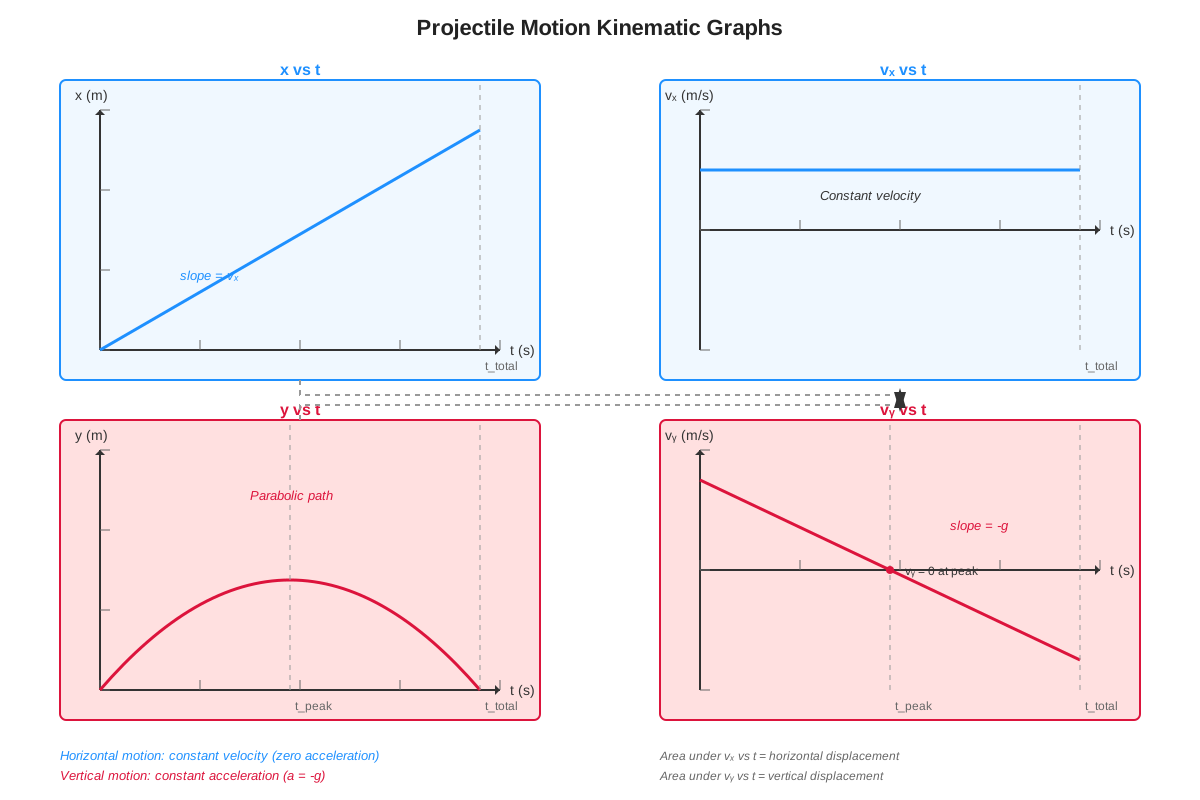
| Graph Type | Horizontal Motion | Vertical Motion |
|---|---|---|
| Position vs. Time | Linear (constant slope) | Parabolic (downward opening) |
| Velocity vs. Time | Horizontal line (constant) | Linear (negative slope = -g) |
| Acceleration vs. Time | Zero (horizontal line at a = 0) | Constant (horizontal line at a = -g) |
Understanding these graphical patterns helps students quickly extract information from MCAT passage figures and identify which component of motion is being represented.
Concept Relationships
The core concepts of projectile motion form an interconnected web where vector decomposition serves as the foundation. Initial velocity decomposition → enables → independent analysis of horizontal and vertical motions → which allows → application of appropriate kinematic equations → leading to → calculation of trajectory parameters (maximum height, range, time of flight).
The principle of independence of perpendicular components connects directly to prerequisite knowledge of vector addition and one-dimensional kinematics. Students must recognize that the same kinematic equations learned for straight-line motion apply to each component separately. The constant horizontal velocity reflects Newton's first law (no net horizontal force), while the constant vertical acceleration demonstrates Newton's second law (gravitational force produces acceleration).
Projectile motion concepts extend to related topics in mechanics. Energy conservation provides an alternative approach: the sum of kinetic and potential energy remains constant (in the absence of air resistance), allowing calculation of speed at any height without using kinematic equations. Momentum becomes relevant when projectiles collide with targets or when analyzing systems of multiple projectiles. Rotational motion may combine with projectile motion when analyzing spinning objects like footballs or Frisbees.
The symmetry properties of parabolic trajectories connect to mathematical concepts of quadratic functions and their graphical representations. Understanding that complementary launch angles produce equal ranges links to trigonometric identities. The optimization problem of finding the angle for maximum range (45°) connects to calculus concepts, though the MCAT requires only recognition of this result, not derivation.
High-Yield Facts
⭐ The horizontal and vertical components of projectile motion are independent; horizontal velocity remains constant while vertical velocity changes at rate g.
⭐ At the highest point of a trajectory, vertical velocity is zero but horizontal velocity equals v₀ cos(θ)—the projectile is still moving.
⭐ Maximum range for a projectile launched and landing at the same height occurs at 45° launch angle; complementary angles (e.g., 30° and 60°) produce equal ranges.
⭐ Time of flight depends only on the vertical component of initial velocity: T = 2v₀ sin(θ)/g for symmetric trajectories.
⭐ Maximum height is proportional to the square of the vertical velocity component: H = v₀² sin²(θ)/(2g).
- The trajectory of a projectile is always parabolic when air resistance is negligible and gravitational acceleration is constant.
- Increasing launch angle from 0° to 45° increases both maximum height and range; increasing from 45° to 90° increases height but decreases range.
- The acceleration vector always points straight down with magnitude g throughout the entire flight, regardless of the velocity direction.
- For projectiles launched from ground level, the impact velocity magnitude equals the launch velocity magnitude (energy conservation), but the direction differs.
- Doubling the initial velocity quadruples both the maximum height and range (both are proportional to v₀²).
- The horizontal component of velocity never changes sign during flight, but the vertical component changes from positive (upward) to negative (downward).
- At any point during flight, the velocity vector is tangent to the parabolic trajectory path.
Quick check — test yourself on Projectile motion so far.
Try Flashcards →Common Misconceptions
Misconception: At the highest point of the trajectory, both velocity components are zero and the projectile momentarily stops.
Correction: Only the vertical velocity component is zero at maximum height; the horizontal velocity component remains v₀ cos(θ), so the projectile continues moving horizontally. The total velocity is never zero during flight (except at the instant of landing for a vertical launch).
Misconception: The acceleration of a projectile changes throughout its flight, being greatest at the highest point or when the projectile is moving fastest.
Correction: The acceleration is constant throughout the entire flight with magnitude g directed downward. Acceleration does not depend on velocity; it depends only on the gravitational force, which remains constant near Earth's surface.
Misconception: A projectile launched at 45° always travels the farthest distance regardless of landing height.
Correction: The 45° angle maximizes range only when the projectile lands at the same height from which it was launched. For projectiles landing at lower elevations, angles less than 45° produce greater range; for landing at higher elevations, angles greater than 45° are optimal.
Misconception: Heavier projectiles fall faster and therefore have shorter flight times than lighter projectiles launched identically.
Correction: In the absence of air resistance, mass does not affect projectile motion. All objects experience the same gravitational acceleration g regardless of mass. A heavy ball and light ball launched with identical initial velocities follow identical trajectories and have identical flight times.
Misconception: The range formula R = v₀² sin(2θ)/g can be used for all projectile motion problems.
Correction: This formula applies only when the projectile lands at the same height from which it was launched. For projectiles launched from elevated positions or landing at different heights, the full kinematic equations must be used to find the time of flight first, then calculate range as R = v₀ₓ · t.
Misconception: When a projectile is launched horizontally (θ = 0°), it has no vertical motion initially.
Correction: While the initial vertical velocity is zero for horizontal launch, vertical motion begins immediately due to gravitational acceleration. The projectile starts falling the instant it is released, with vertical velocity increasing as vᵧ = -gt.
Worked Examples
Example 1: Maximum Height and Range Calculation
Problem: A soccer ball is kicked from ground level with an initial speed of 20 m/s at an angle of 37° above the horizontal. Calculate (a) the maximum height reached, (b) the time of flight, and (c) the horizontal range. Use g = 10 m/s² and sin(37°) ≈ 0.6, cos(37°) ≈ 0.8.
Solution:
First, decompose the initial velocity into components:
- v₀ₓ = v₀ cos(37°) = 20 × 0.8 = 16 m/s
- v₀ᵧ = v₀ sin(37°) = 20 × 0.6 = 12 m/s
(a) Maximum height: Use the formula H = v₀² sin²(θ)/(2g) or equivalently H = v₀ᵧ²/(2g)
H = (12)²/(2 × 10) = 144/20 = 7.2 m
Alternatively, find the time to reach maximum height when vᵧ = 0:
t = v₀ᵧ/g = 12/10 = 1.2 s
Then use y = v₀ᵧt - ½gt²:
H = 12(1.2) - ½(10)(1.2)² = 14.4 - 7.2 = 7.2 m ✓
(b) Time of flight: For symmetric trajectory, T = 2v₀ sin(θ)/g
T = 2(20)(0.6)/10 = 24/10 = 2.4 s
Note this is exactly twice the time to reach maximum height, confirming the symmetry.
(c) Horizontal range: R = v₀ₓ · T
R = 16 × 2.4 = 38.4 m
Alternatively, using the range formula: R = v₀² sin(2θ)/g
Since sin(2 × 37°) = sin(74°) ≈ 0.96:
R = (20)²(0.96)/10 = 400(0.96)/10 = 38.4 m ✓
Key takeaway: This problem demonstrates the standard approach for symmetric projectile motion—decompose velocity, apply appropriate formulas, and verify using alternative methods when possible. The symmetry relationships (T = 2t_max) provide quick checks.
Example 2: Projectile Launched from Elevation
Problem: A ball is thrown horizontally from the top of a 45 m tall building with an initial speed of 20 m/s. (a) How long does it take to reach the ground? (b) How far from the base of the building does it land? (c) What is the velocity (magnitude and direction) just before impact? Use g = 10 m/s².
Solution:
For horizontal launch, θ = 0°, so:
- v₀ₓ = 20 m/s (entire initial velocity is horizontal)
- v₀ᵧ = 0 m/s (no initial vertical velocity)
(a) Time to reach ground: Use vertical motion equation with y₀ = 45 m, y = 0
y = y₀ + v₀ᵧt - ½gt²
0 = 45 + 0 - ½(10)t²
5t² = 45
t² = 9
t = 3 s
(b) Horizontal distance: Since horizontal velocity is constant:
x = v₀ₓt = 20 × 3 = 60 m
(c) Velocity at impact:
Horizontal component remains: vₓ = 20 m/s
Vertical component: vᵧ = v₀ᵧ - gt = 0 - 10(3) = -30 m/s (negative indicates downward)
Magnitude: v = √(vₓ² + vᵧ²) = √(20² + 30²) = √(400 + 900) = √1300 ≈ 36.1 m/s
Direction: θ = tan⁻¹(|vᵧ|/vₓ) = tan⁻¹(30/20) = tan⁻¹(1.5) ≈ 56.3° below horizontal
Key takeaway: Horizontal launch problems require recognizing that v₀ᵧ = 0, making vertical motion equations simpler. The asymmetric trajectory (different launch and landing heights) means standard range formulas don't apply—must calculate time of flight from vertical motion first. The final velocity has both horizontal and vertical components that must be combined vectorially.
Exam Strategy
When approaching projectile motion questions on the MCAT, begin by identifying whether the problem involves symmetric trajectory (same launch and landing height) or asymmetric trajectory (different heights). This determines which formulas apply directly versus which require full kinematic analysis. Draw a quick sketch showing the trajectory, initial velocity vector, and its components—visual representation prevents sign errors and clarifies which quantities are being asked.
Trigger words and phrases to recognize projectile motion contexts:
- "launched," "thrown," "kicked," "projected," "fired"
- "parabolic path," "trajectory," "arc"
- "maximum height," "range," "time of flight"
- "neglecting air resistance" (confirms projectile motion applies)
- "horizontal distance," "lands," "strikes the ground"
Watch for disguised projectile motion in biological contexts: "blood ejected from ventricle," "particle expelled during cough," "jumping animal," "thrown medical instrument." The MCAT often embeds physics in medical scenarios.
Process-of-elimination strategies:
- Eliminate answers where horizontal velocity changes (it must remain constant)
- Eliminate answers where acceleration is anything other than g downward
- For maximum range questions, eliminate any angle other than 45° for symmetric trajectories
- Check dimensional analysis—range and height must have units of length, time of flight must have units of time
- Use limiting cases: at θ = 0° (horizontal launch), maximum height should be zero; at θ = 90° (vertical launch), range should be zero
Time allocation: Discrete projectile motion questions typically require 60-90 seconds. Allocate 30 seconds to identify the scenario type and set up equations, 30-45 seconds for calculations, and 15 seconds to verify the answer makes physical sense. For passage-based questions, spend extra time understanding the experimental setup or biological context before attempting calculations.
Common question types:
- Direct calculation: Given initial conditions, find trajectory parameters (most common)
- Comparison: How does changing one variable affect another? (tests conceptual understanding)
- Graph interpretation: Extract information from position, velocity, or acceleration graphs
- Optimization: What angle or initial speed produces a desired outcome?
- Reverse problems: Given final conditions, determine initial conditions
Always check whether the question asks for a component (horizontal or vertical) or total magnitude. Many students correctly calculate components but forget to combine them vectorially when the total is requested.
Memory Techniques
HIVE mnemonic for remembering what stays constant vs. what changes:
- Horizontal velocity: Invariable (constant)
- Vertical velocity: Evolving (changes due to gravity)
"Max at 45" - Maximum range occurs at 45° launch angle for symmetric trajectories. Visualize a square (45° diagonal) to remember this optimization.
"Height is Vertical, Range is Horizontal × Time" - Maximum height depends only on vertical velocity component; range requires both horizontal velocity and total time. This reinforces the independence of components.
Symmetry Sentence: "What goes up must come down the same way" - For symmetric trajectories, time up equals time down, and speeds at equal heights are equal (though directions differ).
Component Decomposition: Use "SOH-CAH-TOA" but remember:
- Sine goes with Vertical (both have vertical strokes in their letters)
- Cosine goes with Horizontal (both have horizontal elements)
- v₀ᵧ = v₀ sin(θ) [Sine → Vertical]
- v₀ₓ = v₀ cos(θ) [Cosine → Horizontal]
Visualization strategy: Picture the trajectory as a parabola with three key points marked:
- Launch point (both velocity components present)
- Peak (only horizontal velocity remains)
- Landing point (both components present again, vertical component reversed)
At each point, draw velocity component arrows to reinforce which components exist and their directions.
Formula family: Group related formulas by what they calculate:
- Height family: All contain v₀ sin(θ) or v₀ᵧ, and divide by 2g
- Time family: All contain v₀ sin(θ) or v₀ᵧ, and divide by g (no factor of 2)
- Range family: All contain both sin and cos (or sin(2θ)), and divide by g
Summary
Projectile motion represents a fundamental application of two-dimensional kinematics where objects move under the sole influence of gravity after launch. The essential principle is the independence of horizontal and vertical motion components: horizontal motion proceeds at constant velocity while vertical motion experiences constant downward acceleration g. Success in solving projectile motion problems requires decomposing initial velocity into components using trigonometry, applying appropriate kinematic equations to each component independently, and combining results to find trajectory characteristics. Key parameters include maximum height (proportional to the square of vertical velocity component), time of flight (proportional to vertical velocity component), and range (maximized at 45° for symmetric trajectories). The MCAT tests both computational skills and conceptual understanding, often embedding projectile motion within biological contexts or requiring interpretation of experimental data. Students must recognize common misconceptions—particularly that horizontal velocity remains constant, acceleration is always g downward regardless of motion phase, and the 45° maximum range rule applies only to symmetric trajectories. Mastery requires understanding the underlying physics principles, not just memorizing formulas, enabling adaptation to non-standard scenarios frequently encountered on the exam.
Key Takeaways
- Projectile motion involves independent horizontal (constant velocity) and vertical (constant acceleration) components that occur simultaneously over the same time interval
- Initial velocity must be decomposed into v₀ₓ = v₀ cos(θ) and v₀ᵧ = v₀ sin(θ) before applying kinematic equations to each component separately
- At maximum height, vertical velocity is zero but horizontal velocity remains constant—the projectile never stops moving during flight
- Maximum range for symmetric trajectories occurs at 45° launch angle; complementary angles produce equal ranges but different maximum heights
- Acceleration is constant at g downward throughout the entire flight, regardless of velocity magnitude or direction
- Trajectory symmetry (time up = time down, equal speeds at equal heights) applies only when launch and landing occur at the same elevation
- The MCAT frequently tests projectile motion through biological applications, graph interpretation, and scenarios requiring conceptual reasoning beyond formula application
Related Topics
Energy Conservation in Projectile Motion: Analyzing the interchange between kinetic and potential energy at different points along the trajectory provides an alternative problem-solving approach and connects mechanics concepts. Mastering projectile motion kinematics enables deeper understanding of energy transformations.
Two-Dimensional Collisions: Projectile motion principles extend to analyzing collisions where objects move in two dimensions after impact, requiring vector decomposition and momentum conservation in both horizontal and vertical directions.
Circular Motion: Both projectile motion and circular motion involve two-dimensional trajectories and require vector analysis, though circular motion involves centripetal acceleration rather than constant gravitational acceleration.
Inclined Plane Dynamics: Projectiles launched along or from inclined surfaces combine projectile motion with rotated coordinate systems, requiring synthesis of multiple mechanics concepts.
Fluid Dynamics and Air Resistance: Understanding ideal projectile motion (no air resistance) provides the foundation for analyzing more realistic scenarios where drag forces affect trajectories, particularly relevant for biological applications.
Practice CTA
Now that you've mastered the core concepts of projectile motion, it's time to solidify your understanding through active practice. Attempt the accompanying practice questions that mirror actual MCAT question styles and difficulty levels. Work through each problem systematically, applying the decomposition strategies and formulas you've learned. Use the flashcards to reinforce high-yield facts and test your ability to recall key relationships quickly. Remember, projectile motion questions reward both conceptual clarity and computational efficiency—skills that improve dramatically with deliberate practice. Challenge yourself to explain why each wrong answer choice is incorrect, deepening your understanding beyond surface-level memorization. Your investment in mastering this foundational mechanics topic will pay dividends across multiple physics concepts on test day!
Sign up free to keep reading
Create a free AnvayaPrep account to finish this MCAT guide on Projectile motion — plus flashcards and practice questions.