Overview
Kinematic equations form the mathematical foundation for describing motion in one and two dimensions, representing one of the most frequently tested topics in Physics on the MCAT. These equations relate five fundamental variables—displacement, initial velocity, final velocity, acceleration, and time—allowing test-takers to solve complex motion problems systematically. Mastery of kinematic equations is essential not only for direct Mechanics questions but also for understanding projectile motion, circular motion, and even certain biological systems like blood flow dynamics and muscle contraction velocities.
The MCAT tests kinematic equations primarily through passage-based questions involving experimental setups, physiological scenarios, or real-world applications. Students must recognize which equation to apply, identify given variables, and manipulate algebraic relationships under time pressure. Unlike introductory physics courses that may emphasize derivations, the MCAT focuses on rapid application and conceptual understanding of when constant acceleration assumptions hold true.
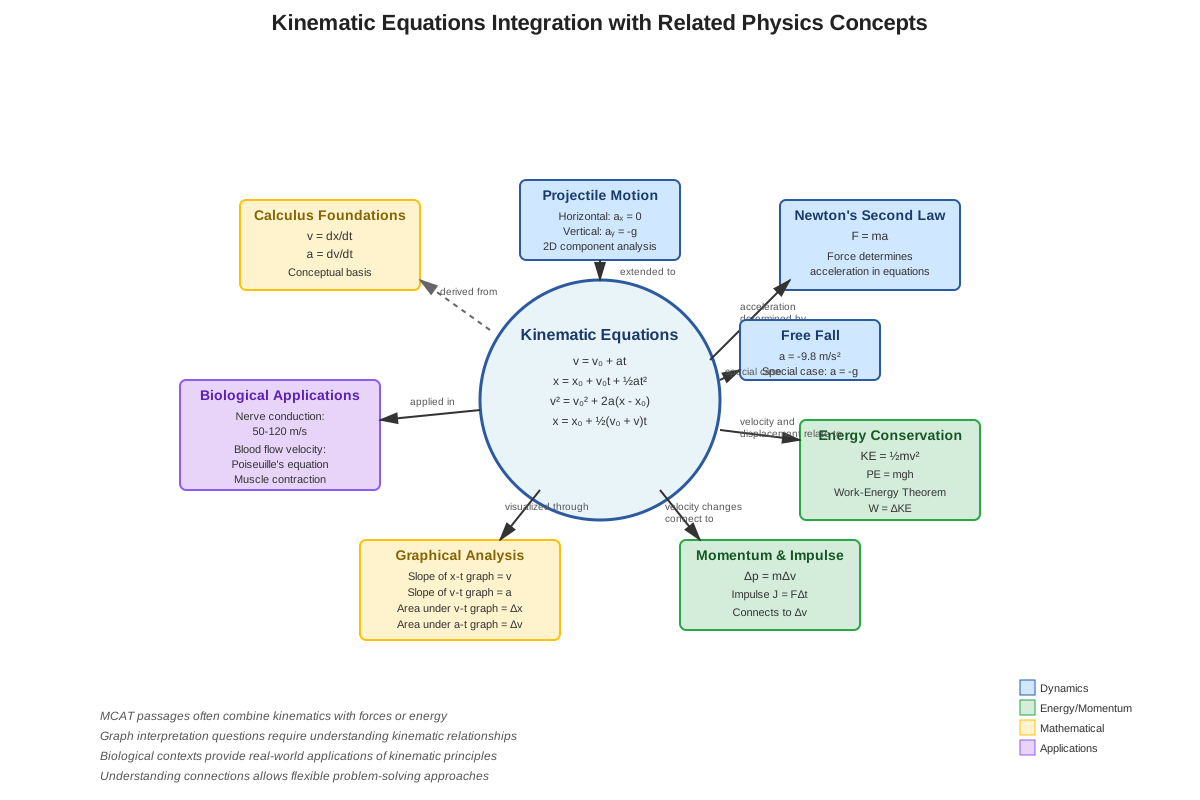
Understanding kinematic equations provides the gateway to more advanced topics in Physics, including Newton's laws of motion, energy conservation, and momentum. These equations bridge the gap between purely descriptive motion (kinematics) and the forces causing that motion (dynamics). For MCAT success, students must develop fluency in selecting the appropriate equation, recognizing the physical meaning of each variable, and connecting mathematical solutions back to biological and clinical contexts.
Learning Objectives
- [ ] Define kinematic equations using accurate Physics terminology
- [ ] Explain why kinematic equations matter for the MCAT
- [ ] Apply kinematic equations to exam-style questions
- [ ] Identify common mistakes related to kinematic equations
- [ ] Connect kinematic equations to related Physics concepts
- [ ] Determine which kinematic equation to use based on given and unknown variables
- [ ] Solve two-dimensional motion problems by decomposing vectors into components
- [ ] Recognize when kinematic equations are valid versus when they cannot be applied
Prerequisites
- Vector addition and decomposition: Kinematic equations in two dimensions require breaking velocity and acceleration into perpendicular components
- Algebra and equation manipulation: Solving for unknown variables demands comfort with quadratic equations and algebraic rearrangement
- Basic calculus concepts (derivatives and integrals): While not required for MCAT problem-solving, understanding that velocity is the derivative of position and acceleration is the derivative of velocity provides conceptual clarity
- Units and dimensional analysis: Consistent SI units (meters, seconds, m/s, m/s²) prevent calculation errors and help verify answer reasonableness
- Graphical interpretation: Position-time, velocity-time, and acceleration-time graphs directly relate to kinematic equations
Why This Topic Matters
Kinematic equations appear in approximately 15-20% of MCAT Physics questions, making them a medium-to-high yield topic that cannot be ignored. The Chemical and Physical Foundations of Biological Systems section frequently embeds kinematic problems within experimental passages describing falling objects, projectile trajectories, or physiological measurements like nerve impulse propagation speeds.
Clinically, kinematic principles underlie numerous medical applications. Emergency medicine physicians calculate impact velocities from fall heights to predict injury severity. Radiologists use kinematic equations when analyzing contrast agent flow through vessels. Physical therapists apply these concepts when designing rehabilitation protocols that account for acceleration limits during joint movement. Sports medicine specialists calculate forces on athletes by first determining their acceleration profiles during jumps or collisions.
On the MCAT, kinematic equations typically appear in three formats: (1) direct calculation problems embedded in passages about experimental apparatus, (2) conceptual questions asking students to predict motion outcomes, and (3) graph interpretation questions requiring translation between graphical and mathematical representations. Discrete questions occasionally test pure kinematic problem-solving, but passage-based questions are more common, often requiring students to extract relevant information from complex experimental descriptions.
Core Concepts
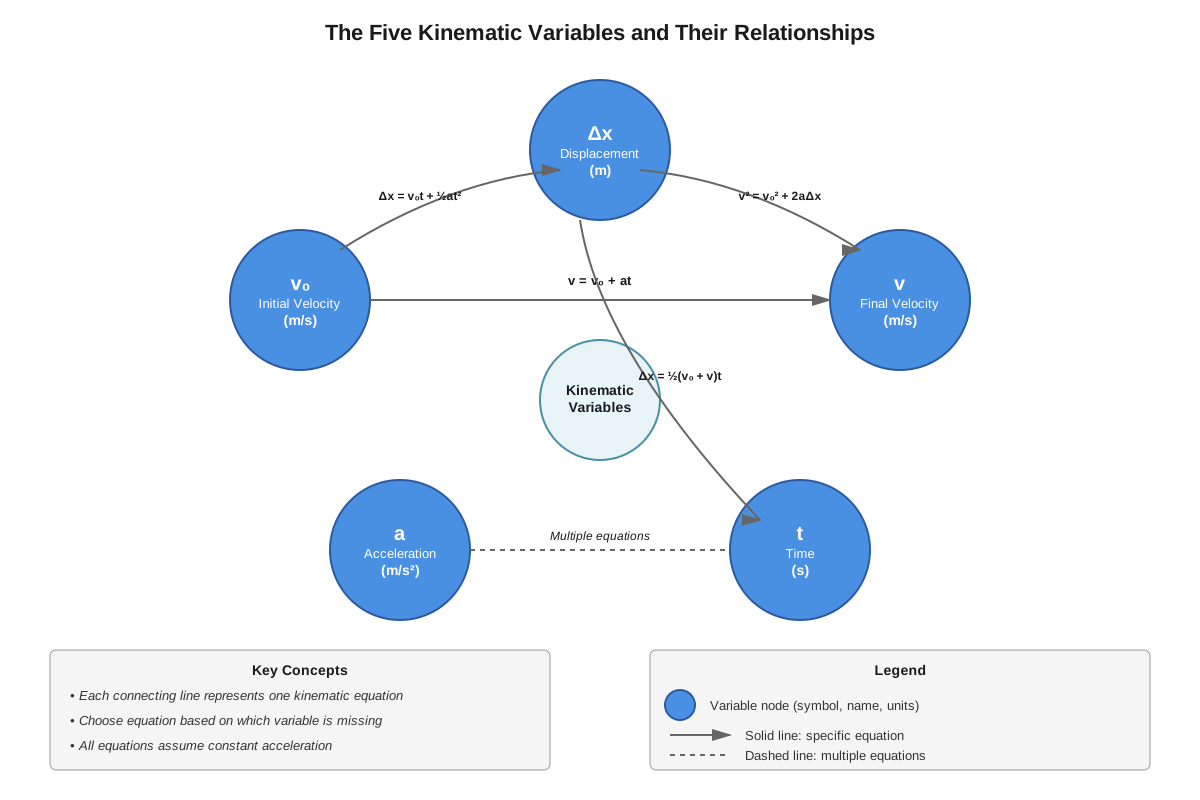
The Five Kinematic Variables
Kinematic equations in Physics describe motion using five fundamental variables that must be clearly understood:
- Displacement (Δx or d): The change in position, a vector quantity measured in meters. Displacement differs from distance traveled; it represents the straight-line change from initial to final position.
- Initial velocity (v₀ or vᵢ): The velocity at the beginning of the time interval being analyzed, measured in m/s. This is a vector with both magnitude and direction.
- Final velocity (v or vf): The velocity at the end of the time interval, also measured in m/s.
- Acceleration (a): The rate of change of velocity, measured in m/s². For kinematic equations to apply, acceleration must be constant throughout the motion.
- Time (t or Δt): The duration of the motion interval, measured in seconds.
Each kinematic equation relates four of these five variables, allowing calculation of any unknown when three variables are known.
The Four Primary Kinematic Equations
The kinematic equations for constant acceleration in one dimension are:
1. v = v₀ + at
2. Δx = v₀t + ½at²
3. v² = v₀² + 2aΔx
4. Δx = ½(v₀ + v)t
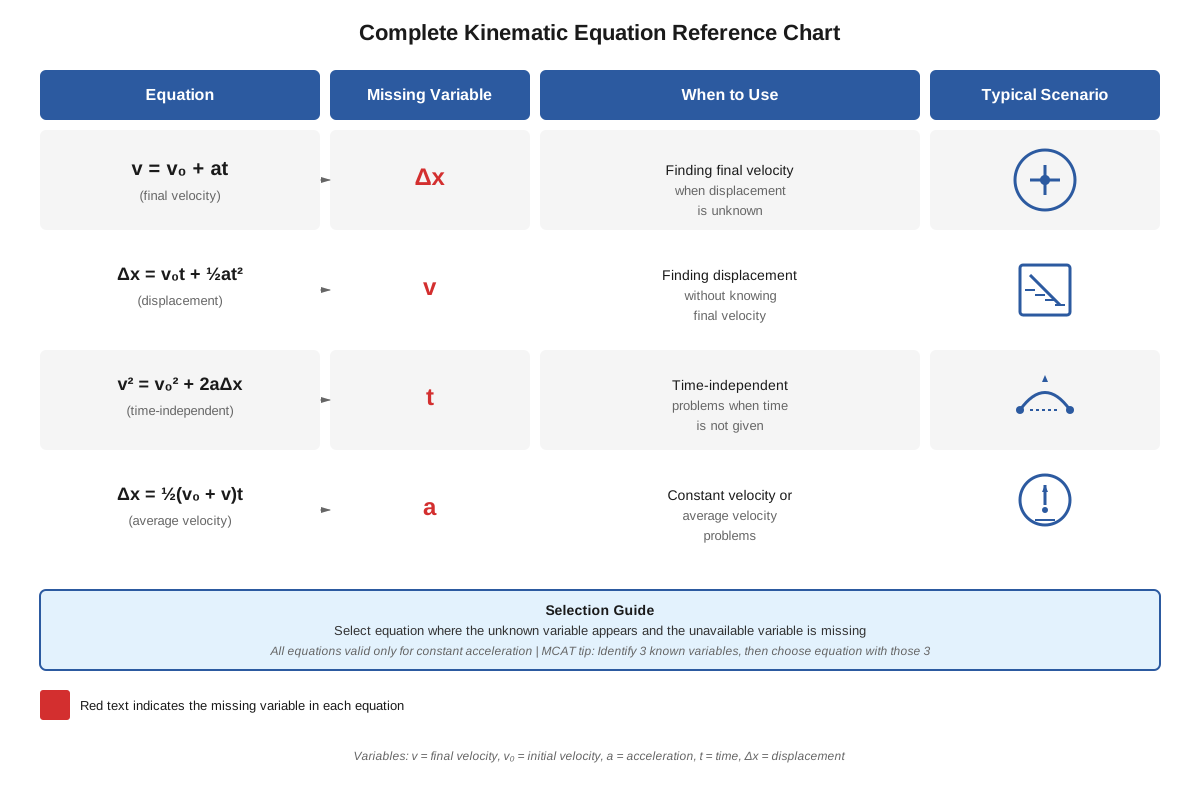
Equation 1 relates velocity, initial velocity, acceleration, and time. It lacks displacement, making it ideal when distance is unknown or irrelevant.
Equation 2 provides displacement as a function of time, incorporating initial velocity and acceleration. This equation is essential for projectile motion problems and situations where time is known.
Equation 3 eliminates time from the relationships, connecting velocities, acceleration, and displacement. This proves invaluable when time information is absent or when solving for final velocity after a known displacement.
Equation 4 represents an alternative displacement formula using average velocity. Since average velocity equals (v₀ + v)/2 for constant acceleration, this equation simplifies certain problems.
| Equation | Missing Variable | Best Used When |
|---|---|---|
| v = v₀ + at | Δx | Displacement is unknown or not needed |
| Δx = v₀t + ½at² | v | Final velocity is not needed |
| v² = v₀² + 2aΔx | t | Time is unknown or not needed |
| Δx = ½(v₀ + v)t | a | Acceleration is unknown or not needed |
Sign Conventions and Coordinate Systems
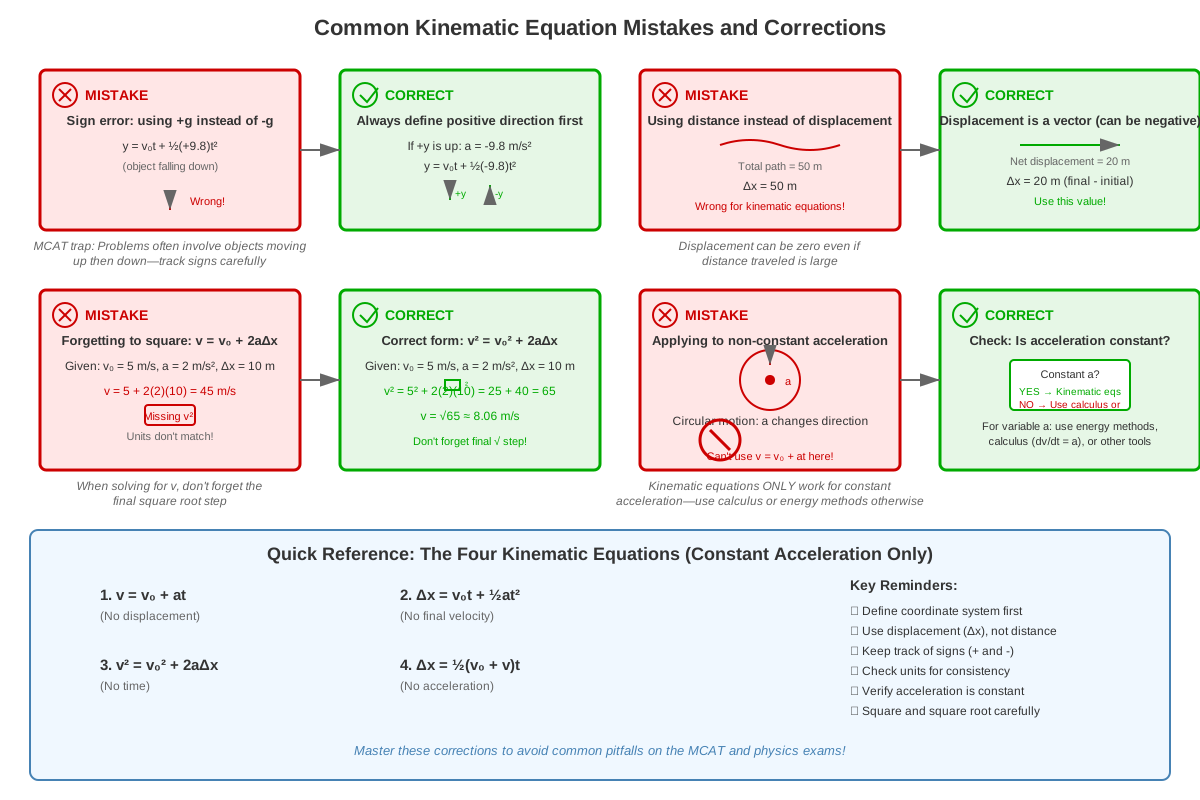
Proper application of kinematic equations requires consistent sign conventions. Establish a coordinate system before solving any problem:
- Choose a positive direction: Typically, right is positive for horizontal motion, and up is positive for vertical motion, though any consistent choice works.
- Assign signs to all vectors: Velocity, displacement, and acceleration must all follow the chosen convention.
- Gravitational acceleration: Near Earth's surface, g = 9.8 m/s² (often approximated as 10 m/s² on the MCAT). If upward is positive, then a = -g = -9.8 m/s² for free fall.
Common sign errors account for a significant percentage of incorrect MCAT responses on kinematic problems.
Two-Dimensional Motion and Vector Decomposition
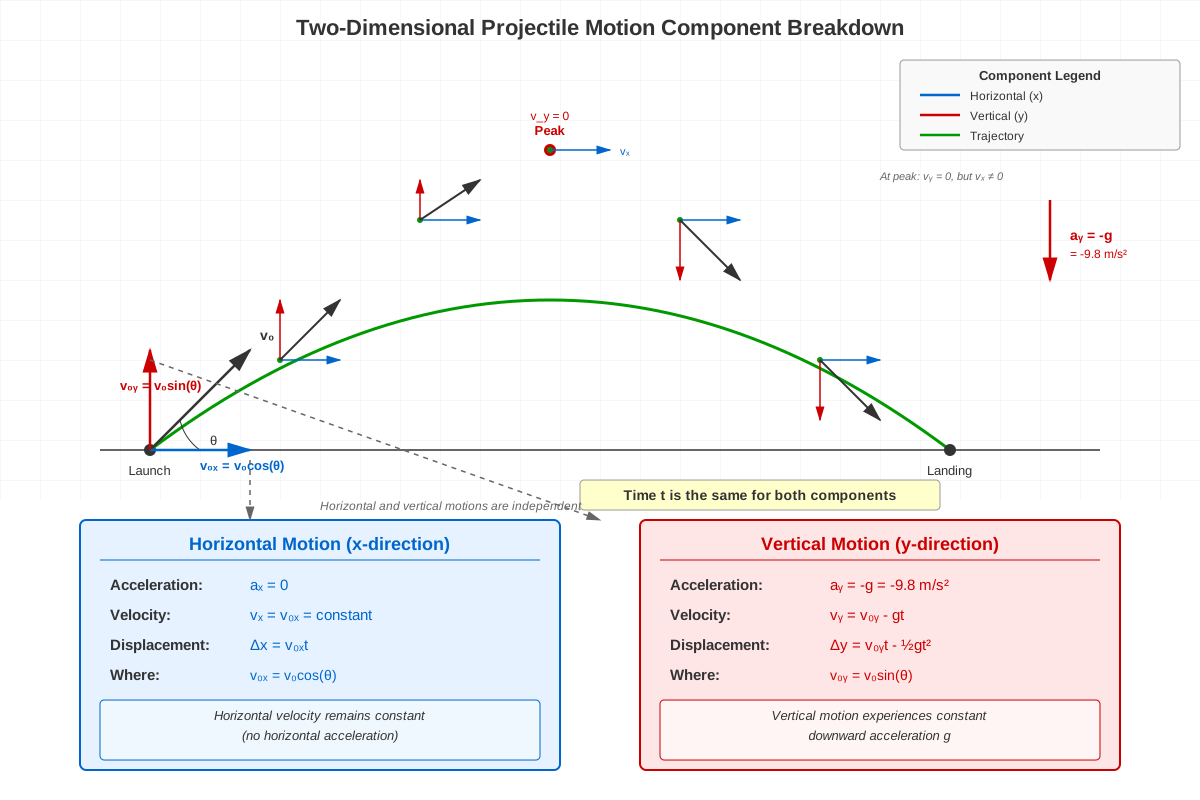
When motion occurs in two dimensions, kinematic equations apply independently to each perpendicular component. For projectile motion:
- Horizontal component: Typically has zero acceleration (ax = 0), so vx remains constant
- Vertical component: Experiences gravitational acceleration (ay = -g)
The key principle: horizontal and vertical motions are independent but share the same time variable. This allows solving for time using one dimension, then applying that time to find quantities in the other dimension.
For a projectile launched at angle θ with initial speed v₀:
- v₀x = v₀ cos(θ)
- v₀y = v₀ sin(θ)
Apply kinematic equations separately to x and y components, remembering that the time of flight is the same for both dimensions.
Free Fall and Projectile Motion
Free fall represents motion under gravity alone, with a = -g (taking upward as positive). Key characteristics:
- At maximum height, vertical velocity equals zero (vy = 0)
- Time to reach maximum height equals time to return to launch height
- Impact speed equals launch speed for symmetric trajectories
- Acceleration remains constant at -g throughout the entire trajectory, even at the peak
For objects thrown vertically upward, the velocity decreases linearly until reaching zero at maximum height, then increases in the downward direction. Many students incorrectly believe acceleration is zero at the peak—acceleration remains -g throughout.
When Kinematic Equations Do NOT Apply
Kinematic equations require constant acceleration. They fail when:
- Acceleration varies with time or position (e.g., air resistance proportional to velocity)
- Motion involves changing forces (e.g., rocket propulsion with decreasing mass)
- Circular motion at constant speed (acceleration direction changes continuously)
- Non-inertial reference frames (accelerating elevators, rotating platforms)
Recognizing these limitations prevents misapplication on MCAT questions designed to test conceptual boundaries.
Concept Relationships
The kinematic equations form an interconnected system where each equation can be derived from the others through algebraic manipulation or calculus. Equation 1 (v = v₀ + at) serves as the foundation, derived from the definition of constant acceleration. Integrating this equation with respect to time yields Equation 2 (Δx = v₀t + ½at²). Combining Equations 1 and 4 and eliminating time produces Equation 3 (v² = v₀² + 2aΔx).
These equations connect directly to graphical representations of motion:
- Position-time graphs → slope gives velocity; curvature indicates acceleration
- Velocity-time graphs → slope gives acceleration; area under curve gives displacement
- Acceleration-time graphs → area under curve gives change in velocity
The relationship flows: Acceleration → Velocity → Position, with each being the time derivative of the next. Conversely, integrating acceleration gives velocity, and integrating velocity gives position.
Kinematic equations serve as prerequisites for understanding:
- Newton's Second Law (F = ma): Once acceleration is found kinematically, forces can be calculated
- Work and Energy: Kinematic variables appear in kinetic energy (½mv²) and work calculations
- Momentum: Velocity from kinematic equations determines momentum (p = mv)
- Circular Motion: Tangential velocity and acceleration connect to kinematic principles
The conceptual map: Kinematic Equations → Describe Motion → Enable Force Analysis → Connect to Energy and Momentum → Explain Complex Systems
Quick check — test yourself on Kinematic equations so far.
Try Flashcards →High-Yield Facts
⭐ The four kinematic equations only apply when acceleration is constant throughout the motion interval
⭐ Gravitational acceleration g = 9.8 m/s² (≈ 10 m/s² on MCAT) acts downward throughout an object's entire trajectory, including at the peak of projectile motion
⭐ At maximum height in projectile motion, vertical velocity equals zero but acceleration remains -g
⭐ For symmetric projectile trajectories, time up equals time down, and launch speed equals impact speed
⭐ Horizontal and vertical components of two-dimensional motion are independent but share the same time variable
- Each kinematic equation omits one of the five variables, making equation selection dependent on which variable is unknown and which are given
- The equation v² = v₀² + 2aΔx is particularly useful for problems where time is not provided or needed
- Sign conventions must be established before solving; mixing positive and negative directions is the most common error source
- Average velocity for constant acceleration equals (v₀ + v)/2, which forms the basis of the fourth kinematic equation
- In free fall problems, objects thrown upward and downward from the same height have equal speeds upon reaching ground level (though opposite directions)
Common Misconceptions
Misconception: Acceleration is zero at the peak of a projectile's trajectory because velocity is momentarily zero.
Correction: Acceleration remains constant at -g throughout the entire trajectory. Velocity being zero at one instant does not mean acceleration is zero; acceleration describes the rate of change of velocity, which continues even when velocity momentarily equals zero.
Misconception: Distance and displacement are interchangeable in kinematic equations.
Correction: Kinematic equations use displacement (Δx), a vector quantity representing net position change. Distance is a scalar representing total path length. For an object thrown upward that returns to its starting point, displacement is zero but distance traveled is not.
Misconception: The equation Δx = vt can always be used to find displacement.
Correction: This simplified equation only applies when velocity is constant (zero acceleration). For constant acceleration, use Δx = v₀t + ½at² or Δx = ½(v₀ + v)t. Using Δx = vt when acceleration is present yields incorrect results.
Misconception: In projectile motion, horizontal velocity changes due to gravity.
Correction: Gravity acts vertically downward, affecting only the vertical component of velocity. Horizontal velocity remains constant throughout flight (neglecting air resistance). This independence of perpendicular motion components is fundamental to solving two-dimensional problems.
Misconception: Kinematic equations can be applied to circular motion at constant speed.
Correction: Even though speed is constant in uniform circular motion, velocity direction changes continuously, meaning acceleration is not zero and not constant in direction. Kinematic equations require constant acceleration in magnitude AND direction, so they fail for circular motion.
Misconception: A negative acceleration always means an object is slowing down.
Correction: Negative acceleration means acceleration points in the negative direction of the chosen coordinate system. An object moving in the negative direction with negative acceleration is actually speeding up. Whether an object speeds up or slows down depends on whether velocity and acceleration have the same or opposite signs.
Worked Examples
Example 1: Vertical Free Fall Problem
Question: A stone is dropped from rest from the top of a 45-meter tall building. How long does it take to reach the ground, and what is its velocity upon impact? (Use g = 10 m/s²)
Solution:
Step 1: Identify known and unknown variables.
- Initial velocity: v₀ = 0 (dropped from rest)
- Displacement: Δy = -45 m (negative because downward, if we take upward as positive)
- Acceleration: a = -10 m/s² (gravity acts downward)
- Unknown: time (t) and final velocity (v)
Step 2: Find time using the equation that contains Δy, v₀, a, and t:
Δy = v₀t + ½at²
-45 = 0(t) + ½(-10)t²
-45 = -5t²
t² = 9
t = 3 seconds
Step 3: Find final velocity using v = v₀ + at:
v = 0 + (-10)(3)
v = -30 m/s
The negative sign indicates downward direction. The stone takes 3 seconds to reach the ground with a speed of 30 m/s.
Alternative approach for velocity: Use v² = v₀² + 2aΔy:
v² = 0² + 2(-10)(-45)
v² = 900
v = -30 m/s (negative because moving downward)
This example demonstrates how multiple kinematic equations can solve the same problem, and choosing the most direct path saves time on the MCAT.
Example 2: Two-Dimensional Projectile Motion
Question: A ball is kicked from ground level at 20 m/s at an angle of 37° above horizontal. What is the maximum height reached, and what is the total horizontal distance traveled when it returns to ground level? (Use g = 10 m/s², sin 37° = 0.6, cos 37° = 0.8)
Solution:
Step 1: Decompose initial velocity into components.
- v₀x = v₀ cos(37°) = 20(0.8) = 16 m/s
- v₀y = v₀ sin(37°) = 20(0.6) = 12 m/s
Step 2: Find maximum height using vertical motion.
At maximum height, vy = 0. Using v² = v₀² + 2aΔy:
0² = 12² + 2(-10)Δy
0 = 144 - 20Δy
Δy = 7.2 meters
Step 3: Find time to reach maximum height using v = v₀ + at:
0 = 12 + (-10)t
t = 1.2 seconds
Step 4: Total flight time is twice the time to maximum height (symmetric trajectory):
Total time = 2(1.2) = 2.4 secondsStep 5: Find horizontal distance using constant horizontal velocity:
Δx = vx × t = 16 × 2.4 = 38.4 metersKey insights: This problem demonstrates the independence of horizontal and vertical motion. The horizontal component experiences zero acceleration, so simple distance = velocity × time applies. The vertical component follows free fall kinematics. Both components share the same time variable, which is the crucial link between dimensions.
Exam Strategy
When approaching kinematic equations questions on the MCAT, follow this systematic process:
- Read carefully and identify the motion type: Is this one-dimensional motion, free fall, or projectile motion? This determines whether to use one or two sets of equations.
- Establish a coordinate system immediately: Write down which direction is positive. For vertical motion, explicitly note whether up or down is positive, then assign signs to all vectors accordingly.
- Create a variable table: List all five kinematic variables (v₀, v, a, Δx, t) and mark which are given, which are unknown, and which are irrelevant to the question. This reveals which equation to use.
- Watch for trigger phrases:
- "Dropped from rest" → v₀ = 0
- "Thrown upward" → v₀ is positive (if up is positive), a = -g
- "Maximum height" → v = 0 at that point
- "Returns to ground level" → symmetric trajectory, Δy = 0 for full flight
- "Constant velocity" → a = 0, kinematic equations simplify
- Check answer reasonableness: Does the sign make sense? Are the units correct? Is the magnitude reasonable for the physical situation?
Exam Tip: If a question provides four of the five kinematic variables, you can always find the fifth. If only three are given, check whether the question implies a fourth (like "dropped from rest" implying v₀ = 0).
Process of elimination strategies:
- Eliminate answers with incorrect units or dimensional inconsistency
- Eliminate answers that violate physical constraints (negative time, speeds exceeding initial conditions without energy input)
- For conceptual questions, eliminate options that confuse velocity and acceleration or distance and displacement
Time allocation: Straightforward kinematic calculations should take 60-90 seconds. If a problem requires more than 2 minutes, consider whether you've chosen the most efficient equation or if there's a conceptual shortcut.
Memory Techniques
Mnemonic for equation selection - "V-DAT" helps remember which variable each equation lacks:
- V (final velocity): Δx = v₀t + ½at² lacks v
- D (displacement): v = v₀ + at lacks Δx (D for distance/displacement)
- A (acceleration): Δx = ½(v₀ + v)t lacks a
- T (time): v² = v₀² + 2aΔx lacks t
Visualization for projectile motion: Picture the trajectory as a symmetric parabola. At the peak, draw a horizontal line (velocity is purely horizontal, vertical component is zero). This visual reinforces that vy = 0 at maximum height while vx remains constant throughout.
"SUVAT" acronym (common in physics education):
- S = displacement (Δx)
- U = initial velocity (v₀)
- V = final velocity (v)
- A = acceleration (a)
- T = time (t)
This helps organize the five variables systematically.
Sign convention reminder: "UPRIGHT" - UP is typically RIGHT (positive) for vertical motion. This consistent choice prevents sign errors.
Free fall memory aid: "What goes up must come down with equal speed" - For symmetric trajectories, launch speed equals landing speed (though directions differ). Time up equals time down.
Summary
Kinematic equations provide the mathematical framework for analyzing motion with constant acceleration, forming an essential component of MCAT Physics tested in approximately 15-20% of Mechanics questions. The four primary equations relate five variables—displacement, initial velocity, final velocity, acceleration, and time—with each equation omitting one variable. Success requires systematic variable identification, proper sign convention establishment, and strategic equation selection based on known and unknown quantities. Two-dimensional motion problems demand vector decomposition and recognition that perpendicular components are independent but temporally linked. Critical concepts include understanding that gravitational acceleration remains constant throughout projectile trajectories (including at maximum height), distinguishing displacement from distance, and recognizing when constant acceleration assumptions fail. MCAT questions typically embed kinematic problems within experimental passages or physiological contexts, requiring rapid equation application and conceptual understanding rather than derivation. Mastery demands fluency in equation manipulation, dimensional analysis, and connecting mathematical solutions to physical meaning.
Key Takeaways
- The four kinematic equations apply only when acceleration is constant in magnitude and direction throughout the motion interval
- Each equation omits one of the five kinematic variables; identify which variable is missing to select the appropriate equation efficiently
- Establish consistent sign conventions before solving; gravitational acceleration is -g when upward is positive and remains constant throughout motion
- In two-dimensional motion, horizontal and vertical components are independent but share the same time variable
- At maximum height in projectile motion, vertical velocity equals zero but acceleration remains -g (not zero)
- Common MCAT trigger phrases like "dropped from rest," "maximum height," and "returns to ground level" provide implicit variable values
- Distinguish between displacement (vector, net position change) and distance (scalar, total path length) in problem setup
Related Topics
Newton's Laws of Motion: After determining acceleration kinematically, Newton's Second Law (F = ma) enables force calculation. Mastering kinematic equations provides the acceleration values needed for dynamics problems.
Work, Energy, and Power: Kinetic energy (KE = ½mv²) directly incorporates velocity from kinematic equations. Work-energy theorem problems often require finding velocity changes using kinematics first.
Momentum and Collisions: Linear momentum (p = mv) depends on velocity determined through kinematic analysis. Collision problems frequently require pre- and post-collision velocities found using kinematic equations.
Circular Motion: While kinematic equations don't apply to circular paths, understanding linear kinematics provides the foundation for tangential velocity and centripetal acceleration concepts.
Fluid Dynamics: Blood flow velocities and flow rates in vessels connect to kinematic principles, particularly when analyzing pulsatile flow or calculating transit times.
Practice CTA
Now that you've mastered the theoretical framework and problem-solving strategies for kinematic equations, it's time to solidify your understanding through active practice. Attempt the accompanying practice questions to test your ability to identify appropriate equations, apply sign conventions correctly, and solve multi-step problems under timed conditions. Use the flashcards to reinforce high-yield facts and common trigger phrases that appear on MCAT passages. Remember: kinematic equations are highly testable and highly learnable—consistent practice transforms these mathematical relationships from abstract formulas into intuitive problem-solving tools. Your investment in mastering this foundational topic will pay dividends across multiple Physics concepts tested on exam day.
Sign up free to keep reading
Create a free AnvayaPrep account to finish this MCAT guide on Kinematic equations — plus flashcards and practice questions.