Overview
Rotational equilibrium is a fundamental concept in Mechanics that describes the state of an object when the net torque acting upon it equals zero. This condition ensures that an object either remains at rest or continues to rotate at a constant angular velocity without angular acceleration. Understanding rotational equilibrium is essential for analyzing systems involving levers, seesaws, bridges, human joints, and any scenario where forces act at distances from a pivot point or axis of rotation.
For the MCAT, rotational equilibrium Physics represents a critical intersection of conceptual understanding and quantitative problem-solving. The exam frequently tests this topic through passages involving biomechanical systems (such as muscle forces acting on bones), structural stability questions, and experimental apparatus setups. Questions may require students to calculate unknown forces, determine the position of a fulcrum, or predict whether a system will remain balanced under specific conditions. The ability to quickly identify pivot points, decompose forces into perpendicular components, and apply the equilibrium condition distinguishes high-scoring students from those who struggle with Physics problems.
Rotational equilibrium MCAT questions connect deeply to translational equilibrium (where net force equals zero), Newton's laws, and energy conservation principles. Mastery of this topic provides the foundation for understanding more complex rotational dynamics, angular momentum, and the biomechanics of human movement—all of which appear across multiple MCAT passages. The concept bridges pure physics with biological applications, making it particularly high-yield for the Chemical and Physical Foundations of Biological Systems section.
Learning Objectives
- [ ] Define rotational equilibrium using accurate Physics terminology
- [ ] Explain why rotational equilibrium matters for the MCAT
- [ ] Apply rotational equilibrium to exam-style questions
- [ ] Identify common mistakes related to rotational equilibrium
- [ ] Connect rotational equilibrium to related Physics concepts
- [ ] Calculate net torque for systems with multiple forces acting at various distances and angles
- [ ] Determine unknown forces or distances in equilibrium systems using torque balance equations
- [ ] Analyze biomechanical systems (joints, bones, muscles) using rotational equilibrium principles
Prerequisites
- Vector decomposition and trigonometry: Essential for resolving forces into perpendicular and parallel components relative to lever arms; torque calculations require understanding sine and cosine functions
- Newton's Laws of Motion: Rotational equilibrium extends Newton's First Law to rotational motion; understanding force and inertia provides the conceptual foundation
- Force concepts (normal force, tension, weight): These forces frequently appear in equilibrium problems and must be identified correctly before calculating torques
- Basic algebra and equation manipulation: Solving equilibrium problems requires setting up and solving systems of equations with multiple unknowns
- Units and dimensional analysis: Torque has units of N·m, and proper unit tracking prevents calculation errors
Why This Topic Matters
Clinical and Real-World Significance
Rotational equilibrium governs countless biological and medical scenarios. The human musculoskeletal system operates as a complex series of levers, with bones acting as rigid beams, joints serving as pivot points, and muscles providing forces at specific attachment points. Physical therapists apply rotational equilibrium principles when designing rehabilitation exercises, orthopedic surgeons consider torque when placing hardware to stabilize fractures, and ergonomic specialists use these concepts to prevent workplace injuries. Understanding why certain muscle attachments provide mechanical advantage—or disadvantage—explains phenomena like why the biceps must exert forces several times body weight to hold objects in the hand.
MCAT Exam Statistics
Rotational equilibrium appears in approximately 3-5% of Physics passages on the MCAT, with questions typically worth 4-6 points per exam. The topic most commonly appears in passages describing experimental setups (balances, measuring devices), biomechanical scenarios (joint forces, muscle mechanics), or structural engineering contexts (bridges, beams). Questions range from straightforward calculations of a single unknown force to complex multi-step problems requiring both translational and rotational equilibrium conditions. The AAMC frequently combines this topic with free-body diagrams, Newton's laws, and occasionally with energy or work concepts.
Common Exam Presentations
MCAT passages present rotational equilibrium through: (1) biomechanical vignettes describing forces on bones during exercise or injury, (2) experimental apparatus requiring balance or calibration, (3) structural scenarios involving beams, bridges, or platforms supporting loads, and (4) everyday objects like doors, seesaws, or wheelbarrows. Discrete questions often feature simplified diagrams with forces acting at specified distances from a pivot. The exam tests whether students can identify the appropriate pivot point, correctly calculate lever arms (perpendicular distances), apply sign conventions for clockwise versus counterclockwise torques, and recognize when systems are in both translational and rotational equilibrium simultaneously.
Core Concepts
Definition of Rotational Equilibrium
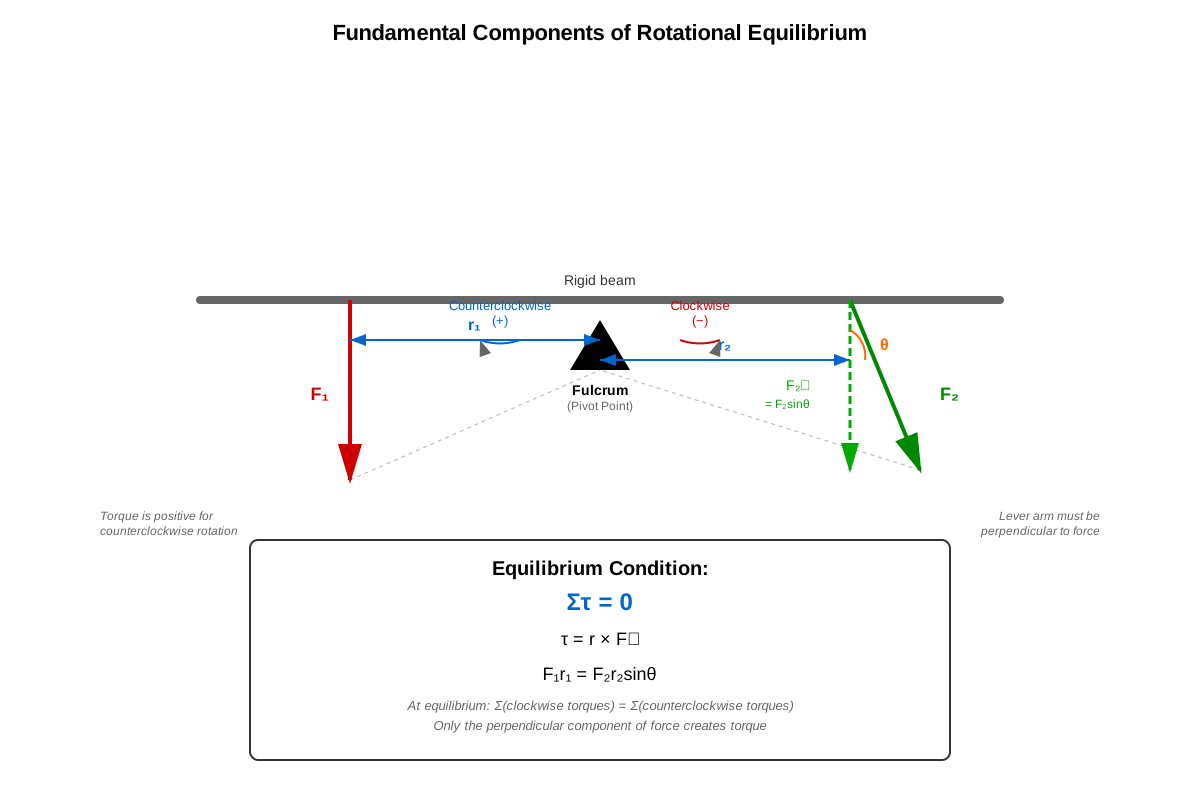
Rotational equilibrium exists when the vector sum of all torques acting on an object equals zero. Mathematically, this condition is expressed as:
Στ = 0Where τ (tau) represents torque. When this condition is satisfied, the object experiences no angular acceleration (α = 0), meaning it either remains stationary or continues rotating at constant angular velocity. For the vast majority of MCAT problems, rotational equilibrium describes objects at rest.
Torque (also called moment of force) is the rotational analog of force. It measures the tendency of a force to cause rotation about a specific axis or pivot point. Torque depends on three factors: the magnitude of the applied force, the distance from the pivot point to where the force is applied, and the angle at which the force acts relative to the lever arm.
Torque Calculation and Components
The magnitude of torque is calculated using:
τ = r × F × sin(θ)Or equivalently:
τ = r⊥ × FWhere:
- r is the distance from the pivot point to the point of force application
- F is the magnitude of the applied force
- θ is the angle between the force vector and the line connecting the pivot to the force application point
- r⊥ is the lever arm or moment arm—the perpendicular distance from the pivot to the line of action of the force
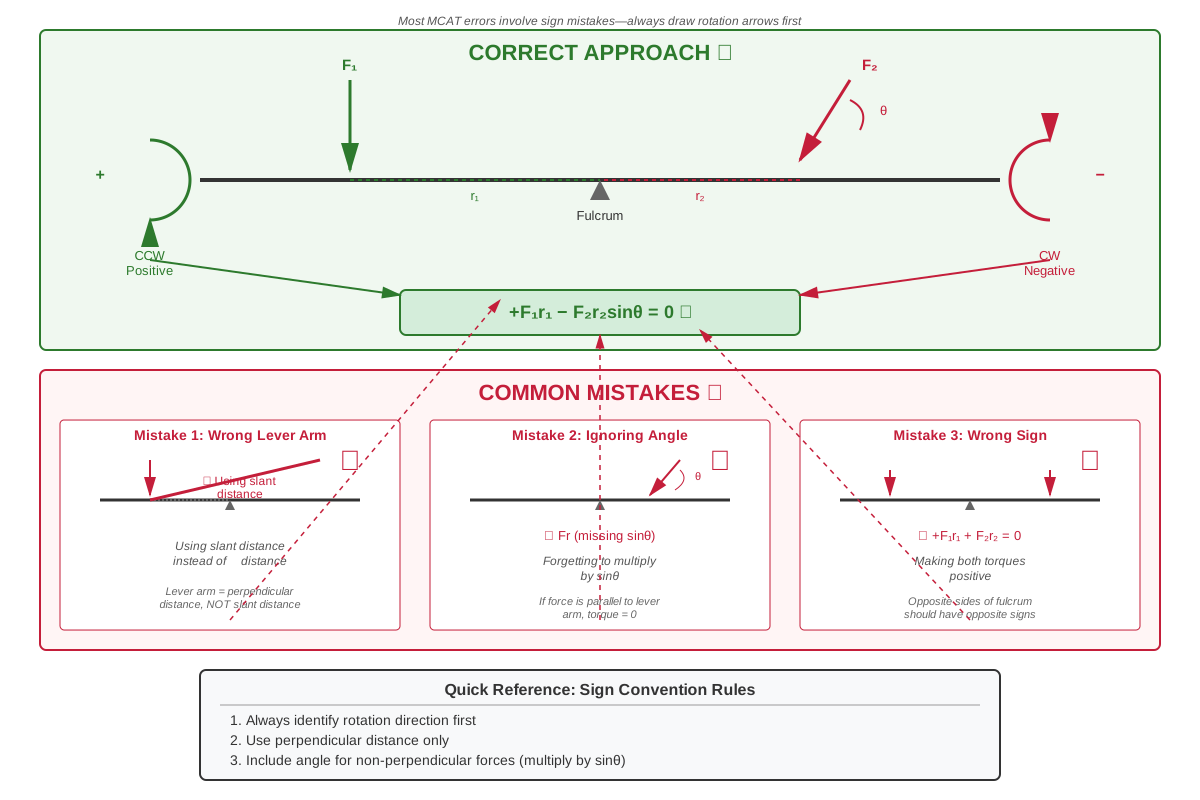
The lever arm concept is crucial for MCAT success. Only the component of force perpendicular to the position vector creates torque. Forces directed toward or away from the pivot point (parallel to r) produce zero torque because sin(0°) = 0 or sin(180°) = 0.
Sign Convention for Torque
Establishing a consistent sign convention is essential for solving equilibrium problems:
- Counterclockwise torques: Conventionally assigned positive (+) values
- Clockwise torques: Conventionally assigned negative (−) values
This convention is arbitrary but must remain consistent throughout a problem. For rotational equilibrium, the sum of positive (counterclockwise) torques must equal the sum of negative (clockwise) torques in magnitude.
Choosing the Pivot Point
A powerful problem-solving strategy involves the strategic selection of the pivot point (also called the axis of rotation or fulcrum). Key principles:
- The pivot point can be chosen anywhere, even at locations where no physical pivot exists
- Any force acting directly at the chosen pivot point produces zero torque (r = 0)
- Strategic pivot selection eliminates unknown forces from the torque equation, simplifying calculations
- The most efficient pivot choice typically places the axis at the location of an unknown force you wish to eliminate from the initial calculation
For example, when solving for tension in a cable supporting a beam, choosing the pivot at the beam's attachment point eliminates the unknown reaction forces at that point from the torque equation.
Conditions for Complete Equilibrium
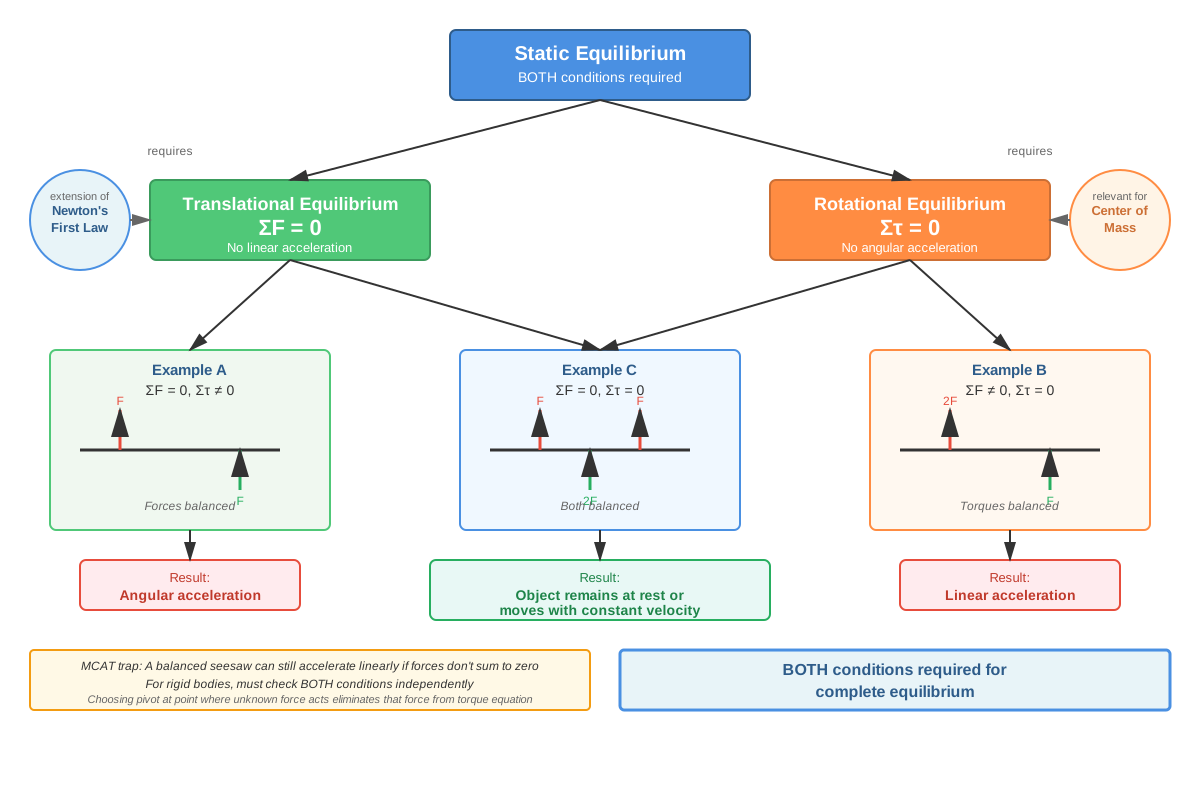
For an object to be in complete mechanical equilibrium, two conditions must be satisfied simultaneously:
| Equilibrium Type | Mathematical Condition | Physical Meaning |
|---|---|---|
| Translational Equilibrium | ΣF = 0 (in all directions) | No linear acceleration; object remains at rest or moves with constant velocity |
| Rotational Equilibrium | Στ = 0 (about any axis) | No angular acceleration; object remains stationary or rotates with constant angular velocity |
MCAT problems frequently require both conditions. The translational equilibrium condition provides additional equations (ΣFx = 0 and ΣFy = 0) that, combined with the rotational equilibrium equation, allow solving for multiple unknowns.
Center of Gravity and Uniform Objects
The center of gravity (or center of mass for uniform gravitational fields) is the point where the entire weight of an object can be considered to act. For uniform, symmetric objects:
- Uniform rods/beams: center of gravity at the geometric center (midpoint)
- Uniform rectangular plates: center of gravity at the intersection of diagonals
- Uniform spheres: center of gravity at the geometric center
When calculating torque due to an object's weight, treat the entire weight as acting at the center of gravity. For a uniform beam of length L supported at one end, the weight creates torque as if all mass were concentrated at L/2 from the support point.
Lever Systems and Mechanical Advantage
Levers are classified into three classes based on the relative positions of the fulcrum (F), effort force (E), and load/resistance (L):
First-class lever: F between E and L (examples: seesaw, crowbar, scissors)
Second-class lever: L between F and E (examples: wheelbarrow, nutcracker, door)
Third-class lever: E between F and L (examples: tweezers, most human joints, fishing rod)
Mechanical advantage (MA) is the ratio of output force to input force:
MA = F_out / F_in = r_in / r_outWhere r_in is the distance from the fulcrum to where effort is applied, and r_out is the distance from the fulcrum to where the load acts. Most human musculoskeletal levers are third-class (mechanical advantage < 1), meaning muscles must exert forces greater than the loads they move, but this arrangement provides greater range of motion and speed.
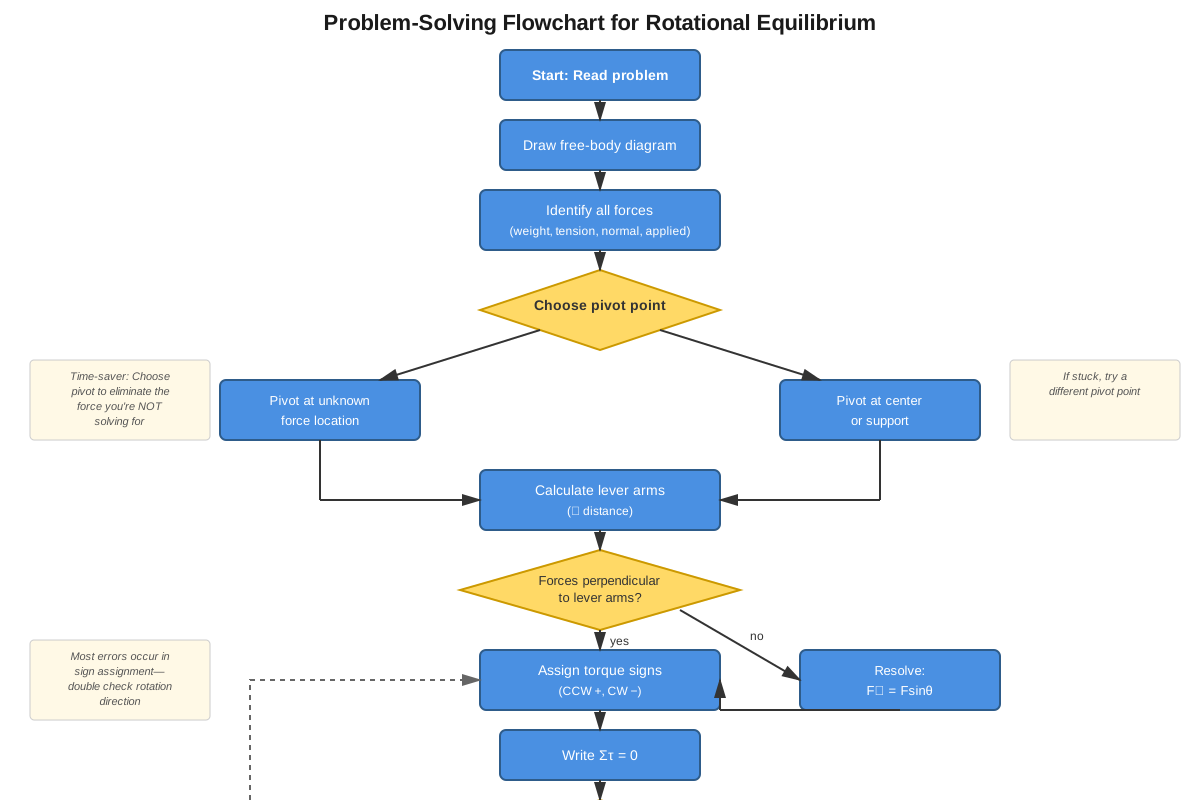
Static Equilibrium Problem-Solving Strategy
A systematic approach ensures success on MCAT rotational equilibrium problems:
- Draw a clear diagram showing all forces, distances, and angles
- Identify all forces acting on the object (weight, normal forces, tensions, applied forces)
- Choose a strategic pivot point to eliminate unknown forces
- Establish a coordinate system and sign convention for torques
- Calculate lever arms (perpendicular distances) for each force
- Write the torque equation: Στ = 0
- Write translational equilibrium equations if needed: ΣFx = 0, ΣFy = 0
- Solve the system of equations for unknowns
- Check the answer for physical reasonableness (positive forces, appropriate magnitudes)
Concept Relationships
Rotational equilibrium connects intimately with translational equilibrium—both represent special cases of Newton's Second Law. When net force equals zero (ΣF = 0), Newton's Second Law (F = ma) indicates zero linear acceleration. Similarly, when net torque equals zero (Στ = 0), the rotational analog (τ = Iα) indicates zero angular acceleration. These equilibrium conditions represent the foundation for analyzing static systems.
The concept of torque itself bridges force (a translational concept) with rotational motion. Torque = r × F demonstrates how the same force produces different rotational effects depending on where and how it's applied. This relationship extends to rotational dynamics: just as force causes linear acceleration (F = ma), torque causes angular acceleration (τ = Iα).
Center of gravity connects rotational equilibrium to the distribution of mass. Objects balance when supported at their center of gravity because the net torque from gravitational forces equals zero about that point. This concept extends to stability analysis: objects with lower centers of gravity are more stable because restoring torques are larger when tilted.
Lever systems demonstrate how rotational equilibrium principles enable mechanical advantage, connecting to work and energy concepts. While levers can multiply force, they cannot multiply work (W = F × d). A lever that doubles output force halves output distance, conserving energy (ignoring friction).
The problem-solving strategy for rotational equilibrium parallels that for translational equilibrium: identify forces, apply equilibrium conditions, solve equations. Many MCAT problems require both simultaneously, creating a system of equations. The strategic choice of pivot point in rotational problems mirrors the strategic choice of coordinate system in translational problems—both simplify calculations by eliminating certain terms.
Concept Flow: Force application → Torque generation (depends on lever arm and angle) → Net torque calculation → Equilibrium condition (Στ = 0) → Static configuration or constant rotation → Connects to translational equilibrium for complete system analysis → Extends to rotational dynamics when equilibrium is broken
High-Yield Facts
⭐ Rotational equilibrium requires net torque equals zero (Στ = 0), meaning the sum of clockwise torques equals the sum of counterclockwise torques
⭐ Torque equals force times perpendicular distance (lever arm): τ = r⊥F, where only the perpendicular component of force contributes to torque
⭐ Forces acting directly through the pivot point produce zero torque regardless of magnitude
⭐ The pivot point can be chosen anywhere for calculation purposes; strategic selection eliminates unknown forces from the torque equation
⭐ Complete mechanical equilibrium requires both ΣF = 0 (translational) and Στ = 0 (rotational) to be satisfied simultaneously
- The lever arm is the perpendicular distance from the pivot to the line of action of the force, not necessarily the distance to where the force is applied
- For uniform objects, weight acts at the center of gravity (geometric center for symmetric objects)
- Counterclockwise torques are conventionally positive; clockwise torques are conventionally negative
- Most human joints function as third-class levers (effort between fulcrum and load), providing speed and range of motion at the expense of mechanical advantage
- When an object is in rotational equilibrium about one point, it is in rotational equilibrium about all points
- The units of torque are N·m (newton-meters), which are dimensionally equivalent to but conceptually distinct from joules
- Torque is maximum when force is applied perpendicular to the lever arm (θ = 90°, sin(θ) = 1)
- An object can be in rotational equilibrium while moving (constant angular velocity) or while accelerating linearly
Quick check — test yourself on Rotational equilibrium so far.
Try Flashcards →Common Misconceptions
Misconception: Torque and work are the same because both have units of N·m.
Correction: While dimensionally equivalent, torque and work are conceptually distinct. Torque is a vector quantity describing rotational tendency, while work is a scalar describing energy transfer. Torque involves perpendicular distance; work involves parallel displacement.
Misconception: The lever arm is always the distance from the pivot to where the force is applied.
Correction: The lever arm is specifically the perpendicular distance from the pivot to the line of action of the force. If force is applied at an angle, the lever arm is shorter than the distance to the application point: r⊥ = r sin(θ).
Misconception: Heavier objects always produce more torque.
Correction: Torque depends on both force magnitude and lever arm. A lighter object farther from the pivot can produce greater torque than a heavier object closer to the pivot. This principle explains why extending your arms while holding weights makes exercises harder.
Misconception: The pivot point must be where a physical fulcrum or support exists.
Correction: The pivot point is a mathematical choice and can be selected anywhere to simplify calculations. Choosing the pivot at the location of an unknown force eliminates that force from the torque equation because its lever arm becomes zero.
Misconception: If an object is in rotational equilibrium, all torques must individually equal zero.
Correction: Individual torques can be non-zero; only the net torque (sum of all torques) must equal zero. Rotational equilibrium results from balanced opposing torques, not from absence of torques.
Misconception: Forces parallel to a beam or lever don't matter in equilibrium problems.
Correction: While forces parallel to the lever arm produce zero torque, they still affect translational equilibrium. Complete equilibrium analysis requires considering all forces in both the torque equation and the force balance equations (ΣFx = 0, ΣFy = 0).
Misconception: Mechanical advantage greater than 1 means you get more work output than input.
Correction: Mechanical advantage describes force multiplication, not work multiplication. Energy conservation requires work output ≤ work input. A lever with MA > 1 multiplies force but reduces displacement proportionally, keeping work constant (ignoring friction).
Worked Examples
Example 1: Uniform Beam with Multiple Forces
Problem: A uniform 6.0-m beam with mass 40 kg is supported at its left end by a hinge and at a point 4.0 m from the left end by a vertical cable. A 60-kg person stands 2.0 m from the left end. Find the tension in the cable.
Solution:
Step 1: Draw a diagram identifying all forces:
- Weight of beam: Wb = (40 kg)(10 m/s²) = 400 N, acting downward at 3.0 m (center of beam)
- Weight of person: Wp = (60 kg)(10 m/s²) = 600 N, acting downward at 2.0 m
- Tension in cable: T, acting upward at 4.0 m
- Reaction force at hinge: Fh (unknown magnitude and direction)
Step 2: Choose the pivot point strategically at the hinge (left end) to eliminate Fh from the torque equation.
Step 3: Establish sign convention: counterclockwise = positive, clockwise = negative.
Step 4: Calculate torques about the hinge:
- Torque from beam weight: τb = −(400 N)(3.0 m) = −1200 N·m (clockwise)
- Torque from person weight: τp = −(600 N)(2.0 m) = −1200 N·m (clockwise)
- Torque from cable tension: τT = +(T)(4.0 m) (counterclockwise)
- Torque from hinge force: τh = 0 (force acts at pivot)
Step 5: Apply rotational equilibrium condition:
Στ = 0
+(T)(4.0 m) + (−1200 N·m) + (−1200 N·m) = 0
T(4.0 m) = 2400 N·m
T = 600 NAnswer: The tension in the cable is 600 N.
Connection to learning objectives: This problem demonstrates strategic pivot selection to eliminate unknown forces, proper calculation of lever arms for distributed weight (center of gravity), and application of the rotational equilibrium condition to solve for an unknown force.
Example 2: Biomechanical Lever System
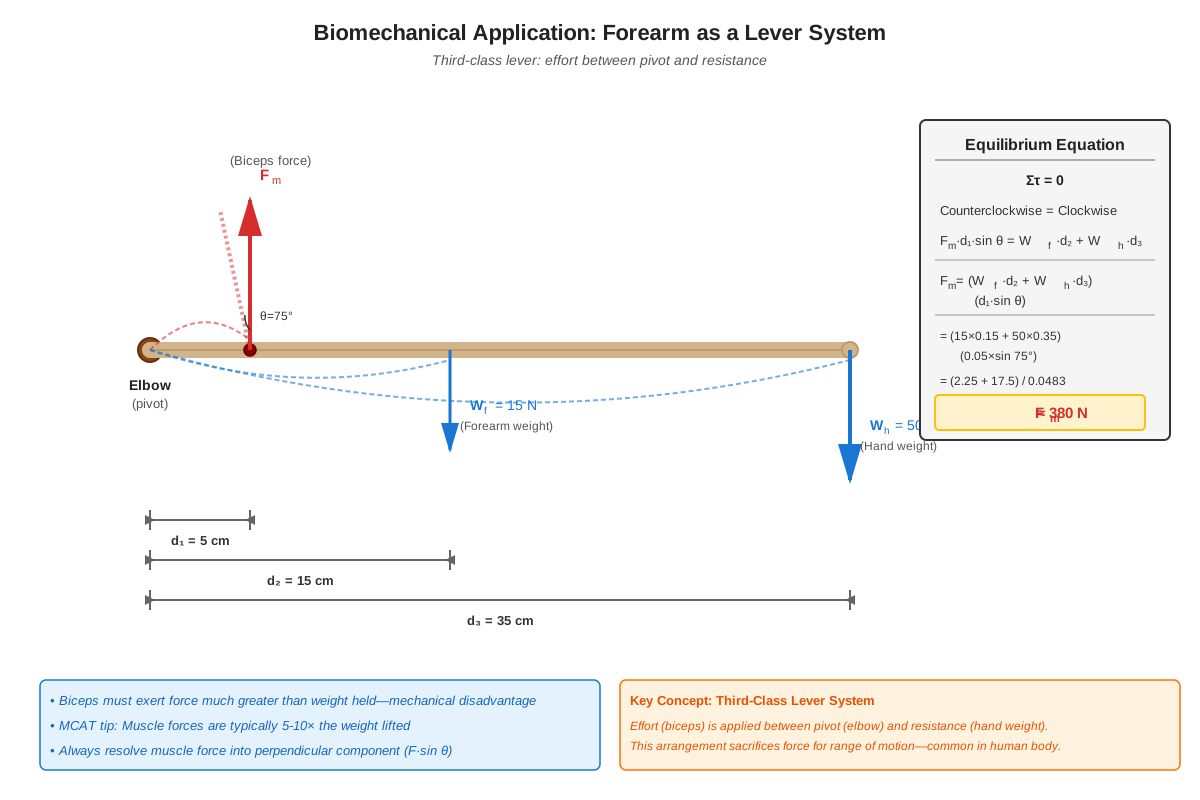
Problem: The human forearm acts as a third-class lever. The elbow joint serves as the fulcrum, the biceps muscle attaches 4.0 cm from the elbow and pulls upward, and a 50-N weight is held in the hand 35 cm from the elbow. The forearm itself weighs 15 N with its center of gravity 15 cm from the elbow. Assuming the forearm is horizontal and in equilibrium, calculate the force exerted by the biceps muscle.
Solution:
Step 1: Identify all forces and distances from the elbow (pivot):
- Biceps force: Fb (unknown), upward, at 4.0 cm = 0.04 m
- Forearm weight: Wf = 15 N, downward, at 15 cm = 0.15 m
- Hand-held weight: Wh = 50 N, downward, at 35 cm = 0.35 m
- Elbow reaction force: Fe (acts at pivot, produces zero torque)
Step 2: The pivot is naturally at the elbow joint.
Step 3: Sign convention: counterclockwise = positive, clockwise = negative.
Step 4: Calculate torques about the elbow:
- Torque from biceps: τb = +(Fb)(0.04 m) (counterclockwise)
- Torque from forearm: τf = −(15 N)(0.15 m) = −2.25 N·m (clockwise)
- Torque from held weight: τh = −(50 N)(0.35 m) = −17.5 N·m (clockwise)
Step 5: Apply rotational equilibrium:
Στ = 0
+(Fb)(0.04 m) + (−2.25 N·m) + (−17.5 N·m) = 0
Fb(0.04 m) = 19.75 N·m
Fb = 493.75 N ≈ 494 N
Step 6: Interpret the result: The biceps must exert approximately 494 N (about 10 times the held weight) because of the poor mechanical advantage of this third-class lever system. The muscle attachment is very close to the fulcrum compared to where the load acts.
Answer: The biceps muscle force is approximately 494 N.
Connection to learning objectives: This problem illustrates biomechanical applications of rotational equilibrium, demonstrates why muscles must exert forces much larger than the loads they move, and shows how third-class levers sacrifice mechanical advantage for range of motion—a key concept for understanding human physiology on the MCAT.
Exam Strategy
Approaching MCAT Rotational Equilibrium Questions
Begin by quickly sketching the system, even if a diagram is provided. Mark all forces with arrows, label distances from potential pivot points, and note any angles. This visual organization prevents errors and helps identify the most strategic pivot point. Spend 15-20 seconds on this step—it saves time later.
Trigger words and phrases that signal rotational equilibrium problems:
- "balanced," "in equilibrium," "remains stationary," "does not rotate"
- "lever," "seesaw," "beam," "plank," "rod"
- "fulcrum," "pivot point," "hinge," "support"
- "torque," "moment," "rotational tendency"
- "muscle attachment," "joint," "bone" (in biomechanical contexts)
- "perpendicular distance," "lever arm," "moment arm"
Strategic Pivot Selection
The most powerful exam strategy involves choosing the pivot point to eliminate the most complex unknown force. If a question asks for tension in a cable, place the pivot at the hinge or support where reaction forces act. If asked for a reaction force, place the pivot where the cable attaches. This strategy converts a potentially complex system of equations into a single equation with one unknown.
Process of Elimination Tips
When evaluating answer choices:
- Eliminate answers with incorrect units: Torque must have units of N·m or equivalent
- Check magnitude reasonableness: In third-class levers (most biological systems), muscle forces must exceed loads; eliminate answers showing muscle forces less than the weight being moved
- Verify direction: Upward forces must balance downward forces; if total downward forces equal 500 N, upward forces must sum to 500 N
- Test extreme cases: If a force moves farther from the pivot, its required magnitude to maintain equilibrium should decrease; eliminate answers that violate this principle
Time Allocation
For a typical 4-point rotational equilibrium question:
- 30 seconds: Read and understand the scenario
- 20 seconds: Draw and label diagram
- 15 seconds: Choose pivot point and identify relevant forces
- 45 seconds: Set up and solve equation
- 10 seconds: Check answer reasonableness and select choice
- Total: ~2 minutes
If a problem requires both rotational and translational equilibrium (system of equations), allocate 3-3.5 minutes. If you exceed this time, flag the question and move on—rotational equilibrium questions rarely justify spending more than 4 minutes.
Common Question Formats
Format 1: Direct calculation—given all but one force/distance, solve for the unknown. Strategy: Choose pivot to eliminate other unknowns, write Στ = 0, solve.
Format 2: Conceptual comparison—"If the person moves farther from the pivot, what happens to the cable tension?" Strategy: Recognize that increasing one torque requires increasing the opposing torque to maintain equilibrium.
Format 3: Biomechanical application—forces on bones, joints, or muscles. Strategy: Identify the joint as the pivot, recognize third-class lever configuration, expect muscle forces to exceed loads.
Format 4: Combined equilibrium—requires both Στ = 0 and ΣF = 0. Strategy: Use rotational equilibrium to find one unknown, then use translational equilibrium to find others.
Memory Techniques
Torque Calculation Mnemonic: "RFPS"
Radius (lever arm) × Force × Perpendicular (sine of angle) = Spin tendency (torque)
Remember: Only the Perpendicular component creates Spin.
Sign Convention: "Counter = Positive"
Counterclockwise torques are Positive. Both words start with consonants followed by vowels, creating a phonetic link. Visualize a clock running backward (counterclockwise) as a "positive" or "good" thing.
Lever Classes: "FLE 1-2-3"
- Fulcrum in middle = 1st class (think: "F" is the 1st letter in the alphabet that appears)
- Load in middle = 2nd class (think: "L" comes 2nd in "FLE")
- Effort in middle = 3rd class (think: "E" comes 3rd in "FLE")
Equilibrium Conditions: "FART"
Forces sum to zero (translational)
And
Rotational (torques) sum to zero
Together = complete equilibrium
Strategic Pivot Selection: "PUKE"
Pivot at the
Unknown you want to
Kill (eliminate)
Easily
Place the pivot where an unknown force acts to make its torque zero (r = 0), eliminating it from the equation.
Biomechanical Lever Visualization
Picture your forearm holding a weight: The elbow (fulcrum) is at one end, the biceps (effort) pulls close to the elbow, and the weight (load) is far away in your hand. This is the classic third-class lever—effort between fulcrum and load. Remember: "Third class = Terrible mechanical advantage" (but great range of motion).
Summary
Rotational equilibrium describes the state when net torque equals zero (Στ = 0), resulting in no angular acceleration. This condition, combined with translational equilibrium (ΣF = 0), defines complete mechanical equilibrium. Torque, the rotational analog of force, depends on force magnitude, lever arm (perpendicular distance from pivot to force's line of action), and the angle of force application (τ = rF sin θ). Strategic selection of the pivot point—which can be chosen anywhere—simplifies problem-solving by eliminating unknown forces from the torque equation. MCAT applications emphasize biomechanical systems where bones act as levers, joints serve as fulcrums, and muscles provide forces, typically in third-class lever configurations that sacrifice mechanical advantage for range of motion. Success requires systematic problem-solving: draw clear diagrams, identify all forces, choose strategic pivot points, establish sign conventions, calculate lever arms correctly, and apply equilibrium conditions. Understanding that forces through the pivot produce zero torque, that only perpendicular force components create torque, and that complete equilibrium requires both rotational and translational balance enables confident navigation of exam questions.
Key Takeaways
- Rotational equilibrium exists when Στ = 0, meaning clockwise and counterclockwise torques balance exactly
- Torque equals force times perpendicular distance (τ = r⊥F), with only the perpendicular component of force contributing to rotational tendency
- Strategic pivot selection eliminates unknown forces from the torque equation by placing the axis where those forces act (making r = 0)
- Complete equilibrium requires both Στ = 0 and ΣF = 0, providing multiple equations to solve for multiple unknowns
- Biomechanical systems typically use third-class levers where muscles attach close to joints, requiring forces much larger than the loads being moved
- Lever arm is perpendicular distance to the force's line of action, not necessarily the distance to where force is applied
- Center of gravity for uniform objects is at the geometric center, where the entire weight can be considered to act for torque calculations
Related Topics
Rotational Dynamics: Extends equilibrium concepts to systems with non-zero net torque, introducing angular acceleration, moment of inertia, and the rotational analog of Newton's Second Law (τ = Iα). Mastering rotational equilibrium provides the foundation for understanding how torques cause angular acceleration.
Angular Momentum: Builds on rotational concepts to describe the quantity of rotational motion (L = Iω) and its conservation in isolated systems. Understanding equilibrium (where angular acceleration is zero) helps contextualize situations where angular momentum changes.
Work and Energy in Rotational Systems: Connects torque to rotational work (W = τθ) and rotational kinetic energy (KE = ½Iω²). The relationship between force, distance, and work in translational systems parallels the relationship between torque, angular displacement, and rotational work.
Biomechanics and Human Movement: Applies rotational equilibrium principles to analyze forces in joints, muscles, and bones during various activities. This topic integrates physics with anatomy and physiology, appearing frequently in MCAT passages.
Statics and Structural Analysis: Extends equilibrium concepts to complex structures like bridges, buildings, and trusses. While less common on the MCAT, understanding how forces and torques balance in extended structures reinforces core equilibrium principles.
Practice CTA
Now that you've mastered the core concepts of rotational equilibrium, it's time to solidify your understanding through active practice. Attempt the practice questions and work through the flashcards to reinforce key definitions, formulas, and problem-solving strategies. Focus especially on problems requiring strategic pivot selection and biomechanical applications—these represent the highest-yield question types for the MCAT. Remember: understanding the concepts is essential, but exam success requires applying them quickly and accurately under time pressure. Each practice problem you complete builds the pattern recognition and confidence needed to excel on test day. You've built a strong foundation—now strengthen it through deliberate practice!
Sign up free to keep reading
Create a free AnvayaPrep account to finish this MCAT guide on Rotational equilibrium — plus flashcards and practice questions.