Overview
Uniform circular motion is a fundamental concept in Mechanics that describes the motion of an object traveling in a circular path at constant speed. While the speed remains constant, the velocity continuously changes because the direction of motion is constantly changing. This seemingly paradoxical situation—constant speed yet changing velocity—makes uniform circular motion a critical topic for understanding the relationship between velocity, acceleration, and force. The concept appears throughout Physics and extends into biological applications, from centrifuges used in laboratory settings to the biomechanics of joint rotation and blood flow through curved vessels.
For the MCAT, uniform circular motion represents a medium-difficulty topic that frequently appears in both passage-based and discrete questions. The MCAT tests not only the mathematical relationships governing circular motion but also the conceptual understanding of why an object moving in a circle must be accelerating even when its speed is constant. This topic integrates vector concepts, Newton's laws, and energy principles, making it an excellent bridge between kinematics and dynamics. Students must be comfortable switching between linear and angular quantities, understanding centripetal acceleration and force, and recognizing circular motion in biological and medical contexts.
Uniform circular motion MCAT questions often appear in passages describing centrifugation techniques for separating blood components, the motion of particles in cyclotrons or mass spectrometers, or the biomechanics of human movement. The topic connects directly to Newton's second law, work and energy, gravitation, and even electromagnetism when charged particles move in magnetic fields. Mastering this topic provides the foundation for understanding more complex rotational dynamics and prepares students for interdisciplinary questions that combine physics principles with biological applications.
Learning Objectives
- [ ] Define uniform circular motion using accurate Physics terminology
- [ ] Explain why uniform circular motion matters for the MCAT
- [ ] Apply uniform circular motion to exam-style questions
- [ ] Identify common mistakes related to uniform circular motion
- [ ] Connect uniform circular motion to related Physics concepts
- [ ] Calculate centripetal acceleration and centripetal force for objects in circular motion
- [ ] Distinguish between centripetal and tangential components of motion
- [ ] Analyze the relationship between period, frequency, and angular velocity in circular motion
- [ ] Apply uniform circular motion principles to laboratory equipment and biological systems
Prerequisites
- Vector quantities and vector addition: Understanding that velocity and acceleration are vectors with both magnitude and direction is essential for recognizing why circular motion involves acceleration despite constant speed
- Newton's laws of motion: The second law (F = ma) forms the basis for understanding centripetal force, while the first law explains why circular motion requires a continuous inward force
- Kinematics equations: Familiarity with displacement, velocity, and acceleration relationships helps in transitioning from linear to circular motion concepts
- Basic trigonometry: Sine, cosine, and understanding of angles are necessary for decomposing vectors and working with angular measurements
- Work and energy principles: Energy conservation applies to circular motion problems and helps verify solutions obtained through force analysis
Why This Topic Matters
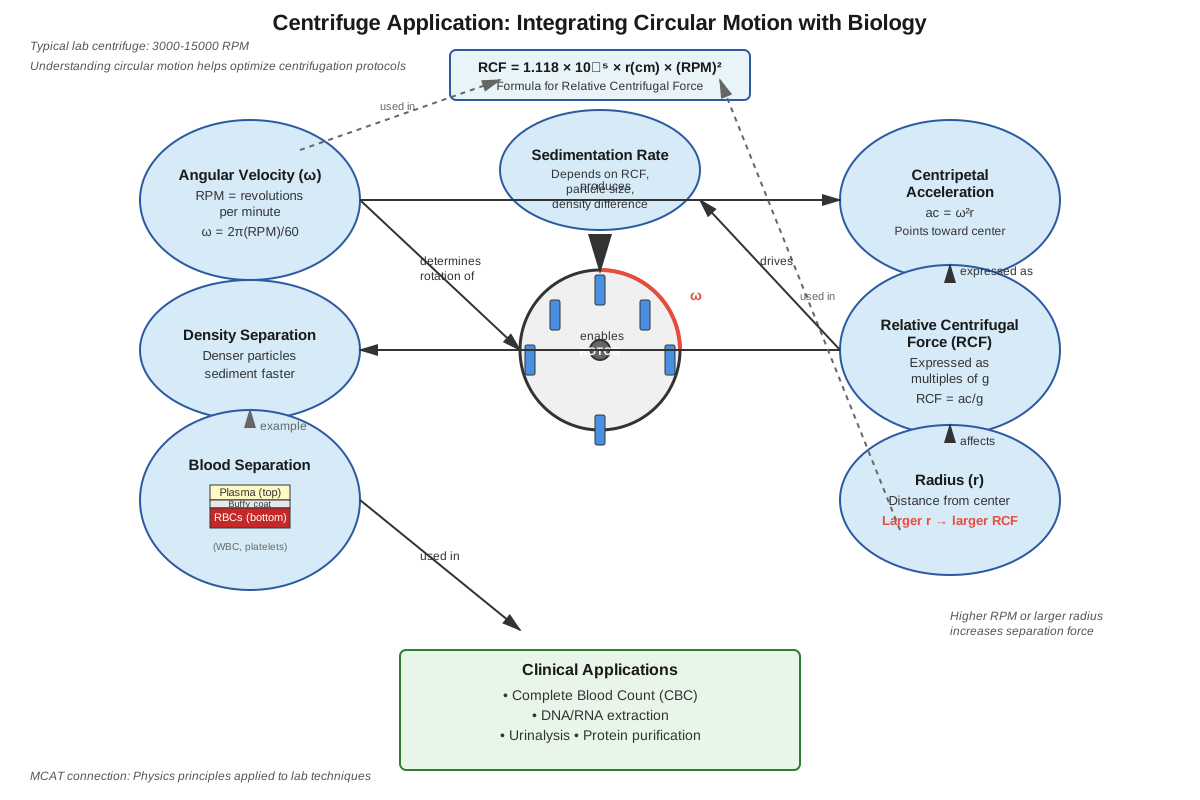
Uniform circular motion has direct clinical and laboratory relevance that makes it particularly important for future medical professionals. Centrifugation is one of the most common laboratory techniques in medicine, used to separate blood components (plasma, red blood cells, white blood cells, platelets), isolate DNA and proteins, and prepare samples for analysis. Understanding the physics of circular motion explains why denser components migrate to the outer radius and how centrifugal force (the apparent outward force in the rotating reference frame) relates to the actual centripetal force. Medical imaging techniques like CT scans involve circular motion of X-ray sources, and understanding the physics helps interpret image acquisition parameters.
On the MCAT, uniform circular motion appears in approximately 2-4% of Physics questions, making it a medium-yield topic that students cannot afford to ignore. Questions typically appear in two formats: discrete questions testing direct application of formulas and conceptual understanding, and passage-based questions embedding circular motion within laboratory techniques, particle physics, or biomechanics contexts. The AAMC particularly favors questions that test whether students understand that centripetal acceleration points toward the center of the circle and that centripetal force is not a new type of force but rather the net force causing circular motion.
Common MCAT passage contexts include: centrifuges separating cellular components based on density and size; mass spectrometers using magnetic fields to curve charged particle paths for molecular weight determination; descriptions of satellite or planetary motion (connecting to gravitation); particles in cyclotrons or other circular accelerators; and biomechanical analyses of joint rotation or curved motion in sports medicine. The exam frequently tests whether students can identify the source of centripetal force in different situations (tension, gravity, friction, normal force, or electromagnetic force) and whether they recognize that "centrifugal force" is a fictitious force that only appears in rotating reference frames.
Core Concepts
Definition of Uniform Circular Motion
Uniform circular motion occurs when an object travels along a circular path at constant speed. The term "uniform" specifically refers to the constancy of the speed (the magnitude of velocity), not the velocity vector itself. This distinction is crucial: while speed remains constant, velocity continuously changes because the direction of motion is constantly changing. Since velocity is a vector quantity with both magnitude and direction, any change in direction constitutes a change in velocity, which by definition means the object is accelerating.
The circular path is characterized by a constant radius (r) from the center of the circle to the object's position. The object maintains a fixed distance from the center throughout its motion, distinguishing circular motion from spiral or elliptical paths. The speed (v) represents the rate at which the object covers distance along the circular path and remains constant throughout uniform circular motion.
Centripetal Acceleration
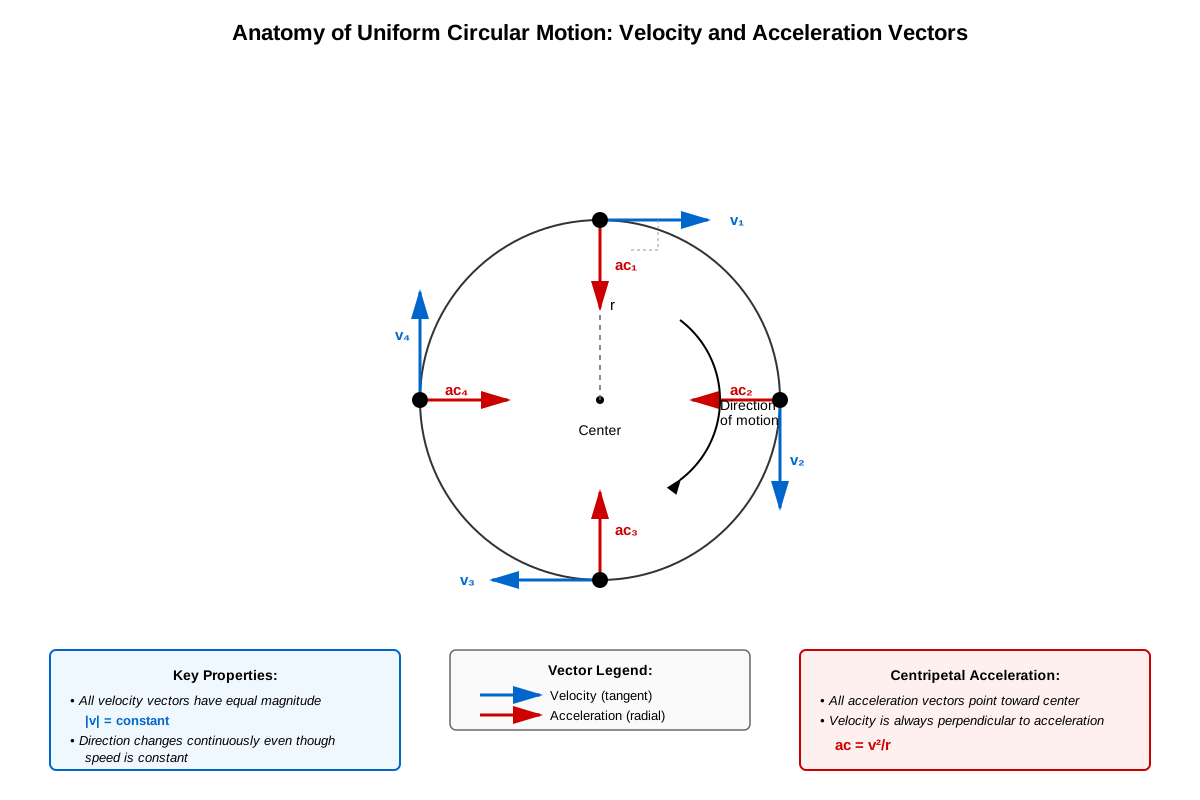
Since velocity changes continuously in uniform circular motion, the object must be accelerating. This acceleration, called centripetal acceleration (ac), always points toward the center of the circle. The magnitude of centripetal acceleration is given by:
a_c = v²/r = ω²rwhere v is the linear speed, r is the radius of the circular path, and ω (omega) is the angular velocity. The direction of centripetal acceleration is always perpendicular to the velocity vector and points radially inward toward the center.
The derivation of this relationship comes from analyzing the change in velocity vectors. Even though the magnitude of velocity remains constant, the direction changes continuously. Over a small time interval, the change in velocity vector points toward the center of the circle, establishing that acceleration must be centripetal (center-seeking). The magnitude depends on both how fast the object moves (v) and how tight the curve is (smaller r means sharper curve and greater acceleration).
Centripetal Force
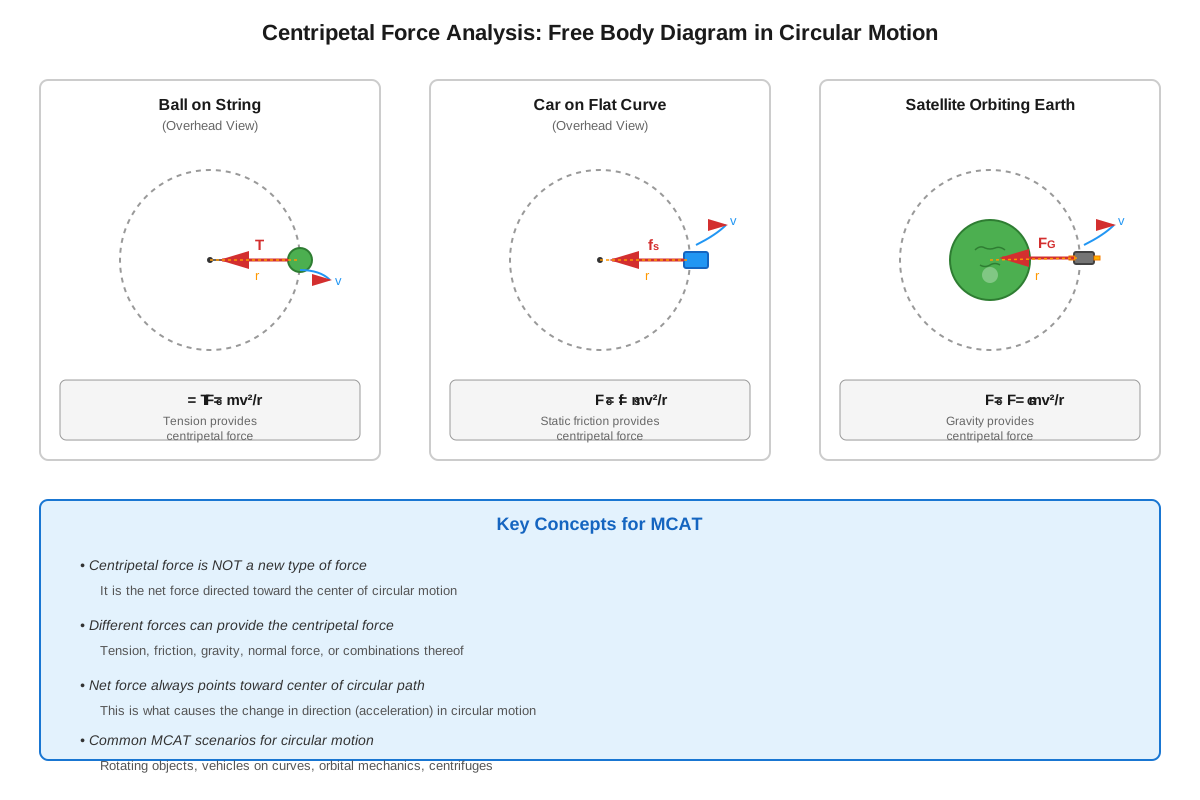
According to Newton's second law, acceleration requires a net force. The net force causing centripetal acceleration is called centripetal force (Fc), given by:
F_c = ma_c = mv²/r = mω²rwhere m is the mass of the object. Centripetal force is not a new type of force but rather describes the role that one or more real forces play in causing circular motion. The centripetal force is always the net force pointing toward the center of the circle.
Different physical forces can provide centripetal force depending on the situation:
- Tension in a string when whirling an object in a circle
- Gravitational force for satellites orbiting Earth or planets orbiting the Sun
- Friction for a car turning on a flat road
- Normal force component for a car on a banked curve or object on a rotating platform
- Magnetic force for charged particles moving in magnetic fields
A critical conceptual point: centripetal force causes circular motion; it does not result from circular motion. Students must identify which real force or combination of forces provides the necessary centripetal force in each situation.
Angular Quantities
Circular motion can be described using angular quantities that often simplify calculations and provide additional insight:
| Linear Quantity | Angular Quantity | Relationship |
|---|---|---|
| Displacement (s) | Angular displacement (θ) | s = rθ |
| Velocity (v) | Angular velocity (ω) | v = rω |
| Acceleration (a) | Angular acceleration (α) | a = rα |
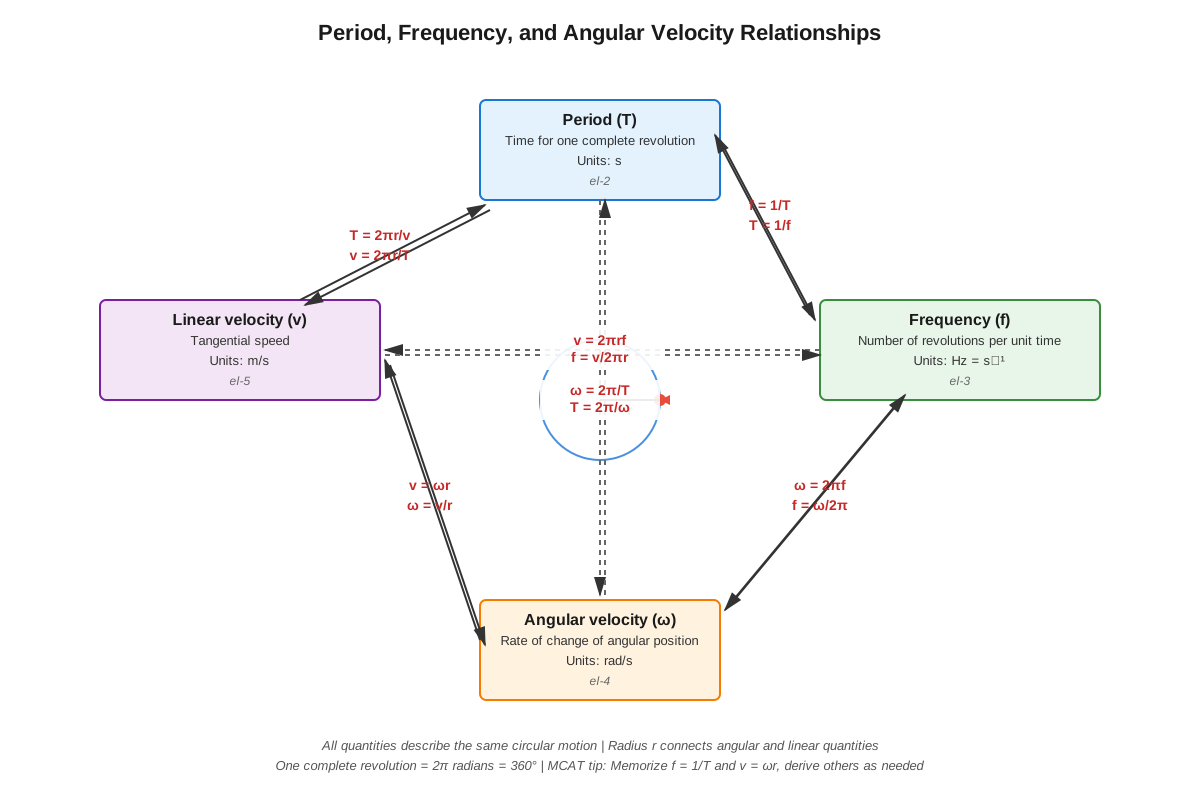
Angular velocity (ω) measures how quickly the object sweeps through angles, typically measured in radians per second (rad/s). For uniform circular motion, angular velocity remains constant. The relationship v = rω connects linear and angular descriptions: objects farther from the center (larger r) must move faster linearly to maintain the same angular velocity.
Period (T) is the time required for one complete revolution, while frequency (f) is the number of revolutions per unit time. These quantities relate to angular velocity through:
ω = 2π/T = 2πfSince one complete revolution covers 2π radians, these relationships follow naturally. Period and frequency are reciprocals: f = 1/T.
Tangential vs. Radial Components
Motion in a circle can be analyzed by decomposing vectors into two perpendicular components:
Radial (centripetal) direction: Points toward or away from the center along the radius. In uniform circular motion, acceleration has only a radial component (pointing inward), and this component has constant magnitude. Velocity has no radial component because the object neither approaches nor recedes from the center.
Tangential direction: Points along the direction of motion, tangent to the circle. In uniform circular motion, velocity has only a tangential component with constant magnitude. Acceleration has no tangential component because speed doesn't change. If tangential acceleration existed, the speed would increase or decrease, making the motion non-uniform.
This decomposition is particularly useful for analyzing non-uniform circular motion (where speed changes) or for understanding forces in circular motion. For example, when analyzing a car on a banked curve, the normal force and gravitational force can be decomposed into radial and tangential components to determine the net centripetal force.
Energy Considerations
In uniform circular motion, the kinetic energy remains constant because speed is constant:
KE = (1/2)mv²Since kinetic energy doesn't change, the net work done on the object is zero. This makes sense because the centripetal force is always perpendicular to the velocity (and thus to the displacement), and work equals force times displacement times the cosine of the angle between them. When the angle is 90°, cos(90°) = 0, so no work is done.
This principle has important implications: the force causing circular motion doesn't add or remove energy from the system. For example, gravitational force does no net work on a satellite in circular orbit, and tension does no work on a ball being whirled in a horizontal circle. Energy considerations often provide the quickest solution method for problems involving circular motion combined with other motion types.
Reference Frames and Centrifugal Force
In an inertial (non-accelerating) reference frame, only centripetal force exists, pointing toward the center and causing the circular motion. However, in a rotating (non-inertial) reference frame—such as the perspective of someone riding on a merry-go-round—objects appear to experience an outward "centrifugal force." This is a fictitious force (also called a pseudo-force) that arises from the acceleration of the reference frame itself, not from any physical interaction.
The MCAT may test whether students recognize that centrifugal force is not a real force in an inertial frame. In the rotating frame, centrifugal force appears to balance centripetal force, making objects seem stationary. However, from an external inertial frame, only the real centripetal force exists, causing the continuous acceleration toward the center. Understanding this distinction prevents errors in force diagrams and applications of Newton's laws.
Concept Relationships
The concepts within uniform circular motion form a tightly interconnected framework. Constant speed combined with changing direction necessitates centripetal acceleration, which through Newton's second law requires centripetal force. The magnitude of centripetal acceleration depends on both the linear speed and the radius of the path, establishing the fundamental relationship ac = v²/r. This relationship can be expressed equivalently using angular velocity through the connection v = rω, yielding ac = ω²r.
Period and frequency describe the temporal aspects of circular motion and connect directly to angular velocity through ω = 2πf = 2π/T. These relationships allow conversion between different descriptions of the same motion: knowing any one of speed, angular velocity, period, or frequency (along with the radius) allows calculation of all others.
The connection to prerequisite topics is extensive. Vector analysis underlies the understanding that velocity changes even when speed doesn't, because direction changes. Newton's second law (F = ma) directly yields the centripetal force equation when applied with centripetal acceleration. Kinematics provides the foundation for understanding speed, velocity, and acceleration, which extend into the circular motion context.
Uniform circular motion connects forward to several advanced topics. Gravitation applies circular motion principles to orbital mechanics, where gravitational force provides the centripetal force. Rotational dynamics extends circular motion concepts to rigid bodies, introducing moment of inertia and angular momentum. Electromagnetism uses circular motion when analyzing charged particles in magnetic fields, where magnetic force provides centripetal force. Simple harmonic motion relates to circular motion through the projection of uniform circular motion onto a diameter, which produces sinusoidal motion.
The relationship map flows as follows:
Constant speed + Changing direction → Changing velocity → Centripetal acceleration → Centripetal force (via Newton's 2nd law) → Identification of real force providing Fc → Application to specific scenarios (centrifuge, orbits, curves, etc.)
Quick check — test yourself on Uniform circular motion so far.
Try Flashcards →High-Yield Facts
⭐ Centripetal acceleration always points toward the center of the circle and has magnitude ac = v²/r = ω²r, even though speed is constant
⭐ Centripetal force is not a separate type of force but rather the net force pointing toward the center; it must be provided by real forces like tension, gravity, friction, or normal force
⭐ The velocity vector in uniform circular motion is always tangent to the circle and perpendicular to the radius at that point
⭐ Period and frequency are reciprocals: T = 1/f, and both relate to angular velocity by ω = 2πf = 2π/T
⭐ No work is done by centripetal force because it is always perpendicular to the displacement, so kinetic energy remains constant in uniform circular motion
- The linear speed and angular velocity relate through v = rω, meaning objects farther from the center move faster linearly for the same angular velocity
- Centrifugal force is a fictitious force that only appears in rotating reference frames; in inertial frames, only centripetal force exists
- For an object to maintain circular motion at constant speed, the net force must equal mv²/r directed toward the center; any deviation causes the path to change
- In a centrifuge, the centripetal acceleration can be expressed as a multiple of g (gravitational acceleration), with clinical centrifuges typically operating at 1,000-15,000 g
- When analyzing banked curves, the horizontal component of the normal force provides centripetal force, allowing turns without relying on friction
- The minimum speed for a vertical circle (like a loop-the-loop) at the top requires that gravity alone can provide the necessary centripetal force: v_min = √(gr)
- Mass spectrometers use the relationship r = mv/(qB) for charged particles in magnetic fields, where radius depends on mass, allowing separation by mass-to-charge ratio
Common Misconceptions
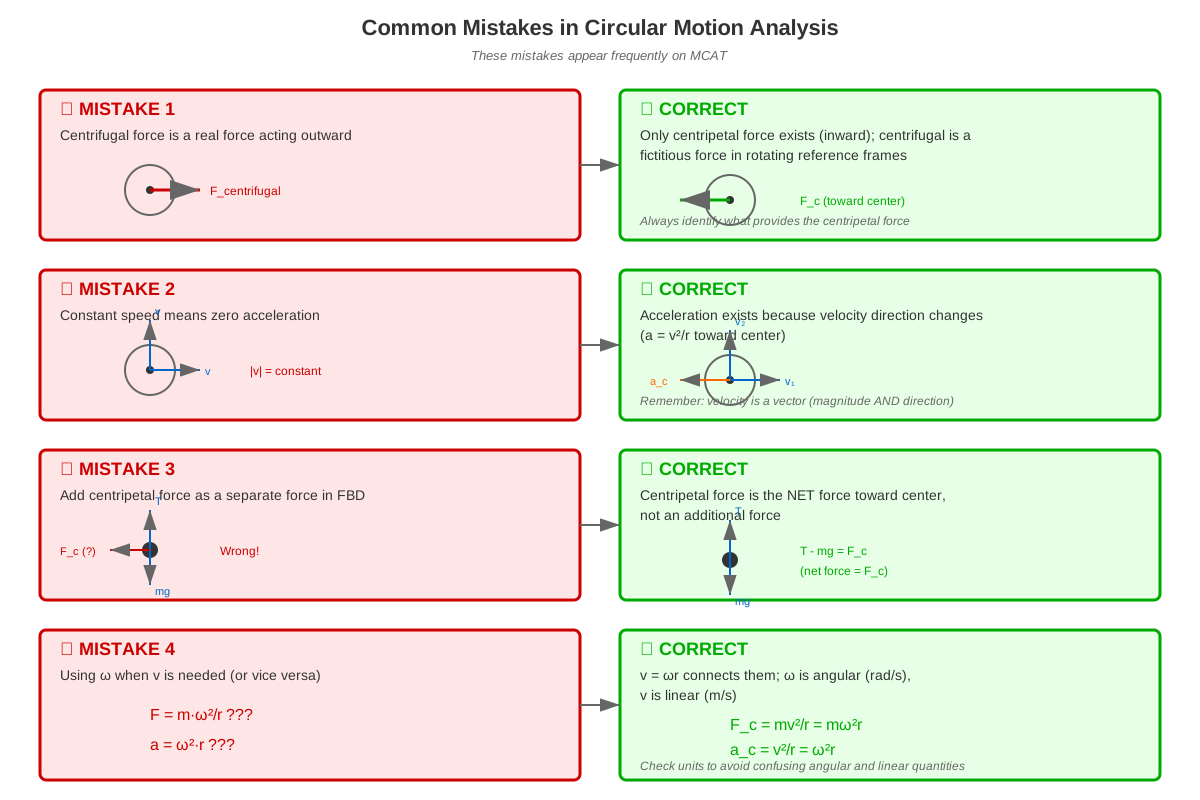
Misconception: Objects in uniform circular motion are not accelerating because their speed is constant.
Correction: Acceleration is the rate of change of velocity (a vector), not speed (a scalar). Since the direction of velocity continuously changes in circular motion, the object is constantly accelerating toward the center with magnitude ac = v²/r, even though speed remains constant.
Misconception: Centrifugal force is a real force that pushes objects outward in circular motion.
Correction: Centrifugal force is a fictitious force that only appears in rotating (non-inertial) reference frames. In an inertial reference frame, only the centripetal force exists, pulling the object inward. The sensation of being "pushed outward" in a rotating car results from inertia—your body tends to continue in a straight line while the car turns.
Misconception: Centripetal force and centrifugal force are action-reaction pairs according to Newton's third law.
Correction: These are not action-reaction pairs. Centripetal force is the net real force causing circular motion (pointing inward), while centrifugal force is fictitious. The actual action-reaction pair involves the centripetal force and the force the object exerts back on whatever is providing the centripetal force (e.g., if tension pulls the object inward, the object pulls outward on the string).
Misconception: Centripetal acceleration increases when the radius of the circular path increases (for constant speed).
Correction: Centripetal acceleration ac = v²/r is inversely proportional to radius when speed is constant. A larger radius means a gentler curve requiring less acceleration to change direction. A tighter curve (smaller r) requires greater acceleration to change direction more rapidly.
Misconception: An object moving in a circle has constant velocity.
Correction: Velocity is a vector with both magnitude and direction. While the magnitude (speed) is constant in uniform circular motion, the direction continuously changes, so velocity is not constant. Constant velocity would mean motion in a straight line at constant speed.
Misconception: The centripetal force does work on the object, maintaining its circular motion.
Correction: Work equals W = Fd cos(θ), where θ is the angle between force and displacement. Since centripetal force is always perpendicular to the velocity (and thus to the displacement), θ = 90° and cos(90°) = 0, so no work is done. The kinetic energy remains constant, and no energy input is needed to maintain uniform circular motion (though energy may be needed to overcome friction or air resistance).
Misconception: In a vertical circle, the tension in the string is constant throughout the motion.
Correction: Tension varies with position in a vertical circle. At the bottom, tension must provide centripetal force and support the weight (T = mv²/r + mg). At the top, both tension and weight point toward the center, so T = mv²/r - mg. The tension is greatest at the bottom and least at the top.
Worked Examples
Example 1: Centrifuge Separation
Problem: A laboratory centrifuge rotates at 3,600 rpm (revolutions per minute). A sample tube is positioned so that the blood sample is 12 cm from the axis of rotation. Calculate: (a) the angular velocity in rad/s, (b) the linear speed of the sample, (c) the centripetal acceleration in m/s² and as a multiple of g, and (d) the centripetal force on a 2.0 mg red blood cell in the sample.
Solution:
(a) First, convert rpm to rad/s:
ω = 3,600 rev/min × (1 min/60 s) × (2π rad/rev)
ω = 3,600 × 2π/60 = 120π rad/s ≈ 377 rad/s
(b) Linear speed using v = rω:
v = rω = (0.12 m)(377 rad/s) = 45.2 m/s(c) Centripetal acceleration using ac = ω²r:
a_c = ω²r = (377 rad/s)²(0.12 m) = 17,040 m/s²As a multiple of g (where g = 9.8 m/s²):
a_c = 17,040/9.8 ≈ 1,740g(d) Centripetal force on the red blood cell:
F_c = ma_c = (2.0 × 10^{-6} kg)(17,040 m/s²) = 0.034 N = 34 mNKey insights: This example demonstrates why centrifuges effectively separate blood components. The centripetal acceleration of 1,740g is nearly 2,000 times stronger than gravity, causing rapid sedimentation based on density differences. Denser red blood cells experience greater effective weight in the rotating frame and migrate to the outer radius, while less dense plasma remains closer to the center. This problem integrates angular and linear quantities, showing how to convert between different representations of circular motion.
Example 2: Banked Curve Analysis
Problem: A highway curve has a radius of 80 m and is banked at an angle of 15° from the horizontal. (a) What is the ideal speed for this curve—the speed at which a car can navigate the curve with no friction? (b) If a car travels at 25 m/s on this curve, what minimum coefficient of static friction is required to prevent sliding?
Solution:
(a) For the ideal speed, the horizontal component of the normal force provides exactly the needed centripetal force, with no friction required.
Setting up force components:
- Vertical: N cos(15°) = mg (no vertical acceleration)
- Horizontal: N sin(15°) = mv²/r (centripetal force)
Dividing the horizontal equation by the vertical equation:
tan(15°) = v²/(rg)
v² = rg tan(15°) = (80 m)(9.8 m/s²)(0.268)
v² = 210 m²/s²
v = 14.5 m/s
(b) At 25 m/s, the car is traveling faster than the ideal speed, so friction must point down the incline (toward the center) to provide additional centripetal force.
The required centripetal force is:
F_c = mv²/r = m(25)²/80 = 7.81m NForce analysis with friction:
- Radial (toward center): N sin(15°) + f cos(15°) = mv²/r
- Vertical: N cos(15°) - f sin(15°) = mg
From the vertical equation: N = (mg + f sin(15°))/cos(15°)
Substituting into the radial equation and using f = μN:
After algebraic manipulation:
μ = (v²/rg - tan(15°))/(1 + v²tan(15°)/rg)
μ = (7.81/9.8 - 0.268)/(1 + 7.81(0.268)/9.8)
μ = (0.797 - 0.268)/(1 + 0.214) = 0.529/1.214 ≈ 0.44
Key insights: Banking curves allows cars to navigate turns at higher speeds by using the normal force component rather than relying solely on friction. The ideal speed depends only on the radius, banking angle, and gravity—not on the car's mass. When traveling faster than the ideal speed, friction must supplement the normal force component. This problem demonstrates how to decompose forces in two dimensions and apply Newton's second law with centripetal acceleration, a common MCAT problem type.
Exam Strategy
When approaching MCAT questions on uniform circular motion, begin by identifying what provides the centripetal force in the specific scenario. This is often the key to solving the problem correctly. Draw a clear free-body diagram showing all real forces acting on the object, then determine which force or force component points toward the center of the circle. Remember that centripetal force is not an additional force to add to your diagram—it's the net force resulting from the real forces present.
Trigger words and phrases that signal uniform circular motion problems include: "circular path," "revolves," "rotates at constant speed," "centrifuge," "banked curve," "satellite in orbit," "horizontal circle," "vertical loop," "mass spectrometer," and "cyclotron." When you see these terms, immediately think about centripetal acceleration and force, and identify the radius and speed (or angular velocity).
For process of elimination, watch for answer choices that:
- Claim centrifugal force is a real force in an inertial frame (eliminate these)
- State that objects in uniform circular motion have constant velocity (eliminate—velocity changes even though speed doesn't)
- Suggest that centripetal acceleration is zero because speed is constant (eliminate)
- Show centripetal force pointing outward or tangent to the circle (eliminate—it must point toward the center)
- Indicate that work is done by centripetal force (eliminate—force perpendicular to displacement does no work)
Time allocation: Discrete questions on circular motion typically require 60-90 seconds. Spend 15-20 seconds identifying the scenario and what provides centripetal force, 30-40 seconds setting up the equation and solving, and 10-15 seconds checking that your answer makes physical sense. For passage-based questions, spend 2-3 minutes on the passage, then 60-90 seconds per question. If a problem involves both circular motion and another topic (like energy conservation or gravitation), budget an additional 30 seconds.
Quick checks for your answers:
- Does centripetal acceleration increase when speed increases or radius decreases? (Yes to both)
- Is the centripetal force proportional to mass? (Yes—heavier objects need more force for the same circular motion)
- Does your identified centripetal force point toward the center? (Must be yes)
- If solving for speed, does it have units of m/s? If solving for angular velocity, does it have units of rad/s?
When passages describe centrifuges, focus on the relationship between rotation rate, radius, and the resulting centripetal acceleration expressed as multiples of g. For mass spectrometer passages, remember that radius depends on mass (r = mv/qB), allowing separation by mass-to-charge ratio. For biomechanics passages involving joint rotation, identify the axis of rotation and the radius from the axis to the point of interest.
Memory Techniques
Mnemonic for centripetal force direction: "Centripetal means Center-seeking" — the force always points toward the center of the circle, never outward or tangent to the path.
Acronym for circular motion quantities: VORTEX
- Velocity (tangent to circle)
- Omega (angular velocity, ω)
- Radius
- Time period
- Energy (kinetic, constant)
- X-acceleration (centripetal, toward center)
Visualization strategy: Picture a ball on a string being whirled in a horizontal circle. The string tension pulls inward (centripetal force), the ball moves tangent to the circle (velocity direction), and if the string breaks, the ball flies off tangent to the circle at that instant (demonstrating that velocity is tangent, not radial). This mental image helps distinguish between force direction (radial inward) and velocity direction (tangential).
Formula relationship memory: Remember "V-squared over R" (v²/r) as the core relationship for centripetal acceleration. All other forms derive from this:
- Multiply by mass to get force: F = mv²/r
- Substitute v = rω to get: a = ω²r and F = mω²r
- Substitute v = 2πr/T to get: a = 4π²r/T²
Perpendicular pair: In uniform circular motion, remember that acceleration and velocity are always perpendicular. Acceleration points toward the center (radial), velocity points tangent to the circle. This perpendicularity explains why no work is done and kinetic energy stays constant.
Centrifuge memory aid: "Denser Down" — in a centrifuge, denser components move down (outward in the rotating frame, toward the bottom of the tube) because they experience greater effective weight in the rotating reference frame. This helps remember that red blood cells (denser) separate to the outside while plasma (less dense) stays toward the center.
Summary
Uniform circular motion describes an object traveling in a circular path at constant speed, characterized by continuously changing velocity due to changing direction. This changing velocity necessitates centripetal acceleration of magnitude ac = v²/r = ω²r, always directed toward the center of the circle. According to Newton's second law, this acceleration requires a net centripetal force Fc = mv²/r, which must be provided by real forces such as tension, gravity, friction, normal force, or electromagnetic force depending on the situation. The motion can be described using either linear quantities (speed v, distance s) or angular quantities (angular velocity ω, angular displacement θ), related through the radius: v = rω and s = rθ. Period T and frequency f describe the temporal aspects, with ω = 2πf = 2π/T. Despite continuous acceleration, no work is done by centripetal force because it remains perpendicular to velocity, keeping kinetic energy constant. Understanding uniform circular motion is essential for analyzing centrifuges, mass spectrometers, orbital mechanics, and banked curves—all common MCAT contexts. The key to mastering this topic lies in recognizing that centripetal force is not a new type of force but rather the role played by net real forces, and that centrifugal force is fictitious, appearing only in rotating reference frames.
Key Takeaways
- Uniform circular motion involves constant speed but continuously changing velocity, requiring centripetal acceleration ac = v²/r directed toward the center
- Centripetal force is the net real force causing circular motion, not a separate type of force; identify which real force(s) provide it in each scenario
- Velocity is always tangent to the circle and perpendicular to the radius; acceleration is always radial (toward center) and perpendicular to velocity
- No work is done by centripetal force because it's perpendicular to displacement, so kinetic energy remains constant in uniform circular motion
- Angular and linear quantities relate through radius: v = rω, with period and frequency connecting via ω = 2πf = 2π/T
- Centrifugal force is fictitious, appearing only in rotating reference frames; in inertial frames, only centripetal force exists
- Common MCAT applications include centrifuges (separating blood components), mass spectrometers (separating by mass), banked curves, and orbital motion
Related Topics
Rotational Dynamics and Angular Momentum: Extends circular motion concepts to rigid bodies rotating about fixed axes, introducing moment of inertia, torque, and angular momentum conservation. Mastering uniform circular motion provides the foundation for understanding how extended objects rotate.
Gravitation and Orbital Mechanics: Applies circular motion principles to satellites and planets, where gravitational force provides the centripetal force. Understanding uniform circular motion is essential before analyzing elliptical orbits and gravitational potential energy.
Simple Harmonic Motion: Connects to circular motion through the mathematical relationship that uniform circular motion projected onto a diameter produces sinusoidal simple harmonic motion. The angular frequency ω appears in both contexts.
Magnetic Force on Moving Charges: When charged particles move through magnetic fields, the magnetic force can provide centripetal force, causing circular paths. The radius depends on mass, charge, velocity, and magnetic field strength (r = mv/qB), forming the basis for mass spectrometry.
Non-uniform Circular Motion: Extends uniform circular motion by allowing speed to change, introducing tangential acceleration in addition to centripetal acceleration. Understanding the uniform case is prerequisite to analyzing the non-uniform case.
Practice CTA
Now that you've mastered the core concepts of uniform circular motion, it's time to solidify your understanding through active practice. Work through the practice questions to test your ability to identify centripetal forces, calculate accelerations and speeds, and apply these concepts to MCAT-style scenarios. Use the flashcards to reinforce key formulas, relationships, and conceptual distinctions. Remember that uniform circular motion appears frequently in interdisciplinary MCAT passages, so practicing diverse question types will prepare you for whatever the exam presents. The investment you make in truly understanding this topic will pay dividends not only in Physics questions but also in passages involving laboratory techniques and biomechanics. You've got this—circular motion mastery is within reach!
Sign up free to keep reading
Create a free AnvayaPrep account to finish this MCAT guide on Uniform circular motion — plus flashcards and practice questions.