Overview
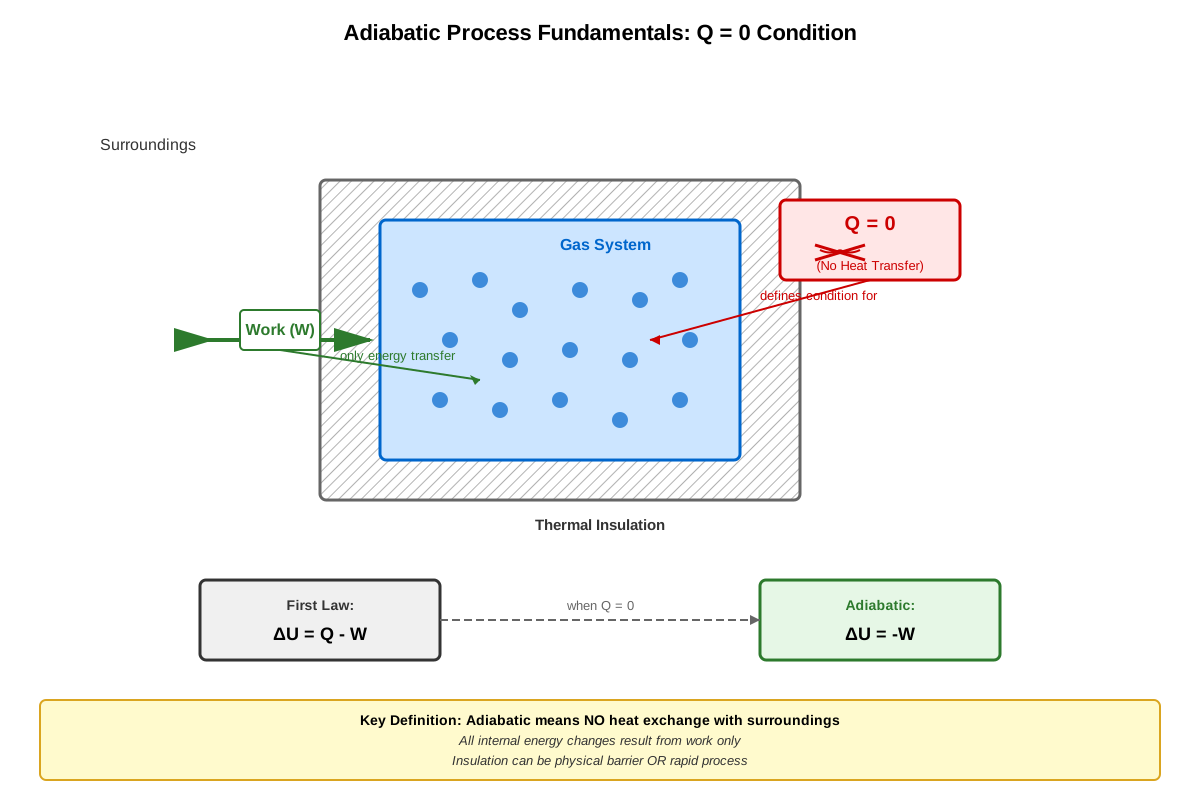
Adiabatic processes represent a fundamental category of thermodynamic transformations in which a system exchanges no heat with its surroundings. Unlike isothermal processes where temperature remains constant through heat exchange, or isobaric and isochoric processes where pressure or volume remain fixed, adiabatic processes occur under conditions of perfect thermal insulation. During an adiabatic process, any change in the internal energy of the system results exclusively from work done on or by the system. This concept bridges multiple domains of Physics tested on the MCAT, connecting thermodynamic principles with gas behavior, energy conservation, and real-world applications ranging from atmospheric phenomena to physiological processes.
Understanding adiabatic processes is essential for MCAT success because these transformations appear frequently in passages involving gas behavior, engine cycles, and biological systems. The MCAT tests not only the mathematical relationships governing adiabatic changes but also the conceptual understanding of energy transfer mechanisms and the ability to distinguish between different thermodynamic pathways. Questions often require students to analyze pressure-volume-temperature relationships, calculate work and internal energy changes, or predict the direction of temperature changes during compression or expansion.
Within the broader context of Thermodynamics and Gases, adiabatic processes serve as a critical link between the First Law of Thermodynamics and practical applications. They demonstrate how energy conservation principles manifest when heat transfer is eliminated, forcing all energy changes to occur through mechanical work. This topic connects directly to concepts including the ideal gas law, specific heats, internal energy, and the pressure-volume work relationship, making it a high-yield area that integrates multiple testable concepts into single exam questions.
Learning Objectives
- [ ] Define adiabatic processes using accurate Physics terminology
- [ ] Explain why adiabatic processes matter for the MCAT
- [ ] Apply adiabatic processes to exam-style questions
- [ ] Identify common mistakes related to adiabatic processes
- [ ] Connect adiabatic processes to related Physics concepts
- [ ] Derive and apply the relationship between pressure, volume, and temperature in adiabatic transformations
- [ ] Distinguish between adiabatic and other thermodynamic processes based on experimental conditions
- [ ] Calculate work, internal energy changes, and temperature changes for adiabatic compressions and expansions
Prerequisites
- First Law of Thermodynamics (ΔU = Q - W): Essential for understanding how eliminating heat transfer (Q = 0) affects the relationship between internal energy and work in adiabatic processes
- Ideal Gas Law (PV = nRT): Required to connect pressure, volume, and temperature changes during adiabatic transformations
- Internal Energy and Temperature: Necessary to understand why temperature changes occur during adiabatic processes despite no heat transfer
- Work in Thermodynamics (W = PΔV): Fundamental for calculating energy changes when gases expand or compress adiabatically
- Specific Heat Capacities (Cv and Cp): Critical for understanding the heat capacity ratio γ that governs adiabatic relationships
Why This Topic Matters
Adiabatic processes have profound clinical and physiological relevance that makes them valuable for MCAT passages. Rapid breathing during hyperventilation approximates an adiabatic process because air moves too quickly for significant heat exchange with lung tissue. The compression and expansion of gases in the respiratory system, particularly during rapid breathing or in medical devices like ventilators, often occur under near-adiabatic conditions. Additionally, the adiabatic cooling of air as it rises in the atmosphere explains altitude-related physiological changes that appear in MCAT passages about mountain sickness and respiratory adaptation.
From an exam statistics perspective, adiabatic processes appear in approximately 3-5% of MCAT Physics questions, typically integrated into passages about thermodynamic cycles, gas behavior, or energy transformations. These questions most commonly test the ability to distinguish between process types, apply the adiabatic condition (Q = 0) to the First Law, and predict qualitative changes in state variables. The MCAT particularly favors questions that require conceptual understanding rather than complex calculations, such as determining whether temperature increases or decreases during compression, or identifying which graph correctly represents an adiabatic process on a PV diagram.
Common exam presentations include passages describing heat engines or refrigeration cycles where one step is adiabatic, experimental setups involving insulated containers, or atmospheric phenomena. Discrete questions often present scenarios requiring students to identify the process type based on described conditions or to rank different processes by the magnitude of temperature or pressure changes. The integration of adiabatic processes with other thermodynamic concepts makes this a high-yield topic for demonstrating comprehensive understanding of energy transfer mechanisms.
Core Concepts
Definition and Fundamental Characteristics
An adiabatic process is a thermodynamic transformation in which no heat is exchanged between the system and its surroundings (Q = 0). The term "adiabatic" derives from Greek roots meaning "impassable," referring to the impermeability to heat transfer. This condition can be achieved through two primary mechanisms: perfect thermal insulation of the system boundaries, or processes that occur so rapidly that insufficient time exists for heat transfer to occur. In practice, truly adiabatic processes are idealizations, but many real-world phenomena approximate adiabatic behavior closely enough for the model to provide accurate predictions.
The defining characteristic that distinguishes adiabatic processes Physics from other thermodynamic pathways is the exclusive relationship between work and internal energy. When Q = 0, the First Law of Thermodynamics simplifies to ΔU = -W, meaning all work done by the system comes from its internal energy, and all work done on the system increases its internal energy. This direct coupling between mechanical work and internal energy produces the characteristic temperature changes observed during adiabatic compressions and expansions.
Mathematical Framework
The mathematical description of adiabatic processes for ideal gases involves several interconnected relationships. The fundamental adiabatic equation relates pressure and volume:
PV^γ = constantwhere γ (gamma) is the heat capacity ratio defined as γ = Cp/Cv, the ratio of specific heat at constant pressure to specific heat at constant volume. For monatomic ideal gases, γ = 5/3 ≈ 1.67; for diatomic gases (including air), γ = 7/5 = 1.4; and for polyatomic gases, γ approaches 1.33.
Alternative forms of the adiabatic relationship connect temperature with volume and pressure:
TV^(γ-1) = constant
T^γ P^(1-γ) = constant
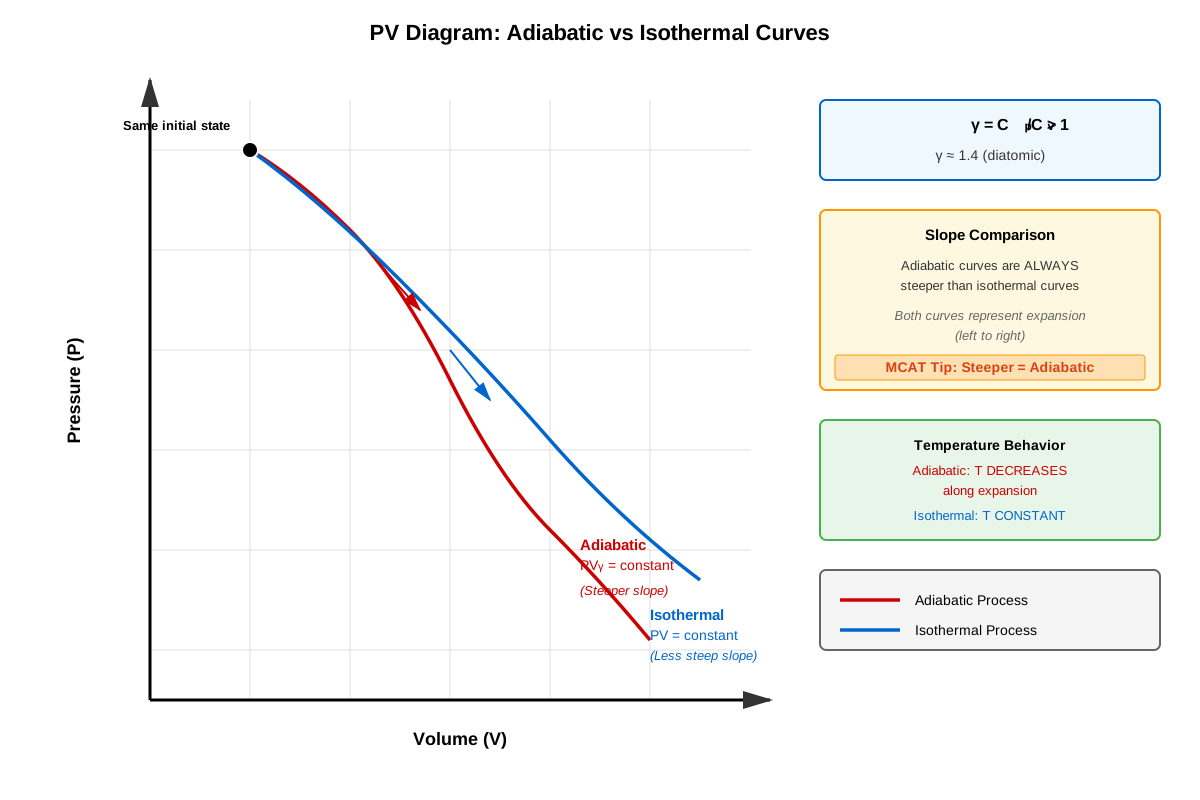
These equations allow calculation of final state variables given initial conditions and one final parameter. The exponent γ always exceeds 1 for real gases, which produces the characteristic steeper slope of adiabatic curves compared to isothermal curves on PV diagrams.
Work and Internal Energy Changes
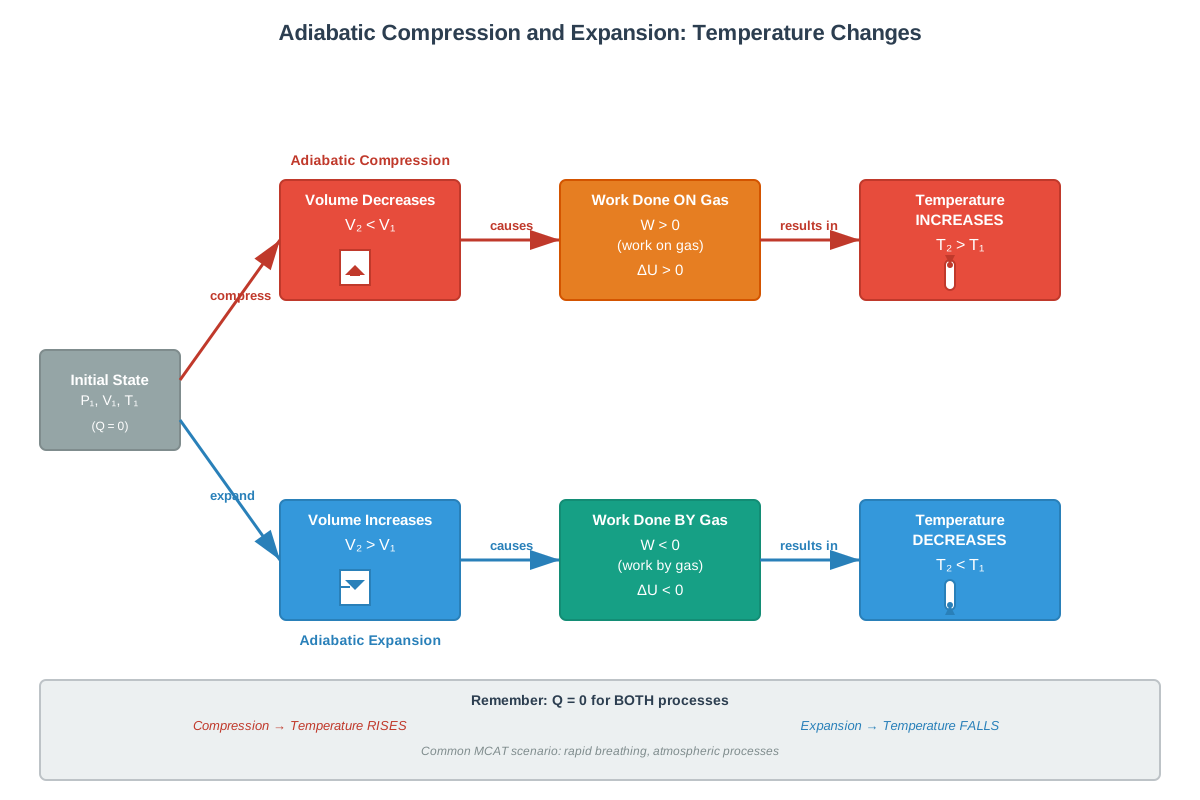
During an adiabatic process, the work done by or on the gas directly determines the change in internal energy. For an ideal gas undergoing adiabatic expansion, the gas does work on its surroundings (W > 0), which decreases the internal energy (ΔU < 0), resulting in a temperature decrease (ΔT < 0). Conversely, during adiabatic compression, work is done on the gas (W < 0), increasing internal energy (ΔU > 0) and temperature (ΔT > 0).
The magnitude of work for an adiabatic process can be calculated using:
W = (P₁V₁ - P₂V₂)/(γ - 1) = nR(T₁ - T₂)/(γ - 1)Alternatively, since ΔU = nCvΔT for an ideal gas and ΔU = -W for adiabatic processes:
W = -nCvΔTThis relationship emphasizes that temperature changes are mandatory during adiabatic processes involving volume changes, distinguishing them fundamentally from isothermal processes.
Comparison with Other Processes
Understanding adiabatic processes requires distinguishing them from other thermodynamic pathways:
| Process Type | Constant Parameter | Heat Transfer (Q) | Temperature Change | First Law Form |
|---|---|---|---|---|
| Adiabatic | Q = 0 | Zero | Yes (unless W = 0) | ΔU = -W |
| Isothermal | Temperature (T) | Non-zero | No | Q = W |
| Isobaric | Pressure (P) | Non-zero | Yes | ΔU = Q - PΔV |
| Isochoric | Volume (V) | Non-zero | Yes | ΔU = Q |
The key distinguishing feature is that adiabatic processes involve temperature changes despite no heat transfer, whereas isothermal processes maintain constant temperature through heat exchange. On a PV diagram, adiabatic curves are steeper than isothermal curves because the exponent γ exceeds 1.
Reversible vs. Irreversible Adiabatic Processes
Adiabatic processes MCAT questions may distinguish between reversible and irreversible adiabatic transformations. A reversible adiabatic process (also called an isentropic process) occurs infinitely slowly through a series of equilibrium states, maintaining constant entropy. These processes follow the adiabatic equations precisely and represent the maximum efficiency achievable.
Irreversible adiabatic processes occur rapidly or involve friction, turbulence, or other dissipative effects. While still satisfying Q = 0, these processes generate entropy and do not follow the ideal adiabatic equations exactly. The final temperature after irreversible adiabatic compression is higher than predicted by reversible equations, and after irreversible expansion, it is higher than the reversible prediction. For MCAT purposes, assume processes are reversible unless explicitly stated otherwise.
Graphical Representation
On a PV diagram, adiabatic processes appear as curves with slope:
dP/dV = -γP/VThis slope is steeper (more negative) than the isothermal slope (-P/V) by the factor γ. During adiabatic expansion, the curve moves from higher to lower pressure and from lower to higher volume, with the curve dropping more steeply than an isotherm. During adiabatic compression, the curve moves in the opposite direction, rising more steeply than an isotherm.
The area under an adiabatic curve on a PV diagram represents the work done during the process, just as for other processes. However, unlike isothermal processes where this work equals the heat transferred, for adiabatic processes this work equals the negative of the internal energy change.
Concept Relationships
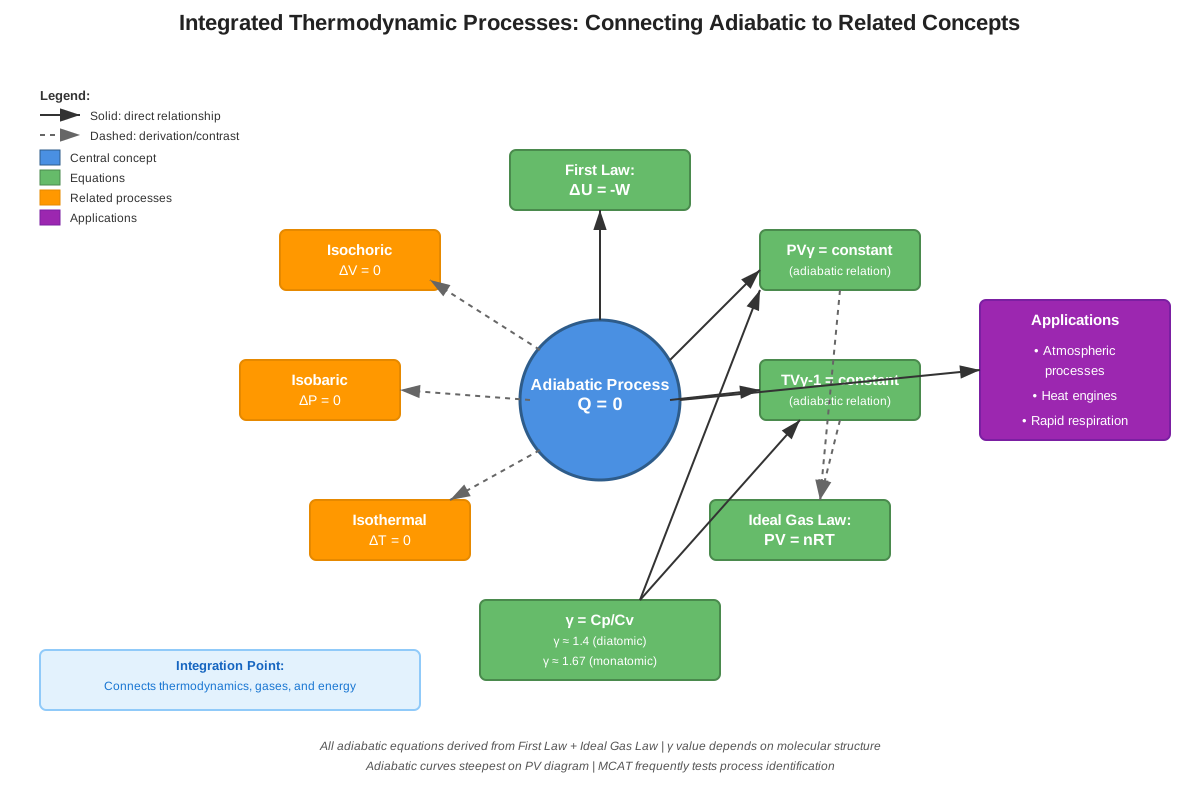
The understanding of adiabatic processes builds hierarchically from foundational thermodynamic principles. The First Law of Thermodynamics (ΔU = Q - W) serves as the starting point, with the adiabatic condition (Q = 0) simplifying this to ΔU = -W. This simplified relationship directly connects to the ideal gas law (PV = nRT) and the definition of internal energy for ideal gases (U = nCvT), creating the mathematical framework for predicting state changes.
The heat capacity ratio γ emerges from the relationship between Cp and Cv, which itself derives from the First Law applied to constant pressure and constant volume processes. This ratio determines the steepness of adiabatic curves and the magnitude of temperature changes, connecting molecular properties (degrees of freedom) to macroscopic behavior. Monatomic gases with fewer degrees of freedom have higher γ values, producing steeper adiabatic curves and larger temperature changes for given volume changes.
Within the topic itself, the three forms of the adiabatic equation (PVγ = constant, TVγ-1 = constant, and TγP1-γ = constant) are mathematically equivalent, derivable from each other using the ideal gas law. The choice of which form to use depends on which variables are known and which must be calculated. The work equation W = nR(T₁ - T₂)/(γ - 1) connects back to the First Law through ΔU = nCvΔT, demonstrating internal consistency.
Adiabatic processes connect forward to more complex topics including thermodynamic cycles (Carnot, Otto, Diesel engines), where adiabatic steps alternate with isothermal or other processes. They also relate to atmospheric physics, where adiabatic cooling of rising air masses explains cloud formation and weather patterns. In biological contexts, the rapid compression and expansion of gases in respiratory physiology approximates adiabatic behavior, connecting thermodynamics to physiology.
The relationship map flows: First Law → Adiabatic condition (Q=0) → ΔU = -W → Temperature changes mandatory → Adiabatic equations (PVγ = constant) → Steeper PV curves than isotherms → Applications in engines and atmosphere → Physiological relevance.
Quick check — test yourself on Adiabatic processes so far.
Try Flashcards →High-Yield Facts
⭐ In an adiabatic process, Q = 0, meaning no heat is exchanged between the system and surroundings
⭐ For adiabatic processes, ΔU = -W, so all work comes from or goes into internal energy
⭐ Adiabatic compression increases temperature; adiabatic expansion decreases temperature
⭐ The adiabatic equation for ideal gases is PVγ = constant, where γ = Cp/Cv
⭐ Adiabatic curves on PV diagrams are steeper than isothermal curves because γ > 1
- For monatomic ideal gases, γ = 5/3 ≈ 1.67; for diatomic gases, γ = 7/5 = 1.4
- Adiabatic processes can occur through perfect insulation or by happening so rapidly that heat transfer is negligible
- The work done during adiabatic expansion equals the decrease in internal energy: W = -ΔU = -nCvΔT
- Reversible adiabatic processes are also called isentropic processes (constant entropy)
- The temperature change during adiabatic processes is given by T₁V₁γ-1 = T₂V₂γ-1
- Adiabatic processes are approximated in nature by rapid atmospheric expansions, sound wave propagations, and quick compressions in engines
- The final temperature after adiabatic compression is always higher than the initial temperature, even though no heat was added
Common Misconceptions
Misconception: Adiabatic processes must occur in perfectly insulated containers → Correction: While perfect insulation creates adiabatic conditions, processes can also be adiabatic if they occur so rapidly that insufficient time exists for heat transfer. Sound waves and rapid compressions in engines are adiabatic despite no special insulation.
Misconception: Since no heat is transferred in adiabatic processes, temperature must remain constant → Correction: Temperature changes are characteristic of adiabatic processes. The absence of heat transfer means that work directly changes internal energy, which manifests as temperature change. Only isothermal processes maintain constant temperature, and they require heat transfer to do so.
Misconception: Adiabatic and isothermal processes are the same on PV diagrams → Correction: Adiabatic curves are steeper than isothermal curves by the factor γ. For the same initial state and final volume, an adiabatic expansion reaches a lower final pressure and temperature than an isothermal expansion.
Misconception: Work done during adiabatic expansion equals PΔV → Correction: The simple formula W = PΔV applies only to isobaric (constant pressure) processes. For adiabatic processes, pressure changes continuously, requiring integration or the formula W = (P₁V₁ - P₂V₂)/(γ - 1) = nR(T₁ - T₂)/(γ - 1).
Misconception: Adiabatic compression requires heat input to increase temperature → Correction: The temperature increase during adiabatic compression results from work done on the gas, not from heat transfer. The mechanical energy of compression converts directly to internal energy, raising temperature without any heat flow.
Misconception: All processes in insulated containers are adiabatic → Correction: While insulation prevents heat transfer with external surroundings, processes within an insulated container may still involve heat transfer between different parts of the system. Only when considering the entire insulated system as a whole is the process adiabatic.
Misconception: The gas does more work during adiabatic expansion than isothermal expansion between the same initial and final volumes → Correction: Isothermal expansion produces more work than adiabatic expansion between the same endpoints. During adiabatic expansion, temperature drops, reducing pressure more rapidly, resulting in less area under the PV curve and therefore less work.
Worked Examples
Example 1: Adiabatic Compression of Air
Problem: A cylinder contains 2.0 moles of diatomic gas (air) initially at 300 K and 1.0 atm. The gas is compressed adiabatically to half its original volume. Calculate: (a) the final temperature, (b) the final pressure, and (c) the work done on the gas. Use γ = 1.4 for diatomic gases and Cv = (5/2)R.
Solution:
(a) Finding final temperature using TVγ-1 = constant:
Given: T₁ = 300 K, V₂ = V₁/2, γ = 1.4
T₁V₁^(γ-1) = T₂V₂^(γ-1)
T₁V₁^0.4 = T₂(V₁/2)^0.4
T₂ = T₁(V₁/V₂)^0.4 = 300 K × (2)^0.4
T₂ = 300 K × 1.32 = 396 K
The temperature increases by 96 K during compression, demonstrating that adiabatic compression always increases temperature.
(b) Finding final pressure using PVγ = constant:
First, find P₁ in SI units: P₁ = 1.0 atm = 101,325 Pa
P₁V₁^γ = P₂V₂^γ
P₂ = P₁(V₁/V₂)^γ = P₁(2)^1.4
P₂ = 101,325 Pa × 2.64 = 267,500 Pa ≈ 2.64 atm
Alternatively, using the ideal gas law to verify:
P₂ = nRT₂/V₂ = P₁(T₂/T₁)(V₁/V₂) = 1.0 atm × (396/300) × 2 = 2.64 atm ✓(c) Finding work using W = -nCvΔT:
W = -nCvΔT = -n(5/2)R(T₂ - T₁)
W = -(2.0 mol)(5/2)(8.314 J/mol·K)(396 K - 300 K)
W = -(2.0)(2.5)(8.314)(96)
W = -3,990 J ≈ -4.0 kJ
The negative sign indicates work was done on the gas (compression). This work increased the internal energy by 4.0 kJ, manifesting as the 96 K temperature increase.
Key Insights: This problem demonstrates all three adiabatic relationships and shows how compression increases both temperature and pressure. The work calculation confirms that all energy input appears as increased internal energy (temperature rise) since Q = 0.
Example 2: Comparing Adiabatic and Isothermal Expansions
Problem: One mole of monatomic ideal gas at initial pressure P₀ and volume V₀ undergoes two different expansions to a final volume of 2V₀: (a) isothermal expansion, and (b) adiabatic expansion. For each process, determine the final pressure and the work done by the gas. Compare the results and explain the differences. Use γ = 5/3 for monatomic gases.
Solution:
(a) Isothermal expansion (T constant):
For isothermal processes: P₁V₁ = P₂V₂
P₂ = P₀(V₀/2V₀) = P₀/2 = 0.5P₀Work for isothermal expansion:
W_isothermal = nRT ln(V₂/V₁) = nRT₀ ln(2) = 0.693nRT₀Since PV = nRT, we can write: W_isothermal = 0.693P₀V₀
(b) Adiabatic expansion (Q = 0):
For adiabatic processes: P₁V₁γ = P₂V₂γ
P₂ = P₀(V₀/2V₀)^(5/3) = P₀(1/2)^1.67 = P₀/3.17 = 0.315P₀Work for adiabatic expansion:
W_adiabatic = (P₁V₁ - P₂V₂)/(γ - 1)
W_adiabatic = (P₀V₀ - 0.315P₀ × 2V₀)/(5/3 - 1)
W_adiabatic = (P₀V₀ - 0.630P₀V₀)/(2/3)
W_adiabatic = 0.370P₀V₀/(2/3) = 0.555P₀V₀Comparison:
| Process | Final Pressure | Work Done | Final Temperature |
|---|---|---|---|
| Isothermal | 0.5P₀ | 0.693P₀V₀ | T₀ (constant) |
| Adiabatic | 0.315P₀ | 0.555P₀V₀ | 0.63T₀ (decreased) |
Explanation: The isothermal expansion produces more work (0.693P₀V₀ vs. 0.555P₀V₀) because heat flows into the system, maintaining temperature and pressure higher throughout the expansion. The adiabatic expansion produces less work because no heat enters; the gas cools as it expands, reducing pressure more rapidly. The final pressure is lower for adiabatic expansion (0.315P₀ vs. 0.5P₀) because temperature decreased. On a PV diagram, the adiabatic curve drops more steeply, creating less area underneath (less work).
Key Insights: This comparison illustrates why adiabatic curves are steeper than isotherms and why isothermal processes are more efficient for extracting work from expanding gases. Understanding this difference is crucial for analyzing heat engines and thermodynamic cycles on the MCAT.
Exam Strategy
When approaching adiabatic processes MCAT questions, begin by identifying the key condition: Q = 0. This immediately tells you that ΔU = -W and that temperature must change unless no work is done. Look for trigger phrases indicating adiabatic conditions: "thermally insulated," "perfectly insulated walls," "occurs too rapidly for heat transfer," or "no heat exchange with surroundings."
Distinguish between process types by identifying what remains constant or what is explicitly stated about heat transfer. If a question mentions constant temperature, it's isothermal (not adiabatic). If it mentions insulation or rapid occurrence with no mention of constant temperature, it's likely adiabatic. Create a mental checklist: Does Q = 0? Does temperature change? Is the system insulated?
For quantitative problems, determine which adiabatic equation to use based on given information. If you know initial and final volumes and need temperature, use TVγ-1 = constant. If you need pressure, use PVγ = constant. If you know temperatures and need work, use W = nCvΔT or W = nR(T₁ - T₂)/(γ - 1). Remember that γ = 1.4 for diatomic gases (including air) and γ = 5/3 for monatomic gases.
For qualitative questions about direction of change, use logical reasoning: compression always increases temperature in adiabatic processes (work done on gas increases internal energy), and expansion always decreases temperature (gas does work, losing internal energy). On PV diagrams, adiabatic curves are always steeper than isotherms passing through the same point.
Process-of-elimination strategies include: eliminate any answer suggesting temperature remains constant during adiabatic volume changes; eliminate answers suggesting heat transfer occurs in insulated systems; eliminate answers showing adiabatic curves less steep than isotherms on PV diagrams; eliminate answers suggesting work equals heat transferred (since Q = 0, work cannot equal Q).
Time allocation: spend 30-45 seconds identifying the process type and relevant equations, 60-90 seconds on calculations if needed, and 15-30 seconds checking that your answer makes physical sense (compression increases T, expansion decreases T, etc.). For passage-based questions, quickly scan for keywords indicating process types before reading in detail.
Memory Techniques
Mnemonic for adiabatic condition: "Adiabatic means Absolutely no heat" - Remember that Q = 0 absolutely.
Mnemonic for temperature changes: "ACID" - Adiabatic Compression Increases, Decompression (expansion) Decreases temperature.
Visualization for PV diagrams: Picture adiabatic curves as "steeper slides" compared to isothermal "gentle slopes." The steeper the slide (higher γ), the faster you descend (pressure drops more rapidly during expansion).
Acronym for adiabatic equations: "PVT" - PVγ = constant, VTγ-1 = constant, TγP1-γ = constant. All three connect the same three variables in different combinations.
Memory aid for γ values: "5-7 rule" - Monatomic gases have 5 in numerator (5/3), diatomic have 7 in numerator (7/5). The pattern: more atoms, smaller γ, gentler curves.
Conceptual anchor: Link adiabatic processes to pumping a bicycle tire. The pump gets hot (adiabatic compression increases temperature) even though you're not heating it externally. The rapid compression prevents heat loss, making it approximately adiabatic.
Formula connection: Remember that Cv appears in work calculations (W = -nCvΔT) because internal energy depends on Cv, and in adiabatic processes, all work changes internal energy. The connection: Cv for Calculating work in adiabatiC processes.
Summary
Adiabatic processes represent thermodynamic transformations occurring without heat exchange (Q = 0), either through perfect insulation or rapid occurrence. The defining relationship ΔU = -W means all work directly changes internal energy, causing mandatory temperature changes during volume changes. Adiabatic compression increases temperature and pressure, while adiabatic expansion decreases both. The mathematical framework centers on PVγ = constant, where γ = Cp/Cv determines curve steepness on PV diagrams. For monatomic gases, γ = 5/3; for diatomic gases, γ = 7/5. Adiabatic curves are steeper than isothermal curves, producing less work during expansion between the same endpoints. Work calculations use W = nR(T₁ - T₂)/(γ - 1) or W = -nCvΔT. MCAT questions test the ability to identify adiabatic conditions, distinguish them from other processes, predict qualitative changes, and apply appropriate equations. Understanding that temperature changes without heat transfer distinguishes adiabatic processes from all other thermodynamic pathways and represents the core concept necessary for answering any exam question on this topic.
Key Takeaways
- Adiabatic processes occur with zero heat transfer (Q = 0), making ΔU = -W the governing relationship
- Adiabatic compression always increases temperature; adiabatic expansion always decreases temperature
- The adiabatic equation PVγ = constant (where γ = Cp/Cv) describes ideal gas behavior, with γ = 1.4 for diatomic gases and γ = 5/3 for monatomic gases
- Adiabatic curves on PV diagrams are steeper than isothermal curves because γ > 1
- Work during adiabatic processes equals the negative change in internal energy: W = -ΔU = -nCvΔT
- Adiabatic conditions arise from perfect insulation or processes occurring too rapidly for heat transfer
- Distinguishing adiabatic from isothermal processes is critical: adiabatic involves temperature change with no heat transfer; isothermal maintains constant temperature through heat exchange
Related Topics
Isothermal Processes: Understanding isothermal transformations (constant temperature, Q = W) provides essential contrast to adiabatic processes and completes the picture of ideal gas behavior. Mastering adiabatic processes makes isothermal processes easier to understand through comparison.
Thermodynamic Cycles (Carnot, Otto, Diesel): These cycles combine adiabatic steps with isothermal or other processes to model heat engines and refrigerators. Adiabatic processes form critical components of these cycles, making this topic foundational for understanding engine efficiency.
Entropy and the Second Law: Reversible adiabatic processes are isentropic (constant entropy), connecting adiabatic transformations to entropy concepts and the Second Law of Thermodynamics.
Atmospheric Physics: Adiabatic cooling of rising air masses explains cloud formation, weather patterns, and altitude effects, connecting thermodynamics to environmental science and physiology passages.
Sound Waves: Sound propagation involves adiabatic compressions and rarefactions because oscillations occur too rapidly for heat transfer, linking thermodynamics to wave physics.
Practice CTA
Now that you've mastered the core concepts of adiabatic processes, it's time to solidify your understanding through active practice. Attempt the practice questions to test your ability to identify adiabatic conditions, apply the appropriate equations, and distinguish between different thermodynamic processes. Use the flashcards to reinforce high-yield facts and equations until they become automatic. Remember, the MCAT rewards not just knowledge but the ability to apply concepts quickly and accurately under time pressure. Each practice problem you solve strengthens the neural pathways that will serve you on test day. You've built a strong foundation—now transform that knowledge into exam success through deliberate practice!
Sign up free to keep reading
Create a free AnvayaPrep account to finish this MCAT guide on Adiabatic processes — plus flashcards and practice questions.