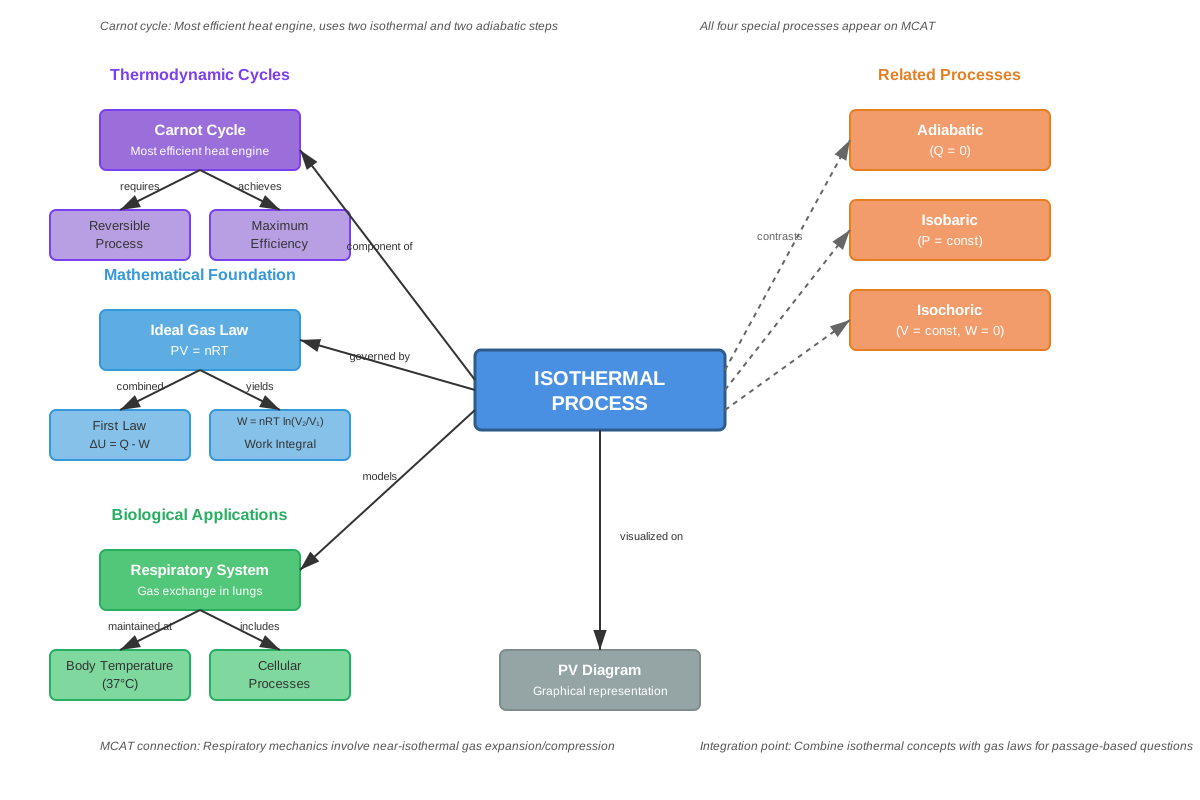
Overview
Isothermal processes represent one of the fundamental thermodynamic transformations that students must master for the MCAT Physics section. An isothermal process occurs when a system undergoes a change while maintaining constant temperature throughout the transformation. This seemingly simple constraint has profound implications for how energy, work, and heat interact within a system, particularly for ideal gases. Understanding isothermal processes requires integrating concepts from Thermodynamics and Gases, including the ideal gas law, the first law of thermodynamics, and the relationship between pressure, volume, and temperature.
For the MCAT, isothermal processes appear frequently in both discrete questions and passage-based problems within the Chemical and Physical Foundations of Biological Systems section. These questions often test a student's ability to apply the ideal gas law under constant temperature conditions, calculate work done by or on a gas, determine heat transfer, and interpret pressure-volume (PV) diagrams. The topic bridges pure physics concepts with practical applications in biological systems, such as respiratory mechanics and cellular processes that occur at constant body temperature.
The mastery of isothermal processes MCAT content connects directly to broader thermodynamic principles, including adiabatic processes, isobaric processes, and isochoric processes. Together, these special processes form a comprehensive framework for understanding how gases behave under various constraints. Additionally, isothermal processes provide essential context for understanding heat engines, refrigerators, and the Carnot cycle—topics that occasionally appear in higher-difficulty MCAT passages. The mathematical relationships governing isothermal transformations also reinforce critical problem-solving skills involving logarithmic functions and graphical analysis that extend beyond thermodynamics into other MCAT domains.
Learning Objectives
- [ ] Define isothermal processes using accurate Physics terminology
- [ ] Explain why isothermal processes matter for the MCAT
- [ ] Apply isothermal processes to exam-style questions
- [ ] Identify common mistakes related to isothermal processes
- [ ] Connect isothermal processes to related Physics concepts
- [ ] Calculate work done during an isothermal expansion or compression using the appropriate formula
- [ ] Interpret PV diagrams to identify isothermal processes and compare them with other thermodynamic processes
- [ ] Apply the first law of thermodynamics specifically to isothermal conditions to determine heat transfer
Prerequisites
- Ideal Gas Law (PV = nRT): Essential for understanding how pressure and volume relate when temperature remains constant during isothermal processes
- First Law of Thermodynamics (ΔU = Q - W): Required to analyze energy transfers and determine the relationship between heat and work in isothermal transformations
- Work in Thermodynamics (W = ∫PdV): Necessary foundation for calculating the work done during volume changes in isothermal processes
- Internal Energy of Ideal Gases: Understanding that internal energy depends only on temperature enables recognition that ΔU = 0 for isothermal processes
- Logarithmic Functions: Mathematical prerequisite for evaluating the work integral in isothermal processes, which yields a natural logarithm
Why This Topic Matters
Isothermal processes have significant real-world and biological relevance that extends beyond abstract physics problems. In biological systems, many cellular processes occur at constant temperature (body temperature for mammals), making isothermal approximations useful for understanding gas exchange in lungs, osmotic pressure changes, and metabolic reactions. Industrial applications include refrigeration cycles, heat engines, and chemical reactors that operate under isothermal conditions to optimize efficiency and control reaction rates.
For MCAT preparation, isothermal processes appear in approximately 2-4 questions per exam, either as discrete items or embedded within thermodynamics passages. These questions typically test conceptual understanding of the relationship between state variables, quantitative problem-solving involving work calculations, and graphical interpretation of PV diagrams. The topic frequently appears alongside other thermodynamic processes in comparative questions that ask students to distinguish between isothermal, adiabatic, isobaric, and isochoric transformations.
Common MCAT passage contexts include: respiratory physiology passages describing gas behavior in lungs at constant body temperature; heat engine passages analyzing different stages of thermodynamic cycles; experimental passages presenting data from gas expansion experiments; and biochemistry passages discussing reactions occurring in temperature-controlled environments. The ability to quickly recognize isothermal conditions and apply the appropriate equations distinguishes high-scoring students from those who struggle with thermodynamics questions. Additionally, isothermal process questions often serve as "medium difficulty" items that separate students scoring in the 125-127 range from those achieving 128-132 on the Chemical and Physical Foundations section.
Core Concepts
Definition and Fundamental Characteristics
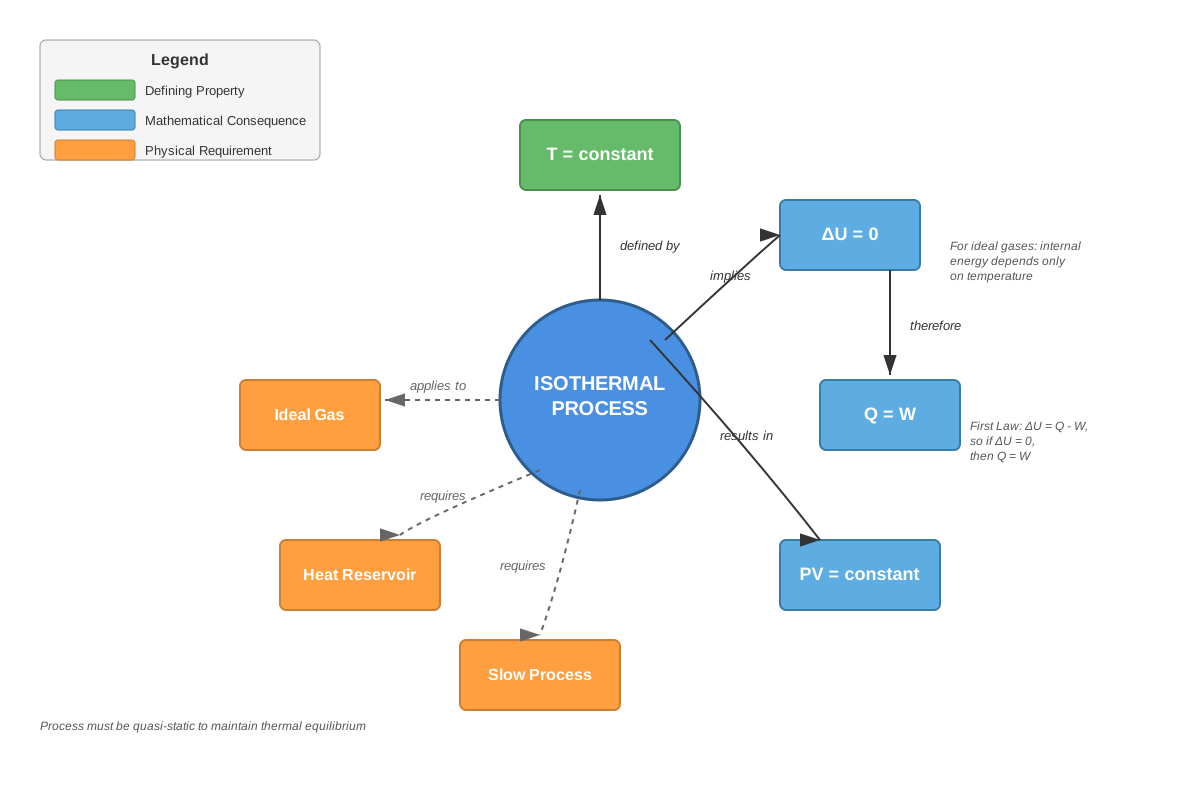
An isothermal process is a thermodynamic transformation in which the temperature of a system remains constant throughout the entire process. The term derives from Greek roots: "iso" meaning equal or same, and "thermal" relating to heat or temperature. For this constant temperature condition to be maintained, the system must be in thermal equilibrium with its surroundings or the process must occur slowly enough that heat can be exchanged to prevent temperature changes.
For an ideal gas undergoing an isothermal process, several key characteristics emerge directly from the constraint of constant temperature:
- The internal energy remains constant (ΔU = 0) because internal energy of an ideal gas depends only on temperature
- Any work done by the system must be exactly balanced by heat absorbed from the surroundings
- The relationship between pressure and volume follows a hyperbolic curve described by Boyle's Law
- The process appears as a curved line (isotherm) on a PV diagram
Mathematical Framework: The Ideal Gas Law Under Isothermal Conditions
When temperature remains constant, the ideal gas law simplifies to reveal a direct inverse relationship between pressure and volume. Starting with:
PV = nRTSince n, R, and T are all constant during an isothermal process:
PV = constantThis can be expressed as:
P₁V₁ = P₂V₂This relationship, known as Boyle's Law, indicates that pressure and volume are inversely proportional during isothermal transformations. If volume doubles, pressure must halve to maintain constant temperature. This hyperbolic relationship creates the characteristic curved shape of isotherms on PV diagrams.
Work Calculation in Isothermal Processes
The work done during an isothermal expansion or compression requires integration because pressure changes continuously as volume changes. Starting with the differential work expression:
W = ∫PdVSubstituting P = nRT/V (from the ideal gas law):
W = ∫(nRT/V)dV = nRT∫(1/V)dVEvaluating this integral from initial volume V₁ to final volume V₂:
W = nRT ln(V₂/V₁)Alternatively, using the relationship P₁V₁ = P₂V₂:
W = nRT ln(P₁/P₂)Critical sign conventions:
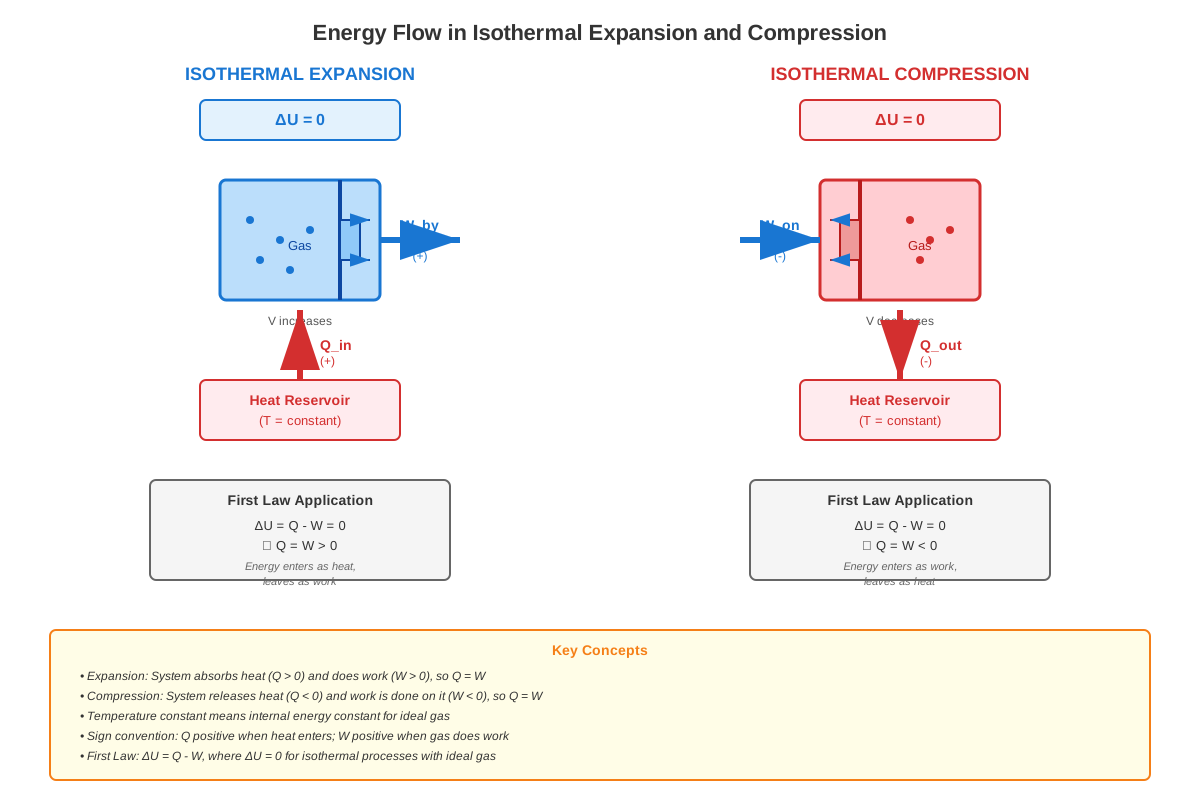
- When the gas expands (V₂ > V₁), work is positive (work done BY the system)
- When the gas compresses (V₂ < V₁), work is negative (work done ON the system)
- The MCAT may use either sign convention, so carefully read the question stem
Energy Analysis: First Law Application
The first law of thermodynamics states:
ΔU = Q - WFor an isothermal process involving an ideal gas, the internal energy change equals zero (ΔU = 0) because internal energy depends only on temperature. Therefore:
0 = Q - WWhich simplifies to:
Q = WThis fundamental relationship reveals that all heat absorbed by the system during isothermal expansion is converted to work, and conversely, all work done on the system during isothermal compression is released as heat. This perfect conversion between heat and work distinguishes isothermal processes from other thermodynamic transformations.
PV Diagram Representation
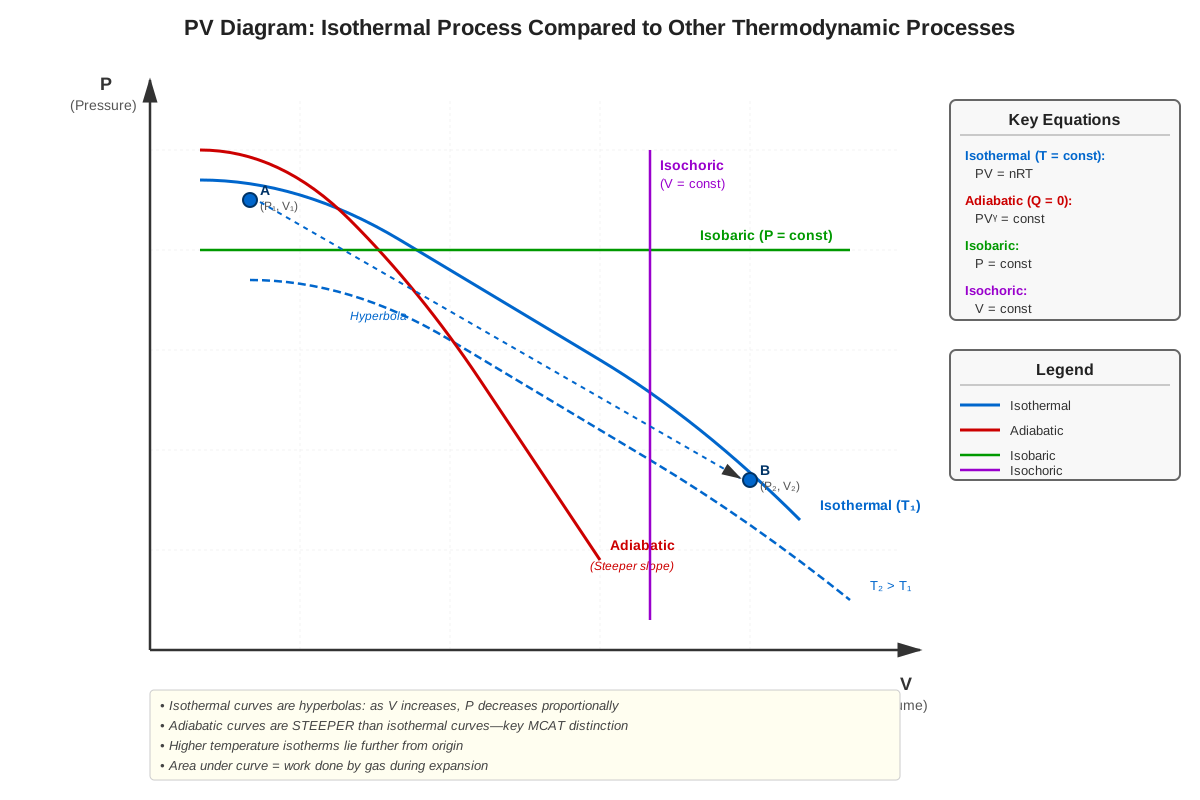
On a pressure-volume diagram, isothermal processes appear as hyperbolic curves called isotherms. Key features include:
- Each isotherm represents a specific constant temperature
- Higher temperature isotherms lie farther from the origin (higher PV values)
- The curve never touches the axes (pressure and volume cannot be zero for an ideal gas)
- The area under the curve represents the work done during the process
- Isotherms are steeper than adiabatic curves at any given point
| Process Type | PV Diagram Shape | Slope Characteristic |
|---|---|---|
| Isothermal | Hyperbola (PV = constant) | Moderate negative slope |
| Adiabatic | Steeper hyperbola (PVᵞ = constant) | Steeper negative slope |
| Isobaric | Horizontal line | Zero slope |
| Isochoric | Vertical line | Infinite slope |
Reversibility and Quasi-Static Processes
True isothermal processes are reversible and quasi-static, meaning they occur infinitely slowly through a continuous series of equilibrium states. In reality, perfectly isothermal processes cannot exist because:
- Heat transfer requires a temperature difference (violating the isothermal condition)
- Infinitely slow processes would take infinite time to complete
However, processes can be approximately isothermal when:
- The system is in excellent thermal contact with a large heat reservoir
- The process occurs slowly enough for heat exchange to maintain near-constant temperature
- Temperature variations remain negligibly small compared to the absolute temperature
For MCAT purposes, assume all isothermal processes are ideal unless the passage explicitly states otherwise.
Comparison with Other Thermodynamic Processes
Understanding isothermal processes requires distinguishing them from other special thermodynamic transformations:
Isothermal vs. Adiabatic:
- Isothermal: Q ≠ 0, ΔT = 0, ΔU = 0, Q = W
- Adiabatic: Q = 0, ΔT ≠ 0, ΔU ≠ 0, ΔU = -W
Isothermal vs. Isobaric:
- Isothermal: P changes, T constant, PV = constant
- Isobaric: P constant, T changes, V/T = constant
Isothermal vs. Isochoric:
- Isothermal: V changes, T constant, W ≠ 0
- Isochoric: V constant, T changes, W = 0
Heat Reservoir Concept
For an isothermal process to occur, the system must exchange heat with a heat reservoir—a body with such large heat capacity that its temperature remains essentially constant regardless of heat transfer. Examples include:
- The atmosphere (for small-scale laboratory processes)
- Large bodies of water (oceans, lakes)
- The human body (for small-scale cellular processes)
- Thermostated baths in laboratory settings
The heat reservoir maintains the system at constant temperature by absorbing heat during expansion or supplying heat during compression.
Concept Relationships
The understanding of isothermal processes builds directly upon the ideal gas law, which provides the mathematical foundation for relating pressure, volume, and temperature. When the temperature constraint is applied (T = constant), the ideal gas law reduces to Boyle's Law, establishing the inverse relationship between pressure and volume that characterizes isothermal transformations.
The first law of thermodynamics serves as the energy accounting framework that reveals the unique property of isothermal processes: since internal energy depends only on temperature for ideal gases, constant temperature means zero change in internal energy (ΔU = 0). This constraint forces the relationship Q = W, meaning heat and work are perfectly balanced during isothermal processes.
Work in thermodynamics connects to isothermal processes through the integral W = ∫PdV. The specific form of this integral for isothermal conditions (W = nRT ln(V₂/V₁)) emerges from substituting the pressure-volume relationship derived from the ideal gas law. This mathematical connection demonstrates how the isothermal constraint transforms a general work expression into a specific logarithmic formula.
The concept of reversibility relates to isothermal processes because maintaining constant temperature requires infinitely slow heat exchange, which defines a reversible process. This connection extends to the Carnot cycle, where isothermal expansion and compression form two of the four stages of the most efficient possible heat engine.
PV diagrams provide the graphical representation that connects isothermal processes to other thermodynamic transformations. The hyperbolic shape of isotherms contrasts with the straight lines of isobaric and isochoric processes and the steeper curves of adiabatic processes, enabling visual comparison and analysis.
Relationship map: Ideal Gas Law → constrains → Isothermal Process → requires → Heat Reservoir → enables → Reversible Transformation → appears in → Carnot Cycle → represents → Maximum Efficiency. Simultaneously: Isothermal Process → analyzed by → First Law → reveals → Q = W relationship → calculated using → Logarithmic Work Formula → visualized on → PV Diagram.
High-Yield Facts
⭐ For an ideal gas undergoing an isothermal process, ΔU = 0 because internal energy depends only on temperature
⭐ During isothermal processes, Q = W (heat absorbed equals work done by the system)
⭐ The work done during isothermal expansion is W = nRT ln(V₂/V₁) = nRT ln(P₁/P₂)
⭐ Isothermal processes follow PV = constant, meaning P₁V₁ = P₂V₂ (Boyle's Law)
⭐ On a PV diagram, isotherms are hyperbolic curves; higher temperature isotherms lie farther from the origin
- Isothermal expansion requires heat absorption from surroundings to maintain constant temperature while doing work
- Isothermal compression releases heat to surroundings to prevent temperature increase from work input
- The area under an isotherm on a PV diagram represents the work done during the process
- Isothermal processes are less steep than adiabatic processes on PV diagrams (adiabats are steeper)
- True isothermal processes are reversible and quasi-static, occurring infinitely slowly through equilibrium states
- For isothermal expansion, work is positive (system does work on surroundings); for compression, work is negative
- The natural logarithm in the work formula means doubling volume produces W = nRT ln(2) ≈ 0.693nRT regardless of initial volume
Quick check — test yourself on Isothermal processes so far.
Try Flashcards →Common Misconceptions
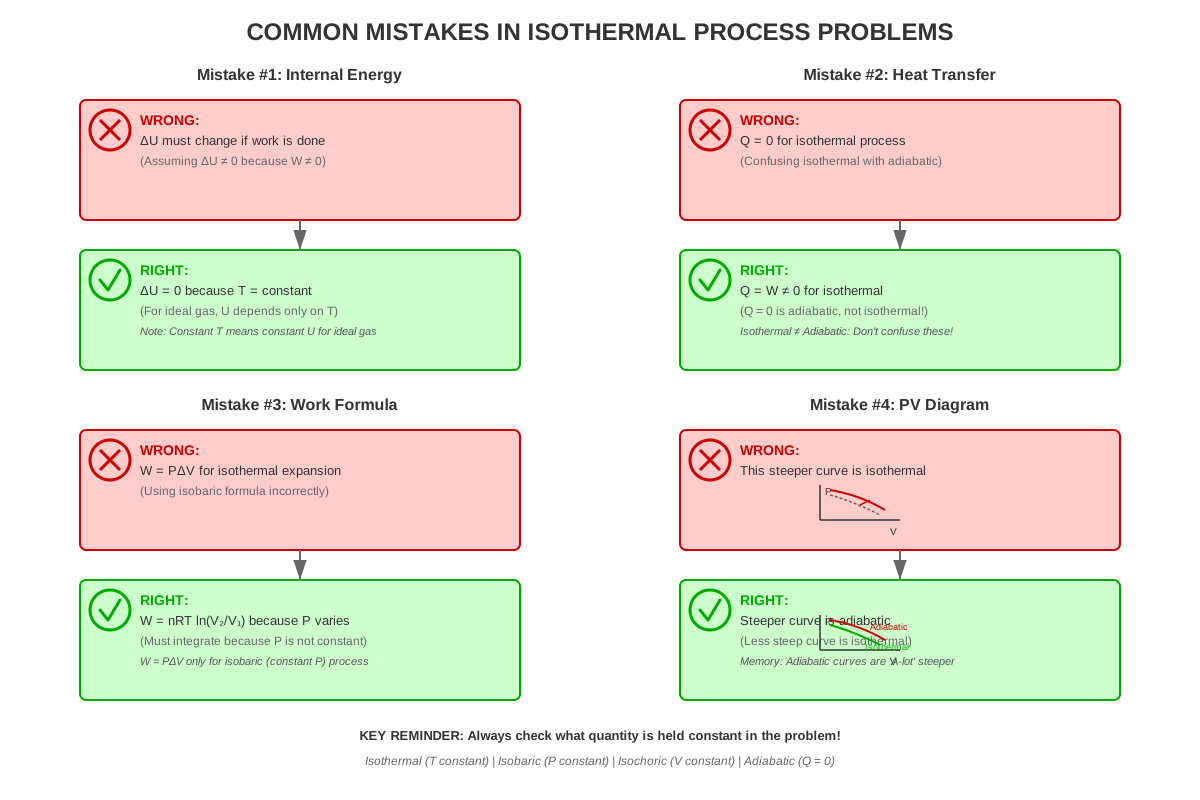
Misconception: Isothermal processes involve no heat transfer because temperature doesn't change.
Correction: Isothermal processes require substantial heat transfer to maintain constant temperature. During expansion, the system absorbs heat to compensate for energy lost as work. During compression, the system releases heat to prevent temperature increase from work input. The equation Q = W confirms that heat transfer equals work for isothermal processes.
Misconception: Since ΔU = 0 for isothermal processes, no energy changes occur.
Correction: While internal energy remains constant (ΔU = 0), significant energy transfers occur between the system and surroundings. Heat flows into or out of the system, and work is done by or on the system. The zero change in internal energy means these energy transfers perfectly balance each other, not that energy transfers are absent.
Misconception: The work formula W = PΔV applies to isothermal processes.
Correction: The formula W = PΔV only applies to constant pressure (isobaric) processes. For isothermal processes, pressure changes continuously as volume changes, requiring integration: W = ∫PdV = nRT ln(V₂/V₁). Using W = PΔV for isothermal processes produces incorrect results.
Misconception: Isothermal and adiabatic processes are similar because both involve curved lines on PV diagrams.
Correction: These processes are fundamentally different. Isothermal processes maintain constant temperature with heat exchange (Q ≠ 0, ΔT = 0), while adiabatic processes involve no heat exchange with changing temperature (Q = 0, ΔT ≠ 0). On PV diagrams, adiabatic curves are steeper than isothermal curves, and they follow different mathematical relationships (PVᵞ = constant vs. PV = constant).
Misconception: Isothermal processes can occur rapidly in real systems.
Correction: True isothermal processes are quasi-static, requiring infinitely slow execution to maintain thermal equilibrium throughout. Rapid processes cannot maintain constant temperature because heat transfer takes time. Real processes can only approximate isothermal conditions when conducted slowly with excellent thermal contact to a heat reservoir.
Misconception: The sign of work in isothermal processes depends on whether heat is absorbed or released.
Correction: The sign of work depends on whether the gas expands or compresses, not directly on heat flow direction. During expansion (V₂ > V₁), work is positive (system does work) and heat is absorbed (Q > 0). During compression (V₂ < V₁), work is negative (work done on system) and heat is released (Q < 0). The relationship Q = W ensures heat and work always have the same sign.
Worked Examples
Example 1: Isothermal Expansion Calculation
Problem: An ideal gas initially occupies 2.0 L at a pressure of 5.0 atm and temperature of 300 K. The gas undergoes isothermal expansion until its volume reaches 6.0 L. Calculate: (a) the final pressure, (b) the work done by the gas, and (c) the heat absorbed by the gas. Use R = 0.0821 L·atm/(mol·K).
Solution:
(a) Finding final pressure:
Since the process is isothermal, we apply P₁V₁ = P₂V₂:
P₂ = P₁V₁/V₂ = (5.0 atm)(2.0 L)/(6.0 L) = 1.67 atmThe pressure decreases to approximately 1.67 atm as the gas expands.
(b) Calculating work done:
First, find the number of moles using the ideal gas law:
n = P₁V₁/(RT) = (5.0 atm)(2.0 L)/[(0.0821 L·atm/(mol·K))(300 K)] = 0.406 molNow apply the isothermal work formula:
W = nRT ln(V₂/V₁) = (0.406 mol)(0.0821 L·atm/(mol·K))(300 K) ln(6.0/2.0)
W = (10.0 L·atm) ln(3) = (10.0 L·atm)(1.099) = 11.0 L·atm
Converting to joules (1 L·atm = 101.3 J):
W = 11.0 L·atm × 101.3 J/(L·atm) = 1114 J ≈ 1.1 kJThe positive work indicates the gas does work on its surroundings during expansion.
(c) Determining heat absorbed:
For an isothermal process, ΔU = 0, so Q = W:
Q = W = 1.1 kJThe gas absorbs 1.1 kJ of heat from its surroundings to maintain constant temperature while doing work.
Key Concepts Applied: This problem demonstrates the application of Boyle's Law for finding final pressure, the logarithmic work formula specific to isothermal processes, and the Q = W relationship that follows from ΔU = 0.
Example 2: PV Diagram Analysis and Process Comparison
Problem: A gas undergoes two different processes from the same initial state (P₁ = 3.0 atm, V₁ = 4.0 L, T₁ = 400 K) to the same final volume (V₂ = 8.0 L). Process A is isothermal, and Process B is isobaric. Compare: (a) the final pressures, (b) the work done in each process, and (c) explain which process requires more heat input.
Solution:
(a) Final pressures:
Process A (Isothermal):
Using P₁V₁ = P₂V₂:
P₂ᴬ = P₁V₁/V₂ = (3.0 atm)(4.0 L)/(8.0 L) = 1.5 atmProcess B (Isobaric):
Pressure remains constant:
P₂ᴮ = P₁ = 3.0 atmThe isobaric process maintains higher pressure at the final volume.
(b) Work done:
Process A (Isothermal):
Wᴬ = P₁V₁ ln(V₂/V₁) = (3.0 atm)(4.0 L) ln(8.0/4.0)
Wᴬ = (12.0 L·atm) ln(2) = (12.0 L·atm)(0.693) = 8.3 L·atm
Process B (Isobaric):
Wᴮ = P(V₂ - V₁) = (3.0 atm)(8.0 L - 4.0 L) = 12.0 L·atmThe isobaric process produces more work (12.0 L·atm vs. 8.3 L·atm) because it maintains higher pressure throughout the expansion.
(c) Heat input comparison:
Process A (Isothermal):
Since ΔU = 0 for isothermal processes:
Qᴬ = Wᴬ = 8.3 L·atmProcess B (Isobaric):
For isobaric processes, ΔU ≠ 0. First find the final temperature:
T₂ = T₁(V₂/V₁) = 400 K (8.0 L/4.0 L) = 800 KCalculate moles:
n = P₁V₁/(RT₁) = (3.0 atm)(4.0 L)/[(0.0821 L·atm/(mol·K))(400 K)] = 0.365 molFor an ideal monatomic gas, ΔU = (3/2)nRΔT:
ΔU = (3/2)(0.365 mol)(0.0821 L·atm/(mol·K))(400 K) = 18.0 L·atmUsing the first law:
Qᴮ = ΔU + Wᴮ = 18.0 L·atm + 12.0 L·atm = 30.0 L·atmProcess B requires significantly more heat input (30.0 L·atm vs. 8.3 L·atm) because heat must both increase internal energy (raising temperature) and perform work, whereas in the isothermal process, all heat input converts directly to work with no temperature change.
Key Concepts Applied: This problem illustrates the fundamental differences between isothermal and isobaric processes, demonstrates how to calculate work using different formulas for different process types, and shows how the first law reveals different heat requirements based on whether internal energy changes.
Exam Strategy
When approaching isothermal processes questions on the MCAT, immediately identify the constant temperature condition as your primary constraint. Look for trigger phrases such as "constant temperature," "thermal equilibrium with surroundings," "temperature-controlled environment," or "isothermal conditions." These phrases signal that you should apply P₁V₁ = P₂V₂ and recognize that ΔU = 0.
Step-by-step approach for isothermal problems:
- Confirm the isothermal condition by identifying constant temperature in the problem stem
- Write down P₁V₁ = P₂V₂ as your primary equation for relating initial and final states
- Recognize ΔU = 0 immediately, which leads to Q = W
- Choose the appropriate work formula: W = nRT ln(V₂/V₁) for calculations, or recognize that work equals the area under the PV curve for graphical questions
- Check sign conventions carefully—expansion means positive work (by the system), compression means negative work (on the system)
Process of elimination strategies:
- Eliminate answer choices that suggest ΔU ≠ 0 for isothermal processes with ideal gases
- Eliminate options that claim Q = 0 (that's adiabatic, not isothermal)
- Eliminate answers using W = PΔV for isothermal processes (that formula is for isobaric processes)
- When comparing processes on PV diagrams, eliminate choices that confuse isothermal curves (moderate slope) with adiabatic curves (steeper slope)
Time allocation advice:
For discrete questions on isothermal processes, allocate 60-90 seconds. These typically involve straightforward application of P₁V₁ = P₂V₂ or recognition of Q = W. For passage-based questions, especially those involving PV diagrams or comparing multiple processes, allocate 90-120 seconds per question. The additional time allows for careful graph interpretation and multi-step calculations.
Red flag phrases that indicate NOT isothermal:
- "Thermally insulated" or "no heat exchange" → adiabatic process
- "Constant pressure" → isobaric process
- "Rigid container" or "constant volume" → isochoric process
- "Rapid expansion" → likely adiabatic (isothermal requires slow process)
Exam Tip: If a question asks about work done during isothermal expansion and provides temperature, volume change, and number of moles, you can calculate work without knowing the actual pressures. Use W = nRT ln(V₂/V₁) directly.
Memory Techniques
Mnemonic for isothermal process characteristics - "IQWH":
- Internal energy change is zero (ΔU = 0)
- Q equals W (heat equals work)
- Work uses natural log formula
- Heat reservoir required
Visualization strategy for PV diagrams:
Picture isotherms as "temperature contour lines" on a PV map. Just as contour lines on a topographic map connect points of equal elevation, isotherms connect points of equal temperature. Higher temperature isotherms lie farther from the origin (northeast direction), like higher elevation contours on mountain peaks.
Acronym for comparing thermodynamic processes - "I-A-I-I":
- Isothermal: Temperature constant, Q = W, moderate PV curve
- Adiabatic: Q = 0, steeper PV curve
- Isobaric: Pressure constant, horizontal line
- Isochoric: Volume constant, vertical line
Memory device for work formula:
"Lazy Nature Requires Time to Log Volume changes"
This encodes W = nRT ln(V₂/V₁), reminding you that the natural Log function appears with Volume ratio.
Conceptual anchor for Q = W relationship:
Imagine a perfectly balanced seesaw: heat on one side, work on the other. For isothermal processes, whatever heat goes in must come out as work (or vice versa) to keep internal energy (the fulcrum) perfectly balanced at zero change.
Summary
Isothermal processes represent thermodynamic transformations occurring at constant temperature, requiring continuous heat exchange with a thermal reservoir to maintain this constraint. For ideal gases, the isothermal condition produces several critical consequences: internal energy remains constant (ΔU = 0) because it depends only on temperature; pressure and volume follow an inverse relationship described by Boyle's Law (P₁V₁ = P₂V₂); and heat absorbed exactly equals work done (Q = W) as required by the first law of thermodynamics. The work performed during isothermal volume changes follows the logarithmic formula W = nRT ln(V₂/V₁), distinguishing it from other thermodynamic processes. On PV diagrams, isotherms appear as hyperbolic curves with moderate negative slopes, less steep than adiabatic processes but more curved than linear isobaric or isochoric processes. True isothermal processes are reversible and quasi-static, occurring infinitely slowly through continuous equilibrium states, though real processes can approximate isothermal conditions when conducted slowly with excellent thermal contact to large heat reservoirs. Mastery of isothermal processes requires understanding their mathematical framework, recognizing their graphical representation, and distinguishing them from other special thermodynamic transformations—skills essential for success on MCAT thermodynamics questions.
Key Takeaways
- Isothermal processes maintain constant temperature (ΔT = 0), resulting in zero internal energy change for ideal gases (ΔU = 0)
- The relationship Q = W defines isothermal processes: all heat absorbed converts to work during expansion, and all work input releases as heat during compression
- Pressure and volume follow Boyle's Law during isothermal transformations: P₁V₁ = P₂V₂, creating hyperbolic curves on PV diagrams
- Work calculation requires the logarithmic formula W = nRT ln(V₂/V₁), not the simple W = PΔV formula used for constant pressure processes
- Isothermal processes require heat reservoirs and slow (quasi-static) execution to maintain thermal equilibrium throughout the transformation
- On PV diagrams, isotherms have moderate slopes (less steep than adiabatic curves), with higher temperature isotherms positioned farther from the origin
- Distinguishing isothermal from adiabatic processes is critical: isothermal involves heat exchange with constant temperature, while adiabatic involves no heat exchange with changing temperature
Related Topics
Adiabatic Processes: Thermodynamic transformations with no heat exchange (Q = 0), contrasting with isothermal processes where heat exchange maintains constant temperature. Mastering isothermal processes provides the foundation for understanding how adiabatic processes differ in their energy relationships and PV diagram representations.
Carnot Cycle: The theoretical maximum efficiency heat engine consisting of two isothermal and two adiabatic processes. Understanding isothermal expansion and compression enables analysis of the Carnot cycle's individual stages and overall efficiency.
PV Diagrams and Thermodynamic Cycles: Graphical representations of state changes and cyclic processes. Isothermal process mastery is essential for interpreting complex PV diagrams showing multiple process types and calculating net work from closed cycles.
Heat Engines and Refrigerators: Devices that convert heat to work or work to heat transfer. Isothermal processes often appear as stages in these practical applications, making this foundational knowledge critical for understanding real-world thermodynamic systems.
Entropy and the Second Law of Thermodynamics: Advanced thermodynamic concepts involving disorder and irreversibility. Isothermal processes provide concrete examples for calculating entropy changes and understanding reversible transformations.
Practice CTA
Now that you've mastered the core concepts of isothermal processes, it's time to solidify your understanding through active practice. Attempt the practice questions and flashcards associated with this topic to test your ability to apply these principles under exam conditions. Focus particularly on problems involving PV diagram interpretation, work calculations using the logarithmic formula, and distinguishing isothermal from other thermodynamic processes. Remember that thermodynamics questions often separate good scores from great scores on the MCAT—your investment in mastering isothermal processes will pay dividends on test day. Challenge yourself with increasingly difficult problems, and don't hesitate to revisit this guide when you encounter concepts that need reinforcement. You've got this!
Sign up free to keep reading
Create a free AnvayaPrep account to finish this MCAT guide on Isothermal processes — plus flashcards and practice questions.