Overview
Heat capacity is a fundamental thermodynamic property that quantifies the amount of thermal energy required to change the temperature of a substance by a specific amount. This concept bridges the microscopic world of molecular motion with the macroscopic observations of temperature change, making it essential for understanding energy transfer in biological and physical systems. Heat capacity appears throughout the MCAT, particularly in passages involving calorimetry, metabolic processes, temperature regulation in organisms, and phase transitions.
For MCAT preparation, heat capacity serves as a cornerstone concept within Thermodynamics and Gases, connecting directly to the First Law of Thermodynamics, internal energy, and the behavior of ideal gases. Understanding heat capacity enables students to solve quantitative problems involving energy transfer, predict temperature changes in chemical reactions, and analyze experimental data from calorimetry passages. The Physics section of the MCAT frequently tests this concept through calculation-based questions and conceptual reasoning about thermal equilibrium.
The relationship between heat capacity and other physics concepts extends to specific heat, latent heat, thermal conductivity, and the kinetic molecular theory of gases. Mastery of heat capacity provides the foundation for understanding why different materials respond differently to thermal energy input, why water serves as an excellent biological temperature buffer, and how organisms maintain homeostasis through thermoregulation. This topic typically appears in 2-4 questions per MCAT exam, either as standalone discrete questions or embedded within passage-based scenarios involving experimental thermodynamics or physiological processes.
Learning Objectives
- [ ] Define Heat capacity using accurate Physics terminology
- [ ] Explain why Heat capacity matters for the MCAT
- [ ] Apply Heat capacity to exam-style questions
- [ ] Identify common mistakes related to Heat capacity
- [ ] Connect Heat capacity to related Physics concepts
- [ ] Distinguish between heat capacity, specific heat capacity, and molar heat capacity quantitatively
- [ ] Calculate temperature changes and heat transfer using heat capacity equations
- [ ] Predict the relative heat capacities of different substances based on molecular structure
- [ ] Analyze calorimetry experiments using heat capacity principles
Prerequisites
- Basic thermodynamics terminology: Understanding heat, temperature, and thermal energy is essential for distinguishing between the quantity of energy transferred and the measure of average kinetic energy
- Units and dimensional analysis: Proficiency with joules, calories, kelvin, and Celsius enables accurate problem-solving and unit conversion in heat capacity calculations
- Algebra and equation manipulation: Heat capacity problems require rearranging equations to solve for unknown variables like mass, temperature change, or heat transferred
- States of matter: Knowledge of solid, liquid, and gas phases provides context for understanding why heat capacity varies with physical state
- Conservation of energy: The principle that energy cannot be created or destroyed underlies all calorimetry and heat transfer calculations
Why This Topic Matters
Heat capacity has profound clinical and real-world significance that extends far beyond theoretical physics. In biological systems, water's exceptionally high heat capacity enables organisms to maintain stable body temperatures despite environmental fluctuations and metabolic heat production. This property explains why humans can survive in diverse climates and why fever represents a significant physiological stress—small temperature changes require substantial energy input or removal. Medical applications include understanding hypothermia treatment, the rationale behind cooling blankets in intensive care, and the thermal properties of tissues during surgical procedures.
On the MCAT, heat capacity appears in approximately 3-5% of physics questions, manifesting in several distinct formats. Discrete questions often test direct calculation skills: given mass, specific heat, and temperature change, calculate heat transferred. Passage-based questions typically embed heat capacity within experimental scenarios such as bomb calorimetry to determine food caloric content, differential scanning calorimetry to analyze protein denaturation, or physiological passages examining thermoregulation in endotherms versus ectotherms. The Chemical and Physical Foundations section frequently combines heat capacity with stoichiometry in questions about enthalpy of reaction and calorimetry.
Common passage contexts include: (1) experimental determination of specific heat using calorimeters, (2) metabolic rate calculations based on heat production, (3) phase transition analysis where heat capacity changes dramatically, (4) comparative physiology examining adaptations to extreme temperatures, and (5) materials science passages discussing thermal properties of biomaterials or medical devices. Understanding heat capacity enables students to quickly identify the relevant equations, recognize when thermal equilibrium applies, and avoid calculation errors that arise from unit inconsistencies.
Core Concepts
Definition and Fundamental Equation
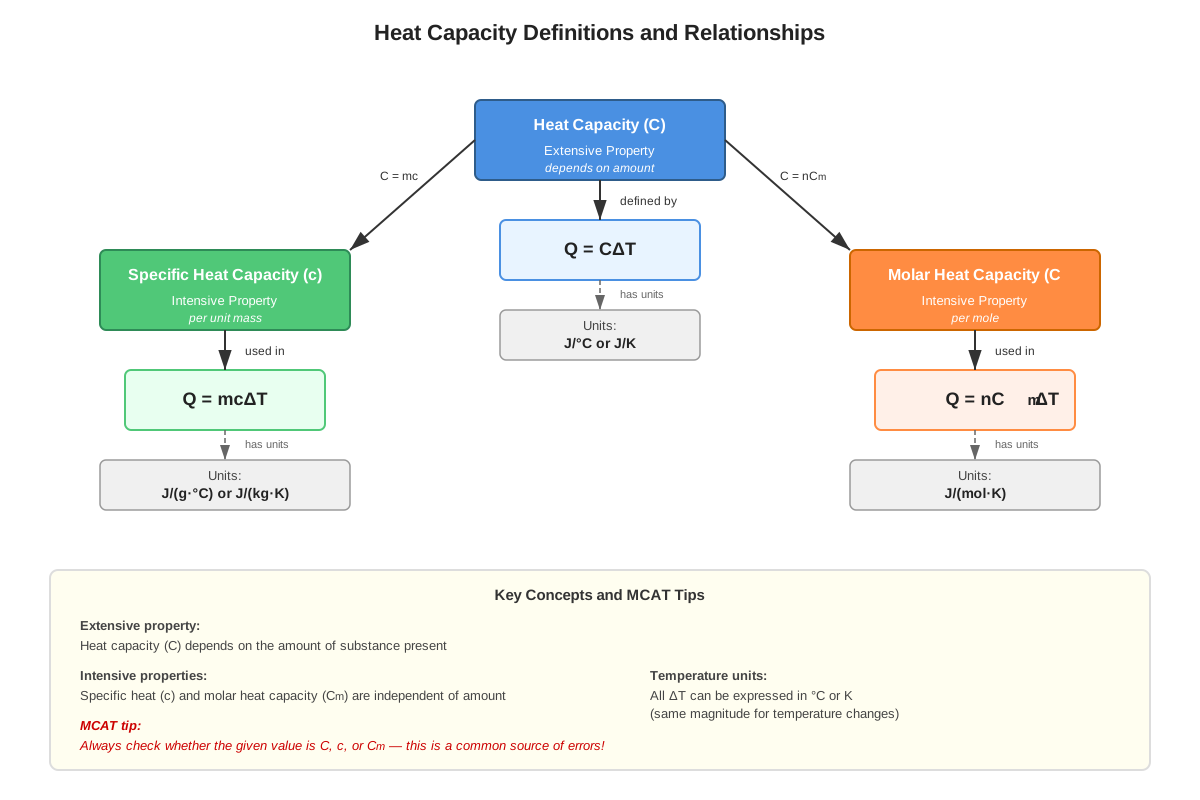
Heat capacity (C) represents the amount of thermal energy required to raise the temperature of an object or substance by one degree Celsius (or one kelvin). Mathematically, heat capacity relates heat transfer (q) to temperature change (ΔT):
C = q / ΔTWhere:
- C = heat capacity (J/°C or J/K)
- q = heat transferred (J)
- ΔT = temperature change (°C or K)
This equation can be rearranged to solve for heat transferred:
q = C × ΔTHeat capacity is an extensive property, meaning it depends on the amount of substance present. A larger sample of the same material has a greater heat capacity than a smaller sample because more thermal energy is required to change its temperature. This distinguishes heat capacity from intensive properties like density or specific heat, which remain constant regardless of sample size.
Specific Heat Capacity
Specific heat capacity (c), often simply called specific heat, is the heat capacity per unit mass. This intensive property characterizes the material itself rather than a particular sample:
c = C / m = q / (m × ΔT)Where:
- c = specific heat capacity (J/(g·°C) or J/(kg·K))
- m = mass (g or kg)
- q = heat transferred (J)
- ΔT = temperature change (°C or K)
The rearranged form for calculating heat transfer is the most commonly used equation on the MCAT:
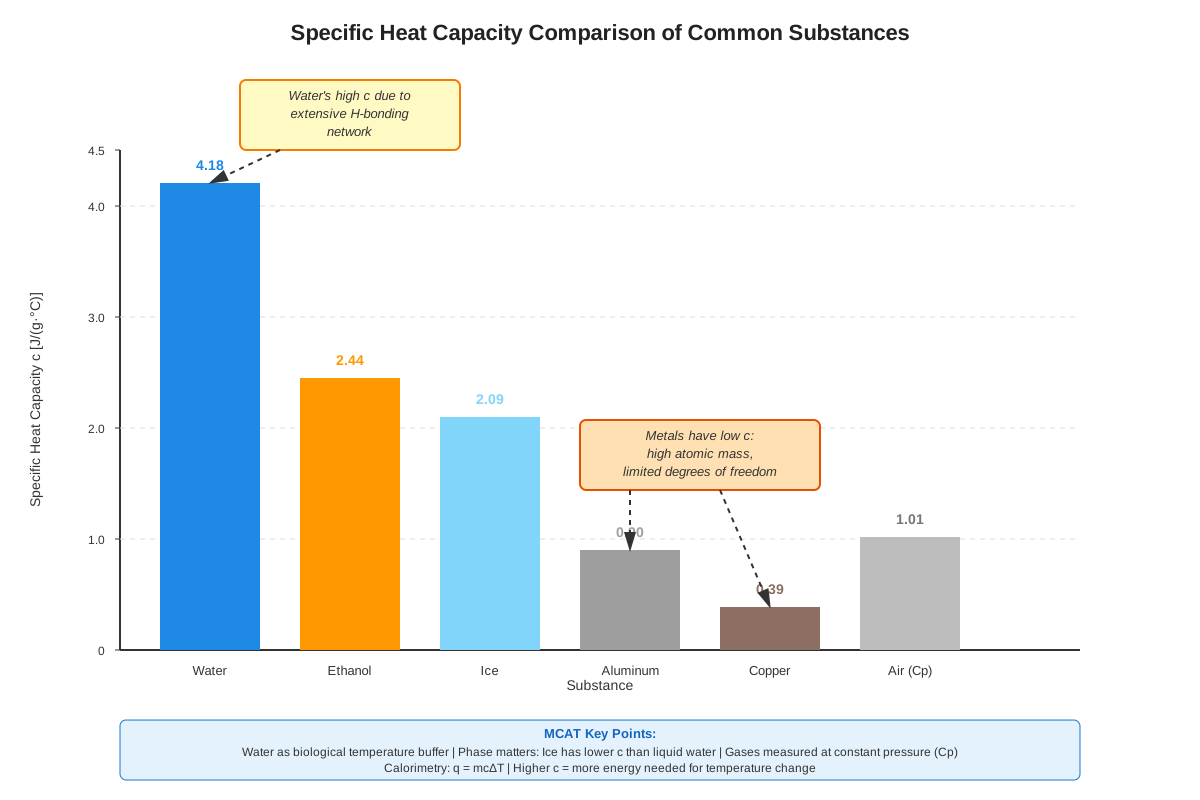
q = m × c × ΔTDifferent substances have characteristic specific heat values that reflect their molecular structure and bonding. Water has an exceptionally high specific heat (4.18 J/(g·°C)), approximately four times that of most metals, which explains its biological importance as a thermal buffer.
Molar Heat Capacity
Molar heat capacity (Cₘ) expresses heat capacity per mole of substance, particularly useful for gases and chemical reactions:
Cₘ = q / (n × ΔT)Where:
- Cₘ = molar heat capacity (J/(mol·K))
- n = number of moles (mol)
- q = heat transferred (J)
- ΔT = temperature change (K)
For ideal gases, molar heat capacity depends on whether heating occurs at constant volume (Cᵥ) or constant pressure (Cₚ). This distinction arises because heating at constant pressure allows the gas to expand and do work, requiring additional energy beyond that needed to increase internal energy:
Cₚ = Cᵥ + RWhere R is the ideal gas constant (8.314 J/(mol·K)). For monatomic ideal gases, Cᵥ = (3/2)R and Cₚ = (5/2)R.
Factors Affecting Heat Capacity
Several molecular and structural factors determine a substance's heat capacity:
Molecular complexity: Molecules with more atoms and degrees of freedom (translational, rotational, vibrational) have higher heat capacities because thermal energy distributes across more modes of motion. Polyatomic molecules like CO₂ have higher molar heat capacities than monatomic gases like helium.
Hydrogen bonding: Substances capable of hydrogen bonding, particularly water, exhibit elevated heat capacities because energy input must overcome intermolecular attractions in addition to increasing kinetic energy. This explains why water's specific heat exceeds that of most organic solvents.
Phase of matter: Gases generally have lower heat capacities per unit mass than liquids or solids of the same substance because gas molecules are farther apart with weaker intermolecular forces. However, molar heat capacities of gases can be substantial due to their low molar masses.
Temperature dependence: Heat capacity varies with temperature, though this variation is often negligible over the temperature ranges encountered in MCAT problems. At very low temperatures, quantum effects become significant, and heat capacity approaches zero as absolute zero is approached (Third Law of Thermodynamics).
Calorimetry Applications
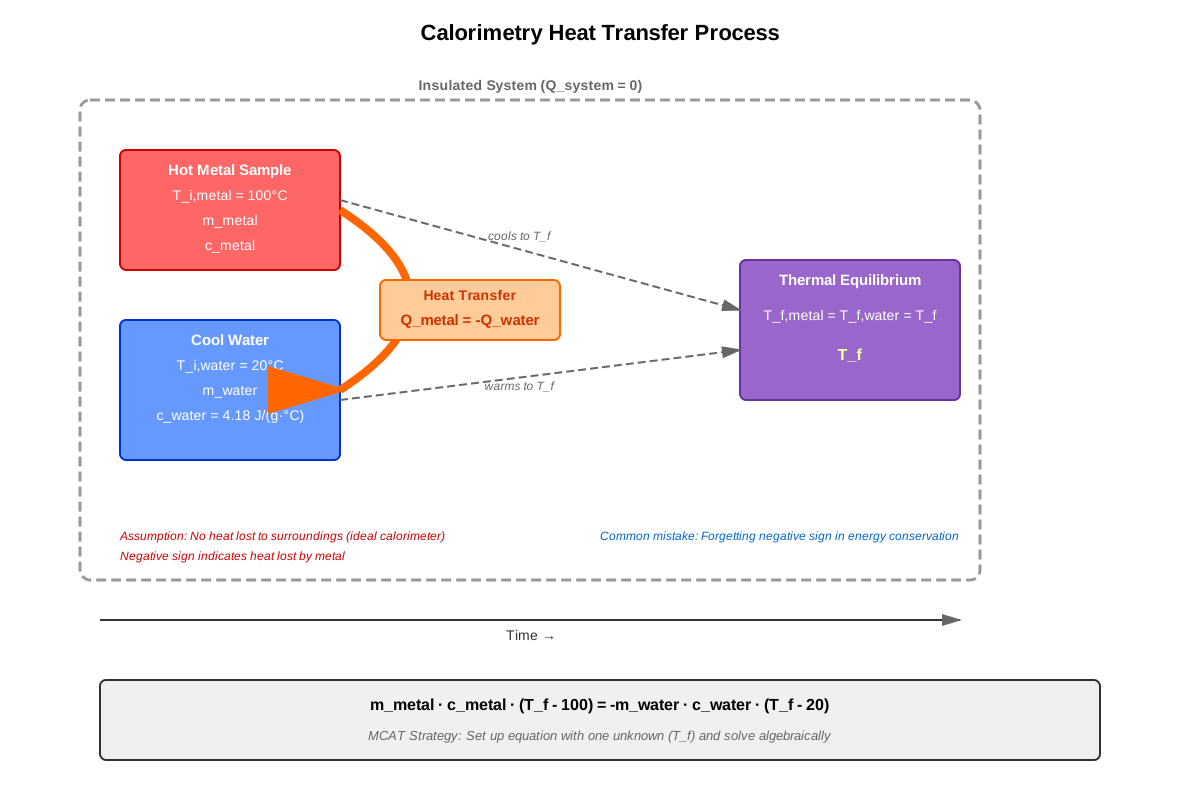
Calorimetry measures heat transfer by observing temperature changes in a system of known heat capacity. The principle of conservation of energy dictates that in an isolated system, heat lost by hot objects equals heat gained by cold objects:
qₗₒₛₜ = -qgₐᵢₙₑdOr more explicitly:
m₁c₁ΔT₁ = -m₂c₂ΔT₂The negative sign indicates that heat flows from higher to lower temperature. At thermal equilibrium, all components reach the same final temperature (Tₓ).
Coffee cup calorimetry (constant pressure calorimetry) uses an insulated container to measure enthalpy changes in solution reactions. The heat released or absorbed by a reaction equals the heat gained or lost by the solution and calorimeter:
qᵣₑₐcₜᵢₒₙ = -(qₛₒₗᵤₜᵢₒₙ + qcₐₗₒᵣᵢₘₑₜₑᵣ)Bomb calorimetry (constant volume calorimetry) measures the heat of combustion by burning a sample in a sealed, rigid container surrounded by water. The temperature increase of the water and calorimeter apparatus allows calculation of the energy content of foods or fuels.
Comparison Table of Heat Capacities
| Substance | Specific Heat (J/(g·°C)) | Significance |
|---|---|---|
| Water (liquid) | 4.18 | Highest common substance; biological temperature regulation |
| Ice | 2.09 | About half that of liquid water |
| Steam | 2.01 | Similar to ice; phase-dependent |
| Ethanol | 2.44 | Typical organic liquid |
| Aluminum | 0.90 | Representative metal; good conductor |
| Copper | 0.39 | Low heat capacity; heats/cools quickly |
| Iron | 0.45 | Similar to copper |
| Air | ~1.00 | At constant pressure, per gram |
This table illustrates why water serves as an excellent coolant and biological medium—it absorbs substantial heat with minimal temperature change. Metals, with low specific heats, rapidly equilibrate to ambient temperature, explaining why metal objects feel colder than wooden objects at the same temperature (they conduct heat away from skin more rapidly).
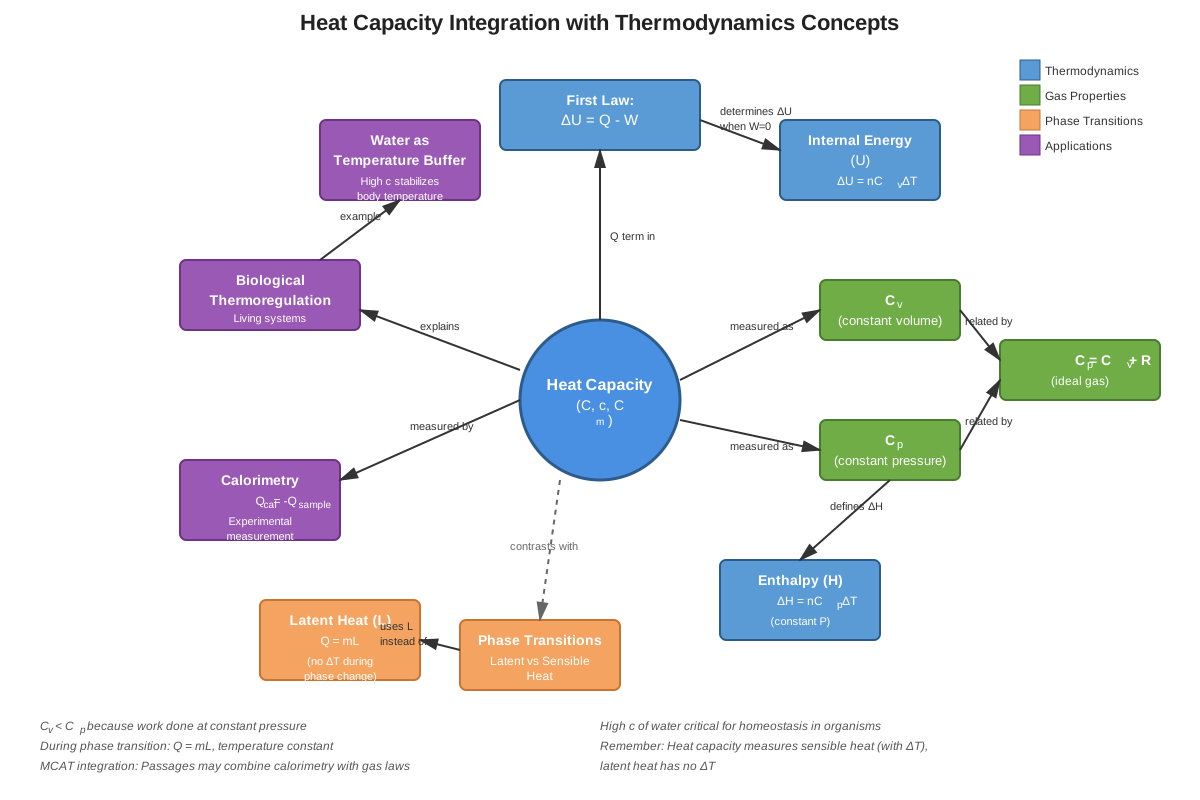
Concept Relationships
Heat capacity serves as the central quantitative link between thermal energy transfer and observable temperature changes. The relationship flows hierarchically: heat capacity (extensive) → specific heat capacity (intensive, per unit mass) → molar heat capacity (intensive, per mole). Each represents the same fundamental concept scaled differently for practical applications.
Within Thermodynamics and Gases, heat capacity connects directly to the First Law of Thermodynamics (ΔU = q - w). For processes at constant volume where no work is done (w = 0), all heat transferred changes internal energy: q = nCᵥΔT = ΔU. For constant pressure processes, q = nCₚΔT = ΔH (enthalpy change). This relationship bridges heat capacity to thermochemistry and reaction energetics.
The kinetic molecular theory provides the microscopic foundation for heat capacity. Temperature measures average kinetic energy of particles, while heat capacity reflects how many particles are present and how many degrees of freedom they possess. This connects heat capacity → kinetic theory → ideal gas law → gas behavior under various conditions.
Calorimetry represents the practical application of heat capacity principles, combining conservation of energy → thermal equilibrium → heat capacity calculations. The calorimeter constant (heat capacity of the apparatus) must be determined before accurate measurements can be made, illustrating how heat capacity applies to complex systems with multiple components.
Phase transitions reveal the limitations of heat capacity concepts. During melting or boiling, temperature remains constant despite continuous heat input, requiring latent heat (heat of fusion or vaporization) rather than heat capacity to describe energy transfer. This relationship maps: heat capacity (temperature changes within a phase) → latent heat (temperature constant during phase change) → phase diagrams (complete picture of thermal behavior).
The connection to biological systems flows through water's unique properties: high specific heat → temperature stability → homeostasis → metabolic efficiency. Organisms exploit water's heat capacity for thermoregulation through sweating (evaporative cooling), panting, and circulatory heat distribution.
Quick check — test yourself on Heat capacity so far.
Try Flashcards →High-Yield Facts
⭐ Water has the highest specific heat of common substances (4.18 J/(g·°C)), making it an ideal biological temperature buffer and explaining why coastal climates are more moderate than inland regions.
⭐ The equation q = mcΔT is the most frequently tested heat capacity relationship on the MCAT, appearing in both calculation and conceptual questions.
⭐ Heat capacity is an extensive property (depends on amount), while specific heat is intensive (independent of amount)—this distinction frequently appears in passage-based questions.
⭐ For ideal gases, Cₚ = Cᵥ + R, where Cₚ > Cᵥ because heating at constant pressure requires additional energy for expansion work.
⭐ In calorimetry problems, heat lost equals heat gained (qₗₒₛₜ = -qgₐᵢₙₑd), and all components reach the same final temperature at equilibrium.
- Metals have low specific heats (typically 0.1-0.9 J/(g·°C)), causing them to heat and cool rapidly compared to water.
- The sign convention for heat transfer: q > 0 indicates heat absorbed (endothermic), q < 0 indicates heat released (exothermic).
- Molar heat capacity at constant volume for monatomic ideal gases equals (3/2)R ≈ 12.5 J/(mol·K), derived from kinetic theory.
- Temperature change (ΔT) is identical whether expressed in Celsius or Kelvin because both scales have the same degree size.
- The calorimeter constant (heat capacity of the apparatus) must be included in precise calorimetry calculations: qₜₒₜₐₗ = qₛᵤbₛₜₐₙcₑ + qcₐₗₒᵣᵢₘₑₜₑᵣ.
- Specific heat varies with temperature, though MCAT problems typically assume constant values over the temperature ranges given.
- One calorie (cal) equals 4.184 joules (J), and nutritional Calories (Cal) are actually kilocalories (1 Cal = 1000 cal = 4184 J).
Common Misconceptions
Misconception: Heat and temperature are the same thing. → Correction: Heat (q) is energy transferred between systems due to temperature difference, measured in joules. Temperature (T) measures average kinetic energy of particles, measured in Kelvin or Celsius. A large cold object can contain more thermal energy than a small hot object.
Misconception: Heat capacity and specific heat are interchangeable terms. → Correction: Heat capacity (C) is extensive and depends on the amount of substance (J/°C), while specific heat capacity (c) is intensive and represents heat capacity per unit mass (J/(g·°C)). A 100 g sample of water has twice the heat capacity but the same specific heat as a 50 g sample.
Misconception: All substances require the same amount of energy to change temperature by one degree. → Correction: Different substances have vastly different specific heats reflecting their molecular structure. Water requires 4.18 J to heat one gram by 1°C, while copper requires only 0.39 J—more than ten times less energy.
Misconception: During phase transitions, adding heat increases temperature. → Correction: During melting, freezing, boiling, or condensation, temperature remains constant while heat is absorbed or released. Heat capacity equations (q = mcΔT) do not apply during phase changes; latent heat equations must be used instead.
Misconception: The final temperature in calorimetry problems is always the average of initial temperatures. → Correction: The final temperature depends on the masses and specific heats of all components, not just initial temperatures. A substance with higher mass or specific heat has greater influence on the final equilibrium temperature.
Misconception: Negative heat (q < 0) means the substance is cold. → Correction: Negative q indicates heat is released or lost by that particular substance (exothermic process), not that the substance is cold. A hot object cooling down has q < 0 even though its temperature remains above room temperature.
Misconception: ΔT must be converted from Celsius to Kelvin in heat capacity calculations. → Correction: Temperature differences (ΔT) are identical in Celsius and Kelvin because both scales have the same degree size. Only absolute temperatures (not differences) require conversion when using equations like the ideal gas law.
Worked Examples
Example 1: Basic Calorimetry Calculation
Problem: A 50.0 g sample of copper at 95.0°C is placed in 100.0 g of water at 20.0°C in an insulated container. What is the final equilibrium temperature? (Specific heat of copper = 0.39 J/(g·°C); specific heat of water = 4.18 J/(g·°C))
Solution:
Step 1: Identify what we know and what we're solving for.
- Copper: m₁ = 50.0 g, c₁ = 0.39 J/(g·°C), T₁ᵢ = 95.0°C
- Water: m₂ = 100.0 g, c₂ = 4.18 J/(g·°C), T₂ᵢ = 20.0°C
- Final temperature: Tₓ = ?
Step 2: Apply conservation of energy. Heat lost by copper equals heat gained by water:
-qcopper = qwater
-m₁c₁(Tₓ - T₁ᵢ) = m₂c₂(Tₓ - T₂ᵢ)
Step 3: Substitute values:
-(50.0)(0.39)(Tₓ - 95.0) = (100.0)(4.18)(Tₓ - 20.0)Step 4: Expand and simplify:
-19.5(Tₓ - 95.0) = 418(Tₓ - 20.0)
-19.5Tₓ + 1852.5 = 418Tₓ - 8360
Step 5: Solve for Tₓ:
1852.5 + 8360 = 418Tₓ + 19.5Tₓ
10212.5 = 437.5Tₓ
Tₓ = 23.3°CAnalysis: The final temperature (23.3°C) is much closer to water's initial temperature (20.0°C) than copper's (95.0°C) because water has both greater mass and much higher specific heat. This demonstrates that substances with higher heat capacity dominate the final equilibrium temperature. This problem type directly tests Learning Objective: Apply heat capacity to exam-style questions.
Example 2: Determining Specific Heat from Calorimetry Data
Problem: A researcher places a 75.0 g sample of an unknown metal at 100.0°C into a coffee cup calorimeter containing 150.0 g of water at 22.0°C. The final temperature of the system is 25.5°C. Assuming no heat loss to the surroundings and negligible heat capacity of the cup, what is the specific heat of the metal?
Solution:
Step 1: Recognize that heat lost by metal equals heat gained by water:
-qmetal = qwaterStep 2: Express each heat term using q = mcΔT:
-mmetal × cmetal × ΔTmetal = mwater × cwater × ΔTwaterStep 3: Calculate temperature changes:
- ΔTmetal = Tₓ - Tᵢ = 25.5°C - 100.0°C = -74.5°C
- ΔTwater = Tₓ - Tᵢ = 25.5°C - 22.0°C = +3.5°C
Step 4: Substitute known values (cwater = 4.18 J/(g·°C)):
-(75.0 g)(cmetal)(-74.5°C) = (150.0 g)(4.18 J/(g·°C))(3.5°C)Step 5: Simplify:
(75.0)(cmetal)(74.5) = (150.0)(4.18)(3.5)
5587.5 × cmetal = 2194.5
Step 6: Solve for cmetal:
cmetal = 2194.5 / 5587.5 = 0.39 J/(g·°C)Analysis: The calculated specific heat (0.39 J/(g·°C)) matches copper, suggesting the unknown metal is likely copper. Notice that the metal's large temperature drop (-74.5°C) produces only a small temperature increase in water (+3.5°C) due to water's much higher specific heat. This problem illustrates how calorimetry determines material properties and connects to Learning Objective: Calculate temperature changes and heat transfer using heat capacity equations. The MCAT may present similar scenarios where students must identify substances based on thermal properties or determine experimental unknowns.
Exam Strategy
When approaching heat capacity questions on the MCAT, first identify whether the problem involves a single substance changing temperature or multiple substances exchanging heat. Single-substance problems use q = mcΔT directly, while multi-substance problems require setting up conservation of energy equations where heat lost equals heat gained.
Trigger words and phrases to watch for include: "thermal equilibrium" (signals final temperature calculation), "calorimeter" (indicates heat exchange problem), "specific heat" (use intensive property), "heat capacity" (may be extensive property), "insulated" or "isolated" (no heat loss to surroundings), and "constant pressure" or "constant volume" (relevant for gases). The phrase "how much heat is required" signals solving for q, while "what is the final temperature" requires solving for Tₓ.
Process-of-elimination strategies specific to heat capacity:
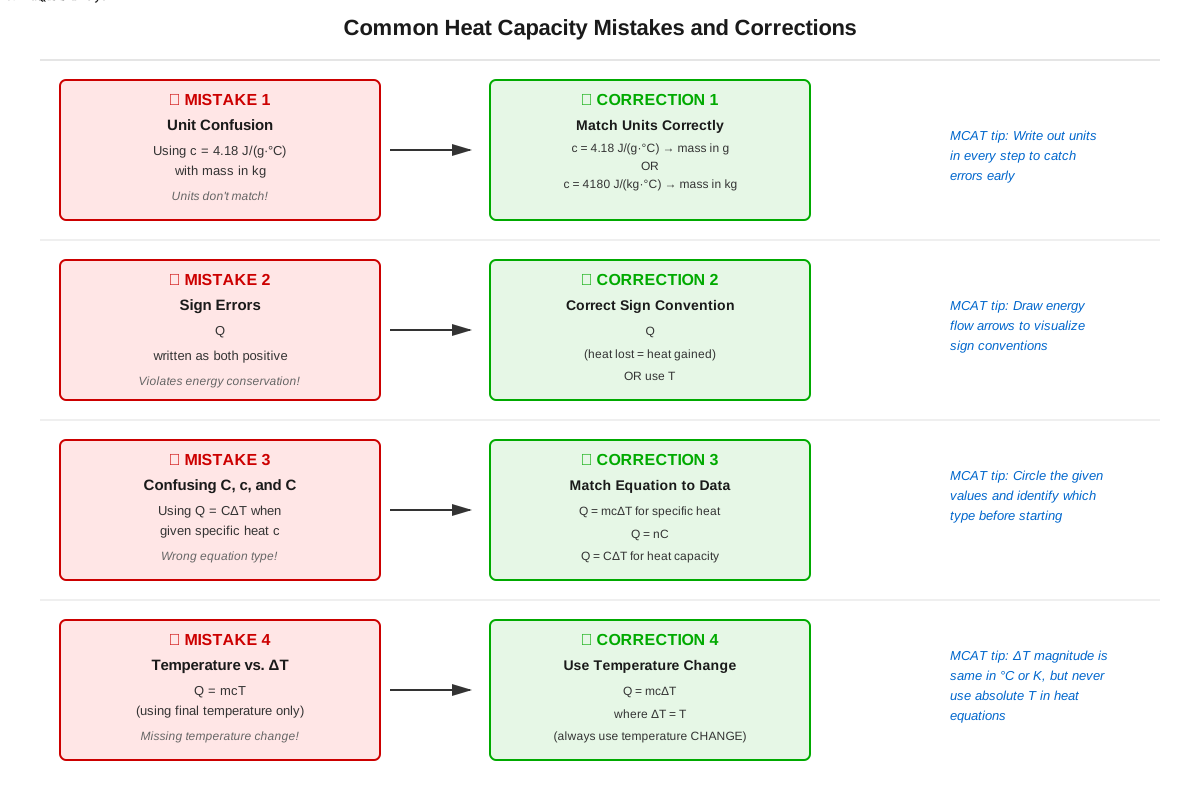
- Check units carefully: Eliminate answer choices with incorrect units. Heat (q) must be in joules or calories, temperature in Celsius or Kelvin, and specific heat in J/(g·°C).
- Verify temperature direction: The final temperature must lie between the initial temperatures of the substances involved. Eliminate any answer outside this range.
- Apply physical intuition: The substance with greater mass × specific heat product dominates the final temperature. If water (high specific heat) is present, the final temperature will be closer to water's initial temperature.
- Sign consistency: Heat gained is positive, heat lost is negative. If a substance cools, its q must be negative; if it warms, q must be positive.
- Magnitude estimation: Before calculating, estimate whether the answer should be large or small based on the specific heats involved. Water problems typically involve larger heat values than metal problems.
Time allocation advice: Straightforward q = mcΔT calculations should take 30-45 seconds. Multi-step calorimetry problems requiring algebraic manipulation may take 90-120 seconds. If a problem requires more than 2 minutes, flag it and return later. On passage-based questions, identify the relevant equation first, then locate the necessary values in the passage—don't read the entire passage before looking at the question.
Exam Tip: When setting up calorimetry equations, write the conservation of energy statement first (heat lost = heat gained), then substitute the q = mcΔT expressions. This systematic approach prevents sign errors and ensures proper equation setup.
Memory Techniques
Mnemonic for heat capacity equation: "Queen Mary Can Dance Tango" → q = mc∆T (the most important equation for this topic)
Visualization strategy for calorimetry: Picture a hot object as a full bucket of water and a cold object as an empty bucket. When placed together, water flows from full to empty until both reach the same level (thermal equilibrium). The bucket with greater capacity (higher mc product) changes level less—analogous to how substances with higher heat capacity change temperature less.
Acronym for factors affecting heat capacity: "Molecular Hydrogen Phase Temperature" → MHPT
- Molecular complexity (more atoms = higher capacity)
- Hydrogen bonding (increases capacity)
- Phase of matter (solid/liquid > gas per unit mass)
- Temperature dependence (varies with T)
Specific heat comparison memory aid: "Water Wins Warmth Wars" → Water has the highest specific heat of common substances, making it the winner at resisting temperature change. For metals, remember "Copper Cools Quickly" (low specific heat).
Sign convention reminder: "Endothermic = Energy Enters" (q positive), "Exothermic = Energy Exits" (q negative). Both start with E to link the concept.
Calorimetry equilibrium: "Hot Loses, Cold Gains, All Same" → Hot objects lose heat, cold objects gain heat, all reach the same final temperature. The first letters spell "HLC GAS" which can remind you this applies to all phases including gases.
Summary
Heat capacity quantifies the relationship between thermal energy transfer and temperature change, serving as a fundamental concept in thermodynamics with significant biological and practical applications. The core equation q = mcΔT enables calculation of heat transfer given mass, specific heat, and temperature change, while calorimetry applies conservation of energy to determine unknown quantities through thermal equilibrium. Water's exceptionally high specific heat (4.18 J/(g·°C)) makes it crucial for biological temperature regulation and explains its prevalence in living systems. Heat capacity is extensive (depends on amount), while specific heat is intensive (characteristic of the substance), a distinction frequently tested on the MCAT. For ideal gases, molar heat capacity differs between constant volume and constant pressure conditions, with Cₚ exceeding Cᵥ by R due to expansion work. Successful problem-solving requires careful attention to signs (heat gained positive, lost negative), units, and the principle that final temperature lies between initial temperatures of interacting substances. Mastery of heat capacity enables students to tackle calorimetry passages, thermochemistry calculations, and physiological scenarios involving thermoregulation.
Key Takeaways
- Heat capacity (C) is extensive and depends on the amount of substance, while specific heat (c) is intensive and characterizes the material itself; the fundamental equation is q = mcΔT
- Water has the highest specific heat (4.18 J/(g·°C)) of common substances, explaining its biological importance as a temperature buffer and its prevalence in living organisms
- Conservation of energy in calorimetry requires that heat lost by hot objects equals heat gained by cold objects, with all components reaching the same final equilibrium temperature
- Temperature changes (ΔT) are identical in Celsius and Kelvin because both scales have the same degree size, eliminating the need for conversion in heat capacity calculations
- For ideal gases, Cₚ = Cᵥ + R because heating at constant pressure requires additional energy for expansion work beyond increasing internal energy
- Sign conventions are critical: q > 0 for endothermic processes (heat absorbed), q < 0 for exothermic processes (heat released)
- Heat capacity equations do not apply during phase transitions where temperature remains constant; latent heat must be used instead for melting, freezing, boiling, or condensation
Related Topics
Latent Heat and Phase Transitions: Understanding heat of fusion and vaporization builds directly on heat capacity concepts, explaining why temperature remains constant during phase changes despite continuous energy input. Mastering heat capacity provides the foundation for analyzing complete heating curves.
First Law of Thermodynamics: Heat capacity connects to internal energy changes through ΔU = q - w, particularly for constant volume processes where all heat transfer changes internal energy. This relationship is essential for understanding energy conservation in thermodynamic systems.
Calorimetry and Thermochemistry: Bomb calorimetry and coffee cup calorimetry apply heat capacity principles to determine enthalpy changes of reactions, heats of combustion, and food caloric content—frequent MCAT passage topics.
Ideal Gas Law and Gas Behavior: Molar heat capacities (Cᵥ and Cₚ) connect to the ideal gas law through the relationship between pressure, volume, and temperature changes during heating processes.
Thermoregulation and Homeostasis: Biological applications of heat capacity explain how organisms maintain constant body temperature through sweating, panting, and circulatory heat distribution—important for MCAT biology passages.
Kinetic Molecular Theory: The microscopic foundation of heat capacity lies in how thermal energy distributes among translational, rotational, and vibrational degrees of freedom in molecules.
Practice CTA
Now that you've mastered the core concepts of heat capacity, it's time to solidify your understanding through active practice. Attempt the practice questions to test your ability to apply q = mcΔT in various contexts, solve multi-step calorimetry problems, and analyze experimental scenarios. Work through the flashcards to reinforce high-yield facts, specific heat values, and the distinctions between heat capacity types. Remember, the MCAT rewards not just knowledge but the ability to apply concepts quickly and accurately under time pressure—practice is where you develop that skill. Each problem you solve strengthens your pattern recognition and builds confidence for test day. You've got this!
Sign up free to keep reading
Create a free AnvayaPrep account to finish this MCAT guide on Heat capacity — plus flashcards and practice questions.