Overview
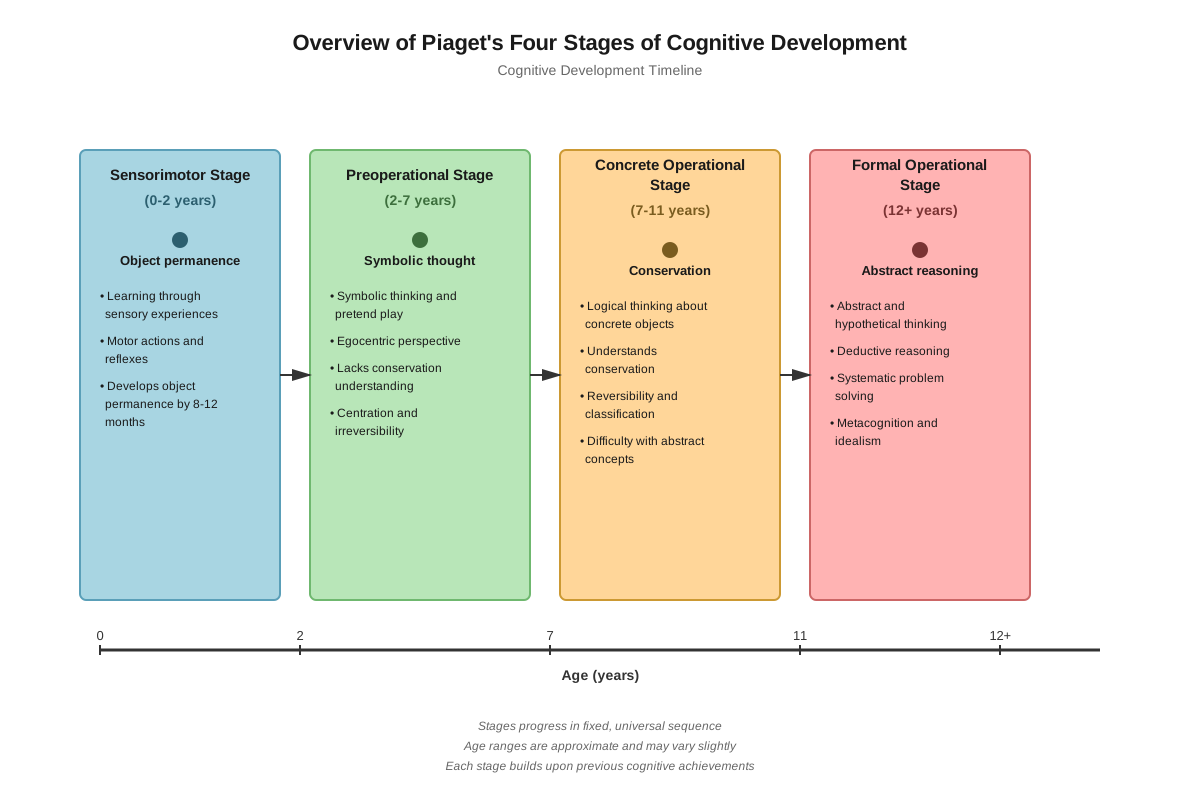
Piaget stages represent one of the most foundational frameworks in developmental psychology, describing how children's cognitive abilities evolve through distinct, qualitatively different phases from infancy through adolescence. Jean Piaget, a Swiss psychologist, revolutionized our understanding of cognitive development by proposing that children are not simply "miniature adults" who know less, but rather think in fundamentally different ways at different ages. His stage theory posits that all children progress through four universal stages in a fixed sequence: the sensorimotor stage, the preoperational stage, the concrete operational stage, and the formal operational stage. Each stage is characterized by specific cognitive capabilities and limitations that shape how children perceive, understand, and interact with their world.
For the MCAT, Piaget stages Psychology is a medium-yield topic that appears regularly in the Psychological, Social, and Biological Foundations of Behavior section. Understanding these stages is essential not only for answering direct questions about developmental milestones but also for analyzing research passages involving pediatric populations, educational interventions, and cognitive assessment. The MCAT frequently tests students' ability to identify which stage a child is in based on behavioral descriptions, recognize the cognitive abilities that emerge at each stage, and apply Piagetian concepts to novel scenarios. Questions may present vignettes describing children's problem-solving approaches, language use, or social interactions, requiring test-takers to match behaviors with the appropriate developmental stage.
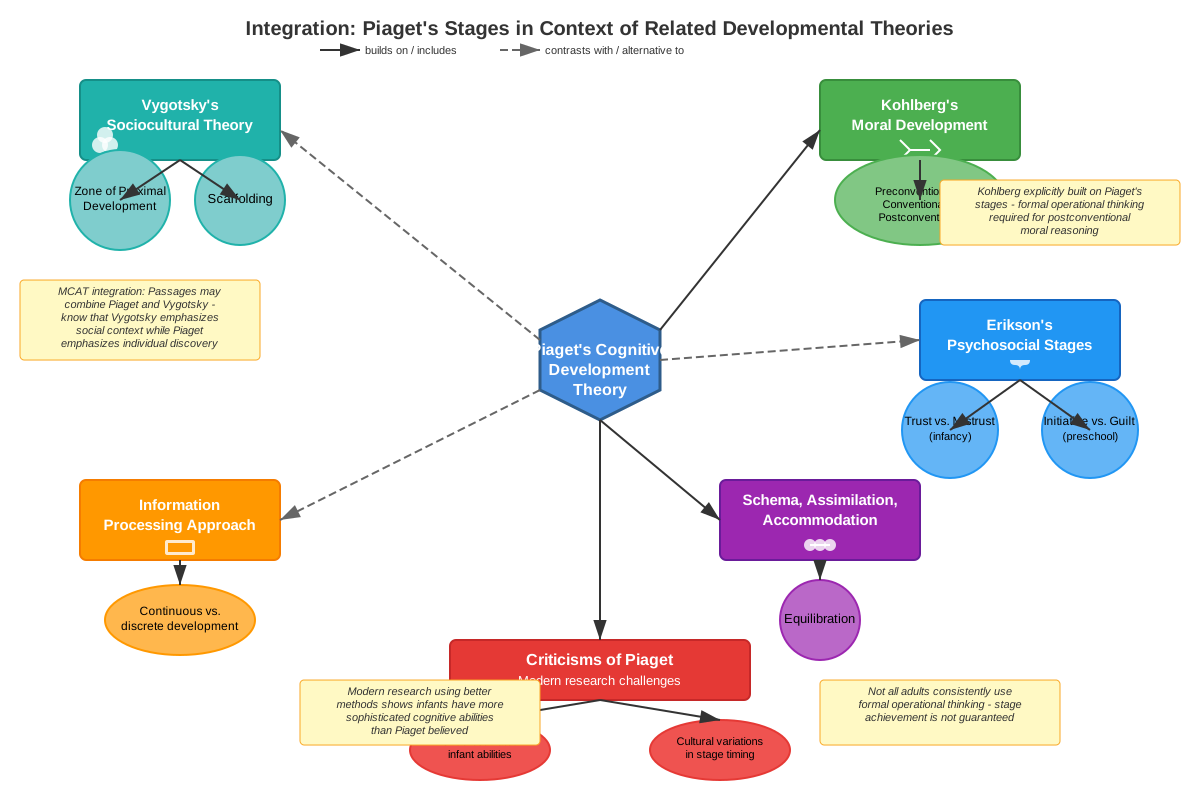
Within the broader context of Development and Personality in Psychology, Piaget's theory connects to numerous related concepts including cognitive development theories (Vygotsky's sociocultural theory, information processing approaches), moral development (Kohlberg's stages), and social development (attachment theory, identity formation). Piaget's work laid the groundwork for understanding how biological maturation and environmental interaction jointly shape cognitive growth, making it a cornerstone concept that integrates with topics ranging from neurological development to educational psychology. Mastering Piaget stages MCAT content enables students to approach developmental questions with a systematic framework for predicting and explaining age-related cognitive changes.
Learning Objectives
- [ ] Define Piaget stages using accurate Psychology terminology
- [ ] Explain why Piaget stages matters for the MCAT
- [ ] Apply Piaget stages to exam-style questions
- [ ] Identify common mistakes related to Piaget stages
- [ ] Connect Piaget stages to related Psychology concepts
- [ ] Distinguish between the cognitive capabilities present and absent at each developmental stage
- [ ] Analyze behavioral vignettes to determine the appropriate Piagetian stage
- [ ] Compare and contrast key concepts such as assimilation, accommodation, and schema formation across stages
Prerequisites
- Basic understanding of developmental psychology principles: Necessary to contextualize stage theories within the broader framework of human development across the lifespan
- Familiarity with cognitive processes: Required to understand how mental operations like memory, attention, and problem-solving evolve through Piaget's stages
- Knowledge of research methodology: Essential for evaluating the experimental tasks Piaget used to assess cognitive abilities at different ages
- General neurological development concepts: Helps explain the biological basis for stage transitions and cognitive maturation
Why This Topic Matters
Clinical and Real-World Significance: Piaget's stages have profound implications for education, parenting, and clinical practice. Educators use Piagetian principles to design age-appropriate curricula—for instance, avoiding abstract algebraic concepts for concrete operational children who cannot yet think hypothetically. Pediatricians and child psychologists reference these stages when assessing whether a child's cognitive development is progressing typically or shows delays requiring intervention. Understanding that a three-year-old's "lying" may reflect egocentrism rather than moral deficiency, or that a seven-year-old can understand conservation of mass but not proportional reasoning, allows professionals to set realistic expectations and provide developmentally appropriate support.
Exam Statistics: Piaget stages appear in approximately 2-4 questions per MCAT administration, typically in the Psychological, Social, and Biological Foundations section. Questions may be standalone discrete items or embedded within passages about child development research, educational interventions, or cognitive assessment studies. The MCAT particularly favors questions that require application rather than simple recall—for example, presenting a scenario where a child demonstrates specific behaviors and asking which stage best explains those behaviors, or identifying which cognitive ability would be present or absent at a given age.
Common Exam Appearances: This topic frequently appears in passages describing developmental research studies, such as experiments testing children's understanding of conservation, object permanence, or perspective-taking. Questions may ask students to identify the dependent variable being measured, predict outcomes for different age groups, or explain why certain tasks are appropriate for specific developmental stages. Standalone questions often present brief vignettes—a child playing with blocks, solving a puzzle, or engaging in pretend play—and require identification of the stage or the cognitive concept being demonstrated. The MCAT also tests understanding of stage transitions, asking what new abilities emerge when moving from one stage to the next.
Core Concepts
Foundational Principles of Piaget's Theory
Jean Piaget's cognitive development theory rests on several foundational principles that apply across all stages. Schema refers to mental frameworks or concepts that organize and interpret information. Children are born with basic schemas (sucking, grasping) and develop increasingly complex ones through experience. Assimilation occurs when children incorporate new information into existing schemas—for example, a child who knows "dog" might initially call all four-legged animals "dog." Accommodation happens when existing schemas must be modified to incorporate new information that doesn't fit—the child learns that cats are different from dogs and creates a new schema. Equilibration is the process of balancing assimilation and accommodation to create stable understanding. These mechanisms drive progression through the stages as children encounter experiences that challenge their current cognitive structures.
Sensorimotor Stage (Birth to 2 Years)
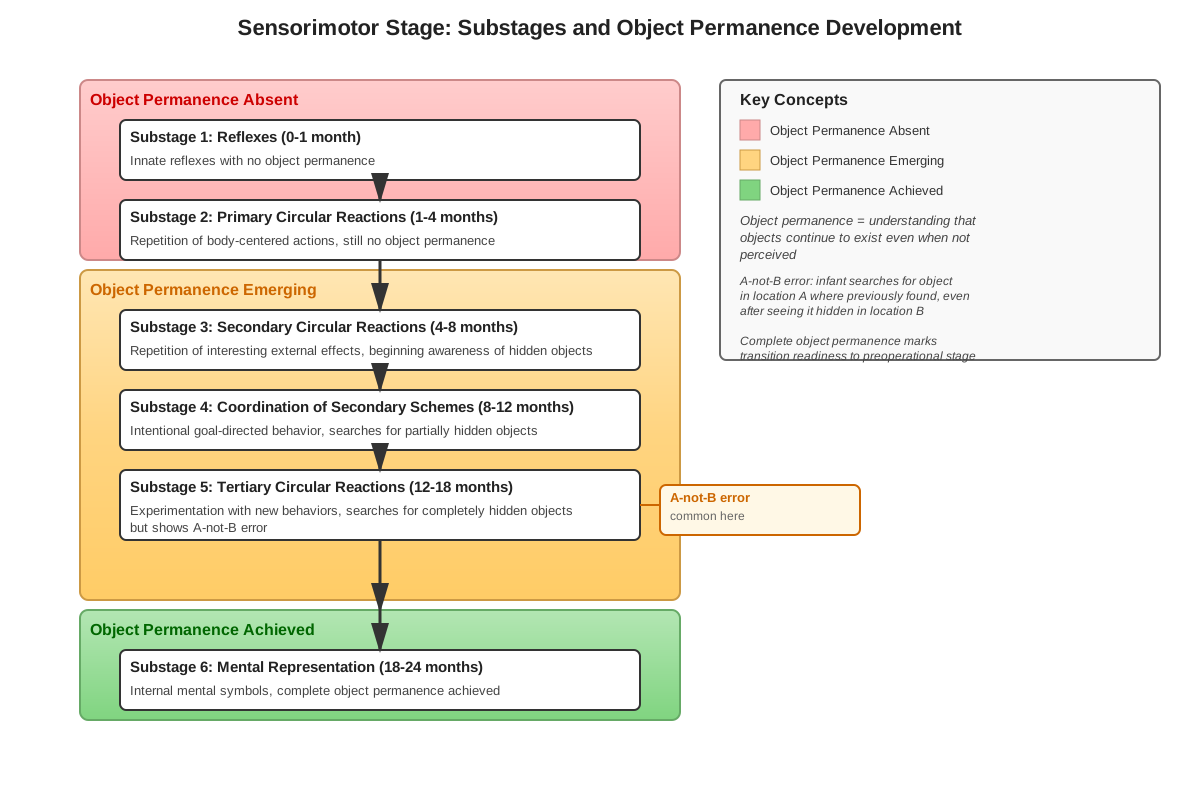
The sensorimotor stage is characterized by infants learning about the world through sensory experiences and motor actions. During this period, cognition is action-based rather than symbolic—infants understand objects by touching, mouthing, looking at, and manipulating them. This stage subdivides into six substages, progressing from simple reflexes to more coordinated and intentional behaviors.
The hallmark achievement of the sensorimotor stage is object permanence, the understanding that objects continue to exist even when out of sight. This ability develops gradually, with young infants (0-8 months) showing no search behavior when objects are hidden, suggesting "out of sight, out of mind." Around 8-12 months, infants begin searching for hidden objects but make the A-not-B error, continuing to search in the location where they previously found an object even after watching it being hidden in a new location. By 18-24 months, children achieve full object permanence and can find objects after invisible displacements.
Other key developments include goal-directed behavior (intentionally performing actions to achieve desired outcomes), deferred imitation (imitating behaviors observed earlier), and the beginning of symbolic thought as the stage concludes. The transition to symbolic representation marks the shift to the preoperational stage.
Preoperational Stage (2 to 7 Years)
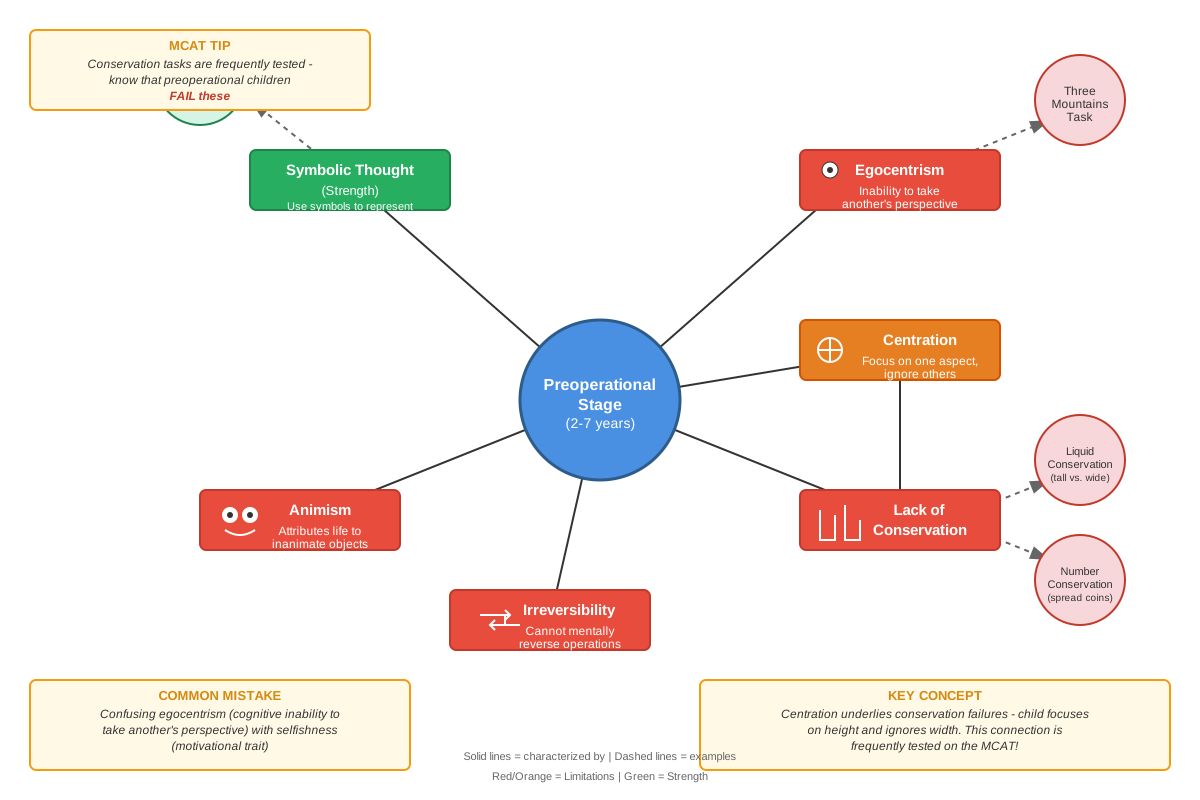
The preoperational stage is defined by the emergence of symbolic thought—the ability to use words, images, and symbols to represent objects and experiences. Children in this stage engage in pretend play, using objects to represent other things (a banana becomes a telephone), and show rapid language development. However, their thinking remains limited by several characteristic features.
Egocentrism is the inability to take another person's perspective, both literally and figuratively. Piaget demonstrated this with the three mountains task, where children could not describe what a scene would look like from another person's viewpoint. Preoperational children assume others see, think, and feel exactly as they do.
Centration refers to focusing on one aspect of a situation while ignoring others. This limitation prevents preoperational children from understanding conservation—the principle that quantity remains the same despite changes in appearance. In the classic conservation of liquid task, when water is poured from a short, wide glass into a tall, narrow glass, preoperational children claim there is now more water because they center on the height dimension while ignoring width. Similar conservation tasks involve number (spreading out a row of coins), mass (reshaping clay), and volume.
Irreversibility means preoperational children cannot mentally reverse actions. They cannot understand that pouring the water back into the original glass would restore the original appearance, demonstrating that quantity remained constant. Their thinking is also characterized by animism (attributing life and consciousness to inanimate objects) and artificialism (believing natural phenomena are created by humans).
Concrete Operational Stage (7 to 11 Years)
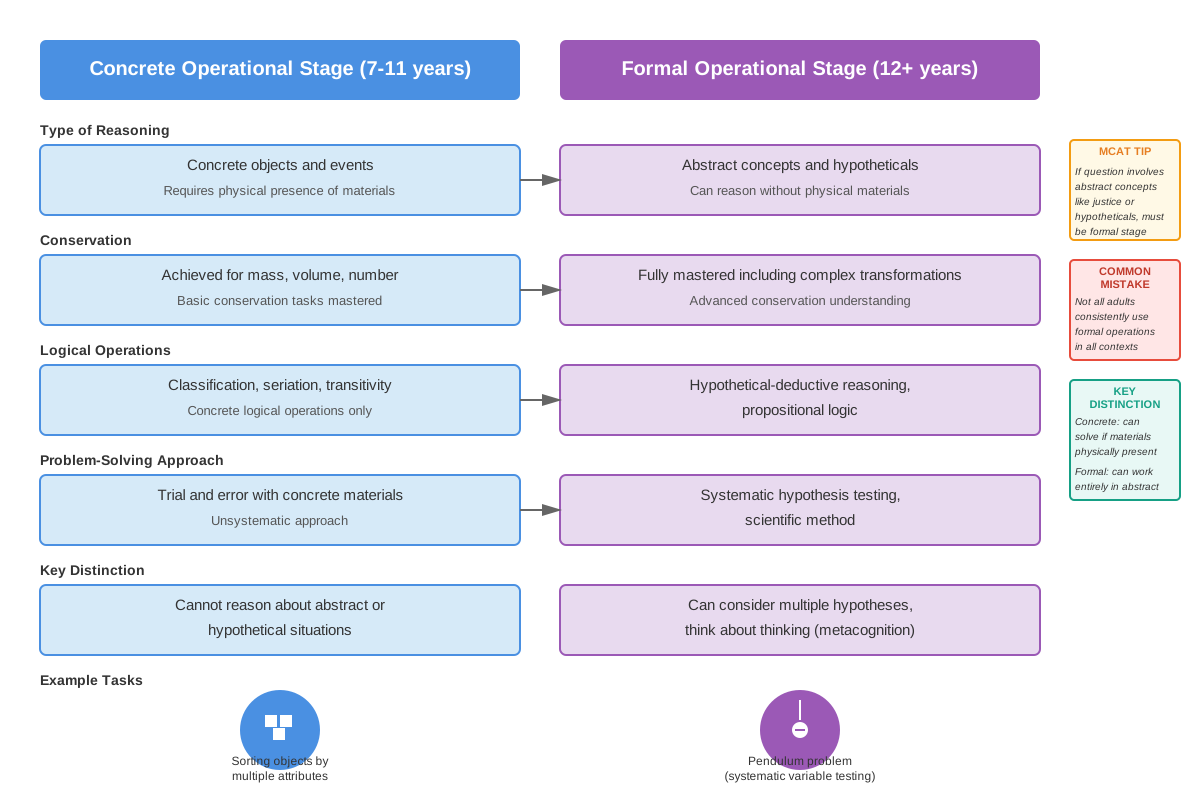
The concrete operational stage marks a major cognitive leap as children develop logical thinking abilities, though still limited to concrete, tangible situations. The defining achievement is mastery of conservation across various dimensions—children now understand that quantity, mass, and volume remain constant despite perceptual changes.
Children acquire several important logical operations during this stage:
- Seriation: The ability to arrange objects in logical order along a quantitative dimension (shortest to tallest, lightest to heaviest)
- Classification: The ability to organize objects into hierarchical categories and understand class inclusion (understanding that all dogs are animals, but not all animals are dogs)
- Transitivity: The ability to infer relationships (if A > B and B > C, then A > C)
- Reversibility: The ability to mentally reverse actions and transformations
Decentration replaces centration, allowing children to consider multiple aspects of a situation simultaneously. Egocentrism declines significantly, and children can take others' perspectives more effectively. However, concrete operational thinking remains tied to tangible, observable situations. Children struggle with abstract concepts, hypothetical scenarios, and systematic scientific reasoning. They can solve problems about concrete objects they can see and manipulate but cannot yet reason about purely abstract or hypothetical situations.
Formal Operational Stage (11+ Years)
The formal operational stage represents the pinnacle of cognitive development in Piaget's theory, characterized by abstract thinking and hypothetical-deductive reasoning. Adolescents and adults in this stage can think about concepts that have no physical referent, reason about possibilities rather than just actualities, and approach problems systematically.
Abstract reasoning allows formal operational thinkers to understand complex concepts like justice, liberty, and love without concrete examples. They can manipulate ideas mentally, engage in philosophical discussions, and understand metaphors and analogies. Hypothetical-deductive reasoning enables them to form hypotheses, deduce logical consequences, and test predictions systematically—the foundation of scientific thinking.
Piaget demonstrated formal operational thinking with the pendulum problem, where individuals must determine which factors (string length, weight, release height, push force) affect a pendulum's swing rate. Formal operational thinkers systematically vary one factor while holding others constant, whereas concrete operational children test variables haphazardly without controlling for confounds.
Other characteristics include propositional thought (reasoning about verbal statements without concrete referents), combinatorial reasoning (systematically considering all possible combinations), and metacognition (thinking about one's own thinking). However, Piaget acknowledged that not all adults consistently demonstrate formal operational thinking, and performance depends on domain expertise and familiarity.
Stage Comparison Table
| Stage | Age Range | Key Achievements | Major Limitations | Signature Task |
|---|---|---|---|---|
| Sensorimotor | 0-2 years | Object permanence, goal-directed behavior, beginning symbolic thought | No symbolic representation initially, limited to sensory-motor actions | Object permanence test (hidden object search) |
| Preoperational | 2-7 years | Symbolic thought, pretend play, rapid language development | Egocentrism, centration, no conservation, irreversibility | Conservation tasks (liquid, number, mass) |
| Concrete Operational | 7-11 years | Conservation, logical operations, classification, seriation, reversibility | Limited to concrete situations, cannot think abstractly or hypothetically | Class inclusion, seriation tasks |
| Formal Operational | 11+ years | Abstract thinking, hypothetical-deductive reasoning, systematic problem-solving | May not be achieved by all individuals, performance varies by domain | Pendulum problem, propositional reasoning |
Concept Relationships
The four Piaget stages form a hierarchical, sequential progression where each stage builds upon and incorporates the achievements of previous stages while adding qualitatively new cognitive capabilities. The sensorimotor stage establishes the foundation of object permanence and intentional action → which enables the symbolic representation characteristic of the preoperational stage → which provides the mental representations necessary for the logical operations of the concrete operational stage → which in turn support the abstract and hypothetical reasoning of the formal operational stage.
Within Piaget's broader theoretical framework, the mechanisms of assimilation, accommodation, and equilibration drive transitions between stages. As children encounter experiences that their current cognitive structures cannot adequately explain, they experience disequilibrium, motivating accommodation and the development of more sophisticated schemas. This process continues throughout development, with each stage representing a qualitatively different equilibrium state.
Piaget's stages connect to Vygotsky's sociocultural theory through contrasting perspectives on development—while Piaget emphasized universal, biologically-driven stages, Vygotsky highlighted the role of social interaction and cultural tools in cognitive growth. The concept of zone of proximal development in Vygotsky's theory addresses the gap between current and potential abilities, complementing Piaget's focus on stage-appropriate capabilities.
The stages also relate to information processing theories, which explain cognitive development through gradual improvements in attention, memory, and processing speed rather than qualitative stage shifts. Understanding both perspectives provides a more complete picture of cognitive development for MCAT purposes.
Connections to moral development are evident in Kohlberg's stages, which parallel Piaget's cognitive stages—preoperational children show preconventional moral reasoning, concrete operational children develop conventional reasoning, and formal operational thinking enables principled moral reasoning. Similarly, theory of mind (understanding that others have different mental states) develops during the transition from preoperational to concrete operational stages as egocentrism declines.
Quick check — test yourself on Piaget stages so far.
Try Flashcards →High-Yield Facts
⭐ Object permanence develops during the sensorimotor stage (0-2 years) and is fully achieved by approximately 18-24 months, marking the transition to symbolic thought.
⭐ Conservation is the hallmark achievement of the concrete operational stage (7-11 years); preoperational children fail conservation tasks due to centration and irreversibility.
⭐ Egocentrism characterizes preoperational thinking (2-7 years) and is demonstrated by the three mountains task, where children cannot adopt another person's visual perspective.
⭐ Abstract thinking and hypothetical-deductive reasoning emerge in the formal operational stage (11+ years), enabling systematic scientific reasoning and philosophical thought.
⭐ The stages progress in a fixed, universal sequence that cannot be skipped, though the age ranges are approximate and show individual variation.
- Centration (focusing on one dimension while ignoring others) explains why preoperational children fail conservation tasks.
- Reversibility (mentally undoing transformations) is achieved in the concrete operational stage and is essential for understanding conservation.
- The A-not-B error occurs around 8-12 months when infants search for hidden objects in the previous location rather than the current one.
- Symbolic thought emerges at the end of the sensorimotor stage and defines the preoperational stage, enabling language and pretend play.
- Class inclusion (understanding hierarchical categories) is a concrete operational ability that preoperational children lack.
- Seriation (ordering objects along a quantitative dimension) develops during the concrete operational stage.
- Animism (attributing life to inanimate objects) is characteristic of preoperational thinking.
- The pendulum problem is Piaget's classic test of formal operational thinking, requiring systematic hypothesis testing.
- Concrete operational children can reason logically about tangible, observable situations but struggle with purely abstract concepts.
- Not all adults consistently demonstrate formal operational thinking; performance depends on domain knowledge and familiarity.
Common Misconceptions
Misconception: The age ranges for Piaget's stages are rigid cutoffs, and all children transition at exactly those ages.
Correction: The age ranges are approximate averages. Individual children may enter or exit stages earlier or later depending on biological maturation, environmental stimulation, and cultural factors. The sequence is fixed, but timing varies.
Misconception: Children in the preoperational stage have no logical abilities whatsoever.
Correction: Preoperational children demonstrate many cognitive advances including symbolic thought, language, and pretend play. Their limitations are specific—they struggle with conservation, perspective-taking, and reversibility, but they are not entirely illogical.
Misconception: Object permanence is an all-or-nothing achievement that suddenly appears around 8 months.
Correction: Object permanence develops gradually throughout the sensorimotor stage. Early forms appear around 4-8 months (tracking partially hidden objects), the A-not-B error occurs around 8-12 months, and full object permanence with invisible displacements is achieved around 18-24 months.
Misconception: Once a child reaches the concrete operational stage, they can solve all types of conservation problems simultaneously.
Correction: Conservation abilities emerge in a predictable sequence called horizontal décalage—children master conservation of number first (around age 6-7), then mass and length (7-8), and finally volume (11-12). They don't acquire all conservation concepts at once.
Misconception: Formal operational thinking is automatically achieved by all adolescents and adults.
Correction: Research shows that many adolescents and adults do not consistently demonstrate formal operational reasoning, especially in unfamiliar domains. Performance depends on education, cultural factors, and domain-specific expertise. Some estimates suggest only 30-40% of adults consistently use formal operational thinking.
Misconception: Egocentrism means preoperational children are selfish or self-centered in a moral sense.
Correction: Egocentrism is a cognitive limitation, not a personality trait. It refers to the inability to mentally represent another person's perspective, not selfishness or lack of empathy. Children genuinely cannot understand that others see things differently.
Misconception: The concrete operational stage is called "concrete" because children think in simple or unsophisticated ways.
Correction: "Concrete" refers to the requirement that logical operations be applied to tangible, observable objects and situations. Concrete operational children demonstrate sophisticated logical reasoning (classification, seriation, transitivity) but need concrete referents rather than purely abstract concepts.
Worked Examples
Example 1: Identifying Stage from Behavioral Description
Vignette: A researcher observes a 4-year-old child playing with toy cars. The child lines up five red cars and five blue cars, with the blue cars spaced farther apart, making a longer line. When asked "Are there more blue cars or more red cars?" the child responds "More blue cars!" The researcher then pushes the red cars closer together and asks again. The child now says "More red cars!"
Question: Which Piagetian stage is this child in, and what cognitive limitation explains this behavior?
Analysis:
- Identify the age: The child is 4 years old, which falls within the preoperational stage (2-7 years).
- Analyze the behavior: The child is making judgments about quantity based on the spatial arrangement (length of the line) rather than actual number. When the arrangement changes, the child's answer changes, even though no cars were added or removed.
- Identify the cognitive limitation: This demonstrates centration—the child is focusing exclusively on one perceptual dimension (length of the line) while ignoring the relevant dimension (actual number of objects). This is also a failure of conservation of number.
- Consider other stage-specific features: The child also demonstrates irreversibility (cannot mentally reverse the spacing change to understand quantity remained constant) and lacks decentration (cannot consider both length and density simultaneously).
Answer: The child is in the preoperational stage. The behavior demonstrates centration and failure of conservation of number. The child centers on the perceptual feature of line length while ignoring the actual count, leading to incorrect judgments that change when appearance changes. This is characteristic of preoperational thinking, which is perception-bound rather than logically operational.
Connection to Learning Objectives: This example demonstrates application of Piaget stages to exam-style scenarios, requiring identification of stage-specific cognitive limitations and connection to observable behaviors.
Example 2: Predicting Performance Across Stages
Vignette: A developmental psychologist designs a study to test children's understanding of class inclusion. She shows children pictures of flowers: 7 roses and 3 daisies. She asks, "Are there more roses or more flowers?"
Question: Predict how children in the preoperational stage versus concrete operational stage would respond, and explain the cognitive basis for the difference.
Analysis:
- Understand the task: This is a classic class inclusion problem requiring understanding of hierarchical categories—roses are a subset of flowers, so there must be more flowers (10) than roses (7).
- Predict preoperational response: Preoperational children (2-7 years) typically answer "more roses" because they compare the two subclasses (roses vs. daisies) rather than comparing a subclass to the superordinate class (roses vs. all flowers). They cannot simultaneously think about the whole class and its parts.
- Explain the cognitive limitation: Preoperational children lack the logical operation of classification and cannot mentally hold the hierarchical relationship in mind. They also demonstrate centration by focusing on the most salient comparison (roses vs. daisies, the two visible groups) rather than the abstract relationship between subset and superset.
- Predict concrete operational response: Concrete operational children (7-11 years) correctly answer "more flowers" because they have developed classification abilities and can understand hierarchical category relationships. They can mentally represent that roses are simultaneously a distinct category AND part of the larger flower category.
- Consider the concrete nature: This task is appropriate for concrete operational children because it involves tangible, visible objects (pictures of flowers) rather than purely abstract concepts. If the question were about abstract categories without visual referents, even concrete operational children might struggle.
Answer: Preoperational children would likely answer "more roses," comparing the two visible subgroups (roses vs. daisies) because they lack class inclusion understanding and cannot simultaneously consider the whole and its parts. Concrete operational children would correctly answer "more flowers" because they have developed classification abilities and can understand that roses are both a distinct category and a subset of the larger flower category. This difference reflects the emergence of logical operations in the concrete operational stage, specifically the ability to understand hierarchical classification systems.
Connection to Learning Objectives: This example requires applying Piaget stages to predict developmental differences, distinguishing between cognitive capabilities at different stages, and explaining the logical operations that emerge during the concrete operational stage.
Exam Strategy
Approaching MCAT Questions on Piaget Stages:
- Age is your first clue: Immediately note the child's age in any vignette. This narrows possibilities to 1-2 stages and helps predict expected capabilities.
- Look for signature behaviors: Each stage has hallmark achievements and limitations. Scan for keywords like "pretend play" (preoperational), "conservation" (concrete operational), or "hypothetical reasoning" (formal operational).
- Identify what the child CAN'T do: MCAT questions often focus on limitations. If a child fails a task, determine which cognitive ability is lacking and match it to the appropriate stage.
- Watch for transition indicators: Questions may describe children at stage boundaries. Look for emerging abilities (beginning object permanence, first conservation successes) that signal transitions.
Trigger Words and Phrases:
- Sensorimotor: "infant," "hidden object," "out of sight," "motor actions," "sensory exploration," "object permanence"
- Preoperational: "preschooler," "pretend play," "symbolic," "egocentric," "cannot take another's perspective," "focuses on appearance," "centration"
- Concrete Operational: "school-age," "conservation," "logical," "classification," "seriation," "reversibility," "but only with concrete objects"
- Formal Operational: "adolescent," "abstract," "hypothetical," "systematic," "scientific reasoning," "possibilities," "propositional"
Process of Elimination Tips:
- Eliminate stages that don't match the age range first
- If a child demonstrates symbolic thought, eliminate sensorimotor
- If a child shows conservation, eliminate preoperational
- If a child reasons abstractly, eliminate concrete operational
- If the question asks about limitations, focus on what abilities are NOT yet present
- Be cautious with age boundaries—a 7-year-old could be late preoperational or early concrete operational
Time Allocation:
Piaget questions are typically straightforward once you identify the stage. Spend 60-70 seconds on discrete questions: 20 seconds reading and identifying age/behaviors, 20 seconds matching to stage and cognitive concepts, 20 seconds selecting and confirming the answer. For passage-based questions, use the passage to establish the age group and research context, then apply stage knowledge to specific questions (60-90 seconds each).
Memory Techniques
Mnemonic for Stage Sequence (SPCCF):
"Some People Can't Cook Fish"
- Sensorimotor (0-2)
- Preoperational (2-7)
- Concrete operational (7-11)
- Formal operational (11+)
Mnemonic for Preoperational Limitations (CEIA):
"Can't Explain It Accurately"
- Centration
- Egocentrism
- Irreversibility
- Animism
Mnemonic for Concrete Operational Abilities (SCRT):
"Smart Children Reason Transitively"
- Seriation
- Classification
- Reversibility
- Transitivity
Visualization Strategy for Conservation:
Picture the classic liquid conservation task as a movie playing forward and backward. Preoperational children can only watch it forward (irreversibility) and focus on the final tall glass (centration). Concrete operational children can mentally rewind the movie (reversibility) and notice that both height and width changed (decentration), understanding nothing was added or removed.
Age Range Memory Aid:
Think of school transitions:
- Sensorimotor (0-2): Before preschool, learning through senses
- Preoperational (2-7): Preschool and kindergarten, preparing for operations
- Concrete Operational (7-11): Elementary school, operating on concrete problems
- Formal Operational (11+): Middle school onward, formal education with abstract concepts
Object Permanence Progression:
"Out of Sight, Out of Mind → Out of Sight, Wrong Place → Out of Sight, Right Place"
- 0-8 months: No search (out of sight, out of mind)
- 8-12 months: A-not-B error (searches wrong place)
- 18-24 months: Full object permanence (searches right place)
Summary
Piaget's stage theory describes cognitive development through four universal, sequential stages: sensorimotor (0-2 years), preoperational (2-7 years), concrete operational (7-11 years), and formal operational (11+ years). The sensorimotor stage is characterized by learning through sensory and motor experiences, culminating in object permanence and the beginning of symbolic thought. The preoperational stage features symbolic representation, language, and pretend play but is limited by egocentrism, centration, and failure to conserve. The concrete operational stage marks the emergence of logical operations including conservation, classification, seriation, and reversibility, though thinking remains tied to concrete situations. The formal operational stage enables abstract thinking, hypothetical-deductive reasoning, and systematic problem-solving. Each stage builds upon previous achievements through the mechanisms of assimilation, accommodation, and equilibration. For the MCAT, students must identify stages from behavioral descriptions, recognize signature achievements and limitations, and apply Piagetian concepts to developmental research scenarios. Understanding these stages provides a framework for predicting age-related cognitive capabilities and limitations across childhood and adolescence.
Key Takeaways
- Piaget's four stages progress in a fixed sequence (sensorimotor → preoperational → concrete operational → formal operational) with approximate age ranges that show individual variation
- Object permanence (understanding objects exist when unseen) is the hallmark achievement of the sensorimotor stage, developing gradually from 0-24 months
- Conservation (understanding quantity remains constant despite perceptual changes) distinguishes concrete operational from preoperational children and results from overcoming centration and irreversibility
- Egocentrism (inability to take another's perspective) characterizes preoperational thinking, while abstract reasoning defines formal operational thinking
- Each stage has specific cognitive capabilities and limitations—match behavioral descriptions to stage-appropriate abilities for MCAT questions
- The mechanisms of assimilation, accommodation, and equilibration drive progression through stages as children encounter experiences that challenge current cognitive structures
- Not all adults consistently demonstrate formal operational thinking; stage achievement depends on biological maturation, environmental factors, and domain expertise
Related Topics
Vygotsky's Sociocultural Theory: Contrasts with Piaget by emphasizing social interaction and cultural tools in cognitive development; introduces concepts like zone of proximal development and scaffolding that complement Piagetian stages.
Information Processing Theory: Provides an alternative to stage theories by explaining cognitive development through gradual improvements in attention, memory capacity, and processing speed rather than qualitative stage shifts.
Theory of Mind: Describes the development of understanding that others have mental states different from one's own; closely related to the decline of egocentrism during the transition from preoperational to concrete operational stages.
Kohlberg's Stages of Moral Development: Parallels Piaget's cognitive stages, with preconventional moral reasoning corresponding to preoperational thinking, conventional reasoning to concrete operations, and postconventional reasoning requiring formal operational abilities.
Attachment Theory: Examines social-emotional development during infancy and early childhood, complementing Piaget's focus on cognitive development during the same periods.
Erikson's Psychosocial Stages: Provides a lifespan framework for identity and personality development that intersects with Piaget's stages during childhood and adolescence.
Practice CTA
Now that you've mastered the core concepts of Piaget's stages of cognitive development, it's time to solidify your understanding through active practice. Challenge yourself with MCAT-style practice questions that require you to identify stages from behavioral vignettes, predict developmental capabilities, and apply Piagetian concepts to research scenarios. Use flashcards to drill the specific achievements and limitations of each stage, ensuring you can quickly recall which abilities emerge when. Remember, the MCAT rewards not just knowledge but application—practice analyzing novel scenarios and connecting behaviors to underlying cognitive structures. Your ability to systematically approach developmental questions will serve you well not only on test day but throughout your medical career as you work with patients across the lifespan. You've got this!
Sign up free to keep reading
Create a free AnvayaPrep account to finish this MCAT guide on Piaget stages — plus flashcards and practice questions.