Overview
Maslow's hierarchy of needs is a foundational motivational theory in Psychology that organizes human needs into a five-tier pyramid structure, ranging from basic physiological requirements to self-actualization. Developed by humanistic psychologist Abraham Maslow in 1943, this theory proposes that individuals are motivated to fulfill lower-level needs before progressing to higher-level psychological and self-fulfillment needs. The hierarchy provides a framework for understanding human behavior, decision-making, and the priorities that drive actions across diverse contexts—from clinical settings to social interactions.
For the MCAT, Maslow's hierarchy appears frequently in the Psychological, Social, and Biological Foundations of Behavior section, particularly within questions addressing Emotion Motivation and Stress. Test-makers use this framework to construct passage-based questions about patient behavior, healthcare access disparities, stress responses, and decision-making under resource constraints. Understanding this hierarchy enables students to predict behavioral patterns, analyze motivational conflicts, and evaluate how unmet needs influence psychological well-being and social functioning.
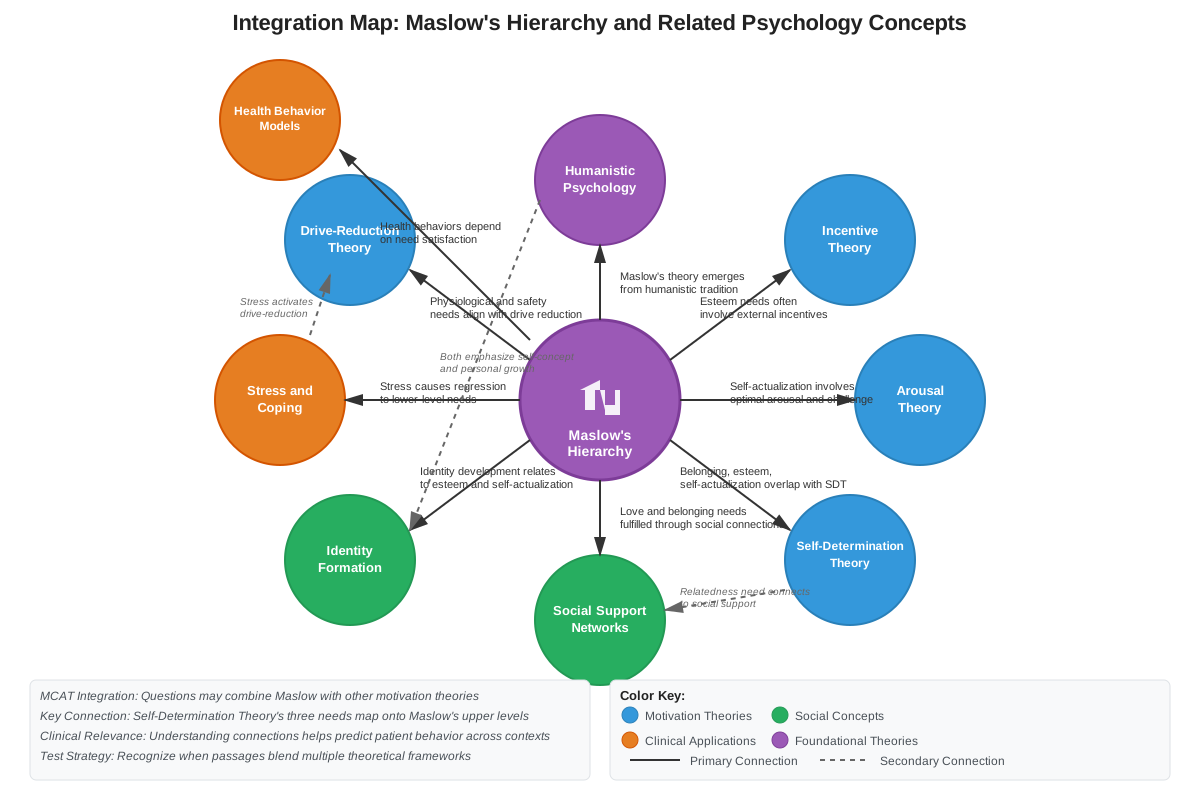
This topic connects intimately with other Psychology concepts including drive-reduction theory, incentive theory, arousal theory, and self-determination theory. It also intersects with social psychology concepts such as social support, identity formation, and group dynamics. Maslow's framework provides a lens through which to understand how physiological states influence cognition and emotion, making it essential for integrating biological and psychological perspectives—a core competency tested throughout the MCAT.
Learning Objectives
- [ ] Define Maslow's hierarchy using accurate Psychology terminology
- [ ] Explain why Maslow's hierarchy matters for the MCAT
- [ ] Apply Maslow's hierarchy to exam-style questions
- [ ] Identify common mistakes related to Maslow's hierarchy
- [ ] Connect Maslow's hierarchy to related Psychology concepts
- [ ] Differentiate between deficiency needs and growth needs within the hierarchy
- [ ] Analyze how cultural factors may influence the universality and application of Maslow's model
- [ ] Evaluate scenarios to determine which level of the hierarchy is most relevant to observed behavior
Prerequisites
- Basic understanding of motivation theories: Necessary to contextualize Maslow's approach within the broader landscape of motivational psychology
- Familiarity with humanistic psychology: Maslow's work emerged from this perspective, which emphasizes personal growth and self-actualization
- Knowledge of basic physiological needs: Understanding homeostasis and biological drives provides foundation for the lowest tier
- Awareness of psychological vs. physiological distinctions: Critical for differentiating between levels of the hierarchy
Why This Topic Matters
Maslow's hierarchy has profound clinical and real-world significance. Healthcare providers use this framework to prioritize patient care—addressing immediate physiological needs (pain management, nutrition) before psychological interventions. In public health, the hierarchy explains why individuals experiencing food insecurity or housing instability may struggle to engage with mental health services or preventive care. Social workers and counselors apply this model to understand client behavior and establish appropriate intervention sequences.
On the MCAT, Maslow's hierarchy appears in approximately 3-5% of Psychology and Sociology questions, making it a medium-yield topic that students cannot afford to ignore. Questions typically present clinical vignettes, research scenarios, or social situations requiring students to identify which need level is driving behavior, predict behavioral responses when needs are unmet, or critique the theory's limitations. The hierarchy frequently appears in passages discussing healthcare disparities, stress responses, patient non-compliance, or developmental psychology.
Common exam presentations include: (1) passages describing patients who refuse treatment due to competing needs (e.g., choosing work over medical appointments to maintain financial security); (2) research studies examining motivation across different socioeconomic contexts; (3) scenarios requiring students to explain seemingly "irrational" behavior through the lens of unmet lower-level needs; and (4) questions asking students to identify criticisms of the theory, particularly regarding cultural universality and empirical support.
Core Concepts
The Five-Tier Hierarchy Structure
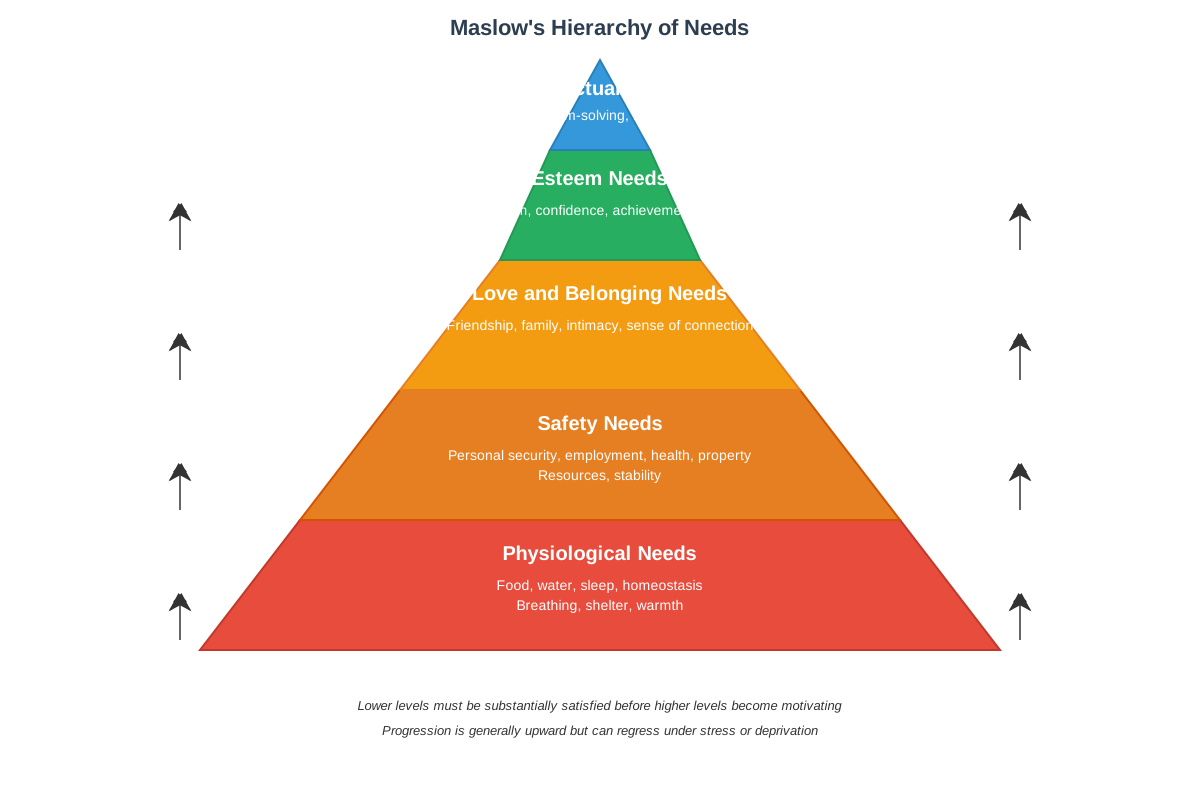
Maslow's hierarchy of needs organizes human motivation into five distinct levels, traditionally depicted as a pyramid. The structure reflects Maslow's proposition that lower-level needs must be substantially satisfied before higher-level needs become motivating forces. This hierarchical arrangement distinguishes between deficiency needs (the bottom four levels) and growth needs (the top level).
The five levels, from bottom to top, are:
- Physiological needs
- Safety needs
- Love and belongingness needs
- Esteem needs
- Self-actualization needs
Maslow later expanded this model to include cognitive needs, aesthetic needs, and transcendence needs, but the MCAT focuses primarily on the original five-tier model.
Level 1: Physiological Needs
Physiological needs constitute the foundation of the hierarchy and represent the most basic requirements for human survival. These include air, water, food, shelter, sleep, clothing, and reproduction. These needs are biological imperatives that, when unmet, dominate an individual's motivation and attention to the exclusion of higher-level concerns.
From an evolutionary perspective, physiological needs align with survival mechanisms. When experiencing hunger, thirst, or sleep deprivation, cognitive resources become focused on satisfying these deficits. The body's homeostatic mechanisms drive behavior toward restoring physiological balance. For the MCAT, recognize that individuals experiencing severe physiological deprivation will prioritize these needs over social relationships, self-esteem, or personal growth.
Clinical example: A patient experiencing severe pain will be unable to engage meaningfully in psychotherapy until pain management is addressed. Similarly, individuals experiencing homelessness may prioritize finding shelter and food over attending medical appointments for chronic disease management.
Level 2: Safety Needs
Once physiological needs are reasonably satisfied, safety needs emerge as motivators. These encompass physical safety (protection from violence, accidents, natural disasters), economic security (stable employment, financial resources), health and wellness, and protection against illness or injury. Safety needs also include psychological security—predictability, order, and freedom from fear and anxiety.
Safety needs extend beyond immediate physical threats to include long-term security concerns. Employment stability, health insurance, safe neighborhoods, and reliable social institutions all address safety needs. Children particularly require consistent, predictable environments to develop secure attachments and healthy psychological functioning.
MCAT relevance: Questions may present scenarios where individuals make decisions that seem to contradict health recommendations (e.g., continuing dangerous work to maintain income) because safety needs (financial security) take precedence over higher-level concerns.
Level 3: Love and Belongingness Needs
With physiological and safety needs met, love and belongingness needs become prominent motivators. These social needs include intimate relationships, friendships, family connections, and group membership. Humans are fundamentally social creatures, and the need for connection, acceptance, and affection profoundly influences behavior and psychological well-being.
Belongingness needs manifest in various ways: forming romantic partnerships, maintaining friendships, participating in community organizations, identifying with cultural or religious groups, and seeking acceptance from peers. Social isolation and loneliness represent unmet belongingness needs and correlate with numerous negative health outcomes, including increased mortality risk, depression, and cardiovascular disease.
Connection to social psychology: This level connects directly to concepts of social support, group dynamics, conformity, and identity formation. The need for belongingness helps explain phenomena such as peer pressure, in-group favoritism, and the psychological distress associated with social rejection or ostracism.
Level 4: Esteem Needs
Esteem needs encompass two related components: self-esteem (self-respect, confidence, competence, achievement, independence) and esteem from others (recognition, status, prestige, attention, reputation). Maslow distinguished between lower esteem needs (respect from others) and higher esteem needs (self-respect and self-evaluation).
Satisfaction of esteem needs produces feelings of confidence, worth, strength, capability, and adequacy. Conversely, unmet esteem needs result in feelings of inferiority, weakness, helplessness, and discouragement. These feelings can manifest as depression, anxiety, or compensatory behaviors aimed at gaining recognition or status.
MCAT application: Esteem needs help explain behaviors such as status-seeking, competitive achievement, sensitivity to criticism, and the psychological impact of unemployment or social rejection. Questions may ask students to identify how threats to self-esteem influence decision-making or emotional responses.
Level 5: Self-Actualization Needs
At the pyramid's apex lies self-actualization—the need to fulfill one's potential and become the most complete version of oneself. Maslow described self-actualization as "becoming everything one is capable of becoming." This growth need differs fundamentally from deficiency needs; it involves personal growth, peak experiences, creativity, problem-solving, spontaneity, and the pursuit of meaning and purpose.
Self-actualized individuals, according to Maslow, exhibit characteristics including: accurate perception of reality, acceptance of self and others, spontaneity, problem-centering (rather than self-centering), autonomy, continued freshness of appreciation, peak experiences, strong ethical standards, and creativity. Importantly, self-actualization is an ongoing process rather than a fixed state.
Key distinction: Unlike deficiency needs, which arise from lacking something, self-actualization represents a growth motivation—the desire to develop and expand one's capabilities. Self-actualization is never fully satisfied; it represents continuous development and self-improvement.
Deficiency Needs vs. Growth Needs
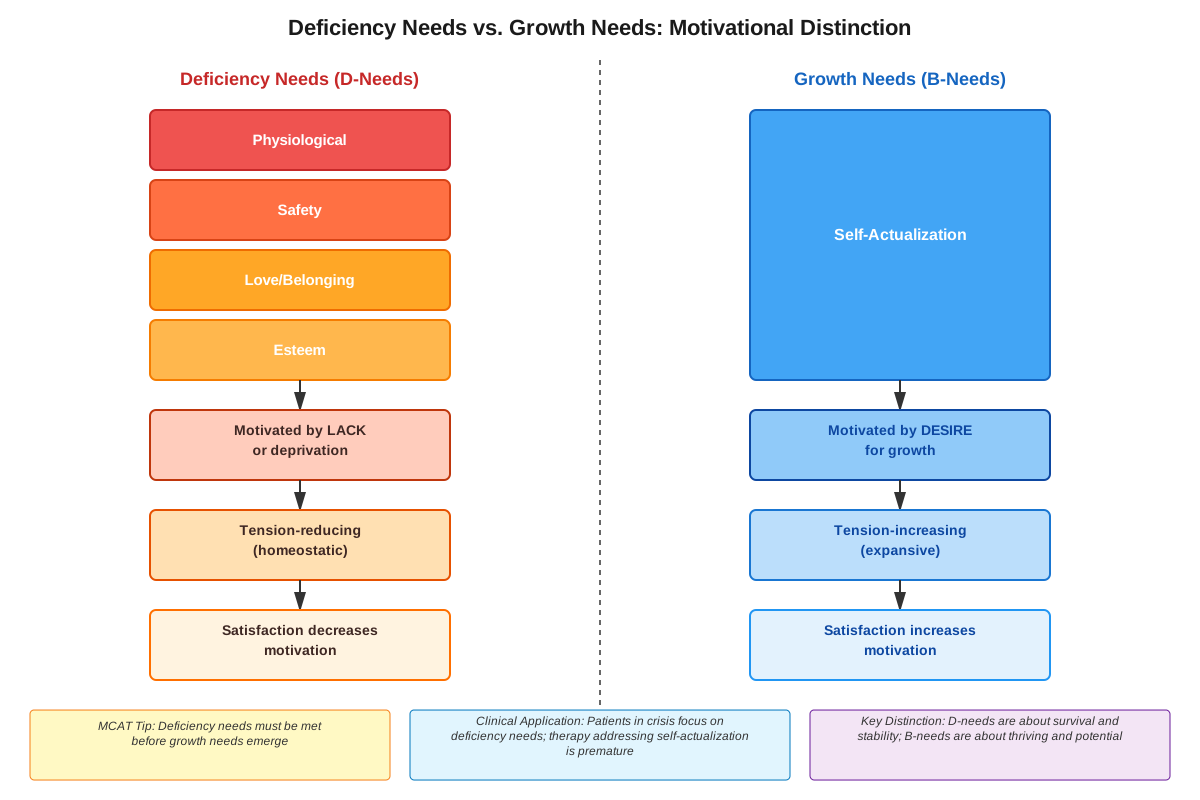
Maslow distinguished between deficiency needs (D-needs) and growth needs (B-needs, or "being" needs). The bottom four levels represent deficiency needs—they arise from lacking something essential and motivate behavior aimed at reducing the deficit. When deficiency needs are unmet, individuals experience physical or psychological distress. Once satisfied, the motivation to fulfill these needs diminishes.
Growth needs, represented by self-actualization, operate differently. They don't arise from deficiency but from the desire to grow and develop. Satisfying growth needs doesn't eliminate the motivation; instead, engagement with growth needs often intensifies the desire for further development. This distinction is crucial for understanding human motivation beyond mere deficit reduction.
| Deficiency Needs | Growth Needs |
|---|---|
| Arise from lacking something | Arise from desire to develop |
| Motivation decreases when satisfied | Motivation may increase with engagement |
| Levels 1-4 of hierarchy | Level 5 (self-actualization) |
| Focused on reducing discomfort | Focused on expanding capabilities |
| Universal across cultures | May vary in expression across cultures |
Progression and Prepotency
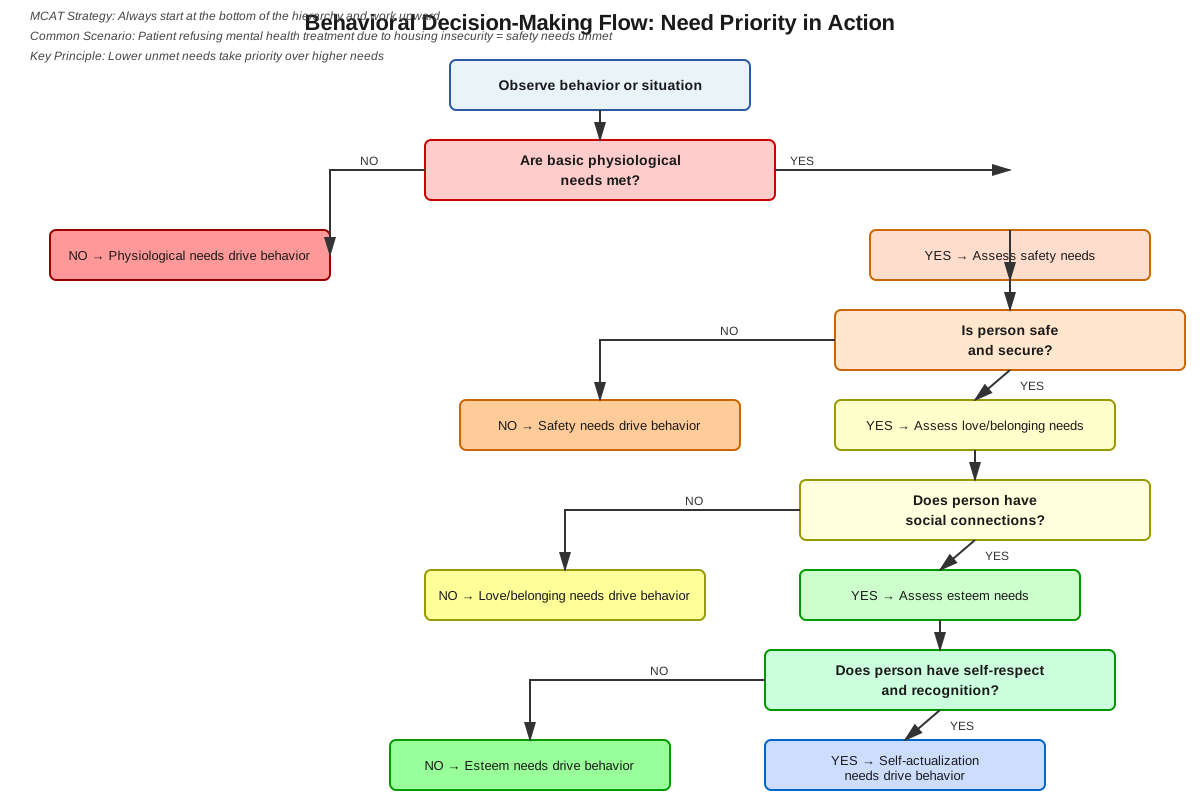
Maslow's theory proposes that needs are prepotent—lower-level needs take precedence over higher-level needs when multiple needs are unmet simultaneously. This prepotency principle explains why individuals experiencing food insecurity may not prioritize social relationships or self-esteem concerns. The hierarchy is not rigidly fixed; individuals may temporarily focus on higher needs even when lower needs are partially unmet, but sustained attention to higher needs requires reasonable satisfaction of lower levels.
Important nuance: Maslow acknowledged that the hierarchy is not absolute. Creative individuals might pursue self-actualization despite unmet lower needs. Cultural values might alter the relative importance of different needs. Some individuals may prioritize esteem over belongingness. The hierarchy represents general tendencies rather than universal laws.
Criticisms and Limitations
Understanding criticisms of Maslow's hierarchy is essential for the MCAT, as questions frequently ask students to identify theoretical limitations:
- Limited empirical support: Research has not consistently validated the hierarchical structure or the progression from one level to the next
- Cultural bias: The theory reflects Western, individualistic values; collectivist cultures may prioritize belongingness over self-actualization
- Individual variation: People vary considerably in need priorities based on personality, values, and circumstances
- Oversimplification: Human motivation is more complex than a simple hierarchy suggests; multiple needs often operate simultaneously
- Self-actualization vagueness: The concept lacks precise definition and measurable criteria
Concept Relationships
Maslow's hierarchy integrates multiple psychological domains. At the foundation, physiological needs connect directly to biological psychology concepts including homeostasis, drive-reduction theory, and the hypothalamus's role in regulating hunger, thirst, and temperature. The body's physiological state influences cognitive processing and emotional experience, demonstrating the biological-psychological interface.
Safety needs relate to stress and anxiety concepts. The amygdala's threat detection mechanisms and the hypothalamic-pituitary-adrenal (HPA) axis activation during perceived danger represent biological substrates of safety needs. Chronic unmet safety needs produce sustained stress responses, connecting to concepts of allostatic load and stress-related illness.
Belongingness needs connect extensively to social psychology: attachment theory, social support networks, conformity, group dynamics, and identity formation. The need for belonging helps explain phenomena such as social facilitation, groupthink, and the psychological distress associated with ostracism. Mirror neurons and oxytocin release during social bonding represent neurobiological correlates of belongingness.
Esteem needs relate to self-concept, self-efficacy, attribution theory, and social comparison processes. The relationship between esteem and mental health connects to clinical psychology concepts including depression, anxiety disorders, and therapeutic approaches aimed at building self-worth.
Self-actualization connects to positive psychology, humanistic approaches, and concepts of meaning and purpose. It relates to Erikson's psychosocial development stages (particularly generativity and ego integrity), Rogers' concept of the fully functioning person, and contemporary research on well-being and flourishing.
Relationship map: Physiological needs → (when satisfied) → Safety needs → (when satisfied) → Belongingness needs → (when satisfied) → Esteem needs → (when satisfied) → Self-actualization needs. Simultaneously, unmet lower needs → redirect attention and resources away from higher needs → influence decision-making and behavior prioritization.
Quick check — test yourself on Maslow hierarchy so far.
Try Flashcards →High-Yield Facts
⭐ Maslow's hierarchy organizes needs into five levels: physiological, safety, love/belongingness, esteem, and self-actualization
⭐ Lower-level needs must be substantially satisfied before higher-level needs become primary motivators (prepotency principle)
⭐ The bottom four levels represent deficiency needs (D-needs); the top level represents growth needs (B-needs)
⭐ Physiological needs include air, water, food, shelter, sleep, and reproduction—the most basic survival requirements
⭐ Self-actualization involves fulfilling one's potential and is characterized by continued growth rather than deficit reduction
- Safety needs encompass both physical security and psychological security (predictability, order, freedom from fear)
- Belongingness needs include intimate relationships, friendships, family connections, and group membership
- Esteem needs include both self-esteem (confidence, competence) and esteem from others (recognition, status)
- The hierarchy reflects Western, individualistic cultural values and may not apply universally across cultures
- Maslow acknowledged that the hierarchy is not rigid; individuals may pursue higher needs despite unmet lower needs in certain circumstances
- Self-actualized individuals exhibit characteristics including accurate reality perception, autonomy, creativity, and peak experiences
- Unmet deficiency needs produce physical or psychological distress; unmet growth needs produce feelings of incompleteness
- The theory has limited empirical support for the strict hierarchical progression Maslow proposed
- Healthcare providers use the hierarchy to prioritize interventions, addressing physiological needs before psychological concerns
- Questions about "irrational" patient behavior often involve conflicts between different need levels
Common Misconceptions
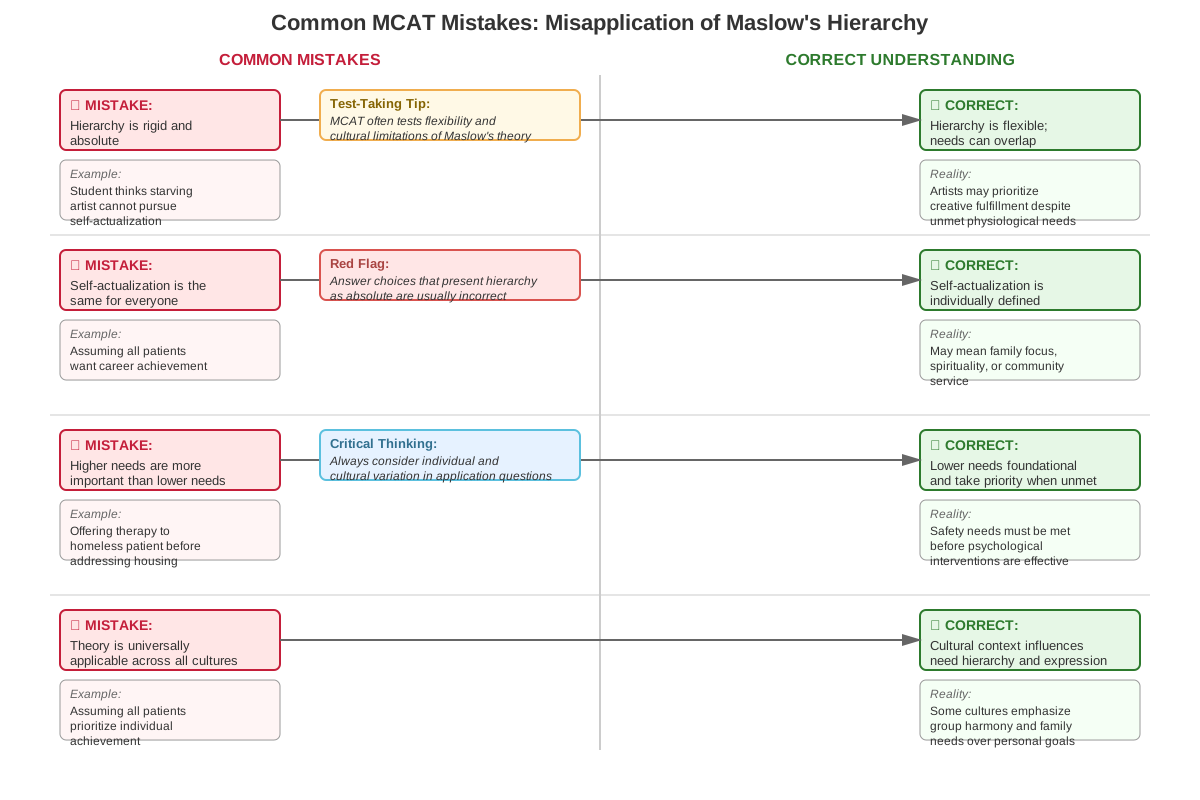
Misconception: The hierarchy is absolute and rigid—people always satisfy lower needs completely before addressing higher needs.
Correction: Maslow acknowledged flexibility in the hierarchy. Individuals may pursue higher needs despite partially unmet lower needs. Artists may create despite poverty (self-actualization despite unmet physiological/safety needs). Parents may sacrifice personal safety for children's wellbeing (safety for belongingness). The hierarchy represents general tendencies and priorities, not absolute rules.
Misconception: Self-actualization is a permanent state that, once achieved, remains stable.
Correction: Self-actualization is an ongoing process of growth and development, not a fixed endpoint. It represents continuous striving toward potential rather than a destination. Even self-actualizing individuals experience setbacks, challenges, and periods where lower needs demand attention.
Misconception: Maslow's hierarchy applies universally across all cultures and contexts.
Correction: The hierarchy reflects Western, individualistic cultural values. Collectivist cultures may prioritize group harmony and belongingness over individual self-actualization. Cultural context significantly influences which needs are emphasized and how they are expressed. The MCAT may present questions requiring recognition of this cultural limitation.
Misconception: All five levels are equally important and receive equal emphasis in Maslow's theory.
Correction: Maslow emphasized self-actualization as the ultimate human motivation and spent considerable effort describing characteristics of self-actualized individuals. However, he recognized that most people spend most of their time addressing deficiency needs rather than growth needs. The lower levels are more universally relevant, while self-actualization represents an ideal that fewer individuals consistently pursue.
Misconception: If someone is focused on esteem or belongingness needs, their physiological and safety needs must be completely satisfied.
Correction: Needs don't require complete satisfaction before higher needs emerge. Maslow suggested that needs must be "substantially" or "reasonably" satisfied—perhaps 85% for physiological needs, 70% for safety, etc. People can simultaneously experience multiple need levels, though lower unmet needs typically exert stronger motivational force.
Worked Examples
Example 1: Patient Non-Compliance Scenario
Vignette: A 45-year-old patient with type 2 diabetes repeatedly misses follow-up appointments and fails to adhere to prescribed medication regimens despite understanding the health risks. The patient works two jobs to support three children after a recent divorce. When questioned, the patient expresses concern about missing work for appointments and the cost of medications. Which level of Maslow's hierarchy best explains this behavior?
Analysis:
Step 1: Identify the competing needs. The patient faces a conflict between health needs (related to safety) and economic security (also related to safety, but more immediate).
Step 2: Recognize that the patient understands the health risks, so this isn't a knowledge deficit. The behavior appears "irrational" from a purely medical perspective but makes sense through Maslow's framework.
Step 3: The patient is prioritizing safety needs—specifically, economic security and the ability to provide for children. Missing work threatens immediate financial stability and the ability to meet physiological needs (food, shelter) for the family.
Step 4: From the patient's perspective, the immediate threat of job loss and inability to provide for children outweighs the longer-term health consequences of poor diabetes management.
Answer: The patient's behavior reflects prioritization of safety needs (economic security) over other safety needs (health). This demonstrates how competing needs within the same hierarchical level can create motivational conflicts. The patient cannot focus on optimal health management (a safety need) when more immediate safety needs (financial security, providing for dependents) are threatened.
MCAT connection: This example illustrates how the hierarchy explains seemingly non-compliant patient behavior. Rather than labeling the patient as "non-compliant" or "unmotivated," understanding the need hierarchy reveals rational decision-making given competing priorities. Effective intervention would address the safety need barriers (financial assistance, flexible appointment scheduling) rather than simply providing more health education.
Example 2: Research Study Interpretation
Vignette: Researchers conduct a study examining factors that predict life satisfaction across different socioeconomic groups. They find that among individuals experiencing food insecurity and housing instability, social relationships and self-esteem show weak correlations with life satisfaction. However, among individuals with stable housing and reliable food access, social relationships and self-esteem strongly predict life satisfaction. How does Maslow's hierarchy explain these findings?
Analysis:
Step 1: Identify which need levels are unmet in each group. The first group has unmet physiological needs (food insecurity) and safety needs (housing instability). The second group has these lower needs substantially satisfied.
Step 2: Apply the prepotency principle. When lower-level needs are unmet, they dominate motivation and attention. Higher-level needs (belongingness, esteem) become less salient and contribute less to overall well-being.
Step 3: Recognize that the findings support Maslow's prediction that need satisfaction follows a hierarchical pattern. Social relationships and self-esteem matter more for life satisfaction when basic survival and security needs are met.
Step 4: Consider alternative explanations and limitations. The findings could also reflect that individuals experiencing severe deprivation have fewer cognitive and emotional resources to invest in relationships and self-evaluation. This doesn't contradict Maslow but adds nuance.
Answer: The findings support Maslow's hierarchy by demonstrating that higher-level needs (belongingness, esteem) predict well-being primarily when lower-level needs (physiological, safety) are satisfied. When basic survival and security are threatened, these concerns dominate, and higher-level needs contribute less to overall life satisfaction. This illustrates the prepotency principle—lower needs take precedence when multiple needs are unmet.
MCAT connection: This example demonstrates how to apply Maslow's hierarchy to research findings and population-level patterns. It also illustrates why interventions targeting self-esteem or social connection may be less effective for populations experiencing severe deprivation unless basic needs are simultaneously addressed. Understanding this principle is crucial for questions about healthcare disparities, public health interventions, and social determinants of health.
Exam Strategy
When approaching MCAT questions on Maslow's hierarchy, follow this systematic approach:
Step 1: Identify the need level in question. Read the vignette carefully to determine which needs are met, unmet, or in conflict. Look for explicit mentions of hunger, safety concerns, social isolation, self-esteem threats, or personal growth pursuits.
Step 2: Apply the prepotency principle. If multiple needs are present, determine which is lowest in the hierarchy. The lowest unmet need typically exerts the strongest motivational influence. Be cautious of scenarios where needs at the same level conflict (e.g., health vs. economic security, both safety needs).
Step 3: Watch for trigger words:
- Physiological: "hunger," "thirst," "sleep-deprived," "pain," "homeless," "shelter"
- Safety: "security," "stability," "fear," "threat," "unemployment," "health insurance"
- Belongingness: "lonely," "isolated," "rejected," "friendship," "intimacy," "community"
- Esteem: "confidence," "recognition," "status," "achievement," "respect," "competence"
- Self-actualization: "potential," "growth," "creativity," "meaning," "purpose," "peak experience"
Step 4: Consider criticisms when appropriate. If answer choices include limitations of the theory (cultural bias, lack of empirical support, individual variation), evaluate whether the question is asking about the theory's application or its limitations.
Step 5: Eliminate answers that:
- Place higher needs as motivators when lower needs are clearly unmet
- Suggest the hierarchy is absolute and invariable
- Ignore cultural context when it's relevant to the scenario
- Confuse deficiency needs with growth needs
Time allocation: Maslow questions typically require 60-90 seconds. Spend 30 seconds carefully reading the vignette to identify need levels, 20 seconds applying the hierarchy, and 20-30 seconds evaluating answer choices. Don't overthink—the hierarchy is relatively straightforward once you identify which needs are relevant.
Exam tip: If a question presents behavior that seems irrational or self-defeating, consider whether unmet lower-level needs explain the behavior. The MCAT frequently uses Maslow's hierarchy to explain why people make decisions that appear to contradict their long-term interests.
Memory Techniques
Primary Mnemonic for the Five Levels (bottom to top):
"Please Stop Loving Expensive Stuff"
- Physiological
- Safety
- Love/Belongingness
- Esteem
- Self-actualization
Visual Strategy: Picture a pyramid with yourself at the bottom, climbing upward. At the base, you're hungry and thirsty (physiological). One level up, you're seeking shelter from a storm (safety). Next level, you're joining hands with friends in a circle (belongingness). Higher still, you're receiving an award on stage (esteem). At the peak, you're painting a masterpiece or solving a complex problem (self-actualization).
Deficiency vs. Growth Mnemonic:
"Don't Be Greedy" = Deficiency needs (bottom 4) vs. Being needs/Growth needs (top 1)
Prepotency Principle Memory Aid: "Lower needs are louder"—when multiple needs compete, lower unmet needs demand attention more insistently than higher needs.
Characteristics of Self-Actualization: Remember "CRAPS" (admittedly crude but memorable):
- Creativity
- Reality perception (accurate)
- Autonomy
- Peak experiences
- Spontaneity
Cultural Limitation Reminder: "Maslow's American pyramid"—remember that the theory reflects Western, individualistic values, with self-actualization (individual achievement) at the top rather than collective harmony or family honor.
Summary
Maslow's hierarchy of needs provides a foundational framework for understanding human motivation by organizing needs into five hierarchical levels: physiological, safety, love/belongingness, esteem, and self-actualization. The theory proposes that lower-level deficiency needs must be substantially satisfied before higher-level needs become primary motivators, a principle called prepotency. The bottom four levels represent deficiency needs arising from lacking something essential, while self-actualization represents growth needs focused on fulfilling potential. For the MCAT, this framework is essential for analyzing patient behavior, healthcare decision-making, and motivational conflicts in clinical and social contexts. Understanding both the theory's applications and its limitations—including cultural bias, limited empirical support, and individual variation—enables students to approach exam questions with appropriate nuance. The hierarchy connects to broader concepts in biological psychology, social psychology, and clinical psychology, making it a integrative topic that bridges multiple domains tested on the MCAT.
Key Takeaways
- Maslow's hierarchy organizes human needs into five levels: physiological, safety, belongingness, esteem, and self-actualization, with lower needs taking priority when unmet
- The prepotency principle states that lower-level needs dominate motivation when multiple needs are unmet simultaneously
- Deficiency needs (levels 1-4) arise from lacking something and decrease in motivational strength when satisfied; growth needs (level 5) arise from the desire to develop and may intensify with engagement
- The theory helps explain seemingly irrational behavior by revealing how unmet lower-level needs redirect attention and resources away from higher-level concerns
- Self-actualization represents continuous personal growth and development rather than a fixed state or endpoint
- Major criticisms include limited empirical support, cultural bias toward Western individualistic values, and oversimplification of complex human motivation
- For the MCAT, apply the hierarchy to predict behavior, explain motivational conflicts, and understand why interventions may fail when basic needs remain unmet
Related Topics
Drive-Reduction Theory: Explores how physiological needs create drives that motivate behavior aimed at reducing tension—directly relates to Maslow's physiological needs level and provides a complementary perspective on basic motivation.
Self-Determination Theory: Examines intrinsic motivation through three universal needs (autonomy, competence, relatedness)—offers an alternative framework that both complements and challenges aspects of Maslow's hierarchy.
Incentive Theory: Focuses on how external rewards motivate behavior—contrasts with Maslow's emphasis on internal needs and helps explain motivation when basic needs are satisfied.
Stress and Coping: Understanding how unmet needs create stress and how individuals cope with competing demands builds directly on Maslow's framework and connects to health psychology.
Social Support and Health: Explores how belongingness needs influence physical and mental health outcomes—provides empirical evidence for the importance of Maslow's third level.
Cultural Psychology: Examines how cultural values shape motivation and behavior—essential for understanding limitations of Maslow's hierarchy and applying it appropriately across diverse populations.
Practice CTA
Now that you've mastered the core concepts of Maslow's hierarchy, it's time to test your understanding with practice questions and flashcards. Active retrieval through practice is the most effective way to consolidate this knowledge and prepare for MCAT-style applications. Challenge yourself to identify need levels in complex scenarios, explain motivational conflicts, and recognize both the theory's applications and limitations. Each practice question you complete strengthens your ability to quickly and accurately apply this framework under exam conditions. You've built a solid foundation—now reinforce it through deliberate practice!
Sign up free to keep reading
Create a free AnvayaPrep account to finish this MCAT guide on Maslow hierarchy — plus flashcards and practice questions.