Overview
Gestalt principles represent a foundational framework in Psychology that explains how humans naturally organize visual information into meaningful wholes rather than perceiving isolated parts. Originating from early 20th-century German psychologists, the term "Gestalt" translates to "unified whole" or "form," emphasizing that perception is not simply a passive reception of sensory data but an active process of pattern recognition and organization. These principles describe predictable ways the human brain groups visual elements, fills in missing information, and creates coherent perceptual experiences from complex sensory input. For the MCAT, understanding Gestalt principles is essential because they bridge the gap between basic sensory processing and higher-order cognitive interpretation—a recurring theme in Sensation and Perception questions.
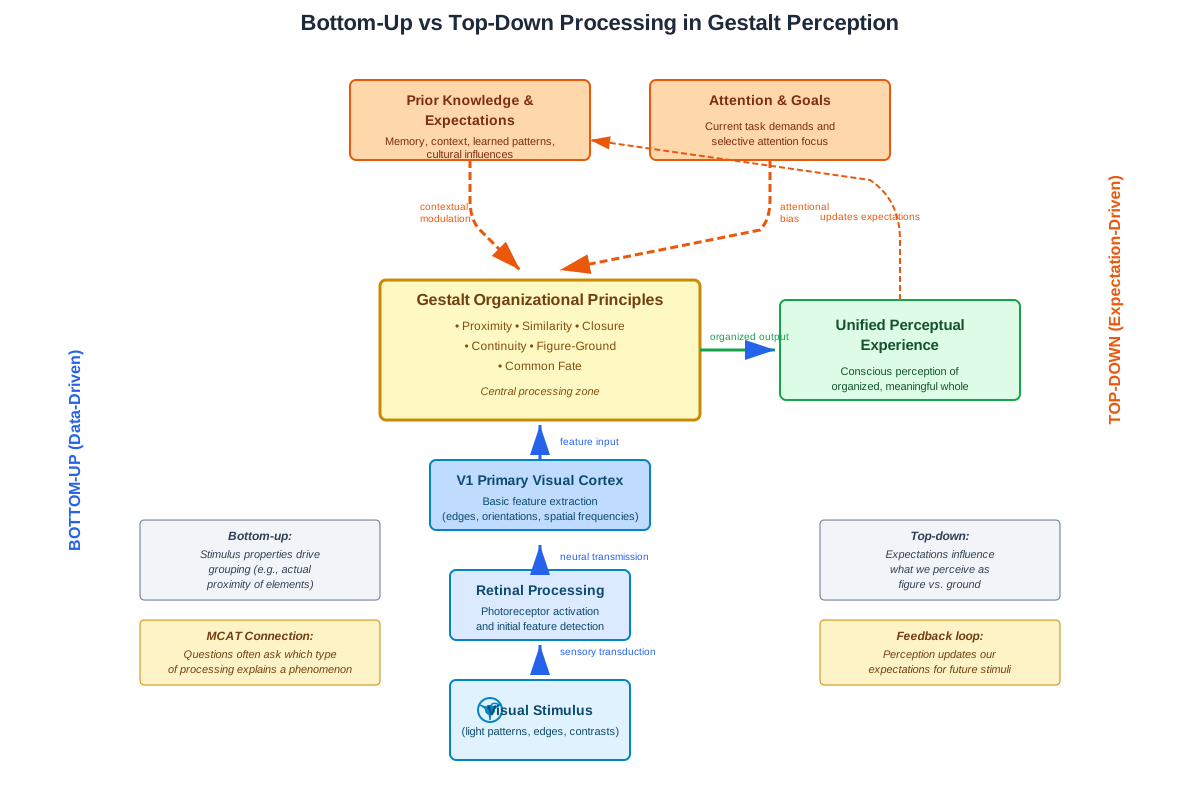
The Gestalt principles MCAT content appears regularly in the Psychological, Social, and Biological Foundations of Behavior section, particularly in passages discussing visual perception, attention, cognitive processing, and even social cognition. These principles demonstrate how bottom-up sensory information combines with top-down cognitive expectations to create our perceptual reality. Questions may present visual stimuli, ask students to identify which principle explains a perceptual phenomenon, or require application of these concepts to real-world scenarios such as reading, driving, or interpreting medical imaging.
Within the broader Psychology curriculum, Gestalt principles connect intimately with theories of attention, memory encoding, problem-solving, and even social perception. They represent a shift from structuralist approaches that attempted to break perception into elementary sensations, instead emphasizing that "the whole is different from the sum of its parts." This holistic perspective influences modern cognitive psychology, neuroscience research on visual processing pathways, and practical applications in design, user interface development, and clinical assessment of perceptual disorders.
Learning Objectives
- [ ] Define Gestalt principles using accurate Psychology terminology
- [ ] Explain why Gestalt principles matters for the MCAT
- [ ] Apply Gestalt principles to exam-style questions
- [ ] Identify common mistakes related to Gestalt principles
- [ ] Connect Gestalt principles to related Psychology concepts
- [ ] Distinguish between each individual Gestalt principle with specific visual examples
- [ ] Analyze how Gestalt principles influence both perception and cognition
- [ ] Evaluate scenarios to determine which Gestalt principle(s) best explain observed perceptual phenomena
Prerequisites
- Basic understanding of sensation versus perception: Sensation involves detecting physical stimuli through sensory receptors, while perception involves interpreting and organizing that sensory information—Gestalt principles operate at the perceptual level.
- Visual processing pathways: Familiarity with how visual information travels from the retina through the thalamus to the visual cortex helps contextualize where Gestalt organization occurs in neural processing.
- Attention mechanisms: Understanding selective and divided attention provides context for how Gestalt principles help the brain efficiently process complex visual scenes by grouping related elements.
- Top-down versus bottom-up processing: Gestalt principles demonstrate how perception involves both data-driven sensory input (bottom-up) and expectation-driven interpretation (top-down).
Why This Topic Matters
Gestalt principles appear in approximately 2-4 questions per MCAT administration, making them medium-yield content that students cannot afford to neglect. These questions typically appear in discrete format or within passages discussing visual perception, cognitive psychology, or neurological conditions affecting perception. The MCAT frequently tests whether students can identify which principle explains a described perceptual phenomenon or apply these principles to novel scenarios involving reading, pattern recognition, or visual illusions.
Clinically, understanding Gestalt principles has significant implications for diagnosing and treating perceptual disorders. Patients with certain neurological conditions (stroke, traumatic brain injury, visual agnosia) may lose the ability to apply specific Gestalt principles, resulting in fragmented perception. Radiologists and pathologists rely on Gestalt principles when interpreting medical images, grouping similar tissue densities and identifying abnormal patterns. Occupational therapists use these principles when designing rehabilitation programs for patients with perceptual deficits.
In exam passages, Gestalt principles commonly appear in contexts discussing: visual illusions and why they occur; reading comprehension and how we recognize words despite missing letters; face recognition and prosopagnosia; attention and how we parse complex visual scenes; design principles in user interfaces; and evolutionary advantages of perceptual organization. The MCAT may present a figure or describe a visual stimulus, then ask which Gestalt principle best explains the perceptual experience, making visual literacy and principle application crucial skills.
Core Concepts
Fundamental Philosophy of Gestalt Psychology
Gestalt principles Psychology emerged as a reaction against structuralism, which attempted to reduce perception to elementary sensations. Gestalt psychologists, including Max Wertheimer, Kurt Koffka, and Wolfgang Köhler, argued that perception is inherently organized and that the perceived whole possesses qualities not present in the individual parts. This philosophy extends beyond visual perception to problem-solving (insight learning), memory (meaningful organization aids recall), and social perception (forming impressions of people as integrated wholes). The core tenet—"the whole is different from the sum of its parts"—means that perceptual organization creates emergent properties that cannot be predicted by analyzing components in isolation.
Figure-Ground Relationship
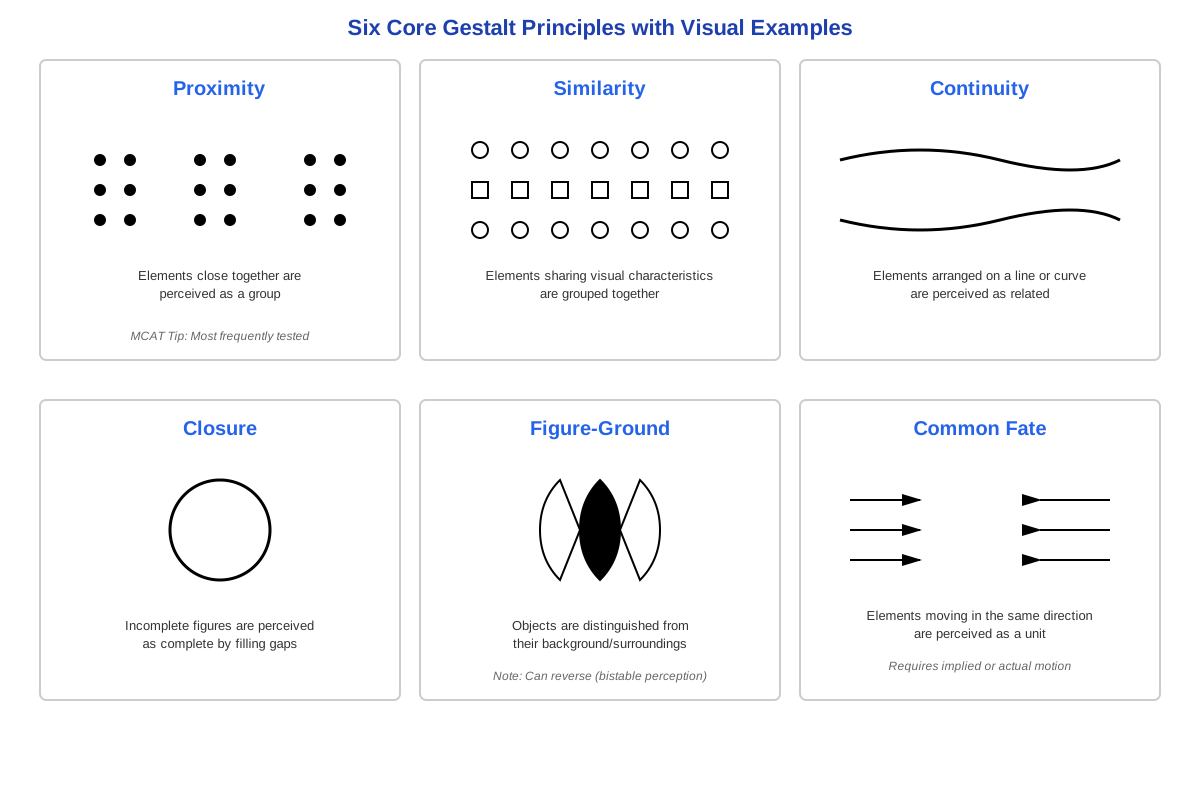
The figure-ground principle describes the brain's tendency to separate visual fields into an object of focus (figure) and its surrounding background (ground). The figure appears more prominent, well-defined, and closer, while the ground seems less distinct and extends behind the figure. This principle operates automatically and continuously as attention shifts. Reversible figures (like the Rubin vase, which can be perceived as either a vase or two faces) demonstrate that figure-ground assignment is not fixed but depends on attention and interpretation.
For the MCAT, recognize that figure-ground organization is fundamental to all other Gestalt principles—without distinguishing objects from backgrounds, further perceptual organization cannot occur. Clinical conditions like visual agnosia may impair figure-ground separation, causing patients to perceive visual scenes as confusing arrays of undifferentiated elements. This principle also relates to attention: what we attend to becomes figure, while unattended elements recede to ground.
Proximity (Nearness)
The principle of proximity states that elements close together in space are perceived as belonging to the same group. This principle operates automatically and powerfully—spatial nearness overrides other grouping cues unless other principles strongly contradict it. For example, dots arranged in closely spaced pairs are perceived as pairs rather than individual dots, even if all dots are identical in size, color, and shape.
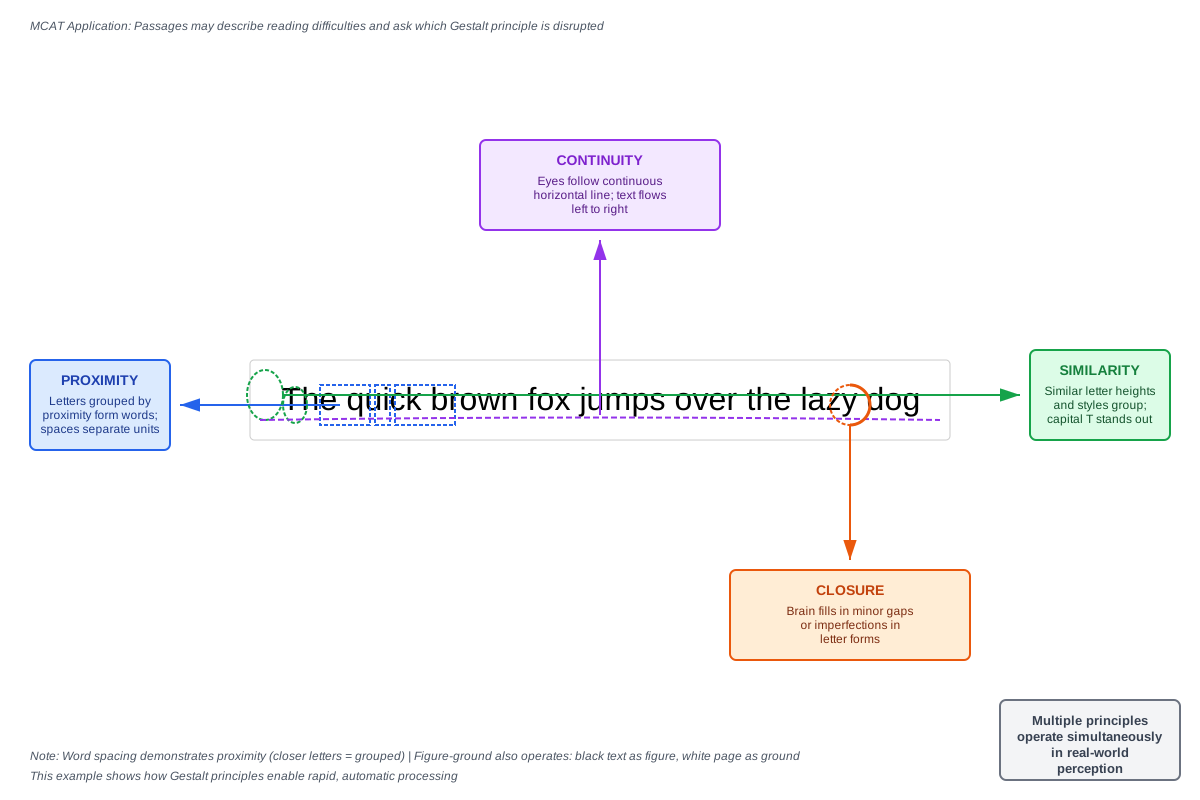
Proximity facilitates efficient visual processing by reducing the number of distinct objects requiring attention. In reading, proximity helps group letters into words and words into phrases. The MCAT may test proximity by presenting visual stimuli with varying spatial arrangements or asking why certain elements appear grouped in a described scenario. Understanding proximity also helps explain why proper spacing in written materials enhances readability and why cluttered visual environments feel overwhelming.
Similarity
The principle of similarity indicates that elements sharing visual characteristics (color, shape, size, orientation, texture) are perceived as belonging together. When proximity and similarity conflict, the stronger cue typically dominates, though this varies by context. For instance, alternating rows of circles and squares are perceived as separate rows based on shape similarity, even if vertical proximity is equal.
Similarity enables rapid categorization and pattern detection, evolutionarily advantageous for identifying predators, food sources, or group members. In modern contexts, similarity helps us quickly scan text for bolded words, identify icons on computer interfaces, or spot familiar faces in crowds. MCAT questions may present scenarios where similarity competes with other Gestalt principles, requiring students to predict which grouping will dominate perception.
Continuity (Good Continuation)
The principle of continuity describes the tendency to perceive smooth, continuous lines or patterns rather than abrupt changes in direction. When lines intersect, the brain preferentially groups elements that follow the smoothest path. For example, when two curved lines cross, we perceive two continuous curves rather than four separate line segments meeting at a point.
Continuity reflects the brain's preference for simplicity and predictability in perceptual organization. This principle helps us track moving objects, follow roads that curve or pass under overpasses, and read cursive writing where letters flow together. Neurologically, continuity may relate to how neurons in the visual cortex respond preferentially to continuous edges and contours. The MCAT may test continuity by describing intersecting paths or asking how observers perceive overlapping elements.
Closure
The principle of closure refers to the tendency to perceive incomplete figures as complete by mentally filling in missing information. When viewing a circle with small gaps, we perceive a complete circle rather than disconnected arcs. Closure demonstrates top-down processing—our knowledge and expectations about complete forms influence perception of incomplete stimuli.
Closure has significant adaptive value, allowing recognition of partially obscured objects (prey behind foliage, faces in shadows). It enables reading despite missing letters (you can read "c_t" as "cat" or "cut" depending on context) and recognizing familiar objects from minimal information. However, excessive closure can lead to perceptual errors, such as seeing patterns in random noise (pareidolia). MCAT questions may present incomplete figures or describe scenarios where observers perceive complete objects despite missing information.
Symmetry
The principle of symmetry states that symmetrical elements are perceived as belonging together and forming coherent figures. Symmetrical regions are more likely to be perceived as figures rather than ground. The brain processes symmetrical patterns more efficiently than asymmetrical ones, possibly because symmetry is common in nature (faces, bodies, leaves) and often signals biological significance.
Symmetry aids in object recognition, face perception, and aesthetic judgments. Disrupted symmetry can signal abnormality or damage, making symmetry detection evolutionarily important. In clinical contexts, loss of facial symmetry may indicate stroke or nerve damage. The MCAT may test symmetry by asking which elements appear grouped or why certain patterns seem more coherent than others.
Common Fate
The principle of common fate indicates that elements moving in the same direction at the same speed are perceived as a unified group. This principle is particularly powerful in dynamic environments and can override static grouping cues like proximity or similarity. For example, a flock of birds moving together is perceived as a single group despite individual birds being separated in space.
Common fate demonstrates that Gestalt principles apply to temporal as well as spatial organization. This principle is crucial for tracking moving objects, perceiving biological motion, and understanding social groups (people walking together are assumed to be associated). In modern contexts, common fate explains how we perceive animated graphics, understand traffic flow, and interpret group behavior. MCAT questions may describe moving elements and ask how observers perceive grouping.
Prägnanz (Good Figure/Simplicity)
The principle of Prägnanz (German for "pithiness" or "precision"), also called the law of simplicity, states that people perceive ambiguous or complex images in the simplest, most stable form possible. This overarching principle suggests that perceptual organization follows the path of least cognitive effort, favoring regular, symmetrical, simple interpretations over complex, irregular ones.
Prägnanz encompasses and explains other Gestalt principles—proximity, similarity, continuity, closure, and symmetry all represent specific ways the brain achieves simple, organized perception. When multiple interpretations are possible, the brain selects the one requiring the least complex explanation. This principle relates to cognitive economy and efficient information processing. The MCAT may test Prägnanz by presenting ambiguous stimuli and asking which interpretation observers are most likely to perceive.
Comparison Table of Gestalt Principles
| Principle | Definition | Key Trigger | Example |
|---|---|---|---|
| Figure-Ground | Separating objects from background | Contrast, attention | Rubin vase; reading text on page |
| Proximity | Grouping nearby elements | Spatial closeness | Paired dots; word spacing |
| Similarity | Grouping elements with shared features | Common color, shape, size | Alternating rows of shapes |
| Continuity | Perceiving smooth, continuous patterns | Aligned elements | Intersecting curves; roads |
| Closure | Completing incomplete figures | Gaps in familiar shapes | Incomplete circles; partial letters |
| Symmetry | Grouping symmetrical elements | Mirror-image arrangement | Faces; balanced designs |
| Common Fate | Grouping elements moving together | Shared motion direction/speed | Flocking birds; marching band |
| Prägnanz | Perceiving simplest interpretation | Ambiguous stimuli | Overlapping shapes seen as separate objects |
Concept Relationships
The Gestalt principles form an interconnected system rather than isolated phenomena. Prägnanz serves as the overarching principle, with other principles representing specific manifestations of the brain's drive toward simple, organized perception. Figure-ground organization must occur before other principles can operate—elements must be distinguished from background before they can be grouped by proximity, similarity, or other factors.
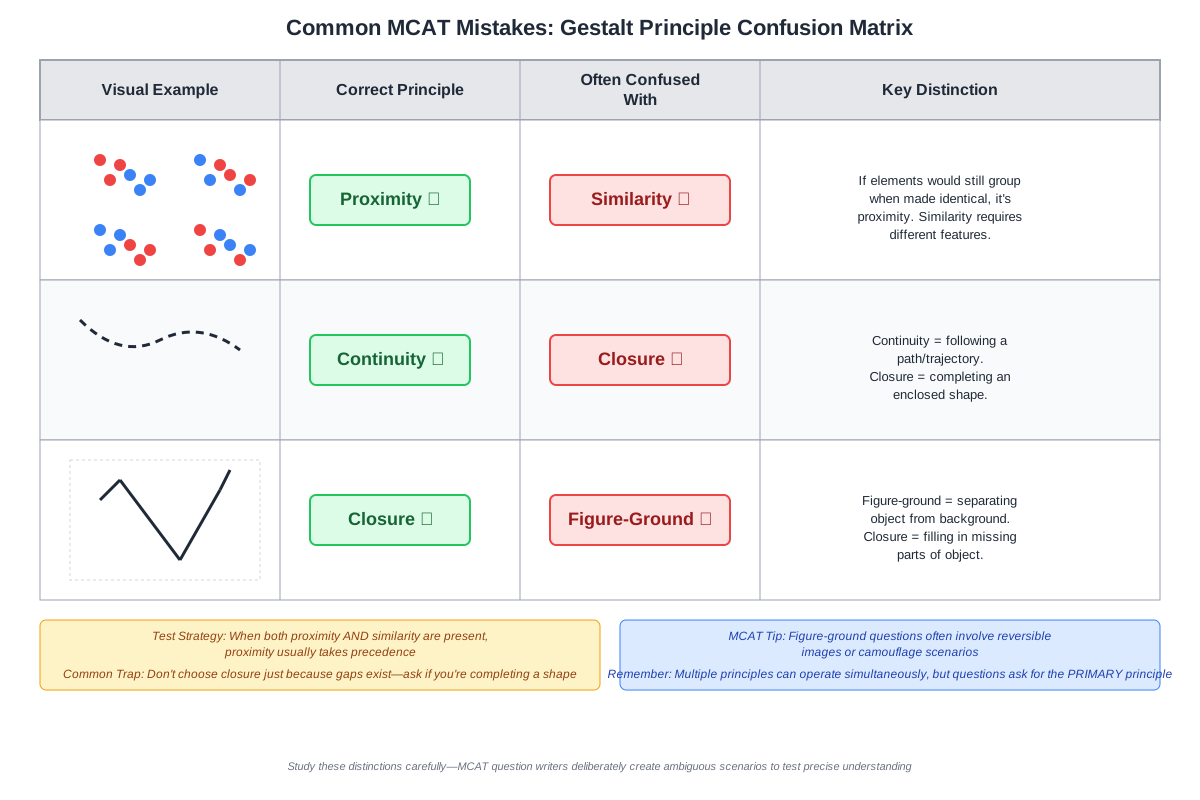
Proximity and similarity often work together, with spatial nearness and shared features reinforcing grouping. When these principles conflict (similar elements far apart versus dissimilar elements close together), the relative strength of each cue determines perceived grouping. Continuity and closure both involve extrapolating beyond given information—continuity extends lines along smooth paths, while closure completes interrupted contours.
Common fate extends Gestalt principles from static spatial organization to dynamic temporal organization, demonstrating that perceptual grouping applies across time as well as space. Symmetry relates to Prägnanz by providing a specific type of simplicity that the brain favors.
These principles connect to broader Sensation and Perception concepts through the distinction between bottom-up and top-down processing. Gestalt principles demonstrate top-down influences—our expectations about organized, meaningful patterns shape how we interpret sensory data. They also relate to attention (figure-ground organization determines attentional focus), memory (organized information is better remembered), and problem-solving (insight involves reorganizing perceptual/conceptual elements according to Gestalt-like principles).
The relationship map: Sensory Input → Figure-Ground Separation → Application of Grouping Principles (Proximity, Similarity, Continuity, Closure, Symmetry, Common Fate) → Organized Percept (following Prägnanz) → Cognitive Interpretation → Behavioral Response
Quick check — test yourself on Gestalt principles so far.
Try Flashcards →High-Yield Facts
⭐ Gestalt principles describe how the brain organizes sensory information into meaningful wholes rather than perceiving isolated parts.
⭐ The principle of proximity states that elements close together are perceived as grouped, regardless of other characteristics.
⭐ Closure involves perceiving incomplete figures as complete by filling in missing information, demonstrating top-down processing.
⭐ Figure-ground organization is fundamental to all perception—objects must be distinguished from background before further organization occurs.
⭐ Continuity causes perception of smooth, continuous patterns rather than abrupt directional changes at intersections.
- Similarity groups elements sharing visual characteristics like color, shape, size, or orientation.
- Common fate groups elements moving in the same direction at the same speed, overriding static grouping cues.
- Symmetry causes symmetrical elements to be perceived as belonging together and forming coherent figures.
- Prägnanz (law of simplicity) is the overarching principle stating that perception favors the simplest, most stable interpretation.
- Gestalt principles demonstrate that "the whole is different from the sum of its parts"—organized percepts have emergent properties.
- These principles apply to auditory and other sensory modalities, not just vision, though visual examples are most common.
- Reversible figures (Rubin vase, Necker cube) demonstrate that perceptual organization is not fixed but depends on attention and interpretation.
Common Misconceptions
Misconception: Gestalt principles only apply to artificial or designed visual stimuli like logos and graphics.
Correction: Gestalt principles describe fundamental perceptual processes that operate constantly in natural environments. They evolved to help organisms efficiently process complex natural scenes, identify objects despite occlusion, and detect patterns relevant to survival. While designers intentionally leverage these principles, they function automatically in all visual perception.
Misconception: Figure-ground is the same as foreground-background in photography or art.
Correction: While related, figure-ground is a perceptual phenomenon, not a physical property of the stimulus. The same visual stimulus can be perceived with different figure-ground organizations depending on attention and interpretation (as in reversible figures). Foreground-background in art refers to spatial depth cues, whereas figure-ground refers to which elements receive perceptual focus versus which recede to undifferentiated background.
Misconception: Proximity always dominates other Gestalt principles because physical distance is objective.
Correction: No single Gestalt principle universally dominates others. The relative strength of grouping cues depends on context, stimulus characteristics, and individual differences. Strong similarity can override proximity, and common fate (motion) often overrides static spatial relationships. Perceptual organization results from the interaction of multiple principles, with Prägnanz determining the simplest overall interpretation.
Misconception: Closure means the brain "sees" the missing parts as if they were physically present.
Correction: Closure involves cognitive completion, not sensory hallucination. The brain interprets incomplete figures as representing complete objects, but observers remain aware of the gaps if attention is directed to them. Closure operates at the perceptual-interpretive level, not the sensory-detection level. This distinction is important for understanding the difference between normal perceptual organization and pathological hallucinations.
Misconception: Gestalt principles are outdated theories replaced by modern neuroscience.
Correction: While modern neuroscience has revealed the neural mechanisms underlying Gestalt phenomena, the principles themselves remain valid descriptions of perceptual organization. Research on visual cortex processing, attention networks, and predictive coding has confirmed and extended Gestalt insights rather than refuting them. Contemporary cognitive neuroscience integrates Gestalt principles with understanding of neural circuits, demonstrating how these perceptual tendencies emerge from brain organization.
Misconception: All Gestalt principles operate equally in all sensory modalities.
Correction: While Gestalt-like organizational principles apply across modalities, they manifest differently in auditory, tactile, and other sensory systems. For example, auditory "proximity" involves temporal closeness (sounds close in time group together), and auditory "continuity" involves perceiving continuous tones despite brief interruptions. Visual Gestalt principles are most thoroughly studied and most directly applicable to MCAT questions, but understanding that organizational principles extend beyond vision demonstrates conceptual depth.
Worked Examples
Example 1: Identifying Principles in a Visual Stimulus
Scenario: A researcher presents participants with an image containing 12 dots arranged in three columns of four dots each. The dots in the left and right columns are black, while the dots in the middle column are white. When asked what they see, most participants report seeing two groups of black dots with white dots between them, rather than three columns.
Analysis: This scenario requires identifying which Gestalt principle(s) explain the described perception.
Step 1: Identify the physical arrangement—dots are organized in columns (proximity in the vertical dimension) but differ in color (similarity).
Step 2: Determine what participants actually perceive—two groups of black dots, not three columns. This indicates that color similarity overrides columnar proximity.
Step 3: Apply the principle of similarity—elements sharing visual characteristics (black color) are grouped together despite being separated by white dots. The white dots form a separate group based on their shared color.
Step 4: Consider why similarity dominates proximity here—color is a highly salient feature that creates strong perceptual grouping. The vertical proximity within columns is not strong enough to override the color-based grouping.
Conclusion: The principle of similarity best explains this perceptual phenomenon. This example demonstrates that when multiple Gestalt principles potentially apply, the relative strength of grouping cues determines the final percept. For MCAT questions, always consider which principle most directly explains the described perception and whether multiple principles might interact.
Example 2: Clinical Application of Gestalt Principles
Scenario: A 68-year-old patient who suffered a right parietal lobe stroke reports difficulty recognizing familiar objects. When shown a picture of a bicycle partially hidden behind a fence, the patient describes seeing "metal bars and circles" but cannot identify it as a bicycle. However, when shown a complete, unobstructed bicycle image, recognition is immediate. Which Gestalt principle is most likely impaired?
Analysis: This clinical vignette requires connecting Gestalt principles to neurological function and identifying which principle explains the deficit.
Step 1: Identify the key symptom—inability to recognize partially occluded objects despite recognizing complete objects. This suggests a problem with perceptual completion rather than object knowledge.
Step 2: Consider which Gestalt principle involves completing incomplete information—the principle of closure enables perception of complete objects from partial information.
Step 3: Connect to neuroanatomy—the right parietal lobe is involved in spatial processing and perceptual integration. Damage here can impair the ability to mentally complete fragmented visual information.
Step 4: Explain the pattern—when the bicycle is fully visible, bottom-up sensory information is sufficient for recognition. When partially occluded, successful recognition requires closure (top-down completion of missing parts), which is impaired by the stroke.
Step 5: Consider differential diagnosis—this is not prosopagnosia (face recognition deficit) or general agnosia (would affect complete objects too). The specific impairment with occluded objects points to closure deficit.
Conclusion: The patient's deficit reflects impaired closure, preventing mental completion of partially visible objects. This example demonstrates how Gestalt principles have clinical relevance and how MCAT questions may embed these concepts in medical scenarios. Understanding the neural basis of perceptual organization helps connect psychological concepts to biological foundations, a key MCAT skill.
Exam Strategy
When approaching Gestalt principles MCAT questions, first determine whether the question asks for principle identification (which principle explains a described phenomenon) or principle application (predict perception given a stimulus). For identification questions, carefully analyze what perceptual organization is described, then match it to the principle definition. For application questions, consider which principle(s) would most strongly influence perception given the stimulus characteristics.
Trigger words and phrases to watch for include:
- "Grouped together" or "perceived as belonging together" → likely proximity, similarity, or common fate
- "Complete" or "fill in" → closure
- "Continuous" or "smooth path" → continuity
- "Stands out from background" → figure-ground
- "Moving together" → common fate
- "Simplest interpretation" → Prägnanz
- "Mirror image" or "balanced" → symmetry
When questions present visual stimuli or describe arrangements, quickly sketch the described configuration if possible. Visual representation helps identify spatial relationships (proximity), shared features (similarity), and potential completions (closure). If the question describes multiple grouping cues, consider which would dominate—motion (common fate) typically overrides static cues, and strong similarity can override proximity.
For process-of-elimination, recognize that incorrect answer choices often confuse similar principles (proximity vs. similarity, continuity vs. closure) or apply principles to inappropriate scenarios. Eliminate choices that describe sensory processes rather than perceptual organization, as Gestalt principles operate at the perceptual-interpretive level, not the sensory-detection level.
Time allocation: Discrete Gestalt questions should take 60-90 seconds—quickly identify the described perceptual phenomenon and match to principle definition. Passage-based questions may require 90-120 seconds if they involve analyzing described stimuli or connecting principles to passage content. Don't overthink these questions; Gestalt principles are straightforward once you understand the definitions.
Exam Tip: If a question describes a perceptual phenomenon and asks "which Gestalt principle," eliminate any answer choice that isn't actually a Gestalt principle (e.g., "selective attention," "parallel processing"). Then match the described perception to principle definitions, focusing on the most direct explanation.
Memory Techniques
Mnemonic for major Gestalt principles: "Please Stop Calling Cute Cats Silly Pets"
- Proximity
- Similarity
- Continuity
- Closure
- Common fate
- Symmetry
- Prägnanz (simplicity)
(Note: Figure-ground is foundational and typically remembered separately as the first step in perceptual organization)
Visualization strategy for proximity: Picture dots on a page—dots close together naturally look like groups, while widely spaced dots look separate. The physical closeness creates perceptual togetherness.
Visualization strategy for closure: Imagine a circle with small gaps—your mind automatically "closes" the gaps to see a complete circle. Think "close the gaps" = closure.
Visualization strategy for continuity: Picture two curved roads crossing—you naturally see two continuous roads, not four separate road segments meeting at a point. The smooth continuation wins.
Visualization strategy for common fate: Imagine a flock of birds flying together versus individual birds flying in different directions—the synchronized movement creates a perceived group. "Common fate" = shared destiny/direction.
Conceptual anchor for Prägnanz: Remember "Prägnanz = preference for simplicity." When perception is ambiguous, the brain chooses the simplest interpretation. This is the "master principle" that explains why other principles work—they all create simpler, more organized perception.
Association technique for similarity: "Similar things stick together"—elements that look alike (color, shape, size) are perceived as belonging together, just like similar people might group together socially.
Summary
Gestalt principles represent fundamental laws of perceptual organization describing how the brain groups sensory information into meaningful wholes. These principles—including figure-ground, proximity, similarity, continuity, closure, symmetry, common fate, and the overarching principle of Prägnanz (simplicity)—demonstrate that perception is an active, organizing process rather than passive sensory reception. For the MCAT, students must be able to define each principle accurately, identify which principle explains described perceptual phenomena, and apply these concepts to novel scenarios including clinical cases. Understanding that these principles reflect the brain's drive toward efficient, organized perception helps connect them to broader concepts in Sensation and Perception, attention, memory, and cognitive processing. The key insight—"the whole is different from the sum of its parts"—captures the Gestalt philosophy that organized percepts possess emergent properties not predictable from analyzing components in isolation. Mastery requires distinguishing between similar principles (proximity vs. similarity, continuity vs. closure), recognizing that multiple principles often interact to determine final perception, and connecting these perceptual phenomena to their neural bases and clinical implications.
Key Takeaways
- Gestalt principles describe predictable ways the brain organizes sensory information into coherent, meaningful wholes rather than perceiving isolated elements.
- Figure-ground separation is foundational—objects must be distinguished from background before other organizational principles can operate.
- Proximity (spatial closeness), similarity (shared features), continuity (smooth paths), closure (completing gaps), symmetry (mirror images), and common fate (shared motion) represent specific grouping principles.
- Prägnanz (law of simplicity) is the overarching principle stating that perception favors the simplest, most stable interpretation when multiple organizations are possible.
- These principles demonstrate top-down processing—expectations and knowledge about organized patterns influence perception of sensory data.
- For MCAT questions, identify which principle most directly explains the described perceptual phenomenon and recognize that multiple principles may interact.
- Clinical applications include understanding perceptual deficits after brain injury and how medical professionals use Gestalt principles in diagnostic imaging interpretation.
Related Topics
Visual Processing Pathways: Understanding how visual information travels from retina through lateral geniculate nucleus to primary visual cortex and beyond provides the neural foundation for Gestalt organization. Mastering Gestalt principles enables deeper understanding of where and how perceptual organization occurs in the visual system.
Attention and Selective Perception: Gestalt principles interact with attention mechanisms—figure-ground organization determines what receives attentional focus, and attention can shift which elements are perceived as figure versus ground. Understanding both topics together reveals how perception and attention mutually influence each other.
Top-Down vs. Bottom-Up Processing: Gestalt principles exemplify top-down influences on perception, demonstrating how expectations and knowledge shape sensory interpretation. This connects to schema theory, perceptual set, and predictive coding models of brain function.
Memory Encoding and Organization: Information organized according to Gestalt-like principles is better remembered than unorganized information. This connects perceptual organization to memory consolidation and retrieval, relevant for understanding effective study strategies.
Problem-Solving and Insight: Gestalt psychologists extended organizational principles beyond perception to cognition, describing insight as perceptual reorganization of problem elements. Understanding perceptual Gestalt principles provides foundation for understanding cognitive applications.
Practice CTA
Now that you've mastered the core concepts of Gestalt principles, it's time to solidify your understanding through active practice. Challenge yourself with MCAT-style questions that require identifying principles from described scenarios, applying principles to predict perception, and connecting these concepts to clinical cases. Use flashcards to drill principle definitions and distinguishing features until recognition becomes automatic. Remember, Gestalt principles appear regularly on the MCAT, and confident mastery of this medium-yield topic can secure valuable points. The principles themselves demonstrate that organized, meaningful practice creates stronger learning than isolated fact memorization—apply Gestalt wisdom to your own studying! You've built a strong foundation; now reinforce it through deliberate practice and watch your confidence soar.
Sign up free to keep reading
Create a free AnvayaPrep account to finish this MCAT guide on Gestalt principles — plus flashcards and practice questions.