Overview
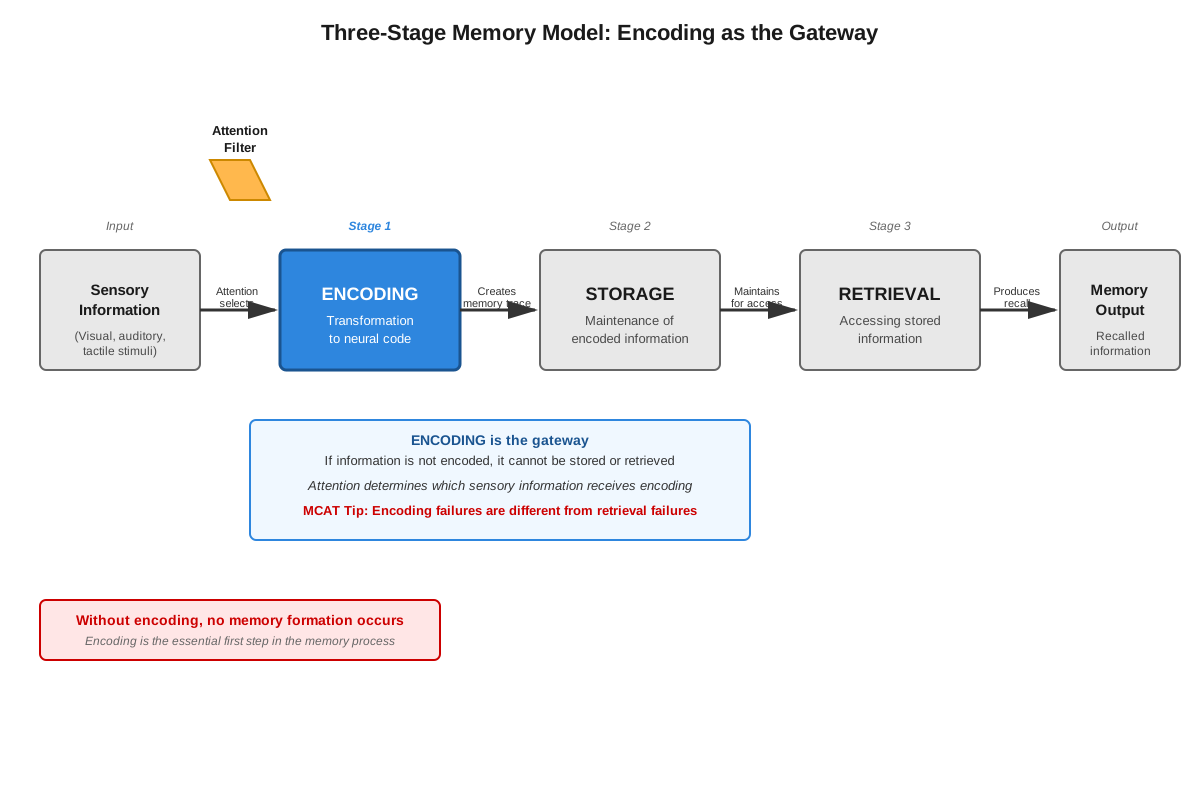
Memory encoding is the critical first stage of memory formation in which sensory information is transformed into a construct that can be stored in the brain. This process represents the gateway through which all experiences, facts, and skills enter our memory systems. Without effective encoding, information cannot be retained or later retrieved, making this topic foundational to understanding human cognition and behavior.
For the MCAT, memory encoding is a high-yield topic that appears frequently in both discrete questions and passage-based items within the Psychology and Sociology section. The exam tests not only definitional knowledge but also the ability to apply encoding principles to experimental designs, clinical scenarios, and real-world situations. Understanding encoding mechanisms allows test-takers to predict outcomes in memory research studies, explain why certain learning strategies succeed or fail, and connect cognitive processes to neural substrates.
Memory encoding sits at the intersection of multiple psychological domains within Learning and Memory. It connects directly to attention (what we attend to gets encoded), perception (how we interpret sensory input affects encoding quality), and later memory stages (storage and retrieval). The topic also bridges to neuroscience (hippocampal function), developmental psychology (encoding changes across lifespan), and social psychology (how social context influences what we encode). Mastering encoding principles provides the foundation for understanding more complex memory phenomena including forgetting, memory distortion, and individual differences in memory performance.
Learning Objectives
- [ ] Define Memory encoding using accurate Psychology terminology
- [ ] Explain why Memory encoding matters for the MCAT
- [ ] Apply Memory encoding to exam-style questions
- [ ] Identify common mistakes related to Memory encoding
- [ ] Connect Memory encoding to related Psychology concepts
- [ ] Distinguish between automatic and effortful encoding processes
- [ ] Compare and contrast different types of encoding (semantic, acoustic, visual, tactile)
- [ ] Analyze how depth of processing affects encoding quality and subsequent retrieval
Prerequisites
- Sensory memory and perception: Memory encoding begins with sensory input, requiring understanding of how information first enters the cognitive system through sensory registers
- Attention mechanisms: Selective attention determines which stimuli receive sufficient processing for encoding to occur
- Basic brain anatomy: Knowledge of hippocampus, prefrontal cortex, and temporal lobe structures that support encoding processes
- Information processing model: Understanding the three-stage model (encoding → storage → retrieval) provides context for where encoding fits in memory formation
Why This Topic Matters
Memory encoding has profound clinical and real-world significance. Encoding deficits underlie many memory disorders, including anterograde amnesia (inability to form new memories after brain injury), early-stage Alzheimer's disease, and attention-deficit disorders. Understanding encoding principles informs educational practices, therapeutic interventions for memory disorders, and strategies for eyewitness testimony reliability. Healthcare professionals must recognize when patients struggle with encoding versus retrieval to provide appropriate interventions.
On the MCAT, memory encoding appears in approximately 3-5 questions per exam, representing roughly 2-3% of the Psychological, Social, and Biological Foundations of Behavior section. Questions typically present experimental scenarios testing encoding manipulations, clinical vignettes describing memory impairments, or theoretical passages exploring cognitive processes. The topic frequently appears in:
- Research design passages examining variables that enhance or impair encoding (e.g., divided attention studies, levels of processing experiments)
- Clinical vignettes describing patients with encoding deficits following brain injury or disease
- Discrete questions testing definitional knowledge and ability to distinguish encoding from storage and retrieval
- Application questions requiring students to predict memory performance based on encoding conditions
The MCAT particularly favors questions that integrate encoding with neuroscience (brain regions involved), research methods (identifying independent/dependent variables in encoding studies), and practical applications (improving study techniques).
Core Concepts
Definition and Basic Mechanisms
Memory encoding is the process by which sensory information is converted into a form that can be stored in memory. This transformation involves changing physical and sensory input into meaningful representations that the brain can maintain over time. Encoding is not a passive recording process like a video camera; rather, it is an active, constructive process that involves interpretation, organization, and integration with existing knowledge.
The encoding process begins when sensory information from the environment enters sensory memory through our five senses. However, only information that receives sufficient attention proceeds to deeper encoding. The quality and durability of encoding depends on multiple factors including the type of processing applied, the individual's existing knowledge structures, emotional state, and the presence of retrieval cues during initial learning.
Types of Encoding
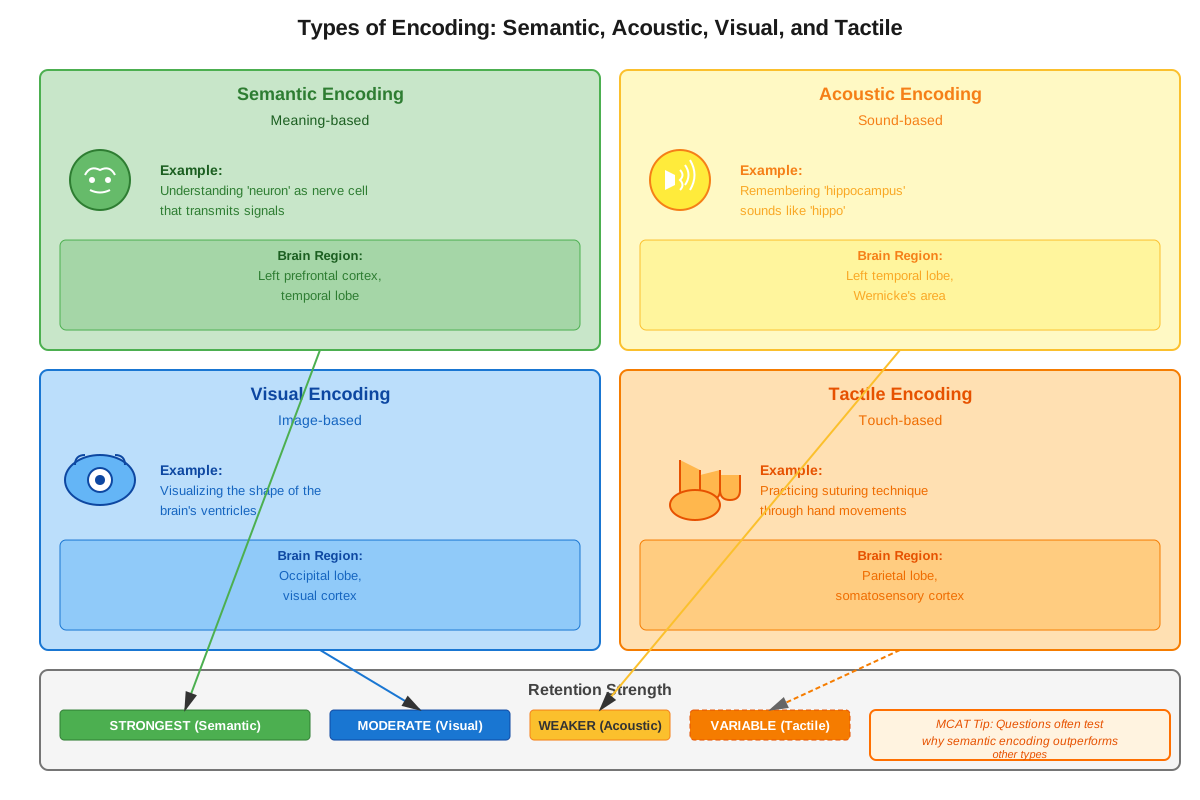
Memory encoding Psychology research has identified several distinct types of encoding based on the nature of information being processed:
| Encoding Type | Description | Example | Durability |
|---|---|---|---|
| Visual encoding | Processing information based on appearance and physical characteristics | Remembering a person's face or the layout of a room | Moderate |
| Acoustic encoding | Processing information based on sound, particularly important for language | Remembering a phone number by repeating it aloud | Moderate |
| Semantic encoding | Processing information based on meaning and relationships to existing knowledge | Understanding and remembering concepts by connecting to prior knowledge | High |
| Tactile encoding | Processing information through touch and physical sensation | Remembering the texture of fabric or muscle memory for procedures | Moderate-High |
Semantic encoding typically produces the strongest, most durable memories because it involves deeper processing and creates more retrieval pathways. This principle underlies effective study strategies for the MCAT and other standardized exams.
Automatic vs. Effortful Processing
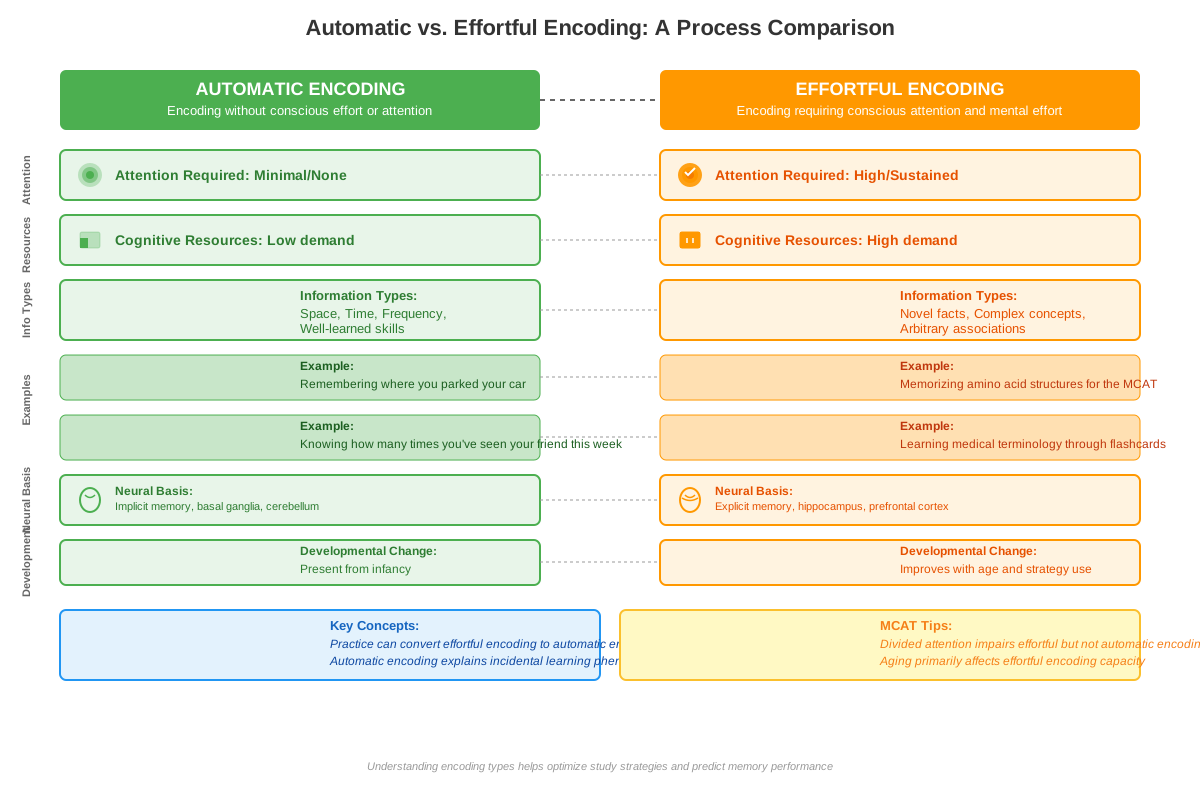
Encoding can occur through two fundamentally different mechanisms:
Automatic processing occurs without conscious awareness or intention. This type of encoding happens for:
- Space and location information (where things are)
- Time and sequence information (when events occurred)
- Frequency information (how often something happens)
- Well-learned information (reading words for fluent readers)
Automatic processing requires minimal attentional resources and occurs in parallel with other cognitive tasks. For example, you automatically encode where you parked your car without deliberately trying to memorize the location.
Effortful processing requires conscious attention and deliberate rehearsal. This type of encoding is necessary for:
- Novel, complex information
- Abstract concepts
- Information without inherent meaning
- Details that require precise accuracy
Most academic learning, including MCAT preparation, requires effortful processing. The amount of effort invested during encoding directly correlates with memory strength and retrieval success.
Levels of Processing Framework
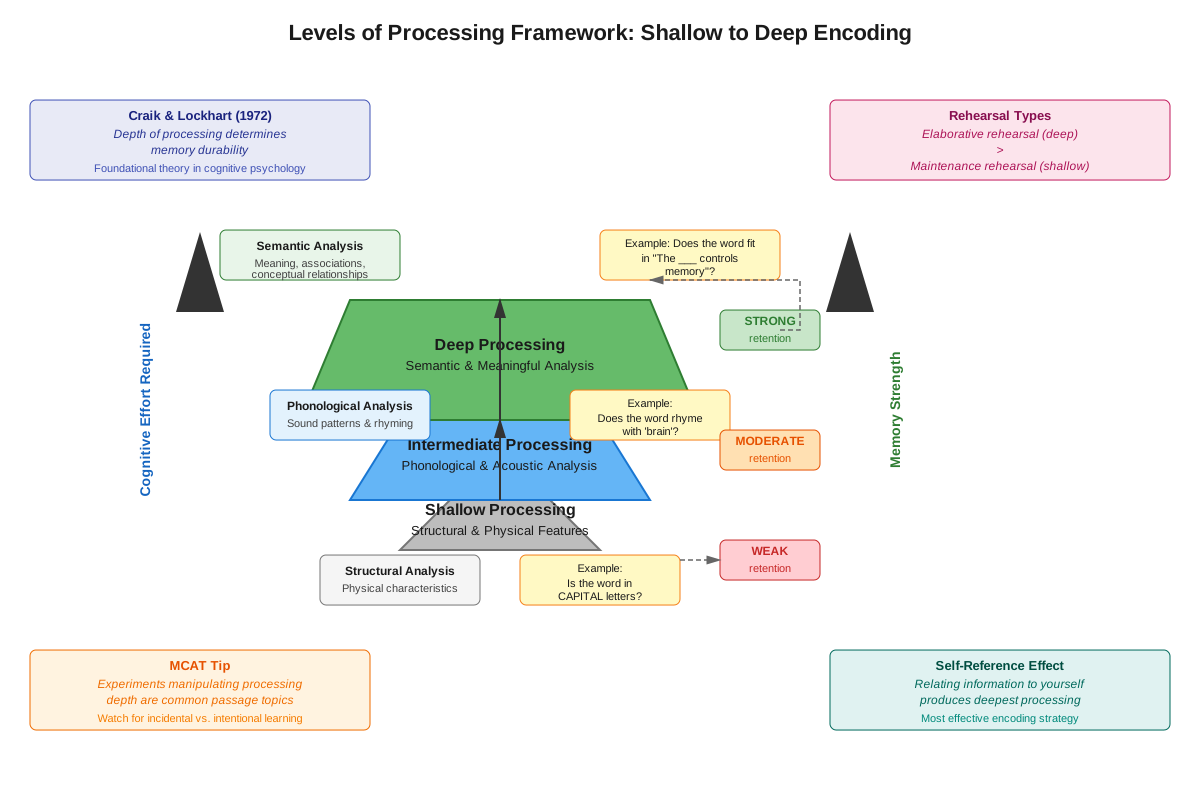
The levels of processing theory, proposed by Craik and Lockhart, revolutionized understanding of encoding by proposing that memory durability depends on the depth of processing during encoding rather than rehearsal duration alone. This framework identifies three levels:
- Structural (shallow) processing: Encoding based on physical and perceptual features (e.g., "Is the word in capital letters?")
- Phonemic (intermediate) processing: Encoding based on sound (e.g., "Does the word rhyme with 'cat'?")
- Semantic (deep) processing: Encoding based on meaning (e.g., "Does the word fit in this sentence?" or "How does this concept relate to what I already know?")
Research consistently demonstrates that deeper, semantic processing produces superior memory compared to shallow processing, even when time spent encoding is held constant. This finding has profound implications for Learning and Memory strategies: understanding material produces better retention than superficial review.
Elaborative Encoding
Elaborative encoding involves forming associations between new information and existing knowledge, creating a rich network of connections. This process enhances memory through multiple mechanisms:
- Creates multiple retrieval pathways (more ways to access the memory)
- Integrates new information into existing schemas
- Generates meaningful relationships that aid reconstruction
- Engages deeper semantic processing
Elaborative techniques include:
- Generating examples from personal experience
- Creating analogies to familiar concepts
- Asking "why" and "how" questions about material
- Connecting new concepts to previously learned information
For MCAT preparation, elaborative encoding means connecting psychological concepts to biological mechanisms, clinical applications, and research examples rather than memorizing isolated definitions.
Self-Reference Effect
The self-reference effect demonstrates that information encoded in relation to oneself is remembered exceptionally well. When people process information by relating it to personal experiences, traits, or situations, encoding is enhanced beyond even standard semantic processing. This occurs because:
- Self-related information connects to the most elaborate, well-developed schema (knowledge about oneself)
- Personal relevance increases attention and emotional engagement
- Self-referential processing activates additional brain regions (medial prefrontal cortex)
Practical application: When studying Psychology concepts, creating personal examples or considering how concepts apply to one's own life enhances encoding and retention.
Encoding Specificity Principle
The encoding specificity principle states that memory retrieval is most effective when the conditions at retrieval match the conditions present during encoding. This principle encompasses:
- Context-dependent memory: Physical environment cues present during encoding facilitate retrieval (e.g., studying in a similar environment to the test room)
- State-dependent memory: Internal physiological or emotional states present during encoding serve as retrieval cues (e.g., information learned while happy is better recalled when happy)
- Mood-congruent memory: Emotional states bias encoding toward mood-consistent information
This principle explains why encoding should include cues that will be available during retrieval. For standardized testing, this means practicing retrieval under test-like conditions and encoding information in multiple contexts to create flexible retrieval pathways.
Neural Basis of Encoding
Memory encoding MCAT questions often integrate neuroscience, requiring knowledge of brain structures involved in encoding:
- Hippocampus: Critical for encoding new declarative memories (facts and events); damage causes anterograde amnesia
- Prefrontal cortex: Supports working memory and effortful encoding processes; involved in organizing and elaborating information
- Amygdala: Enhances encoding of emotionally significant information through stress hormone modulation
- Sensory cortices: Initial encoding of modality-specific information (visual cortex for visual encoding, auditory cortex for acoustic encoding)
The hippocampus does not permanently store memories but is essential for the initial encoding and consolidation process. Once consolidated, memories become less hippocampus-dependent and more distributed across cortical regions.
Factors Affecting Encoding Quality
Multiple variables influence encoding effectiveness:
Attention: Divided attention during encoding significantly impairs memory formation. Multitasking while studying reduces encoding quality even if the learner feels productive.
Emotion: Moderate emotional arousal enhances encoding through amygdala activation and stress hormone release. However, extreme stress can impair encoding, particularly for peripheral details.
Prior knowledge: Existing schemas facilitate encoding of related new information through elaboration and meaningful organization.
Intention to learn: While incidental learning can occur, intentional learning typically produces better encoding through increased attention and deeper processing.
Repetition and spacing: Distributed practice (spacing encoding episodes over time) produces superior encoding compared to massed practice (cramming), a phenomenon called the spacing effect.
Concept Relationships
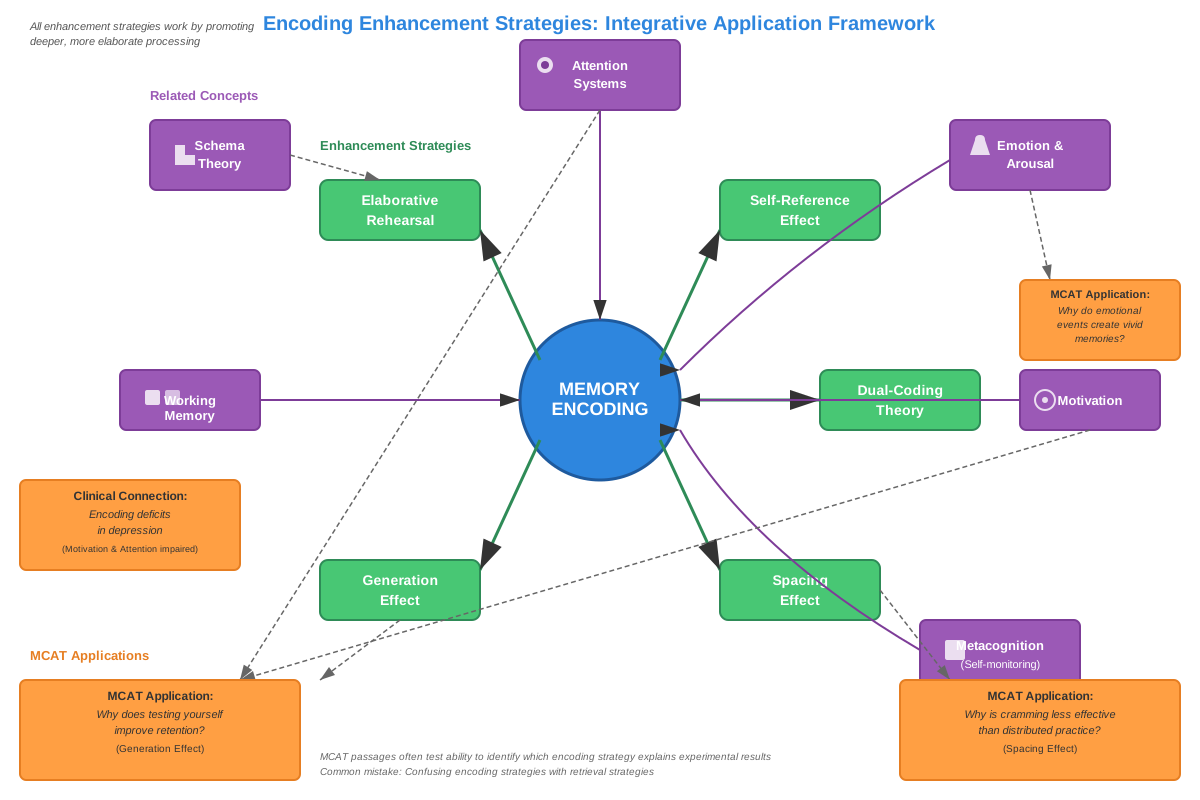
Memory encoding serves as the foundation for all subsequent memory processes. The relationship flows sequentially: Attention → Encoding → Storage → Retrieval. Without successful encoding, information never enters storage and cannot be retrieved, making encoding the critical gateway to memory formation.
Within encoding itself, concepts form a hierarchical relationship: Type of encoding (visual, acoustic, semantic) determines depth of processing (shallow to deep), which influences encoding quality (weak to strong), ultimately affecting retrieval success (difficult to easy). Semantic encoding produces deeper processing than visual or acoustic encoding, creating more durable memory traces.
The self-reference effect represents a special case of elaborative encoding, which itself is a form of semantic processing. This nested relationship shows how specific encoding strategies leverage deeper processing mechanisms: Self-reference → Elaboration → Semantic processing → Deep encoding → Strong memory.
Encoding specificity connects encoding to retrieval by establishing that encoding conditions → create context cues → facilitate retrieval. This principle bridges the encoding and retrieval stages, demonstrating that these processes are not independent but intimately linked.
Prerequisite concepts support encoding understanding: Attention determines what information receives encoding; sensory memory provides the raw input for encoding; working memory serves as the workspace where encoding processes operate; brain structures (hippocampus, prefrontal cortex) provide the neural substrate for encoding mechanisms.
Encoding connects forward to related topics: Storage maintains encoded information; retrieval accesses encoded memories; forgetting often results from encoding failures; memory distortion can occur when encoding is incomplete or biased; learning strategies optimize encoding through application of encoding principles.
Quick check — test yourself on Memory encoding so far.
Try Flashcards →High-Yield Facts
⭐ Memory encoding is the process of transforming sensory information into a form that can be stored in memory; it is the first stage of memory formation.
⭐ Semantic encoding (processing based on meaning) produces more durable memories than acoustic (sound-based) or visual (appearance-based) encoding.
⭐ Levels of processing theory states that deeper processing (semantic) creates stronger memories than shallow processing (structural/phonemic), regardless of rehearsal time.
⭐ Automatic processing occurs without conscious effort for spatial, temporal, and frequency information, while effortful processing requires deliberate attention and is necessary for most academic learning.
⭐ The self-reference effect demonstrates that information encoded in relation to oneself is remembered better than information processed through standard semantic encoding.
- Elaborative encoding creates multiple retrieval pathways by connecting new information to existing knowledge, enhancing memory strength and accessibility.
- The encoding specificity principle states that retrieval is most successful when conditions at retrieval match conditions present during encoding (context-dependent and state-dependent memory).
- The hippocampus is essential for encoding new declarative memories; damage causes anterograde amnesia (inability to form new memories).
- Divided attention during encoding significantly impairs memory formation; multitasking reduces encoding quality even when learners feel productive.
- Distributed practice (spacing encoding over time) produces superior encoding compared to massed practice (cramming), demonstrating the spacing effect.
- Moderate emotional arousal enhances encoding through amygdala activation, but extreme stress can impair encoding, particularly for peripheral details.
- Prior knowledge facilitates encoding of related new information by providing schemas for organization and elaboration.
Common Misconceptions
Misconception: Memory encoding works like a video camera, creating exact recordings of experiences.
Correction: Encoding is an active, constructive process that involves interpretation, selection, and organization. We encode meaningful representations, not exact sensory copies. This explains why memories can be distorted or incomplete even immediately after encoding.
Misconception: Spending more time studying (rehearsing) always improves encoding and memory.
Correction: The quality of processing matters more than quantity of time. Shallow, repetitive review produces weaker encoding than shorter periods of deep, semantic processing. Ten minutes of elaborative encoding beats thirty minutes of passive re-reading.
Misconception: Automatic and effortful processing are completely separate systems that never interact.
Correction: These represent endpoints on a continuum, and many encoding processes involve both. Additionally, with extensive practice, initially effortful processes can become automatic (e.g., driving a car, reading for fluent readers).
Misconception: Encoding failures and retrieval failures produce identical outcomes (forgetting), so they cannot be distinguished.
Correction: These failures have different characteristics. Encoding failures mean information never entered memory (no amount of cueing helps retrieval), while retrieval failures mean information is stored but temporarily inaccessible (appropriate cues can trigger recall). Clinical tests can distinguish these through recognition testing.
Misconception: The hippocampus permanently stores all encoded memories.
Correction: The hippocampus is critical for initial encoding and consolidation but does not permanently store memories. Over time, memories become less hippocampus-dependent and more distributed across cortical regions. The hippocampus acts as an "encoder" and "indexer" rather than a permanent storage site.
Misconception: Emotional information is always encoded better than neutral information.
Correction: While moderate emotional arousal enhances encoding, the relationship is an inverted U-shape. Extreme stress or emotion can impair encoding through multiple mechanisms including attentional narrowing and stress hormone effects on hippocampal function.
Misconception: Encoding is complete immediately after experiencing information.
Correction: Encoding continues after initial experience through consolidation processes. Sleep, in particular, plays a critical role in stabilizing newly encoded memories. Interference shortly after encoding can disrupt this consolidation process.
Worked Examples
Example 1: Levels of Processing Experiment
Scenario: Researchers present participants with a list of 30 words. Group A is asked whether each word is printed in uppercase or lowercase letters (structural processing). Group B is asked whether each word rhymes with a target word (phonemic processing). Group C is asked whether each word fits meaningfully into a sentence (semantic processing). After a 10-minute delay, all participants complete a surprise recall test.
Question: Predict the pattern of results and explain the underlying mechanism.
Solution:
Step 1: Identify the independent and dependent variables.
- IV: Type of processing (structural, phonemic, semantic)
- DV: Number of words recalled
Step 2: Apply levels of processing theory.
According to Craik and Lockhart's framework, deeper processing produces more durable encoding. The three groups represent increasing depth:
- Group A: Shallow (structural) - processing only physical features
- Group B: Intermediate (phonemic) - processing sound properties
- Group C: Deep (semantic) - processing meaning
Step 3: Predict outcomes.
Expected recall performance: Group C > Group B > Group A
Group C should recall the most words because semantic processing creates richer, more elaborate memory traces with more retrieval pathways. Group A should recall the fewest words because structural processing creates weak, impoverished memory traces.
Step 4: Explain the mechanism.
Semantic processing engages existing knowledge networks, creating connections between new information and prior knowledge. These connections serve as retrieval cues and make memories more distinctive and meaningful. Structural processing creates isolated, superficial representations with few retrieval pathways.
Step 5: Connect to MCAT application.
This demonstrates why understanding concepts (semantic processing) produces better retention than memorizing superficial features. For MCAT preparation, explaining concepts in your own words and connecting them to examples represents semantic processing that enhances encoding.
Learning objective addressed: Apply memory encoding to exam-style questions; distinguish between types of encoding and their effects.
Example 2: Clinical Vignette - Encoding Deficit
Scenario: A 68-year-old patient presents with progressive memory complaints. Neuropsychological testing reveals that he can recall only 2 out of 15 words from a list after a 5-minute delay (free recall). However, when given a recognition test with the 15 target words mixed with 15 new words, he correctly identifies 14 of the 15 target words. MRI shows bilateral hippocampal atrophy. His working memory and attention are intact.
Question: Does this patient have primarily an encoding deficit, storage deficit, or retrieval deficit? Justify your answer.
Solution:
Step 1: Analyze the test results.
- Poor free recall (2/15) suggests memory impairment
- Excellent recognition (14/15) indicates information was successfully encoded and stored
- The discrepancy between recall and recognition is the critical finding
Step 2: Distinguish between encoding, storage, and retrieval deficits.
- Encoding deficit: Information never enters memory; both recall AND recognition would be impaired
- Storage deficit: Information is lost from memory; both recall AND recognition would be impaired
- Retrieval deficit: Information is stored but difficult to access; recall is impaired but recognition is preserved
Step 3: Interpret the pattern.
The patient's excellent recognition performance (14/15) demonstrates that:
- Encoding was successful (information entered memory)
- Storage is intact (information remained in memory over the 5-minute delay)
- Free recall is impaired due to retrieval difficulties (accessing stored information without cues)
Step 4: Integrate neuroanatomical information.
Hippocampal atrophy can impair both encoding and retrieval. However, the preserved recognition performance indicates that encoding is relatively intact. The hippocampus plays a role in effortful retrieval, which explains the recall deficit.
Step 5: Reach a conclusion.
This patient has primarily a retrieval deficit, not an encoding deficit. The recognition test provides sufficient cues to access stored memories, while free recall requires self-generated retrieval that is impaired.
Clinical note: This pattern is common in early Alzheimer's disease and normal aging. True encoding deficits (as seen in severe hippocampal damage causing anterograde amnesia) would impair both recall and recognition.
Learning objective addressed: Apply memory encoding concepts to clinical scenarios; distinguish encoding from other memory processes; connect encoding to neural substrates.
Exam Strategy
When approaching MCAT questions on memory encoding, follow this systematic strategy:
1. Identify the memory stage being tested: MCAT questions often require distinguishing encoding from storage and retrieval. Look for temporal clues:
- Encoding: Occurs during initial learning/experience
- Storage: Occurs during retention interval
- Retrieval: Occurs during testing/recall
Trigger phrases for encoding questions:
- "During the learning phase..."
- "While studying the material..."
- "Factors that affect initial memory formation..."
- "Processing during presentation..."
2. Determine the type of processing: Questions frequently test levels of processing or encoding types. Identify whether the scenario describes:
- Structural/shallow processing (physical features)
- Phonemic/intermediate processing (sound)
- Semantic/deep processing (meaning)
3. Apply the depth principle: When comparing conditions, predict that deeper, semantic processing will produce better memory outcomes. This principle appears in approximately 60% of encoding questions.
4. Watch for encoding-retrieval interactions: Questions may test encoding specificity. Look for matches or mismatches between:
- Encoding context and retrieval context
- Encoding state and retrieval state
- Encoding cues and available retrieval cues
5. Eliminate answers based on common distractors:
- Answers confusing encoding with retrieval (e.g., claiming encoding deficit when recognition is intact)
- Answers suggesting encoding is passive/automatic when the scenario describes effortful learning
- Answers claiming time spent studying is more important than processing depth
6. Consider neural substrates: If the question mentions brain regions:
- Hippocampus → encoding of declarative memories
- Prefrontal cortex → working memory and effortful encoding
- Amygdala → emotional enhancement of encoding
- Damage to these regions predicts specific encoding impairments
Time allocation: Encoding questions typically require 60-90 seconds. Spend time identifying the memory stage and type of processing; the answer usually follows directly from these determinations.
Process of elimination tip: On encoding questions, eliminate answers that:
- Describe retrieval processes when the question asks about initial learning
- Suggest all encoding is automatic (most academic learning requires effortful processing)
- Claim encoding is identical across different processing types
Memory Techniques
Mnemonic for types of encoding - "VAST":
- Visual (appearance)
- Acoustic (sound)
- Semantic (meaning) ← produces strongest memories
- Tactile (touch)
Mnemonic for levels of processing - "SPS" (Shallow to Deep):
- Structural (physical features) - shallowest
- Phonemic (sound)
- Semantic (meaning) - deepest
Mnemonic for factors enhancing encoding - "EASE":
- Elaboration (connecting to existing knowledge)
- Attention (focused, undivided)
- Self-reference (relating to personal experience)
- Emotion (moderate arousal)
Visualization for encoding specificity: Picture encoding as "planting" a memory with specific "soil conditions" (context). Retrieval works best when you return to the same "soil" (matching context). Mismatched contexts are like trying to find a plant in different soil.
Acronym for automatic processing - "STF":
- Space (location information)
- Time (sequence and temporal information)
- Frequency (how often things occur)
Conceptual anchor: Remember that encoding is like translating information from one language (sensory input) to another (memory representation). Just as translation quality depends on the translator's skill and effort, encoding quality depends on processing depth and elaboration. Poor translation (shallow encoding) loses meaning; excellent translation (deep encoding) preserves and enriches meaning.
Summary
Memory encoding represents the critical gateway through which information enters memory systems, transforming sensory input into storable mental representations. This active, constructive process varies in effectiveness based on processing depth, with semantic encoding (meaning-based processing) producing more durable memories than acoustic or visual encoding. The levels of processing framework demonstrates that understanding and elaborating information creates stronger encoding than superficial review, regardless of time spent. Encoding can occur automatically for spatial, temporal, and frequency information, but most academic learning requires effortful processing with focused attention. The self-reference effect and elaborative encoding enhance memory by creating rich networks of associations and multiple retrieval pathways. Encoding specificity establishes that retrieval success depends on matching conditions between encoding and retrieval contexts. Neural substrates, particularly the hippocampus, prefrontal cortex, and amygdala, support different aspects of encoding, with hippocampal damage causing profound encoding deficits for new declarative memories. For MCAT success, students must distinguish encoding from storage and retrieval, predict outcomes based on processing depth, and apply encoding principles to experimental designs and clinical scenarios.
Key Takeaways
- Memory encoding transforms sensory information into storable representations and is the essential first stage of memory formation; without successful encoding, information cannot be stored or retrieved
- Semantic encoding (meaning-based) produces superior memory compared to acoustic (sound-based) or visual (appearance-based) encoding due to deeper processing and richer associations
- Levels of processing theory establishes that processing depth, not rehearsal duration, determines memory strength; understanding material beats repetitive review
- Automatic processing handles spatial, temporal, and frequency information without effort, while effortful processing is required for novel, complex academic material like MCAT content
- Elaborative encoding and the self-reference effect enhance memory by creating multiple retrieval pathways through connections to existing knowledge and personal experience
- The encoding specificity principle demonstrates that retrieval is optimized when conditions match between encoding and retrieval, explaining context-dependent and state-dependent memory effects
- The hippocampus is essential for encoding new declarative memories; damage causes anterograde amnesia, while recognition testing can distinguish encoding from retrieval deficits
Related Topics
Memory Storage and Consolidation: After successful encoding, information must be stabilized and maintained through consolidation processes. Understanding storage mechanisms, including the role of sleep and the distinction between short-term and long-term memory, builds directly on encoding principles.
Memory Retrieval: Retrieval represents the complementary process to encoding, accessing stored information. Mastering encoding provides the foundation for understanding retrieval cues, retrieval failure, and the relationship between encoding and retrieval success.
Forgetting and Memory Distortion: Many instances of forgetting result from encoding failures rather than storage or retrieval problems. Understanding encoding helps explain why some information is never successfully learned and how incomplete encoding contributes to false memories.
Attention and Working Memory: These prerequisite topics connect intimately with encoding—attention determines what receives encoding, and working memory provides the workspace where encoding processes operate. Deeper study reveals how attentional limitations constrain encoding capacity.
Neuroanatomy of Memory: The neural substrates of encoding, particularly hippocampal circuits and prefrontal-hippocampal interactions, represent a high-yield integration of psychology and neuroscience frequently tested on the MCAT.
Practice CTA
Now that you have mastered the core concepts of memory encoding, it's time to solidify your understanding through active practice. Complete the practice questions and flashcards for this topic, focusing on distinguishing encoding from other memory stages, applying levels of processing principles, and analyzing experimental scenarios. Remember that your understanding of encoding principles directly improves your own study effectiveness—apply semantic processing and elaborative encoding to all your MCAT preparation. Each practice question you work through creates another opportunity to encode this material deeply, building the strong memory traces that will serve you on test day. You've got this!
Sign up free to keep reading
Create a free AnvayaPrep account to finish this MCAT guide on Memory encoding — plus flashcards and practice questions.