Overview
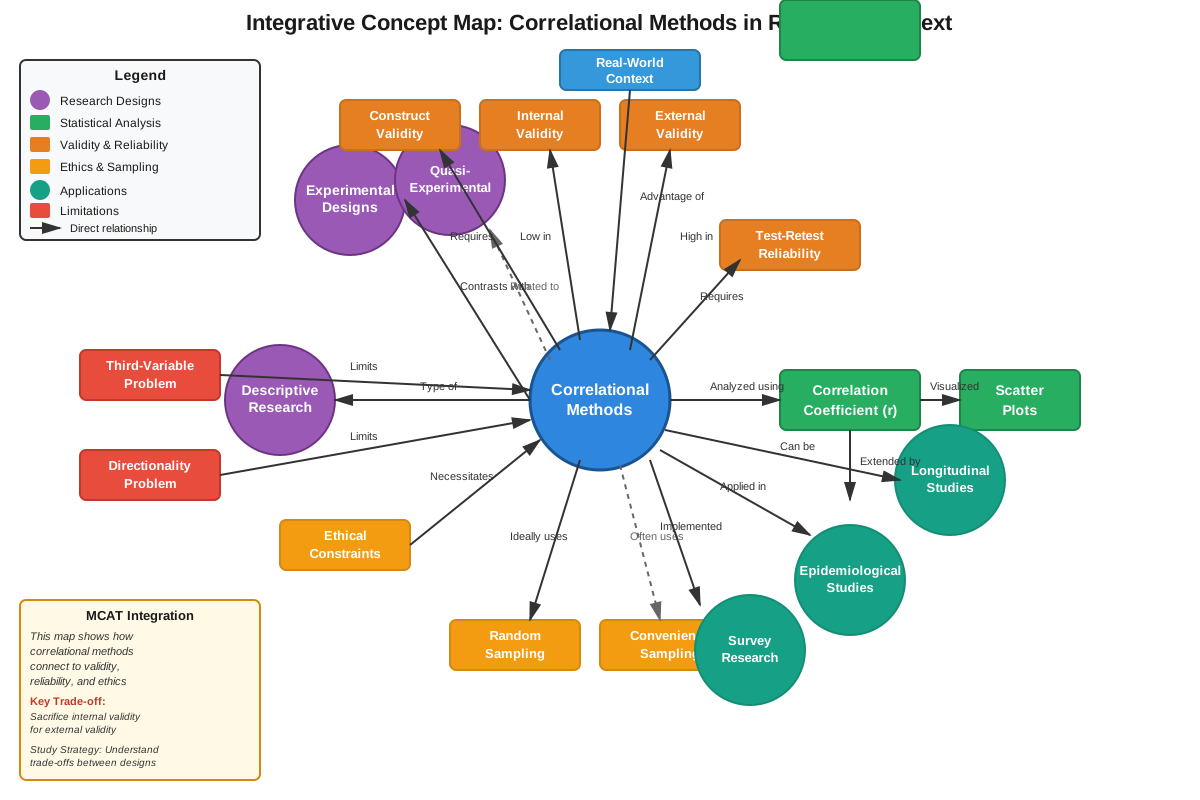
Correlational methods represent a fundamental approach in Sociology research that examines the relationships between two or more variables without manipulating them. Unlike experimental designs that establish causation through controlled manipulation, correlational research identifies patterns, associations, and predictive relationships in naturally occurring phenomena. This non-experimental approach is essential for studying variables that cannot be ethically or practically manipulated, such as socioeconomic status, race, gender, or pre-existing health conditions. For the MCAT, understanding correlational methods is critical because these designs appear frequently in passage-based questions within the Psychological, Social, and Biological Foundations of Behavior section, where students must interpret research findings, identify methodological limitations, and distinguish between correlation and causation.
The importance of correlational methods for the MCAT extends beyond simple recognition of research designs. Test-takers must demonstrate the ability to analyze correlation coefficients, understand directionality and strength of relationships, recognize the third-variable problem, and evaluate the appropriateness of conclusions drawn from correlational data. These methods form the foundation for epidemiological studies, survey research, naturalistic observations, and archival research—all of which appear regularly in MCAT passages. Students who master correlational methods gain a critical advantage in interpreting data presentations, graphs, and research conclusions that appear throughout the exam.
Within the broader context of Research Methods and Statistics, correlational methods occupy a central position alongside experimental designs, descriptive statistics, and inferential statistics. They bridge observational research and experimental manipulation, providing researchers with tools to generate hypotheses, identify potential causal relationships for future experimental investigation, and study phenomena in real-world contexts. Understanding correlational methods also connects directly to concepts such as validity, reliability, sampling techniques, and ethical considerations in research—all high-yield topics for MCAT success.
Learning Objectives
- [ ] Define correlational methods using accurate Sociology terminology
- [ ] Explain why correlational methods matters for the MCAT
- [ ] Apply correlational methods to exam-style questions
- [ ] Identify common mistakes related to correlational methods
- [ ] Connect correlational methods to related Sociology concepts
- [ ] Distinguish between positive, negative, and zero correlations with appropriate interpretation of correlation coefficients
- [ ] Analyze the limitations of correlational research, including the inability to establish causation and the third-variable problem
- [ ] Evaluate the appropriateness of correlational methods for specific research questions and contexts
Prerequisites
- Basic statistical concepts: Understanding measures of central tendency (mean, median, mode) and variability provides the foundation for interpreting correlation coefficients and scatter plots
- Variables and operational definitions: Knowledge of independent and dependent variables, though less relevant in correlational research, helps distinguish correlational from experimental designs
- Research ethics: Familiarity with ethical principles in research explains why correlational methods are sometimes the only appropriate approach for studying certain phenomena
- Basic graph interpretation: Ability to read and interpret scatter plots is essential for visualizing correlational relationships
Why This Topic Matters
Correlational methods appear with remarkable frequency on the MCAT, particularly in the Psychological, Social, and Biological Foundations of Behavior section. Approximately 15-20% of research-based passages in this section present correlational data, requiring students to interpret findings, evaluate methodological soundness, and identify appropriate conclusions. The MCAT specifically tests whether students can recognize the critical limitation that "correlation does not imply causation"—a concept that appears in various forms across multiple passages each exam administration.
In real-world applications, correlational methods drive much of public health research, epidemiological studies, and social science investigation. Understanding these methods enables interpretation of studies linking socioeconomic status to health outcomes, examining relationships between stress and immune function, or exploring associations between social support and mental health. Medical professionals regularly encounter correlational research in journal articles, clinical guidelines, and evidence-based practice recommendations, making this knowledge essential for informed clinical decision-making.
On the MCAT, correlational methods typically appear in passages describing observational studies, survey research, or secondary data analysis. Questions may ask students to identify the research design, interpret correlation coefficients, recognize confounding variables, evaluate the validity of causal claims, or suggest alternative explanations for observed relationships. The exam frequently presents graphs showing scatter plots with trend lines, requiring students to determine the direction and approximate strength of correlations. Additionally, questions often test whether students can identify when researchers inappropriately claim causation from correlational data—a critical thinking skill emphasized throughout the exam.
Core Concepts
Definition and Fundamental Characteristics
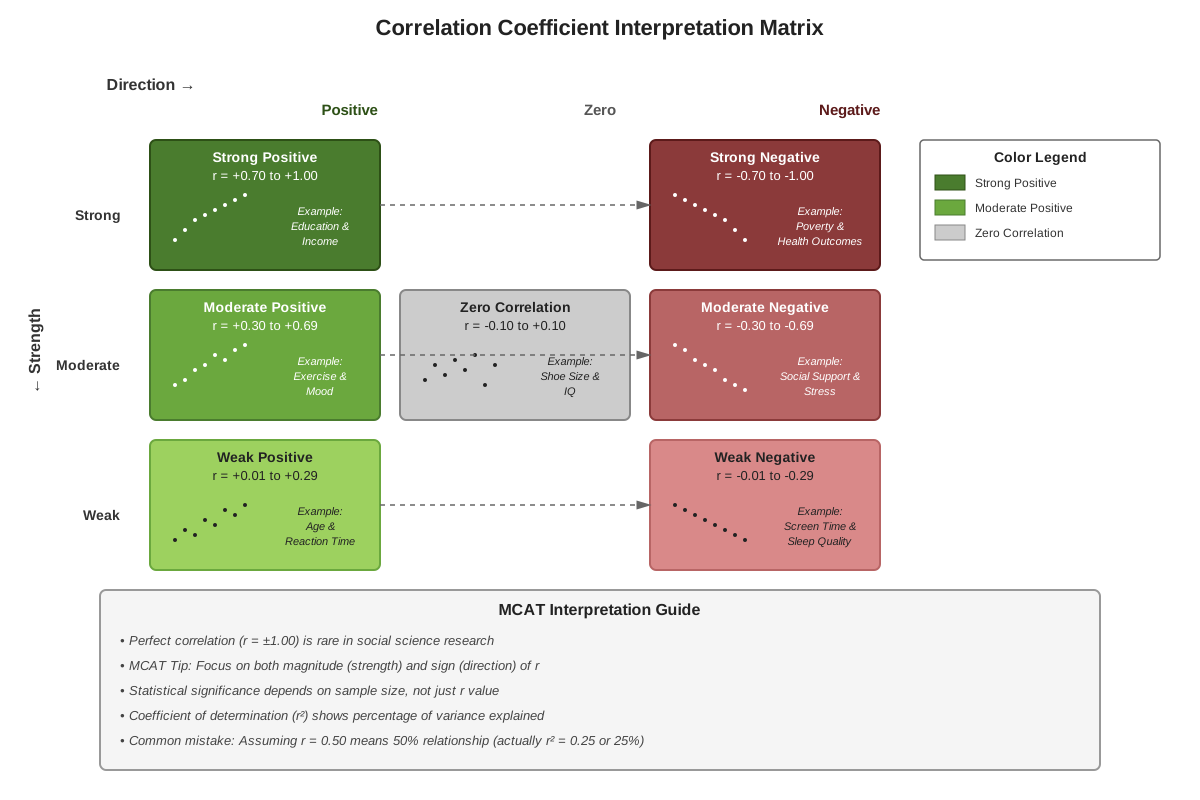
Correlational methods are non-experimental research approaches that measure the statistical relationship between two or more variables as they naturally occur, without manipulation or random assignment. These methods quantify the degree to which variables change together, producing a correlation coefficient that indicates both the direction and strength of the relationship. The correlation coefficient, typically represented by the symbol r, ranges from -1.00 to +1.00, with values closer to the extremes indicating stronger relationships and values near zero indicating weak or no relationship.
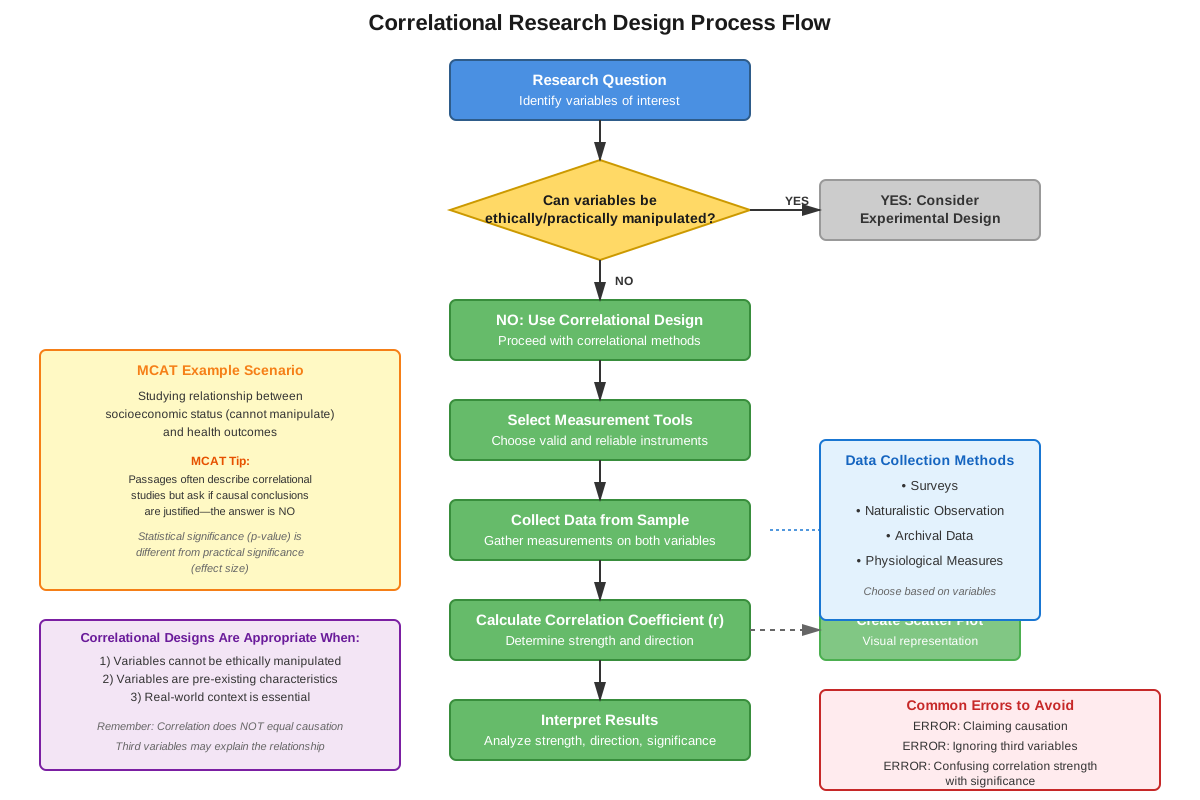
The fundamental characteristic distinguishing correlational methods from experimental designs is the absence of manipulation. Researchers observe, measure, and analyze variables in their natural state without intervening to change conditions or randomly assigning participants to groups. This approach offers significant advantages for studying variables that cannot be ethically or practically manipulated, such as examining the relationship between childhood trauma and adult mental health, or investigating associations between genetic markers and disease susceptibility.
Types of Correlational Relationships
Correlational relationships manifest in three primary forms, each with distinct interpretations:
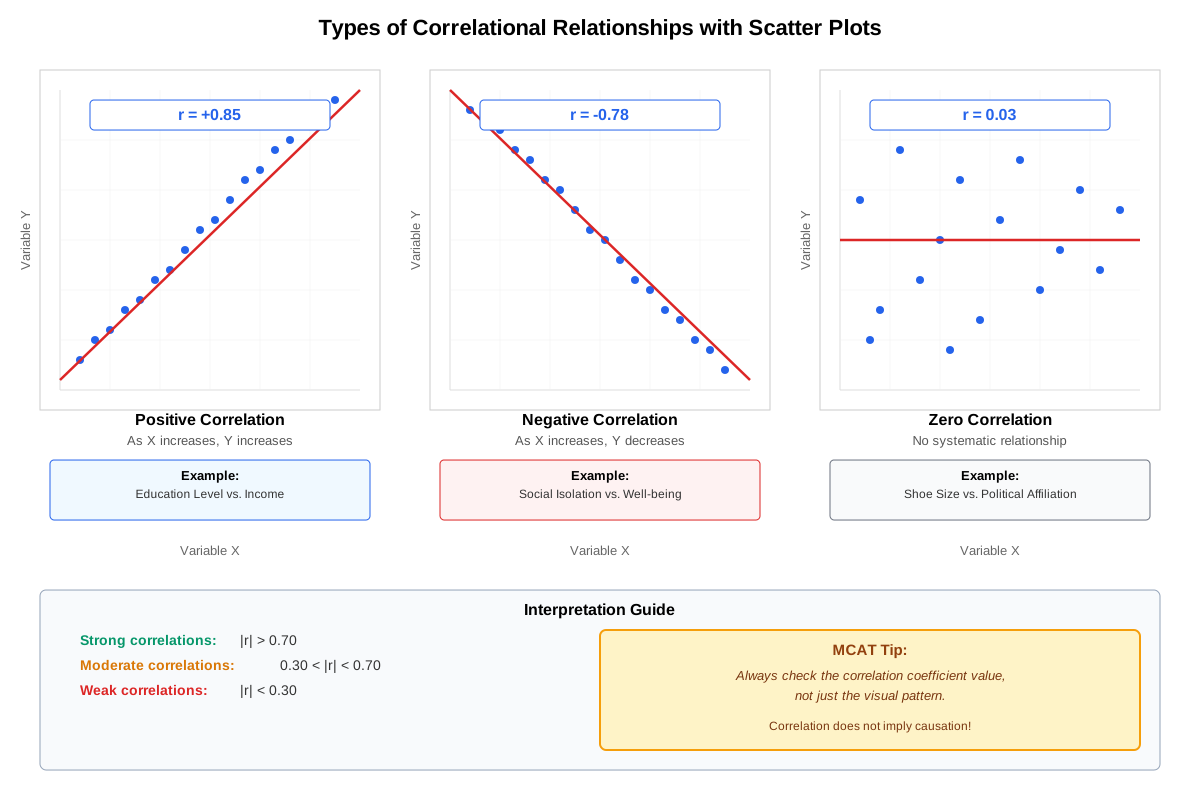
Positive correlations occur when both variables increase together or decrease together. As one variable increases in value, the other variable also tends to increase. For example, research consistently demonstrates a positive correlation between hours of study and exam performance—students who study more hours generally achieve higher scores. The correlation coefficient for positive relationships ranges from 0.01 to +1.00, with +1.00 representing a perfect positive correlation where every increase in one variable corresponds to a proportional increase in the other.
Negative correlations (also called inverse correlations) occur when variables move in opposite directions. As one variable increases, the other tends to decrease. For instance, research shows a negative correlation between stress levels and immune function—as stress increases, immune system effectiveness typically decreases. Negative correlation coefficients range from -0.01 to -1.00, with -1.00 representing a perfect negative correlation.
Zero correlations indicate no systematic relationship between variables. Changes in one variable show no predictable pattern with changes in the other variable. For example, shoe size and intelligence show a zero correlation in adult populations—knowing someone's shoe size provides no information about their cognitive abilities.
Interpreting Correlation Coefficients
Understanding the magnitude and meaning of correlation coefficients is essential for MCAT success. The following table provides standard interpretations:
| Correlation Coefficient (r) | Strength | Interpretation |
|---|---|---|
| ±0.90 to ±1.00 | Very strong | Variables are highly predictive of each other |
| ±0.70 to ±0.89 | Strong | Substantial relationship exists |
| ±0.40 to ±0.69 | Moderate | Meaningful but not dominant relationship |
| ±0.20 to ±0.39 | Weak | Small but detectable relationship |
| ±0.01 to ±0.19 | Very weak | Minimal relationship |
| 0.00 | None | No linear relationship |
The coefficient of determination (r²) represents the proportion of variance in one variable that can be explained by the other variable. For example, if the correlation between social support and depression is r = -0.60, then r² = 0.36, meaning 36% of the variance in depression scores can be explained by differences in social support levels.
Scatter Plots and Visual Representation
Scatter plots provide visual representations of correlational relationships, with each point representing one participant's scores on both variables. The pattern of points reveals the direction, strength, and form of the relationship. In positive correlations, points cluster around an upward-sloping line from lower-left to upper-right. In negative correlations, points cluster around a downward-sloping line from upper-left to lower-right. Stronger correlations show tighter clustering around the trend line, while weaker correlations show more scattered, dispersed points.
Outliers—data points that fall far from the general pattern—can substantially influence correlation coefficients, particularly in small samples. A single extreme outlier can artificially inflate or deflate the correlation coefficient, leading to misleading conclusions about the relationship between variables.
The Causation Problem
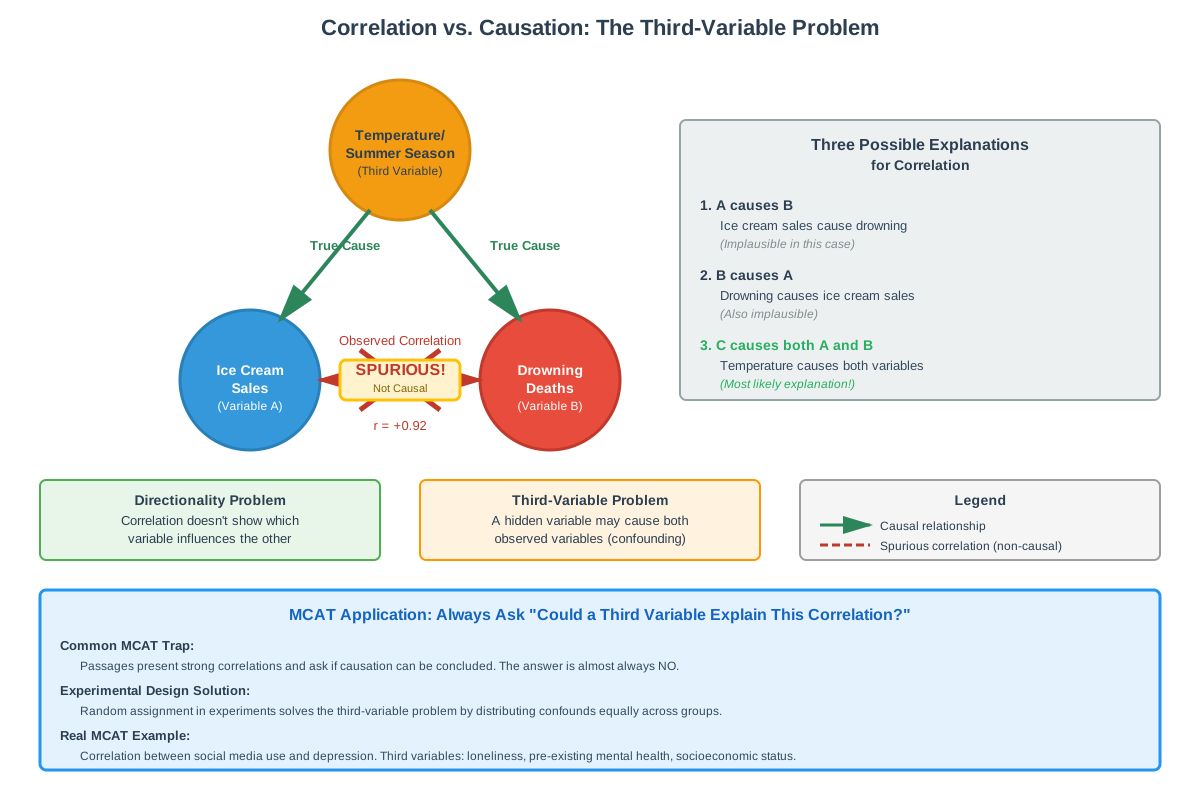
The most critical limitation of correlational methods is the inability to establish causation. The principle that "correlation does not imply causation" represents one of the most frequently tested concepts on the MCAT. Even when two variables show a strong correlation, three possible explanations exist:
- Variable A causes Variable B: The first variable directly influences the second
- Variable B causes Variable A: The second variable directly influences the first (reverse causation)
- Variable C causes both A and B: A third, unmeasured variable influences both observed variables (the third-variable problem or confounding variable problem)
For example, research shows a positive correlation between ice cream sales and drowning deaths. However, ice cream consumption does not cause drowning, nor does drowning cause ice cream purchases. Instead, a third variable—warm weather—increases both ice cream sales and swimming activity, which increases drowning risk.
The Third-Variable Problem
The third-variable problem (also called the confounding variable problem) occurs when an unmeasured variable influences both variables in a correlational study, creating a spurious (false) relationship. This represents a fundamental threat to the validity of correlational research. For instance, studies show a positive correlation between coffee consumption and heart disease. However, this relationship may be confounded by smoking behavior—coffee drinkers are more likely to smoke, and smoking causes heart disease. When researchers control for smoking statistically, the correlation between coffee and heart disease often disappears or reverses.
Directionality Problem
The directionality problem (also called the bidirectionality problem) refers to the ambiguity about which variable influences the other in a correlational relationship. For example, research demonstrates a correlation between depression and social isolation. Does depression cause people to withdraw socially, or does social isolation trigger depression? Both directions are plausible, and correlational methods cannot determine which is correct. Only experimental manipulation with random assignment can establish causal direction.
Types of Correlational Research Designs
Several specific research designs employ correlational methods:
Naturalistic observation involves observing and recording behavior in natural settings without intervention. Researchers might observe playground interactions to study correlations between aggressive behavior and peer rejection.
Survey research collects self-report data from large samples to examine relationships between variables such as attitudes, behaviors, and demographic characteristics. Surveys might explore correlations between political attitudes and socioeconomic status.
Archival research analyzes existing records, databases, or historical documents to identify correlational patterns. Researchers might examine medical records to study correlations between medication adherence and health outcomes.
Longitudinal correlational studies measure the same variables repeatedly over time, allowing examination of how relationships change and providing some evidence about temporal precedence (which variable changes first). While stronger than cross-sectional correlations, longitudinal correlations still cannot definitively establish causation.
Concept Relationships
Correlational methods connect intimately with other research methodologies within the broader framework of Research Methods and Statistics. The relationship flows as follows: Correlational methods → identify potential relationships → generate hypotheses → lead to experimental designs that can test causation. This progression represents the typical research cycle, where correlational findings suggest causal relationships that require experimental verification.
Within correlational methods themselves, the concepts form an interconnected system: Correlation coefficients → quantify relationships shown in scatter plots → but cannot establish causation due to → the third-variable problem and directionality problem → which necessitates → careful interpretation and appropriate conclusions. Understanding this conceptual chain prevents the most common error in interpreting correlational research—claiming causation from correlational data.
Correlational methods also connect to broader Sociology concepts including social stratification, health disparities, and social determinants of health. Much of the evidence linking socioeconomic status to health outcomes comes from correlational research, as researchers cannot randomly assign people to different social classes. Similarly, studies examining relationships between discrimination and mental health, social support and physical health, or education and longevity rely primarily on correlational methods.
The relationship between correlational methods and statistical concepts is fundamental: Measures of central tendency and variability → provide the foundation for calculating → correlation coefficients → which are interpreted using → probability and statistical significance → to determine whether observed relationships likely reflect true population relationships or merely sampling error.
Quick check — test yourself on Correlational methods so far.
Try Flashcards →High-Yield Facts
⭐ Correlation coefficients range from -1.00 to +1.00, with values closer to the extremes indicating stronger relationships and the sign indicating direction (positive or negative).
⭐ Correlation does not imply causation—this is the most frequently tested principle regarding correlational methods on the MCAT.
⭐ The third-variable problem occurs when an unmeasured confounding variable influences both variables in a correlational study, creating a spurious relationship.
⭐ The directionality problem means correlational research cannot determine which variable influences the other, even when a strong relationship exists.
⭐ Positive correlations indicate variables move in the same direction (both increase or both decrease together).
- Negative correlations indicate variables move in opposite directions (as one increases, the other decreases).
- The coefficient of determination (r²) represents the proportion of variance in one variable explained by the other variable.
- Outliers can substantially influence correlation coefficients, particularly in small samples.
- Scatter plots visually represent correlational relationships, with point clustering indicating relationship strength.
- Longitudinal correlational studies provide stronger evidence than cross-sectional studies but still cannot definitively establish causation.
- Correlational methods are appropriate when variables cannot be ethically or practically manipulated.
- Zero correlation (r ≈ 0.00) indicates no systematic linear relationship between variables.
- Restriction of range (limited variability in one or both variables) can artificially reduce correlation coefficients.
Common Misconceptions
Misconception: A strong correlation between two variables means one causes the other.
Correction: Correlation only indicates that variables are related or change together; causation requires experimental manipulation with random assignment. Even perfect correlations (r = ±1.00) do not establish causation. The relationship might be due to reverse causation or a third variable influencing both measured variables.
Misconception: Negative correlations indicate weak or unimportant relationships.
Correction: The sign of the correlation coefficient indicates direction only, not strength. A correlation of r = -0.85 is just as strong as r = +0.85; they simply indicate opposite directional relationships. Negative correlations can be highly significant and meaningful.
Misconception: A correlation of zero means the variables are completely unrelated.
Correction: A zero correlation indicates no linear relationship, but variables might have a strong nonlinear relationship. For example, the relationship between arousal and performance follows an inverted U-shape (Yerkes-Dodson law), which would show a near-zero linear correlation despite a strong curvilinear relationship.
Misconception: Correlational research is inferior to experimental research and should be avoided.
Correction: Correlational methods are essential and appropriate for many research questions, particularly when studying variables that cannot be ethically or practically manipulated. They provide valuable information about naturally occurring relationships, generate hypotheses for experimental testing, and allow research in real-world contexts with high external validity.
Misconception: If researchers control for confounding variables statistically, correlational research can establish causation.
Correction: Statistical control improves correlational research by accounting for known confounds, but it cannot establish causation because researchers can only control for variables they measure and recognize as potential confounds. Unknown or unmeasured confounding variables may still explain the relationship, and the directionality problem remains unresolved.
Misconception: Larger correlation coefficients always indicate more important relationships.
Correction: The practical significance of a correlation depends on context, not just magnitude. In some fields, correlations of r = 0.30 represent important findings with substantial real-world implications, while in other contexts, even correlations of r = 0.70 might have limited practical utility. Statistical significance, sample size, and theoretical importance all factor into evaluating correlation importance.
Worked Examples
Example 1: Interpreting Correlational Research
Scenario: Researchers conducted a study examining the relationship between social media use and self-esteem among college students. They surveyed 500 students, measuring daily social media use (in hours) and self-esteem scores (on a standardized scale). The correlation coefficient was r = -0.42, p < 0.01. The researchers concluded: "Social media use causes decreased self-esteem in college students."
Analysis:
Step 1: Identify the research design. This is a correlational study using survey methodology. Researchers measured two variables (social media use and self-esteem) as they naturally occur without manipulation or random assignment.
Step 2: Interpret the correlation coefficient. The value r = -0.42 indicates a moderate negative correlation. As social media use increases, self-esteem scores tend to decrease. The coefficient of determination (r² = 0.18) indicates that approximately 18% of the variance in self-esteem can be explained by differences in social media use.
Step 3: Evaluate statistical significance. The notation p < 0.01 indicates the correlation is statistically significant—the probability of obtaining this correlation by chance alone is less than 1%. This suggests a true relationship exists in the population.
Step 4: Evaluate the causal claim. The researchers' conclusion is inappropriate and incorrect. Correlational data cannot establish causation. Three alternative explanations exist:
- Social media use might cause decreased self-esteem (the researchers' claim)
- Low self-esteem might cause increased social media use (reverse causation)—students with lower self-esteem might seek validation through social media
- A third variable might cause both (third-variable problem)—depression could cause both increased social media use and decreased self-esteem
Step 5: Formulate appropriate conclusion. A correct conclusion would be: "Social media use and self-esteem show a moderate negative correlation. Students who use social media more hours per day tend to report lower self-esteem. However, this correlational design cannot determine whether social media use influences self-esteem, whether self-esteem influences social media use, or whether other factors influence both variables."
Connection to learning objectives: This example demonstrates how to apply correlational methods to exam-style questions, identify common mistakes (claiming causation), and use accurate Sociology terminology.
Example 2: Identifying the Third-Variable Problem
Scenario: A public health study found a strong positive correlation (r = 0.68) between coffee consumption and lung cancer rates across different countries. Some media outlets reported: "Coffee drinking increases lung cancer risk."
Analysis:
Step 1: Recognize the correlational design. This is archival correlational research examining aggregate data across countries. The strong positive correlation (r = 0.68) indicates that countries with higher coffee consumption tend to have higher lung cancer rates.
Step 2: Question the causal interpretation. The media's causal claim should trigger skepticism. What third variables might explain this relationship?
Step 3: Identify potential confounding variables. Smoking behavior represents a likely confound. Countries with high coffee consumption (particularly European countries) historically had high smoking rates. Smoking causes lung cancer and is often associated with coffee drinking (many smokers drink coffee while smoking).
Step 4: Consider how to test the third-variable explanation. Researchers could statistically control for smoking rates across countries. If the correlation between coffee and lung cancer disappears or substantially decreases when controlling for smoking, this suggests smoking is a confounding variable creating a spurious relationship.
Step 5: Evaluate what research design could establish causation. To determine whether coffee actually causes lung cancer, researchers would need experimental studies (which are unethical with humans for this question) or prospective longitudinal studies that carefully measure and control for smoking and other potential confounds. In fact, when researchers conduct such studies controlling for smoking, coffee consumption shows either no relationship or a slight protective effect against some cancers.
Connection to learning objectives: This example illustrates the third-variable problem, demonstrates why correlational methods matter for interpreting health research, and shows how to connect correlational methods to related concepts like confounding variables and research design selection.
Exam Strategy
When approaching MCAT questions about correlational methods, employ this systematic strategy:
Step 1: Identify the research design. Look for trigger words indicating correlational methods: "examined the relationship between," "measured the association," "survey research," "archival analysis," "observed correlation," or "no manipulation." The absence of random assignment and experimental manipulation signals correlational design.
Step 2: Evaluate any causal claims with extreme skepticism. If a passage or answer choice claims that one variable "causes," "produces," "leads to," or "results in" another based on correlational data, this is almost certainly incorrect. Flag these as potential wrong answers immediately.
Step 3: Consider alternative explanations. For any correlational finding, systematically consider: (a) reverse causation—could the proposed effect actually be the cause? (b) third variables—what unmeasured factors might influence both variables? Questions often ask you to identify potential confounding variables or alternative explanations.
Step 4: Interpret correlation coefficients carefully. Remember that the sign indicates direction (positive or negative), while the absolute value indicates strength. Don't confuse negative correlations with weak correlations. Values above ±0.40 generally indicate moderate to strong relationships.
Step 5: Analyze graphs and scatter plots. When presented with scatter plots, assess: (a) direction—upward slope (positive) or downward slope (negative), (b) strength—tight clustering (strong) or dispersed points (weak), (c) outliers—points far from the pattern that might distort the correlation.
Time allocation: Correlational methods questions typically require 60-90 seconds. Spend 30 seconds identifying the design and understanding the relationship, then 30-60 seconds evaluating answer choices. Don't overthink—if a causal claim appears in a correlational study, it's wrong.
Process of elimination tips: Eliminate answer choices that (a) claim causation from correlational data, (b) confuse correlation direction with strength, (c) ignore obvious confounding variables, or (d) suggest correlational designs can establish causation with sufficient sample size (they cannot, regardless of sample size).
Common question stems to recognize:
- "Which of the following best explains the limitation of this study?"—Look for answers about inability to establish causation
- "What alternative explanation could account for these findings?"—Consider third variables
- "Based on these results, which conclusion is most appropriate?"—Choose the answer that describes correlation without claiming causation
- "What confounding variable might explain this relationship?"—Identify factors that could influence both measured variables
Memory Techniques
Mnemonic for correlation limitations: "Can't Tell Direction"
- Causation cannot be established
- Third-variable problem
- Directionality problem
Mnemonic for correlation coefficient interpretation: "PNZS"
- Positive: both variables increase together
- Negative: variables move in opposite directions
- Zero: no systematic relationship
- Strength: determined by absolute value (closer to 1 = stronger)
Visualization strategy for correlation direction: Picture two people walking. In positive correlations, they walk in the same direction (both forward or both backward). In negative correlations, they walk in opposite directions (one forward, one backward). In zero correlation, their movements are unrelated—one person's direction tells you nothing about the other's.
Acronym for evaluating correlational claims: "TRACE"
- Third variables—consider confounds
- Reverse causation—could the effect be the cause?
- Alternative explanations—what else could explain this?
- Causation—can this design establish it? (No!)
- Experimental design—what would be needed to test causation?
Memory aid for coefficient of determination: "r-squared tells you the percentage of variance shared"—if r = 0.60, then r² = 0.36, meaning 36% shared variance. Square the correlation, move the decimal two places right, and you have the percentage.
Summary
Correlational methods represent essential non-experimental research approaches that measure relationships between variables as they naturally occur, without manipulation or random assignment. These methods produce correlation coefficients ranging from -1.00 to +1.00, indicating both the direction (positive, negative, or zero) and strength of relationships. While correlational research provides valuable information about how variables relate and generates hypotheses for experimental testing, it cannot establish causation due to the third-variable problem and directionality problem. For MCAT success, students must recognize correlational designs, interpret correlation coefficients and scatter plots accurately, understand that correlation does not imply causation, identify potential confounding variables, and evaluate the appropriateness of conclusions drawn from correlational data. These methods appear frequently in MCAT passages examining health disparities, social determinants of health, and psychological research, making mastery essential for achieving competitive scores.
Key Takeaways
- Correlational methods measure relationships between variables without manipulation, producing correlation coefficients (r) ranging from -1.00 to +1.00
- Correlation does not imply causation—the most critical principle for MCAT success; even strong correlations cannot establish that one variable causes another
- The third-variable problem occurs when unmeasured confounding variables influence both measured variables, creating spurious relationships
- The directionality problem means correlational research cannot determine which variable influences the other, even when strong relationships exist
- Positive correlations indicate variables move together in the same direction; negative correlations indicate variables move in opposite directions; correlation strength is determined by absolute value, not sign
- Scatter plots visually represent correlational relationships, with point clustering indicating strength and slope indicating direction
- Correlational methods are appropriate and valuable when variables cannot be ethically or practically manipulated, providing essential information for generating hypotheses and studying real-world phenomena
Related Topics
Experimental Research Designs: Understanding experimental methods with random assignment and manipulation provides essential contrast to correlational methods, highlighting how causation can be established through controlled studies. Mastering correlational methods creates the foundation for appreciating when and why experimental designs are necessary.
Confounding Variables and Internal Validity: Deeper exploration of threats to internal validity, including confounding variables, selection bias, and temporal ambiguity, builds directly on understanding the third-variable problem in correlational research.
Statistical Significance and Hypothesis Testing: Advanced statistical concepts including p-values, confidence intervals, and Type I/Type II errors extend the interpretation of correlation coefficients beyond simple magnitude and direction.
Longitudinal Research Designs: Studying longitudinal methods that measure variables repeatedly over time provides insight into how correlational research can be strengthened to provide better (though still not definitive) evidence about causal relationships.
Regression Analysis: Multiple regression and other advanced correlational techniques allow researchers to statistically control for confounding variables and examine complex relationships among multiple variables simultaneously.
Practice CTA
Now that you've mastered the fundamentals of correlational methods, challenge yourself with practice questions and flashcards to solidify your understanding. Focus particularly on distinguishing appropriate from inappropriate causal claims, identifying confounding variables, and interpreting correlation coefficients in context. The ability to quickly recognize correlational designs and their limitations will serve you throughout the MCAT, particularly in the Psychological, Social, and Biological Foundations of Behavior section. Remember: consistent practice with exam-style questions transforms conceptual knowledge into test-day performance. You've built a strong foundation—now apply it!
Sign up free to keep reading
Create a free AnvayaPrep account to finish this MCAT guide on Correlational methods — plus flashcards and practice questions.