Overview
A hypothesis is a testable, falsifiable statement that predicts the relationship between two or more variables in a research study. In Sociology, hypotheses serve as the foundation for empirical research, guiding the design of studies and the collection of data to understand social phenomena. Within the context of Research Methods and Statistics, hypotheses bridge theoretical frameworks and empirical observation, allowing researchers to systematically investigate social patterns, behaviors, and structures.
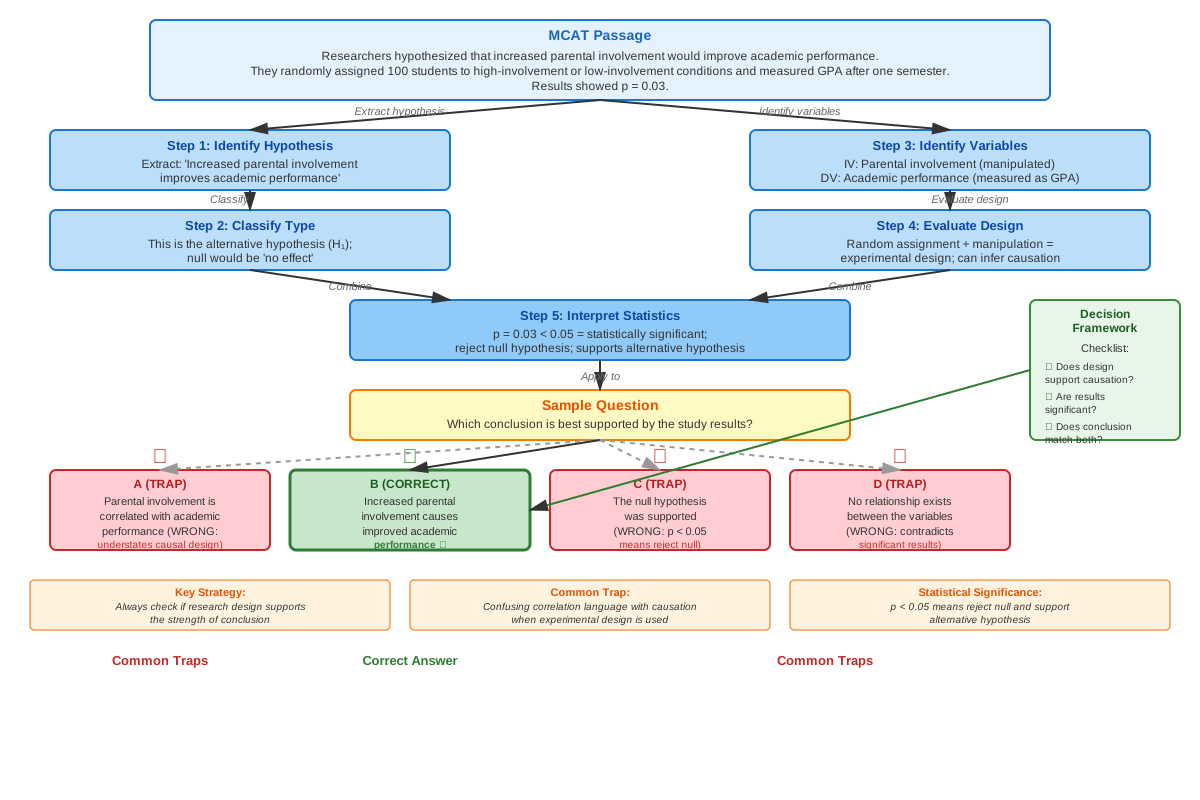
For the MCAT, understanding hypotheses is essential because the exam frequently presents research scenarios in the Psychological, Social, and Biological Foundations of Behavior section. Test-takers must be able to identify different types of hypotheses, evaluate whether research designs appropriately test stated hypotheses, and recognize when conclusions are supported or contradicted by data. Questions may present experimental passages where students must distinguish between null and alternative hypotheses, identify independent and dependent variables, or critique methodological flaws that compromise hypothesis testing.
The concept of hypothesis connects intimately with other sociology and research methodology topics including research design, variables, operationalization, statistical testing, and theory construction. A well-formulated hypothesis emerges from theoretical frameworks and literature review, guides the selection of appropriate research methods (experimental, correlational, observational), and determines which statistical tests researchers will employ to analyze data. Understanding hypotheses also requires knowledge of causation versus correlation, confounding variables, and the logic of scientific inference—all high-yield topics for MCAT success.
Learning Objectives
- [ ] Define Hypothesis using accurate Sociology terminology
- [ ] Explain why Hypothesis matters for the MCAT
- [ ] Apply Hypothesis to exam-style questions
- [ ] Identify common mistakes related to Hypothesis
- [ ] Connect Hypothesis to related Sociology concepts
- [ ] Distinguish between null hypotheses and alternative hypotheses in research contexts
- [ ] Evaluate whether a given hypothesis is appropriately testable and falsifiable
- [ ] Analyze research passages to identify stated and implied hypotheses
- [ ] Determine whether research conclusions are logically supported by hypothesis testing
Prerequisites
- Variables (independent, dependent, confounding): Understanding variable types is essential because hypotheses explicitly state predicted relationships between these variables
- Basic research design principles: Knowledge of experimental versus observational studies helps contextualize how different hypothesis types guide research approaches
- Causation versus correlation: This distinction is fundamental to formulating and interpreting hypotheses correctly
- Scientific method: Hypotheses represent a specific stage in the scientific method, following observation and preceding experimentation
- Basic statistical concepts: Understanding significance testing and p-values is necessary to comprehend how hypotheses are evaluated
Why This Topic Matters
In real-world research and clinical practice, hypotheses drive the advancement of medical and social scientific knowledge. Every clinical trial, epidemiological study, and social intervention program begins with a hypothesis about expected outcomes. For example, a public health researcher might hypothesize that increased access to mental health services reduces suicide rates in underserved communities, then design a study to test this prediction. The ability to formulate clear, testable hypotheses distinguishes rigorous scientific inquiry from speculation.
On the MCAT, hypothesis-related content appears with moderate to high frequency, particularly in passages describing research studies in the Psychological, Social, and Biological Foundations of Behavior section. Approximately 15-20% of questions in this section involve evaluating research methodology, and hypothesis identification and evaluation constitute a significant portion of these questions. The exam tests whether students can identify the hypothesis being tested, recognize when data support or refute a hypothesis, and spot methodological problems that compromise hypothesis testing.
Common MCAT question formats include: (1) asking students to identify the researcher's hypothesis from a passage describing a study; (2) presenting data and asking which hypothesis is best supported; (3) describing a flawed study and asking how the design fails to adequately test the stated hypothesis; (4) requiring students to distinguish between null and alternative hypotheses; and (5) asking what additional data would be needed to support or refute a hypothesis. Passages often embed hypothesis information within complex experimental descriptions, requiring careful reading and analytical thinking.
Core Concepts
Definition and Characteristics of a Hypothesis
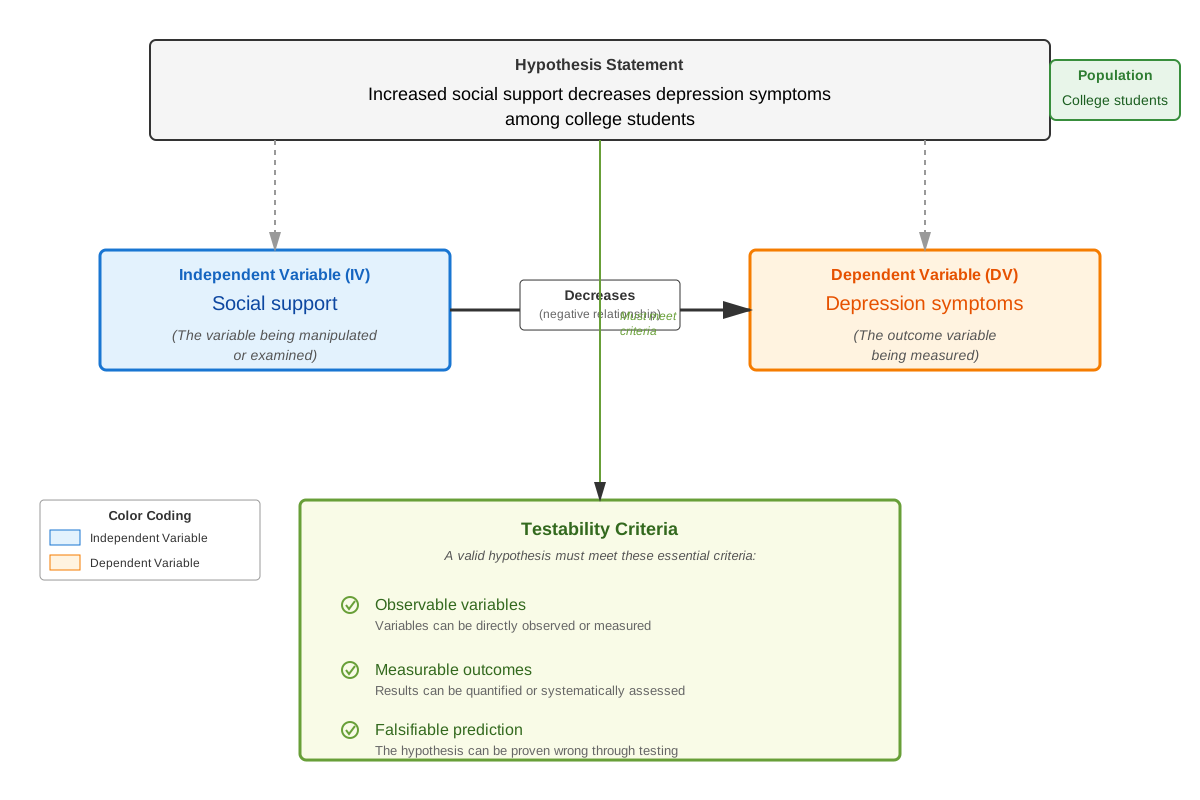
A hypothesis is a specific, testable prediction about the expected relationship between variables. In formal research methodology, a hypothesis must possess several critical characteristics. First, it must be falsifiable, meaning it is possible to collect data that would prove the hypothesis wrong. This falsifiability criterion, articulated by philosopher Karl Popper, distinguishes scientific hypotheses from unfalsifiable claims. Second, a hypothesis must be testable through empirical observation or experimentation. Third, it should be specific enough to guide research design and data collection. Fourth, it typically derives from existing theory or prior observations, providing a logical foundation for the prediction.
A properly constructed hypothesis includes clearly defined variables and specifies the predicted direction or nature of the relationship. For example: "Increased social support decreases the likelihood of depression among college students" identifies social support as the independent variable, depression likelihood as the dependent variable, and predicts an inverse relationship. This specificity allows researchers to operationalize variables, select appropriate measurement tools, and design studies that can definitively test the prediction.
Null Hypothesis versus Alternative Hypothesis
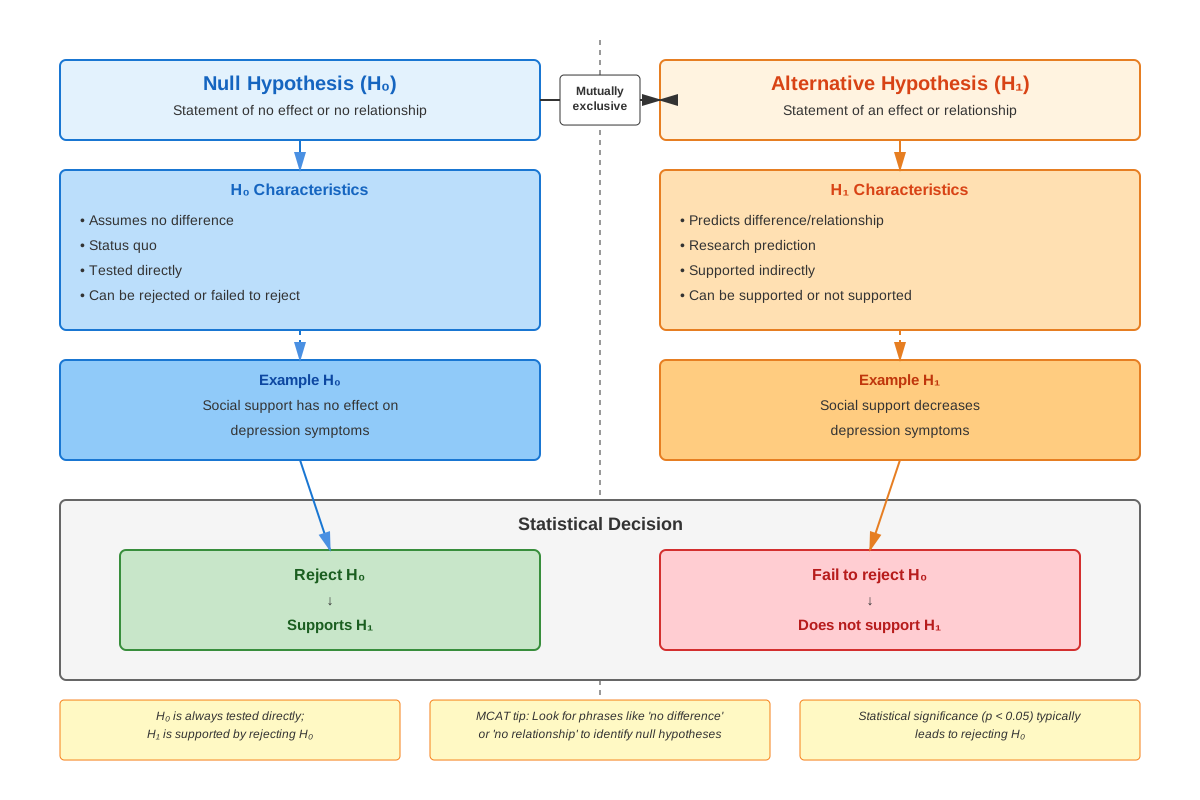
In statistical hypothesis testing, researchers work with two complementary hypotheses. The null hypothesis (H₀) states that there is no relationship between variables or no difference between groups. It represents the default position that any observed effects are due to chance rather than a true relationship. For example: "There is no difference in academic performance between students who receive tutoring and those who do not."
The alternative hypothesis (H₁ or Hₐ) states that there is a relationship between variables or a difference between groups. This is typically what the researcher actually expects to find. For example: "Students who receive tutoring demonstrate higher academic performance than those who do not." The alternative hypothesis can be directional (one-tailed), predicting the specific direction of the effect, or non-directional (two-tailed), simply predicting that a difference exists without specifying direction.
Statistical testing aims to determine whether there is sufficient evidence to reject the null hypothesis in favor of the alternative hypothesis. Researchers never "prove" a hypothesis; they either reject the null hypothesis (suggesting the alternative is supported) or fail to reject it (meaning insufficient evidence exists to support the alternative). This logical structure protects against confirmation bias and maintains scientific rigor.
Types of Hypotheses in Sociological Research
Descriptive hypotheses predict the characteristics of a single variable or population. Example: "More than 50% of college students experience significant stress during final exams." These hypotheses don't predict relationships but rather describe expected patterns.
Correlational hypotheses predict that two variables are related but don't specify causation. Example: "Higher levels of social media use are associated with increased feelings of loneliness." These hypotheses acknowledge that variables change together but don't claim one causes the other.
Causal hypotheses predict that changes in one variable directly cause changes in another. Example: "Exposure to violent media causes increased aggressive behavior in children." These hypotheses require experimental designs with manipulation of independent variables and control of confounding factors to test adequately.
Comparative hypotheses predict differences between groups or conditions. Example: "Women report higher levels of emotional empathy than men." These hypotheses often guide experimental designs comparing treatment and control groups.
Hypothesis Formulation Process
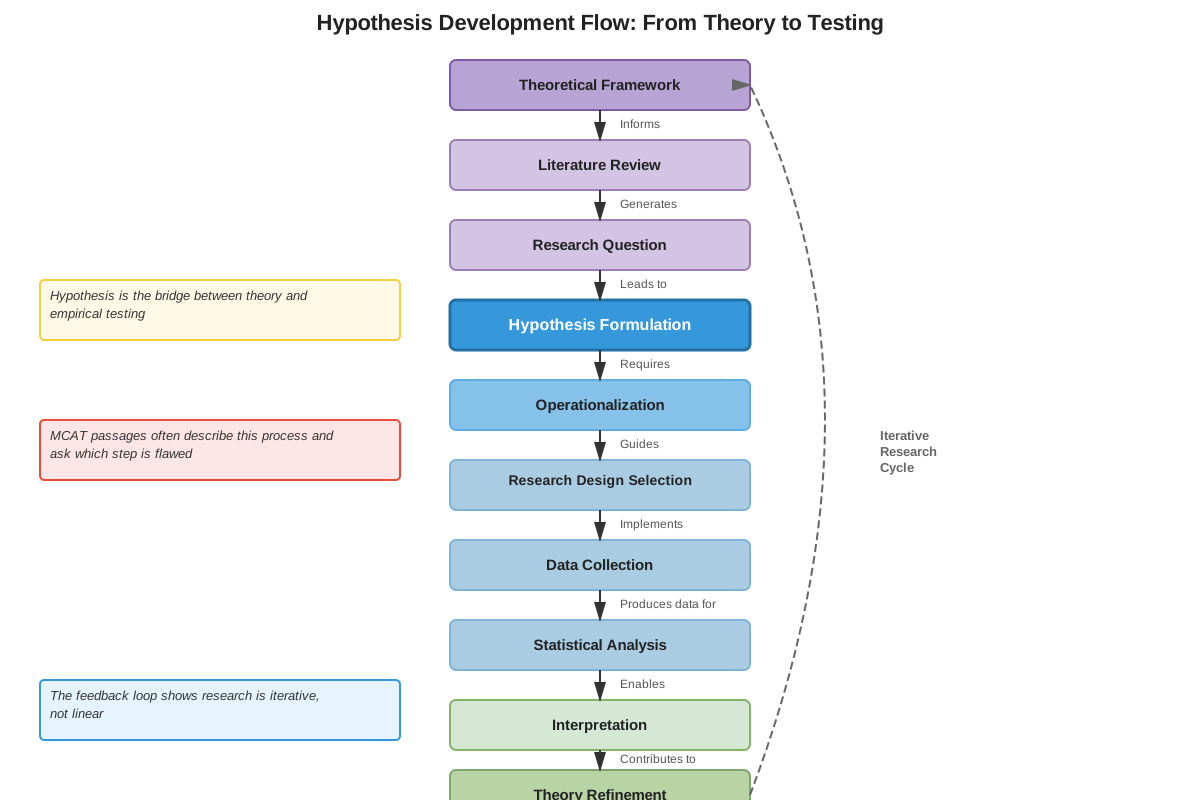
Hypothesis development follows a systematic process within the scientific method. First, researchers conduct literature review to understand existing knowledge and identify gaps. Second, they develop a theoretical framework that explains why variables might be related. Third, they operationalize variables, defining exactly how abstract concepts will be measured. Fourth, they formulate the specific hypothesis statement. Fifth, they design a study capable of testing the hypothesis. This process ensures hypotheses are grounded in existing knowledge rather than arbitrary speculation.
For MCAT purposes, understanding this process helps evaluate whether researchers in passage-based questions have followed appropriate scientific procedures. Questions may ask students to identify which step in hypothesis development was flawed or what additional information would strengthen a hypothesis.
Relationship Between Hypotheses and Variables
Every hypothesis involves at least one independent variable (the presumed cause or predictor) and one dependent variable (the presumed effect or outcome). In the hypothesis "Increased exercise frequency reduces symptoms of anxiety," exercise frequency is the independent variable and anxiety symptoms are the dependent variable. Proper hypothesis formulation requires clear identification of which variable is independent and which is dependent, as this determines research design.
Confounding variables pose threats to hypothesis testing by providing alternative explanations for observed relationships. For example, if a study finds that exercise reduces anxiety, but participants who exercise more also have higher incomes (which independently affects anxiety), income is a confounding variable. Strong hypothesis testing requires controlling for potential confounds through experimental design or statistical methods.
| Hypothesis Component | Definition | Example |
|---|---|---|
| Independent Variable | Variable manipulated or measured as predictor | Social support level |
| Dependent Variable | Variable measured as outcome | Depression severity |
| Predicted Relationship | Expected direction/nature of association | Inverse (more support → less depression) |
| Population | Group to which hypothesis applies | College students |
| Operational Definitions | Specific measurement methods | Beck Depression Inventory scores |
Concept Relationships
The concept of hypothesis sits at the center of a network of interconnected research methodology concepts. Theory → generates → Hypothesis → guides → Research Design → produces → Data → undergoes → Statistical Analysis → leads to → Conclusions → which either support or refute the original hypothesis and inform theory revision.
Hypotheses depend fundamentally on proper understanding of variables. The independent variable in a hypothesis determines what researchers will manipulate or measure as a predictor, while the dependent variable determines what outcomes they will assess. Confounding variables threaten the validity of hypothesis testing by providing alternative explanations for observed relationships, connecting hypotheses to concepts of internal validity and experimental control.
The distinction between null and alternative hypotheses connects directly to statistical inference and significance testing. When researchers calculate p-values and confidence intervals, they are determining the probability of observing their data if the null hypothesis were true. This connects hypothesis testing to concepts of Type I error (false positive—rejecting a true null hypothesis) and Type II error (false negative—failing to reject a false null hypothesis).
Different types of hypotheses (descriptive, correlational, causal) align with different research designs. Causal hypotheses require experimental designs with random assignment and manipulation of independent variables. Correlational hypotheses can be tested with observational or correlational designs. This relationship means that evaluating whether a research design appropriately tests a hypothesis is a common MCAT question type.
Operationalization bridges the gap between abstract theoretical concepts and testable hypotheses. A hypothesis stating "social isolation increases depression" requires operational definitions of both social isolation and depression before testing can occur. This connects hypothesis formulation to measurement validity and reliability.
Finally, hypotheses connect to broader concepts of scientific reasoning and the philosophy of science. The requirement that hypotheses be falsifiable relates to demarcation criteria distinguishing science from pseudoscience. The process of hypothesis testing exemplifies deductive reasoning, while hypothesis generation often involves inductive reasoning from observations.
Quick check — test yourself on Hypothesis so far.
Try Flashcards →High-Yield Facts
⭐ A hypothesis must be both testable and falsifiable to qualify as scientific—if no possible observation could disprove it, it's not a valid scientific hypothesis.
⭐ The null hypothesis (H₀) always states there is no relationship or no difference—researchers attempt to reject the null hypothesis, not prove it.
⭐ The alternative hypothesis (H₁) represents what the researcher actually expects to find—it states there is a relationship or difference between variables.
⭐ Causal hypotheses require experimental designs with manipulation and control—correlational studies cannot adequately test causal hypotheses.
⭐ A hypothesis must specify both independent and dependent variables clearly—ambiguous variable identification makes hypothesis testing impossible.
- Directional (one-tailed) hypotheses predict the specific direction of an effect, while non-directional (two-tailed) hypotheses simply predict that an effect exists.
- Rejecting the null hypothesis does not prove the alternative hypothesis is true—it only suggests the data are inconsistent with the null hypothesis.
- A well-formulated hypothesis emerges from theory and prior research rather than arbitrary speculation.
- Operational definitions transform abstract concepts in hypotheses into measurable variables.
- Confounding variables provide alternative explanations for observed relationships, threatening the validity of hypothesis testing.
- Statistical significance (p < 0.05) indicates low probability of observing the data if the null hypothesis were true, but doesn't measure effect size or practical importance.
- Hypotheses should be stated before data collection to avoid confirmation bias and data fishing.
Common Misconceptions
Misconception: A hypothesis is just an educated guess without formal requirements.
Correction: A scientific hypothesis must meet specific criteria including testability, falsifiability, and clear specification of variables and predicted relationships. Not all predictions qualify as scientific hypotheses.
Misconception: Researchers try to prove their hypothesis is correct.
Correction: Researchers attempt to reject the null hypothesis, not prove the alternative hypothesis. Scientific reasoning works through falsification—gathering evidence inconsistent with the null hypothesis—rather than absolute proof.
Misconception: Failing to reject the null hypothesis means the null hypothesis is true.
Correction: Failing to reject the null hypothesis simply means insufficient evidence exists to support the alternative hypothesis. The null hypothesis is never "proven" true; researchers merely lack evidence to reject it.
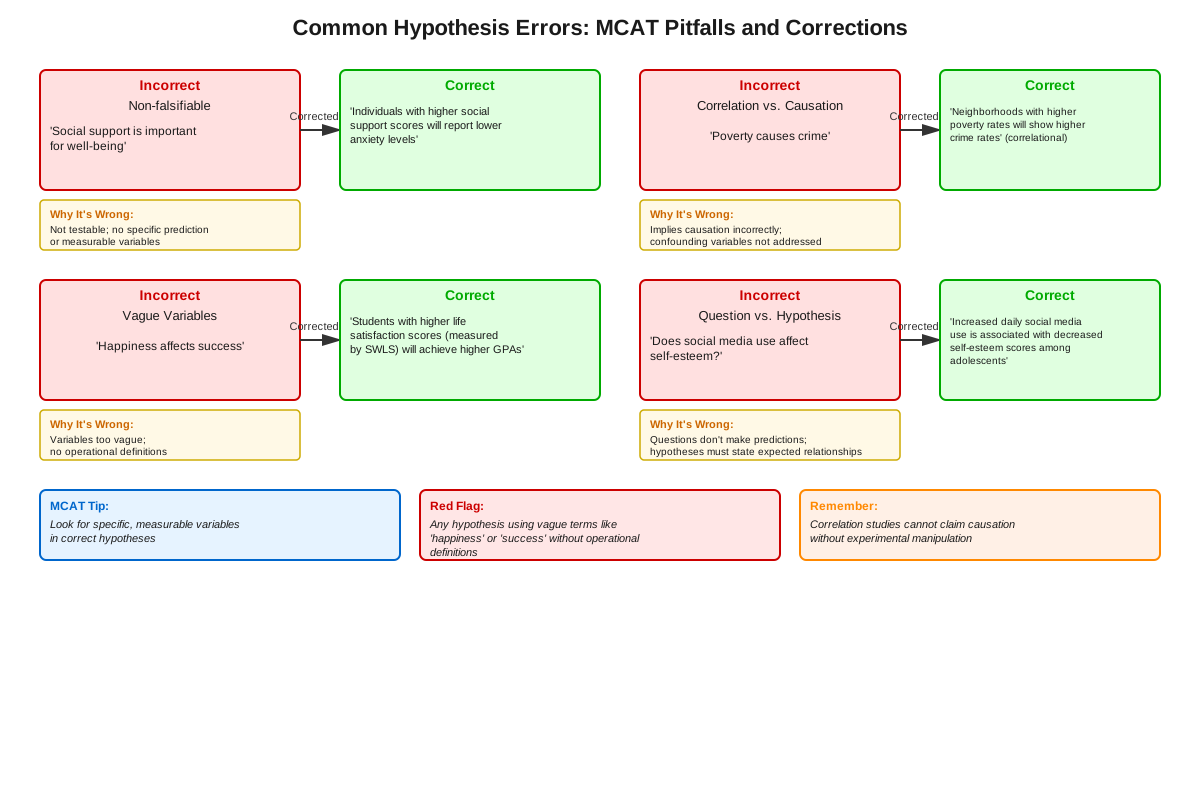
Misconception: Correlation hypotheses can establish causation if the correlation is strong enough.
Correction: No degree of correlation, regardless of strength, establishes causation. Causal claims require experimental manipulation, temporal precedence, and elimination of alternative explanations through controlled designs.
Misconception: A hypothesis and a theory are the same thing.
Correction: A theory is a broad, well-substantiated explanation for phenomena, while a hypothesis is a specific, testable prediction often derived from theory. Theories generate multiple hypotheses and are supported by extensive evidence from many studies.
Misconception: Statistical significance means a hypothesis is practically important or clinically meaningful.
Correction: Statistical significance only indicates that results are unlikely due to chance. A statistically significant finding may have a tiny effect size with minimal practical importance. Conversely, important effects may not reach statistical significance in underpowered studies.
Misconception: Hypotheses can be formulated after seeing the data.
Correction: Post-hoc hypotheses (formed after viewing results) are subject to confirmation bias and data fishing. Proper scientific method requires hypothesis formulation before data collection, though exploratory analyses can generate hypotheses for future testing.
Worked Examples
Example 1: Identifying and Evaluating Hypotheses in a Research Passage
Passage Summary: Researchers investigated whether mindfulness meditation reduces test anxiety among high school students. They recruited 100 students who reported high test anxiety and randomly assigned 50 to an 8-week mindfulness meditation program and 50 to a waitlist control group. Before and after the intervention period, all students completed the Test Anxiety Inventory (TAI), a validated measure of test anxiety. Results showed that students in the meditation group had significantly lower TAI scores after the intervention (M = 45, SD = 8) compared to the control group (M = 58, SD = 9), t(98) = 7.2, p < 0.001.
Question: What is the alternative hypothesis being tested in this study?
Step 1: Identify the independent variable. The independent variable is participation in mindfulness meditation (meditation group vs. control group).
Step 2: Identify the dependent variable. The dependent variable is test anxiety level, operationalized as TAI scores.
Step 3: Determine the predicted relationship. The researchers expect meditation to reduce anxiety, indicating a directional prediction.
Step 4: Formulate the alternative hypothesis. H₁: High school students who participate in mindfulness meditation will demonstrate lower test anxiety scores compared to students who do not participate in meditation.
Step 5: Identify the null hypothesis for comparison. H₀: There is no difference in test anxiety scores between students who participate in mindfulness meditation and those who do not.
Step 6: Evaluate whether the study design appropriately tests this hypothesis. Yes—the experimental design with random assignment, control group, validated measurement tool, and pre-post assessment appropriately tests a causal hypothesis about meditation's effect on anxiety.
Connection to Learning Objectives: This example demonstrates how to identify hypotheses in research passages, distinguish between null and alternative hypotheses, and evaluate whether research designs appropriately test stated hypotheses—all critical MCAT skills.
Example 2: Critiquing Hypothesis Testing
Scenario: A researcher hypothesizes that "social media use causes depression in teenagers." To test this, she surveys 200 teenagers, asking them to report their average daily social media use and complete a depression screening questionnaire. She finds a significant positive correlation (r = 0.45, p < 0.01) between social media use and depression scores.
Question: Does this study adequately test the stated hypothesis? If not, what are the problems?
Step 1: Identify the type of hypothesis. This is a causal hypothesis, claiming that social media use causes depression.
Step 2: Evaluate the research design. The study uses a correlational design (survey with self-reported measures) rather than an experimental design.
Step 3: Identify the critical flaw. Causal hypotheses require experimental manipulation of the independent variable, random assignment, and control of confounding variables. This correlational design cannot establish causation.
Step 4: Identify alternative explanations. The correlation could be explained by: (1) reverse causation—depressed teenagers might use social media more as a coping mechanism; (2) third variables—factors like loneliness, family problems, or academic stress might cause both increased social media use and depression.
Step 5: Determine what would be needed to properly test the causal hypothesis. An experimental design would require randomly assigning teenagers to different levels of social media use (high vs. low) and measuring depression outcomes while controlling confounding variables. However, ethical constraints make this difficult with potentially harmful interventions.
Step 6: Reformulate an appropriate hypothesis for this design. A more appropriate hypothesis would be: "Social media use is positively correlated with depression scores in teenagers," which is a correlational hypothesis matching the correlational design.
Connection to Learning Objectives: This example illustrates common mistakes in hypothesis testing, demonstrates how to evaluate whether research designs match hypothesis types, and shows how to identify confounding variables and alternative explanations—all high-yield MCAT skills.
Exam Strategy
When approaching MCAT questions about hypotheses, begin by carefully reading the research description to identify the independent and dependent variables. Often, passages embed this information within complex experimental descriptions, so active reading and annotation are essential. Underline or mentally note phrases like "the researchers predicted," "the study examined whether," or "the hypothesis was that," as these signal hypothesis statements.
Trigger words and phrases that indicate hypothesis-related content include: "predicted," "expected," "hypothesized," "proposed," "tested whether," "examined the relationship between," "investigated the effect of," and "sought to determine." When you see these phrases, immediately identify what relationship between which variables is being predicted.
For questions asking you to identify the null hypothesis, remember it always states "no relationship" or "no difference." Eliminate answer choices that predict any relationship or difference. Conversely, alternative hypotheses always predict some relationship or difference exists. Watch for directional language (increases, decreases, higher, lower) that indicates one-tailed hypotheses versus non-directional language (differs, is related to, affects) indicating two-tailed hypotheses.
When evaluating whether a study adequately tests a hypothesis, apply this checklist:
- Does the hypothesis type (causal, correlational, descriptive) match the research design?
- Are the variables properly operationalized with valid measures?
- Are confounding variables controlled?
- Is the sample appropriate for the population specified in the hypothesis?
- Does the statistical analysis match the hypothesis structure?
Process of elimination strategy: For questions about hypothesis identification, eliminate options that: (1) don't specify both independent and dependent variables; (2) make unfalsifiable claims; (3) describe results rather than predictions; (4) contradict the stated research purpose. For questions about hypothesis testing adequacy, eliminate options that: (1) confuse correlation with causation; (2) ignore obvious confounding variables; (3) claim proof rather than support; (4) misidentify which hypothesis (null vs. alternative) is being tested.
Time allocation: Hypothesis questions typically require 60-90 seconds. Spend 30-40 seconds carefully reading the relevant passage section, 20-30 seconds analyzing the hypothesis structure, and 10-20 seconds eliminating wrong answers and confirming your choice. Don't overthink—MCAT hypothesis questions test straightforward application of definitions and principles rather than obscure edge cases.
Memory Techniques
FIST Mnemonic for hypothesis requirements:
- Falsifiable: Must be possible to prove wrong
- Independent and dependent variables: Must specify both clearly
- Specific: Must make precise predictions
- Testable: Must be possible to collect relevant data
NULL = No Underlying Link or Level difference helps remember that null hypotheses always state no relationship or no difference.
Alternative = Actually Looking To Establish Relationship Naturally Achieves Testing In Verified Experiments (admittedly forced, but memorable!) reminds you that alternative hypotheses state what researchers actually expect to find.
Visualization strategy: Picture a hypothesis as a bridge connecting two islands (variables). The independent variable island has an arrow pointing toward the dependent variable island. The bridge's structure (strong vs. weak, one-way vs. two-way) represents the predicted relationship. The null hypothesis is the absence of a bridge—just water between islands.
Causal vs. Correlational distinction: Remember "Causal requires Control"—the alliteration helps recall that causal hypotheses require controlled experimental designs. Correlational hypotheses can use "Correlational Convenience"—they can be tested with more convenient observational designs.
Type I and Type II errors: "Type I is Innocent convicted" (rejecting a true null hypothesis—false positive). "Type II is Guilty freed" (failing to reject a false null hypothesis—false negative). This legal analogy helps distinguish the error types.
Summary
A hypothesis is a testable, falsifiable prediction about relationships between variables that guides scientific research. In sociology and research methodology, hypotheses bridge theory and empirical observation, providing specific predictions that can be systematically evaluated through data collection and statistical analysis. The MCAT tests understanding of hypothesis formulation, the distinction between null and alternative hypotheses, the relationship between hypothesis types and appropriate research designs, and the ability to evaluate whether studies adequately test their stated hypotheses. Key principles include that hypotheses must clearly specify independent and dependent variables, causal hypotheses require experimental designs while correlational hypotheses can use observational designs, null hypotheses always state no relationship or difference, and researchers attempt to reject null hypotheses rather than prove alternative hypotheses. Common question formats involve identifying hypotheses from research passages, evaluating methodological adequacy, distinguishing hypothesis types, and recognizing when conclusions are supported or contradicted by data. Mastery requires understanding not just definitions but the logical structure of hypothesis testing and its connection to broader research methodology concepts.
Key Takeaways
- A scientific hypothesis must be testable, falsifiable, and specify clear relationships between defined variables—vague predictions don't qualify as proper hypotheses
- The null hypothesis (H₀) always states no relationship or no difference; the alternative hypothesis (H₁) predicts a relationship or difference exists
- Causal hypotheses require experimental designs with manipulation and control; correlational designs cannot establish causation regardless of correlation strength
- Researchers never prove hypotheses—they either reject the null hypothesis (supporting the alternative) or fail to reject it (insufficient evidence)
- Hypothesis type must match research design: evaluate MCAT passages for this alignment to identify methodological flaws
- Confounding variables provide alternative explanations for observed relationships, threatening hypothesis testing validity
- Statistical significance indicates results unlikely due to chance but doesn't measure practical importance or prove causation
Related Topics
Research Design (Experimental vs. Observational): Understanding different research designs is essential for evaluating whether studies appropriately test their hypotheses. Experimental designs with random assignment test causal hypotheses, while observational designs test correlational hypotheses.
Statistical Inference and Significance Testing: Hypothesis testing relies on statistical methods to determine whether data support rejecting the null hypothesis. Understanding p-values, confidence intervals, and statistical power deepens comprehension of hypothesis evaluation.
Variables and Operationalization: Every hypothesis involves variables that must be operationalized (defined in measurable terms). Mastering variable types and measurement validity strengthens hypothesis formulation and evaluation skills.
Internal and External Validity: These concepts relate directly to hypothesis testing quality. Internal validity concerns whether a study truly tests what it claims to test, while external validity concerns generalizability—both critical for evaluating hypothesis testing adequacy.
Theory Construction in Sociology: Hypotheses derive from broader theoretical frameworks. Understanding major sociological theories (functionalism, conflict theory, symbolic interactionism) provides context for hypothesis generation and interpretation.
Practice CTA
Now that you've mastered the fundamentals of hypotheses in sociological research, it's time to solidify your understanding through active practice. Attempt the practice questions and flashcards associated with this topic, focusing on identifying hypotheses in research passages, distinguishing null from alternative hypotheses, and evaluating whether research designs appropriately test stated hypotheses. These skills are directly tested on the MCAT and improve with deliberate practice. Remember: understanding hypothesis testing is not just about memorizing definitions—it's about developing the analytical skills to critically evaluate research, a competency that will serve you throughout medical school and clinical practice. You've built a strong foundation; now apply it!
Sign up free to keep reading
Create a free AnvayaPrep account to finish this MCAT guide on Hypothesis — plus flashcards and practice questions.