Overview
Ethnography is a qualitative research method rooted in anthropology and sociology that involves the systematic study of people and cultures through direct observation and immersive participation in their natural environments. As a cornerstone of Sociology research methodology, ethnography allows researchers to gain deep, contextualized understanding of social phenomena by embedding themselves within the communities they study. Unlike quantitative methods that prioritize numerical data and statistical analysis, ethnography emphasizes rich, descriptive accounts of social life, cultural practices, and the meanings people attach to their experiences.
For the MCAT, understanding Ethnography MCAT concepts is essential because the exam frequently tests students' ability to distinguish between various Research Methods and Statistics approaches and to identify the most appropriate methodology for specific research questions. The Psychological, Social, and Biological Foundations of Behavior section regularly presents passages describing research studies where students must evaluate methodological choices, identify limitations, and interpret findings within their proper methodological context. Ethnography represents a fundamentally different epistemological approach compared to experimental or survey-based research, making it a high-yield topic for comparison questions.
Within the broader landscape of Sociology research methods, ethnography occupies a unique position as the primary tool for understanding culture, social interaction, and meaning-making processes in their natural contexts. It connects directly to symbolic interactionism, social constructionism, and interpretive sociology—theoretical frameworks that emphasize how individuals create and negotiate meaning through social interaction. Mastering ethnography enables students to understand not just a research technique, but an entire paradigm for understanding social reality that contrasts with positivist approaches dominant in natural sciences.
Learning Objectives
- [ ] Define Ethnography using accurate Sociology terminology
- [ ] Explain why Ethnography matters for the MCAT
- [ ] Apply Ethnography to exam-style questions
- [ ] Identify common mistakes related to Ethnography
- [ ] Connect Ethnography to related Sociology concepts
- [ ] Compare and contrast ethnography with other qualitative and quantitative research methods
- [ ] Analyze the strengths and limitations of ethnographic research in various contexts
- [ ] Evaluate the appropriateness of ethnographic methods for specific research questions
Prerequisites
- Basic understanding of qualitative vs. quantitative research: Ethnography is a qualitative method, and distinguishing these paradigms is fundamental to understanding its unique characteristics
- Familiarity with research design terminology: Terms like validity, reliability, generalizability, and bias provide the framework for evaluating ethnographic studies
- Introduction to sociological perspectives: Symbolic interactionism and social constructionism provide theoretical foundations that justify ethnographic approaches
- Basic understanding of research ethics: Ethnography raises unique ethical considerations regarding informed consent, privacy, and researcher-participant relationships
Why This Topic Matters
Ethnography holds significant real-world importance across multiple domains relevant to medical practice and healthcare research. Medical anthropologists and health sociologists routinely employ ethnographic methods to understand patient experiences, healthcare disparities, illness narratives, and the cultural dimensions of health behaviors. For example, ethnographic research has illuminated how different cultural communities understand mental illness, why certain populations underutilize preventive care, and how hospital cultures affect patient outcomes. Physicians who understand ethnographic insights are better equipped to provide culturally competent care and recognize how social contexts shape health outcomes.
On the MCAT, ethnography appears with moderate frequency, typically in 2-4 questions per exam administration. Questions most commonly appear in two formats: (1) passage-based questions where students must identify the research method described or evaluate its appropriateness for the stated research aims, and (2) discrete questions testing knowledge of methodological characteristics, strengths, and limitations. The exam particularly favors questions that require students to distinguish ethnography from other qualitative methods (case studies, interviews, focus groups) or to identify situations where ethnographic approaches would be superior to quantitative methods.
Common exam scenarios include passages describing health disparities research, studies of medical culture or healthcare institutions, investigations of illness experiences in specific communities, or research on health behaviors in cultural context. Students must recognize ethnographic hallmarks—prolonged fieldwork, participant observation, cultural immersion—and understand both the rich insights ethnography provides and its limitations regarding generalizability and researcher bias.
Core Concepts
Definition and Fundamental Characteristics
Ethnography is a qualitative research methodology that involves the in-depth, systematic study of people and cultures in their natural settings through prolonged engagement, participant observation, and immersive fieldwork. The term derives from Greek roots: "ethnos" (people/culture) and "grapho" (writing), literally meaning "writing about people." Ethnographers seek to understand social phenomena from the emic perspective—the insider's viewpoint—rather than imposing external frameworks or predetermined categories.
The defining features of ethnographic research include:
- Naturalistic setting: Research occurs in real-world environments where social phenomena naturally unfold, not in controlled laboratory conditions
- Prolonged engagement: Ethnographers typically spend months or years in the field, building relationships and deepening understanding
- Participant observation: Researchers actively participate in the community's daily life while simultaneously observing and documenting social interactions
- Holistic approach: Ethnography examines phenomena within their full social, cultural, and historical context
- Inductive reasoning: Rather than testing predetermined hypotheses, ethnographers allow themes and theories to emerge from observed data
- Thick description: Ethnographic accounts provide rich, detailed narratives that capture not just behaviors but their meanings and contexts
Participant Observation: The Core Method
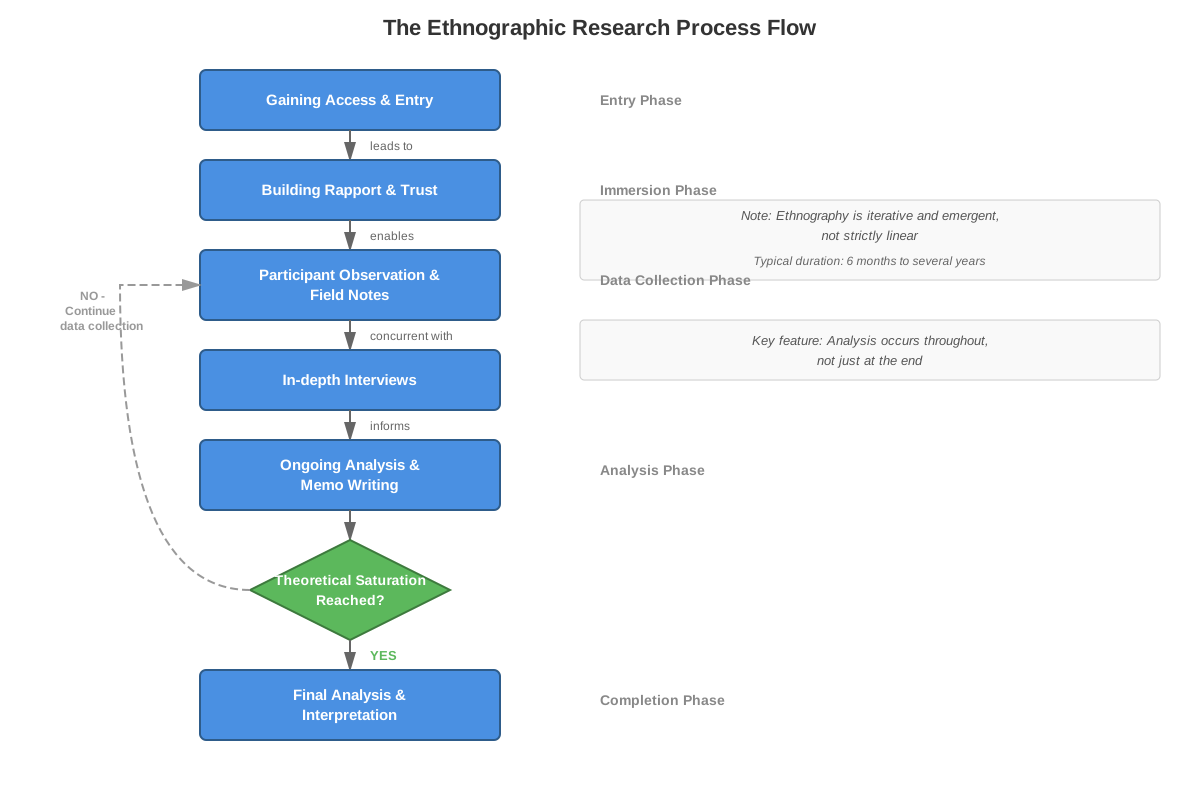
Participant observation represents the methodological heart of ethnography. This technique requires researchers to immerse themselves in the community under study, participating in daily activities while maintaining analytical distance to observe and record social patterns. The researcher occupies a dual role—simultaneously insider and outsider, participant and observer.
The degree of participation exists on a continuum:
| Level | Description | Example |
|---|---|---|
| Complete participant | Researcher fully joins the community, identity may be concealed | Journalist working undercover in a factory |
| Participant-as-observer | Primary role is participation, but research identity is known | Anthropologist living with indigenous community |
| Observer-as-participant | Primary role is observation, with limited participation | Researcher attending community meetings regularly |
| Complete observer | No participation, pure observation | Watching public interactions from distance |
Most ethnographic research employs the middle positions, balancing insider access with analytical perspective. The researcher maintains field notes—detailed written records of observations, conversations, impressions, and emerging interpretations—which form the primary data for analysis.
Data Collection Techniques
Ethnographers employ multiple complementary data collection methods:
Field notes constitute the primary data source, including:
- Descriptive notes: Objective accounts of observed events, settings, and behaviors
- Reflective notes: The researcher's interpretations, questions, and emerging insights
- Methodological notes: Documentation of research decisions and process
Interviews supplement observation, ranging from informal conversations to structured interviews. Ethnographic interviews typically follow participants' natural speech patterns and priorities rather than rigid question sequences.
Document analysis incorporates existing materials like photographs, letters, organizational records, or media content that illuminate cultural practices and meanings.
Audio/video recording captures interactions for detailed analysis, though raises ethical considerations about consent and privacy.
Ethnographic Analysis and Interpretation
Ethnographic analysis involves coding—systematically identifying patterns, themes, and categories within field notes and other data. Unlike quantitative analysis with predetermined variables, ethnographic coding is iterative and emergent. Researchers read through data multiple times, identifying recurring themes, contradictions, and significant patterns.
The goal is developing grounded theory—explanatory frameworks that emerge from and remain grounded in observed data rather than imposed from external theoretical frameworks. Ethnographers seek to understand the cultural logic—the internal coherence and meaning systems that make sense to community members, even if they differ from researcher expectations.
Triangulation strengthens ethnographic validity by comparing multiple data sources (observations, interviews, documents) and perspectives to confirm interpretations and identify discrepancies.
Strengths of Ethnographic Research
Ethnography offers unique advantages for certain research questions:
- Contextual understanding: Captures social phenomena within their full environmental and cultural context
- Depth over breadth: Provides rich, nuanced understanding of complex social processes
- Flexibility: Researchers can pursue unexpected findings and adapt to emerging insights
- Emic perspective: Accesses insider viewpoints and meanings that surveys or experiments cannot capture
- Discovery of unknown factors: Reveals unanticipated variables and relationships
- Validity: High ecological validity because research occurs in natural settings
- Process illumination: Excellent for understanding how social processes unfold over time
Limitations and Challenges
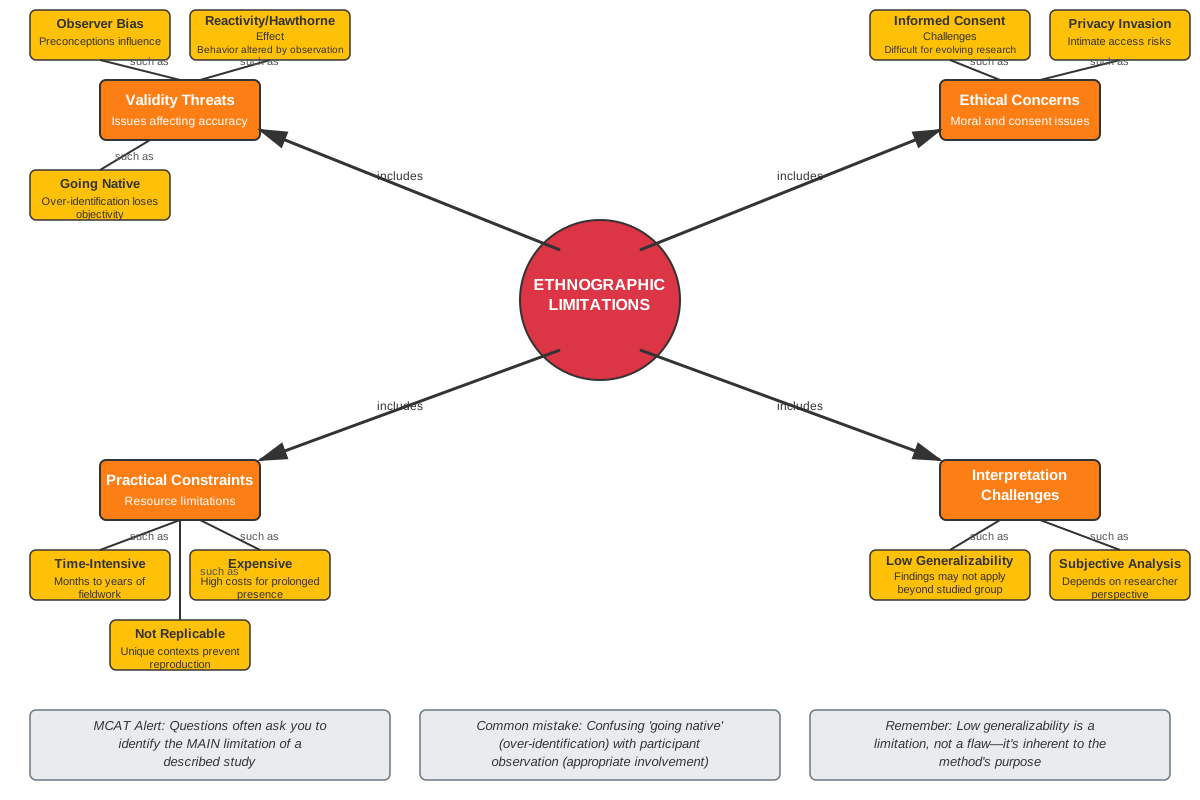
Ethnography also faces significant limitations:
- Generalizability: Findings from one cultural context may not transfer to others; small sample sizes limit statistical generalization
- Time and resource intensive: Requires months or years of fieldwork and substantial funding
- Researcher bias: The researcher is the primary instrument; personal biases, assumptions, and presence affect observations
- Reactivity: Participants may alter behavior when aware of being observed (Hawthorne effect)
- Ethical complexities: Prolonged relationships create obligations; balancing rapport with analytical distance is challenging
- Replicability: Unique researcher-participant relationships and contexts make exact replication impossible
- Subjectivity: Interpretation involves researcher judgment; different researchers might interpret data differently
Ethnography in Healthcare Research
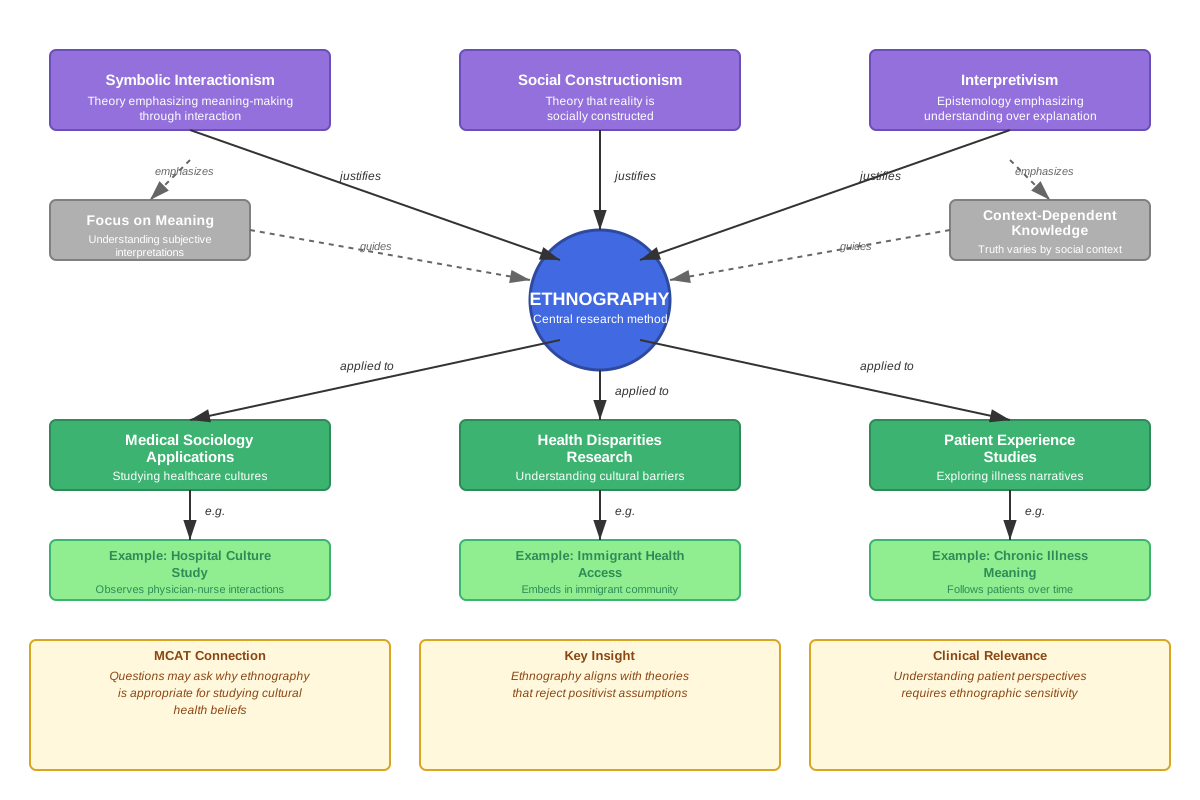
Ethnography Sociology applications in healthcare contexts include:
- Studying hospital cultures and medical team dynamics
- Understanding patient experiences of chronic illness
- Investigating health disparities in specific communities
- Examining how cultural beliefs shape health behaviors
- Analyzing doctor-patient communication patterns
- Exploring mental health stigma in various cultural contexts
For example, ethnographic research has revealed how hospital hierarchies affect patient safety, how immigrant communities navigate healthcare systems, and how cultural concepts of personhood influence end-of-life care decisions.
Concept Relationships
Ethnography connects to multiple concepts within sociology and research methodology. At the foundational level, ethnography operationalizes symbolic interactionism—the theoretical perspective emphasizing that people create meaning through social interaction. Ethnographic methods are specifically designed to capture these meaning-making processes as they naturally occur.
The relationship flows: Symbolic Interactionism (theoretical framework) → Ethnography (methodological approach) → Participant Observation (specific technique) → Field Notes (data form) → Grounded Theory (analytical product).
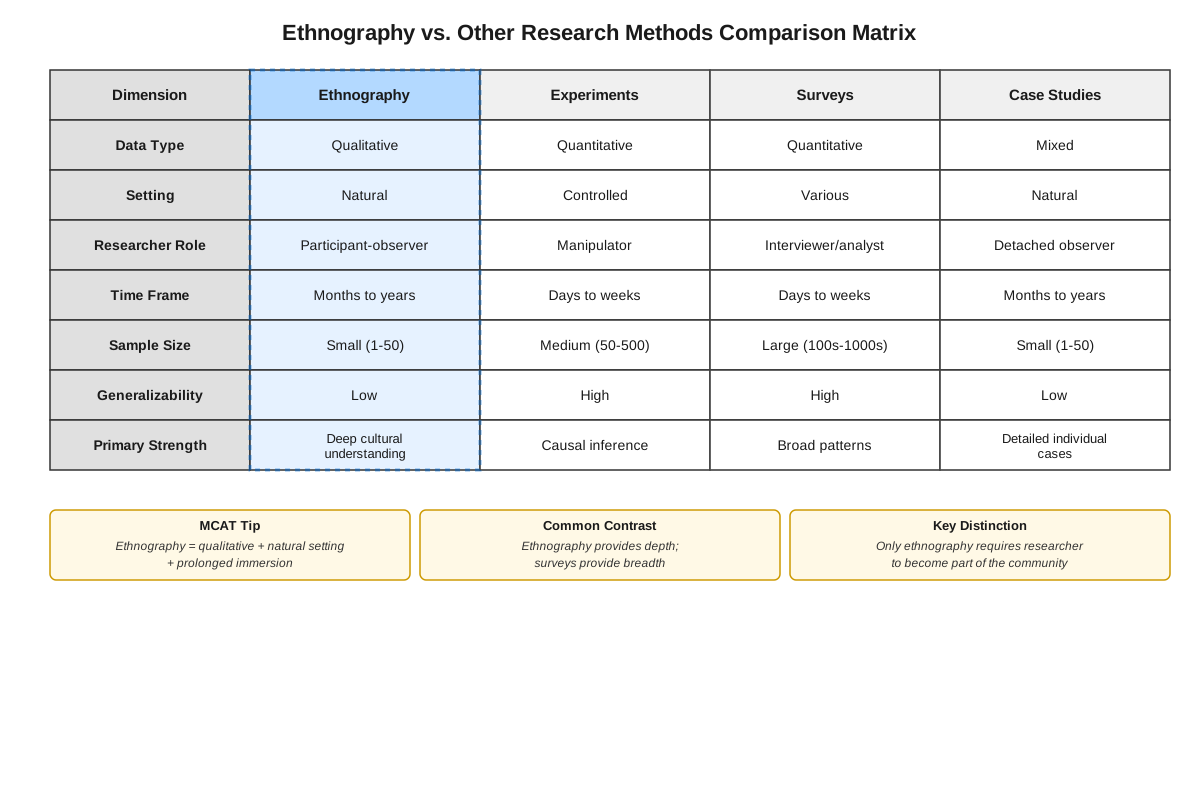
Ethnography contrasts with quantitative research methods (surveys, experiments) along multiple dimensions: qualitative vs. quantitative data, inductive vs. deductive reasoning, depth vs. breadth, and contextual understanding vs. generalizability. However, these approaches are complementary rather than mutually exclusive; mixed methods research often combines ethnographic depth with quantitative breadth.
Within qualitative methods, ethnography relates to but differs from case studies (which may or may not involve fieldwork), phenomenology (focused specifically on lived experience), and grounded theory (which can be developed from various data sources, not just ethnographic fieldwork).
Ethnography also connects to research ethics, particularly regarding informed consent in naturalistic settings, protecting participant confidentiality when describing specific communities, and managing dual relationships when researchers become community members.
Understanding ethnography enables comprehension of cultural competence in healthcare—ethnographic insights inform how providers should approach cultural differences in clinical settings.
High-Yield Facts
⭐ Ethnography is a qualitative research method involving prolonged, immersive fieldwork in natural settings to understand culture and social phenomena from participants' perspectives
⭐ Participant observation—simultaneously participating in and observing a community—is the defining methodological technique of ethnography
⭐ Ethnography prioritizes depth and contextual understanding over breadth and generalizability
⭐ Field notes (detailed written records of observations and reflections) constitute the primary data in ethnographic research
⭐ Ethnography is particularly appropriate for research questions about cultural meanings, social processes, and phenomena that cannot be studied experimentally
- Ethnographic research typically requires months to years of fieldwork, making it time and resource-intensive
- The emic perspective (insider's viewpoint) distinguishes ethnography from etic (outsider's) approaches
- Thick description—rich, detailed narrative accounts—characterizes ethnographic writing
- Ethnography has high ecological validity because research occurs in natural settings but faces challenges with generalizability
- Researcher bias and reactivity (participants changing behavior when observed) are significant limitations of ethnographic methods
- Triangulation (comparing multiple data sources) strengthens the validity of ethnographic findings
- Ethnography emerged from anthropology but is now widely used across social sciences, including medical sociology and health services research
- Grounded theory—explanatory frameworks emerging from data rather than predetermined hypotheses—is a common analytical approach in ethnography
Quick check — test yourself on Ethnography so far.
Try Flashcards →Common Misconceptions
Misconception: Ethnography is just casual observation or "hanging out" with people
Correction: Ethnography is a rigorous, systematic research methodology requiring extensive training, careful documentation, and analytical discipline. Ethnographers follow established protocols for data collection, maintain detailed field notes, and employ systematic analytical techniques. The apparent informality of participant observation masks sophisticated methodological and theoretical frameworks.
Misconception: Ethnographic findings cannot be trusted because they're subjective and based on small samples
Correction: While ethnography does involve researcher interpretation and typically studies small groups, this does not make findings invalid or untrustworthy. Ethnography prioritizes different validity criteria than quantitative research—seeking deep understanding and contextual validity rather than statistical generalizability. Rigorous ethnography employs triangulation, member checking (confirming interpretations with participants), and reflexivity (acknowledging researcher positionality) to ensure trustworthy findings.
Misconception: Ethnography and qualitative research are synonymous terms
Correction: Ethnography is one specific type of qualitative research, but not all qualitative research is ethnographic. Qualitative research includes various methods (interviews, focus groups, document analysis, case studies) that may not involve prolonged fieldwork or participant observation. Ethnography specifically requires immersive engagement in natural settings over extended periods.
Misconception: Ethnographers should remain completely objective and detached from participants
Correction: Ethnography recognizes that complete objectivity is impossible and that researcher-participant relationships are essential for accessing insider perspectives. Rather than striving for detachment, ethnographers practice reflexivity—critically examining how their own backgrounds, assumptions, and relationships affect observations and interpretations. The goal is awareness and transparency about subjectivity, not its elimination.
Misconception: Ethnography is only useful for studying exotic or remote cultures
Correction: While ethnography originated in anthropological studies of non-Western societies, contemporary ethnography is equally valuable for studying familiar settings—hospitals, schools, workplaces, online communities, or any social context where understanding cultural meanings and social processes is important. Medical ethnography, for example, studies healthcare institutions and practices in researchers' own societies.
Misconception: Ethnographic research doesn't follow the scientific method
Correction: Ethnography follows systematic research procedures, though they differ from experimental methods. Ethnographers formulate research questions, collect data systematically, analyze data using established techniques, and draw conclusions that can be evaluated by other researchers. The inductive approach (theory emerging from data) is scientifically valid, complementing deductive hypothesis-testing approaches.
Worked Examples
Example 1: Identifying Ethnographic Research
Vignette: A researcher wants to understand how medical residents learn to deliver bad news to patients. She spends six months shadowing residents during their oncology rotation, attending patient meetings, observing conversations, and conducting informal interviews with residents about their experiences. She takes detailed notes after each observation session and analyzes these notes to identify patterns in how residents develop communication skills.
Question: Which research method is the researcher employing?
Analysis:
Let's systematically evaluate the methodological characteristics described:
- Setting: Natural clinical environment (oncology rotation), not controlled laboratory
- Duration: Six months—extended engagement characteristic of ethnography
- Data collection: Multiple methods including observation, informal interviews, and field notes
- Researcher role: Shadowing residents suggests participant observation (observer-as-participant)
- Analysis approach: Identifying patterns emerging from data (inductive, grounded theory approach)
- Research focus: Understanding a social process (learning communication skills) in context
Answer: This is ethnographic research. The prolonged immersion in the natural clinical setting, use of participant observation, collection of field notes, and inductive analysis of emerging patterns all indicate ethnography. The researcher is studying the cultural process of professional socialization within its natural context.
Key learning objective addressed: This example demonstrates how to identify ethnographic research by recognizing its defining characteristics and distinguishing it from other methods.
Example 2: Evaluating Methodological Appropriateness
Vignette: A research team wants to investigate why Somali immigrant women in a Midwestern city have low rates of cervical cancer screening despite free clinic access. They are considering four research approaches:
A) Mail surveys to 1,000 Somali women asking about screening behaviors and barriers
B) Experimental study randomly assigning women to educational intervention vs. control groups
C) Six-month ethnographic study involving participant observation in the Somali community, attending community events, and conducting in-depth interviews
D) Medical record review documenting screening rates across demographic groups
Question: Which approach would best address the research question, and why?
Analysis:
The research question asks "why"—seeking to understand reasons, meanings, and cultural factors behind a health behavior. Let's evaluate each option:
Option A (Surveys): Could identify self-reported barriers but assumes researchers already know relevant factors to ask about. May miss cultural meanings or factors researchers haven't anticipated. Language barriers and cultural differences in survey response patterns could limit validity.
Option B (Experiment): Could test whether an intervention increases screening but doesn't explain why current rates are low. Requires understanding barriers before designing intervention—putting the cart before the horse.
Option C (Ethnography): Allows researchers to understand the cultural context, discover unanticipated factors, learn how Somali women conceptualize health and healthcare, identify trust issues or cultural barriers, and understand the community's perspective. The immersive approach can reveal factors that surveys wouldn't capture.
Option D (Record review): Documents the problem but doesn't explain it. Provides no information about reasons or cultural factors.
Answer: Option C (ethnography) is most appropriate. The research question requires understanding cultural meanings, beliefs, and social contexts that shape health behavior. Ethnography's strengths—contextual understanding, emic perspective, discovery of unknown factors—directly address the research needs. The prolonged engagement allows researchers to build trust, understand cultural nuances, and identify barriers that community members might not articulate in surveys or that researchers wouldn't know to ask about.
Follow-up consideration: An ideal research program might use ethnography first to understand barriers, then develop culturally appropriate interventions (informed by ethnographic insights) to test experimentally, demonstrating how methods complement each other.
Key learning objectives addressed: This example demonstrates applying ethnographic concepts to evaluate methodological appropriateness and recognizing when ethnography is superior to other approaches.
Exam Strategy
When approaching MCAT questions about ethnography, employ these strategic approaches:
Trigger words indicating ethnographic research: Watch for passages describing "prolonged fieldwork," "participant observation," "immersion," "natural settings," "cultural understanding," "emic perspective," or "thick description." These phrases signal ethnographic methodology.
Distinguishing ethnography from other qualitative methods: The MCAT frequently tests whether students can differentiate ethnography from interviews, focus groups, or case studies. The key distinguisher is prolonged immersion with participant observation in natural settings. A single interview is not ethnography; a series of focus groups is not ethnography; even a detailed case study may not be ethnographic unless it involves extended fieldwork.
Strengths vs. limitations questions: When asked about ethnographic strengths, focus on contextual understanding, depth, flexibility, and accessing insider perspectives. For limitations, emphasize generalizability concerns, time/resource requirements, and researcher bias. Match the strength or limitation to the specific research context described.
Methodological appropriateness questions: Use this decision tree:
- Does the research question ask "why" or seek to understand meanings/culture? → Consider qualitative methods
- Is the phenomenon best studied in natural settings? → Favor ethnography over laboratory methods
- Are relevant factors unknown or culturally specific? → Ethnography's inductive approach is advantageous
- Is generalizability the primary concern? → Ethnography may not be optimal
Process of elimination: When ethnography appears among answer choices:
- Eliminate options describing quantitative methods if the question emphasizes understanding meanings or culture
- Eliminate ethnography if the passage describes brief, one-time data collection
- Eliminate ethnography if the question prioritizes large sample sizes or statistical generalization
- Keep ethnography if the passage emphasizes prolonged engagement, natural settings, or cultural understanding
Time allocation: Ethnography questions typically don't require complex calculations, so allocate standard time (approximately 1-1.5 minutes per question). Don't overthink—if the passage clearly describes prolonged fieldwork with participant observation, confidently select ethnography.
Exam Tip: The MCAT often contrasts ethnography with experimental methods. Remember that these represent different epistemological approaches—ethnography seeks understanding and meaning, while experiments seek causal relationships. Neither is inherently superior; appropriateness depends on the research question.
Memory Techniques
ETHNOGRAPHY mnemonic for key characteristics:
- Extended engagement (prolonged fieldwork)
- Thick description (rich, detailed accounts)
- Holistic approach (full context)
- Natural settings (not laboratories)
- Observation (participant observation)
- Grounded theory (inductive analysis)
- Researcher immersion
- Analysis of culture
- Participant perspective (emic view)
- Human interaction focus
- Years not days (time-intensive)
Visual memory aid: Picture an anthropologist living in a village, participating in daily activities while taking notes in a journal. This image captures the essence of ethnographic participant observation—simultaneously being part of the community and documenting it.
Comparison memory device: "Ethnography goes DEEP, surveys go WIDE"
- Ethnography: Depth, Emic perspective, Extended time, Particular contexts
- Surveys: Wide samples, Etic perspective, Brief data collection, General populations
Strengths vs. Limitations: Remember "CONTEXT vs. GENERALIZE"
- Ethnography's strength: CONTEXT (understanding phenomena in full social/cultural context)
- Ethnography's limitation: GENERALIZE (findings may not generalize beyond studied group)
Summary
Ethnography is a qualitative research methodology involving prolonged, immersive fieldwork in natural settings to understand culture, social phenomena, and meanings from participants' perspectives. The defining technique—participant observation—requires researchers to simultaneously participate in and observe community life while maintaining detailed field notes. Ethnography prioritizes depth over breadth, contextual understanding over generalizability, and inductive theory development over hypothesis testing. Its strengths include accessing insider perspectives, discovering unanticipated factors, and understanding complex social processes in context. Limitations include restricted generalizability, time and resource demands, and potential researcher bias. For the MCAT, students must recognize ethnographic research by its characteristic features (prolonged engagement, natural settings, participant observation), distinguish it from other qualitative and quantitative methods, evaluate its appropriateness for specific research questions, and understand both its unique contributions and inherent limitations. Ethnography is particularly valuable for research questions about cultural meanings, health behaviors in context, and social processes that cannot be studied experimentally.
Key Takeaways
- Ethnography is defined by prolonged immersive fieldwork using participant observation in natural settings to understand culture and social phenomena from insider perspectives
- Participant observation—the core ethnographic technique—involves simultaneously participating in community life while systematically observing and documenting social patterns
- Ethnography's primary strengths are contextual understanding, depth, flexibility, and accessing emic (insider) perspectives; primary limitations are restricted generalizability, time intensity, and researcher bias
- Field notes (detailed written records of observations and reflections) constitute the primary data source in ethnographic research
- Ethnography is most appropriate for research questions about cultural meanings, social processes, and phenomena requiring contextual understanding rather than statistical generalization
- On the MCAT, distinguish ethnography from other methods by identifying prolonged engagement, natural settings, and participant observation—not just any qualitative data collection
- Ethnography connects to symbolic interactionism theoretically and complements quantitative methods by providing depth and contextual understanding that surveys and experiments cannot capture
Related Topics
Qualitative vs. Quantitative Research Paradigms: Understanding the fundamental epistemological differences between these approaches provides the framework for appreciating why ethnography employs its distinctive methods and evaluation criteria.
Other Qualitative Methods: Studying phenomenology, grounded theory methodology, case studies, and narrative analysis helps distinguish ethnography's unique characteristics and appropriate applications.
Research Ethics: Ethnography raises distinctive ethical challenges regarding informed consent, confidentiality, and researcher-participant relationships that warrant deeper exploration.
Symbolic Interactionism: This theoretical perspective provides the conceptual foundation justifying ethnographic approaches and explains why understanding meaning-making processes requires immersive observation.
Cultural Competence in Healthcare: Ethnographic insights about cultural differences in health beliefs and behaviors directly inform clinical practice and patient-provider communication.
Mixed Methods Research: Understanding how ethnographic and quantitative approaches can be combined provides a more sophisticated view of research design possibilities.
Practice CTA
Now that you've mastered the fundamentals of ethnography, reinforce your learning by attempting practice questions and reviewing flashcards focused on this topic. Challenge yourself to identify ethnographic research in passage-based questions, evaluate methodological appropriateness in various scenarios, and distinguish ethnography from related qualitative methods. Remember that understanding research methodology isn't just about memorizing definitions—it's about developing the analytical skills to evaluate how knowledge is produced and what conclusions are warranted. Your ability to think critically about ethnographic research will serve you not only on the MCAT but throughout your medical career as you evaluate research evidence and understand the social contexts shaping health and illness. You've got this!
Sign up free to keep reading
Create a free AnvayaPrep account to finish this MCAT guide on Ethnography — plus flashcards and practice questions.