Overview
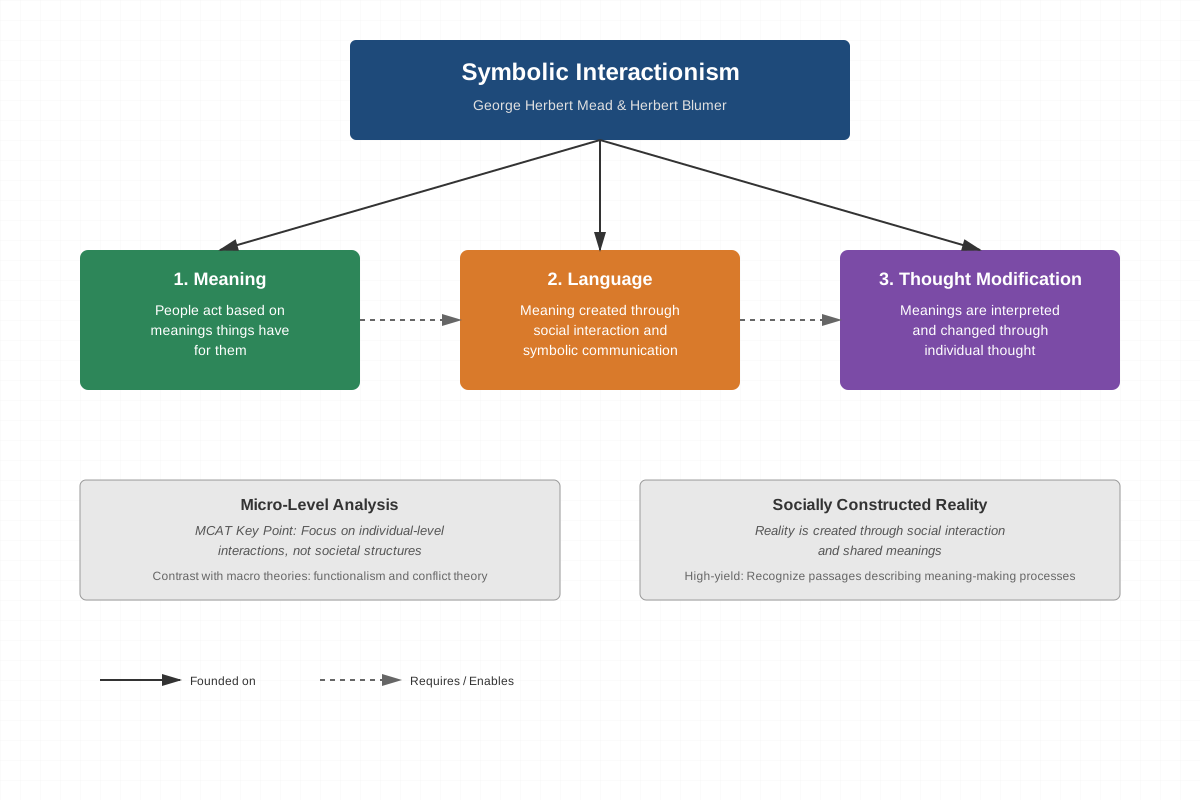
Symbolic interactionism is a foundational sociological perspective that examines how individuals create and interpret meaning through social interactions using symbols, particularly language and gestures. This micro-level theoretical framework, developed primarily by George Herbert Mead and later refined by Herbert Blumer, posits that society is constructed through the everyday interactions between individuals who continuously negotiate and reinterpret shared meanings. Unlike macro-level theories that focus on large-scale social structures, symbolic interactionism emphasizes the subjective experiences of individuals and how they actively shape their social reality through communication and interpretation.
For the MCAT, understanding symbolic interactionism is essential because it represents one of the three major sociological paradigms tested on the exam, alongside functionalism and conflict theory. The MCAT Psychological, Social, and Biological Foundations of Behavior section frequently presents passages describing interpersonal interactions, identity formation, and meaning-making processes that require students to identify and apply symbolic interactionist concepts. Questions may ask students to analyze how individuals develop self-concepts, how social roles are negotiated, or how symbols acquire meaning through social processes.
Within the broader context of Social Structure and Institutions, symbolic interactionism provides the micro-level complement to macro-level theories. While functionalism and conflict theory explain how large-scale social structures operate, symbolic interactionism reveals how these structures are created, maintained, and modified through individual interactions. This perspective is particularly relevant for understanding socialization processes, identity development, deviance labeling, and the social construction of reality—all high-yield topics for MCAT Sociology. Mastering symbolic interactionism enables students to analyze social phenomena from multiple theoretical perspectives, a critical skill for answering complex MCAT passages that require theoretical application.
Learning Objectives
- [ ] Define Symbolic interactionism using accurate Sociology terminology
- [ ] Explain why Symbolic interactionism matters for the MCAT
- [ ] Apply Symbolic interactionism to exam-style questions
- [ ] Identify common mistakes related to Symbolic interactionism
- [ ] Connect Symbolic interactionism to related Sociology concepts
- [ ] Compare and contrast symbolic interactionism with functionalism and conflict theory
- [ ] Analyze how the "looking-glass self" and "I" versus "Me" concepts relate to identity formation
- [ ] Evaluate real-world scenarios using symbolic interactionist principles to predict behavioral outcomes
Prerequisites
- Basic understanding of sociological perspectives: Familiarity with the distinction between micro-level and macro-level analysis helps contextualize symbolic interactionism's focus on individual interactions
- Concept of socialization: Knowledge of how individuals learn social norms provides the foundation for understanding how meanings are transmitted and negotiated
- Definition of symbols and language: Understanding that symbols are objects, gestures, or words that represent something else is essential for grasping how meaning is created
- Social roles and status: Awareness of how individuals occupy positions in society helps explain how people perform and negotiate identities through interaction
Why This Topic Matters
Symbolic interactionism appears frequently on the MCAT because it provides a framework for analyzing the interpersonal and identity-related scenarios commonly featured in Psychological, Social, and Biological Foundations passages. Approximately 15-20% of sociology questions on the MCAT involve applying theoretical perspectives to social situations, and symbolic interactionism is one of the three major paradigms students must master. The MCAT particularly favors questions that require students to distinguish between theoretical approaches or identify which perspective best explains a described phenomenon.
In clinical and real-world contexts, symbolic interactionism helps explain patient-provider communication, the social construction of illness, and how medical labels affect patient identity. For example, understanding how a diabetes diagnosis becomes part of a patient's self-concept, or how healthcare providers and patients negotiate meaning during medical encounters, relies on symbolic interactionist principles. This perspective is crucial for future physicians who must recognize that medical interactions involve continuous interpretation and meaning-making, not just the transmission of objective information.
On the MCAT, symbolic interactionism typically appears in passages describing: social interactions where individuals interpret each other's behaviors; identity formation and self-concept development; labeling processes in deviance or mental health contexts; role-taking and perspective-taking scenarios; and situations involving the negotiation of meaning through communication. Questions may present a vignette and ask which theoretical perspective best explains the behavior, or they may describe a research study and ask students to identify the underlying theoretical framework. Recognizing trigger words like "meaning," "interpretation," "symbols," "self-concept," and "interaction" helps students quickly identify when symbolic interactionism is relevant.
Core Concepts
Definition and Foundational Principles
Symbolic interactionism is a micro-level sociological perspective that focuses on how individuals create and interpret meaning through social interactions using symbols. The theory rests on three core premises articulated by Herbert Blumer: (1) humans act toward things based on the meanings those things have for them; (2) meanings arise from social interaction with others; and (3) meanings are modified through an interpretive process as individuals encounter new situations. This perspective emphasizes that social reality is not fixed but continuously constructed and reconstructed through everyday interactions.
The term "symbolic" refers to the use of symbols—objects, gestures, words, or images that represent something beyond themselves and carry shared meaning within a social group. Language is the most important symbol system, enabling complex communication and the transmission of culture. The "interactionism" component emphasizes that meaning emerges from the dynamic process of interaction between individuals, not from isolated individual thought or from external social structures alone.
George Herbert Mead's Contributions
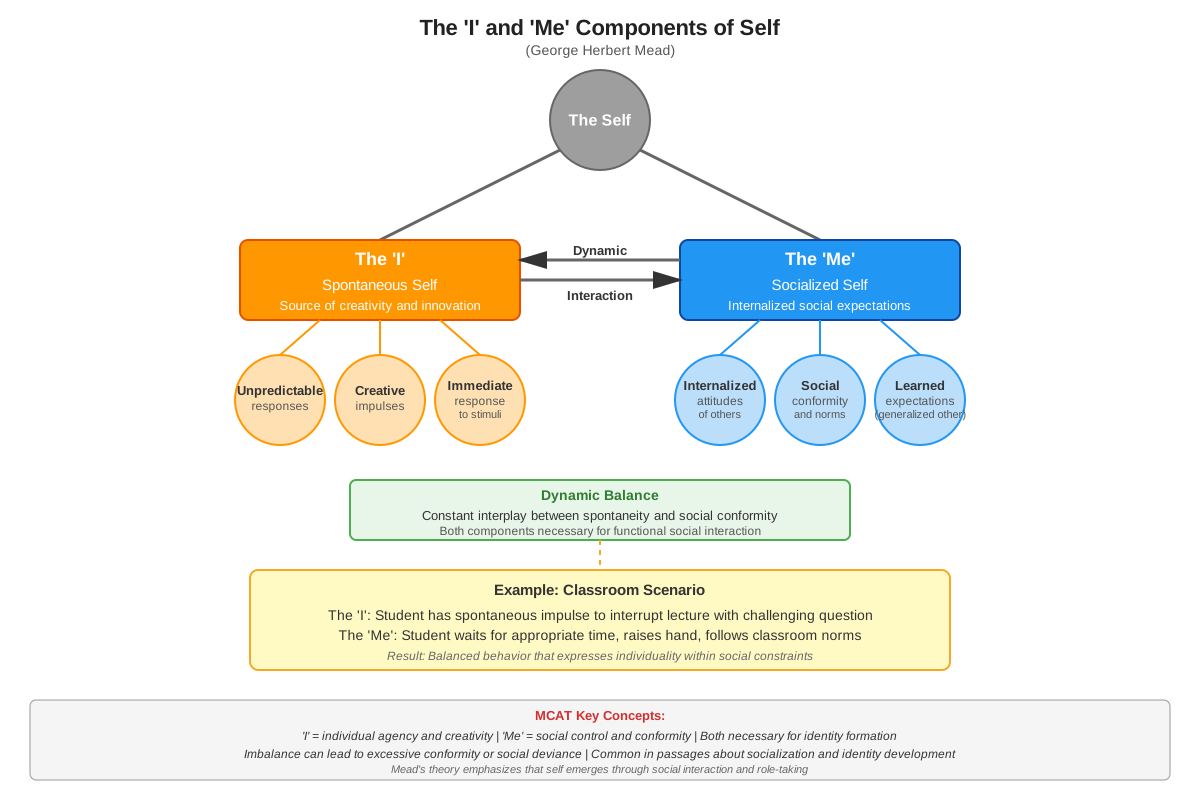
George Herbert Mead, considered the founder of symbolic interactionism, introduced several key concepts that form the theoretical foundation. Mead emphasized that the self is not innate but develops through social interaction. He distinguished between the "I" and the "Me" as two components of the self. The "I" represents the spontaneous, creative, and unpredictable aspect of the self—the part that responds to situations in the moment. The "Me" represents the socialized aspect of the self—the internalized attitudes and expectations of others that guide behavior according to social norms.
Mead also introduced the concept of role-taking, the ability to imaginatively place oneself in another person's position and view the world from their perspective. This capacity develops through stages: the preparatory stage (children imitate others without understanding meaning), the play stage (children take on specific roles like "doctor" or "parent"), and the game stage (children understand multiple roles simultaneously and how they interrelate). The generalized other represents the internalized attitudes of the entire community or social group, allowing individuals to consider how society as a whole views their actions.
Charles Cooley's Looking-Glass Self
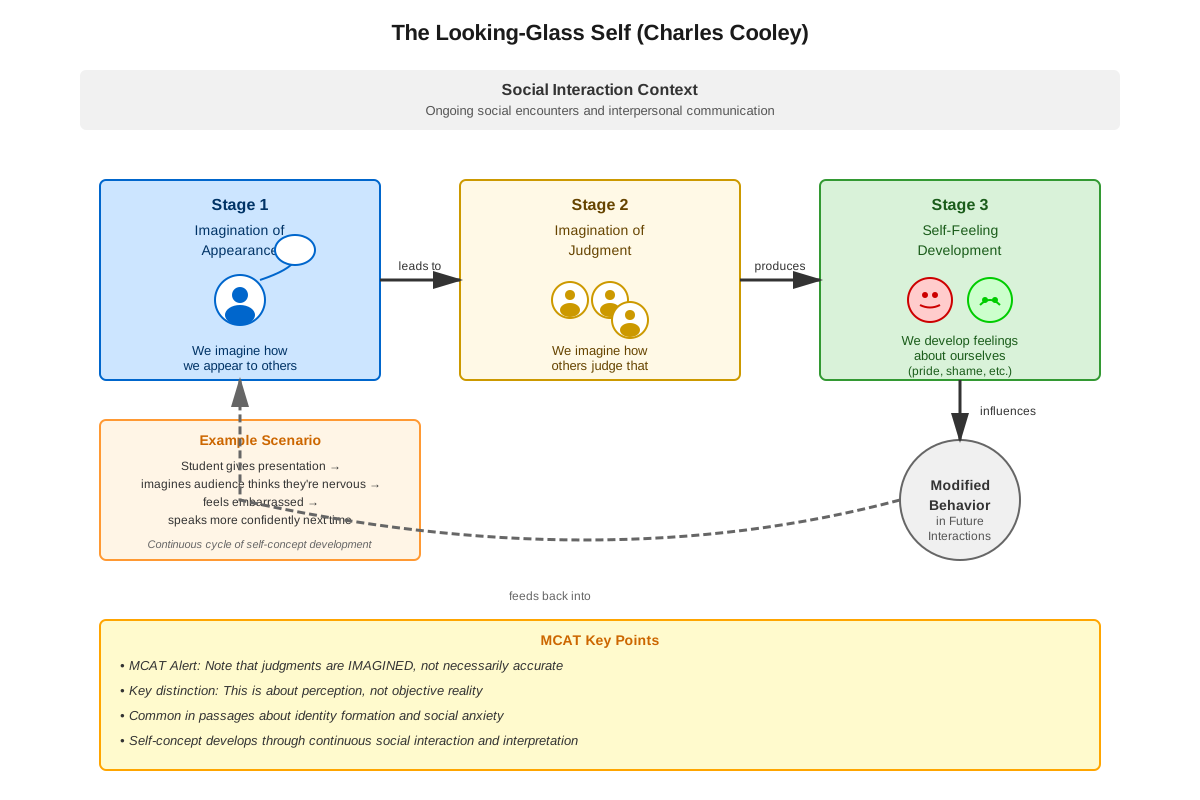
Charles Cooley contributed the concept of the looking-glass self, which describes how individuals develop their self-concept through imagining how others perceive them. This process involves three steps: (1) we imagine how we appear to others; (2) we imagine how others judge that appearance; and (3) we develop feelings about ourselves based on our perception of those judgments. For example, if a medical student believes their attending physician views them as competent, they develop positive feelings about their abilities and incorporate "competent medical student" into their self-concept.
The looking-glass self demonstrates that identity is fundamentally social—we see ourselves reflected in the reactions of others, like looking in a mirror. Importantly, this process is based on our perception of others' judgments, which may not accurately reflect their actual opinions. This concept is frequently tested on the MCAT in scenarios involving identity formation, self-esteem development, or social feedback effects.
Dramaturgical Approach
Erving Goffman extended symbolic interactionism through his dramaturgical approach, which uses theater as a metaphor for social interaction. Goffman proposed that individuals are like actors performing on a stage, managing the impressions they create for different audiences. The front stage represents settings where individuals perform roles for an audience and carefully manage their behavior according to social expectations. The back stage represents private spaces where individuals can relax, drop their performances, and behave more authentically.
Impression management refers to the strategies individuals use to control how others perceive them. This includes verbal communication, body language, appearance, and the manipulation of physical settings. For MCAT purposes, understanding impression management helps explain behaviors like code-switching (adjusting language and behavior for different social contexts) or how healthcare providers maintain professional demeanor with patients while expressing frustration in private staff areas.
Social Construction of Reality
Symbolic interactionism emphasizes that reality is socially constructed—meanings are not inherent in objects or situations but are created through social agreement and interaction. What counts as "illness," "deviance," "success," or "normal" varies across cultures and historical periods because these categories are defined through social processes, not objective criteria alone. Peter Berger and Thomas Luckmann elaborated this concept, explaining how repeated interactions create habitualization (routine patterns), which become institutionalized (established as standard practices), leading individuals to experience socially constructed categories as objective reality.
The social construction of reality is particularly relevant for understanding medical sociology topics on the MCAT. For example, the medicalization of conditions like ADHD or menopause involves social processes that define certain experiences as medical problems requiring treatment. Similarly, the sick role—a set of expectations for how ill people should behave—is socially constructed and varies across cultures.
Labeling Theory
Labeling theory, an application of symbolic interactionism to deviance, proposes that deviance is not inherent in an act but results from how others label and respond to that act. When society labels someone as "deviant," "criminal," or "mentally ill," that label becomes part of the person's identity through a process called secondary deviance—the individual internalizes the label and begins to act according to it. This creates a self-fulfilling prophecy where the label shapes behavior in ways that confirm the initial categorization.
The distinction between primary deviance (initial rule-breaking that is not labeled or has minimal consequences) and secondary deviance (deviance that results from being labeled and treated as deviant) is important for MCAT questions. For example, a teenager who experiments with marijuana once (primary deviance) but is arrested, labeled as a "drug user," and subsequently adopts that identity and increases drug use (secondary deviance) illustrates this process.
Comparison with Other Theoretical Perspectives
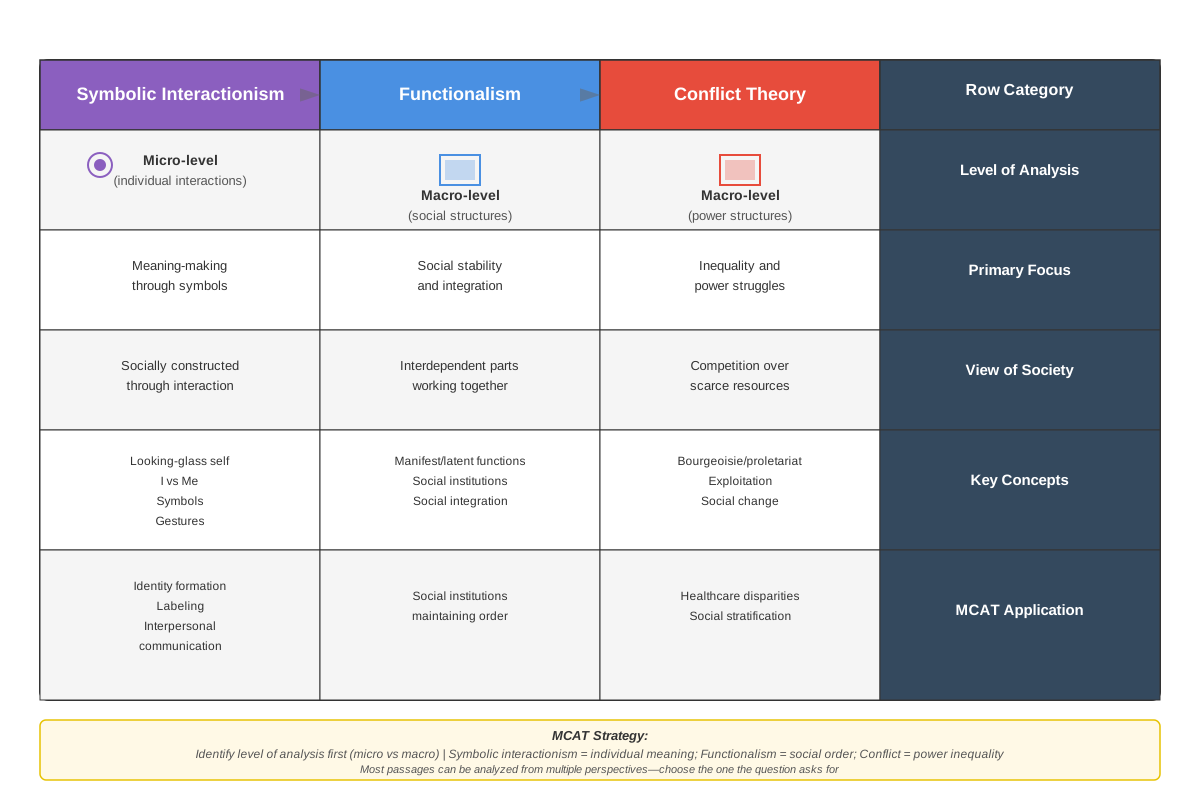
| Aspect | Symbolic Interactionism | Functionalism | Conflict Theory |
|---|---|---|---|
| Level of analysis | Micro-level (individual interactions) | Macro-level (society as a whole) | Macro-level (groups and power) |
| Focus | Meaning, interpretation, symbols | Social stability, functions | Power, inequality, competition |
| View of society | Continuously constructed through interaction | Stable system with interdependent parts | Arena of conflict between groups |
| Key question | How do people create meaning? | How does this contribute to social order? | Who benefits and who is disadvantaged? |
| Change | Emerges from shifting meanings and interactions | Disrupts equilibrium; adaptation needed | Results from power struggles |
| Example application | How patients interpret illness based on interactions with providers | How the sick role maintains social stability | How medical institutions serve elite interests |
Concept Relationships
The concepts within symbolic interactionism form an interconnected framework for understanding social interaction and identity formation. The foundational principle that meaning arises from interaction leads directly to Mead's analysis of how the self develops through role-taking. As individuals engage in role-taking, they internalize the perspectives of others, forming the "Me" component of self while retaining the spontaneous "I". This process is closely related to Cooley's looking-glass self, which specifies the mechanism by which others' perceived judgments shape self-concept.
The development of self through interaction enables impression management (Goffman's dramaturgical approach), as individuals with established self-concepts strategically present themselves to different audiences. This performance of identity contributes to the social construction of reality, as repeated interactions create shared understandings of social categories and roles. When these socially constructed categories are applied to individuals through labeling, they can fundamentally alter identity and behavior, demonstrating how symbolic interactionism explains both normal identity development and deviance.
Symbolic interactionism connects to prerequisite knowledge of socialization by explaining the micro-level processes through which socialization occurs—not just passive learning but active interpretation and meaning-making. It relates to social roles by showing how roles are not simply scripts to follow but are actively negotiated and performed through interaction. The perspective also connects to broader Social Structure and Institutions by revealing how macro-level structures are created and maintained through countless micro-level interactions. For example, the institution of medicine exists not just as an abstract structure but through daily interactions between patients and providers who negotiate meanings of illness, treatment, and health.
The relationship map flows as follows: Symbols and language → enable → Social interaction → produces → Meaning → shapes → Self-concept (I and Me) → guides → Role-taking and impression management → creates → Social construction of reality → can involve → Labeling processes → influences → Identity and behavior → feeds back into → Future interactions and meanings.
Quick check — test yourself on Symbolic interactionism so far.
Try Flashcards →High-Yield Facts
⭐ Symbolic interactionism is a micro-level perspective focusing on how individuals create meaning through social interaction using symbols, particularly language.
⭐ The three core premises of symbolic interactionism are: (1) people act based on meanings, (2) meanings arise from social interaction, and (3) meanings are modified through interpretation.
⭐ Mead's "I" represents the spontaneous, creative self, while the "Me" represents the socialized self that reflects internalized social expectations.
⭐ The looking-glass self involves three steps: imagining how we appear to others, imagining their judgment, and developing self-feelings based on perceived judgments.
⭐ Role-taking develops through three stages: preparatory (imitation), play (taking specific roles), and game (understanding multiple interrelated roles).
- The generalized other represents the internalized attitudes of the entire community, allowing individuals to consider societal expectations when acting.
- Goffman's dramaturgical approach uses theater as a metaphor, distinguishing between front stage (public performance) and back stage (private behavior).
- Impression management refers to strategies individuals use to control how others perceive them in social interactions.
- Reality is socially constructed—meanings are created through social agreement rather than being inherent in objects or situations.
- Labeling theory proposes that deviance results from social labels rather than inherent qualities of acts; secondary deviance occurs when individuals internalize labels and act accordingly.
- Primary deviance refers to initial rule-breaking with minimal consequences, while secondary deviance results from being labeled and treated as deviant.
- Symbolic interactionism differs from functionalism and conflict theory by focusing on micro-level interactions rather than macro-level structures or power dynamics.
Common Misconceptions
Misconception: Symbolic interactionism claims that all reality is subjective and there are no objective facts. → Correction: Symbolic interactionism argues that the meanings people assign to objective phenomena are socially constructed, not that the phenomena themselves don't exist. A disease may have biological reality, but what it means to be "sick" and how patients should behave are socially constructed.
Misconception: The "Me" is the true self while the "I" is fake or superficial. → Correction: Both the "I" and "Me" are authentic components of the self. The "Me" represents socialized aspects shaped by others' expectations, while the "I" represents spontaneous, creative responses. A complete self requires both components working together.
Misconception: The looking-glass self means we see ourselves exactly as others see us. → Correction: The looking-glass self is based on our perception of how others judge us, which may be inaccurate. We develop self-concepts based on what we think others think, not necessarily their actual opinions.
Misconception: Symbolic interactionism only applies to face-to-face interactions and is irrelevant in modern digital communication. → Correction: Symbolic interactionism applies to any interaction involving symbols and meaning-making, including online communication, social media, and text messaging. Digital interactions still involve interpretation of symbols and impression management.
Misconception: Labeling theory suggests that labels cause deviant behavior in all cases. → Correction: Labeling theory proposes that labels can lead to secondary deviance when individuals internalize the label and it becomes part of their identity, but not everyone labeled as deviant will engage in secondary deviance. Individual responses to labels vary based on numerous factors.
Misconception: Symbolic interactionism and functionalism are compatible and can be used simultaneously to analyze the same phenomenon at the same level. → Correction: While both perspectives can analyze the same phenomenon, they operate at different levels (micro vs. macro) and ask different questions. A complete analysis might use both, but they provide distinct, complementary insights rather than identical explanations.
Worked Examples
Example 1: Identity Formation in Medical School
Vignette: Maria is a first-year medical student who initially feels uncertain about her abilities. During her first clinical rotation, her supervising physician frequently praises her patient communication skills and asks her to demonstrate techniques to other students. Maria begins to think of herself as "good with patients" and volunteers for additional patient interaction opportunities. She notices that when she wears her white coat and stethoscope, both patients and her peers treat her more respectfully, which reinforces her emerging identity as a competent medical professional.
Question: Which concept from symbolic interactionism best explains how Maria's self-concept as a competent medical professional developed?
Analysis: This vignette illustrates multiple symbolic interactionist concepts. First, identify the key elements: Maria's self-concept changes based on social interactions (the physician's praise), she perceives how others view her (looking-glass self), and symbols (white coat, stethoscope) carry meaning that affects interactions.
The looking-glass self is the primary concept at work. Maria imagines how her supervising physician perceives her (as having good communication skills), imagines the physician's positive judgment (the praise), and develops positive feelings about herself based on this perceived judgment (begins to think of herself as "good with patients"). This process directly shapes her self-concept and subsequent behavior (volunteering for more opportunities).
Additionally, the vignette demonstrates impression management through symbols—the white coat and stethoscope are props that communicate "medical professional" to others, affecting how they interact with Maria. The "Me" component of self is developing as Maria internalizes the expectations and attitudes of the medical community. The physician represents a significant other whose opinions particularly matter in shaping Maria's professional identity.
Answer: The looking-glass self best explains Maria's development, as her self-concept as a competent medical professional emerges from her perception of how her supervising physician and others judge her abilities, leading her to internalize this positive evaluation.
Example 2: Labeling and Mental Illness
Vignette: A research study examines patients diagnosed with schizophrenia. The study finds that patients who are hospitalized and publicly labeled as "mentally ill" are more likely to experience social isolation, unemployment, and repeated hospitalizations compared to patients with similar symptoms who receive outpatient treatment without public labeling. Interviews reveal that many hospitalized patients describe themselves primarily in terms of their diagnosis and report that others treat them differently after learning about their mental illness, which affects their self-concept and behavior.
Question: Which symbolic interactionist concept best explains why publicly labeled patients experience worse outcomes?
Analysis: This vignette describes a labeling process and its consequences. Key elements include: a label ("mentally ill") is applied publicly, others treat labeled individuals differently, individuals internalize the label into their self-concept, and behavior changes following the labeling (social isolation, repeated hospitalization).
Labeling theory and the concept of secondary deviance best explain these outcomes. The initial symptoms represent primary deviance—behavior that deviates from norms but hasn't yet been formally labeled. When patients are hospitalized and publicly labeled as "mentally ill," this label becomes a master status that overshadows other aspects of their identity. Others respond to them primarily as "mentally ill people" rather than as individuals with multiple roles and characteristics.
The patients then experience secondary deviance—they internalize the label, begin to see themselves primarily as mentally ill, and their behavior increasingly conforms to expectations associated with that label. This creates a self-fulfilling prophecy: being labeled and treated as mentally ill leads to behaviors and outcomes (isolation, unemployment, repeated hospitalization) that confirm the label. The social construction of mental illness means that the label itself, not just the symptoms, shapes the patient's experience and trajectory.
The comparison between hospitalized (publicly labeled) and outpatient (less publicly labeled) patients with similar symptoms demonstrates that the label and social response, rather than symptom severity alone, contribute to outcomes—a core principle of labeling theory.
Answer: Labeling theory and secondary deviance best explain the worse outcomes, as public labeling leads patients to internalize the "mentally ill" identity, which becomes a self-fulfilling prophecy that shapes their behavior and others' responses, resulting in social isolation and repeated hospitalization.
Exam Strategy
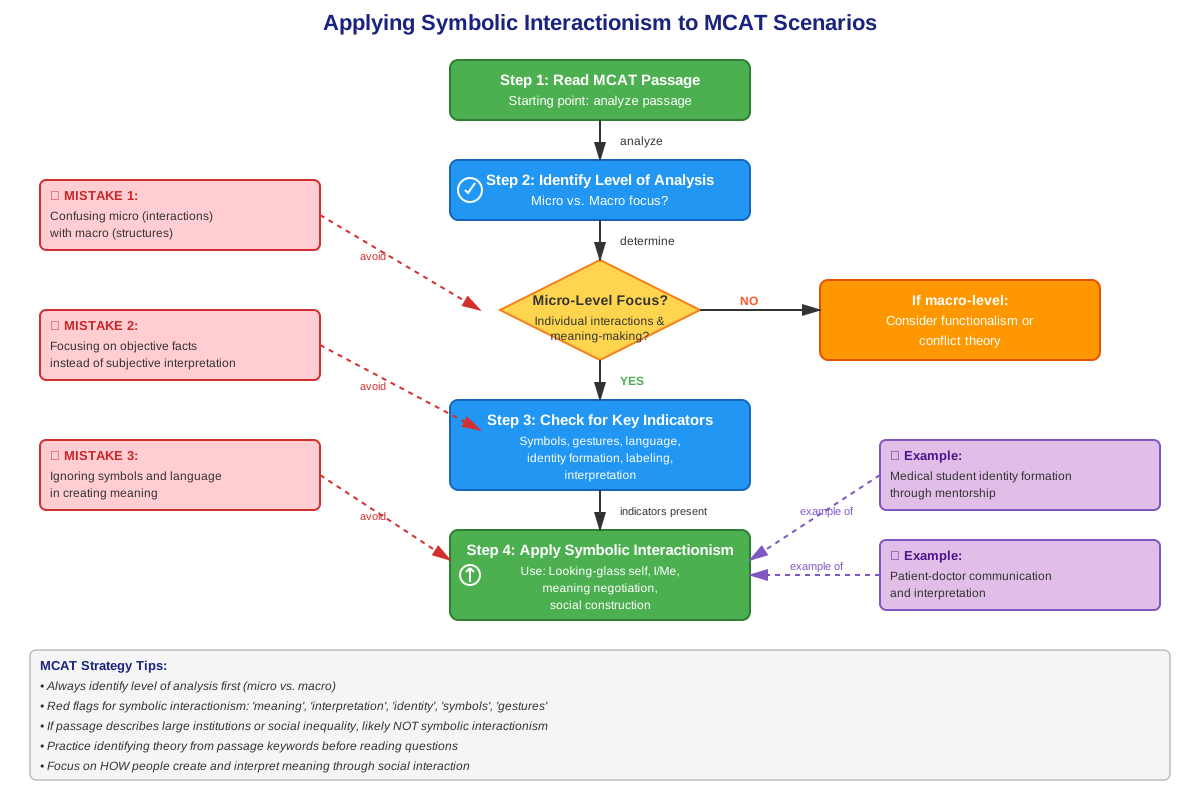
When approaching MCAT questions on symbolic interactionism, first identify whether the question asks about micro-level interactions and meaning-making or macro-level structures and functions. If the passage describes individual interactions, interpretation of symbols, identity formation, or how people assign meaning to situations, symbolic interactionism is likely relevant. If the passage focuses on large-scale social structures, social stability, or power inequalities, consider functionalism or conflict theory instead.
Trigger words and phrases that signal symbolic interactionism include: "meaning," "interpretation," "symbols," "self-concept," "identity," "interaction," "perception," "role-taking," "looking-glass self," "impression management," "labeling," "social construction," and "negotiation." When you see these terms, immediately consider how symbolic interactionist concepts apply to the scenario.
For questions asking which theoretical perspective best explains a phenomenon, use process of elimination by considering what each perspective emphasizes. Eliminate functionalism if the question doesn't focus on social stability or how something contributes to social order. Eliminate conflict theory if the question doesn't emphasize power, inequality, or competition between groups. Choose symbolic interactionism if the question centers on how individuals create meaning, develop identity, or interpret social situations through interaction.
When applying symbolic interactionism to passages, identify the key concepts present: Is someone developing a self-concept based on others' reactions (looking-glass self)? Are individuals managing impressions for different audiences (dramaturgical approach)? Is a label affecting someone's identity and behavior (labeling theory)? Is meaning being negotiated through interaction (core premise)? Matching the scenario to specific concepts helps you answer application questions accurately.
Time allocation: Symbolic interactionism questions typically require careful reading to identify which specific concept applies, but the concepts themselves are straightforward once learned. Spend 60-70 seconds reading the question stem and relevant passage portions, 20-30 seconds identifying the applicable concept, and 30-40 seconds eliminating wrong answers and confirming your choice. Don't overthink—if a scenario clearly shows someone developing self-concept based on perceived judgments, the looking-glass self is almost certainly the answer, even if other concepts are tangentially relevant.
Memory Techniques
Mnemonic for the three core premises of symbolic interactionism: "MAM" - Meaning guides action, meaning Arises from interaction, meaning is Modified through interpretation.
Mnemonic for looking-glass self steps: "API" - Appearance (imagine how we appear), Perception of judgment (imagine their judgment), Identity feelings (develop self-feelings).
Mnemonic for Mead's stages of role-taking: "PPG" - Preparatory (imitation), Play (specific roles), Game (multiple roles, generalized other).
Visualization for "I" vs. "Me": Picture the letter "I" as a straight, unpredictable line representing spontaneity and creativity. Picture "Me" as a mirror reflecting others' expectations—the socialized self that reflects back what society expects.
Acronym for distinguishing theoretical perspectives: "SIM-FuCo" - Symbolic Interactionism = Micro-level; Functionalism = Functions and stability; Conflict theory = Competition and power.
Memory palace technique: Imagine walking through a theater (Goffman's dramaturgical approach). On the front stage, actors perform for an audience (public behavior, impression management). Behind the curtain in the back stage, actors relax and drop their performances (private behavior). This spatial visualization helps recall the distinction and the theatrical metaphor.
Story technique for labeling theory: Imagine a student who makes one mistake (primary deviance) but gets labeled as a "troublemaker." The label sticks, teachers treat them differently, the student internalizes it and thinks "I'm a troublemaker," and begins acting accordingly (secondary deviance). The story format makes the progression memorable.
Summary
Symbolic interactionism is a micro-level sociological perspective that examines how individuals create and interpret meaning through social interactions using symbols, particularly language. Founded by George Herbert Mead and refined by Herbert Blumer, this theory rests on three core premises: people act based on meanings, meanings arise from social interaction, and meanings are modified through interpretation. Key concepts include Mead's distinction between the spontaneous "I" and socialized "Me" components of self, Cooley's looking-glass self showing how identity develops through perceived judgments of others, and Goffman's dramaturgical approach emphasizing impression management. The perspective explains how reality is socially constructed through interaction and how labeling processes can create secondary deviance by shaping identity. For the MCAT, students must distinguish symbolic interactionism from macro-level perspectives (functionalism and conflict theory), apply specific concepts like the looking-glass self and labeling theory to scenarios, and recognize that this perspective focuses on meaning-making and interpretation rather than social structures or power dynamics.
Key Takeaways
- Symbolic interactionism is a micro-level perspective focusing on how individuals create meaning through interaction using symbols, distinguishing it from macro-level theories like functionalism and conflict theory.
- The three core premises are that people act based on meanings, meanings arise from social interaction, and meanings are modified through interpretation—these form the foundation for all symbolic interactionist concepts.
- Mead's "I" (spontaneous self) and "Me" (socialized self) work together to form identity, while the looking-glass self explains how perceived judgments of others shape self-concept through a three-step process.
- Goffman's dramaturgical approach uses theater as a metaphor, with front stage (public performance) and back stage (private behavior) representing impression management in different social contexts.
- Labeling theory demonstrates how social labels can create secondary deviance by becoming part of an individual's identity, leading to self-fulfilling prophecies.
- Reality is socially constructed—meanings are created through social agreement rather than being inherent, which is particularly relevant for understanding medical sociology topics like the sick role and medicalization.
- On the MCAT, trigger words like "meaning," "interpretation," "symbols," "self-concept," and "interaction" signal that symbolic interactionism is the relevant theoretical framework for analyzing the scenario.
Related Topics
Functionalism and Conflict Theory: These macro-level perspectives complement symbolic interactionism by explaining large-scale social structures and power dynamics. Mastering symbolic interactionism enables comparison questions that require distinguishing between theoretical approaches.
Socialization and Identity Formation: Symbolic interactionism provides the theoretical framework for understanding how socialization occurs through interaction and how identities develop across the lifespan, connecting to topics like agents of socialization and life course perspectives.
Deviance and Social Control: Labeling theory extends symbolic interactionism to explain deviance, connecting to broader topics about how societies define and respond to rule-breaking behavior.
Medical Sociology: Concepts like the sick role, medicalization, and patient-provider communication are analyzed through symbolic interactionist principles, showing how illness meanings are socially constructed and negotiated.
Social Construction of Reality: This concept connects to topics about how categories like race, gender, and mental illness are created and maintained through social processes rather than being purely biological or objective.
Practice CTA
Now that you've mastered the core concepts of symbolic interactionism, test your understanding with practice questions and flashcards. Focus on distinguishing symbolic interactionism from other theoretical perspectives, applying specific concepts like the looking-glass self and labeling theory to scenarios, and recognizing trigger words that signal when this perspective is relevant. Remember that symbolic interactionism questions often require you to analyze how individuals interpret situations and create meaning through interaction—keep this micro-level focus in mind as you practice. You've built a strong foundation in one of the three major sociological paradigms tested on the MCAT. With practice applying these concepts to exam-style questions, you'll be well-prepared to tackle any symbolic interactionism question on test day. Keep up the excellent work!
Sign up free to keep reading
Create a free AnvayaPrep account to finish this MCAT guide on Symbolic interactionism — plus flashcards and practice questions.