Overview
The p value is one of the most fundamental concepts in statistical hypothesis testing and a critical component of research methodology that appears regularly on the MCAT. Understanding p value basics enables students to interpret research findings, evaluate the strength of scientific evidence, and critically analyze experimental data presented in passage-based questions. Within the context of Sociology and the broader Research Methods and Statistics framework, the p value serves as a quantitative measure that helps researchers determine whether observed differences or relationships in their data are likely due to genuine effects or merely random chance.
For MCAT preparation, mastering p value basics is essential because the exam frequently presents research studies, experimental designs, and data interpretations across all sections—particularly in the Psychological, Social, and Biological Foundations of Behavior section. Questions may ask students to evaluate whether study results are statistically significant, interpret the meaning of reported p values, or identify flaws in researchers' conclusions based on statistical evidence. The p value connects directly to hypothesis testing, Type I and Type II errors, confidence intervals, and the broader scientific method that underlies evidence-based research in sociology, psychology, and the natural sciences.
The conceptual understanding of p values extends beyond mere memorization of the 0.05 threshold. Students must grasp what p values actually represent, what they do not represent, and how they fit into the larger framework of inferential statistics. This knowledge integrates with other Sociology concepts including research design, sampling methods, validity, reliability, and the interpretation of correlational versus causal relationships. A solid foundation in p value basics empowers students to think critically about scientific claims and distinguish between statistically significant findings and practically meaningful results.
Learning Objectives
- [ ] Define p value basics using accurate Sociology terminology
- [ ] Explain why p value basics matters for the MCAT
- [ ] Apply p value basics to exam-style questions
- [ ] Identify common mistakes related to p value basics
- [ ] Connect p value basics to related Sociology concepts
- [ ] Interpret p values in the context of null and alternative hypotheses
- [ ] Distinguish between statistical significance and practical significance
- [ ] Evaluate the relationship between p values, sample size, and effect size
Prerequisites
- Basic probability concepts: Understanding probability is essential because p values represent the probability of obtaining results at least as extreme as those observed, assuming the null hypothesis is true
- Null and alternative hypotheses: P values are calculated specifically to test the null hypothesis, making this foundational knowledge critical
- Normal distribution and sampling: P values are derived from probability distributions, requiring familiarity with how sample statistics relate to population parameters
- Basic research design: Understanding independent and dependent variables helps contextualize what relationships p values are testing
Why This Topic Matters
In real-world research and clinical practice, p values guide decision-making about whether interventions work, whether risk factors are associated with outcomes, and whether observed patterns reflect genuine phenomena or random variation. Medical professionals regularly encounter p values in journal articles, clinical trials, and evidence-based practice guidelines. Misinterpretation of p values has contributed to the replication crisis in social sciences and has led to inappropriate clinical decisions, making proper understanding crucial for future healthcare professionals.
On the MCAT, p value questions appear with moderate frequency, particularly in passages describing experimental studies or correlational research. According to AAMC data, approximately 5-8% of questions in the Psychological, Social, and Biological Foundations section involve statistical interpretation, with p values being among the most commonly tested statistical concepts. These questions typically appear in two formats: (1) passage-based questions where students must interpret p values reported in study results, and (2) discrete questions testing conceptual understanding of what p values represent.
The MCAT commonly presents p values in the context of comparing experimental groups, evaluating the effectiveness of interventions, or assessing relationships between variables in sociological research. Students might encounter a passage describing a study on social stratification where researchers report "p < 0.05" when comparing income levels across different demographic groups, then be asked whether the results support a particular conclusion. Alternatively, questions may present scenarios where students must identify whether a reported p value of 0.08 indicates statistical significance or recognize that a very small p value doesn't necessarily indicate a large or important effect.
Core Concepts
Definition of P Value
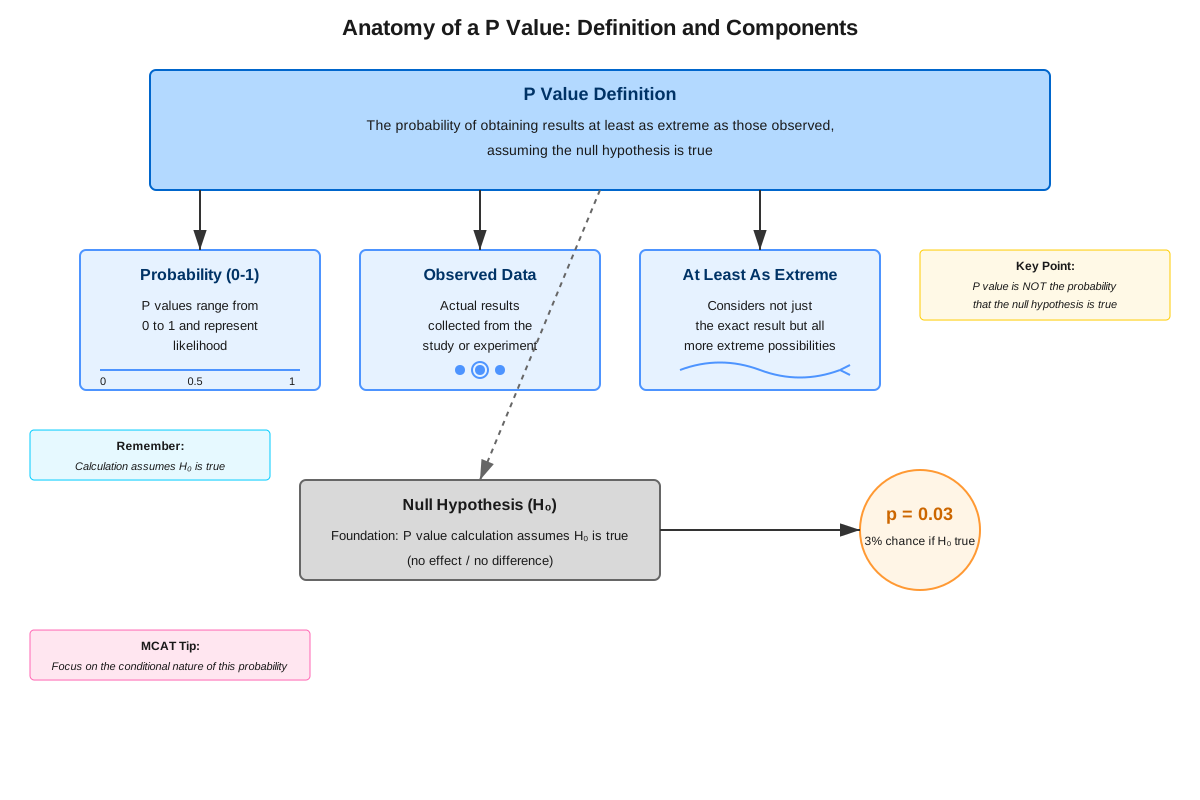
The p value (probability value) represents the probability of obtaining test results at least as extreme as the observed results, assuming that the null hypothesis is true. More precisely, it quantifies how compatible the observed data are with a specified statistical model (typically the null hypothesis of no effect or no difference). A p value is always a number between 0 and 1, often expressed as a decimal (e.g., 0.03) or in scientific notation (e.g., p < 0.001).
The calculation of a p value involves comparing the test statistic (such as a t-statistic or z-score) derived from sample data against a theoretical probability distribution. This comparison yields a probability that answers the question: "If there truly were no effect in the population, how likely would we be to observe data this extreme or more extreme?" Importantly, the p value does NOT tell us the probability that the null hypothesis is true or false—this is one of the most critical distinctions students must understand for the MCAT.
The Null Hypothesis Framework
Understanding p values requires firm grounding in hypothesis testing. Researchers begin with two competing hypotheses:
- Null hypothesis (H₀): States that there is no effect, no difference, or no relationship in the population
- Alternative hypothesis (H₁ or Hₐ): States that there is an effect, difference, or relationship
The p value specifically tests the null hypothesis by determining how unusual the observed data would be if H₀ were true. For example, in a study comparing stress levels between two socioeconomic groups, the null hypothesis might state that mean stress levels are equal between groups, while the alternative hypothesis would state they differ.
Statistical Significance and Alpha Levels
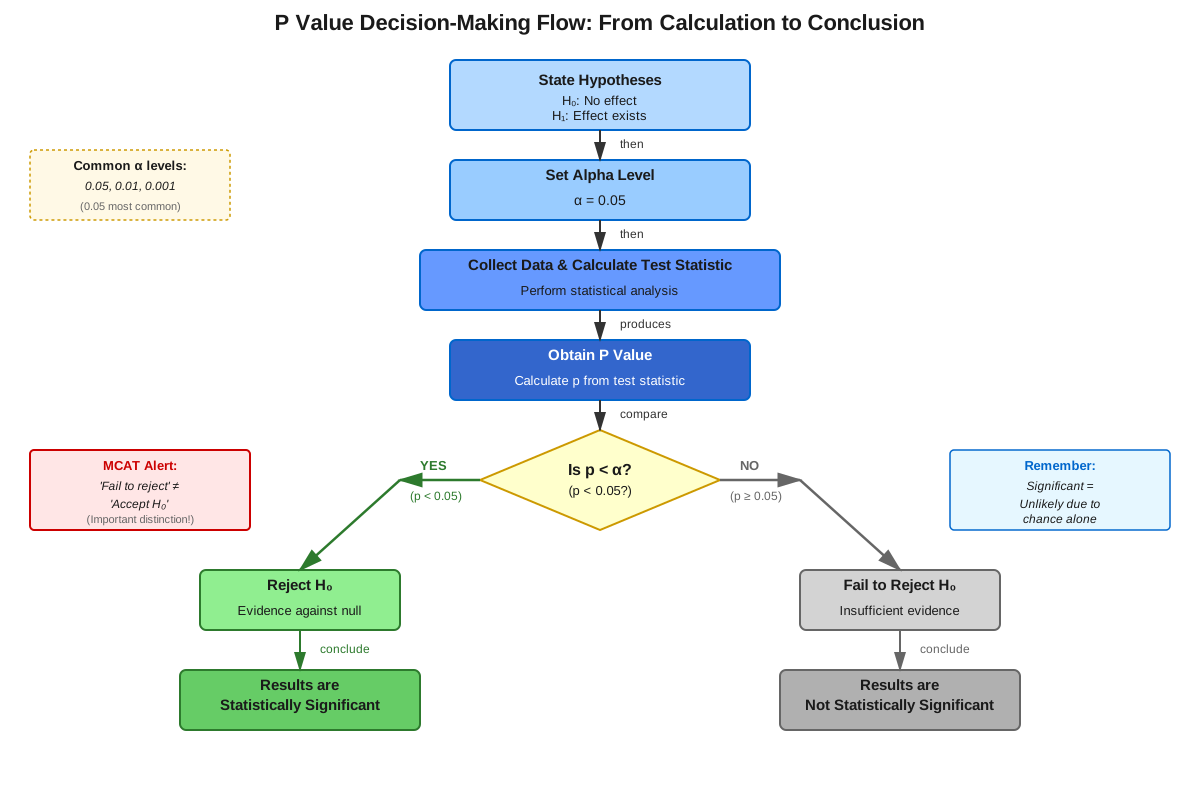
Statistical significance is determined by comparing the p value to a predetermined threshold called the alpha level (α) or significance level. The most commonly used alpha level is 0.05, though researchers may choose 0.01 or 0.10 depending on the context and consequences of errors.
The decision rule is straightforward:
- If p ≤ α: Reject the null hypothesis (results are statistically significant)
- If p > α: Fail to reject the null hypothesis (results are not statistically significant)
When p ≤ 0.05, researchers conclude that the observed results would occur less than 5% of the time by chance alone if the null hypothesis were true, providing sufficient evidence to reject H₀. This 5% threshold is a convention, not an absolute rule, and the MCAT may present scenarios using different alpha levels.
Interpreting P Values
| P Value Range | Interpretation | Typical Conclusion |
|---|---|---|
| p < 0.001 | Very strong evidence against H₀ | Highly statistically significant |
| 0.001 ≤ p < 0.01 | Strong evidence against H₀ | Very statistically significant |
| 0.01 ≤ p < 0.05 | Moderate evidence against H₀ | Statistically significant |
| 0.05 ≤ p < 0.10 | Weak evidence against H₀ | Marginally significant (not significant at α = 0.05) |
| p ≥ 0.10 | Little to no evidence against H₀ | Not statistically significant |
A smaller p value indicates stronger evidence against the null hypothesis. However, "stronger evidence" does not automatically mean "larger effect" or "more important finding"—this distinction is crucial for MCAT questions.
What P Values Do NOT Tell Us
This section addresses critical limitations that frequently appear in MCAT questions:
- P values do not indicate the probability that the null hypothesis is true: A p value of 0.03 does NOT mean there's a 3% chance the null hypothesis is true. It means that if the null hypothesis were true, there would be a 3% chance of observing data this extreme.
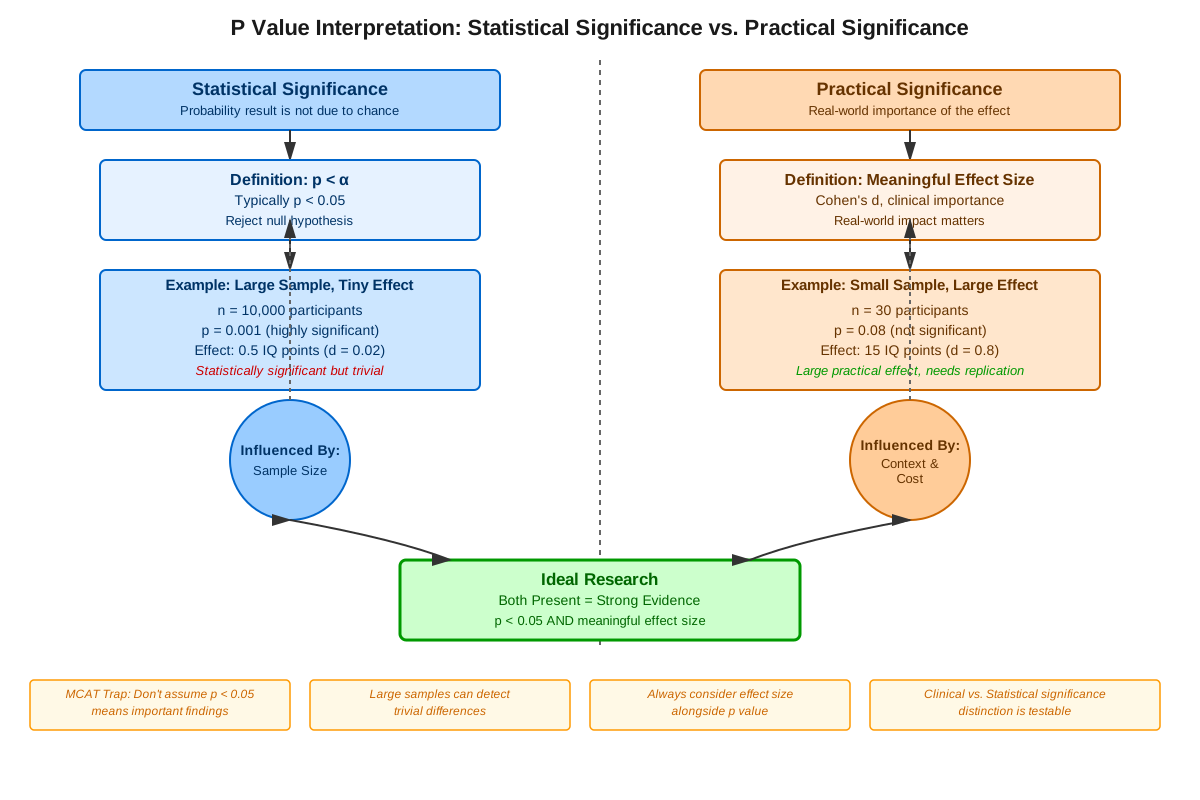
- P values do not measure effect size: A very small p value (e.g., p = 0.0001) can result from a tiny, practically meaningless effect if the sample size is large enough. Conversely, a large, important effect might yield p > 0.05 if the sample size is small.
- P values do not indicate practical or clinical significance: Statistical significance (p < 0.05) does not automatically mean the finding matters in real-world contexts. A drug might reduce symptoms by an amount that is statistically significant but too small to benefit patients meaningfully.
- P values are not the probability that results occurred by chance: This is a subtle but important distinction. The p value assumes the null hypothesis is true and calculates the probability of the data; it does not calculate the probability of the hypothesis given the data.
Factors Affecting P Values
Three primary factors influence p values in research:
Sample Size: Larger samples produce more precise estimates and smaller p values for the same effect size. With a sufficiently large sample, even trivial differences can become statistically significant. This is why the MCAT may present scenarios where researchers find p < 0.05 but the actual difference between groups is negligibly small.
Effect Size: The magnitude of the difference or strength of the relationship being tested directly affects p values. Larger effects are more likely to produce smaller p values, all else being equal.
Variability: Greater variability (spread) in the data makes it harder to detect effects, resulting in larger p values. Studies with more homogeneous samples or more precise measurements tend to yield smaller p values for the same effect size.
P Values in Sociology Research
In Sociology research specifically, p values help researchers evaluate hypotheses about social phenomena, group differences, and relationships between variables. Common applications include:
- Testing whether socioeconomic status differs significantly across racial/ethnic groups
- Evaluating whether an educational intervention significantly improves outcomes
- Determining whether correlation coefficients between social variables are statistically significant
- Assessing whether observed frequencies in categorical data differ from expected frequencies (chi-square tests)
Sociological research often deals with complex, multifaceted phenomena where effect sizes may be modest but meaningful. Understanding p values helps researchers and consumers of research distinguish signal from noise in social data.
Concept Relationships
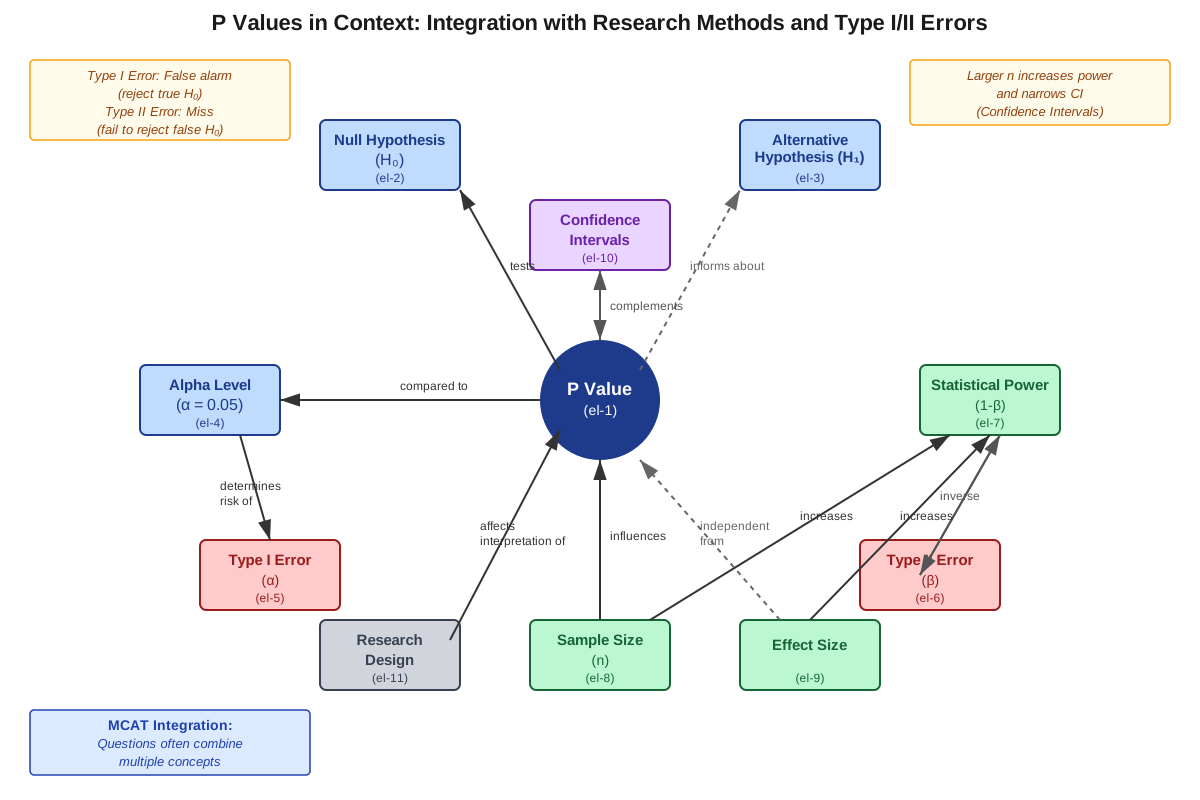
The p value sits at the center of a network of interconnected statistical and research methodology concepts. Hypothesis testing provides the framework within which p values operate: researchers formulate null and alternative hypotheses → collect data → calculate test statistics → determine p values → make decisions about rejecting or failing to reject the null hypothesis.
P values connect directly to Type I and Type II errors. A Type I error (false positive) occurs when researchers reject a true null hypothesis, and the alpha level represents the probability of making this error. When researchers set α = 0.05, they accept a 5% risk of Type I error. The p value threshold determines this error rate. Type II errors (false negatives) occur when researchers fail to reject a false null hypothesis, and while p values don't directly measure Type II error probability, the concepts are related through statistical power.
The relationship between p values and confidence intervals is complementary: both provide information about statistical significance. If a 95% confidence interval for a difference between means does not include zero, the corresponding p value will be less than 0.05. Confidence intervals offer additional information about the range of plausible values for the parameter being estimated.
Effect size measures (such as Cohen's d) and p values together provide a complete picture of research findings. Effect size → indicates magnitude of difference or strength of relationship; p value → indicates whether the effect is distinguishable from chance. The MCAT may present scenarios requiring students to recognize that both pieces of information are necessary for proper interpretation.
Within Research Methods and Statistics, p values connect to sampling distributions, the central limit theorem, and various statistical tests (t-tests, ANOVA, chi-square, correlation). Each test produces a test statistic that is converted to a p value using the appropriate probability distribution.
High-Yield Facts
⭐ The p value represents the probability of obtaining results at least as extreme as observed, assuming the null hypothesis is true—NOT the probability that the null hypothesis is true
⭐ Statistical significance (typically p < 0.05) does not automatically indicate practical or clinical significance
⭐ Smaller p values indicate stronger evidence against the null hypothesis, but do not measure effect size
⭐ The alpha level (commonly 0.05) is the threshold for determining statistical significance and represents the acceptable Type I error rate
⭐ Larger sample sizes produce smaller p values for the same effect size, which can lead to statistically significant but trivial findings
- A p value of 0.05 means that if the null hypothesis were true, results this extreme would occur 5% of the time by chance
- P values range from 0 to 1, with values closer to 0 providing stronger evidence against the null hypothesis
- "Failing to reject the null hypothesis" is not the same as "accepting the null hypothesis" or "proving no effect exists"
- P values are continuous measures, but the significance/non-significance distinction at α = 0.05 is arbitrary; p = 0.049 and p = 0.051 provide similar evidence despite different conclusions
- Multiple comparisons increase the likelihood of Type I errors, requiring adjustments to p value thresholds (Bonferroni correction)
- One-tailed tests produce smaller p values than two-tailed tests for the same data, but require directional hypotheses specified before data collection
Quick check — test yourself on p value basics so far.
Try Flashcards →Common Misconceptions
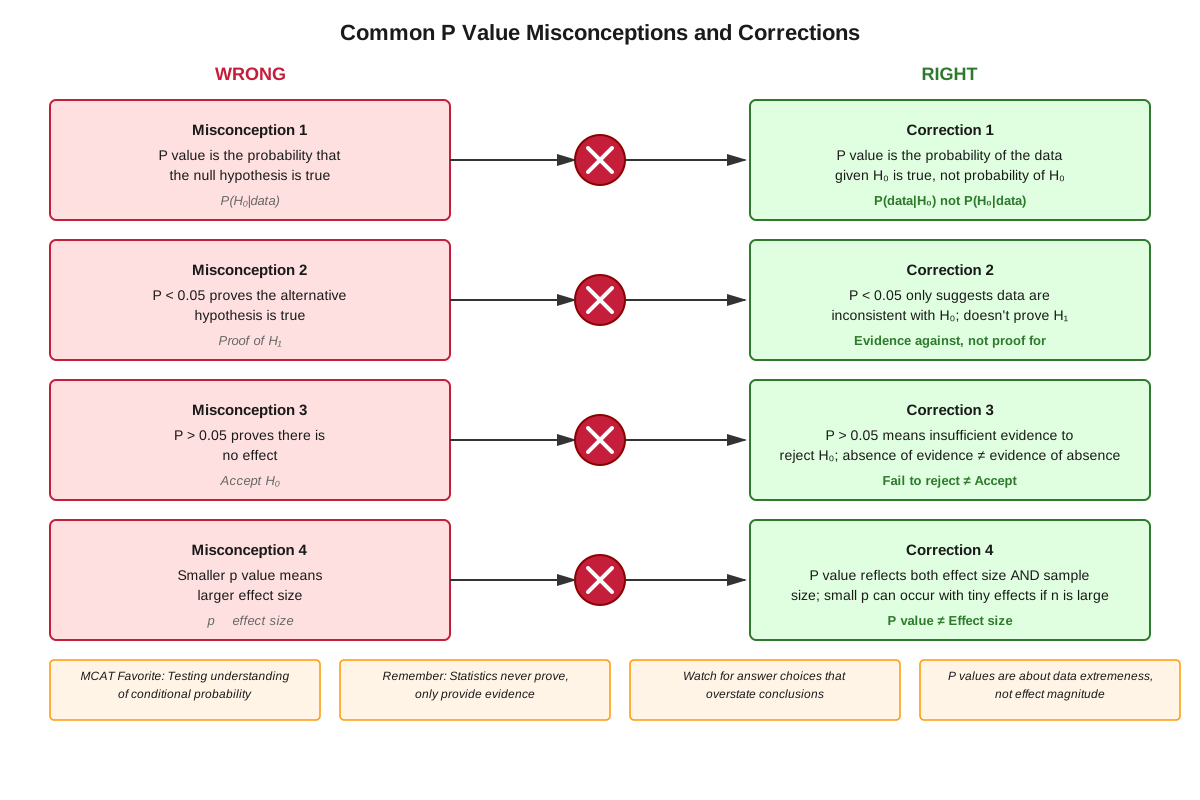
Misconception: A p value of 0.03 means there is a 3% probability that the null hypothesis is true.
Correction: The p value is calculated assuming the null hypothesis IS true. It represents the probability of observing data this extreme if H₀ were true, not the probability that H₀ is true. The latter would require Bayesian analysis incorporating prior probabilities.
Misconception: A non-significant result (p > 0.05) proves there is no effect or difference.
Correction: Failing to reject the null hypothesis simply means insufficient evidence was found to conclude an effect exists. The effect might exist but be too small to detect with the given sample size, or variability might obscure a real effect. Absence of evidence is not evidence of absence.
Misconception: A smaller p value indicates a larger or more important effect.
Correction: P values conflate effect size, sample size, and variability. A tiny, unimportant effect can produce p < 0.001 with a large sample, while a large, important effect might yield p > 0.05 with a small sample. Effect size measures (Cohen's d, correlation coefficients, odds ratios) quantify magnitude independently of sample size.
Misconception: Results are either "significant" or "not significant" with no middle ground.
Correction: While the p < 0.05 threshold creates a binary decision for hypothesis testing, evidence exists on a continuum. A p value of 0.06 provides nearly as much evidence against H₀ as p = 0.04. The 0.05 cutoff is a convention, not a natural boundary. Some researchers report exact p values and describe strength of evidence rather than making binary significant/not-significant declarations.
Misconception: If p < 0.05, the results must be due to the hypothesized cause rather than chance.
Correction: Statistical significance rules out random chance as an explanation but does not rule out confounding variables, bias, or alternative explanations. A significant p value in a poorly designed study with confounds does not establish causation. Research design quality determines whether causal inferences are justified, not p values alone.
Misconception: Replicating a study with p < 0.05 will always yield another significant result.
Correction: Even when a true effect exists, individual studies may yield p > 0.05 due to sampling variability. Statistical power (typically 80%) means that 20% of studies testing a real effect will fail to reach significance. Additionally, publication bias means published p < 0.05 results may overestimate effect sizes, making replication less likely to achieve significance.
Worked Examples
Example 1: Interpreting P Values in a Sociological Study
Scenario: Researchers investigate whether meditation training reduces perceived stress among college students. They randomly assign 50 students to a meditation group and 50 to a control group. After 8 weeks, they measure stress using a validated scale (higher scores = more stress). The meditation group has a mean stress score of 42.3 (SD = 8.1) and the control group has a mean of 46.7 (SD = 9.2). An independent samples t-test yields t(98) = 2.51, p = 0.014.
Question: What can we conclude from this p value?
Solution:
Step 1: Identify the null and alternative hypotheses.
- H₀: There is no difference in mean stress scores between meditation and control groups (μ₁ = μ₂)
- H₁: There is a difference in mean stress scores between groups (μ₁ ≠ μ₂)
Step 2: Compare the p value to the standard alpha level.
- p = 0.014 < α = 0.05
Step 3: Make a decision about the null hypothesis.
- Since p < 0.05, we reject the null hypothesis.
Step 4: State the conclusion in context.
- The difference in stress scores between the meditation group (M = 42.3) and control group (M = 46.7) is statistically significant at the 0.05 level. If there were truly no difference between groups in the population, we would expect to observe a difference this large or larger only 1.4% of the time by chance alone.
Step 5: Consider limitations and additional information needed.
- The p value tells us the result is unlikely due to chance, but doesn't tell us whether a 4.4-point difference on this stress scale is practically meaningful to students' lives.
- We would need to know the effect size (Cohen's d) and the minimal clinically important difference for this scale to evaluate practical significance.
- The significant p value supports that meditation had an effect, but doesn't prove meditation caused the reduction—though random assignment strengthens causal inference.
Connection to Learning Objectives: This example demonstrates proper interpretation of p values in context, distinguishes statistical from practical significance, and connects p values to research design considerations.
Example 2: Evaluating Conflicting P Values and Sample Size
Scenario: Two studies examine the relationship between social media use and life satisfaction:
Study A: n = 50 participants, correlation r = 0.35, p = 0.012
Study B: n = 500 participants, correlation r = 0.10, p = 0.024
Both studies find statistically significant negative correlations (more social media use associated with lower life satisfaction), but the correlation coefficients differ substantially.
Question: How should we interpret these findings, and which provides stronger evidence for a meaningful relationship?
Solution:
Step 1: Recognize that both p values are below 0.05, indicating statistical significance.
- Both studies provide evidence against the null hypothesis of no correlation (ρ = 0).
Step 2: Examine the effect sizes (correlation coefficients).
- Study A: r = 0.35 (medium effect size by Cohen's conventions)
- Study B: r = 0.10 (small effect size)
Step 3: Consider the role of sample size.
- Study B has 10 times the sample size of Study A.
- Larger samples detect smaller effects with greater precision, producing smaller p values even for weak relationships.
- Study B's smaller p value (0.024 vs. 0.012) despite a weaker correlation illustrates how sample size influences p values.
Step 4: Evaluate practical significance.
- Study A's r = 0.35 means social media use explains about 12% of variance in life satisfaction (r² = 0.12), suggesting a moderate relationship.
- Study B's r = 0.10 means social media use explains only 1% of variance (r² = 0.01), suggesting a weak relationship with limited practical importance.
Step 5: Synthesize the findings.
- Study A provides evidence for a more substantial relationship, despite the slightly larger p value.
- Study B's significant p value demonstrates that even weak relationships can achieve statistical significance with sufficient sample size.
- For practical purposes, Study A's findings suggest a more meaningful relationship, highlighting why effect size matters more than p values alone.
Connection to Learning Objectives: This example illustrates the critical distinction between statistical and practical significance, demonstrates how sample size affects p values, and shows why effect size must be considered alongside p values when evaluating research findings.
Exam Strategy
When approaching MCAT questions involving p values, follow this systematic approach:
Step 1: Identify what the question is actually asking. MCAT questions may ask about:
- The meaning or interpretation of a reported p value
- Whether results are statistically significant
- What conclusions are justified based on p values
- Limitations of p value interpretation
- The relationship between p values and other statistical concepts
Step 2: Look for trigger words and phrases:
- "statistically significant" → check if p < α (usually 0.05)
- "due to chance" → relates to p value interpretation
- "meaningful difference" or "clinically significant" → may be testing whether you confuse statistical with practical significance
- "sample size" mentioned → likely testing understanding of how sample size affects p values
- "correlation" or "association" with p values → remember that significant p values don't prove causation
Step 3: Apply process of elimination:
- Eliminate answers that confuse p values with the probability that H₀ is true
- Eliminate answers that equate small p values with large effects without considering sample size
- Eliminate answers that claim p > 0.05 proves no effect exists
- Eliminate answers that make causal claims based solely on p values without considering study design
Step 4: Watch for common traps:
- Questions presenting p = 0.06 and asking if results are significant (not at α = 0.05, but close)
- Scenarios with very large samples and small p values for trivial differences
- Studies with p < 0.05 but poor design (confounds, bias) where causal conclusions aren't justified
- Comparing two p values and asking which shows a "stronger effect" (trick: p values don't directly measure effect strength)
Exam Tip: If a passage reports multiple p values, the MCAT often asks about the one closest to 0.05 or the one that's non-significant, testing whether you understand the threshold and can avoid over-interpreting borderline results.
Time allocation: P value questions typically require 60-90 seconds. Spend 20-30 seconds identifying what's being asked, 20-30 seconds recalling the relevant concept, and 20-30 seconds eliminating wrong answers and confirming the correct one. Don't get bogged down calculating p values—the MCAT tests interpretation, not calculation.
Memory Techniques
Mnemonic for what p values represent: "P-ATEN"
- Probability of data
- Assuming null is true
- This extreme or more
- Evidence against null
- Not probability of hypothesis
Visualization for p value interpretation: Picture a courtroom where the null hypothesis is "on trial." The p value represents the strength of evidence against the defendant (H₀). A small p value is like overwhelming evidence suggesting guilt (reject H₀), while a large p value is like insufficient evidence (fail to reject H₀). Just as "not guilty" doesn't mean "innocent," failing to reject H₀ doesn't prove it's true.
Acronym for p value limitations: "NEPS"
- Not probability of hypothesis
- Effect size not measured
- Practical significance separate
- Sample size influences results
Memory aid for significance threshold: "Point-oh-FIVE keeps findings ALIVE" (p < 0.05 allows rejecting H₀ and claiming the finding is "alive"/real)
Conceptual anchor: Remember that p values answer the question: "How weird is my data if nothing is really happening?" Small p values mean "very weird, so something probably IS happening." Large p values mean "not that weird, so maybe nothing is happening."
Summary
The p value is a fundamental statistical concept representing the probability of obtaining results at least as extreme as those observed, assuming the null hypothesis is true. For the MCAT, students must understand that p values provide evidence for or against the null hypothesis but do not indicate the probability that hypotheses are true, do not measure effect size, and do not automatically indicate practical importance. Statistical significance, determined by comparing p values to alpha levels (typically 0.05), differs critically from practical significance. Sample size substantially influences p values—large samples can produce significant p values for trivial effects, while small samples may fail to detect important effects. Within Sociology and Research Methods and Statistics, p values enable researchers to evaluate whether observed patterns in social phenomena reflect genuine effects or random variation. MCAT questions test conceptual understanding of what p values mean, what they don't mean, and how to interpret them in research contexts. Success requires distinguishing statistical from practical significance, recognizing the influence of sample size, and avoiding common misinterpretations about probability and causation.
Key Takeaways
- The p value is the probability of obtaining results at least as extreme as observed IF the null hypothesis is true, not the probability that the null hypothesis is true
- Statistical significance (p < 0.05) indicates results unlikely due to chance but does not measure effect size or guarantee practical importance
- Larger sample sizes produce smaller p values for the same effect, potentially making trivial differences statistically significant
- Failing to reject the null hypothesis (p > 0.05) does not prove no effect exists—only that insufficient evidence was found
- P values must be interpreted alongside effect sizes, confidence intervals, and research design quality to draw appropriate conclusions
- The 0.05 threshold is a convention, not an absolute rule; evidence exists on a continuum
- For the MCAT, focus on conceptual understanding and interpretation rather than calculation of p values
Related Topics
Type I and Type II Errors: Understanding p values provides the foundation for learning about statistical errors in hypothesis testing. Type I error probability is directly controlled by the alpha level used to evaluate p values, while Type II errors relate to statistical power and the ability to detect true effects.
Effect Size Measures: Cohen's d, correlation coefficients, and odds ratios complement p values by quantifying the magnitude of effects. Mastering p values enables students to understand why both significance and effect size are necessary for complete interpretation.
Confidence Intervals: These provide an alternative approach to statistical inference that includes information about both significance and effect size. Understanding p values helps students grasp the relationship between confidence intervals and hypothesis testing.
Statistical Power: Power analysis determines the probability of detecting true effects and relates directly to p values, sample size, and effect size. P value knowledge is prerequisite to understanding power.
Research Design and Validity: P values indicate whether results are unlikely due to chance, but research design determines whether causal inferences are justified. This connection is crucial for evaluating the strength of scientific evidence.
Practice CTA
Now that you've mastered the fundamentals of p values, it's time to solidify your understanding through active practice. Attempt the practice questions and flashcards associated with this topic to test your ability to interpret p values in various research contexts, identify common misconceptions, and apply this knowledge to MCAT-style passages. Remember that statistical reasoning is a skill that improves with practice—each question you work through strengthens your ability to think critically about research findings and prepares you for the diverse ways the MCAT tests these concepts. You've built a strong foundation; now reinforce it through application!
Sign up free to keep reading
Create a free AnvayaPrep account to finish this MCAT guide on p value basics — plus flashcards and practice questions.