Overview
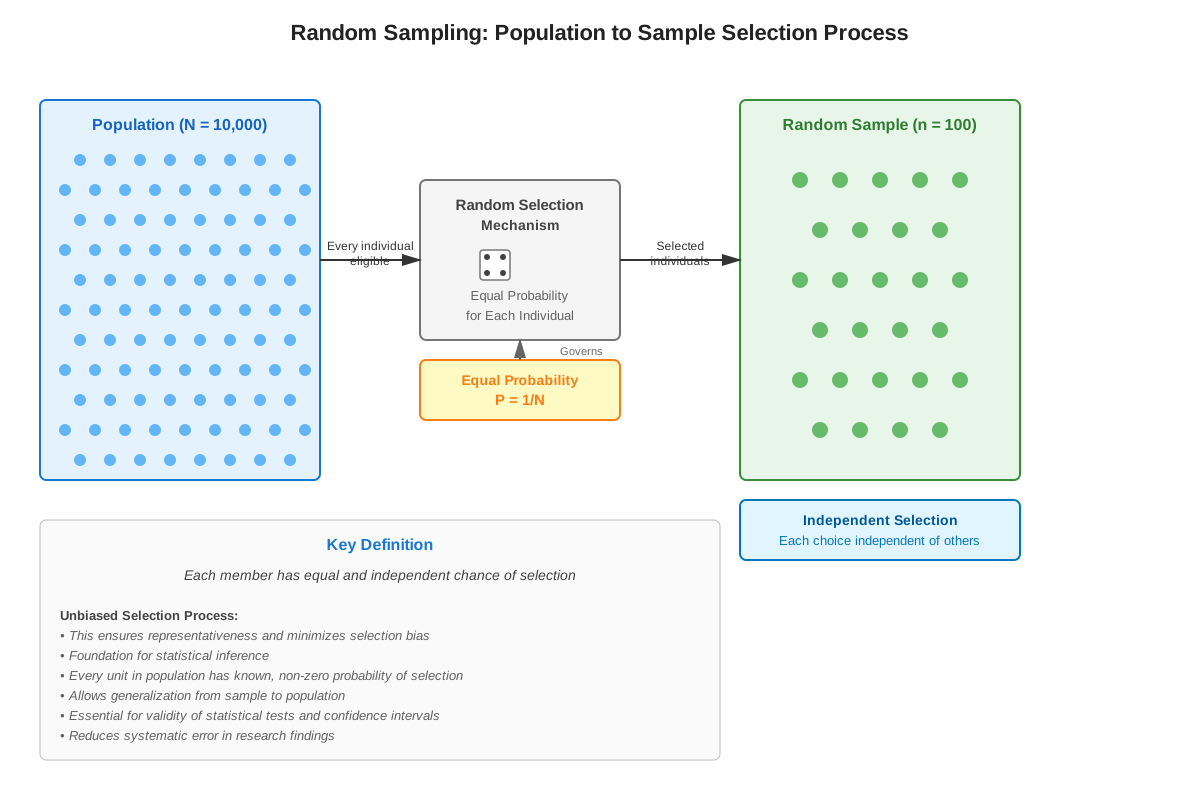
Random sampling is a fundamental research methodology concept that forms the backbone of valid, generalizable scientific inquiry in sociology and the behavioral sciences. This technique involves selecting participants from a population in such a way that every individual has an equal and independent chance of being chosen for the study. The principle ensures that the sample represents the larger population without systematic bias, allowing researchers to make inferences about population characteristics based on sample data.
For the MCAT, understanding random sampling is critical because it appears frequently in the Psychological, Social, and Biological Foundations of Behavior section, particularly when evaluating research design quality, identifying methodological flaws, and interpreting study results. Questions often present research scenarios where students must identify whether proper sampling techniques were employed, recognize threats to external validity, or determine whether conclusions drawn from a study are justified given the sampling method used. The MCAT tests not just definitional knowledge but the ability to apply sampling concepts to evaluate real research scenarios critically.
Random sampling connects to broader themes in Research Methods and Statistics and Sociology, including concepts of representativeness, generalizability, external validity, sampling bias, and statistical inference. It serves as a foundation for understanding how sociological knowledge is generated and validated, linking directly to topics such as survey research, experimental design, population parameters versus sample statistics, and the scientific method itself. Mastery of random sampling enables students to critically evaluate research claims, understand the limitations of different study designs, and recognize when findings can legitimately be extended beyond the immediate study sample to larger populations.
Learning Objectives
- [ ] Define Random sampling using accurate Sociology terminology
- [ ] Explain why Random sampling matters for the MCAT
- [ ] Apply Random sampling to exam-style questions
- [ ] Identify common mistakes related to Random sampling
- [ ] Connect Random sampling to related Sociology concepts
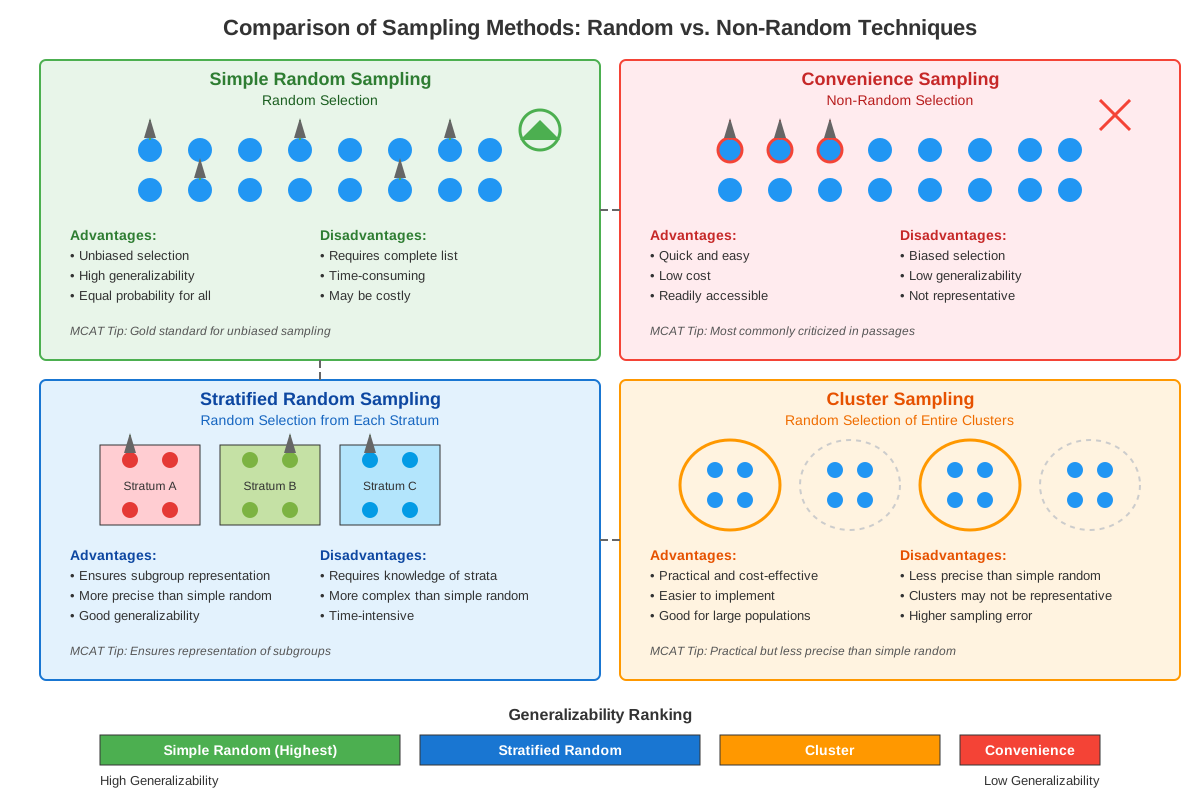
- [ ] Distinguish between random sampling and other sampling techniques (convenience, stratified, cluster)
- [ ] Evaluate the impact of sampling method on external validity and generalizability
- [ ] Analyze research scenarios to identify appropriate and inappropriate applications of random sampling
Prerequisites
- Basic statistical concepts: Understanding of populations versus samples is essential for grasping why sampling methods matter and how they relate to making inferences about larger groups.
- Research design fundamentals: Knowledge of independent and dependent variables, experimental versus observational studies provides context for where sampling fits in the research process.
- External validity: Familiarity with the concept of generalizability helps students understand the primary purpose and benefit of random sampling.
- Bias in research: Understanding that systematic errors can compromise study validity is necessary to appreciate how random sampling minimizes selection bias.
Why This Topic Matters
Random sampling represents a cornerstone of empirical research that directly impacts how sociological and psychological knowledge is generated and validated. In real-world applications, random sampling enables researchers to study manageable subsets of populations while maintaining confidence that findings reflect broader patterns. Public health initiatives, policy decisions, clinical trials, and social programs all depend on research using proper sampling techniques to ensure that interventions proven effective in study samples will work in target populations.
On the MCAT, random sampling appears with moderate frequency across multiple question types. Approximately 3-5% of Psychological, Social, and Biological Foundations questions directly test sampling concepts, but many additional questions indirectly require this knowledge when evaluating research validity. Questions typically appear in three formats: (1) passage-based questions asking students to identify methodological strengths or weaknesses in described studies, (2) discrete questions presenting research scenarios requiring identification of sampling type or evaluation of generalizability, and (3) questions asking students to identify which conclusions are supported by given research designs.
Common MCAT presentations include passages describing sociological studies where students must evaluate whether the sampling method supports the researchers' conclusions, questions asking which population a study's findings can legitimately be generalized to, and scenarios requiring identification of potential sampling biases that might compromise validity. The exam frequently tests the distinction between random sampling (for generalizability) and random assignment (for causality), a common point of confusion that appears in both correct answers and distractors.
Core Concepts
Definition and Fundamental Principles
Random sampling is a probability sampling technique in which every member of the target population has an equal, known, and independent probability of being selected for inclusion in the study sample. This method contrasts with non-probability sampling approaches where selection chances are unknown or unequal. The "random" aspect refers to the selection process being determined by chance rather than researcher choice or participant self-selection, typically implemented through random number generators, lottery methods, or systematic random selection procedures.
The fundamental principle underlying random sampling is that randomization eliminates systematic selection bias. When selection is truly random, characteristics that might influence study outcomes are distributed similarly in the sample and population. This doesn't guarantee the sample will perfectly mirror the population—random variation still occurs—but it ensures that any differences are due to chance rather than systematic bias. Over repeated sampling, random samples will, on average, accurately represent population characteristics.
Types of Random Sampling
Several variations of random sampling exist, each with specific applications:
Simple random sampling represents the purest form, where researchers select individuals directly from the entire population with equal probability. Implementation might involve assigning each population member a number and using a random number generator to select participants. This method works well for homogeneous populations but can be impractical for large, geographically dispersed populations.
Stratified random sampling involves dividing the population into homogeneous subgroups (strata) based on specific characteristics (age, gender, socioeconomic status), then randomly sampling from each stratum. This approach ensures representation of important subgroups and often increases precision compared to simple random sampling. For example, a study of healthcare access might stratify by income level to ensure adequate representation across socioeconomic groups.
Cluster random sampling involves randomly selecting naturally occurring groups (clusters) rather than individuals, then studying all members within selected clusters or randomly sampling within them. This method is practical when populations are geographically dispersed or when individual-level sampling frames are unavailable. A researcher might randomly select schools (clusters) then survey all students within selected schools.
Systematic random sampling involves selecting every nth individual from a population list after a random starting point. While not purely random, this method approximates random sampling when the list order is unrelated to study variables. For instance, selecting every 10th patient from a hospital registry after randomly choosing a starting point between 1 and 10.
Random Sampling vs. Random Assignment
A critical distinction for the MCAT involves understanding that random sampling and random assignment serve different purposes and address different validity types:
| Aspect | Random Sampling | Random Assignment |
|---|---|---|
| Purpose | Enhances external validity and generalizability | Enhances internal validity and causal inference |
| Process | Selecting participants from population | Assigning participants to experimental conditions |
| What it controls | Selection bias | Confounding variables |
| Validity type | External validity | Internal validity |
| Allows inference about | Population characteristics | Causal relationships |
Studies can employ random sampling without random assignment (observational studies with random samples), random assignment without random sampling (experiments with convenience samples), both (randomized controlled trials with random samples), or neither (convenience sample observational studies). The MCAT frequently tests whether students recognize which validity type is compromised when one or both are absent.
Sampling Frame and Coverage
The sampling frame is the actual list or mechanism from which the sample is drawn. Ideally, the sampling frame perfectly matches the target population, but discrepancies often exist. For example, using telephone directories as a sampling frame excludes individuals without listed numbers, creating coverage error. The quality of random sampling depends critically on sampling frame quality—even perfect randomization from a flawed frame produces biased samples.
Sample Size and Sampling Error
Sampling error refers to the natural variation between sample statistics and population parameters that occurs even with perfect random sampling. Larger random samples reduce sampling error and provide more precise population estimates. However, sample size doesn't compensate for sampling bias—a large biased sample remains biased regardless of size. This distinction is crucial: random sampling addresses bias (systematic error), while sample size addresses precision (random error).
Generalizability and External Validity
The primary advantage of random sampling is enhanced generalizability—the ability to extend findings beyond the study sample to the broader population. When samples are randomly selected, researchers can use inferential statistics to estimate population parameters with known confidence levels. External validity, the degree to which findings apply to other settings, populations, and times, is strengthened when samples represent target populations through random selection.
Concept Relationships
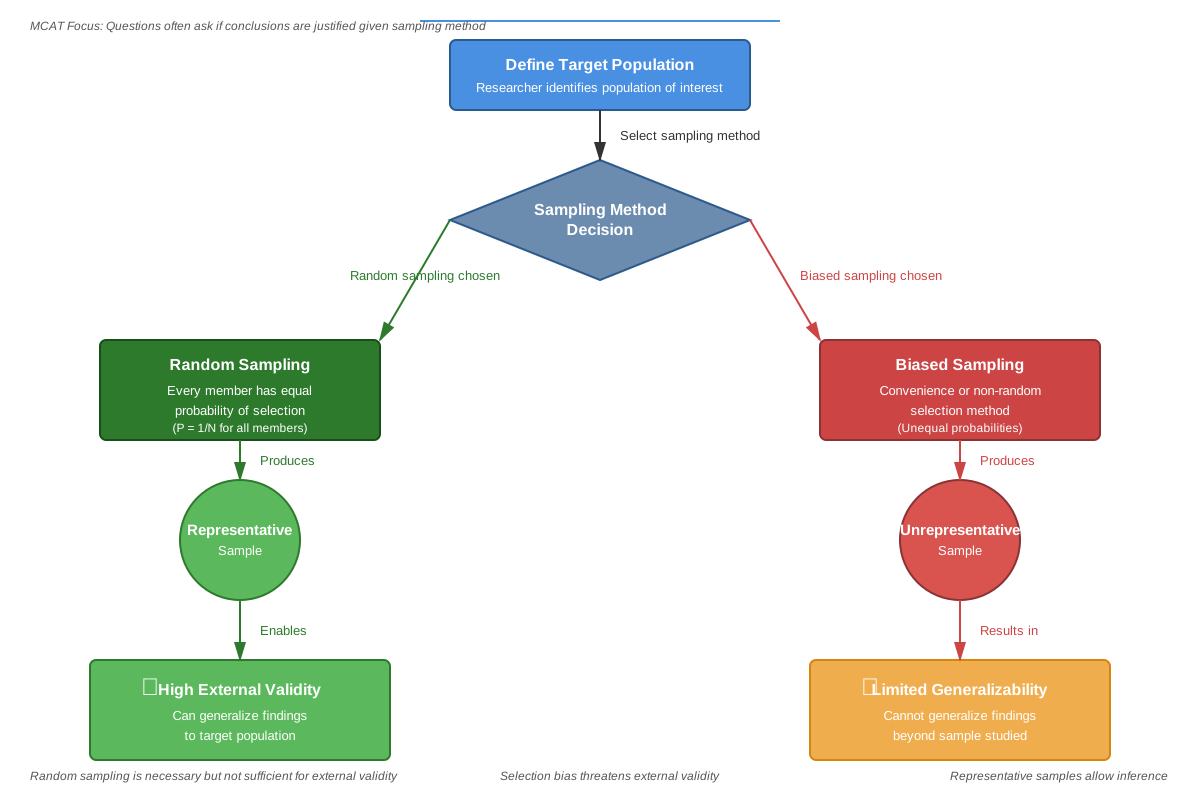
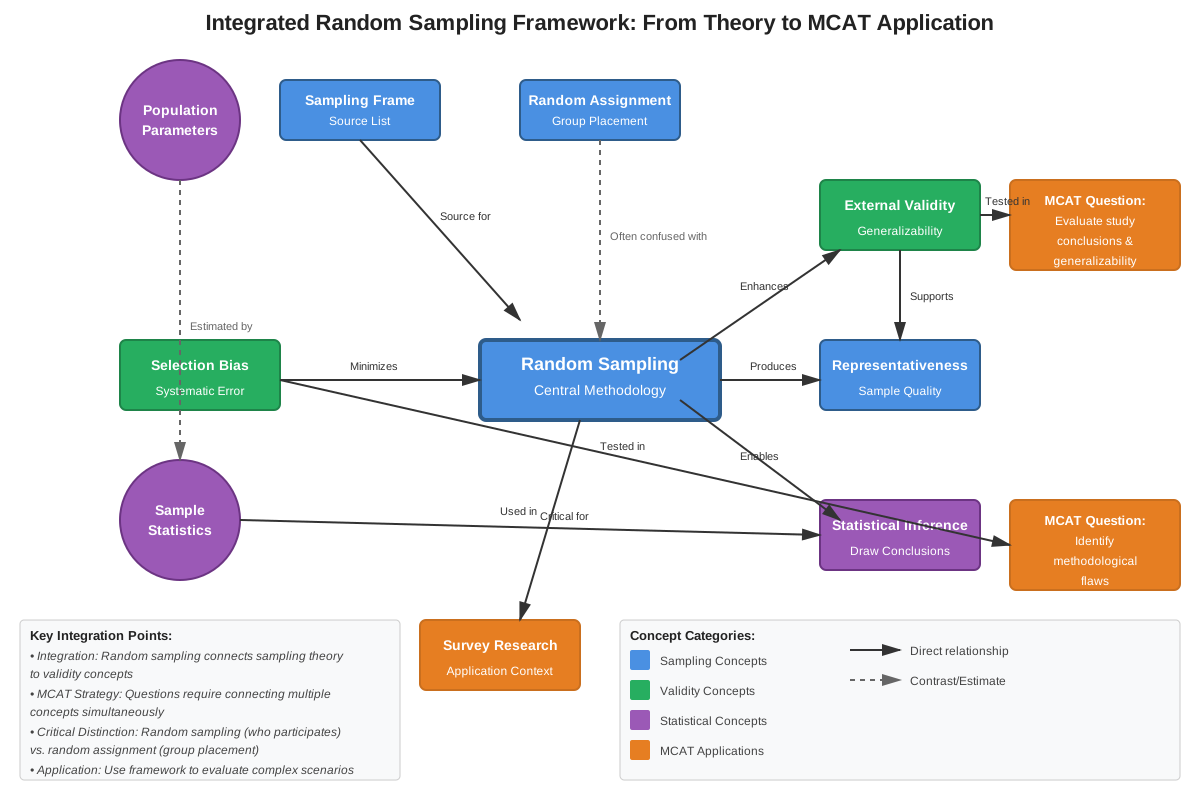
Random sampling connects to multiple research methodology concepts in an integrated framework. The relationship begins with defining the target population (the complete group about which researchers want to draw conclusions), which determines the sampling frame (the operational list from which selection occurs). The quality of alignment between target population and sampling frame affects coverage, which influences whether random sampling can achieve true representativeness.
Random sampling directly enhances external validity by ensuring the sample represents the population, enabling generalizability of findings. This contrasts with but complements random assignment, which enhances internal validity by distributing confounding variables equally across experimental conditions, enabling causal inference. Together, these form the foundation of rigorous experimental research: random sampling allows generalization to populations, while random assignment allows causal conclusions.
The relationship flows: Population → Sampling Frame → Random Sampling → Representative Sample → External Validity → Generalizability. Simultaneously: Sample → Random Assignment → Equivalent Groups → Internal Validity → Causal Inference. Optimal research designs incorporate both pathways, though practical constraints often necessitate trade-offs.
Random sampling also connects to sampling bias (which it minimizes), selection effects (which it controls), and statistical inference (which it enables). The concept relates to probability theory, as random sampling creates the foundation for using probability distributions to make population inferences. Understanding these relationships helps students recognize that random sampling isn't isolated but rather integrates into the broader research methodology framework tested on the MCAT.
High-Yield Facts
⭐ Random sampling enhances external validity and generalizability, not internal validity or causality—this distinction from random assignment is frequently tested.
⭐ Every member of the population must have an equal and independent chance of selection for true random sampling to occur.
⭐ Random sampling minimizes selection bias but does not eliminate sampling error—even random samples vary from populations due to chance.
⭐ Large sample size cannot compensate for biased sampling methods—a large convenience sample remains biased regardless of size.
⭐ Random sampling enables inferential statistics and confidence intervals by creating probability-based samples where sampling distributions are known.
- Stratified random sampling increases precision by ensuring representation of important subgroups while maintaining randomization.
- Cluster sampling is practical for geographically dispersed populations but typically has larger sampling error than simple random sampling.
- The sampling frame must adequately represent the target population for random sampling to produce representative samples.
- Systematic random sampling approximates simple random sampling when list order is unrelated to study variables.
- Random sampling is most critical when researchers want to generalize findings to populations beyond the study sample.
- Coverage error occurs when the sampling frame excludes segments of the target population, compromising representativeness even with random selection.
- Self-selection bias cannot be eliminated through random sampling if selected individuals choose whether to participate.
Quick check — test yourself on Random sampling so far.
Try Flashcards →Common Misconceptions
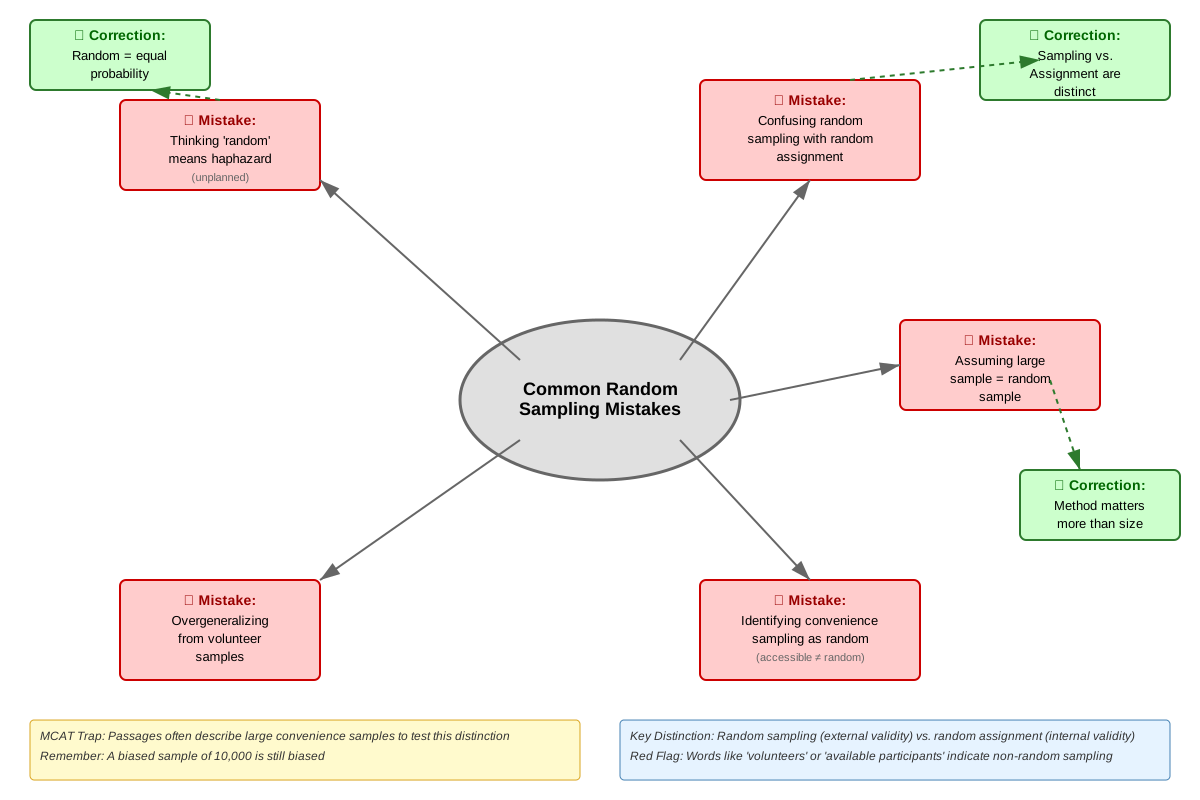
Misconception: Random sampling and random assignment are the same thing or serve the same purpose.
Correction: Random sampling (selecting participants from a population) enhances external validity and generalizability, while random assignment (assigning participants to conditions) enhances internal validity and enables causal inference. They address different validity threats and can occur independently.
Misconception: A large sample size makes the sampling method unimportant.
Correction: Sample size affects precision (sampling error) but does not address bias. A large convenience sample remains systematically biased and cannot be generalized to populations, while a smaller random sample, though less precise, avoids systematic bias and supports generalization.
Misconception: Random sampling means haphazardly or casually selecting participants.
Correction: Random sampling requires systematic procedures ensuring equal selection probability for all population members, typically using random number generators or formal randomization protocols. Haphazard selection introduces researcher bias and doesn't constitute true random sampling.
Misconception: If a study uses random sampling, its findings automatically apply to all populations.
Correction: Random sampling enables generalization only to the population from which the sample was drawn. A random sample of college students supports generalizations about college students, not all adults or all humans.
Misconception: Random sampling guarantees the sample will perfectly represent the population.
Correction: Random sampling ensures that any differences between sample and population are due to chance rather than systematic bias, but sampling error means individual random samples will vary from population parameters. Random sampling provides unbiased estimates on average across repeated sampling.
Misconception: Stratified sampling isn't truly random because researchers deliberately select from subgroups.
Correction: Stratified random sampling maintains randomization—selection within each stratum is random. The stratification step enhances representativeness and precision while preserving the fundamental principle that individuals have known, equal probabilities of selection within their stratum.
Misconception: Random sampling is always the best sampling method for any research question.
Correction: While random sampling optimizes generalizability, other considerations (cost, feasibility, research goals) may make alternative methods more appropriate. Exploratory research, case studies, or studies focused on specific subpopulations may appropriately use non-random sampling.
Worked Examples
Example 1: Evaluating Sampling Method and Generalizability
Scenario: Researchers want to study stress levels among healthcare workers during a pandemic. They post recruitment flyers in hospital break rooms inviting volunteers to complete an online survey. 500 healthcare workers respond. The researchers conclude that healthcare workers generally experience high stress during pandemics.
Analysis:
Step 1: Identify the sampling method used.
The researchers used convenience sampling with self-selection. Participants volunteered rather than being randomly selected from the population of all healthcare workers.
Step 2: Evaluate whether random sampling occurred.
No random sampling occurred because:
- Not all healthcare workers had an equal chance of selection
- Only those who saw flyers and chose to respond were included
- Selection probability was unknown and unequal
Step 3: Assess threats to external validity.
Multiple threats exist:
- Self-selection bias: Healthcare workers experiencing higher stress may be more motivated to participate
- Coverage error: Only workers in specific hospitals with break room access could participate
- Volunteer bias: Volunteers may differ systematically from non-volunteers
Step 4: Evaluate the conclusion's validity.
The conclusion that "healthcare workers generally experience high stress" overgeneralizes. The sample may not represent all healthcare workers due to systematic selection bias. The finding applies only to the specific volunteers studied, not healthcare workers broadly.
Step 5: Identify what would improve the design.
Random sampling from a comprehensive list of healthcare workers (sampling frame) would enhance generalizability. For example, randomly selecting workers from hospital employee databases across multiple institutions would create a representative sample supporting broader conclusions.
Connection to learning objectives: This example demonstrates applying random sampling concepts to evaluate research validity, identifying when random sampling is absent, and recognizing how sampling method affects generalizability—all critical MCAT skills.
Example 2: Distinguishing Random Sampling from Random Assignment
Scenario: A researcher recruits 100 college students from psychology classes to study the effect of meditation on anxiety. The researcher randomly assigns 50 students to practice daily meditation and 50 to a control group. After four weeks, the meditation group shows significantly lower anxiety. The researcher concludes that meditation reduces anxiety in the general population.
Analysis:
Step 1: Identify what randomization occurred.
The study used random assignment (participants randomly assigned to meditation vs. control conditions) but not random sampling (participants were a convenience sample from psychology classes).
Step 2: Evaluate internal validity.
Random assignment enhances internal validity by distributing confounding variables equally across groups. The researcher can reasonably conclude that meditation caused the anxiety reduction in this sample because random assignment controlled for alternative explanations.
Step 3: Evaluate external validity.
External validity is limited because:
- No random sampling from the general population occurred
- Psychology students may differ from the general population in motivation, mental health awareness, or other characteristics
- The sampling frame (psychology classes) doesn't represent the target population (general population)
Step 4: Assess the conclusion's validity.
The causal conclusion (meditation reduces anxiety) is supported for this sample due to random assignment. However, generalizing to "the general population" is not justified because the sample wasn't randomly selected from that population. The conclusion should be limited to populations similar to college psychology students.
Step 5: Identify the validity trade-off.
This study prioritized internal validity (establishing causation through random assignment) over external validity (generalizability through random sampling). This trade-off is common in experimental research where practical constraints limit random sampling, but random assignment remains feasible.
Correct interpretation: "Among college psychology students, meditation reduces anxiety" (supported by random assignment within this sample). "Meditation reduces anxiety in the general population" (not supported without random sampling from that population).
Connection to learning objectives: This example illustrates the critical distinction between random sampling and random assignment, demonstrates how to evaluate both internal and external validity, and shows how sampling method affects the scope of legitimate conclusions—all high-yield MCAT concepts.
Exam Strategy
When approaching MCAT questions about random sampling, follow this systematic strategy:
Step 1: Identify what the question is actually asking. Distinguish whether the question concerns:
- Sampling method (how participants were selected)
- Assignment method (how participants were allocated to conditions)
- Validity type (internal vs. external)
- Generalizability (to what population can findings extend)
Step 2: Look for trigger words and phrases that signal random sampling concepts:
- "Representative sample" → suggests random sampling
- "Generalize to" → tests external validity and sampling method
- "Randomly assigned" → refers to assignment, not sampling
- "Volunteers," "convenience sample," "recruited from" → indicates non-random sampling
- "Selected from," "drawn from" → describes sampling method
- "Causal relationship" → tests internal validity and random assignment
Step 3: Apply the validity framework:
- If the question asks about causation → focus on random assignment and internal validity
- If the question asks about generalization → focus on random sampling and external validity
- If both are mentioned → recognize they address different aspects
Step 4: Evaluate the sampling frame:
- Identify the target population (who researchers want to generalize to)
- Identify the sampling frame (who could actually be selected)
- Assess alignment—poor alignment limits generalizability even with random sampling
Step 5: Use process of elimination:
- Eliminate answers confusing random sampling with random assignment
- Eliminate answers claiming large sample size compensates for biased sampling
- Eliminate answers overgeneralizing beyond the sampled population
- Eliminate answers claiming random sampling establishes causation
Exam Tip: When a passage describes a study, immediately identify both the sampling method AND assignment method. Create a quick mental note: "Convenience sample + random assignment = good internal validity, limited external validity."
Time allocation: Spend 30-45 seconds identifying sampling and assignment methods when reading passages. This upfront investment saves time on multiple questions that may test these concepts. For discrete questions, spend 60-90 seconds carefully distinguishing what aspect of research design is being tested.
Common trap: Answer choices that sound sophisticated but confuse concepts. For example, "The random sampling ensures that meditation caused the anxiety reduction" sounds scientific but incorrectly attributes causation to sampling rather than assignment. Always verify that the reasoning chain matches the concept being tested.
Memory Techniques
Mnemonic for Random Sampling Purpose: "EGGS"
- External validity
- Generalizability
- Getting representative samples
- Selection bias minimization
Mnemonic for Random Sampling vs. Random Assignment: "SAGE"
- Sampling → External validity (both have "S" and "E")
- Assignment → Good for causation (both start with consonants)
Visualization Strategy: Picture random sampling as casting a wide net randomly across an ocean (population) to catch fish (participants) that represent all fish in the ocean. Picture random assignment as taking your caught fish and randomly putting them into different tanks (conditions). The first determines if your fish represent the ocean; the second determines if tank differences caused outcome differences.
Acronym for Sampling Types: "SSCS" (Simple, Stratified, Cluster, Systematic)
- Simple: Straightforward selection from whole population
- Stratified: Subgroups first, then random selection
- Cluster: Choose groups, not individuals
- Systematic: Select every nth person
Memory Hook: "Random sampling lets you GENERALIZE (9 letters, sounds like 'general population'). Random assignment lets you find CAUSES (6 letters, shorter and more focused, like the specific relationship between variables)."
Conceptual Anchor: Link random sampling to jury selection—the goal is getting jurors who represent the community (generalizability), not determining guilt (causation). Random selection from voter rolls creates a representative jury, just as random sampling creates representative research samples.
Summary
Random sampling is a probability-based selection method ensuring every population member has an equal, independent chance of inclusion in a research sample. This technique fundamentally enhances external validity and generalizability by minimizing selection bias, enabling researchers to make valid inferences about populations based on sample data. The MCAT frequently tests the distinction between random sampling (which addresses external validity through representative selection) and random assignment (which addresses internal validity through equivalent group creation), as well as the ability to evaluate whether sampling methods support researchers' conclusions. Key variations include simple random sampling, stratified random sampling, cluster sampling, and systematic sampling, each with specific applications and trade-offs. Understanding that random sampling cannot be compensated for by large sample sizes, that it enables but doesn't guarantee perfect representation, and that generalizability is limited to the population from which sampling occurred are critical for MCAT success. Students must recognize sampling method impacts on study validity, identify appropriate and inappropriate generalizations, and evaluate research designs by assessing both how participants were selected and how they were assigned to conditions.
Key Takeaways
- Random sampling enhances external validity and enables generalization to populations, while random assignment enhances internal validity and enables causal inference—these serve distinct purposes and are frequently confused on the MCAT.
- True random sampling requires that every population member has an equal, known, and independent probability of selection, which eliminates systematic selection bias but not random sampling error.
- Large sample sizes increase precision but cannot compensate for biased sampling methods—representativeness depends on how participants are selected, not how many are selected.
- The sampling frame must adequately represent the target population for random sampling to produce generalizable results; coverage error compromises external validity even with perfect randomization.
- Generalizability is limited to the population from which the sample was randomly drawn—random samples of college students support conclusions about college students, not all adults.
- Stratified random sampling maintains randomization while ensuring representation of important subgroups, often providing more precise population estimates than simple random sampling.
- MCAT questions frequently test whether conclusions are justified given the sampling method used, requiring evaluation of both what randomization occurred (sampling vs. assignment) and what population findings can legitimately be generalized to.
Related Topics
Sampling Bias and Selection Effects: Understanding various forms of bias (self-selection, volunteer bias, non-response bias) that compromise sample representativeness even when random sampling is attempted. Mastering random sampling provides the foundation for recognizing when these biases threaten validity.
Internal Validity and Random Assignment: The complement to random sampling, focusing on how random assignment to conditions enables causal inference by controlling confounding variables. Together, these concepts form the complete framework for evaluating research design quality.
External Validity and Generalizability: Broader examination of factors affecting whether findings extend beyond immediate study contexts, including population, setting, and temporal generalizability. Random sampling is the primary method for enhancing population generalizability.
Survey Research Methods: Application of random sampling principles to survey design, including sampling frames, response rates, and coverage error. Understanding random sampling is essential for evaluating survey validity.
Statistical Inference and Confidence Intervals: The mathematical foundation explaining how random samples enable population parameter estimation with known confidence levels. Random sampling creates the probability basis for inferential statistics.
Experimental Design: Integration of sampling and assignment methods within complete research designs, including randomized controlled trials, quasi-experiments, and observational studies. Mastering random sampling enables sophisticated evaluation of design trade-offs.
Practice CTA
Now that you've mastered the core concepts of random sampling, it's time to solidify your understanding through active practice. Work through the practice questions to apply these concepts to MCAT-style scenarios, testing your ability to distinguish sampling methods, evaluate generalizability, and identify validity threats. Use the flashcards to reinforce high-yield facts and distinctions, particularly the critical difference between random sampling and random assignment. Remember, the MCAT tests application and analysis, not just recognition—practice evaluating research scenarios critically, asking yourself: "How were participants selected? How were they assigned? What can legitimately be concluded?" Your ability to systematically analyze sampling methods will serve you across multiple questions on test day. You've built a strong foundation—now strengthen it through deliberate practice!
Sign up free to keep reading
Create a free AnvayaPrep account to finish this MCAT guide on Random sampling — plus flashcards and practice questions.