Overview
Standard deviation is a fundamental statistical measure that quantifies the amount of variation or dispersion in a dataset. In the context of Sociology and Research Methods and Statistics, standard deviation provides researchers with a precise numerical value that describes how spread out data points are from the mean (average) of the distribution. When data points cluster tightly around the mean, the standard deviation is small; when they are widely scattered, the standard deviation is large. This concept is essential for understanding population characteristics, research findings, and the reliability of sociological measurements.
For the MCAT, standard deviation appears regularly in passages that present research studies, experimental results, and population health data. The exam tests whether students can interpret statistical findings, evaluate research quality, and understand the implications of data variability. Questions may ask students to compare the consistency of different datasets, identify which group shows more homogeneity, or determine whether observed differences between groups are meaningful given the spread of the data. Standard deviation is particularly important in the Psychological, Social, and Biological Foundations of Behavior section, where research methodology questions frequently appear.
Understanding standard deviation connects to broader sociological concepts including normal distribution, sampling methods, research validity, and data interpretation. It serves as a bridge between raw data collection and meaningful conclusions about social phenomena. Mastery of this topic enables students to critically evaluate research claims, understand population variability, and recognize when statistical findings are robust versus when they might be misleading due to high variability within groups.
Learning Objectives
- [ ] Define Standard deviation using accurate Sociology terminology
- [ ] Explain why Standard deviation matters for the MCAT
- [ ] Apply Standard deviation to exam-style questions
- [ ] Identify common mistakes related to Standard deviation
- [ ] Connect Standard deviation to related Sociology concepts
- [ ] Calculate and interpret standard deviation values in research contexts
- [ ] Compare datasets using standard deviation to assess variability and consistency
- [ ] Evaluate the relationship between standard deviation and normal distribution curves
Prerequisites
- Mean (average): Standard deviation measures spread around the mean, making understanding of central tendency essential
- Basic arithmetic operations: Calculating standard deviation requires addition, subtraction, squaring, and square roots
- Concept of variability: Understanding that data points differ from one another and that this variation can be quantified
- Normal distribution basics: Standard deviation divides the normal curve into predictable segments
- Research study design: Context for interpreting what standard deviation reveals about study populations
Why This Topic Matters
Standard deviation has profound real-world significance in sociology, public health, and medical research. When researchers study health disparities, educational outcomes, or behavioral interventions, standard deviation reveals whether findings apply broadly or only to specific subgroups. For example, if a new therapy reduces depression scores by an average of 10 points but has a standard deviation of 15 points, this indicates enormous variability—some patients improved dramatically while others may have worsened. Conversely, a standard deviation of 2 points would indicate consistent improvement across participants, making the intervention more reliable and generalizable.
On the MCAT, standard deviation appears in approximately 3-5% of questions in the Psychological, Social, and Biological Foundations of Behavior section. Questions typically present research passages with data tables or graphs showing means and standard deviations for different experimental groups. Students must interpret whether groups differ meaningfully, which dataset shows more consistency, or what the standard deviation reveals about population characteristics. The exam also tests conceptual understanding through questions about research design quality, sampling adequacy, and the implications of high versus low variability.
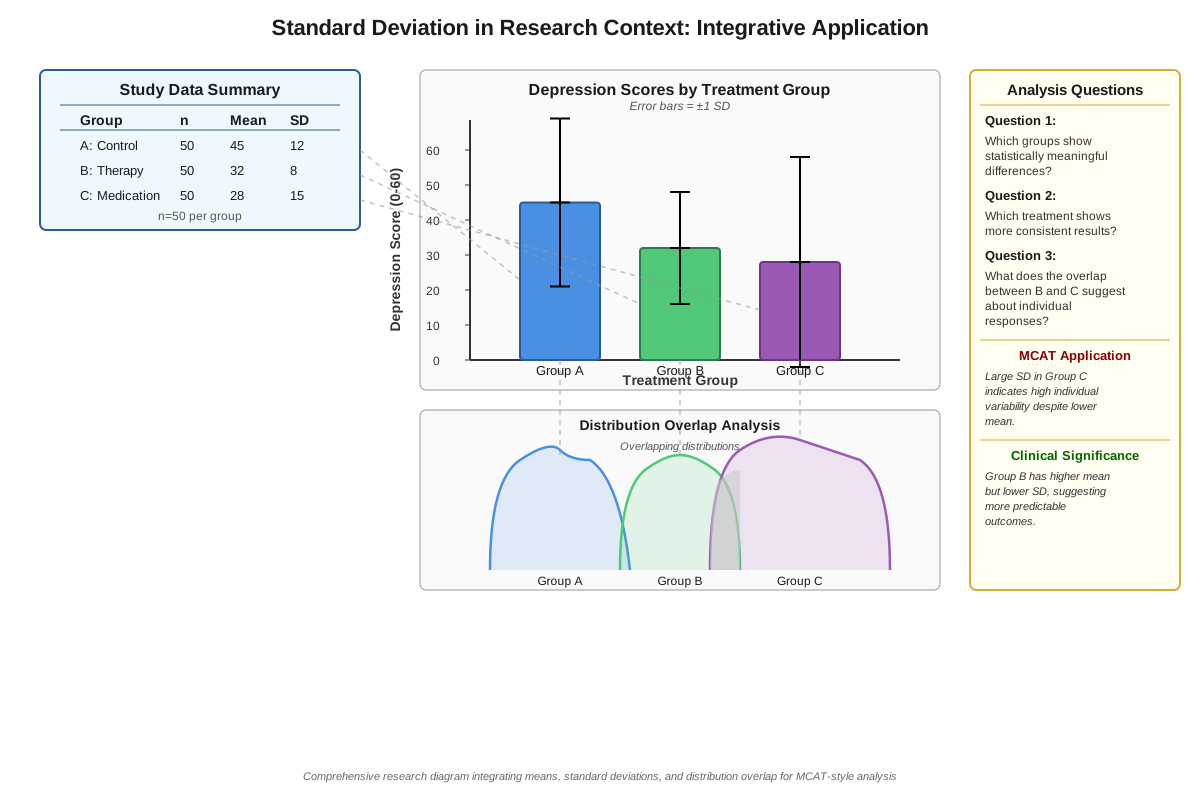
Common MCAT presentations include: (1) comparing two treatment groups with different standard deviations to determine which shows more consistent effects; (2) interpreting error bars on graphs, which often represent standard deviation; (3) evaluating whether sample sizes are adequate given the variability in measurements; (4) determining which population is more homogeneous based on standard deviation values; and (5) recognizing when high standard deviation undermines the meaningfulness of mean differences between groups.
Core Concepts
Definition and Meaning
Standard deviation is a statistical measure that quantifies the average distance of data points from the mean of their distribution. Mathematically, it represents the square root of the variance (the average of squared deviations from the mean). In Sociology research, standard deviation provides crucial information about population heterogeneity and the consistency of measurements across individuals or groups.
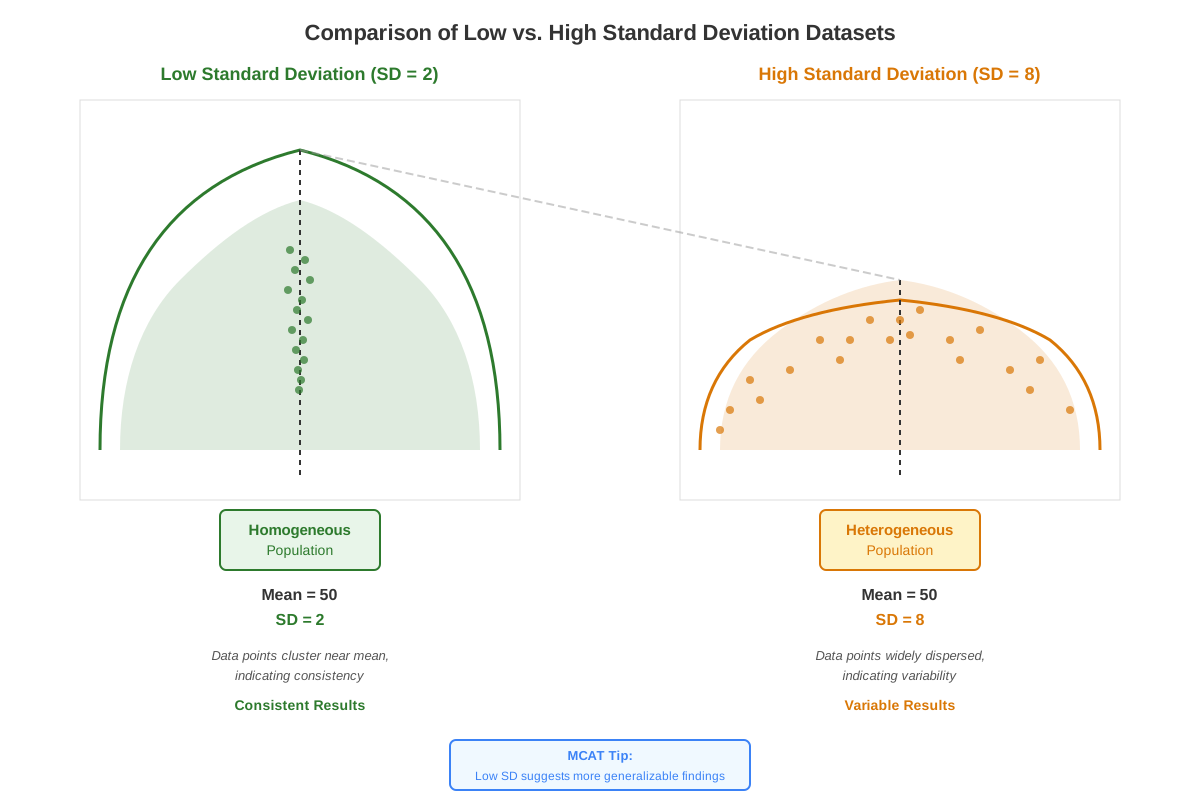
A small standard deviation indicates that most data points cluster closely around the mean, suggesting homogeneity within the population or consistency in measurements. A large standard deviation indicates that data points are widely dispersed, suggesting heterogeneity or high variability. For example, if average income in Community A is $50,000 with a standard deviation of $5,000, most residents earn between $45,000 and $55,000. If Community B also has an average income of $50,000 but a standard deviation of $25,000, incomes range much more widely, from very low to very high earners.
Calculation Components
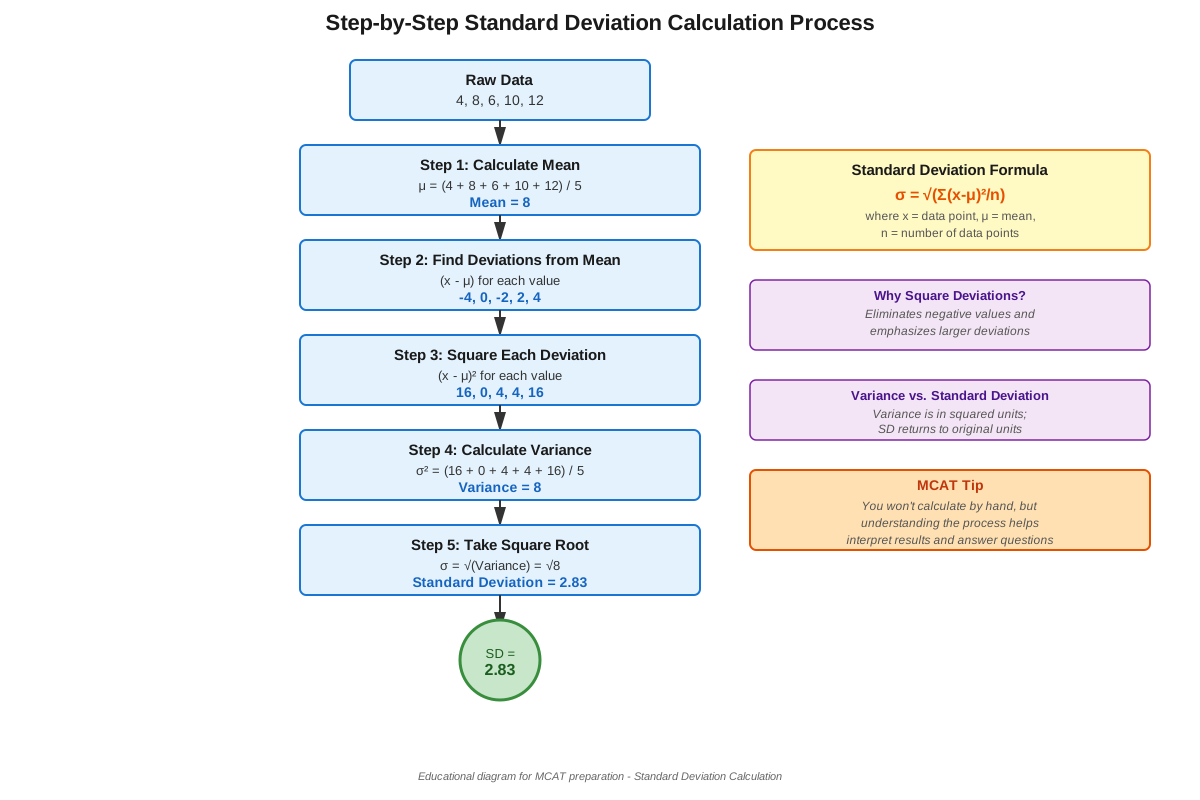
While the MCAT rarely requires manual calculation of standard deviation, understanding the calculation process illuminates its meaning. The process involves:
- Calculate the mean of all data points
- Subtract the mean from each individual data point (finding deviations)
- Square each deviation (eliminating negative values)
- Calculate the average of these squared deviations (this is the variance)
- Take the square root of the variance (this is the standard deviation)
Standard Deviation (σ) = √[Σ(x - μ)² / N]

Where:
σ = standard deviation
x = each individual data point
μ = mean of all data points
N = number of data points
Σ = sum of all values
This calculation method ensures that standard deviation is always positive and is expressed in the same units as the original data, making it interpretable and meaningful.
Standard Deviation and the Normal Distribution
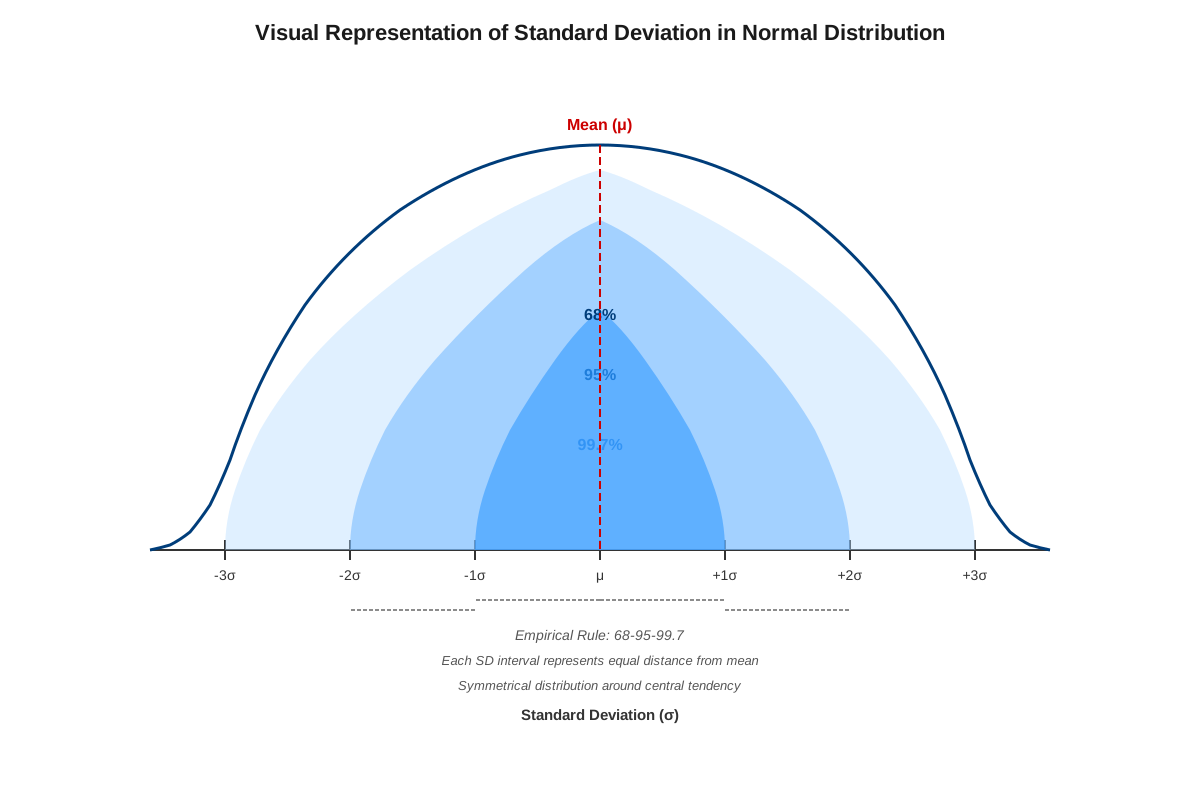
In a normal distribution (bell curve), standard deviation creates predictable segments. This relationship is fundamental to interpreting research data:
- 68% of data falls within ±1 standard deviation of the mean
- 95% of data falls within ±2 standard deviations of the mean
- 99.7% of data falls within ±3 standard deviations of the mean
This is known as the empirical rule or 68-95-99.7 rule. For MCAT purposes, this means that if a study reports a mean score of 100 with a standard deviation of 15, approximately 68% of participants scored between 85 and 115, and 95% scored between 70 and 130.
Standard Deviation in Research Interpretation
In Research Methods and Statistics, standard deviation serves multiple critical functions:
Assessing measurement reliability: Low standard deviation in repeated measurements of the same phenomenon suggests reliable, consistent measurement tools. High standard deviation may indicate measurement error or genuine variability in the phenomenon being studied.
Comparing group homogeneity: When comparing two populations or experimental groups, the group with smaller standard deviation is more homogeneous. This has implications for generalizability—findings from homogeneous samples may not apply to more diverse populations.
Evaluating intervention effectiveness: An intervention that produces large mean changes but also large standard deviations may work well for some individuals but poorly for others. Smaller standard deviations suggest more consistent, predictable effects.
Understanding overlap between groups: Even when two groups have different means, large standard deviations may indicate substantial overlap. For example, if men average 70 inches tall (SD = 4) and women average 65 inches tall (SD = 4), many individual women are taller than many individual men despite the mean difference.
Standard Deviation vs. Standard Error
A critical distinction for the MCAT involves differentiating standard deviation from standard error of the mean:
| Feature | Standard Deviation | Standard Error |
|---|---|---|
| Measures | Variability within a sample or population | Precision of the sample mean as an estimate of population mean |
| Interpretation | How spread out individual data points are | How much sample means would vary if study were repeated |
| Calculation | Based on individual data points | Standard deviation divided by square root of sample size |
| Use | Describes population characteristics | Assesses sampling accuracy |
| Value | Larger values indicate more variability | Larger values indicate less precise estimates |
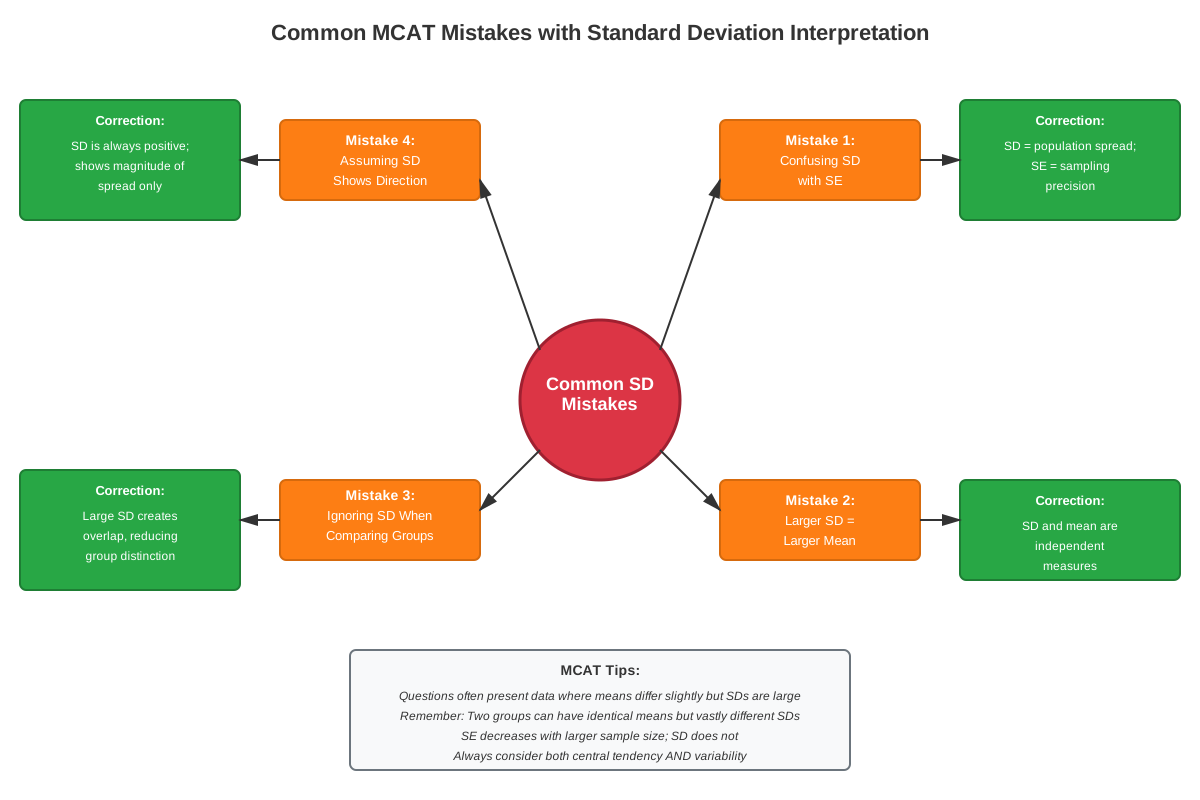
Standard error decreases as sample size increases (because larger samples provide more precise estimates), while standard deviation remains relatively stable regardless of sample size (it describes the actual population variability).
Practical Applications in Sociology
In sociological research, standard deviation helps researchers understand:
Social stratification: Income inequality can be quantified through standard deviation—societies with larger income standard deviations show greater economic inequality.
Educational outcomes: Test score standard deviations reveal whether educational systems produce uniform outcomes or wide achievement gaps.
Health disparities: Standard deviation in health metrics (blood pressure, BMI, disease prevalence) indicates population health homogeneity or heterogeneity.
Behavioral consistency: Standard deviation in behavioral measures (aggression scores, cooperation rates, response times) reveals whether behaviors are consistent across individuals or highly variable.
Cultural variation: Standard deviation in attitude surveys or value assessments indicates cultural homogeneity versus diversity within populations.
Concept Relationships
Standard deviation connects intimately with the mean because it measures spread around this central value. Without knowing the mean, standard deviation lacks context; without knowing standard deviation, the mean provides incomplete information about the dataset. Together, they offer a two-dimensional description: where the center is and how spread out the data are.
The relationship flows: Raw Data → Mean Calculation → Deviation Calculation → Variance → Standard Deviation. Each step builds on the previous, transforming individual observations into a summary statistic that describes the entire distribution.
Standard deviation directly relates to the normal distribution concept. When data follow a normal distribution, standard deviation becomes especially powerful because it allows precise probability statements. Approximately 68% of observations fall within one standard deviation of the mean, creating predictable patterns that researchers exploit for hypothesis testing and confidence interval construction.
Variance is the mathematical precursor to standard deviation (standard deviation is the square root of variance). While variance is used in many statistical calculations, standard deviation is preferred for interpretation because it's expressed in the original measurement units rather than squared units.
Standard deviation connects to sampling methods because sample representativeness affects whether sample standard deviation accurately reflects population standard deviation. Biased samples may show artificially low or high standard deviations that misrepresent true population variability.
The concept links to research validity because high standard deviation can obscure treatment effects. If an intervention produces a mean improvement of 5 points but standard deviation is 20 points, the signal (treatment effect) is weak relative to the noise (natural variability), potentially leading to false negative conclusions.
Standard deviation relates to effect size calculations, which quantify the magnitude of differences between groups. Cohen's d, a common effect size measure, divides the mean difference between groups by the pooled standard deviation, showing how many standard deviations separate the groups.
Quick check — test yourself on Standard deviation so far.
Try Flashcards →High-Yield Facts
⭐ Standard deviation measures the average distance of data points from the mean, quantifying spread or dispersion in a dataset.
⭐ In a normal distribution, approximately 68% of data falls within ±1 standard deviation, 95% within ±2 standard deviations, and 99.7% within ±3 standard deviations of the mean.
⭐ Smaller standard deviation indicates more homogeneous data with values clustering tightly around the mean.
⭐ Larger standard deviation indicates more heterogeneous data with values widely dispersed from the mean.
⭐ Standard deviation is always expressed in the same units as the original data, making it directly interpretable (e.g., if measuring height in inches, standard deviation is in inches).
- Standard deviation is always a positive value (or zero if all data points are identical).
- Two datasets can have identical means but vastly different standard deviations, revealing completely different distributions.
- Standard error decreases with larger sample sizes, but standard deviation remains relatively constant regardless of sample size.
- High standard deviation within treatment groups can mask real differences between groups, reducing statistical power.
- Standard deviation is calculated using squared deviations, which prevents positive and negative deviations from canceling each other out.
- In research graphs, error bars often represent standard deviation (or standard error), showing data variability visually.
- Outliers disproportionately affect standard deviation because deviations are squared in the calculation.
- Standard deviation is the square root of variance, making it more interpretable than variance for describing data spread.
Common Misconceptions
Misconception: Standard deviation and standard error are the same thing.
Correction: Standard deviation describes variability within a sample or population (how spread out individual data points are), while standard error describes the precision of the sample mean as an estimate of the population mean. Standard error equals standard deviation divided by the square root of sample size.
Misconception: A larger standard deviation always indicates a problem with the data or measurement.
Correction: Large standard deviation may simply reflect genuine heterogeneity in the population being studied. For example, income naturally has high standard deviation because people's earnings vary widely. This is informative, not problematic.
Misconception: If two groups have the same mean, they have the same distribution.
Correction: Groups can have identical means but completely different standard deviations, indicating different levels of variability. One group might cluster tightly around the mean while another shows wide dispersion, despite having the same average.
Misconception: Standard deviation tells you the range of the data.
Correction: Standard deviation describes average spread around the mean, not the full range. The range is simply maximum minus minimum. Data can extend beyond several standard deviations from the mean, especially in non-normal distributions.
Misconception: Standard deviation is always calculated the same way.
Correction: There are two formulas—one for population standard deviation (dividing by N) and one for sample standard deviation (dividing by N-1). The sample formula provides an unbiased estimate of population standard deviation. For MCAT purposes, understanding the concept matters more than memorizing formulas.
Misconception: Small standard deviation always means the data are more reliable or accurate.
Correction: Small standard deviation indicates consistency or homogeneity, but this doesn't necessarily mean accuracy. A measurement tool could consistently produce the same wrong answer (high precision, low accuracy). Standard deviation describes spread, not correctness.
Misconception: You can directly compare standard deviations between variables measured on different scales.
Correction: Standard deviation is scale-dependent. A standard deviation of 10 might be large for one variable (e.g., test scores out of 100) but small for another (e.g., annual income in dollars). The coefficient of variation (standard deviation divided by mean) allows comparison across different scales.
Worked Examples
Example 1: Comparing Treatment Consistency
Scenario: A research study tests two different interventions for reducing anxiety. Treatment A produces a mean anxiety reduction of 12 points (SD = 3), while Treatment B produces a mean anxiety reduction of 12 points (SD = 9). Both groups had 50 participants. Which treatment shows more consistent effects?
Analysis:
Both treatments produce the same average reduction (mean = 12 points), so we must examine the standard deviations to understand consistency.
Treatment A has SD = 3, meaning most participants experienced anxiety reductions between 9 and 15 points (within one standard deviation of the mean). Using the 68-95-99.7 rule, approximately 68% of participants had reductions between 9 and 15 points, and 95% had reductions between 6 and 18 points.
Treatment B has SD = 9, meaning most participants experienced anxiety reductions between 3 and 21 points (within one standard deviation). This much wider range indicates that some participants improved dramatically (reductions of 20+ points) while others improved minimally or potentially worsened (reductions near 0 or negative values).
Conclusion: Treatment A shows more consistent effects because its smaller standard deviation indicates that most participants experienced similar levels of improvement. Treatment B's larger standard deviation suggests it works very well for some people but poorly for others, making outcomes less predictable. For clinical application, Treatment A would be preferred because patients can expect more reliable, consistent results.
MCAT Connection: This example demonstrates how standard deviation reveals information not captured by means alone. Exam questions often present scenarios where means are similar but standard deviations differ, testing whether students recognize that consistency and predictability depend on variability, not just average outcomes.
Example 2: Interpreting Population Homogeneity
Scenario: A sociologist studies educational attainment in two communities. Community X has a mean of 14 years of education (SD = 2 years), while Community Y has a mean of 14 years of education (SD = 5 years). What do these statistics reveal about the communities?
Analysis:
Both communities have identical mean educational attainment (14 years, roughly equivalent to some college education), but their standard deviations reveal dramatically different social structures.
Community X (SD = 2) shows high educational homogeneity. Most residents have between 12 and 16 years of education (within one standard deviation), suggesting a relatively uniform population where most people complete high school and attend some college. There are few residents with only elementary education and few with advanced graduate degrees. This pattern might indicate a middle-class suburban community with similar socioeconomic backgrounds.
Community Y (SD = 5) shows high educational heterogeneity. Residents' education levels range widely, from 9 to 19 years (within one standard deviation), and even more broadly at two standard deviations (4 to 24 years). This community likely includes residents who didn't complete high school alongside others with doctoral degrees. This pattern might indicate an economically diverse urban area or a community with distinct socioeconomic subgroups.
Implications: The larger standard deviation in Community Y suggests greater social stratification and potentially greater inequality in educational opportunities. Programs or policies designed for "average" residents (14 years education) would miss the mark for many community members. Community X's homogeneity suggests that one-size-fits-all approaches might work better.
MCAT Connection: This example illustrates how standard deviation reveals population characteristics relevant to sociology and public health. Exam passages often describe communities or populations with different variability levels, testing whether students can infer social structure, inequality, or diversity from statistical measures.
Exam Strategy
When approaching MCAT questions involving standard deviation, first identify what the question is really asking. Is it about consistency, variability, homogeneity, overlap between groups, or reliability of measurements? Standard deviation questions often test conceptual understanding rather than calculation ability.
Trigger words and phrases to watch for include: "more consistent," "greater variability," "more homogeneous," "more diverse," "more reliable," "wider spread," "tighter clustering," "more predictable outcomes," and "greater heterogeneity." These phrases signal that standard deviation is the key to answering the question.
When comparing two groups, create a mental or written table organizing means and standard deviations. This visual organization helps you see patterns. Remember that groups can have identical means but different standard deviations (indicating different consistency) or different means but similar standard deviations (indicating similar variability around different centers).
Process-of-elimination strategy: Eliminate answer choices that confuse standard deviation with other concepts (range, standard error, variance). Eliminate choices that suggest standard deviation tells you about accuracy rather than precision/consistency. Eliminate choices that ignore the standard deviation information when it's provided—if a passage gives you standard deviations, they're relevant to answering the question.
For questions involving graphs with error bars, determine whether the bars represent standard deviation or standard error (the passage should specify). Error bars showing standard deviation reveal data spread; longer bars mean more variability. If error bars from two groups overlap substantially, the groups may not be as different as their means suggest.
Time allocation: Standard deviation questions typically require 60-90 seconds. Spend 20-30 seconds understanding what's being compared, 20-30 seconds analyzing the standard deviations, and 20-30 seconds selecting and confirming your answer. Don't get bogged down trying to calculate exact values—the MCAT tests conceptual understanding.
When a question asks about research quality or study limitations, consider whether high standard deviation might be relevant. High variability can mask treatment effects, reduce statistical power, or indicate measurement problems. This is a sophisticated application that appears in higher-difficulty questions.
Memory Techniques
Mnemonic for the 68-95-99.7 rule: "68 is CLOSE, 95 is MOST, 99.7 is ALMOST ALL"
- 68% within 1 SD (close to the mean)
- 95% within 2 SD (most of the data)
- 99.7% within 3 SD (almost all the data)
Visualization strategy: Picture standard deviation as a "spread zone" around the mean. Small standard deviation = narrow zone with data points packed tightly. Large standard deviation = wide zone with data points scattered broadly. When comparing groups, visualize overlapping or separate zones to understand whether groups truly differ.
Acronym for what standard deviation measures: "SHAVE"
- Spread of data
- Heterogeneity vs. homogeneity
- Average distance from mean
- Variability in measurements
- Extent of dispersion
Memory aid for SD vs. SE: "Standard Deviation describes Data spread; Standard Error describes Estimate precision." The matching letters help you remember which is which.
Conceptual anchor: Think of standard deviation as a "consistency score." Low SD = high consistency (everyone similar). High SD = low consistency (people very different). This simple framework helps you quickly interpret standard deviation values in any context.
Summary
Standard deviation is a fundamental statistical measure that quantifies variability in data by calculating the average distance of data points from the mean. For the MCAT, understanding standard deviation is essential for interpreting research findings, comparing groups, and evaluating study quality. Small standard deviation indicates homogeneous, consistent data with values clustering tightly around the mean, while large standard deviation indicates heterogeneous, variable data with values widely dispersed. In normally distributed data, approximately 68% of values fall within one standard deviation of the mean, 95% within two standard deviations, and 99.7% within three standard deviations. This predictable pattern allows researchers to make probability statements and assess whether individual values are typical or unusual. Standard deviation differs from standard error (which measures sampling precision) and from range (which only captures extreme values). On the MCAT, standard deviation appears in research passages where students must compare treatment consistency, evaluate population characteristics, or determine whether group differences are meaningful given data variability. Mastering this concept requires understanding both its mathematical basis and its practical implications for interpreting sociological and health research.
Key Takeaways
- Standard deviation quantifies data spread by measuring the average distance of data points from the mean, with smaller values indicating more homogeneous data and larger values indicating more heterogeneous data.
- The 68-95-99.7 rule states that in normal distributions, approximately 68% of data falls within ±1 SD, 95% within ±2 SD, and 99.7% within ±3 SD of the mean.
- Two groups can have identical means but vastly different standard deviations, revealing different levels of consistency, predictability, and homogeneity despite similar averages.
- Standard deviation differs from standard error: SD describes variability within data, while SE describes precision of the sample mean as an estimate of the population mean.
- Large standard deviation can mask treatment effects by indicating high variability that makes it difficult to detect meaningful differences between groups.
- Standard deviation is always expressed in the original measurement units, making it directly interpretable (unlike variance, which is in squared units).
- On the MCAT, standard deviation questions test conceptual understanding of consistency, variability, and research interpretation rather than calculation ability.
Related Topics
Variance: The mathematical precursor to standard deviation (SD is the square root of variance), used extensively in advanced statistical analyses like ANOVA. Understanding variance deepens comprehension of why standard deviation is calculated as it is.
Normal Distribution: The bell-shaped curve that describes many natural phenomena. Mastering standard deviation enables full understanding of normal distribution properties and probability calculations.
Confidence Intervals: Statistical ranges that use standard error (related to standard deviation) to estimate population parameters from sample data. This topic builds directly on standard deviation concepts.
Effect Size: Measures like Cohen's d that quantify the magnitude of differences between groups using standard deviation as the denominator. Understanding standard deviation is prerequisite to interpreting effect sizes.
Statistical Significance vs. Practical Significance: High standard deviation can make statistically significant findings practically meaningless, or vice versa. This advanced topic requires solid standard deviation mastery.
Sampling Distributions: The distribution of sample statistics (like means) across repeated samples. Standard error, which derives from standard deviation, describes the spread of sampling distributions.
Practice CTA
Now that you've mastered the conceptual foundations of standard deviation, it's time to solidify your understanding through active practice. Work through the practice questions to apply these concepts to MCAT-style scenarios, and use the flashcards to reinforce high-yield facts and relationships. Remember, standard deviation appears regularly on the MCAT, and confident mastery of this topic will help you quickly and accurately interpret research findings in exam passages. The time you invest in practice now will translate directly into points on test day. You've got this!
Sign up free to keep reading
Create a free AnvayaPrep account to finish this MCAT guide on Standard deviation — plus flashcards and practice questions.