Overview
The normal distribution, also known as the Gaussian distribution or bell curve, is a fundamental statistical concept that appears frequently in MCAT passages involving research methods and statistics within the Sociology and Psychological, Social, and Biological Foundations of Behavior section. This probability distribution describes how data points cluster around a central mean value, with values tapering off symmetrically on both sides. Understanding the normal distribution is essential for interpreting research findings, evaluating study validity, and analyzing population-level data that appears in experimental passages on the MCAT.
For the MCAT, the normal distribution serves as the foundation for understanding statistical inference, hypothesis testing, and the interpretation of standardized scores. Many biological and social phenomena naturally follow this distribution pattern—from height and weight measurements to IQ scores and reaction times. When MCAT passages present research data or population statistics, recognizing whether data follows a normal distribution helps determine which statistical tests are appropriate and how to interpret results. This concept bridges pure statistics with practical applications in medical research, epidemiology, and social science studies that frequently appear in MCAT passages.
The normal distribution connects to broader Sociology concepts including sampling methods, measurement validity, and the interpretation of social trends across populations. It provides the mathematical framework for understanding standard scores (z-scores), percentiles, and confidence intervals—all of which appear regularly in MCAT data interpretation questions. Mastering this topic enables students to quickly analyze graphs, identify outliers, understand statistical significance, and evaluate the generalizability of research findings presented in experimental passages.
Learning Objectives
- [ ] Define normal distribution using accurate Sociology terminology
- [ ] Explain why normal distribution matters for the MCAT
- [ ] Apply normal distribution to exam-style questions
- [ ] Identify common mistakes related to normal distribution
- [ ] Connect normal distribution to related Sociology concepts
- [ ] Calculate and interpret z-scores within a normal distribution
- [ ] Recognize when data does and does not follow a normal distribution pattern
- [ ] Apply the empirical rule (68-95-99.7 rule) to solve problems involving standard deviations
- [ ] Distinguish between normal distributions with different means and standard deviations
Prerequisites
- Basic statistical measures: Understanding mean, median, mode, and standard deviation is essential because the normal distribution is defined by its mean (center) and standard deviation (spread)
- Graph interpretation: Ability to read and analyze coordinate graphs and curves, as normal distributions are typically presented visually on the MCAT
- Percentages and proportions: Facility with converting between percentages, decimals, and fractions to interpret areas under the curve
- Basic probability concepts: Understanding that probabilities sum to 1.0 and that areas under probability curves represent likelihood of outcomes
Why This Topic Matters
In medical research and public health, the normal distribution provides the foundation for determining whether treatment effects are statistically significant, whether patient measurements fall within healthy ranges, and whether population-level interventions are effective. Clinical reference ranges for laboratory values, blood pressure, and anthropometric measurements are typically based on normal distribution assumptions. Understanding this distribution allows healthcare providers to identify abnormal values that may indicate disease states and to communicate risk effectively to patients using percentiles and standard scores.
On the MCAT, questions involving normal distribution appear in approximately 2-4 passages per exam administration, primarily in the Psychological, Social, and Biological Foundations of Behavior section. These questions typically test the ability to interpret research data, calculate probabilities based on standard deviations, identify appropriate statistical tests, and evaluate study conclusions. The MCAT frequently presents graphs of distributions and asks students to identify characteristics, compare groups, or determine the likelihood of specific outcomes.
Common MCAT passage contexts include: epidemiological studies presenting disease prevalence across populations, psychological research showing test score distributions, sociological studies examining income or education distributions, and experimental research comparing treatment and control groups. Questions may ask students to identify which group shows greater variability, determine what percentage of a population falls above a certain threshold, or evaluate whether observed differences are likely due to chance. The ability to quickly recognize normal distribution properties and apply the empirical rule saves valuable time on test day.
Core Concepts
Definition and Characteristics of Normal Distribution
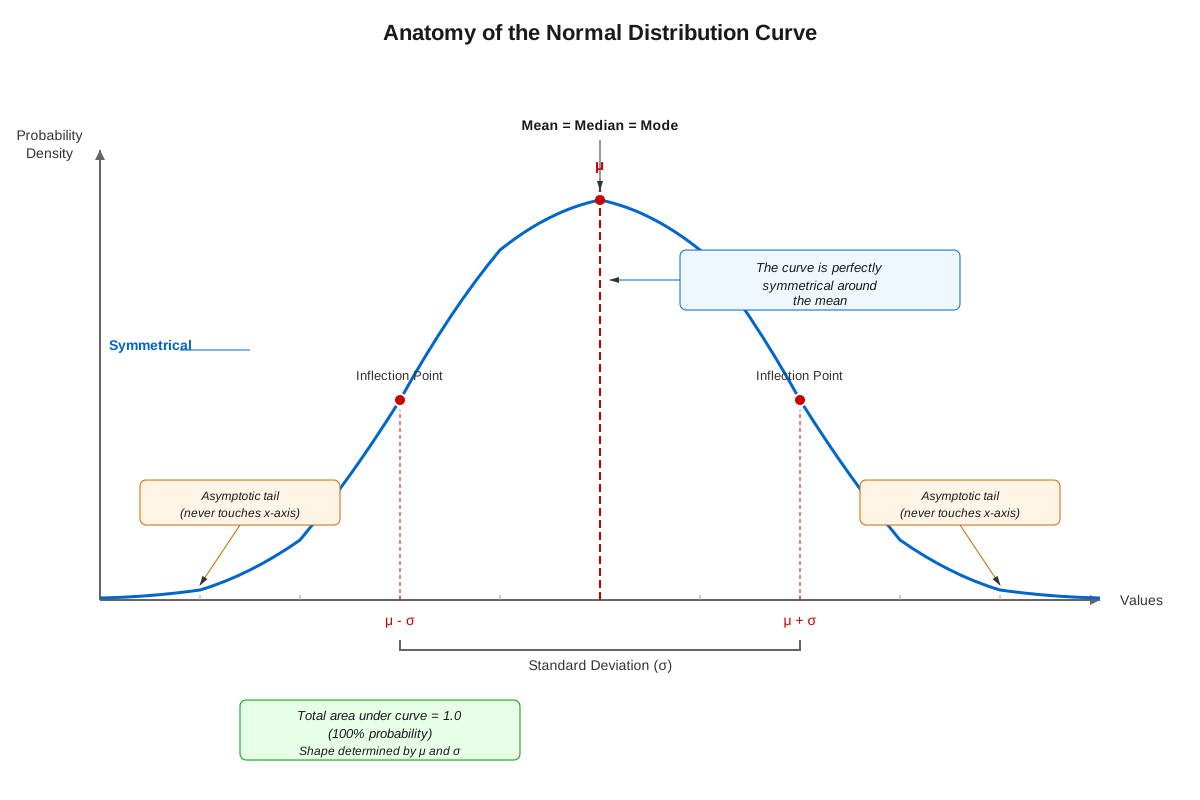
The normal distribution is a continuous probability distribution characterized by a symmetric, bell-shaped curve where data clusters around a central mean value. This distribution is completely defined by two parameters: the mean (μ), which determines the center of the distribution, and the standard deviation (σ), which determines the spread or width of the curve. The normal distribution exhibits several key properties that make it fundamental to statistical analysis in research methods and statistics.
The curve is perfectly symmetrical around the mean, meaning the left and right halves are mirror images. In a true normal distribution, the mean, median, and mode all occur at the same central point. The tails of the distribution extend infinitely in both directions but approach (never touch) the horizontal axis, meaning extreme values are possible but increasingly unlikely as distance from the mean increases. The total area under the curve equals 1.0 (or 100%), representing all possible outcomes in the distribution.
The Empirical Rule (68-95-99.7 Rule)
The empirical rule is the most high-yield concept for MCAT questions involving normal distributions. This rule states that in a normal distribution:
- Approximately 68% of data falls within one standard deviation of the mean (μ ± 1σ)
- Approximately 95% of data falls within two standard deviations of the mean (μ ± 2σ)
- Approximately 99.7% of data falls within three standard deviations of the mean (μ ± 3σ)
This rule allows rapid estimation of probabilities and percentiles without complex calculations. For example, if IQ scores follow a normal distribution with mean 100 and standard deviation 15, approximately 68% of people have IQ scores between 85 and 115 (100 ± 15), and approximately 95% have scores between 70 and 130 (100 ± 30). Values beyond three standard deviations from the mean are considered extremely rare, occurring in less than 0.3% of cases.
Standard Scores and Z-Scores
A z-score (or standard score) indicates how many standard deviations a particular value lies from the mean. The formula for calculating a z-score is:
z = (X - μ) / σWhere X is the observed value, μ is the population mean, and σ is the standard deviation. Z-scores allow comparison of values from different normal distributions by converting them to a common scale. A z-score of 0 indicates a value exactly at the mean, positive z-scores indicate values above the mean, and negative z-scores indicate values below the mean.
For MCAT purposes, recognizing that z-scores standardize distributions is more important than memorizing the formula. A z-score of +2.0 always represents a value two standard deviations above the mean, regardless of the original measurement scale. This standardization enables comparison of measurements in different units (such as comparing height percentiles to weight percentiles) and is fundamental to many statistical tests.
Properties of Different Normal Distributions
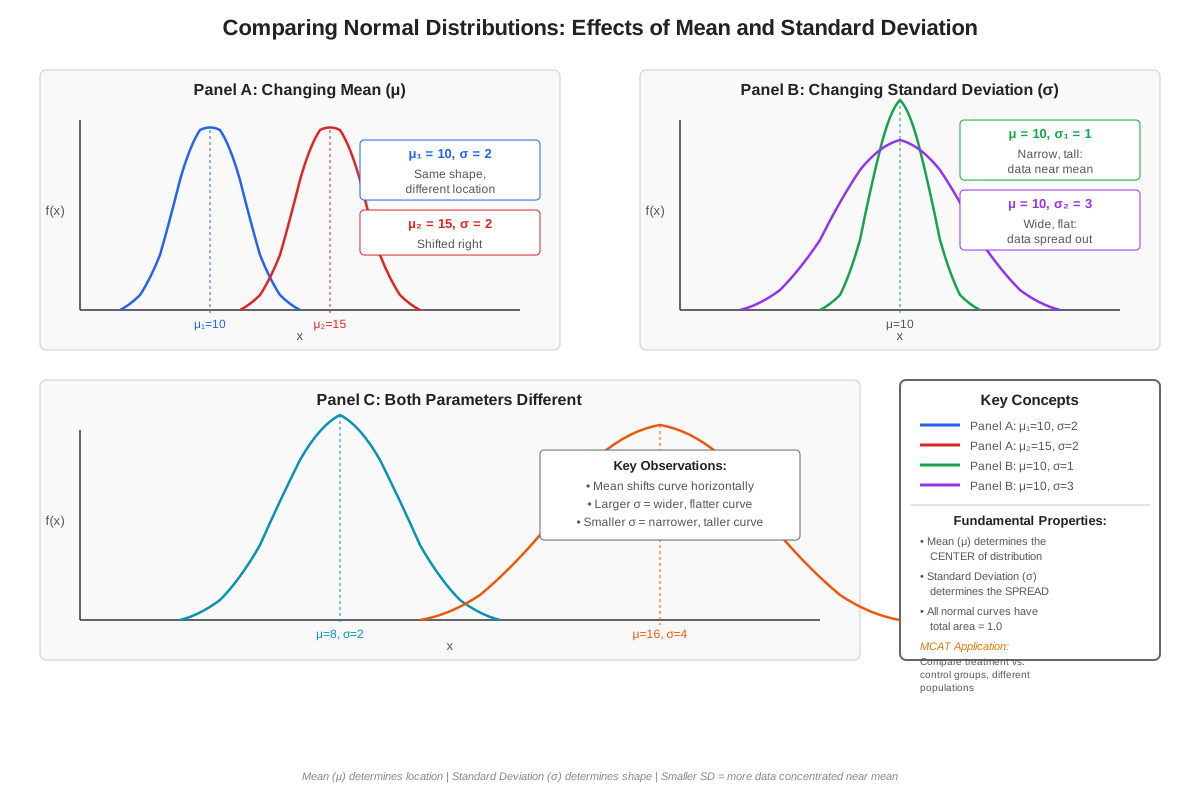
While all normal distributions share the same bell-shaped curve and symmetry, they differ in their mean (location) and standard deviation (spread). Two normal distributions can have:
| Property Difference | Visual Effect | Interpretation |
|---|---|---|
| Different means, same SD | Curves centered at different points, same width | Populations differ in average value but have similar variability |
| Same mean, different SD | Curves centered at same point, different widths | Populations have same average but differ in variability/consistency |
| Different means and SD | Curves differ in both location and width | Populations differ in both central tendency and variability |
A distribution with a larger standard deviation appears flatter and wider, indicating greater variability in the data. A distribution with a smaller standard deviation appears taller and narrower, indicating data points cluster more tightly around the mean. On the MCAT, comparing the shapes of distribution curves helps identify which groups show more consistent measurements or which populations have higher average values.
Skewness and Departures from Normality
Not all data follows a normal distribution. Skewness refers to asymmetry in a distribution. A positively skewed (right-skewed) distribution has a longer tail extending toward higher values, with the mean pulled above the median. A negatively skewed (left-skewed) distribution has a longer tail extending toward lower values, with the mean pulled below the median. Income distributions typically show positive skew, as a small number of very high earners pull the mean upward.
Recognizing non-normal distributions is crucial for MCAT passages because many statistical tests assume normality. When data is severely skewed, the empirical rule does not apply, and different analytical approaches may be needed. MCAT questions may present distribution graphs and ask students to identify whether data is normally distributed or skewed, which affects the interpretation of means and the appropriateness of certain statistical tests.
Applications in Research and Sampling
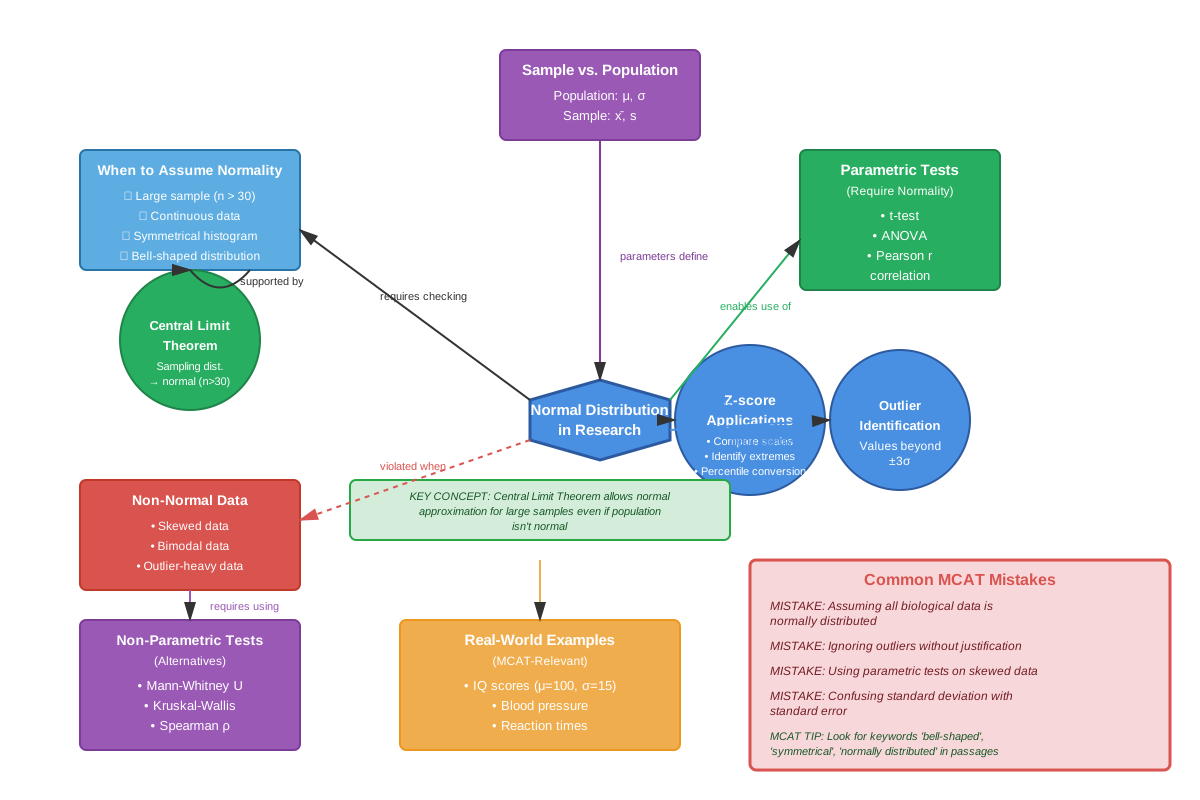
The central limit theorem states that the distribution of sample means approaches a normal distribution as sample size increases, regardless of the population's original distribution shape. This principle justifies using normal distribution-based statistical tests even when individual measurements don't follow a normal distribution. For MCAT passages involving sampling and inference, understanding that larger samples produce more normally distributed means helps evaluate study design quality.
Sampling distributions of means are typically narrower than the original population distribution, with standard deviation equal to the population standard deviation divided by the square root of sample size (the standard error). This relationship explains why larger studies provide more precise estimates and why confidence intervals narrow as sample size increases—concepts frequently tested in MCAT research methods questions.
Concept Relationships
The normal distribution serves as the central organizing concept connecting multiple statistical and research methodology topics. The distribution's parameters—mean and standard deviation—are descriptive statistics that summarize data, while the distribution itself enables inferential statistics that draw conclusions about populations from samples. This relationship flows as: raw data → descriptive statistics (mean, SD) → normal distribution model → inferential statistics (hypothesis testing, confidence intervals).
Z-scores transform any normal distribution into the standard normal distribution (mean = 0, SD = 1), creating a bridge between specific measurements and universal probability tables. This standardization connects to percentiles, as each z-score corresponds to a specific percentile rank. For example, a z-score of +1.0 corresponds to approximately the 84th percentile (50% below the mean plus 34% between the mean and +1 SD).
The empirical rule connects directly to hypothesis testing and statistical significance. Values beyond two standard deviations from the mean (outside the 95% range) are often considered statistically unusual, forming the basis for the common p < 0.05 significance threshold. This relationship explains why researchers report confidence intervals and why MCAT passages discuss whether findings are "statistically significant."
Sampling distributions connect the normal distribution to research design and generalizability. The central limit theorem ensures that sample means follow a normal distribution, which justifies using parametric statistical tests and enables researchers to calculate confidence intervals around sample estimates. This connection appears in MCAT passages evaluating whether study samples adequately represent target populations.
Skewness and departures from normality connect to measurement validity and data transformation. When MCAT passages present non-normal data, questions may address whether researchers should use median instead of mean, whether parametric tests are appropriate, or whether data transformations might normalize the distribution. Understanding these connections helps evaluate the appropriateness of statistical methods described in research passages.
Quick check — test yourself on Normal distribution so far.
Try Flashcards →High-Yield Facts
⭐ In a normal distribution, approximately 68% of values fall within one standard deviation of the mean, 95% within two standard deviations, and 99.7% within three standard deviations (the empirical rule)
⭐ The mean, median, and mode are identical in a perfectly normal distribution, all occurring at the center of the symmetric curve
⭐ A z-score represents the number of standard deviations a value is from the mean, with z = 0 at the mean, positive z-scores above the mean, and negative z-scores below the mean
⭐ The total area under the normal curve equals 1.0 (100%), with 50% of values above the mean and 50% below the mean due to symmetry
⭐ Standard deviation determines the width of the normal curve—larger standard deviations produce wider, flatter curves indicating greater variability
- The normal distribution is completely defined by just two parameters: mean (μ) and standard deviation (σ)
- Values more than three standard deviations from the mean are extremely rare, occurring in less than 0.3% of cases
- The central limit theorem ensures that sampling distributions of means approach normality as sample size increases, regardless of the original population distribution
- Positively skewed distributions have mean > median > mode, while negatively skewed distributions have mode > median > mean
- Many biological and psychological variables naturally follow normal distributions, including height, blood pressure, IQ scores, and measurement errors
- The standard normal distribution has a mean of 0 and standard deviation of 1, serving as the reference for z-score tables
- Approximately 95% of values fall within 1.96 standard deviations of the mean (the basis for 95% confidence intervals)
Common Misconceptions
Misconception: All data naturally follows a normal distribution. → Correction: Many variables follow normal distributions, but income, reaction times, and many biological measures are skewed. The normal distribution is a model that approximates many phenomena but doesn't describe all data. MCAT passages may specifically test whether students recognize non-normal distributions.
Misconception: The empirical rule percentages (68%, 95%, 99.7%) apply to all distributions. → Correction: These percentages only apply to normal distributions. Skewed or bimodal distributions follow different patterns. Always check whether data is normally distributed before applying the empirical rule.
Misconception: A larger standard deviation means the data is "wrong" or "bad." → Correction: Standard deviation describes variability, not quality. Some populations naturally have more variability than others. A larger standard deviation simply indicates greater spread around the mean, which may be expected for certain variables.
Misconception: The mean is always the best measure of central tendency. → Correction: For normally distributed data, the mean is appropriate, but for skewed distributions, the median better represents the typical value. MCAT passages may present skewed data where the mean is misleading due to extreme outliers.
Misconception: Values beyond three standard deviations are impossible. → Correction: The normal distribution's tails extend infinitely, so extreme values are possible but very rare (less than 0.3% probability). These outliers can occur naturally and don't necessarily indicate measurement error.
Misconception: A z-score of 2.0 means the value is twice the mean. → Correction: A z-score of 2.0 means the value is two standard deviations above the mean, not twice the mean value. Z-scores measure distance from the mean in standard deviation units, not as multiples of the mean.
Misconception: Normal distributions always have the same shape. → Correction: While all normal distributions are bell-shaped and symmetric, they differ in height and width depending on the standard deviation. Distributions with smaller standard deviations are taller and narrower; those with larger standard deviations are flatter and wider.
Worked Examples
Example 1: Applying the Empirical Rule to Test Scores
Question: A standardized sociology exam has scores that follow a normal distribution with a mean of 500 and a standard deviation of 100. What percentage of students scored between 400 and 700? What is the approximate percentile rank of a student who scored 600?
Solution:
Step 1: Identify the parameters. Mean (μ) = 500, Standard Deviation (σ) = 100.
Step 2: Determine how many standard deviations the boundary values are from the mean.
- 400 is 100 points below 500, which is 1 standard deviation below the mean (μ - 1σ)
- 700 is 200 points above 500, which is 2 standard deviations above the mean (μ + 2σ)
Step 3: Apply the empirical rule. We know:
- 68% of scores fall within μ ± 1σ (between 400 and 600)
- 95% of scores fall within μ ± 2σ (between 300 and 700)
Step 4: Calculate the percentage between 400 and 700. Due to symmetry:
- 50% of scores fall below the mean (500)
- From the 68% rule, 34% fall between the mean and +1σ (500 to 600)
- From the 95% rule, 47.5% fall between the mean and +2σ (500 to 700)
- Below the mean, 34% fall between -1σ and the mean (400 to 500)
- Total between 400 and 700: 34% + 47.5% = 81.5%
Step 5: Determine the percentile for a score of 600.
- 600 is exactly 1 standard deviation above the mean
- 50% of scores are below the mean
- 34% of scores fall between the mean and +1σ
- Percentile rank = 50% + 34% = 84th percentile
Answer: Approximately 81.5% of students scored between 400 and 700, and a score of 600 corresponds to approximately the 84th percentile.
Connection to learning objectives: This example demonstrates applying the normal distribution to solve exam-style questions using the empirical rule and interpreting standard deviations in context.
Example 2: Comparing Variability Between Groups
Question: A research study examines reaction times for two groups. Group A (meditation practitioners) has a mean reaction time of 250 ms with a standard deviation of 20 ms. Group B (control group) has a mean reaction time of 250 ms with a standard deviation of 50 ms. Both distributions are approximately normal. If a participant has a reaction time of 290 ms, in which group would this be considered more unusual?
Solution:
Step 1: Calculate the z-score for 290 ms in Group A.
- z = (X - μ) / σ = (290 - 250) / 20 = 40 / 20 = 2.0
- A reaction time of 290 ms is 2 standard deviations above the mean for Group A
Step 2: Calculate the z-score for 290 ms in Group B.
- z = (X - μ) / σ = (290 - 250) / 50 = 40 / 50 = 0.8
- A reaction time of 290 ms is 0.8 standard deviations above the mean for Group B
Step 3: Interpret the z-scores using the empirical rule.
- In Group A, a z-score of 2.0 places the value at approximately the 97.5th percentile (beyond 95% of the distribution)
- In Group B, a z-score of 0.8 is well within one standard deviation, representing a fairly typical value
Step 4: Compare the relative unusualness.
- The same absolute reaction time (290 ms) is much more unusual in Group A than Group B
- This demonstrates that Group A has less variability (more consistent reaction times)
- Group B's larger standard deviation means 290 ms is relatively common
Answer: A reaction time of 290 ms would be considered more unusual in Group A (z = 2.0, beyond 95% of values) than in Group B (z = 0.8, within typical range). This illustrates that the meditation group has more consistent (less variable) reaction times.
Connection to learning objectives: This example demonstrates connecting normal distribution concepts to research interpretation, identifying how standard deviation affects the interpretation of individual scores, and applying z-scores to compare across groups—all common MCAT question types.
Exam Strategy
When approaching MCAT questions involving normal distribution, first identify whether the passage explicitly states or implies that data follows a normal distribution. Look for phrases like "normally distributed," "bell-shaped curve," "Gaussian distribution," or graphs showing symmetric, bell-shaped curves. If normality is established, the empirical rule becomes your most powerful tool for rapid estimation.
Trigger words and phrases to watch for include: "standard deviation," "within X standard deviations," "z-score," "percentile," "typical range," "unusual values," and "approximately 95% of values." These phrases signal that the question tests normal distribution concepts. When you see graphs of distributions, immediately assess symmetry—if the curve is symmetric and bell-shaped, apply normal distribution principles; if skewed, recognize that the empirical rule doesn't apply.
For process-of-elimination, eliminate answer choices that violate basic normal distribution properties. If a question asks about the percentage of values within two standard deviations, immediately eliminate any answer not close to 95%. If asked about the relationship between mean and median, eliminate choices suggesting they differ in a normal distribution. When comparing groups, eliminate answers that confuse standard deviation (spread) with mean (central location).
Time allocation for normal distribution questions should be approximately 60-90 seconds per question. Most MCAT questions on this topic require applying the empirical rule or interpreting z-scores, which should be rapid calculations. If a question requires complex calculations beyond basic z-score formulas, consider whether estimation using the empirical rule might be sufficient. The MCAT rarely requires precise probability calculations; approximate answers using 68%, 95%, and 99.7% are usually adequate.
When passages present multiple distributions, quickly sketch the curves mentally or on your noteboard, noting the relative positions of means and the relative widths (standard deviations). This visualization helps answer questions about which group has higher average values or which shows more variability. Remember that the MCAT tests conceptual understanding more than computational skill—focus on interpreting what the statistics mean rather than performing complex calculations.
Memory Techniques
Empirical Rule Mnemonic: "68-95-99.7: 1-2-3, Easy as Can Be" — 68% within 1 SD, 95% within 2 SD, 99.7% within 3 SD. The numbers increase in a memorable pattern, and the rhyme helps recall.
Z-Score Direction: "Positive Zs Zoom Up, Negative Zs Navigate Down" — Positive z-scores indicate values above the mean, negative z-scores indicate values below the mean.
Skewness Direction: "The tail tells the tale" — A distribution is skewed in the direction its tail points. Right-skewed (positive skew) has a tail extending right; left-skewed (negative skew) has a tail extending left.
Mean-Median-Mode in Skewed Distributions: "The mean follows the tail" — In right-skewed distributions, mean > median > mode because the tail pulls the mean toward higher values. In left-skewed distributions, mode > median > mean because the tail pulls the mean toward lower values.
Visualization Strategy: Picture the normal curve as a bell or hill. The peak is the mean (where most people are), and as you walk away from the peak in either direction, you encounter fewer people. One standard deviation is like walking to where the hill starts to flatten noticeably (68% of people are within this range). Two standard deviations is near the bottom of the hill (95% within this range). Three standard deviations is off the hill entirely (99.7% within this range, only 0.3% beyond).
Standard Deviation Size: "Skinny SD = Steep curve, Fat SD = Flat curve" — Small standard deviations produce tall, narrow (steep) curves; large standard deviations produce short, wide (flat) curves.
Summary
The normal distribution is a fundamental statistical concept for the MCAT, describing the symmetric, bell-shaped pattern that many biological and social variables follow. Defined completely by its mean (center) and standard deviation (spread), the normal distribution enables researchers to calculate probabilities, identify unusual values, and make inferences about populations. The empirical rule (68-95-99.7) provides the most high-yield tool for MCAT questions, allowing rapid estimation of the percentage of values within one, two, or three standard deviations of the mean. Z-scores standardize values across different normal distributions, enabling comparisons and percentile calculations. Understanding when data does and does not follow a normal distribution is crucial for evaluating research methods and statistical test appropriateness in MCAT passages. The normal distribution connects to broader concepts in research methods and statistics, including sampling distributions, hypothesis testing, and confidence intervals, making it essential for interpreting the experimental passages that appear throughout the Psychological, Social, and Biological Foundations of Behavior section.
Key Takeaways
- The normal distribution is symmetric and bell-shaped, completely defined by mean (μ) and standard deviation (σ), with mean = median = mode at the center
- The empirical rule (68-95-99.7) states that approximately 68% of values fall within 1 SD, 95% within 2 SD, and 99.7% within 3 SD of the mean
- Z-scores indicate how many standard deviations a value is from the mean, enabling standardized comparisons across different distributions
- Larger standard deviations produce wider, flatter curves indicating greater variability; smaller standard deviations produce taller, narrower curves indicating less variability
- Not all data is normally distributed—skewed distributions have asymmetric tails and different relationships between mean, median, and mode
- The central limit theorem ensures sampling distributions of means approach normality, justifying many statistical inference procedures used in research
- Values beyond two standard deviations (outside the 95% range) are considered statistically unusual and form the basis for significance testing
Related Topics
Descriptive Statistics (mean, median, mode, standard deviation): These measures summarize data and serve as the parameters defining normal distributions. Mastering normal distributions deepens understanding of what standard deviation represents and when different measures of central tendency are appropriate.
Inferential Statistics and Hypothesis Testing: Normal distributions provide the foundation for t-tests, ANOVA, and other parametric tests. Understanding normality assumptions helps evaluate whether researchers used appropriate statistical methods in MCAT passages.
Sampling Methods and Sampling Distributions: The central limit theorem connects normal distributions to sampling theory, explaining why larger samples produce more reliable estimates and narrower confidence intervals.
Measurement Validity and Reliability: Normal distributions help identify outliers and measurement errors. Understanding expected distributions for variables helps evaluate whether measurement instruments are functioning properly.
Correlation and Regression: Many correlation and regression techniques assume variables follow normal distributions. Recognizing normality helps evaluate whether these analytical approaches are appropriate for presented data.
Practice CTA
Now that you've mastered the core concepts of normal distribution, it's time to solidify your understanding through active practice. Attempt the practice questions and flashcards associated with this topic to test your ability to apply the empirical rule, calculate z-scores, and interpret distribution graphs under timed conditions. Focus especially on questions that require you to compare distributions or identify whether data is normally distributed—these are high-yield question types that appear frequently on the MCAT. Remember, understanding the concepts is just the first step; developing speed and accuracy through repeated practice is what translates knowledge into points on test day. You've built a strong foundation—now strengthen it through deliberate practice!
Sign up free to keep reading
Create a free AnvayaPrep account to finish this MCAT guide on Normal distribution — plus flashcards and practice questions.