Overview
Cultural capital is a foundational concept in Sociology that describes the non-financial social assets that promote social mobility and influence an individual's position within the social hierarchy. Introduced by French sociologist Pierre Bourdieu, cultural capital encompasses knowledge, skills, education, and cultural competencies that individuals accumulate throughout their lives. These assets include familiarity with elite cultural forms, educational credentials, linguistic styles, aesthetic preferences, and social etiquette that signal membership in particular social classes. Understanding cultural capital is essential for analyzing how social advantages are transmitted across generations and how inequality is perpetuated through seemingly neutral cultural mechanisms rather than purely economic means.
For the MCAT, cultural capital represents a high-yield topic within Social Stratification and Inequality that frequently appears in Sociology passages and discrete questions. The exam tests students' ability to recognize how cultural resources function as a form of capital—similar to economic capital—that can be invested, accumulated, and converted into other forms of advantage. MCAT passages often present scenarios involving educational achievement gaps, healthcare access disparities, or professional advancement barriers that require students to identify the role of cultural capital in maintaining or challenging social hierarchies. The concept bridges multiple sociological frameworks, connecting theories of social reproduction, educational inequality, and class stratification.
The significance of cultural capital extends beyond isolated theoretical knowledge; it interconnects with numerous other Sociology concepts tested on the MCAT, including social capital, economic capital, symbolic capital, habitus, social reproduction, and meritocracy. Understanding these relationships enables students to analyze complex sociological phenomena presented in MCAT passages, particularly those examining why individuals from different social backgrounds experience divergent outcomes despite ostensibly equal opportunities. Mastery of cultural capital provides the analytical framework necessary to deconstruct questions about educational systems, healthcare disparities, and social mobility—all frequent themes in the Psychological, Social, and Biological Foundations of Behavior section.
Learning Objectives
- [ ] Define Cultural capital using accurate Sociology terminology
- [ ] Explain why Cultural capital matters for the MCAT
- [ ] Apply Cultural capital to exam-style questions
- [ ] Identify common mistakes related to Cultural capital
- [ ] Connect Cultural capital to related Sociology concepts
- [ ] Distinguish between the three forms of cultural capital (embodied, objectified, and institutionalized)
- [ ] Analyze how cultural capital contributes to social reproduction and the perpetuation of inequality
- [ ] Evaluate the relationship between cultural capital and educational achievement across different social classes
Prerequisites
- Social class and stratification: Understanding the hierarchical organization of society is necessary to comprehend how cultural capital functions as a mechanism for maintaining class distinctions
- Socialization: Knowledge of how individuals acquire values, norms, and behaviors through social interaction provides the foundation for understanding how cultural capital is transmitted
- Social mobility: Familiarity with movement between social positions helps contextualize cultural capital's role in facilitating or hindering upward mobility
- Basic economic concepts: Understanding capital as an asset that can be invested and generate returns is essential for grasping the metaphorical extension to cultural resources
Why This Topic Matters
Cultural capital has profound real-world significance in healthcare, education, and professional settings—domains frequently examined on the MCAT. In medical contexts, patients with higher cultural capital often navigate healthcare systems more effectively, communicate more assertively with providers, understand medical terminology, and advocate for better care. These advantages contribute to health disparities that persist even when controlling for economic factors. Physicians who understand cultural capital can recognize how patients' varying levels of familiarity with medical culture affect health outcomes and can adapt their communication strategies accordingly.
On the MCAT, cultural capital appears with high frequency in the Psychological, Social, and Biological Foundations of Behavior section, particularly in passages addressing educational inequality, healthcare access, and social determinants of health. Exam statistics indicate that questions involving cultural capital appear in approximately 15-20% of Sociology passages, often integrated with questions about social reproduction, meritocracy, and class stratification. The concept typically appears in three question formats: (1) passage-based questions requiring students to identify examples of cultural capital in research scenarios, (2) discrete questions testing definitional knowledge and the ability to distinguish cultural capital from other forms of capital, and (3) application questions asking students to predict outcomes based on differences in cultural capital.
Common MCAT passage contexts include: research studies examining achievement gaps between students from different socioeconomic backgrounds; analyses of healthcare utilization patterns across social classes; investigations of workplace advancement and professional networking; and studies of cultural consumption patterns (museum attendance, reading habits, artistic appreciation). Questions often require students to recognize that differences in outcomes cannot be attributed solely to economic resources but reflect unequal distribution of cultural knowledge and competencies that are valued by dominant institutions.
Core Concepts
Definition and Theoretical Foundation
Cultural capital refers to the accumulation of knowledge, behaviors, skills, and credentials that confer social status and facilitate social mobility within a stratified society. Pierre Bourdieu developed this concept in the 1970s to explain how social inequality is reproduced across generations through mechanisms beyond direct economic inheritance. The term "capital" is deliberately chosen to emphasize that cultural resources function analogously to economic capital: they can be accumulated, invested, transmitted to others, and converted into material or symbolic advantages.
The theoretical power of cultural capital lies in its ability to explain persistent inequality in societies that claim to be meritocratic. Educational systems, for example, ostensibly reward talent and effort equally, yet students from privileged backgrounds consistently outperform their peers from disadvantaged backgrounds. Cultural capital theory reveals that this disparity reflects not innate ability differences but rather unequal access to the cultural knowledge, linguistic codes, and behavioral dispositions that educational institutions implicitly value and reward. Children from upper-class families inherit cultural capital from their parents—familiarity with "high culture," sophisticated vocabulary, confidence in institutional settings—giving them systematic advantages that appear as individual merit.
Three Forms of Cultural Capital
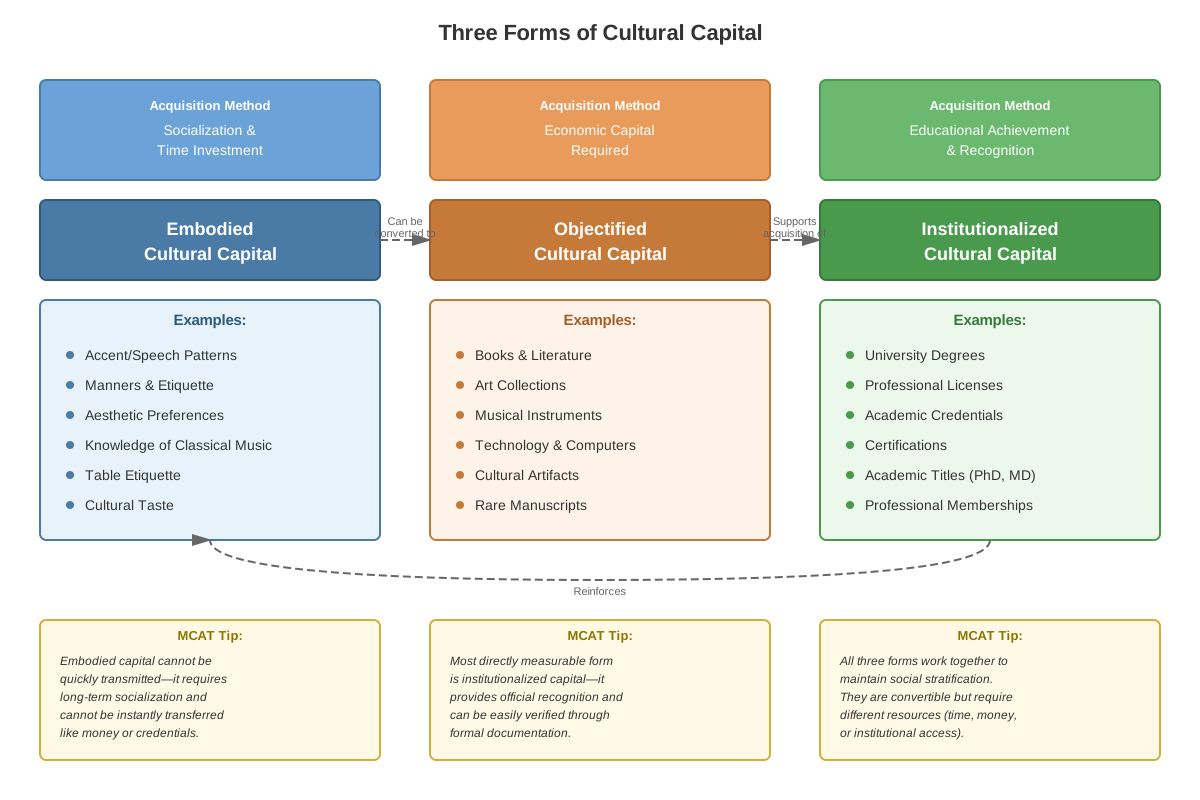
Bourdieu identified three distinct forms in which cultural capital exists, each with different properties and mechanisms of transmission:
| Form | Description | Examples | Transmission Method |
|---|---|---|---|
| Embodied | Internalized knowledge, skills, and dispositions acquired through socialization | Accent, posture, aesthetic tastes, conversational style, critical thinking skills | Long-term socialization, primarily in family settings |
| Objectified | Physical objects and media that require cultural capital to use appropriately | Books, artworks, musical instruments, scientific equipment | Purchase (requires economic capital) plus embodied capital to utilize |
| Institutionalized | Formal recognition of cultural capital through credentials and qualifications | Academic degrees, professional certifications, awards, titles | Educational institutions and credentialing organizations |
Embodied cultural capital represents the most fundamental form—the deeply internalized cultural competencies that become part of an individual's habitus (durable dispositions and ways of being). This form requires significant time investment to acquire and cannot be instantly transmitted or purchased. A child raised in a household where parents discuss literature, visit museums, and model sophisticated language patterns gradually embodies cultural capital through everyday interactions. This embodied capital manifests in subtle ways: comfort speaking with authority figures, familiarity with abstract reasoning, appreciation of classical music, or knowledge of proper etiquette in formal settings. Because embodied cultural capital develops gradually through socialization, it appears "natural" rather than learned, disguising its role in perpetuating advantage.
Objectified cultural capital exists in material form—the paintings, books, instruments, and other cultural goods that families possess. However, mere ownership does not constitute cultural capital; one must possess the embodied cultural capital necessary to appreciate, interpret, and utilize these objects appropriately. A home library represents objectified cultural capital only if family members have the reading skills, literary knowledge, and disposition to engage with books meaningfully. This form demonstrates the interconnection between economic and cultural capital: purchasing cultural goods requires money, but deriving social advantage from them requires embodied cultural competencies.
Institutionalized cultural capital takes the form of academic credentials and professional qualifications that provide official recognition of cultural competence. A medical degree represents institutionalized cultural capital—it certifies that the holder has acquired specific knowledge and skills, granting legal authority to practice medicine and conferring social prestige. This form is particularly powerful because it converts cultural capital into a credential with relatively stable, widely recognized value. Institutionalized cultural capital can partially compensate for deficits in other forms; an individual from a working-class background who earns an elite university degree gains institutionalized cultural capital that facilitates upward mobility, though they may still lack some embodied cultural capital of their upper-class peers.
Cultural Capital and Social Reproduction
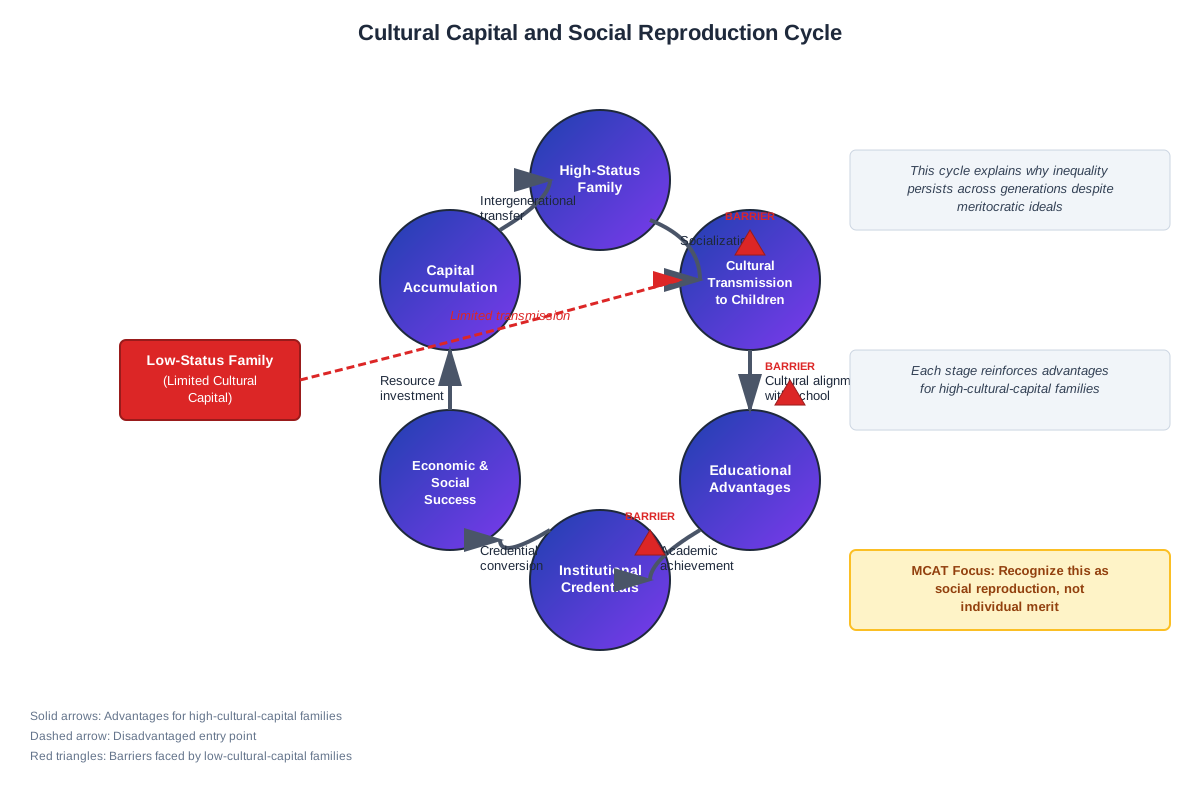
Social reproduction refers to the processes through which social inequality is transmitted across generations, maintaining the existing class structure. Cultural capital plays a central role in social reproduction by providing children from privileged families with systematic advantages in educational and professional settings. This process operates subtly, through mechanisms that appear meritocratic and fair, making inequality seem like the natural result of individual differences in ability or effort rather than structural advantages.
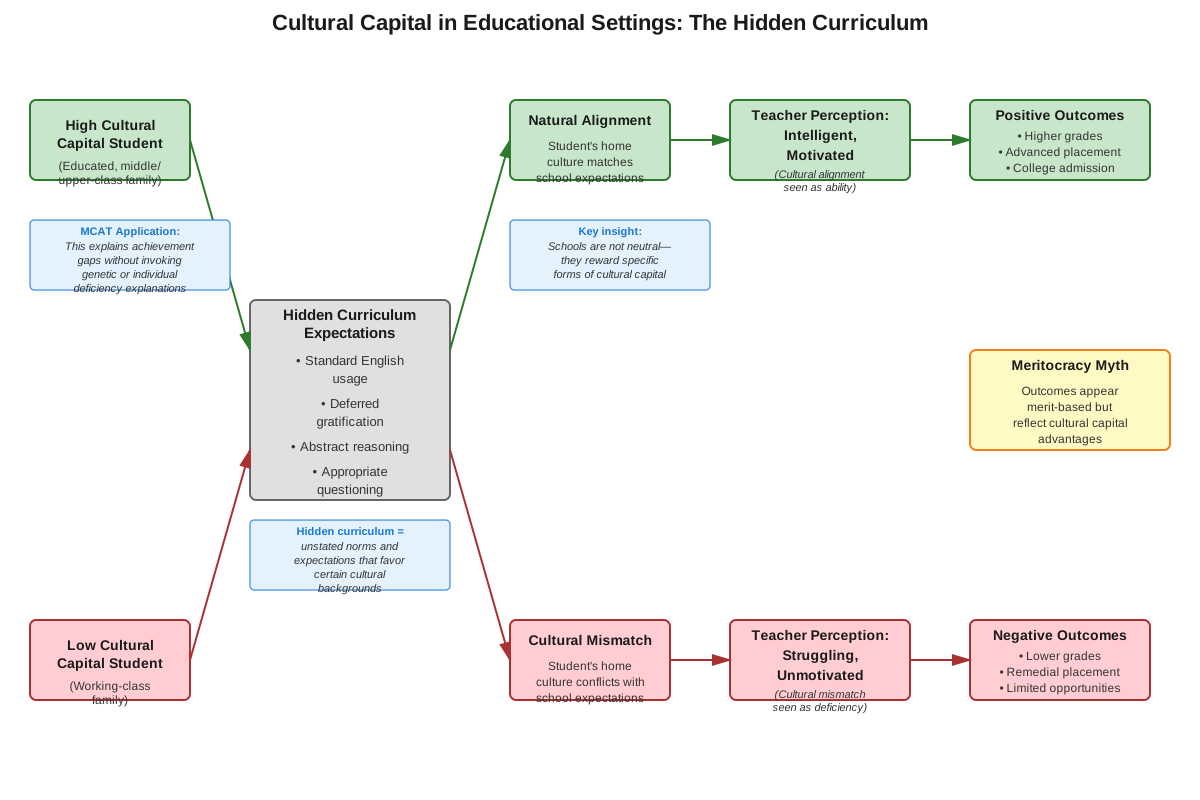
The educational system serves as the primary institution through which cultural capital is converted into academic success and credentials. Schools implicitly reward students who possess the cultural capital valued by the dominant class: familiarity with standard language forms, comfort with abstract reasoning, knowledge of cultural references, and behavioral dispositions like deferred gratification and self-directed learning. Students from upper-middle-class families typically acquire this cultural capital at home, arriving at school already fluent in the "hidden curriculum" of educational success. Teachers, often unconsciously, recognize and reward these cultural markers, interpreting them as signs of intelligence, motivation, and academic potential.
In contrast, students from working-class or lower-income families often possess different forms of cultural knowledge—practical skills, community-specific cultural traditions, or linguistic varieties—that schools do not recognize or value. These students must simultaneously learn academic content and acquire unfamiliar cultural codes, placing them at a systematic disadvantage. Their struggles are often misinterpreted as individual deficits (lack of ability or motivation) rather than mismatches between their cultural capital and institutional expectations. This dynamic perpetuates inequality: students with appropriate cultural capital succeed, earn credentials, and transmit cultural capital to their own children, while students lacking such capital face barriers to advancement.
Cultural Capital in Healthcare Settings
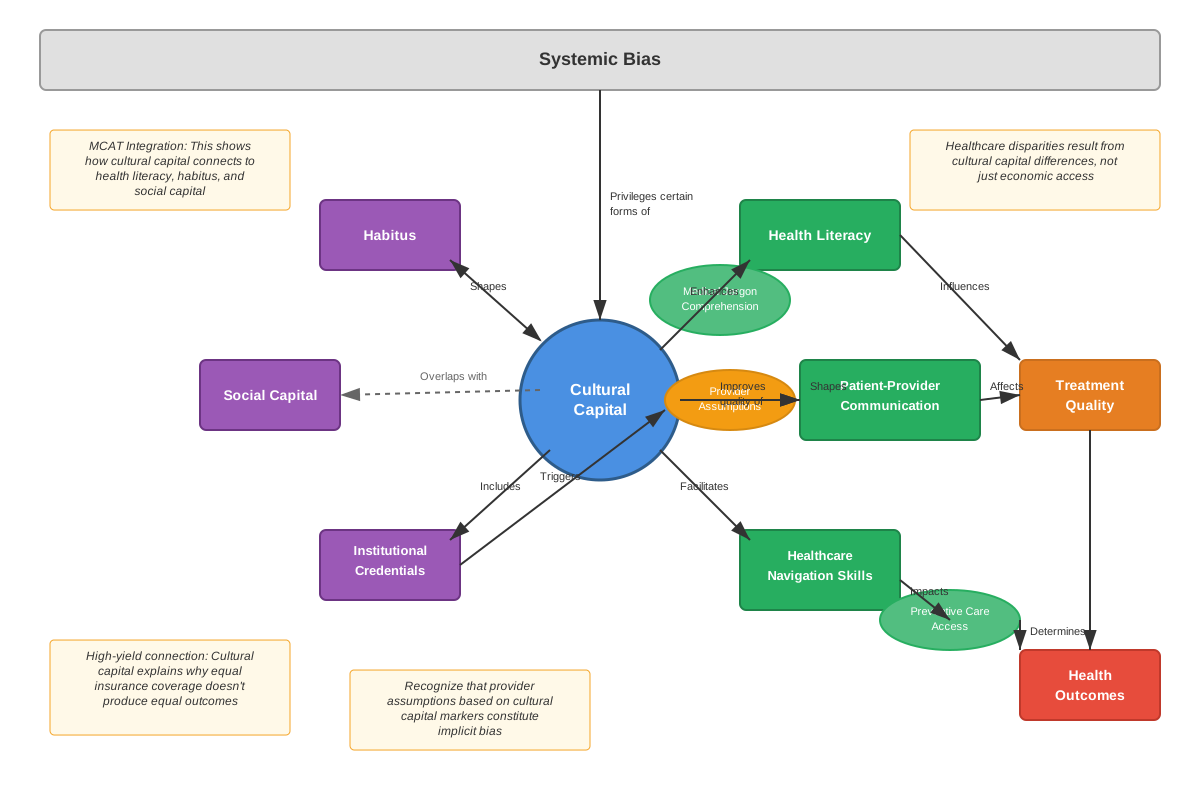
Understanding cultural capital is particularly relevant for future physicians because it profoundly affects patient-provider interactions and health outcomes. Patients with higher cultural capital typically navigate healthcare systems more effectively: they understand medical terminology, ask informed questions, research treatment options, advocate assertively for themselves, and maintain organized health records. These competencies—forms of embodied cultural capital—enable patients to receive better care, even when controlling for insurance coverage and economic resources.
Healthcare institutions, like educational systems, implicitly reward patients who possess cultural capital aligned with medical culture. Physicians often respond more positively to patients who communicate in ways that signal education and cultural sophistication, spending more time with them and providing more detailed explanations. Patients familiar with medical culture understand implicit expectations: arriving prepared with symptom lists, asking questions during appointments rather than after, and following up appropriately. Those lacking such cultural capital may appear "non-compliant" or "difficult," when in reality they simply lack familiarity with healthcare system norms.
Concept Relationships
Cultural capital interconnects with multiple sociological concepts to form a comprehensive framework for understanding social stratification and inequality. The relationship map below illustrates these connections:
Habitus → generates → Cultural Capital → facilitates → Social Mobility → maintains or challenges → Social Stratification
Habitus, another Bourdieu concept, refers to the durable dispositions, habits, and ways of perceiving the world that individuals develop through socialization. Habitus generates cultural capital by shaping what knowledge and skills individuals acquire and how they deploy them. A person's habitus—formed by their class position—determines what cultural practices seem natural, desirable, or accessible, thereby influencing what cultural capital they accumulate.
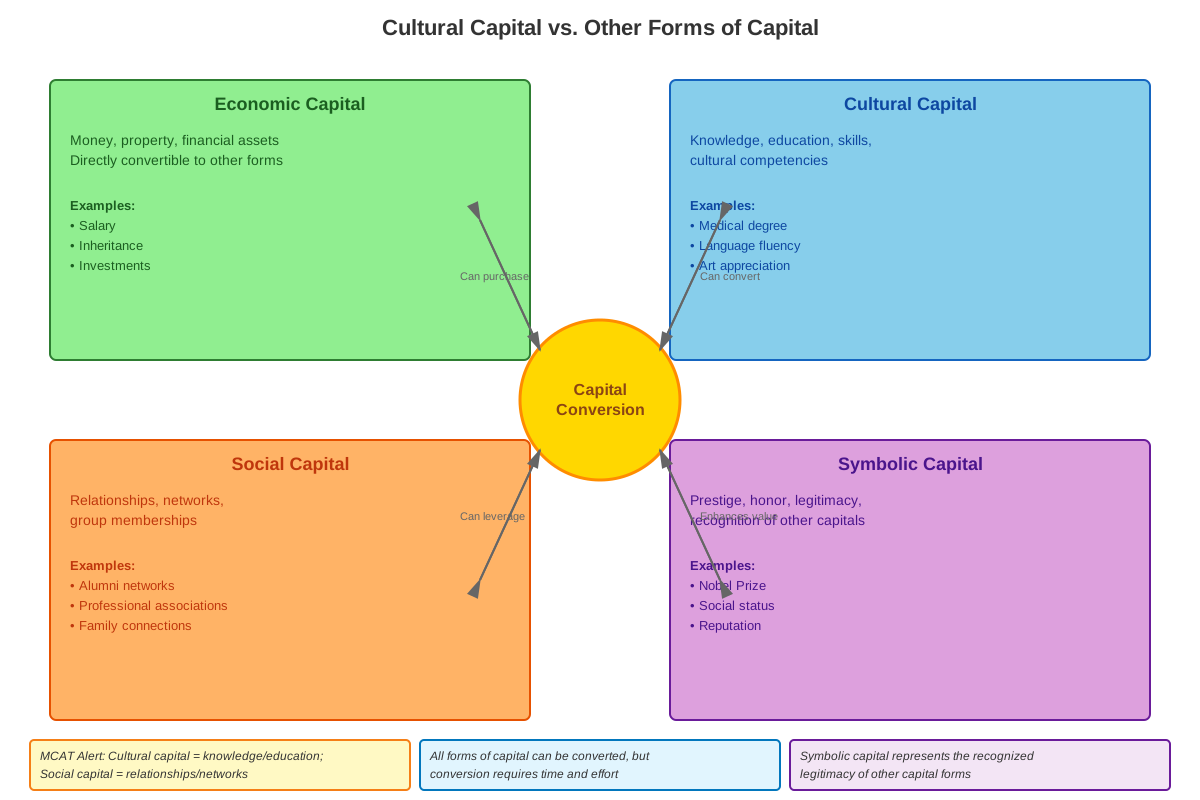
Social capital—networks of relationships and social connections—works synergistically with cultural capital. Cultural capital often facilitates the formation of social capital (shared cultural knowledge creates bonds between individuals), while social capital provides access to opportunities for acquiring additional cultural capital (connections to mentors, invitations to cultural events, information about educational opportunities).
Economic capital (financial resources and material assets) relates to cultural capital through processes of conversion and reinforcement. Economic capital enables the purchase of objectified cultural capital (books, art, educational experiences) and institutionalized cultural capital (tuition for elite schools). Conversely, cultural capital can be converted into economic capital through credentials that provide access to high-paying professions. However, the conversion is not perfectly efficient—cultural capital has independent effects beyond what economic resources alone can purchase.
Symbolic capital represents the prestige, honor, and recognition that individuals or groups possess. Cultural capital often converts into symbolic capital when cultural competencies are recognized and valued by others, conferring social status. An individual's sophisticated taste in art or literature becomes symbolic capital when others acknowledge and defer to their cultural expertise.
The concept of meritocracy—the belief that social positions are allocated based on individual merit—stands in tension with cultural capital theory. Cultural capital reveals that apparent meritocracy often disguises the reproduction of privilege, as children from advantaged backgrounds inherit cultural resources that manifest as "merit" in educational and professional settings.
High-Yield Facts
⭐ Cultural capital refers to non-financial social assets (knowledge, skills, education, cultural competencies) that promote social mobility and confer social status within stratified societies.
⭐ Pierre Bourdieu developed the concept of cultural capital to explain how social inequality is reproduced across generations through mechanisms beyond direct economic inheritance.
⭐ The three forms of cultural capital are embodied (internalized knowledge and dispositions), objectified (cultural goods and objects), and institutionalized (credentials and qualifications).
⭐ Embodied cultural capital requires significant time investment to acquire and cannot be instantly transmitted, making it appear "natural" rather than learned.
⭐ Educational systems serve as primary institutions for converting cultural capital into academic credentials, systematically advantaging students whose cultural capital aligns with institutional expectations.
- Institutionalized cultural capital (academic degrees, professional certifications) provides official recognition of cultural competence with relatively stable, widely recognized value.
- Social reproduction operates through cultural capital by transmitting advantages across generations in ways that appear meritocratic, disguising structural inequality as individual merit.
- Cultural capital and economic capital are distinct but interrelated; cultural capital has independent effects that cannot be reduced to financial resources alone.
- In healthcare settings, patients with higher cultural capital navigate systems more effectively, communicate more assertively with providers, and often receive better care independent of economic resources.
- The "hidden curriculum" of educational institutions rewards cultural capital that upper-middle-class students typically acquire at home, creating systematic advantages that appear as individual ability differences.
- Cultural capital can be converted into other forms of capital: institutionalized cultural capital (degrees) converts into economic capital (higher salaries), while economic capital enables purchase of objectified cultural capital (books, art).
- Working-class students often possess valuable cultural knowledge and skills that educational institutions do not recognize or reward, leading to misinterpretation of their struggles as individual deficits.
Quick check — test yourself on Cultural capital so far.
Try Flashcards →Common Misconceptions
Misconception: Cultural capital is the same as being "cultured" or having refined tastes in art and music.
Correction: While appreciation of "high culture" is one form of cultural capital, the concept is much broader, encompassing any knowledge, skills, or competencies that confer advantage within a particular social context. In some settings, technical knowledge, street smarts, or community-specific cultural knowledge can function as cultural capital. What matters is whether the cultural resource is valued and rewarded by dominant institutions in a given society.
Misconception: Cultural capital is simply another term for education or intelligence.
Correction: Cultural capital includes but extends beyond formal education. It encompasses embodied dispositions, linguistic styles, aesthetic preferences, and social competencies acquired through socialization, not just academic knowledge. Moreover, cultural capital theory challenges the notion that educational success reflects innate intelligence, revealing instead how inherited cultural resources create systematic advantages that appear as individual merit.
Misconception: Anyone can acquire cultural capital through hard work and effort, making society truly meritocratic.
Correction: While individuals can acquire cultural capital, the process is neither equal nor straightforward. Embodied cultural capital requires long-term socialization typically beginning in childhood, and individuals from disadvantaged backgrounds must simultaneously learn academic content while acquiring unfamiliar cultural codes. The time, resources, and social support needed to accumulate cultural capital are unequally distributed, meaning that apparent "merit" often reflects inherited advantages rather than pure individual effort.
Misconception: Cultural capital only matters for elite professions or academic settings.
Correction: Cultural capital operates across all social domains, including healthcare, legal systems, employment, and everyday institutional interactions. Patients navigating healthcare systems, defendants interacting with legal institutions, and job applicants in interviews all benefit from possessing cultural capital aligned with institutional expectations. The specific forms of valued cultural capital vary by context, but the mechanism operates broadly.
Misconception: Objectified cultural capital (owning books, art, instruments) automatically confers advantage.
Correction: Mere possession of cultural objects does not constitute functional cultural capital. One must possess the embodied cultural capital—the knowledge, skills, and dispositions—necessary to appropriately use, interpret, and derive social advantage from these objects. A home library provides advantage only if family members have the reading skills, literary knowledge, and disposition to engage meaningfully with books.
Misconception: Cultural capital theory blames individuals from privileged backgrounds for social inequality.
Correction: Cultural capital is a structural concept that explains how inequality is reproduced through institutional mechanisms, not individual moral failings. The theory does not blame individuals for possessing or transmitting cultural capital but rather illuminates how seemingly neutral institutions systematically reward certain cultural resources, thereby perpetuating inequality. Understanding this structural process is essential for developing interventions that promote equity.
Worked Examples
Example 1: Educational Achievement Gap
Scenario: A research study examines why students from upper-middle-class families consistently outperform working-class students on standardized tests, even when both groups attend the same schools and have similar measured IQ scores. The study finds that upper-middle-class students demonstrate greater familiarity with test-taking strategies, more sophisticated vocabulary, and higher comfort levels with abstract reasoning tasks. Additionally, these students' parents are more likely to challenge grades, request specific teachers, and navigate school bureaucracies effectively.
Question: Which sociological concept best explains these findings?
Analysis: This scenario requires identifying the mechanism producing educational disparities that persist despite similar schools and measured abilities. Let's systematically evaluate the evidence:
- Identifying the pattern: Students from different class backgrounds show different competencies (test-taking strategies, vocabulary, abstract reasoning comfort) and their parents demonstrate different levels of institutional navigation skills.
- Ruling out economic capital alone: Both groups attend the same schools, suggesting similar economic investment in education. The differences cannot be explained purely by financial resources.
- Recognizing cultural capital markers: The competencies described—sophisticated vocabulary, comfort with abstract reasoning, test-taking strategies—represent embodied cultural capital acquired through long-term socialization. Parents' ability to navigate school bureaucracies and advocate effectively also reflects cultural capital.
- Understanding the mechanism: Upper-middle-class families transmit cultural capital that aligns with educational institutions' implicit expectations. Students arrive at school already fluent in the cultural codes that schools reward, creating systematic advantages that appear as individual merit (test performance).
Answer: Cultural capital best explains these findings. The study demonstrates how embodied cultural capital (internalized knowledge, skills, and dispositions) transmitted through family socialization creates educational advantages independent of economic resources or innate ability. This exemplifies social reproduction—the perpetuation of class advantages across generations through cultural mechanisms.
Connection to learning objectives: This example demonstrates how to apply cultural capital to exam-style questions by identifying markers of embodied cultural capital, distinguishing it from economic capital, and recognizing its role in social reproduction.
Example 2: Healthcare Utilization Patterns
Scenario: A public health study investigates why patients from different socioeconomic backgrounds experience different health outcomes despite having similar insurance coverage. Researchers observe that higher-SES patients ask more questions during appointments, bring written lists of symptoms, research their conditions online using medical databases, and follow up proactively when test results are delayed. Lower-SES patients are less likely to question physicians' recommendations, often miss appointments due to misunderstanding scheduling procedures, and report feeling intimidated in medical settings. Physicians spend an average of 3 minutes longer with higher-SES patients and provide more detailed explanations.
Question: How does cultural capital contribute to these health disparities?
Analysis: This scenario requires recognizing how cultural capital operates in healthcare settings to produce disparities independent of economic access (insurance coverage is similar).
- Identifying cultural capital markers: Higher-SES patients demonstrate embodied cultural capital aligned with medical culture: comfort communicating with authority figures (physicians), familiarity with medical terminology and research databases, organizational skills (symptom lists), and knowledge of implicit healthcare system norms (proactive follow-up).
- Recognizing institutional rewards: Healthcare institutions implicitly reward patients who possess this cultural capital. Physicians respond more positively (spending more time, providing detailed explanations) to patients who communicate in culturally familiar ways, even if unconsciously.
- Understanding the mechanism: Lower-SES patients may possess valuable cultural knowledge in other domains but lack the specific cultural capital valued in medical settings. Their discomfort and unfamiliarity with medical culture is misinterpreted as lack of engagement rather than recognized as a cultural capital mismatch.
- Connecting to health outcomes: These interaction patterns accumulate over time, producing health disparities. Patients with appropriate cultural capital receive more thorough care, better understand their conditions, and navigate the system more effectively, leading to better health outcomes independent of insurance coverage.
Answer: Cultural capital contributes to health disparities by creating systematic differences in how patients navigate healthcare systems and interact with providers. Higher-SES patients possess embodied cultural capital (medical knowledge, communication skills, institutional familiarity) that healthcare systems implicitly reward, while lower-SES patients face barriers related to cultural capital mismatches rather than purely economic access. This demonstrates how cultural capital operates across social domains, not just education, to perpetuate inequality.
Connection to learning objectives: This example illustrates cultural capital's real-world significance in healthcare, demonstrates application to clinical scenarios, and shows how to distinguish cultural capital effects from economic factors—all essential skills for MCAT passages.
Exam Strategy
When approaching MCAT questions about cultural capital, employ this systematic strategy:
Step 1: Identify the domain. Determine whether the passage or question involves education, healthcare, professional advancement, or another institutional setting. Cultural capital operates across domains but manifests differently in each.
Step 2: Look for trigger phrases that signal cultural capital:
- "Despite similar economic resources/income levels..."
- "Familiarity with institutional norms/expectations..."
- "Comfort navigating bureaucratic systems..."
- "Sophisticated vocabulary/communication styles..."
- "Parental involvement in education..."
- "Knowledge of implicit rules/hidden curriculum..."
- "Academic credentials/professional qualifications..."
Step 3: Distinguish forms of capital. MCAT questions often require differentiating cultural capital from economic capital (money, material resources) and social capital (networks, connections). Ask: Is the advantage described primarily about financial resources, relationships, or knowledge/skills/credentials?
Step 4: Identify the form of cultural capital:
- Embodied: Internalized knowledge, skills, dispositions, communication styles
- Objectified: Physical cultural goods (books, art, instruments)
- Institutionalized: Credentials, degrees, certifications
Step 5: Recognize social reproduction mechanisms. Questions often ask how inequality persists across generations. Look for scenarios where advantages appear as individual merit but actually reflect inherited cultural resources.
Process of elimination tips:
- Eliminate answers that attribute differences solely to economic factors when the passage describes similar financial resources
- Eliminate answers that invoke individual ability or motivation when the passage presents systematic group differences
- Eliminate answers confusing cultural capital with social capital (networks) or symbolic capital (prestige/honor)
- Be cautious of answers suggesting cultural capital is easily or quickly acquired—embodied cultural capital requires long-term socialization
Time allocation: Cultural capital questions typically appear in passages (6-7 minutes per passage including questions) rather than as discrete items. Spend 3-4 minutes reading and annotating the passage, identifying examples of cultural capital and its effects. Reserve 1-1.5 minutes per question. If a question asks about mechanisms of inequality, immediately consider whether cultural capital explains the pattern described.
Common question stems:
- "Which concept best explains the observed differences in outcomes?"
- "The findings suggest that [group] possesses greater..."
- "According to Bourdieu's theory, the advantage described represents..."
- "The study demonstrates how inequality is perpetuated through..."
Memory Techniques
Mnemonic for three forms of cultural capital: "EOI"
- Embodied: Inside your body/mind (internalized knowledge and dispositions)
- Objectified: Objects you can touch (books, art, instruments)
- Institutionalized: Official papers/credentials (degrees, certifications)
Visualization strategy: Picture cultural capital as an invisible toolkit that some people inherit from their families. Upper-class children receive a toolkit perfectly matched to school and professional settings (containing tools like "sophisticated vocabulary," "test-taking strategies," "institutional confidence"). Working-class children receive a different toolkit (containing valuable tools like "practical skills" and "community knowledge") but find that schools and institutions don't recognize or reward their tools. This mismatch—not lack of tools—creates disadvantage.
Acronym for cultural capital's role in social reproduction: "SMART"
- Socialization transmits cultural capital from parents to children
- Misrecognized as individual merit rather than inherited advantage
- Advantages accumulate over time in educational settings
- Rewarded by institutions that value dominant-class cultural forms
- Transmitted across generations, perpetuating inequality
Memory hook for distinguishing capital types:
- Economic capital = "What's in your wallet?" (money, assets)
- Social capital = "Who's in your contacts?" (networks, relationships)
- Cultural capital = "What's in your head and credentials?" (knowledge, skills, degrees)
Conceptual anchor: Remember that cultural capital explains why "equal opportunity" doesn't produce equal outcomes. Even when schools, healthcare, or jobs are theoretically accessible to everyone, people with different cultural capital experience them differently—like having different instruction manuals for navigating the same system.
Summary
Cultural capital represents one of sociology's most powerful concepts for understanding how social inequality persists across generations through mechanisms beyond direct economic inheritance. Developed by Pierre Bourdieu, the concept encompasses the knowledge, skills, credentials, and cultural competencies that confer social advantage and facilitate mobility within stratified societies. Cultural capital exists in three forms: embodied (internalized dispositions and knowledge), objectified (cultural goods requiring embodied capital to utilize), and institutionalized (official credentials and qualifications). Educational systems serve as primary institutions for converting cultural capital into academic success and credentials, systematically advantaging students whose cultural capital aligns with institutional expectations while disadvantaging those who possess different forms of cultural knowledge. This process of social reproduction operates subtly, making inherited advantages appear as individual merit and perpetuating inequality in ways that seem fair and meritocratic. For the MCAT, understanding cultural capital is essential for analyzing passages about educational achievement gaps, healthcare disparities, and social mobility, as the concept frequently appears in questions requiring students to identify mechanisms of inequality that operate independently of purely economic factors.
Key Takeaways
- Cultural capital encompasses non-financial social assets (knowledge, skills, credentials) that promote social mobility and confer status, functioning analogously to economic capital as resources that can be accumulated, invested, and converted into advantages
- The three forms of cultural capital—embodied (internalized competencies), objectified (cultural goods), and institutionalized (credentials)—have distinct properties and transmission mechanisms, with embodied capital being most fundamental and time-intensive to acquire
- Educational systems perpetuate inequality by implicitly rewarding cultural capital that upper-middle-class students inherit from families, creating systematic advantages that appear as individual merit rather than structural privilege
- Social reproduction operates through cultural capital as children from privileged backgrounds inherit cultural resources that institutions value, maintaining class hierarchies across generations through seemingly meritocratic processes
- Cultural capital operates across social domains including healthcare, where patients with appropriate cultural capital navigate systems more effectively and receive better care independent of economic resources
- On the MCAT, cultural capital questions typically require distinguishing it from economic and social capital, identifying its role in perpetuating inequality, and recognizing how institutional practices reward certain forms of cultural knowledge while devaluing others
- Understanding cultural capital reveals that persistent inequality reflects not individual deficits but systematic mismatches between the cultural resources different groups possess and the cultural competencies that dominant institutions recognize and reward
Related Topics
Social Capital: Networks of relationships and social connections that provide access to resources and opportunities; works synergistically with cultural capital as shared cultural knowledge facilitates relationship formation while social networks provide access to cultural capital acquisition opportunities.
Habitus: Durable dispositions, habits, and ways of perceiving the world developed through socialization; generates cultural capital by shaping what knowledge individuals acquire and how they deploy it, forming the foundation for understanding how class position influences cultural practices.
Social Reproduction Theory: Comprehensive framework explaining how social inequality is transmitted across generations through multiple mechanisms including cultural capital, economic capital, and institutional practices; mastering cultural capital enables deeper analysis of reproduction processes.
Meritocracy and Credentialism: Examination of how societies claim to allocate positions based on merit while cultural capital reveals that apparent merit often reflects inherited advantages; understanding cultural capital is essential for critically analyzing meritocratic ideology.
Educational Inequality: Analysis of systematic disparities in educational access, experiences, and outcomes across social groups; cultural capital provides the primary theoretical framework for explaining persistent achievement gaps that economic factors alone cannot account for.
Health Disparities and Social Determinants of Health: Investigation of how social factors produce health inequalities; cultural capital extends analysis beyond economic access to examine how cultural competencies affect healthcare navigation and patient-provider interactions.
Practice CTA
Now that you've mastered the concept of cultural capital and its central role in social stratification and inequality, you're prepared to tackle MCAT-style questions that require applying this framework to complex sociological scenarios. Challenge yourself with practice questions that ask you to identify forms of cultural capital in research passages, distinguish cultural capital from other forms of capital, and analyze how cultural mechanisms perpetuate inequality across educational and healthcare settings. Use flashcards to reinforce the three forms of cultural capital and their distinctive properties, ensuring you can quickly recognize examples under exam time pressure. Remember: understanding cultural capital isn't just about memorizing definitions—it's about developing the analytical lens to see how seemingly neutral institutions systematically reward certain cultural resources, perpetuating inequality in ways that appear fair and meritocratic. This conceptual mastery will serve you not only on the MCAT but throughout your medical career as you work to provide equitable care to patients from diverse backgrounds. You've got this!
Sign up free to keep reading
Create a free AnvayaPrep account to finish this MCAT guide on Cultural capital — plus flashcards and practice questions.