Overview
The area of rectangles is a foundational geometric concept that appears frequently on the SAT Math section, making it one of the most high-yield topics for test preparation. While calculating the area of a rectangle may seem straightforward—simply multiplying length by width—the SAT tests this concept in sophisticated ways that require students to apply algebraic reasoning, coordinate geometry principles, and problem-solving strategies. Questions involving rectangular areas often appear disguised within word problems, coordinate plane scenarios, optimization challenges, and multi-step reasoning tasks that combine several mathematical concepts simultaneously.
Understanding rectangular area is essential not only as a standalone skill but also as a gateway to more complex geometric concepts tested on the SAT. The sat area of rectangles questions frequently integrate with topics such as perimeter calculations, similar figures, three-dimensional geometry (particularly surface area and volume), and coordinate geometry. Students who master this topic gain confidence in tackling a significant portion of the geometry questions that constitute approximately 10-15% of the entire math section. Moreover, the logical reasoning required to solve area problems strengthens algebraic manipulation skills and spatial reasoning abilities that transfer to other SAT question types.
The SAT's approach to rectangular area extends beyond simple computation to test conceptual understanding, algebraic representation, and the ability to extract relevant information from complex scenarios. Questions may present rectangles implicitly through coordinate points, require students to work backward from a given area to find dimensions, or embed rectangular area calculations within real-world contexts involving cost, materials, or optimization. This comprehensive guide will equip students with the conceptual foundation, problem-solving strategies, and exam-specific techniques needed to confidently approach any rectangular area question on test day.
Learning Objectives
- [ ] Identify key features of area of rectangles, including dimensions, units, and geometric properties
- [ ] Explain how area of rectangles appears on the SAT in various question formats and contexts
- [ ] Apply area of rectangles to answer SAT-style questions efficiently and accurately
- [ ] Solve multi-step problems that combine rectangular area with algebraic expressions and equations
- [ ] Determine dimensions of rectangles given area and relationships between length and width
- [ ] Calculate areas of rectangles positioned on the coordinate plane using vertex coordinates
- [ ] Analyze composite figures by decomposing them into rectangular components
Prerequisites
- Basic multiplication and division: Essential for computing area values and working backward from area to find dimensions
- Understanding of variables and algebraic expressions: Necessary for representing unknown dimensions and setting up equations
- Coordinate plane fundamentals: Required for finding dimensions of rectangles defined by coordinate points
- Unit conversion basics: Important for handling problems involving different measurement systems
- Perimeter concepts: Often tested alongside area, requiring students to distinguish between these related but distinct measurements
Why This Topic Matters
Rectangular area calculations appear in countless real-world applications, from determining the amount of flooring needed for a room to calculating land parcels, screen sizes, garden plots, and construction materials. Professionals in architecture, engineering, interior design, agriculture, and urban planning use these calculations daily. Understanding area also develops spatial reasoning skills that enhance problem-solving abilities across disciplines, from physics to computer graphics.
On the SAT, rectangular area questions appear with remarkable frequency—typically 2-4 questions per test, representing approximately 3-6% of the total Math section score. These questions span both the calculator and no-calculator portions and appear in multiple-choice and grid-in formats. The College Board consistently includes area problems because they effectively assess multiple mathematical competencies simultaneously: geometric reasoning, algebraic manipulation, unit analysis, and problem-solving strategy.
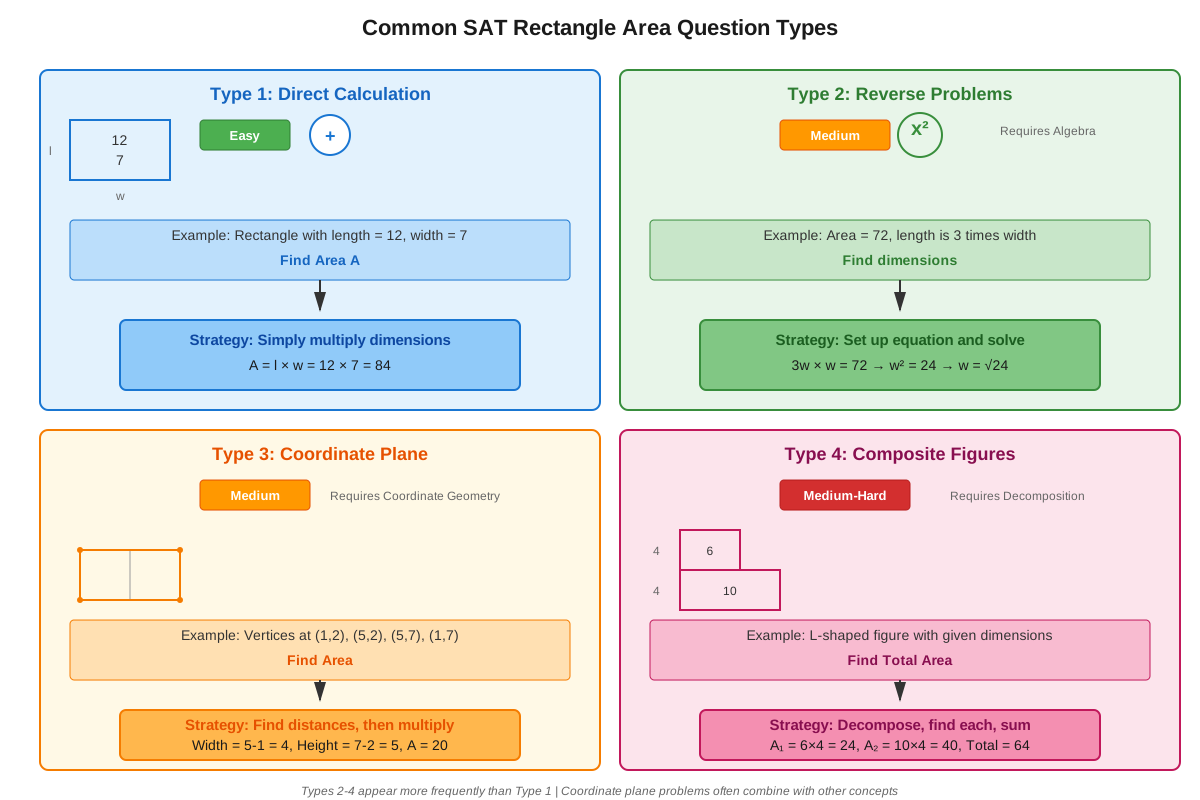
Common SAT question formats include: word problems describing real-world scenarios requiring area calculations; coordinate geometry problems where rectangles are defined by vertices; optimization problems asking for maximum or minimum areas given constraints; problems involving scale factors and similar rectangles; composite figure problems requiring decomposition into rectangular components; and algebraic problems where dimensions are expressed as variables or expressions. The versatility of rectangular area as a testing vehicle makes it one of the most reliable topics for score improvement through focused preparation.
Core Concepts
The Fundamental Area Formula
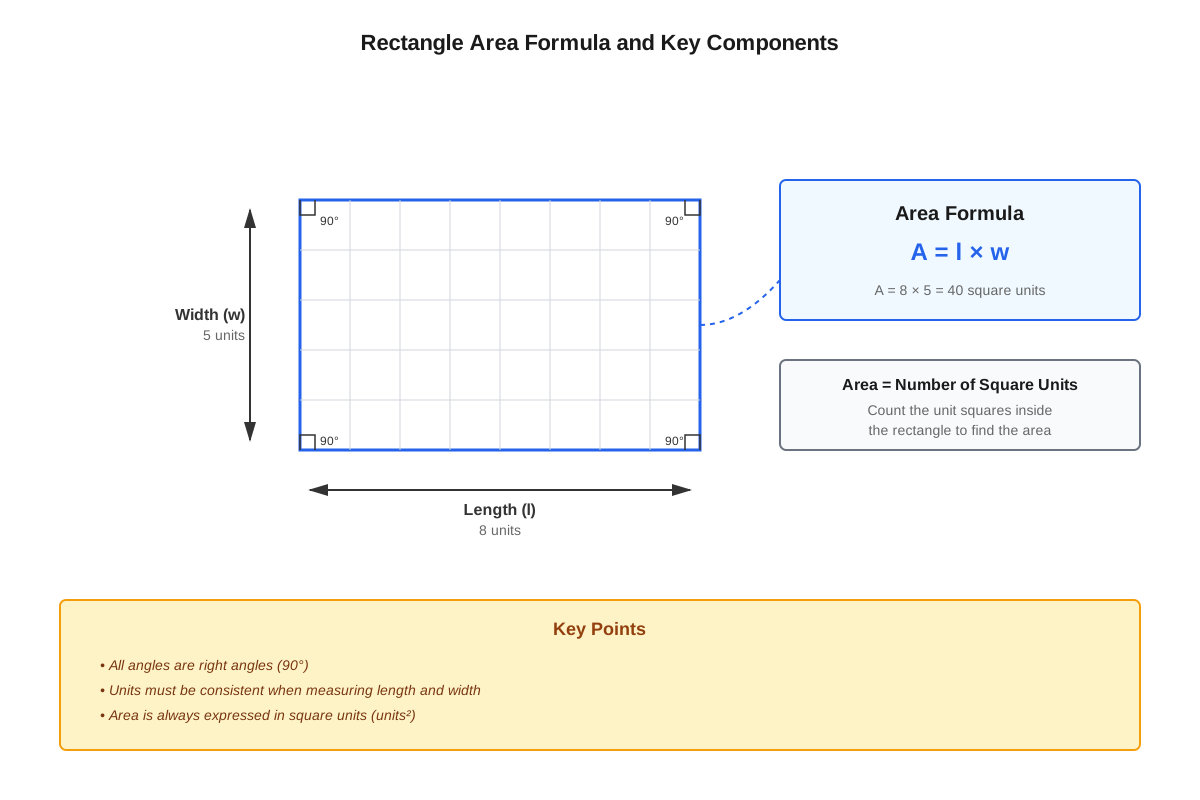
The area of rectangles is calculated using the fundamental formula: Area = length × width (A = l × w). This formula represents the total number of square units contained within the rectangle's boundaries. The area itself is always expressed in square units (square inches, square feet, square meters, etc.), which is crucial for dimensional analysis on the SAT. Students must recognize that area measures two-dimensional space, distinguishing it from linear measurements like perimeter.
The formula works because a rectangle can be conceptually divided into rows and columns of unit squares. If a rectangle has a length of 5 units and a width of 3 units, it contains 5 columns of 3 unit squares each, totaling 15 square units. This visual understanding helps students grasp why we multiply dimensions rather than add them, a common source of confusion.
Properties of Rectangles Relevant to Area
Rectangles possess specific geometric properties that influence area calculations:
- Opposite sides are equal: A rectangle has two pairs of parallel sides with equal lengths
- All angles are right angles (90°): This perpendicularity ensures the length-width multiplication accurately represents area
- Diagonals are equal: While not directly used in area calculations, this property helps identify rectangles in coordinate geometry
- Adjacent sides are perpendicular: This guarantees that length and width measurements are independent dimensions
Algebraic Representation of Rectangular Area
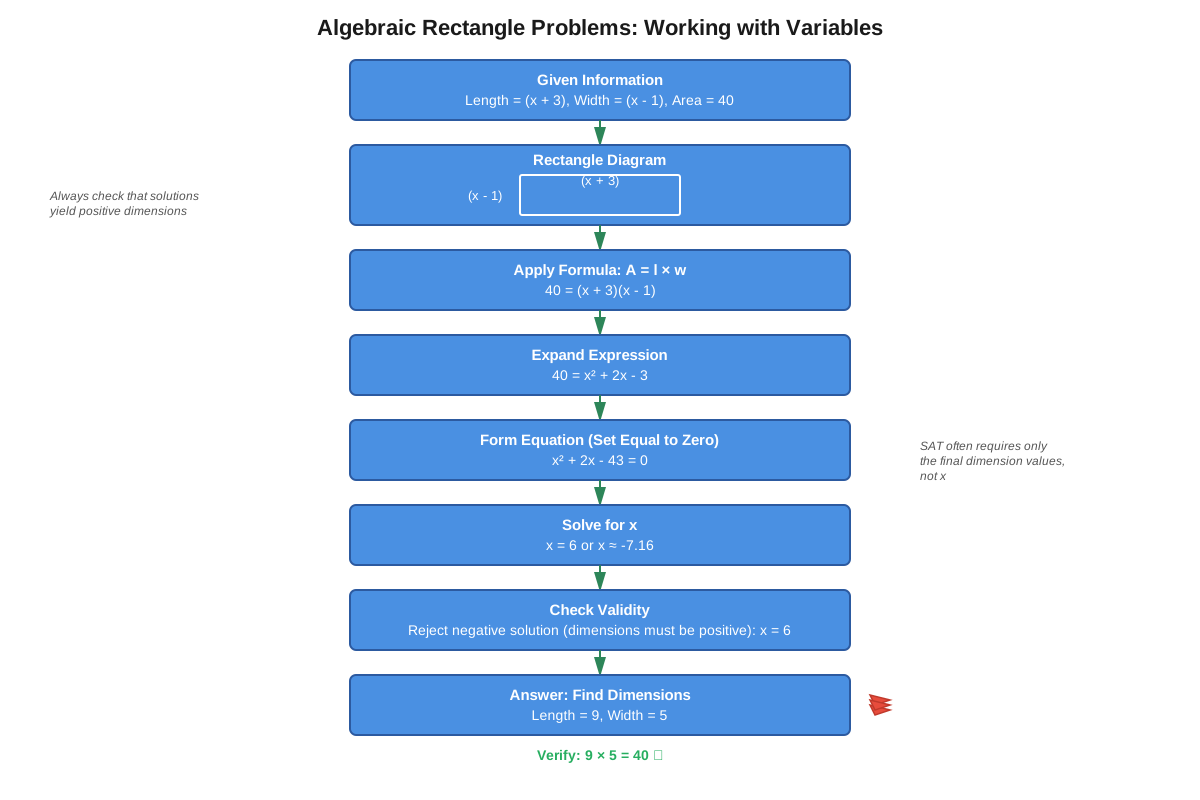
SAT questions frequently express dimensions algebraically rather than numerically. For example, if a rectangle has length (2x + 3) and width (x - 1), the area becomes:
A = (2x + 3)(x - 1)
A = 2x² - 2x + 3x - 3
A = 2x² + x - 3
Students must be comfortable expanding binomial expressions, factoring quadratic expressions, and solving equations where area is given and dimensions must be found. This algebraic approach transforms simple geometry into a powerful tool for testing mathematical reasoning.
Rectangles on the Coordinate Plane
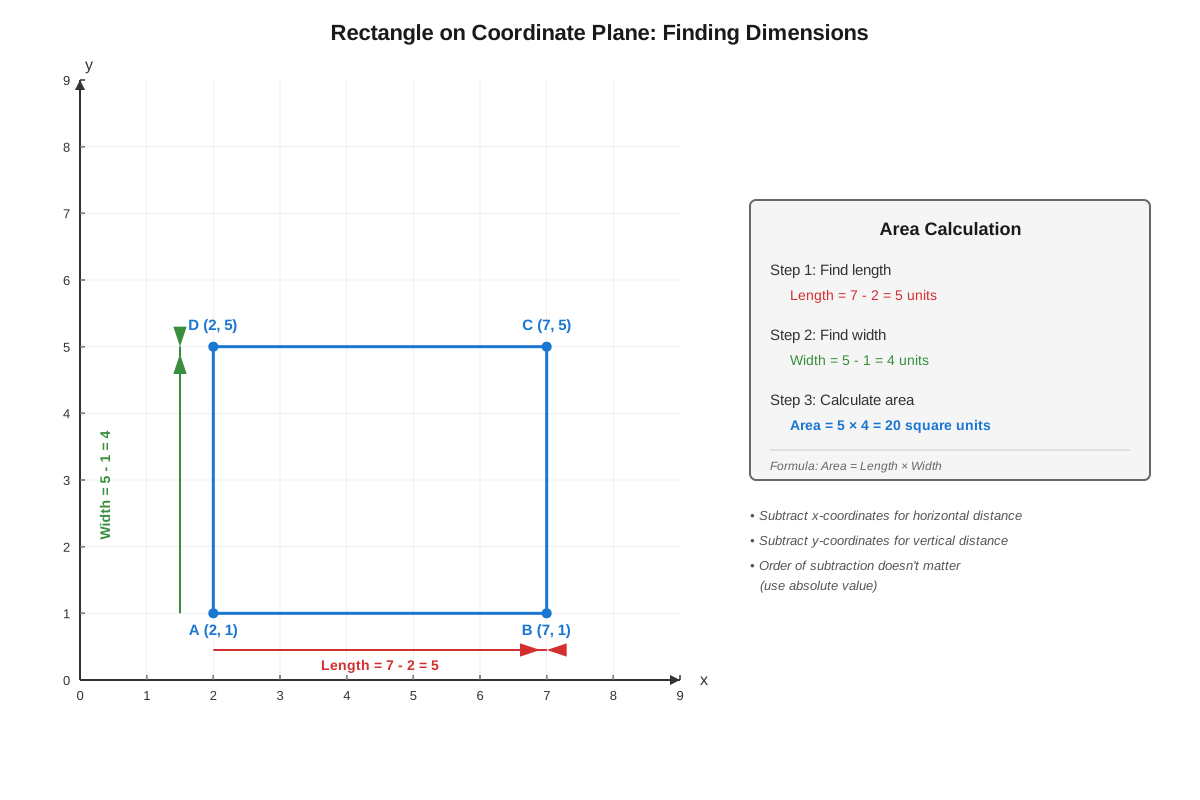
When rectangles are positioned on the coordinate plane with sides parallel to the axes, finding the area requires determining dimensions from coordinate points. If a rectangle has vertices at (x₁, y₁), (x₂, y₁), (x₂, y₂), and (x₁, y₂), then:
- Length = |x₂ - x₁|
- Width = |y₂ - y₁|
- Area = |x₂ - x₁| × |y₂ - y₁|
The absolute value ensures positive dimensions regardless of coordinate order. For example, a rectangle with vertices at (2, 3), (7, 3), (7, 8), and (2, 8) has:
- Length = |7 - 2| = 5 units
- Width = |8 - 3| = 5 units
- Area = 5 × 5 = 25 square units
Working Backward from Area
Many SAT questions provide the area and require finding dimensions. If the area is 48 square units and the length is twice the width, students must set up and solve:
Let w = width
Then 2w = length
Area = length × width
48 = 2w × w
48 = 2w²
24 = w²
w = √24 = 2√6 (taking positive root since width is positive)
This reverse-engineering approach tests algebraic problem-solving and equation-solving skills within a geometric context.
Composite Figures and Decomposition
Complex figures often require decomposition into rectangular components. The total area equals the sum of individual rectangular areas. For L-shaped figures, students can either:
- Divide the figure into multiple rectangles and add their areas
- Consider the figure as a large rectangle with a rectangular piece removed and subtract areas
Both approaches yield the same result, but recognizing which method is more efficient saves valuable test time.
Units and Dimensional Analysis
Area calculations require careful attention to units. When dimensions are given in different units, conversion is necessary before multiplication. For example, if length is 3 feet and width is 24 inches:
- Convert to common units: 3 feet = 36 inches
- Calculate area: 36 inches × 24 inches = 864 square inches
- Or: 3 feet × 2 feet = 6 square feet
The SAT may test whether students recognize that area units are squared (ft² not ft) and can convert between different area units (1 ft² = 144 in²).
Concept Relationships
The area of rectangles serves as a central hub connecting multiple mathematical domains. The fundamental formula (A = l × w) directly relates to multiplication concepts and algebraic expressions, as dimensions may be represented by variables or polynomial expressions. When solving for unknown dimensions given an area, students apply equation-solving techniques and factoring skills, creating a bridge between geometry and algebra.
Rectangular area connects intimately with perimeter calculations (P = 2l + 2w), and SAT questions frequently present both measurements simultaneously, requiring students to set up systems of equations. The relationship flows: dimensions → area and perimeter → optimization problems. Understanding that area and perimeter are independent (rectangles with the same perimeter can have different areas) is crucial for avoiding common errors.
The concept extends naturally to coordinate geometry, where rectangles defined by vertices require students to calculate distances using coordinate differences before applying the area formula. This progression follows: coordinate points → dimension calculation → area formula application. Similarly, rectangular area forms the foundation for three-dimensional geometry, as surface area of rectangular prisms involves calculating areas of rectangular faces, and volume extends the concept to three dimensions (V = l × w × h).
Composite figure problems demonstrate how rectangular area relates to addition and subtraction of areas and spatial decomposition strategies. The relationship map: complex figure → identify rectangular components → calculate individual areas → combine through addition or subtraction → total area. This hierarchical problem-solving approach appears frequently on the SAT and develops critical spatial reasoning skills.
High-Yield Facts
⭐ The area of a rectangle equals length times width (A = l × w), always expressed in square units
⭐ When dimensions are given algebraically, expand expressions carefully and combine like terms to find area
⭐ For rectangles on the coordinate plane with sides parallel to axes, find dimensions by taking absolute differences of coordinates
⭐ Area and perimeter are independent—rectangles with the same perimeter can have vastly different areas
⭐ When working backward from area to dimensions, set up an equation and solve for the unknown variable
- A square is a special rectangle where length equals width, so area = side²
- Doubling one dimension of a rectangle doubles its area; doubling both dimensions quadruples the area
- The maximum area for a given perimeter occurs when the rectangle is a square
- Converting linear units requires squaring the conversion factor for area (1 ft = 12 in, so 1 ft² = 144 in²)
- Composite figures can be solved by either adding rectangular areas or subtracting from a larger rectangle
- If dimensions are in a ratio, use a variable to represent the common factor (e.g., if l:w = 3:2, let l = 3x and w = 2x)
- The diagonal of a rectangle creates two congruent right triangles, connecting area to the Pythagorean theorem
- When dimensions contain radicals or fractions, simplify the final area expression completely
- Area problems often combine with percent increase/decrease concepts (e.g., "If length increases by 20%...")
- Grid-in questions may require calculating area then performing additional operations like division or finding ratios
Quick check — test yourself on Area of rectangles so far.
Try Flashcards →Common Misconceptions
Misconception: Area and perimeter are the same thing or can be used interchangeably.
Correction: Area measures the two-dimensional space inside a rectangle (square units), while perimeter measures the distance around the rectangle (linear units). They are calculated differently and represent distinct geometric properties.
Misconception: When both dimensions of a rectangle double, the area also doubles.
Correction: When both dimensions double, the area quadruples. If original area is l × w, the new area is (2l) × (2w) = 4lw, which is four times the original area. This scaling principle is frequently tested on the SAT.
Misconception: The area formula can be applied to any quadrilateral by multiplying any two sides.
Correction: The formula A = l × w specifically applies to rectangles (and squares) because their sides are perpendicular. For other quadrilaterals like parallelograms or trapezoids, different formulas are required.
Misconception: When converting units, the conversion factor for area is the same as for length.
Correction: Area conversion factors must be squared. Since 1 foot = 12 inches, 1 square foot = 144 square inches (12²), not 12 square inches. This is one of the most common errors on SAT unit conversion problems.
Misconception: If a rectangle's area is 24 square units, the dimensions must be whole numbers like 6 and 4.
Correction: Dimensions can be any positive real numbers whose product equals 24, including fractions, decimals, or irrational numbers like 2√6 and 2√6. The SAT often uses non-integer dimensions to test deeper understanding.
Misconception: On the coordinate plane, the area of a rectangle can be found by multiplying the coordinates of opposite vertices.
Correction: Area requires finding the differences in x-coordinates (for one dimension) and y-coordinates (for the other dimension), then multiplying these differences. Simply multiplying coordinates gives an incorrect result.
Misconception: A larger perimeter always means a larger area.
Correction: Rectangles with the same perimeter can have different areas. For example, a 1×9 rectangle has perimeter 20 and area 9, while a 4×6 rectangle has perimeter 20 and area 24. Area and perimeter are independent properties.
Worked Examples
Example 1: Algebraic Dimensions with Constraints
Problem: A rectangle has a length that is 5 units more than twice its width. If the area of the rectangle is 63 square units, what is the width of the rectangle?
Solution:
Step 1: Define variables based on the given relationship.
- Let w = width
- Then length = 2w + 5
Step 2: Set up the area equation using A = l × w.
Area = length × width
63 = (2w + 5) × w
Step 3: Expand and rearrange into standard quadratic form.
63 = 2w² + 5w
2w² + 5w - 63 = 0
Step 4: Factor the quadratic equation.
2w² + 5w - 63 = 0
(2w - 9)(w + 7) = 0
Step 5: Solve for w.
2w - 9 = 0  or  w + 7 = 0
w = 4.5  or  w = -7
Step 6: Select the physically meaningful solution.
Since width must be positive, w = 4.5 units.
Step 7: Verify the answer.
- Width = 4.5 units
- Length = 2(4.5) + 5 = 14 units
- Area = 4.5 × 14 = 63 square units ✓
Connection to Learning Objectives: This problem demonstrates applying algebraic representation to rectangular area, working backward from area to find dimensions, and solving quadratic equations within a geometric context—all essential SAT skills.
Example 2: Coordinate Plane Rectangle with Composite Calculation
Problem: On the coordinate plane, rectangle ABCD has vertices at A(2, 1), B(8, 1), C(8, 5), and D(2, 5). A smaller rectangle with vertices at E(4, 2), F(6, 2), G(6, 4), and H(4, 4) is removed from the interior of rectangle ABCD. What is the area of the remaining region?
Solution:
Step 1: Calculate the dimensions of the larger rectangle ABCD.
- Length (horizontal distance) = |8 - 2| = 6 units
- Width (vertical distance) = |5 - 1| = 4 units
Step 2: Calculate the area of rectangle ABCD.
Area_ABCD = 6 × 4 = 24 square unitsStep 3: Calculate the dimensions of the smaller rectangle EFGH.
- Length (horizontal distance) = |6 - 4| = 2 units
- Width (vertical distance) = |4 - 2| = 2 units
Step 4: Calculate the area of rectangle EFGH.
Area_EFGH = 2 × 2 = 4 square unitsStep 5: Subtract the removed area from the original area.
Remaining area = Area_ABCD - Area_EFGH
Remaining area = 24 - 4 = 20 square units
Connection to Learning Objectives: This problem integrates coordinate geometry with rectangular area calculations and demonstrates the composite figure approach of subtracting areas, all within a single multi-step problem typical of medium-difficulty SAT questions.
Exam Strategy
When approaching sat area of rectangles questions, begin by carefully identifying what information is given and what is being asked. Draw a diagram if one isn't provided—visual representation prevents errors and reveals relationships between given information. Label all known dimensions, variables, and relationships directly on the diagram.
Trigger words and phrases to watch for include: "length is 3 more than width" (algebraic relationship), "twice as long as it is wide" (ratio relationship), "perimeter and area" (system of equations), "coordinate plane" (use coordinate differences), "composite figure" or "L-shaped" (decomposition strategy), "maximum area" (optimization, often leading to a square), and "scale factor" (area scales by the square of the linear scale factor).
For process-of-elimination on multiple-choice questions, immediately eliminate answers with incorrect units (linear units instead of square units) or unreasonable magnitudes (area smaller than either dimension, which is impossible for dimensions greater than 1). If the problem involves algebraic expressions, substitute simple values to test whether answer choices produce reasonable results. When dimensions are given as expressions, expand answer choices and compare to your calculated expression to identify matches.
Time allocation for rectangular area questions should typically be 45-90 seconds for straightforward calculations, 90-120 seconds for problems involving algebra or coordinate geometry, and up to 2 minutes for complex composite figures or multi-step word problems. If a problem requires more than 2 minutes, mark it for review and move on—returning with fresh perspective often reveals a simpler approach.
Develop a systematic approach: (1) identify the type of rectangle problem, (2) extract or calculate dimensions, (3) apply the area formula, (4) check units and reasonableness, (5) verify the answer addresses what was asked. Many students correctly calculate area but fail to answer the actual question, which might ask for a dimension, a ratio, or a related quantity rather than area itself.
Memory Techniques
"Length × Width = Area" Mnemonic: Remember "L-W-A" as "Long Walk Ahead" to recall that Length times Width gives Area. The sequential nature reinforces the multiplication relationship.
Unit Conversion Visualization: Picture a square foot as a 12×12 grid of square inches. Visualizing this grid makes it memorable that 1 ft² = 144 in² (12 squared), preventing the common error of using 12 as the conversion factor.
Coordinate Plane Strategy: Use the acronym "DASH" for coordinate rectangles: Difference in x-coordinates, Absolute value, Same for y-coordinates, Horizontal times vertical. This ensures you calculate dimensions correctly before multiplying.
Algebraic Setup Reminder: The phrase "WIDE Length" reminds you that when setting up equations, Write Identified Dimensions Explicitly, then apply Length × width = area. This prevents skipping the crucial step of defining variables clearly.
Composite Figure Approach: Remember "ADD or SUBTRACT": Analyze the shape, Divide into rectangles, Determine individual areas, then either Subtract removed portions Using Bigger minus smaller, Totaling Rectangular Areas by Combining Them. This comprehensive acronym guides the entire problem-solving process.
Scaling Relationship: The phrase "Square the Scale" reminds you that when linear dimensions change by a factor, area changes by the square of that factor. If dimensions double, area quadruples (2² = 4).
Summary
The area of rectangles is a fundamental geometric concept that appears consistently on the SAT Math section, requiring students to master both computational skills and conceptual understanding. The basic formula A = l × w serves as the foundation, but SAT questions extend this concept through algebraic representation, coordinate geometry applications, composite figures, and multi-step problem-solving scenarios. Success requires recognizing that area measures two-dimensional space in square units, understanding the independence of area and perimeter, and developing facility with working both forward (dimensions to area) and backward (area to dimensions). Students must be comfortable with algebraic manipulation when dimensions are expressed as variables or expressions, coordinate geometry techniques for rectangles defined by vertices, and decomposition strategies for composite figures. Attention to units, particularly when converting between measurement systems, prevents common errors. The ability to set up equations from word problems, solve quadratic equations arising from area constraints, and verify answers through dimensional analysis distinguishes high-scoring students. Mastering rectangular area provides the foundation for more advanced geometric concepts while simultaneously strengthening algebraic reasoning skills essential throughout the SAT Math section.
Key Takeaways
- The fundamental formula A = l × w applies to all rectangles, with area always expressed in square units
- SAT questions test rectangular area through algebraic expressions, coordinate geometry, composite figures, and word problems requiring multi-step reasoning
- Area and perimeter are independent properties—rectangles with identical perimeters can have vastly different areas
- When working backward from area to dimensions, set up equations carefully and solve algebraically, remembering that dimensions must be positive
- For coordinate plane rectangles with sides parallel to axes, calculate dimensions using absolute differences in coordinates before applying the area formula
- Unit conversion for area requires squaring the linear conversion factor (1 ft² = 144 in², not 12 in²)
- Composite figures require strategic decomposition—either add rectangular components or subtract removed portions from a larger rectangle
Related Topics
Perimeter of Rectangles: Understanding how to calculate the distance around rectangles (P = 2l + 2w) and solving problems that provide both area and perimeter constraints, leading to systems of equations.
Area of Other Quadrilaterals: Extending area concepts to parallelograms (A = bh), trapezoids (A = ½h(b₁ + b₂)), and rhombuses (A = ½d₁d₂), building on rectangular area foundations.
Surface Area of Rectangular Prisms: Applying rectangular area calculations to three-dimensional objects by finding areas of six rectangular faces and summing them.
Volume of Rectangular Prisms: Extending the two-dimensional area concept to three dimensions with V = l × w × h, where the base area (l × w) is multiplied by height.
Optimization Problems: Using calculus or algebraic reasoning to find maximum or minimum areas given constraints, often involving rectangles with fixed perimeters.
Similar Figures and Scale Factors: Understanding how area scales with the square of the linear scale factor when rectangles are enlarged or reduced proportionally.
Practice CTA
Now that you've mastered the core concepts, formulas, and strategies for rectangular area problems, it's time to solidify your understanding through active practice. The practice questions and flashcards have been specifically designed to mirror actual SAT question formats and difficulty levels, giving you the opportunity to apply everything you've learned in this guide. Challenge yourself with problems involving algebraic dimensions, coordinate geometry, and composite figures—these are the exact scenarios you'll encounter on test day. Remember, consistent practice with immediate feedback is the most effective way to transform understanding into automatic problem-solving ability. Approach each practice question strategically, and don't just check your answer—analyze your problem-solving process to identify areas for improvement. You've built a strong foundation; now strengthen it through deliberate practice!
Sign up free to keep reading
Create a free AnvayaPrep account to finish this SAT guide on Area of rectangles — plus flashcards and practice questions.