Overview
Parabolas are one of the most frequently tested topics in SAT math, appearing in multiple questions across both the calculator and no-calculator sections. A parabola is the U-shaped curve that represents the graph of a quadratic function, and understanding its properties is essential for success on the exam. Students will encounter parabolas in various contexts: identifying key features from equations, interpreting graphs, solving real-world application problems, and manipulating algebraic expressions to reveal specific characteristics.
The SAT tests parabolas through multiple lenses, requiring students to move fluidly between algebraic representations (standard form, vertex form, and factored form) and graphical interpretations. Questions may ask students to identify the vertex, axis of symmetry, y-intercept, x-intercepts (roots or zeros), direction of opening, and maximum or minimum values. Additionally, the exam frequently presents word problems where parabolic relationships model real-world scenarios such as projectile motion, profit optimization, or architectural design.
Mastering parabolas connects directly to broader mathematical concepts tested on the SAT. This topic builds upon linear functions and extends into systems of equations, where students might need to find intersection points between parabolas and lines. Understanding parabolas also reinforces algebraic manipulation skills, factoring techniques, and the ability to extract meaningful information from different equation forms—all critical competencies for achieving a high score in the math section.
Learning Objectives
- [ ] Identify key features of parabolas including vertex, axis of symmetry, y-intercept, and x-intercepts
- [ ] Explain how parabolas appears on the SAT in various question formats and contexts
- [ ] Apply parabolas concepts to answer SAT-style questions efficiently and accurately
- [ ] Convert between different forms of quadratic equations (standard, vertex, and factored forms)
- [ ] Determine the direction of opening and whether a parabola has a maximum or minimum value
- [ ] Interpret the meaning of parabola features in real-world application problems
- [ ] Use the discriminant to determine the number of x-intercepts without graphing
Prerequisites
- Linear equations and graphing: Understanding coordinate planes and plotting points is essential for visualizing parabolas and their key features
- Basic algebraic manipulation: Expanding, factoring, and simplifying expressions enables conversion between different quadratic forms
- Solving quadratic equations: Methods including factoring, completing the square, and the quadratic formula are necessary for finding x-intercepts
- Function notation: Familiarity with f(x) notation helps interpret parabola equations and evaluate specific points
- Exponent rules: Understanding how squared terms behave is fundamental to working with quadratic expressions
Why This Topic Matters
Parabolas represent one of the highest-yield topics for SAT preparation, appearing in approximately 3-5 questions per test across both math sections. This translates to roughly 10-15% of all math questions, making it one of the most frequently tested concepts. The College Board consistently includes parabola questions because they assess multiple mathematical competencies simultaneously: algebraic reasoning, graphical interpretation, and problem-solving in context.
In real-world applications, parabolic relationships appear throughout physics, engineering, economics, and architecture. Projectile motion follows parabolic paths—whether calculating the trajectory of a basketball shot or designing fountain water arcs. Business applications include profit maximization problems where revenue and cost functions create parabolic relationships. Architects use parabolic shapes in bridge designs, satellite dishes, and suspension cables because of their unique reflective and structural properties.
On the SAT, parabola questions typically appear in several formats: pure algebraic manipulation (converting between forms), graphical interpretation (identifying features from a graph), application problems (modeling real-world scenarios), and hybrid questions combining multiple skills. Students might encounter questions asking them to identify which equation matches a given graph, determine the maximum height of a projectile, find where two functions intersect, or interpret the meaning of a vertex in context. The versatility of parabola questions makes them particularly valuable for the test makers to assess mathematical maturity.
Core Concepts
Forms of Quadratic Equations
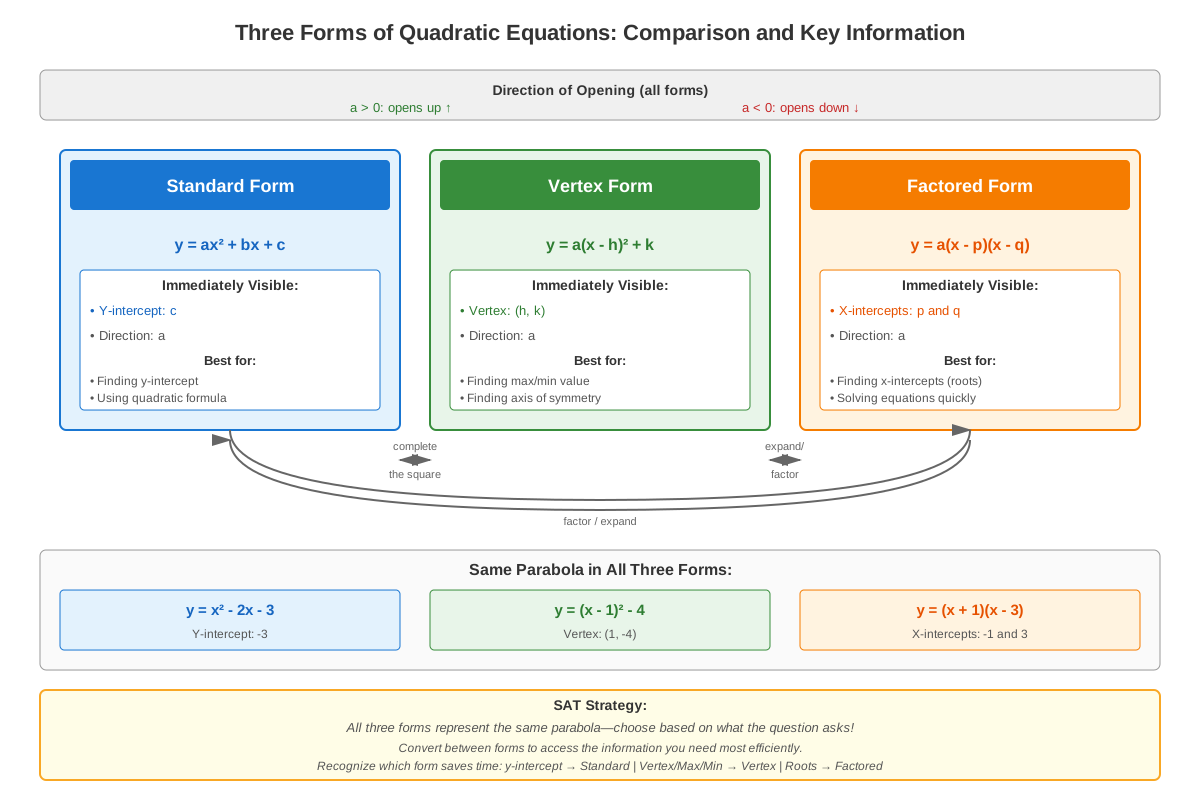
A quadratic function creates a parabola when graphed, and understanding the three primary forms is crucial for SAT success. Each form reveals different information about the parabola's key features.
Standard form: y = ax² + bx + c
This form immediately reveals the y-intercept at point (0, c). The coefficient 'a' determines the direction of opening: if a > 0, the parabola opens upward (has a minimum); if a < 0, it opens downward (has a maximum). The standard form is useful for quickly identifying the y-intercept and is often the starting point for algebraic manipulation.
Vertex form: y = a(x - h)² + k
This form directly reveals the vertex at point (h, k), which is the parabola's turning point—either the maximum or minimum value. The vertex form is particularly valuable for SAT questions asking about maximum or minimum values in application problems. Note the sign convention: the vertex x-coordinate is h (opposite of the sign in the equation), while k maintains its sign.
Factored form: y = a(x - p)(x - q)
This form immediately shows the x-intercepts (also called roots, zeros, or solutions) at points (p, 0) and (q, 0). When a quadratic is factorable, this form provides the quickest path to finding where the parabola crosses the x-axis. The axis of symmetry always lies exactly halfway between the two x-intercepts.
Key Features of Parabolas
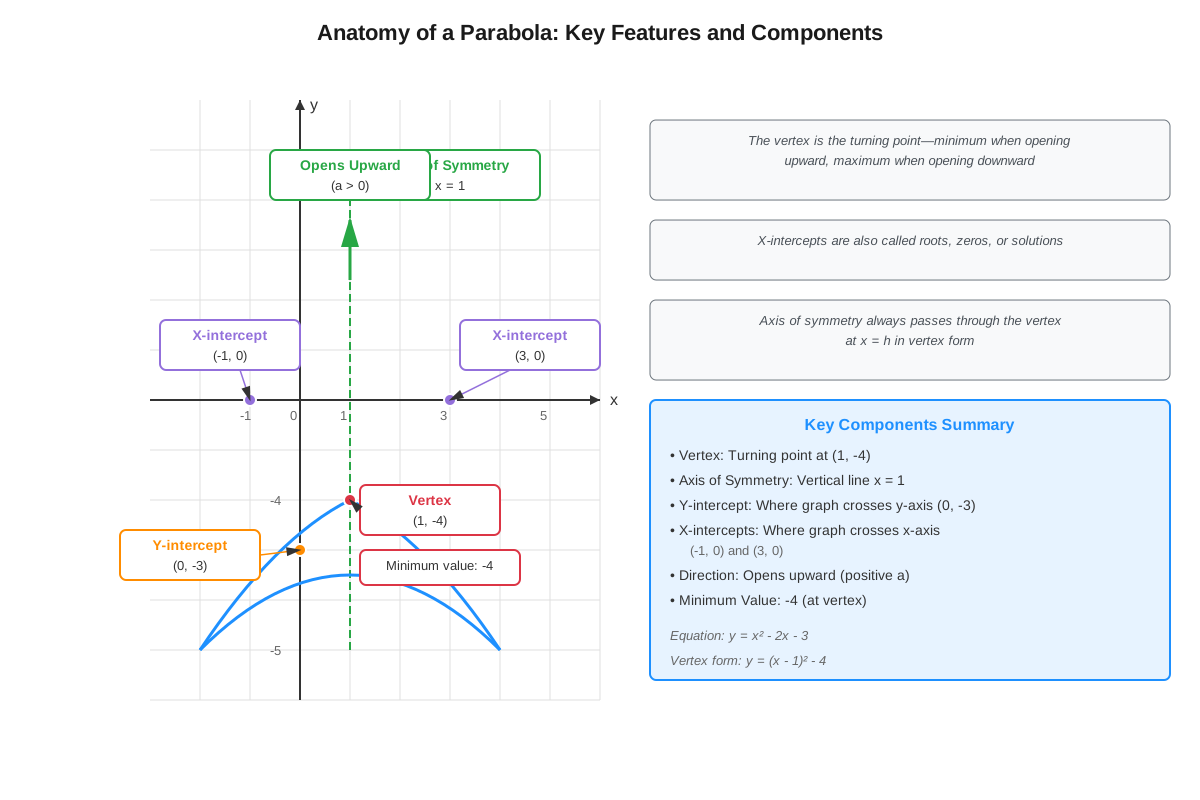
| Feature | Definition | How to Find |
|---|---|---|
| Vertex | The turning point (maximum or minimum) | From vertex form: (h, k); From standard form: x = -b/(2a), then substitute |
| Axis of Symmetry | Vertical line through the vertex | x = h (vertex form) or x = -b/(2a) (standard form) |
| Y-intercept | Where the parabola crosses the y-axis | Set x = 0; from standard form: (0, c) |
| X-intercepts | Where the parabola crosses the x-axis | Set y = 0 and solve; from factored form: (p, 0) and (q, 0) |
| Direction | Whether parabola opens up or down | Sign of 'a': positive = up, negative = down |
| Maximum/Minimum | Highest or lowest point | The y-coordinate of the vertex (k) |
Finding the Vertex from Standard Form
When given a quadratic in standard form y = ax² + bx + c, the vertex can be found using a two-step process:
- Find the x-coordinate of the vertex:
x = -b/(2a) - Substitute this x-value back into the original equation to find the y-coordinate
For example, given y = 2x² - 8x + 3:
- x-coordinate: x = -(-8)/(2·2) = 8/4 = 2
- y-coordinate: y = 2(2)² - 8(2) + 3 = 8 - 16 + 3 = -5
- Vertex: (2, -5)
The Discriminant and X-intercepts
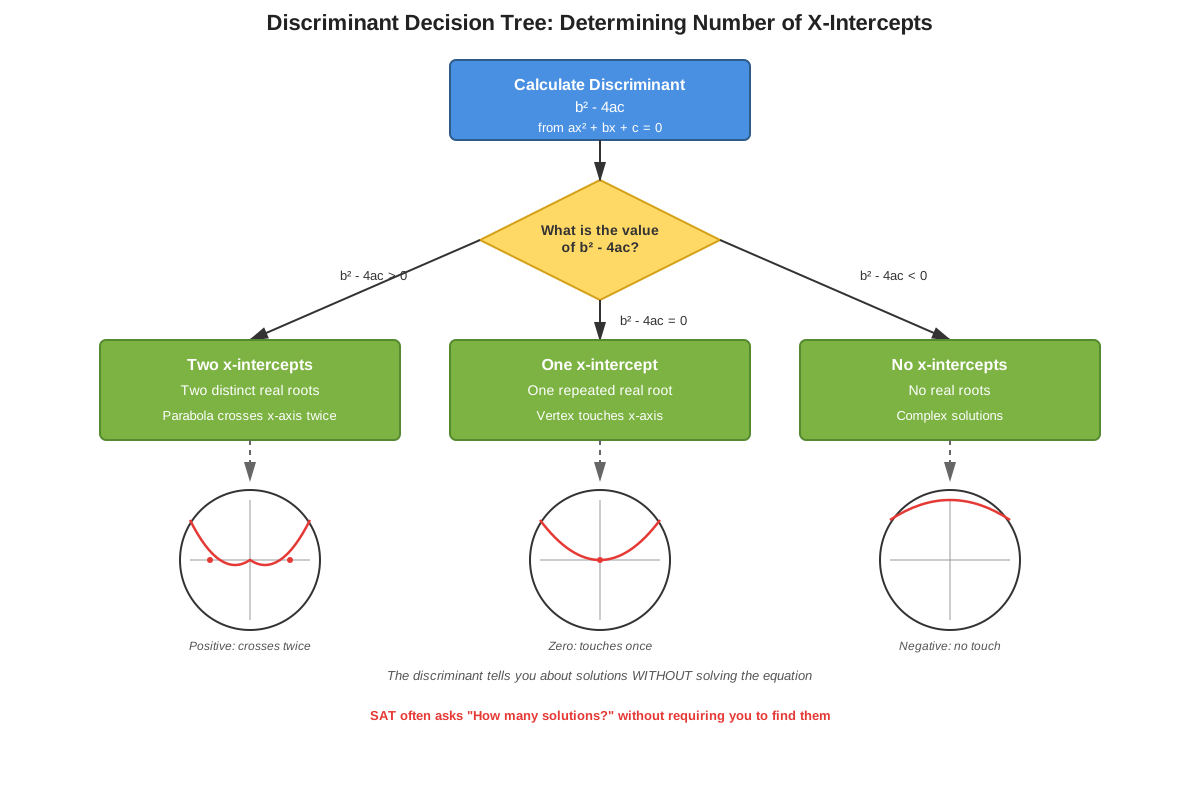
The discriminant b² - 4ac from the quadratic formula determines how many x-intercepts a parabola has:
- If b² - 4ac > 0: Two distinct x-intercepts (parabola crosses x-axis twice)
- If b² - 4ac = 0: One x-intercept (parabola touches x-axis at vertex)
- If b² - 4ac < 0: No x-intercepts (parabola doesn't touch x-axis)
This concept frequently appears on the SAT when questions ask about the number of solutions or real roots without requiring students to solve completely.
Axis of Symmetry
The axis of symmetry is a vertical line that divides the parabola into two mirror images. Every parabola has exactly one axis of symmetry passing through its vertex. The equation is always x = h where h is the x-coordinate of the vertex. This property is particularly useful for SAT questions because:
- The axis of symmetry is always halfway between the x-intercepts
- Any two points equidistant from the axis of symmetry have the same y-value
- Knowing one point on the parabola allows you to find its symmetric partner
Transformations of Parabolas
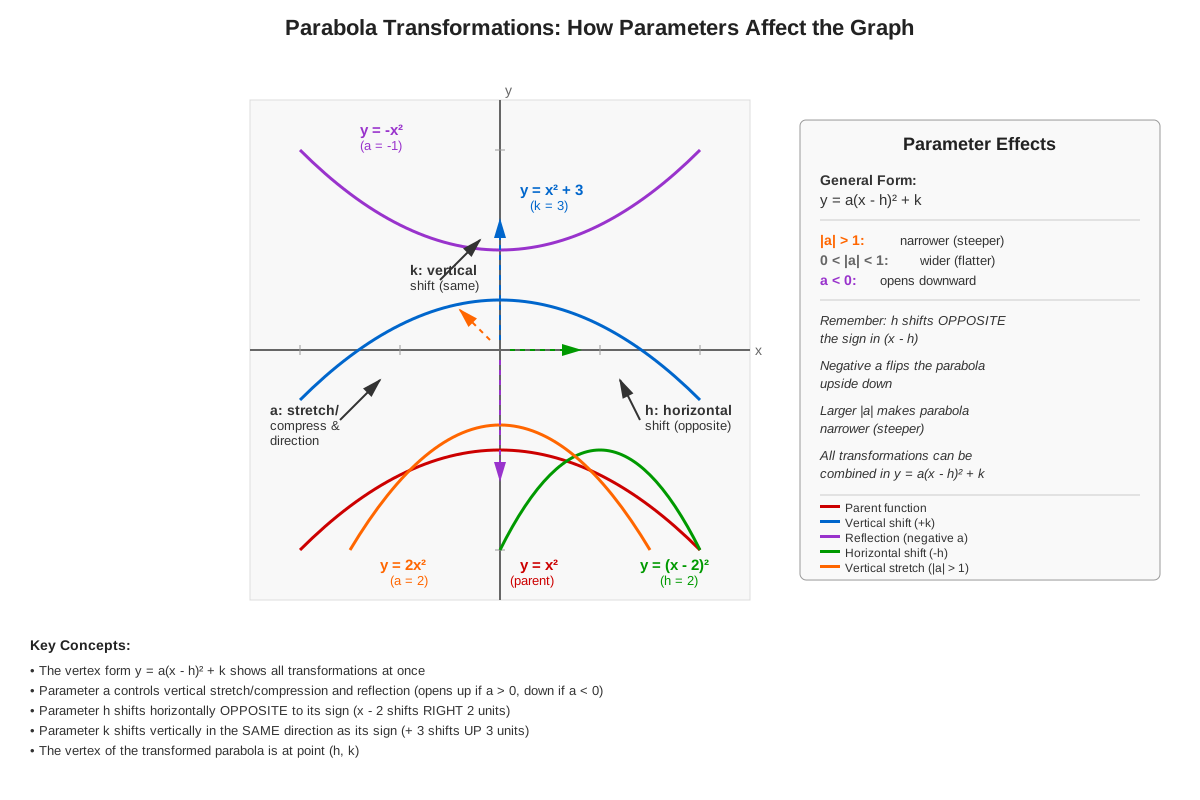
Understanding how changes to the equation affect the graph helps with SAT questions involving function transformations:
y = a(x - h)² + kshifts the basic parabolay = x²right h units and up k units- Increasing |a| makes the parabola narrower (steeper)
- Decreasing |a| makes the parabola wider (flatter)
- Negative 'a' reflects the parabola over the x-axis
Concept Relationships
The three forms of quadratic equations are interconnected through algebraic manipulation. Standard form serves as the foundation, from which both vertex form (through completing the square) and factored form (through factoring techniques) can be derived. Conversely, both vertex and factored forms can be expanded back to standard form through distribution.
The vertex connects to multiple other features: it lies on the axis of symmetry, represents the maximum or minimum value, and is equidistant from the x-intercepts (when they exist). The relationship flows: Axis of Symmetry → Vertex → Maximum/Minimum Value.
The discriminant determines the number of x-intercepts, which in turn affects whether the parabola can be written in factored form (only possible with real x-intercepts). This creates the relationship: Discriminant → Number of X-intercepts → Factorability.
Understanding transformations builds upon knowledge of the basic parabola y = x², showing how the parameters a, h, and k in vertex form modify the graph's position and shape. This connects to the broader concept of function transformations tested throughout the SAT math section.
The connection to prerequisite topics is direct: linear equations provide the foundation for understanding coordinate systems and graphing, while algebraic manipulation skills enable conversion between forms. Solving quadratic equations is the tool used to find x-intercepts, completing the circle of understanding.
High-Yield Facts
⭐ The vertex form y = a(x - h)² + k directly reveals the vertex at (h, k), with the x-coordinate being the opposite sign of what appears in the equation
⭐ The coefficient 'a' determines direction: positive 'a' means the parabola opens upward (minimum), negative 'a' means downward (maximum)
⭐ The axis of symmetry is always x = -b/(2a) in standard form or x = h in vertex form
⭐ The y-intercept in standard form y = ax² + bx + c is always the constant term 'c'
⭐ The discriminant b² - 4ac determines the number of x-intercepts: positive = 2, zero = 1, negative = 0
- The vertex represents either the maximum or minimum value of the quadratic function, never both
- X-intercepts in factored form
y = a(x - p)(x - q)occur at x = p and x = q - The axis of symmetry always passes through the vertex and is equidistant from the x-intercepts
- Completing the square converts standard form to vertex form, revealing the vertex coordinates
- Two points with the same y-value on a parabola are equidistant from the axis of symmetry
- The width of a parabola is determined by |a|: larger values create narrower parabolas
- A parabola has exactly one y-intercept but can have zero, one, or two x-intercepts
- The vertex lies on the axis of symmetry by definition
- In application problems, the vertex often represents the optimal value (maximum profit, minimum cost, etc.)
- The quadratic formula
x = [-b ± √(b² - 4ac)]/(2a)always finds x-intercepts when they exist
Quick check — test yourself on Parabolas so far.
Try Flashcards →Common Misconceptions
Misconception: The vertex in y = a(x - h)² + k is at (-h, k) because of the minus sign.
Correction: The vertex is at (h, k). The equation shows (x - h), so if the equation is y = (x - 3)², the vertex x-coordinate is positive 3, not negative 3. The subtraction is already built into the form.
Misconception: A parabola opening downward has a minimum value.
Correction: A parabola opening downward (negative 'a') has a maximum value at its vertex. The parabola extends downward infinitely, so there is no minimum. Conversely, upward-opening parabolas have minimum values.
Misconception: The y-intercept and vertex are the same point.
Correction: These are only the same when the axis of symmetry is the y-axis (x = 0). In most cases, they are different points. The y-intercept always has x-coordinate of 0, while the vertex x-coordinate is -b/(2a).
Misconception: If a quadratic has no x-intercepts, it has no solutions.
Correction: The quadratic equation has no real solutions, but the quadratic function still exists and has a graph. The parabola simply doesn't cross the x-axis. It still has a vertex, y-intercept, and all other features.
Misconception: The axis of symmetry is a horizontal line.
Correction: The axis of symmetry for a parabola of the form y = ax² + bx + c is always a vertical line with equation x = constant. Horizontal lines would be axes of symmetry for parabolas that open sideways (not standard SAT content).
Misconception: Larger values of 'a' make the parabola wider.
Correction: Larger absolute values of 'a' make the parabola narrower (steeper). Smaller absolute values (closer to zero) make it wider (flatter). Think of |a| as a "stretch factor" away from the x-axis.
Misconception: The factored form y = (x - 2)(x - 5) has x-intercepts at x = -2 and x = -5.
Correction: The x-intercepts are at x = 2 and x = 5 (the values that make each factor equal zero). Set each factor to zero: (x - 2) = 0 gives x = 2, and (x - 5) = 0 gives x = 5.
Worked Examples
Example 1: Converting Forms and Finding Key Features
Problem: Given the quadratic function f(x) = x² - 6x + 5, find the vertex, axis of symmetry, y-intercept, and x-intercepts.
Solution:
Step 1: Identify the y-intercept from standard form.
The equation is in standard form y = ax² + bx + c where c = 5.
Y-intercept: (0, 5)
Step 2: Find the axis of symmetry and vertex x-coordinate.
Using the formula x = -b/(2a) where a = 1 and b = -6:
x = -(-6)/(2·1) = 6/2 = 3
Axis of symmetry: x = 3
Step 3: Find the vertex y-coordinate.
Substitute x = 3 into the original equation:
f(3) = (3)² - 6(3) + 5 = 9 - 18 + 5 = -4
Vertex: (3, -4)
Step 4: Find the x-intercepts by factoring.
f(x) = x² - 6x + 5 = (x - 1)(x - 5)
Set equal to zero: (x - 1)(x - 5) = 0
X-intercepts: (1, 0) and (5, 0)
Step 5: Verify using symmetry.
The x-intercepts at x = 1 and x = 5 are equidistant from the axis of symmetry at x = 3 (both are 2 units away), confirming our answer.
Connection to Learning Objectives: This example demonstrates identifying all key features of a parabola and applying multiple forms to extract information efficiently—essential skills for SAT questions.
Example 2: Application Problem with Maximum Value
Problem: A company's daily profit P (in dollars) from selling x items is modeled by the function P(x) = -2x² + 80x - 300. How many items should be sold to maximize profit, and what is the maximum profit?
Solution:
Step 1: Identify what the question asks.
We need the maximum value, which occurs at the vertex. The equation is in standard form with a = -2 (negative, so parabola opens downward, confirming a maximum exists).
Step 2: Find the x-coordinate of the vertex (optimal number of items).
Using x = -b/(2a) where a = -2 and b = 80:
x = -80/(2·(-2)) = -80/(-4) = 20
The company should sell 20 items.
Step 3: Find the y-coordinate of the vertex (maximum profit).
Substitute x = 20 into the profit function:
P(20) = -2(20)² + 80(20) - 300
P(20) = -2(400) + 1600 - 300
P(20) = -800 + 1600 - 300 = 500
Step 4: State the answer in context.
The company should sell 20 items to achieve a maximum profit of $500.
Alternative approach using vertex form:
Complete the square to convert to vertex form:
P(x) = -2(x² - 40x) - 300
P(x) = -2(x² - 40x + 400 - 400) - 300
P(x) = -2(x - 20)² + 800 - 300
P(x) = -2(x - 20)² + 500
This immediately shows the vertex at (20, 500), confirming our answer.
Connection to Learning Objectives: This example applies parabola concepts to a real-world SAT-style application problem, demonstrating how to interpret the vertex in context and showing multiple solution methods.
Exam Strategy
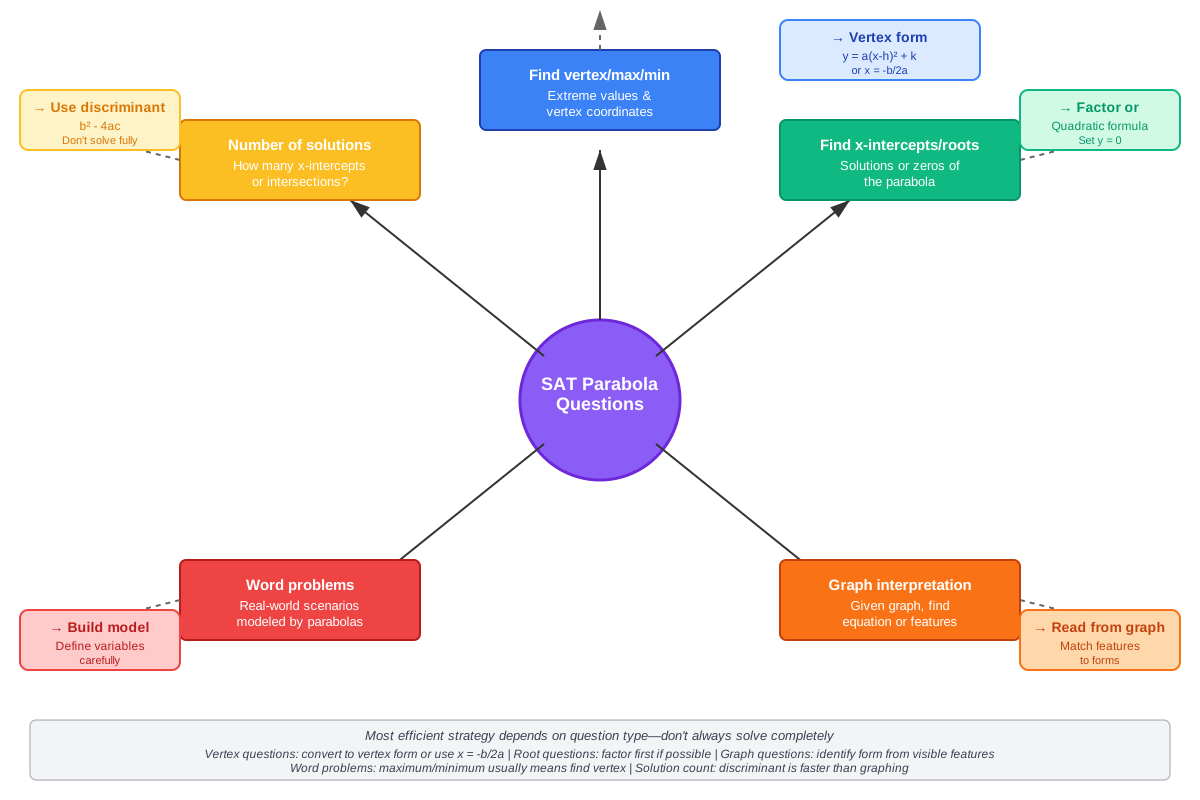
When approaching SAT parabolas questions, begin by identifying which form the equation is presented in and what information is being requested. If the question asks about the vertex or maximum/minimum values, vertex form is most efficient. If x-intercepts are needed, look for factored form or factor the equation. For y-intercepts, standard form provides immediate answers.
Trigger words and phrases to recognize:
- "Maximum" or "minimum" → Find the vertex
- "Crosses the x-axis" or "zeros" or "roots" → Find x-intercepts
- "Crosses the y-axis" → Find y-intercept (set x = 0)
- "Axis of symmetry" → Find x = -b/(2a) or x = h
- "Opens upward/downward" → Check the sign of 'a'
- "How many solutions" → Use the discriminant
- "Optimal," "greatest," "least" → Find the vertex in application problems
Process-of-elimination strategies:
- Eliminate answer choices with incorrect direction of opening by checking the sign of 'a'
- If given a graph, eliminate equations whose y-intercept doesn't match the graph
- For vertex questions, substitute the x-coordinate of each answer choice to verify the y-coordinate
- If the question provides x-intercepts, eliminate any equation that doesn't factor to those values
- Check extreme values: if a parabola opens upward, eliminate any answer suggesting a maximum
Time allocation advice:
Spend 30-45 seconds identifying the form and what's being asked, then 60-90 seconds on calculations. If a problem requires converting between forms, consider whether there's a faster approach using the given information. Don't waste time converting to all three forms—only convert to the form that reveals the requested information. For application problems, spend extra time understanding what the variables represent before calculating.
Exam Tip: When a question shows a graph and asks which equation matches it, check the y-intercept first (easiest to verify), then the vertex, then the x-intercepts. This systematic approach eliminates wrong answers quickly.
Memory Techniques
Vertex Form Mnemonic: "Vertex form shows Vertex" - The form y = a(x - h)² + k directly reveals the vertex (h, k).
Direction Mnemonic: "Positive Parabola Points Up" - When 'a' is positive, the parabola opens upward like a cup that holds water.
Axis of Symmetry Acronym: AOS = "Always Opposite Sign" - In vertex form, the axis of symmetry x-coordinate is the opposite sign of what appears in (x - h).
Discriminant Memory Device: "Discriminant Determines Distinct solutions"
- D > 0: Double (two x-intercepts)
- D = 0: Duplicate (one x-intercept)
- D < 0: Doesn't exist (no real x-intercepts)
Visualization Strategy: Picture the parabola as a smile (opens up, happy, has a minimum) or a frown (opens down, sad, has a maximum). This helps remember which direction corresponds to maximum versus minimum.
Form Recognition Pattern:
- Standard form shows Starting point (y-intercept)
- Vertex form shows Vertex
- Factored form shows Feet (where it touches the x-axis)
Completing the Square Acronym: HATS - Half the middle term, Add and subtract the square, Take out the common factor, Simplify to vertex form.
Summary
Parabolas represent the graphical form of quadratic functions and constitute a high-yield topic for SAT math success. Mastery requires fluency with three equation forms: standard form y = ax² + bx + c (reveals y-intercept), vertex form y = a(x - h)² + k (reveals vertex), and factored form y = a(x - p)(x - q) (reveals x-intercepts). The coefficient 'a' determines both direction (positive opens upward, negative opens downward) and width (larger |a| creates narrower parabolas). Key features include the vertex (turning point representing maximum or minimum), axis of symmetry (vertical line through the vertex at x = -b/(2a)), y-intercept (where x = 0), and x-intercepts (where y = 0). The discriminant b² - 4ac determines the number of x-intercepts without solving completely. SAT questions test these concepts through pure algebraic manipulation, graphical interpretation, and real-world application problems. Success requires recognizing which form best reveals the requested information and converting between forms efficiently when necessary.
Key Takeaways
- The three forms of quadratic equations each reveal different key features: standard (y-intercept), vertex (maximum/minimum), and factored (x-intercepts)
- The sign of coefficient 'a' determines direction: positive opens upward with a minimum, negative opens downward with a maximum
- The vertex can be found from standard form using x = -b/(2a), then substituting to find the y-coordinate
- The axis of symmetry is a vertical line through the vertex, equidistant from the x-intercepts
- The discriminant b² - 4ac determines the number of x-intercepts: positive (2), zero (1), negative (0)
- Application problems typically ask for maximum or minimum values, which are found at the vertex
- Converting between forms through factoring, expanding, or completing the square is essential for extracting different types of information efficiently
Related Topics
Systems of Equations with Quadratics: Building on parabola knowledge, students learn to find intersection points between parabolas and lines or between two parabolas, requiring both graphical interpretation and algebraic solution methods.
Quadratic Inequalities: Extends parabola concepts to determine regions where quadratic expressions are greater than or less than specific values, using the parabola's graph to identify solution intervals.
Polynomial Functions: Parabolas serve as the foundation for understanding higher-degree polynomials, with similar concepts of end behavior, turning points, and intercepts applying to cubic and quartic functions.
Function Transformations: The transformations learned with parabolas (shifts, stretches, reflections) apply to all function types, making parabola mastery essential for understanding how changes to equations affect graphs generally.
Optimization Problems in Calculus: While beyond SAT scope, the vertex-finding techniques for parabolas introduce optimization concepts that become central in calculus, making this topic valuable for future mathematical study.
Practice CTA
Now that you've mastered the core concepts of parabolas, it's time to solidify your understanding through active practice. Attempt the practice questions to test your ability to identify key features, convert between forms, and solve application problems under timed conditions. Use the flashcards to reinforce high-yield facts and formulas until they become automatic. Remember, parabolas appear on every SAT, and mastering this topic can directly translate to multiple correct answers on test day. Your investment in practice now will pay dividends in your score—start practicing today!
Sign up free to keep reading
Create a free AnvayaPrep account to finish this SAT guide on Parabolas — plus flashcards and practice questions.