Overview
Rotations are a fundamental transformation in coordinate geometry that involve turning a figure around a fixed point, typically the origin, by a specified angle. On the SAT, understanding rotations is crucial for solving problems involving coordinate plane transformations, symmetry, and spatial reasoning. While rotations may seem abstract at first, they follow predictable patterns that can be mastered through understanding key rules and practicing systematic approaches.
The SAT frequently tests rotations in the context of coordinate geometry problems, where students must determine the new coordinates of points after rotation, identify rotational symmetry in figures, or apply rotation rules to solve multi-step geometry problems. These questions typically appear in both the calculator and no-calculator sections of the math portion, often integrated with other transformation concepts like reflections and translations. Mastering rotations not only helps students tackle direct transformation questions but also builds spatial reasoning skills essential for more complex geometry problems.
Rotations connect deeply to other mathematical concepts tested on the SAT, including the coordinate plane, angle measures, trigonometry basics, and geometric properties of shapes. Understanding how figures behave under rotation helps students recognize patterns, apply algebraic reasoning to geometric situations, and develop the visual-spatial skills that underpin success across multiple SAT math domains. This topic serves as a bridge between pure algebra and pure geometry, requiring students to think both analytically and visually.
Learning Objectives
- [ ] Identify key features of rotations, including center of rotation, angle of rotation, and direction
- [ ] Explain how rotations appears on the SAT in various question formats and difficulty levels
- [ ] Apply rotations to answer SAT-style questions involving coordinate transformations
- [ ] Determine the coordinates of a point after rotation by 90°, 180°, or 270° around the origin
- [ ] Recognize rotational symmetry in geometric figures and apply this knowledge to problem-solving
- [ ] Combine rotations with other transformations to solve multi-step coordinate geometry problems
Prerequisites
- Coordinate plane fundamentals: Understanding x and y coordinates is essential since rotations transform points from one location to another on the coordinate plane
- Angle measurement: Knowledge of degrees and standard angle measures (90°, 180°, 270°, 360°) helps identify rotation amounts
- Basic geometry of shapes: Familiarity with properties of triangles, quadrilaterals, and circles aids in visualizing how figures change under rotation
- Negative numbers: Understanding positive and negative values is crucial since rotations often change the signs of coordinates
- Algebraic manipulation: Basic ability to work with variables and expressions helps when applying rotation formulas
Why This Topic Matters
Rotations appear regularly on the SAT, typically in 1-3 questions per test, making them a high-yield topic for focused study. These questions often appear in the coordinate geometry section and may be worth 1-2 points each, representing a significant opportunity for score improvement. Understanding rotations provides students with tools to solve problems efficiently and builds confidence in tackling visual-spatial reasoning challenges.
In real-world applications, rotations are fundamental to computer graphics, engineering design, robotics, architecture, and physics. When designers create animations, engineers model mechanical systems, or architects plan building orientations, they rely on the same rotation principles tested on the SAT. This practical relevance makes rotations not just an academic exercise but a genuinely useful mathematical skill.
On the SAT, rotations commonly appear in several formats: direct questions asking for coordinates after rotation, problems involving rotational symmetry of figures, questions combining multiple transformations, and word problems requiring students to visualize and apply rotation concepts. The College Board particularly favors questions involving 90° and 180° rotations around the origin, as these follow clear patterns that reward both memorization and conceptual understanding. Students who master rotations gain an advantage in the coordinate geometry domain and develop problem-solving strategies applicable to other transformation questions.
Core Concepts
Definition and Basic Properties of Rotations
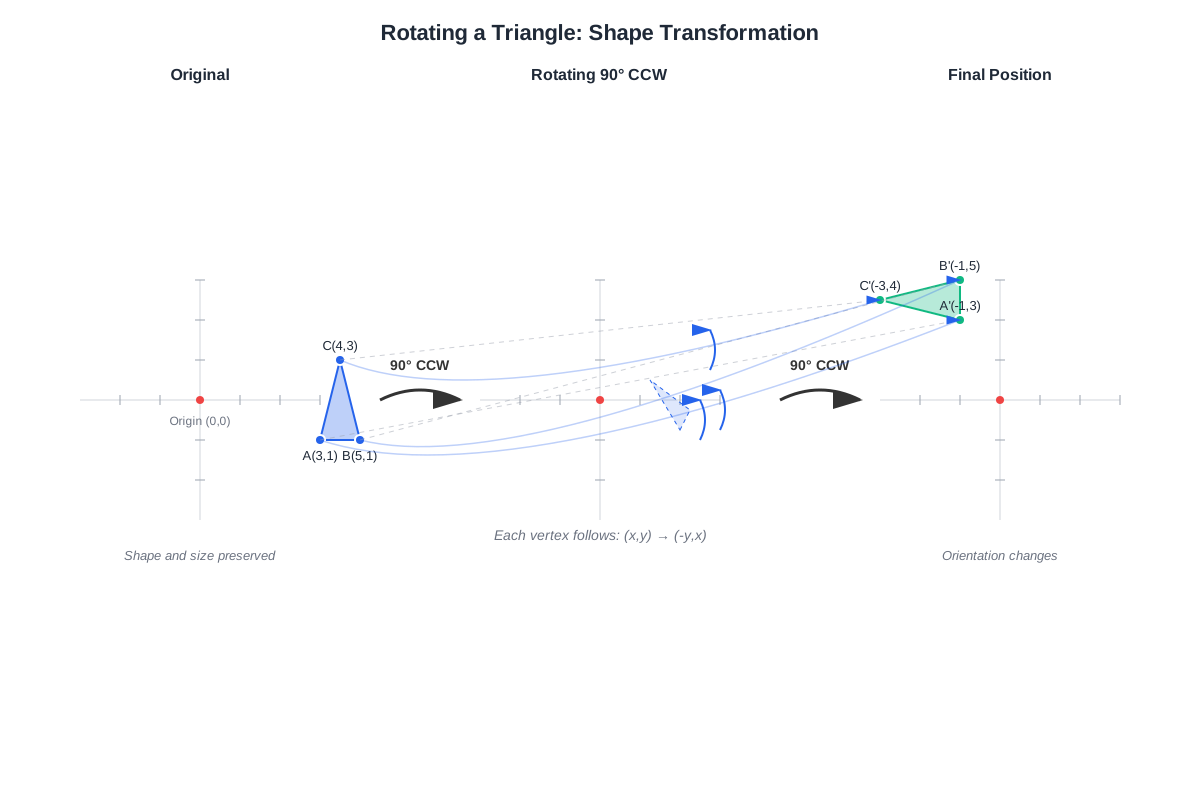
A rotation is a transformation that turns a figure around a fixed point called the center of rotation through a specified angle of rotation. On the SAT, the center of rotation is almost always the origin (0, 0) of the coordinate plane. Rotations preserve the size and shape of figures—they are rigid transformations or isometries—meaning the pre-image and image are congruent.
Every rotation has three essential characteristics:
- Center of rotation: The fixed point around which the figure turns (typically the origin)
- Angle of rotation: The amount of turning, measured in degrees
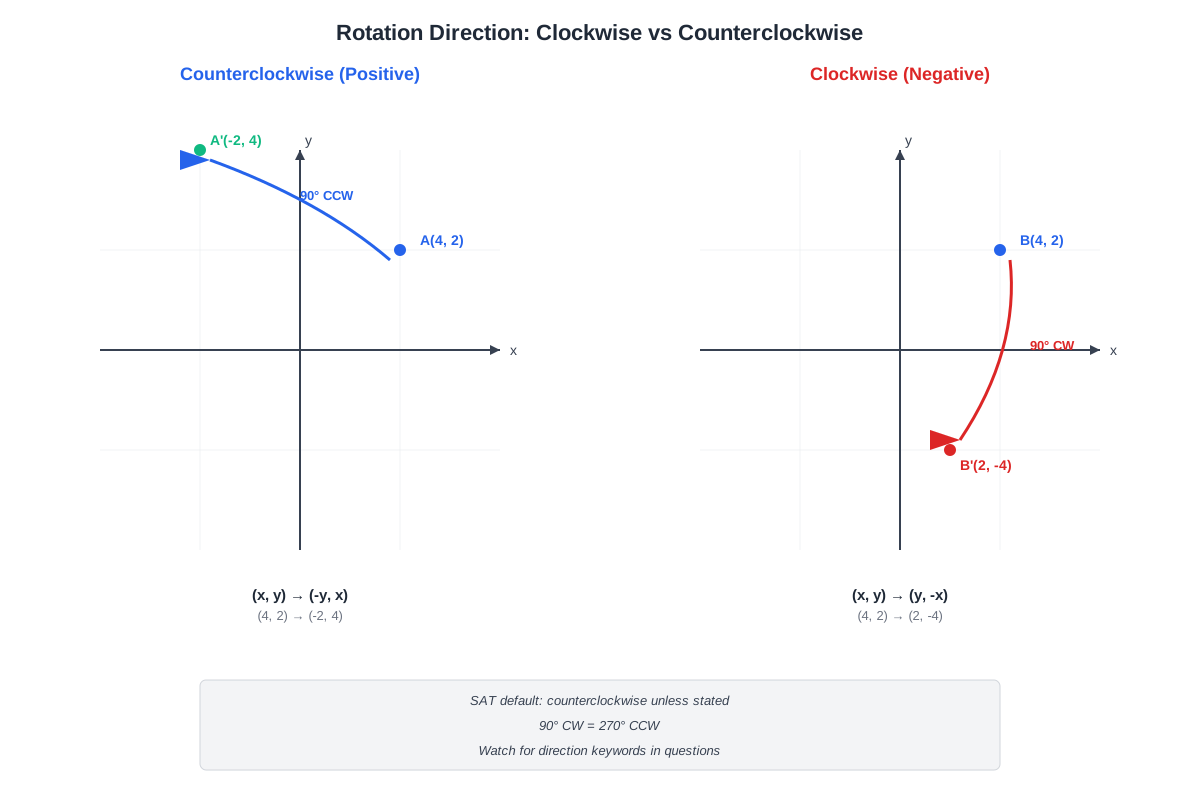
- Direction of rotation: Either counterclockwise (positive angles) or clockwise (negative angles)
By convention, rotations are measured counterclockwise from the positive x-axis unless otherwise specified. A 90° counterclockwise rotation is equivalent to a 270° clockwise rotation, and understanding these equivalences helps solve problems more efficiently.
Rotation Rules for Common Angles
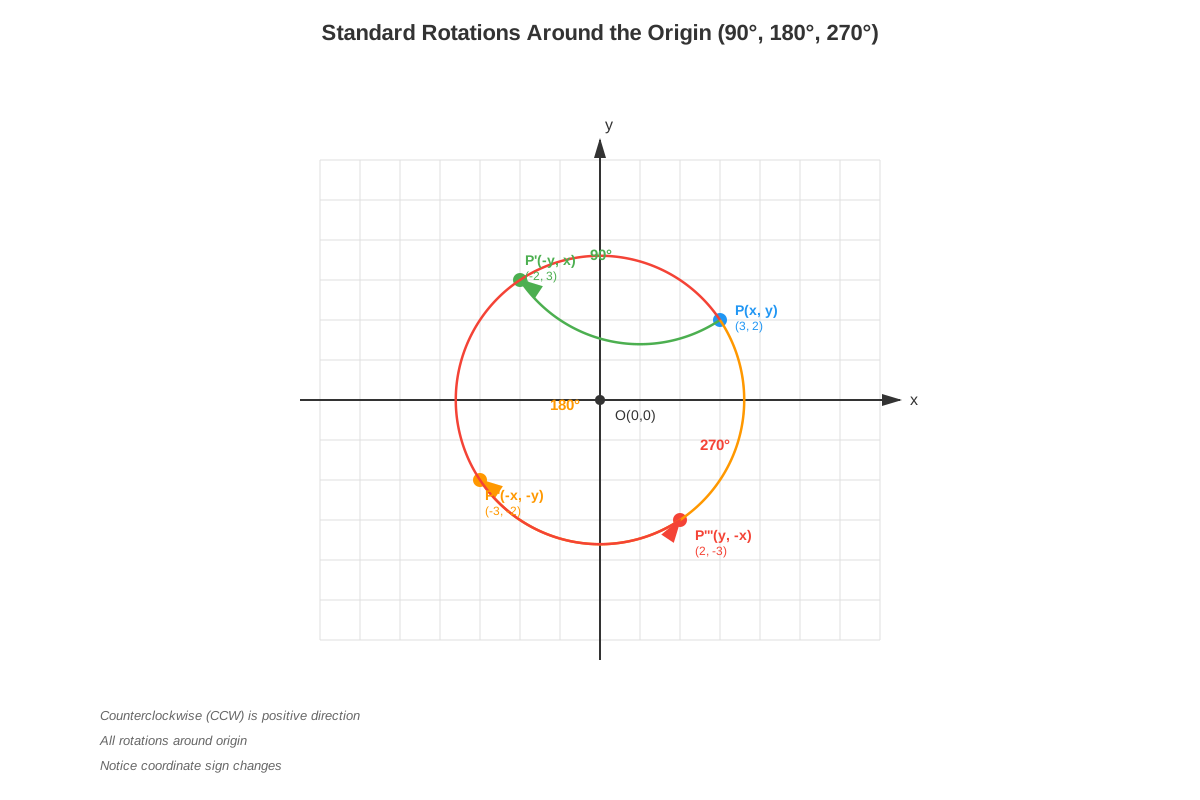
The SAT focuses primarily on rotations of 90°, 180°, and 270° counterclockwise around the origin. These rotations follow predictable patterns that can be memorized and applied quickly:
| Rotation Angle | Original Point (x, y) | Image Point | Pattern Description |
|---|---|---|---|
| 90° counterclockwise | (x, y) | (-y, x) | Switch coordinates, negate the new x |
| 180° | (x, y) | (-x, -y) | Negate both coordinates |
| 270° counterclockwise | (x, y) | (y, -x) | Switch coordinates, negate the new y |
| 360° | (x, y) | (x, y) | Complete rotation returns to original |
These formulas are the most high-yield facts for SAT rotations. Students should practice applying them until the transformations become automatic. Notice that 180° rotation produces the same result whether rotating clockwise or counterclockwise, making it the simplest rotation to apply.
Visualizing Rotations on the Coordinate Plane
To understand rotations conceptually rather than just memorizing formulas, visualize the coordinate plane divided into four quadrants. When a point rotates 90° counterclockwise:
- Points in Quadrant I (positive x, positive y) move to Quadrant II (negative x, positive y)
- Points in Quadrant II move to Quadrant III (negative x, negative y)
- Points in Quadrant III move to Quadrant IV (positive x, negative y)
- Points in Quadrant IV return to Quadrant I
For a 180° rotation, points move to the opposite quadrant: Quadrant I to Quadrant III, Quadrant II to Quadrant IV, and vice versa. This diagonal movement explains why both coordinates change sign.
The distance from any point to the origin remains constant during rotation. If a point is 5 units from the origin before rotation, it remains 5 units away after rotation. This property, called distance preservation, is fundamental to understanding why rotations are rigid transformations.
Rotational Symmetry
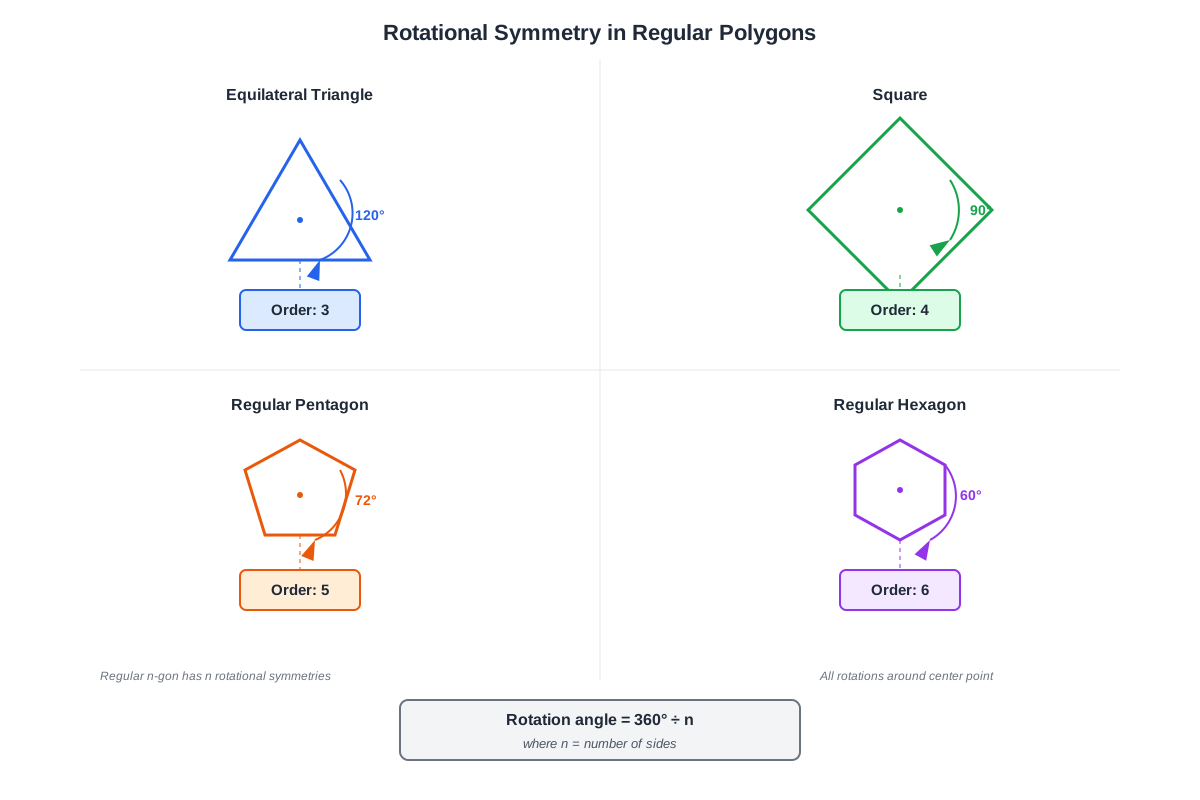
Rotational symmetry occurs when a figure can be rotated less than 360° about its center and appear unchanged. The order of rotational symmetry indicates how many times the figure matches its original appearance during a complete 360° rotation. For example:
- A square has rotational symmetry of order 4 (matches at 0°, 90°, 180°, 270°)
- An equilateral triangle has rotational symmetry of order 3 (matches at 0°, 120°, 240°)
- A regular pentagon has rotational symmetry of order 5 (matches at 0°, 72°, 144°, 216°, 288°)
The SAT may ask students to identify figures with rotational symmetry or determine the minimum angle of rotation that maps a figure onto itself. The formula for the minimum rotation angle is 360° divided by the order of symmetry.
Combining Rotations with Other Transformations
Advanced SAT questions may require applying multiple transformations in sequence. When combining transformations, order matters. A rotation followed by a translation produces a different result than a translation followed by a rotation.
Key principles for combined transformations:
- Two rotations about the same center can be combined by adding their angles
- A 90° rotation followed by another 90° rotation equals a 180° rotation
- Rotations preserve orientation (clockwise figures remain clockwise) unlike reflections
- The composition of two rotations about the origin is always another rotation about the origin
Special Cases and Edge Cases
Certain points and figures behave uniquely under rotation:
- The origin (0, 0) is invariant under any rotation about the origin—it always maps to itself
- Points on the axes follow simplified patterns (e.g., (a, 0) rotated 90° becomes (0, a))
- Horizontal and vertical lines through the origin swap positions under 90° and 270° rotations
- Circles centered at the origin appear unchanged under any rotation, though individual points move
Concept Relationships
Rotations connect to multiple mathematical concepts both within and beyond coordinate geometry. Understanding these relationships deepens comprehension and improves problem-solving flexibility.
Within rotations: The angle of rotation → determines the transformation rule → which produces new coordinates → that maintain distance from the center. Rotational symmetry emerges when → multiple rotation angles → map a figure onto itself → revealing the figure's order of symmetry.
Connection to coordinate geometry: The coordinate plane provides the framework → for expressing rotations algebraically → through coordinate transformation rules → that can be verified geometrically by measuring distances and angles.
Connection to transformations: Rotations are one of four rigid transformations → alongside translations, reflections, and glide reflections → all of which preserve distance and congruence → but only rotations and translations preserve orientation.
Connection to trigonometry: Rotation formulas for arbitrary angles → use sine and cosine functions → though SAT questions focus on special angles → where these reduce to simple patterns involving 0, 1, and -1.
Connection to symmetry: Rotational symmetry → is a special case of rotation → where certain angles map a figure to itself → revealing structural properties useful for solving geometry problems.
High-Yield Facts
⭐ A 90° counterclockwise rotation about the origin transforms point (x, y) to (-y, x)
⭐ A 180° rotation about the origin transforms point (x, y) to (-x, -y)
⭐ A 270° counterclockwise rotation about the origin transforms point (x, y) to (y, -x)
⭐ Rotations preserve distance from the center of rotation—if a point is d units from the origin before rotation, it remains d units away after rotation
⭐ The origin (0, 0) is the only point that remains fixed under rotation about the origin
- A 270° counterclockwise rotation is equivalent to a 90° clockwise rotation
- A 360° rotation returns every point to its original position
- Rotations preserve the size and shape of figures (they are rigid transformations)
- A figure has rotational symmetry of order n if it maps onto itself n times during a 360° rotation
- The minimum rotation angle for a figure with order n symmetry is 360°/n
- Two consecutive 90° rotations about the origin equal one 180° rotation
- Rotations preserve angle measures within figures
- The composition of two rotations about the origin is another rotation about the origin
- Points on a circle centered at the origin remain on that circle after any rotation
- Clockwise rotations use negative angles; counterclockwise rotations use positive angles
Quick check — test yourself on Rotations so far.
Try Flashcards →Common Misconceptions
Misconception: Rotating 90° clockwise is the same as rotating 90° counterclockwise.
Correction: These are opposite rotations. A 90° clockwise rotation transforms (x, y) to (y, -x), while a 90° counterclockwise rotation transforms (x, y) to (-y, x). Clockwise rotation by θ degrees equals counterclockwise rotation by (360° - θ) degrees.
Misconception: After a 180° rotation, the x-coordinate stays the same and only the y-coordinate changes sign.
Correction: Both coordinates change sign in a 180° rotation. The point (x, y) becomes (-x, -y). This is because the point moves to the diametrically opposite position across the origin.
Misconception: Rotations change the size or shape of figures.
Correction: Rotations are rigid transformations that preserve all distances and angles. The image is always congruent to the pre-image. Only the position and orientation change, never the size or shape.
Misconception: The rotation formulas work for any center of rotation.
Correction: The standard SAT rotation formulas (x, y) → (-y, x) for 90°, etc., only work when rotating about the origin. Rotations about other points require different approaches, though these rarely appear on the SAT.
Misconception: A figure with rotational symmetry looks the same from any angle.
Correction: Rotational symmetry means the figure looks the same at specific rotation angles, not all angles. A square looks the same at 90°, 180°, and 270° rotations, but not at 45° or 60°.
Misconception: When combining transformations, order doesn't matter.
Correction: The order of transformations is crucial. A rotation followed by a translation generally produces a different result than a translation followed by a rotation. Always apply transformations in the specified sequence.
Misconception: All points move the same distance during a rotation.
Correction: Points farther from the center of rotation travel greater distances along their circular paths. A point 5 units from the origin travels farther during a 90° rotation than a point 2 units from the origin, though both maintain their original distances from the origin.
Worked Examples
Example 1: Basic Rotation of a Point
Problem: Point A has coordinates (3, -2). What are the coordinates of point A' after a 90° counterclockwise rotation about the origin?
Solution:
Step 1: Identify the rotation type and angle.
- We're performing a 90° counterclockwise rotation about the origin
Step 2: Recall the rotation rule for 90° counterclockwise.
- The rule is: (x, y) → (-y, x)
Step 3: Apply the rule to point A(3, -2).
- Original coordinates: x = 3, y = -2
- New x-coordinate = -y = -(-2) = 2
- New y-coordinate = x = 3
- Therefore, A' = (2, 3)
Step 4: Verify the answer makes sense.
- Original point (3, -2) was in Quadrant IV (positive x, negative y)
- After 90° counterclockwise rotation, it should be in Quadrant I (positive x, positive y)
- Point (2, 3) is indeed in Quadrant I ✓
- Distance from origin: √(3² + (-2)²) = √13 before rotation
- Distance from origin: √(2² + 3²) = √13 after rotation ✓
Answer: A' = (2, 3)
This example demonstrates the direct application of the 90° rotation rule, which is the most commonly tested rotation on the SAT. The verification step, while not always necessary under time pressure, helps catch errors and builds confidence.
Example 2: Multi-Step Rotation Problem
Problem: Triangle PQR has vertices P(2, 4), Q(6, 2), and R(4, 0). The triangle undergoes a 180° rotation about the origin to form triangle P'Q'R'. What are the coordinates of vertex Q', and what is the area of triangle P'Q'R'?
Solution:
Step 1: Find the coordinates of Q' after 180° rotation.
- The rule for 180° rotation is: (x, y) → (-x, -y)
- Original Q = (6, 2)
- Q' = (-6, -2)
Step 2: Find coordinates of all vertices after rotation (for area calculation).
- P(2, 4) → P'(-2, -4)
- Q(6, 2) → Q'(-6, -2)
- R(4, 0) → R'(-4, 0)
Step 3: Calculate the area of triangle P'Q'R'.
- Since rotation is a rigid transformation, the area remains unchanged
- We can calculate using the original triangle or the rotated triangle
- Using the shoelace formula for the original triangle:
Area = ½|x₁(y₂ - y₃) + x₂(y₃ - y₁) + x₃(y₁ - y₂)|
Area = ½|2(2 - 0) + 6(0 - 4) + 4(4 - 2)|
Area = ½|4 - 24 + 8|
Area = ½|-12|
Area = 6 square units
Step 4: State both answers.
- Q' = (-6, -2)
- Area of triangle P'Q'R' = 6 square units
Answer: Q' is located at (-6, -2), and the area of triangle P'Q'R' is 6 square units.
This example illustrates how rotations preserve area and demonstrates the application of rotation rules to multiple points. It also shows how understanding that rotations are rigid transformations can simplify calculations—we could have calculated the area using either the original or rotated triangle.
Exam Strategy
When approaching rotation questions on the SAT, follow this systematic process:
Step 1: Identify the transformation type
Look for trigger words like "rotated," "turned," "rotation," or "rotational symmetry." Note the angle (90°, 180°, 270°) and direction (clockwise or counterclockwise).
Step 2: Determine the center of rotation
Unless stated otherwise, assume the center is the origin (0, 0). If a different center is specified, the problem will provide additional information or context.
Step 3: Apply the appropriate rule
Use the memorized formulas:
- 90° counterclockwise: (x, y) → (-y, x)
- 180°: (x, y) → (-x, -y)
- 270° counterclockwise: (x, y) → (y, -x)
Step 4: Check your answer
Verify that the rotated point is in the expected quadrant and maintains the correct distance from the origin.
Exam Tip: If you forget the rotation formulas, sketch a quick coordinate plane and plot the original point. Visualize or trace the rotation with your pencil to determine the new quadrant, then work out the signs of the coordinates.
Process of elimination strategies:
- Eliminate answers where the distance from the origin has changed (unless the problem involves additional transformations)
- For 90° and 270° rotations, the coordinates should be swapped; eliminate answers where they aren't
- For 180° rotations, both coordinates should change sign; eliminate answers where only one changes
- Check if the answer is in the geometrically correct quadrant
Time allocation:
Basic rotation problems should take 30-60 seconds once you've memorized the rules. Multi-step problems involving rotational symmetry or combined transformations may require 90-120 seconds. If a problem is taking longer, mark it and return after completing easier questions.
Common trigger phrases:
- "rotated counterclockwise about the origin"
- "after a rotation of [angle] degrees"
- "has rotational symmetry"
- "maps onto itself after a rotation"
- "the image of point [X] after rotation"
Memory Techniques
Mnemonic for 90° counterclockwise rotation: "Negative Y comes First, then X" → (-y, x)
Think: "New York First, then eXit" to remember the order and the negative sign.
Mnemonic for 180° rotation: "Opposite Signs On Both" → (-x, -y)
Both coordinates become their opposites.
Mnemonic for 270° counterclockwise: "Y First, Negative X" → (y, -x)
This is the reverse pattern of 90°.
Visualization strategy: Picture a clock face on the coordinate plane with 12 o'clock pointing up (positive y-axis). When rotating counterclockwise:
- 90° = quarter turn left
- 180° = half turn (upside down)
- 270° = three-quarter turn left (or one-quarter turn right)
Acronym for rigid transformations: "Rotations Retain Real Dimensions" (RRRD)
Rotations preserve size, shape, angles, and distances—they're rigid transformations.
Pattern recognition: Notice that 90° and 270° rotations swap coordinates, while 180° keeps them in the same order. The negative signs follow a pattern: 90° has one negative (on the new x), 180° has two negatives (on both), and 270° has one negative (on the new y).
Summary
Rotations are rigid transformations that turn figures around a fixed point (typically the origin on the SAT) by a specified angle while preserving size, shape, and distance relationships. The three most important rotation rules to memorize are: 90° counterclockwise transforms (x, y) to (-y, x), 180° transforms (x, y) to (-x, -y), and 270° counterclockwise transforms (x, y) to (y, -x). These transformations follow predictable patterns where coordinates swap positions and change signs according to the rotation angle. Rotational symmetry occurs when a figure maps onto itself after rotation by less than 360°, with the order of symmetry indicating how many times this occurs during a complete rotation. On the SAT, rotation questions test both direct application of transformation rules and conceptual understanding of how figures behave under rotation. Success requires memorizing the standard rotation formulas, practicing their application to various points and figures, and developing the spatial reasoning to verify answers through visualization and distance preservation checks.
Key Takeaways
- Rotations are rigid transformations that preserve distance, size, shape, and angle measures while changing position and orientation
- The three essential rotation rules for the SAT are: 90° counterclockwise (x, y) → (-y, x), 180° (x, y) → (-x, -y), and 270° counterclockwise (x, y) → (y, -x)
- The origin remains fixed under any rotation about the origin, and all other points maintain constant distance from the origin
- Rotational symmetry indicates how many times a figure maps onto itself during a 360° rotation, with the minimum rotation angle equal to 360° divided by the order of symmetry
- Verification strategies include checking that rotated points are in the correct quadrant and maintain their original distance from the origin
- Counterclockwise rotation by θ degrees equals clockwise rotation by (360° - θ) degrees, providing flexibility in problem-solving
- Combined transformations must be applied in the specified order, as different sequences produce different results
Related Topics
Reflections: Another rigid transformation that flips figures across a line of reflection, often combined with rotations in multi-step problems. Mastering rotations provides the foundation for understanding all coordinate plane transformations.
Translations: The third major rigid transformation, involving sliding figures without rotating or flipping them. Understanding how rotations differ from translations clarifies the unique properties of each transformation type.
Coordinate Geometry: The broader context in which rotations appear, including distance formula, midpoint formula, and slope. Strong rotation skills enhance overall coordinate geometry problem-solving ability.
Trigonometry: Advanced rotation formulas for arbitrary angles use sine and cosine functions. While SAT questions focus on special angles, understanding this connection prepares students for higher-level mathematics.
Symmetry in Geometry: Rotational symmetry connects to line symmetry and other geometric properties, appearing in questions about regular polygons, circles, and complex figures.
Practice CTA
Now that you've mastered the core concepts of rotations, it's time to solidify your understanding through practice! Work through the practice questions to apply these rotation rules to SAT-style problems, and use the flashcards to reinforce the key formulas and concepts. Remember, the difference between knowing the rotation rules and being able to apply them quickly under test conditions comes down to deliberate practice. Each problem you solve builds the pattern recognition and confidence you need to tackle any rotation question the SAT throws at you. You've got this—start practicing now!
Sign up free to keep reading
Create a free AnvayaPrep account to finish this SAT guide on Rotations — plus flashcards and practice questions.