Overview
Reflections are a fundamental transformation in coordinate geometry that appear regularly on the SAT Math section. A reflection creates a mirror image of a geometric figure across a line of reflection, preserving the shape and size of the original figure while changing its position and orientation. Understanding reflections is crucial for success on the SAT because these transformations test spatial reasoning, coordinate manipulation, and the ability to visualize geometric relationships—skills that appear across multiple question types in both the calculator and no-calculator portions of the exam.
On the SAT, reflections typically appear in questions involving coordinate geometry, function transformations, and symmetry. Students must be able to identify reflected points, determine lines of reflection, and understand how reflections affect the coordinates of geometric figures. These questions often integrate multiple concepts, requiring students to combine knowledge of reflections with understanding of distance, midpoints, slopes, and equations of lines. Mastery of reflections also builds the foundation for understanding more complex transformations and symmetry properties that appear in higher-level geometry problems.
The concept of sat reflections connects directly to broader mathematical themes including transformations, symmetry, and function behavior. Reflections are one of four rigid transformations (along with translations, rotations, and dilations) that preserve distance and angle measures. On the SAT, reflection problems frequently appear alongside questions about parabolas, absolute value functions, and geometric proofs, making this topic a high-yield area for focused study. Students who master reflections gain a significant advantage in tackling multi-step problems that combine algebraic and geometric reasoning.
Learning Objectives
- [ ] Identify key features of reflections including the line of reflection, corresponding points, and preserved properties
- [ ] Explain how reflections appear on the SAT in various question formats and contexts
- [ ] Apply reflections to answer SAT-style questions involving coordinate geometry and transformations
- [ ] Calculate the coordinates of reflected points across the x-axis, y-axis, and the line y = x
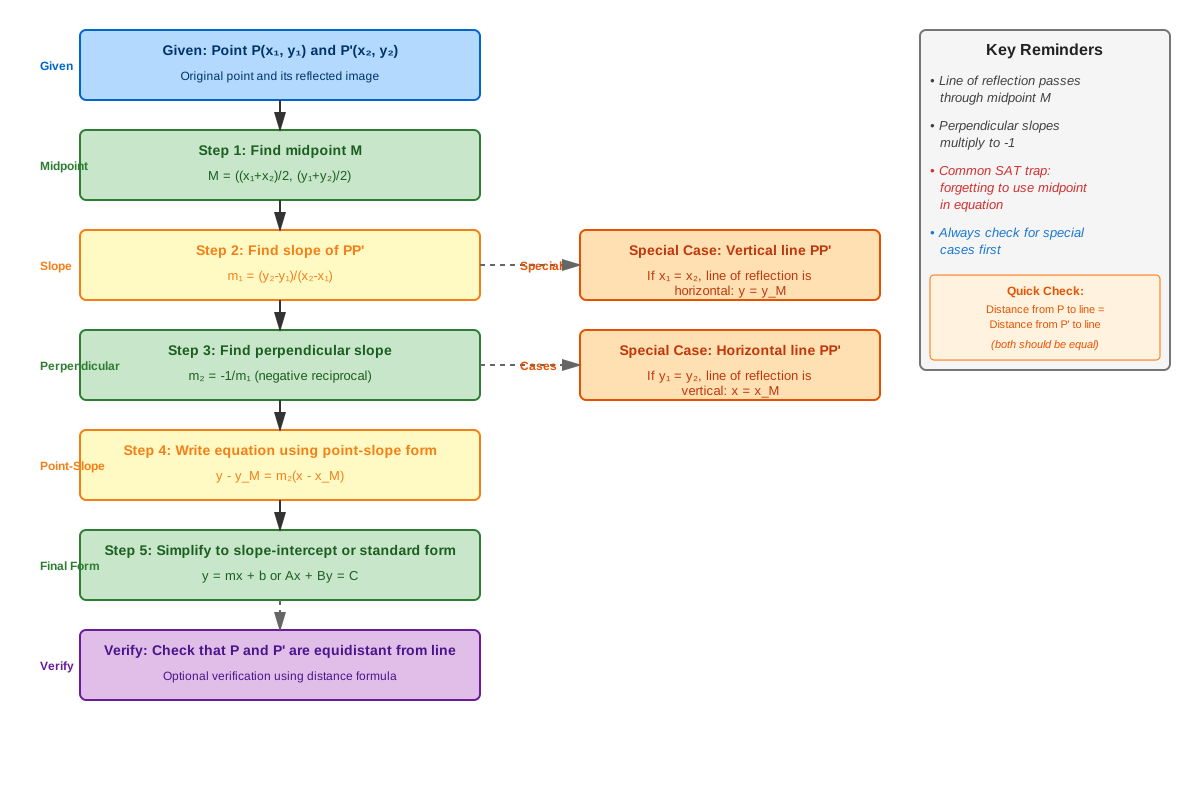
- [ ] Determine the equation of a line of reflection given a point and its image
- [ ] Recognize and apply the properties of reflections in function transformations and graph analysis
Prerequisites
- Coordinate plane basics: Understanding ordered pairs, quadrants, and plotting points is essential for locating original and reflected points
- Distance formula: Calculating distances between points helps verify that reflections preserve length and that points are equidistant from the line of reflection
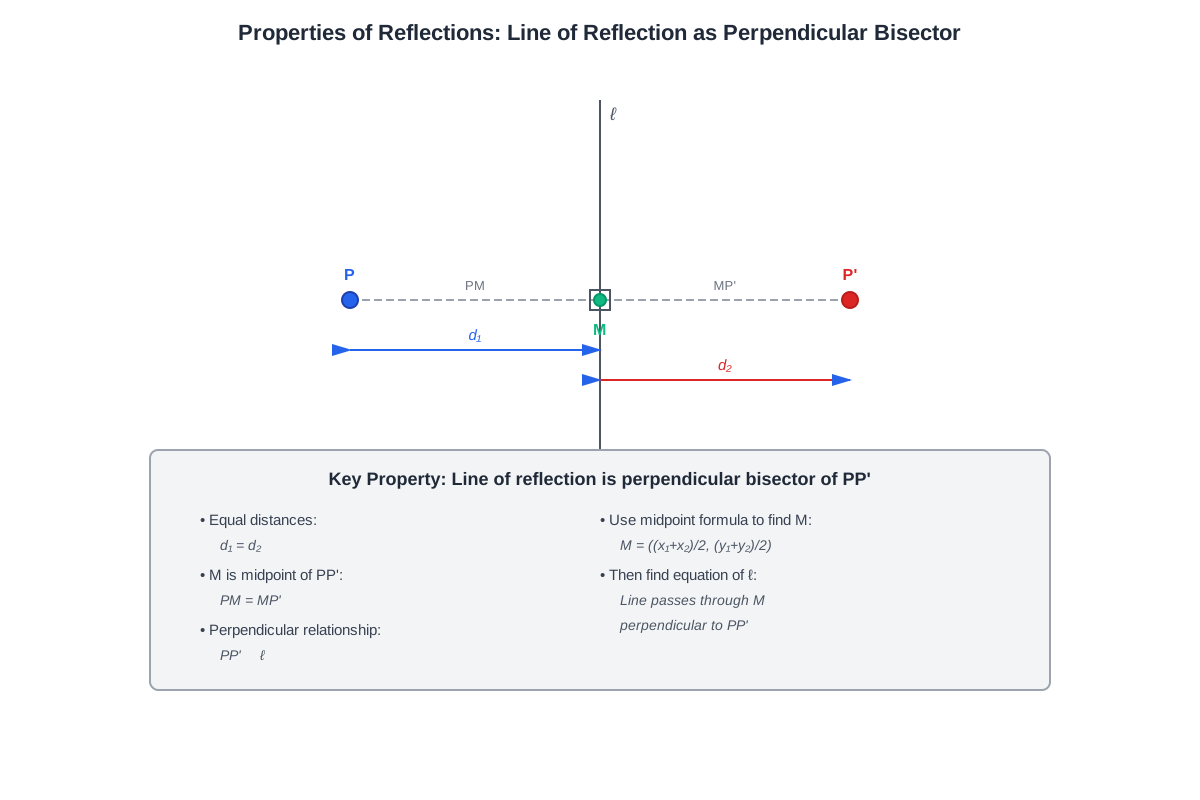
- Midpoint formula: Finding midpoints is crucial for determining lines of reflection, as the line of reflection is the perpendicular bisector of the segment connecting a point to its image
- Slope and perpendicular lines: Recognizing that the line connecting a point to its reflection is perpendicular to the line of reflection is fundamental to solving reflection problems
- Basic function notation: Understanding f(x) notation is necessary for working with function transformations involving reflections
Why This Topic Matters
Reflections have practical applications far beyond the SAT. In physics, reflections describe how light bounces off mirrors and how sound waves echo. In computer graphics and animation, reflection algorithms create realistic visual effects and symmetrical designs. Architects and engineers use reflections to design buildings with symmetrical features, while biologists study reflectional symmetry in organisms. Understanding reflections develops spatial reasoning skills that are valuable in fields ranging from medical imaging to robotics.
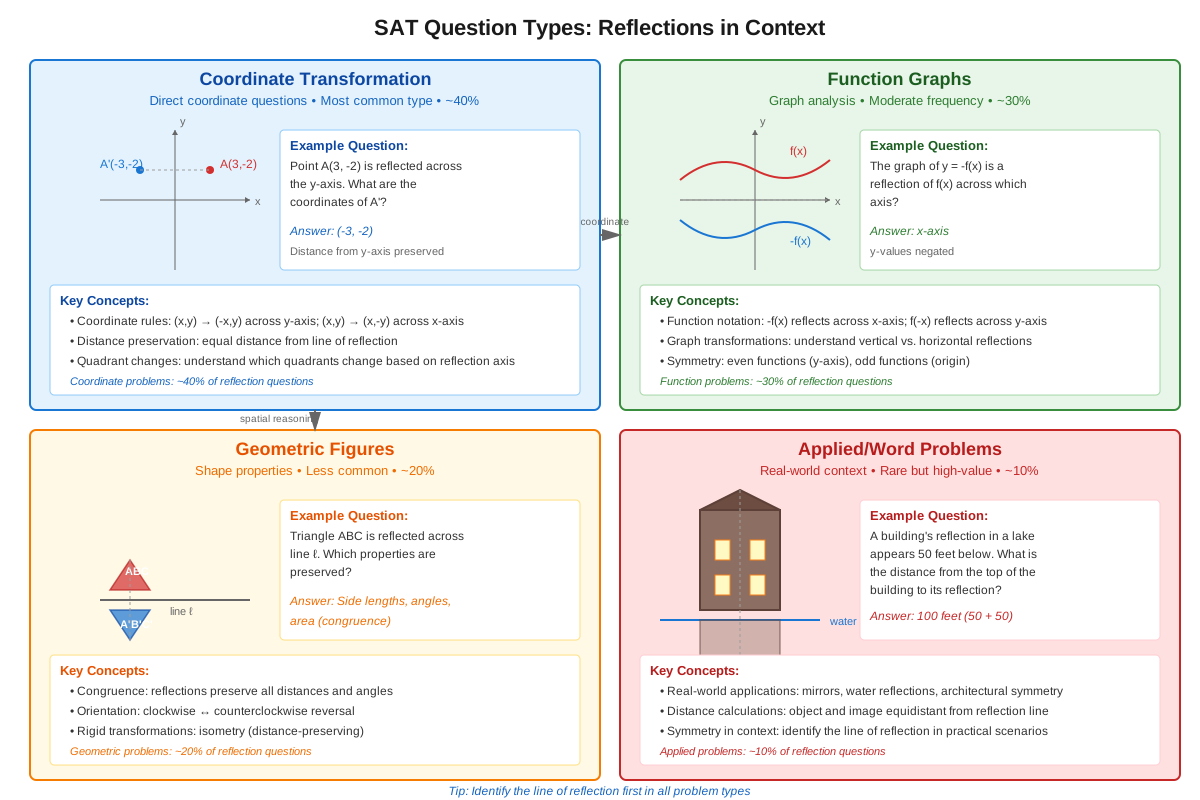
On the SAT, reflections appear in approximately 2-4 questions per test, making them a high-yield topic for focused study. These questions typically fall into several categories: direct coordinate transformation problems (where students must find the coordinates of a reflected point), function transformation questions (where students analyze how f(-x) or -f(x) affects a graph), and multi-step geometry problems that combine reflections with other concepts. Reflections often appear in questions worth 1-2 points each, and because they follow predictable patterns, they represent an excellent opportunity for students to secure quick, reliable points.
Common SAT question formats include: identifying the coordinates of a reflected point given specific reflection lines; determining which transformation was applied to a figure based on before-and-after coordinates; analyzing the symmetry of functions and graphs; and solving problems that require multiple transformations in sequence. Reflections also appear in questions about absolute value functions, parabolas, and geometric proofs involving congruent triangles formed by reflection.
Core Concepts
Definition and Properties of Reflections
A reflection is a rigid transformation that flips a figure over a line called the line of reflection, creating a mirror image. The reflected figure, called the image, is congruent to the original figure (called the pre-image), meaning all corresponding sides and angles are equal. Every point on the original figure has a corresponding point on the reflected figure such that the line of reflection is the perpendicular bisector of the segment connecting each point to its image.
Key properties that reflections preserve:
- Distance between any two points (reflections are isometries)
- Angle measures
- Parallelism of lines
- Collinearity of points
- Size and shape of figures
Properties that reflections change:
- Position in the coordinate plane
- Orientation (clockwise becomes counterclockwise and vice versa)
- The "handedness" or chirality of figures
Reflection Across the X-Axis
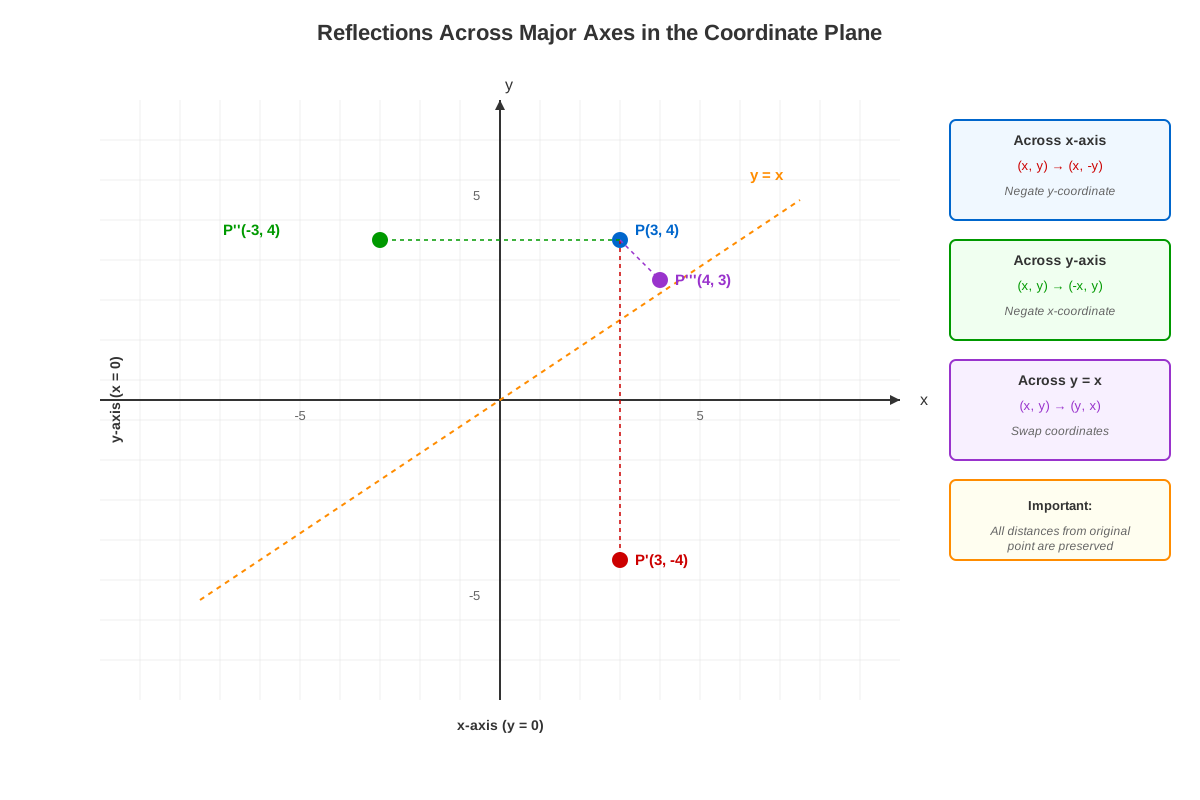
When reflecting a point across the x-axis, the x-coordinate remains unchanged while the y-coordinate changes sign. This is one of the most common reflections tested on the SAT.
Rule: The point (x, y) reflects to (x, -y) across the x-axis.
For example:
- Point (3, 5) reflects to (3, -5)
- Point (-2, 4) reflects to (-2, -4)
- Point (7, -3) reflects to (7, 3)
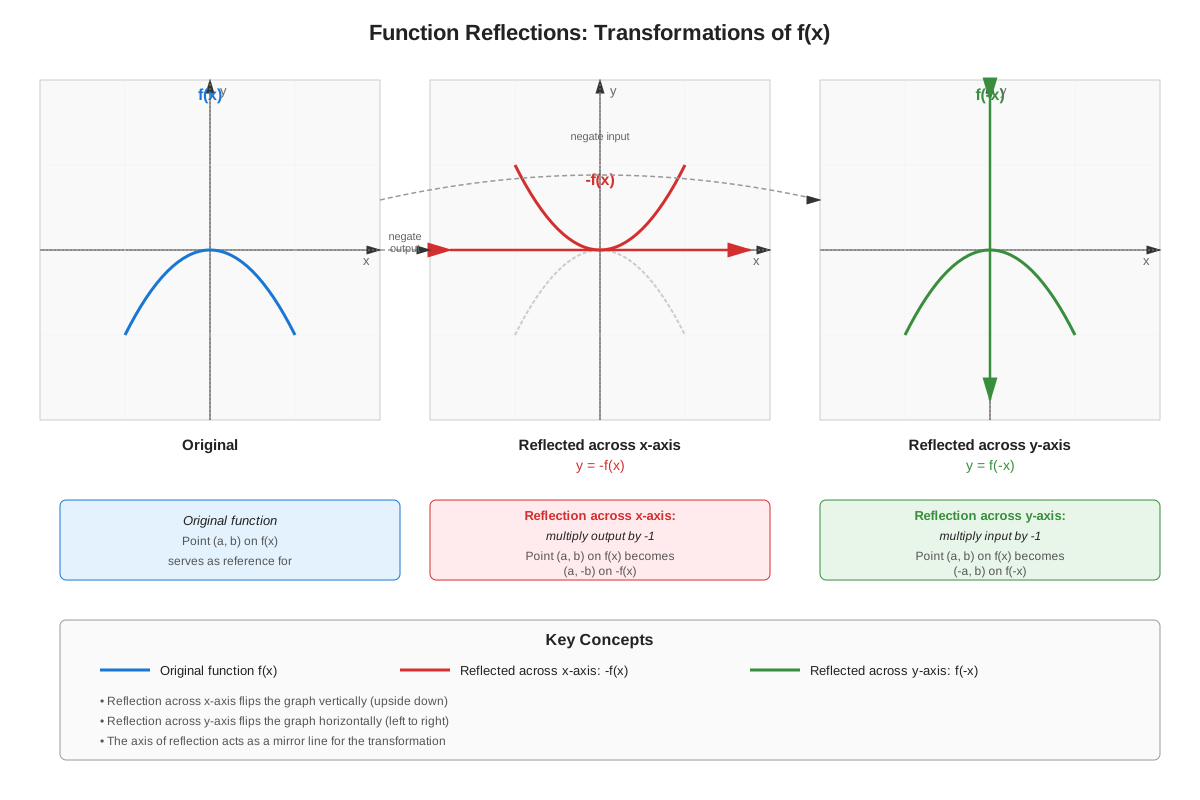
In function notation, reflecting the graph of f(x) across the x-axis produces the graph of -f(x). This means every y-value is multiplied by -1, flipping the graph vertically. If the original function has a point (a, b) on its graph, the reflected function has the point (a, -b).
Reflection Across the Y-Axis
When reflecting a point across the y-axis, the y-coordinate remains unchanged while the x-coordinate changes sign.
Rule: The point (x, y) reflects to (-x, y) across the y-axis.
For example:
- Point (4, 2) reflects to (-4, 2)
- Point (-5, -3) reflects to (5, -3)
- Point (6, 0) reflects to (-6, 0)
In function notation, reflecting the graph of f(x) across the y-axis produces the graph of f(-x). This means the input value is multiplied by -1, flipping the graph horizontally. If the original function has a point (a, b) on its graph, the reflected function has the point (-a, b).
Reflection Across the Line y = x
Reflecting across the line y = x (the diagonal line through the origin with slope 1) swaps the x and y coordinates.
Rule: The point (x, y) reflects to (y, x) across the line y = x.
For example:
- Point (2, 7) reflects to (7, 2)
- Point (-3, 5) reflects to (5, -3)
- Point (4, 4) reflects to (4, 4) [points on the line of reflection map to themselves]
This reflection is particularly important because it represents the relationship between a function and its inverse. If f(x) contains the point (a, b), then f⁻¹(x) contains the point (b, a).
Reflection Across the Line y = -x
Reflecting across the line y = -x (the diagonal line through the origin with slope -1) swaps the coordinates and changes both signs.
Rule: The point (x, y) reflects to (-y, -x) across the line y = -x.
For example:
- Point (3, 2) reflects to (-2, -3)
- Point (-4, 5) reflects to (-5, 4)
- Point (0, 6) reflects to (-6, 0)
Reflection Across Arbitrary Lines
For reflections across lines other than the axes or y = ±x, the process involves more steps:
- Find the perpendicular from the original point to the line of reflection
- Determine where this perpendicular intersects the line of reflection
- Extend the perpendicular an equal distance on the opposite side
The line of reflection is always the perpendicular bisector of the segment connecting any point to its reflected image. This property is crucial for determining unknown lines of reflection on the SAT.
Comparison Table of Common Reflections
| Line of Reflection | Original Point | Reflected Point | What Changes |
|---|---|---|---|
| x-axis | (x, y) | (x, -y) | y-coordinate sign |
| y-axis | (x, y) | (-x, y) | x-coordinate sign |
| y = x | (x, y) | (y, x) | Coordinates swap |
| y = -x | (x, y) | (-y, -x) | Coordinates swap and both signs change |
| Origin (point) | (x, y) | (-x, -y) | Both coordinate signs |
Concept Relationships
Reflections connect to multiple mathematical concepts both within and beyond coordinate geometry. Understanding these relationships helps students recognize when reflection knowledge applies to SAT questions.
Within transformations: Reflections → combine with → Translations and Rotations → to create → Composite transformations. Two reflections across parallel lines produce a translation, while two reflections across intersecting lines produce a rotation. This relationship occasionally appears in advanced SAT geometry questions.
Connection to symmetry: Reflections → define → Lines of symmetry → which determine → Even and odd functions. A function is even if f(-x) = f(x), meaning it has y-axis symmetry (reflection across the y-axis maps the graph onto itself). A function is odd if f(-x) = -f(x), meaning it has origin symmetry (180° rotation about the origin).
Connection to distance and midpoint: The line of reflection → is the perpendicular bisector of → the segment connecting a point to its image → which requires → midpoint and distance formulas. This relationship is crucial for problems asking students to find the line of reflection given a point and its image.
Connection to inverse functions: Reflection across y = x → transforms → a function into its inverse → which relates to → solving equations and function composition. This appears in SAT questions about inverse functions and their graphs.
Connection to absolute value: Reflections → explain the graph of → |f(x)| → which reflects → negative portions of f(x) across the x-axis. This creates the characteristic "V" shape or modified graph structure tested on the SAT.
High-Yield Facts
⭐ Reflecting across the x-axis changes the sign of the y-coordinate only: (x, y) → (x, -y)
⭐ Reflecting across the y-axis changes the sign of the x-coordinate only: (x, y) → (-x, y)
⭐ Reflecting across y = x swaps the coordinates: (x, y) → (y, x)
⭐ The line of reflection is the perpendicular bisector of the segment connecting any point to its reflected image
⭐ Reflections preserve distance, angle measures, and the size and shape of figures (they are rigid transformations)
- Reflecting across y = -x swaps coordinates and changes both signs: (x, y) → (-y, -x)
- Reflecting a point across the origin (a 180° rotation) changes both coordinate signs: (x, y) → (-x, -y)
- Points that lie on the line of reflection map to themselves (they are invariant)
- In function notation, f(-x) represents reflection across the y-axis, while -f(x) represents reflection across the x-axis
- Two successive reflections across the same line return a figure to its original position
- Reflections reverse orientation: clockwise order becomes counterclockwise and vice versa
- The composition of two reflections across parallel lines equals a translation perpendicular to those lines
- The composition of two reflections across intersecting lines equals a rotation about the point of intersection
Quick check — test yourself on Reflections so far.
Try Flashcards →Common Misconceptions
Misconception: Reflecting across the x-axis changes the x-coordinate.
Correction: Reflection across the x-axis only changes the sign of the y-coordinate. The x-coordinate remains unchanged because points move vertically to their mirror positions, not horizontally.
Misconception: f(-x) and -f(x) represent the same transformation.
Correction: These represent different reflections. f(-x) reflects the graph across the y-axis (horizontal flip), while -f(x) reflects across the x-axis (vertical flip). The order of operations matters: f(-x) changes the input, while -f(x) changes the output.
Misconception: Reflecting a point twice across different lines returns it to its original position.
Correction: Only reflecting twice across the same line returns a point to its original position. Reflecting across two different lines produces a rotation or translation, depending on whether the lines intersect or are parallel.
Misconception: The distance from a point to the line of reflection equals the distance from the reflected point to the line of reflection, but these distances can be measured along any path.
Correction: These distances must be measured along the perpendicular from each point to the line of reflection. The perpendicular distance is the shortest distance and is the defining characteristic of reflection.
Misconception: Reflections change the size of figures.
Correction: Reflections are rigid transformations (isometries) that preserve all distances and therefore preserve the size and shape of figures. Only dilations change size. If a figure appears to change size after a transformation, that transformation is not a pure reflection.
Misconception: When reflecting across y = x, you just swap the coordinates without considering their signs.
Correction: While swapping coordinates is correct for y = x, students must be careful not to confuse this with reflection across y = -x, which requires swapping coordinates AND changing both signs. Always identify the specific line of reflection before applying the transformation rule.
Misconception: The midpoint between a point and its reflection lies on the line of reflection, so any midpoint calculation identifies the line of reflection.
Correction: While the midpoint does lie on the line of reflection, this alone doesn't determine the line's equation. The line of reflection must also be perpendicular to the segment connecting the point and its image. Both conditions (containing the midpoint and being perpendicular) are necessary.
Worked Examples
Example 1: Finding Reflected Coordinates
Problem: Point A has coordinates (4, -3). Find the coordinates of point A after:
a) Reflection across the x-axis
b) Reflection across the y-axis
c) Reflection across the line y = x
d) Reflection across the origin
Solution:
a) Reflection across the x-axis: Apply the rule (x, y) → (x, -y)
- Original point: (4, -3)
- Keep x-coordinate: 4
- Change sign of y-coordinate: -(-3) = 3
- Answer: (4, 3)
b) Reflection across the y-axis: Apply the rule (x, y) → (-x, y)
- Original point: (4, -3)
- Change sign of x-coordinate: -(4) = -4
- Keep y-coordinate: -3
- Answer: (-4, -3)
c) Reflection across y = x: Apply the rule (x, y) → (y, x)
- Original point: (4, -3)
- Swap coordinates: x becomes y, y becomes x
- Answer: (-3, 4)
d) Reflection across the origin: Apply the rule (x, y) → (-x, -y)
- Original point: (4, -3)
- Change sign of x-coordinate: -4
- Change sign of y-coordinate: 3
- Answer: (-4, 3)
Connection to learning objectives: This example demonstrates the application of reflection rules to calculate transformed coordinates, a fundamental skill for SAT questions on this topic.
Example 2: Determining the Line of Reflection
Problem: Point P(2, 5) is reflected to point P'(8, 5). What is the equation of the line of reflection?
Solution:
Step 1: Observe that the y-coordinates are the same (both are 5), which means the points lie on a horizontal line. This suggests the line of reflection is vertical.
Step 2: Find the midpoint of segment PP', which must lie on the line of reflection.
- Midpoint formula: M = ((x₁ + x₂)/2, (y₁ + y₂)/2)
- M = ((2 + 8)/2, (5 + 5)/2) = (10/2, 10/2) = (5, 5)
Step 3: Determine the orientation of the line of reflection.
- The segment PP' is horizontal (same y-coordinates)
- The line of reflection must be perpendicular to PP'
- A line perpendicular to a horizontal line is vertical
Step 4: Write the equation of the vertical line through (5, 5).
- Vertical lines have the form x = k
- Since the line passes through x = 5
- Answer: x = 5
Verification: Check that both points are equidistant from the line x = 5:
- Distance from P(2, 5) to x = 5: |2 - 5| = 3 units
- Distance from P'(8, 5) to x = 5: |8 - 5| = 3 units ✓
Connection to learning objectives: This example shows how to identify key features of reflections (the line of reflection) and applies the perpendicular bisector property, demonstrating the type of multi-step reasoning required on SAT questions.
Exam Strategy
When approaching SAT reflections questions, follow this systematic process:
Step 1: Identify the transformation type. Look for keywords like "reflected," "mirror image," "flipped," or "symmetric." Questions may also describe reflections indirectly by giving before-and-after coordinates or showing transformed graphs.
Step 2: Determine the line of reflection. The SAT most commonly tests reflections across:
- The x-axis (most frequent)
- The y-axis (very common)
- The line y = x (moderately common)
- Vertical or horizontal lines like x = k or y = k (less common but still tested)
Trigger phrases to watch for:
- "Reflected across the x-axis" → change y-coordinate sign
- "Reflected across the y-axis" → change x-coordinate sign
- "Reflected over the line y = x" → swap coordinates
- "Mirror image" → look for the line of symmetry
- "The graph of -f(x)" → reflection across x-axis
- "The graph of f(-x)" → reflection across y-axis
Step 3: Apply the appropriate transformation rule. Memorize the four most common reflection rules and apply them mechanically. Don't try to visualize complex reflections mentally—use the formulas.
Step 4: Check your answer. For coordinate problems, verify that:
- The distance from the original point to the line of reflection equals the distance from the reflected point to the line of reflection
- The line connecting the original and reflected points is perpendicular to the line of reflection
- At least one coordinate changed (unless the point lies on the line of reflection)
Process of elimination tips:
- If a question asks about reflection across the x-axis, eliminate any answer choices where the x-coordinate changed
- If reflecting across the y-axis, eliminate choices where the y-coordinate changed
- For function transformations, sketch a quick point or two to eliminate impossible graphs
- If the problem involves symmetry, eliminate answers that don't preserve distance or angle measures
Time allocation: Most reflection questions should take 45-90 seconds. If you're spending more than 2 minutes, you may be overcomplicating the problem. Return to the basic transformation rules and apply them step-by-step rather than trying to visualize the entire transformation.
Calculator usage: For reflections involving non-standard lines, use your calculator to:
- Find midpoints quickly
- Calculate slopes of perpendicular lines
- Verify distances are equal
However, for standard reflections (across axes or y = x), mental math is faster than calculator work.
Memory Techniques
Mnemonic for axis reflections: "X marks the spot, Y you fly"
- X-axis reflection: the x-coordinate stays put (marks the spot)
- Y-axis reflection: the y-coordinate stays put (you fly horizontally)
Mnemonic for coordinate changes: "XNEG-Y, YNEG-X"
- X-axis reflection: NEGate Y (change y-coordinate sign)
- Y-axis reflection: NEGate X (change x-coordinate sign)
Visual memory technique for y = x: Imagine the line y = x as a mirror placed diagonally across your paper. When you "flip" a point over this mirror, the coordinates trade places, just like looking at your reflection swaps left and right.
Acronym for reflection properties: "DAPS"
- Distance preserved
- Angles preserved
- Parallelism preserved
- Shape and size preserved
Function transformation memory aid: "Inside changes X, Outside changes Y"
- f(-x) has the change inside the function → affects x-coordinates → y-axis reflection
- -f(x) has the change outside the function → affects y-coordinates → x-axis reflection
Finger technique for y = x and y = -x:
- For y = x: Hold your right hand with fingers pointing up and to the right (positive slope). Swapping coordinates moves along this direction.
- For y = -x: Hold your right hand with fingers pointing up and to the left (negative slope). This reflection involves sign changes.
Summary
Reflections are rigid transformations that create mirror images of geometric figures across a line of reflection, preserving distance, angle measures, and the size and shape of figures while changing position and orientation. On the SAT, students must master four primary reflections: across the x-axis (changing the y-coordinate sign), across the y-axis (changing the x-coordinate sign), across the line y = x (swapping coordinates), and across the line y = -x (swapping coordinates and changing both signs). The line of reflection is always the perpendicular bisector of the segment connecting any point to its reflected image, a property essential for determining unknown lines of reflection. In function notation, f(-x) represents reflection across the y-axis while -f(x) represents reflection across the x-axis. Success on SAT reflection questions requires memorizing transformation rules, recognizing trigger phrases, and systematically applying formulas rather than relying solely on visualization. These concepts appear in 2-4 questions per test across coordinate geometry, function transformations, and symmetry problems, making reflections a high-yield topic for focused study.
Key Takeaways
- Reflections are rigid transformations that preserve distance, angles, and figure size while creating mirror images across a line of reflection
- Master the four essential transformation rules: x-axis (x, y) → (x, -y); y-axis (x, y) → (-x, y); y = x (x, y) → (y, x); y = -x (x, y) → (-y, -x)
- The line of reflection is the perpendicular bisector of the segment connecting any point to its reflected image—use this property to find unknown lines of reflection
- In function notation, distinguish between f(-x) and -f(x): f(-x) reflects across the y-axis (horizontal flip), while -f(x) reflects across the x-axis (vertical flip)
- Points on the line of reflection map to themselves and remain unchanged by the transformation
- Reflections appear in multiple SAT contexts including coordinate geometry, function transformations, symmetry problems, and composite transformations
- Apply transformation rules mechanically rather than relying on visualization alone—systematic application of formulas prevents errors and saves time
Related Topics
Translations: After mastering reflections, study translations (slides) to complete your understanding of rigid transformations. Translations move figures without changing orientation, and combining translations with reflections creates glide reflections.
Rotations: Rotations turn figures around a point and can be understood as compositions of two reflections across intersecting lines. Understanding reflections makes rotation problems more intuitive.
Function Transformations: Expand your knowledge of reflections to include vertical and horizontal stretches, compressions, and combinations of multiple transformations applied to parent functions.
Symmetry: Study line symmetry and rotational symmetry, which are defined using reflections and rotations. This connects to even and odd functions, an important SAT algebra topic.
Inverse Functions: The relationship between a function and its inverse is a reflection across y = x, making reflection knowledge essential for understanding inverse function graphs and properties.
Congruence and Similarity: Reflections are one way to prove triangles congruent. Understanding transformations provides an alternative approach to traditional congruence proofs.
Practice CTA
Now that you've mastered the core concepts of reflections, it's time to solidify your understanding through practice! Attempt the practice questions to test your ability to apply reflection rules under timed conditions, just like you'll face on test day. Work through the flashcards to reinforce the transformation formulas and key properties until they become automatic. Remember, reflections appear on every SAT, and with focused practice, these questions become reliable points that boost your score. You've built the foundation—now practice until reflections become second nature!
Sign up free to keep reading
Create a free AnvayaPrep account to finish this SAT guide on Reflections — plus flashcards and practice questions.