Overview
Translations represent one of the fundamental transformations in coordinate geometry, a topic that appears consistently on the SAT Math section. A translation is a geometric transformation that moves every point of a figure the same distance in the same direction, creating a "slide" without rotation, reflection, or change in size. Understanding translations is crucial for success on the SAT because these transformations appear in multiple question formats, from pure coordinate geometry problems to applied scenarios involving functions and real-world modeling.
On the SAT, translations questions test a student's ability to visualize geometric movement, apply transformation rules to coordinates, and understand how shifting affects equations and graphs. These problems often integrate with other mathematical concepts such as linear equations, function notation, and geometric properties. Mastery of translations provides the foundation for understanding more complex transformations and is frequently combined with other coordinate geometry concepts in medium to high-difficulty questions.
The significance of translations extends beyond isolated geometry problems. This concept connects directly to function transformations, where horizontal and vertical shifts modify parent functions—a critical skill for both the calculator and no-calculator portions of the math section. Students who thoroughly understand translation mechanics can quickly identify patterns, eliminate incorrect answer choices, and solve multi-step problems efficiently, making this a high-yield topic for score improvement.
Learning Objectives
- [ ] Identify key features of translations including direction, magnitude, and invariant properties
- [ ] Explain how translations appear on the SAT in coordinate geometry, function, and applied contexts
- [ ] Apply translations to answer SAT-style questions involving coordinate pairs, equations, and graphs
- [ ] Calculate the image coordinates of points after translation using vector notation
- [ ] Determine the translation rule that maps one figure onto another
- [ ] Recognize how translations preserve distance, angle measures, and orientation
- [ ] Solve composite transformation problems involving translations combined with other transformations
Prerequisites
- Coordinate plane fundamentals: Understanding x and y coordinates is essential because translations are defined by changes in these values
- Basic algebraic manipulation: Ability to add and subtract from variables enables application of translation rules to general points
- Function notation: Familiarity with f(x) notation helps understand translations as function transformations
- Distance formula: Knowledge of calculating distances between points allows verification that translations preserve lengths
- Geometric properties: Understanding of congruence and basic shape properties helps recognize what translations preserve
Why This Topic Matters
Translations have practical applications throughout mathematics, science, and real-world scenarios. In computer graphics and animation, translations move objects across screens. In physics, they model displacement and motion. In architecture and design, translations help create patterns and tessellations. Understanding how objects move through space while maintaining their properties is fundamental to spatial reasoning and problem-solving.
On the SAT, translation questions appear in approximately 3-5% of all math questions, making them a reliable score-boosting opportunity. These questions typically appear as:
- Direct coordinate transformation problems: Given a point and translation rule, find the image
- Function transformation questions: Identify how f(x) changes to f(x-h) + k
- Graph interpretation problems: Determine which graph shows a translated figure
- Applied word problems: Model real-world scenarios involving movement or shifting
- Multi-step geometry problems: Combine translations with other concepts like area or perimeter
The SAT frequently embeds translation concepts within more complex questions, testing whether students can recognize the underlying transformation amid other mathematical operations. Questions may present translations using vector notation, verbal descriptions, or function notation, requiring flexibility in interpretation. Because translations preserve so many geometric properties, they often appear in proof-based or reasoning questions where students must identify what remains constant versus what changes.
Core Concepts
Definition and Basic Properties
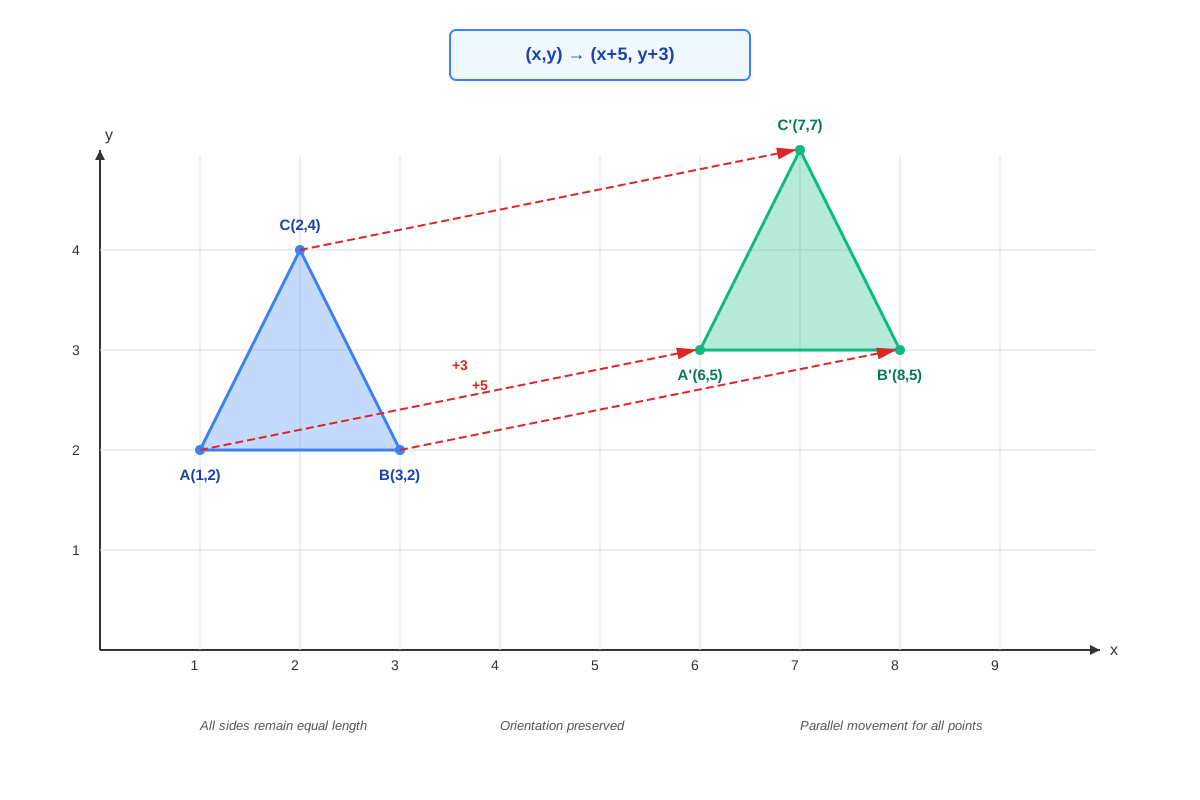
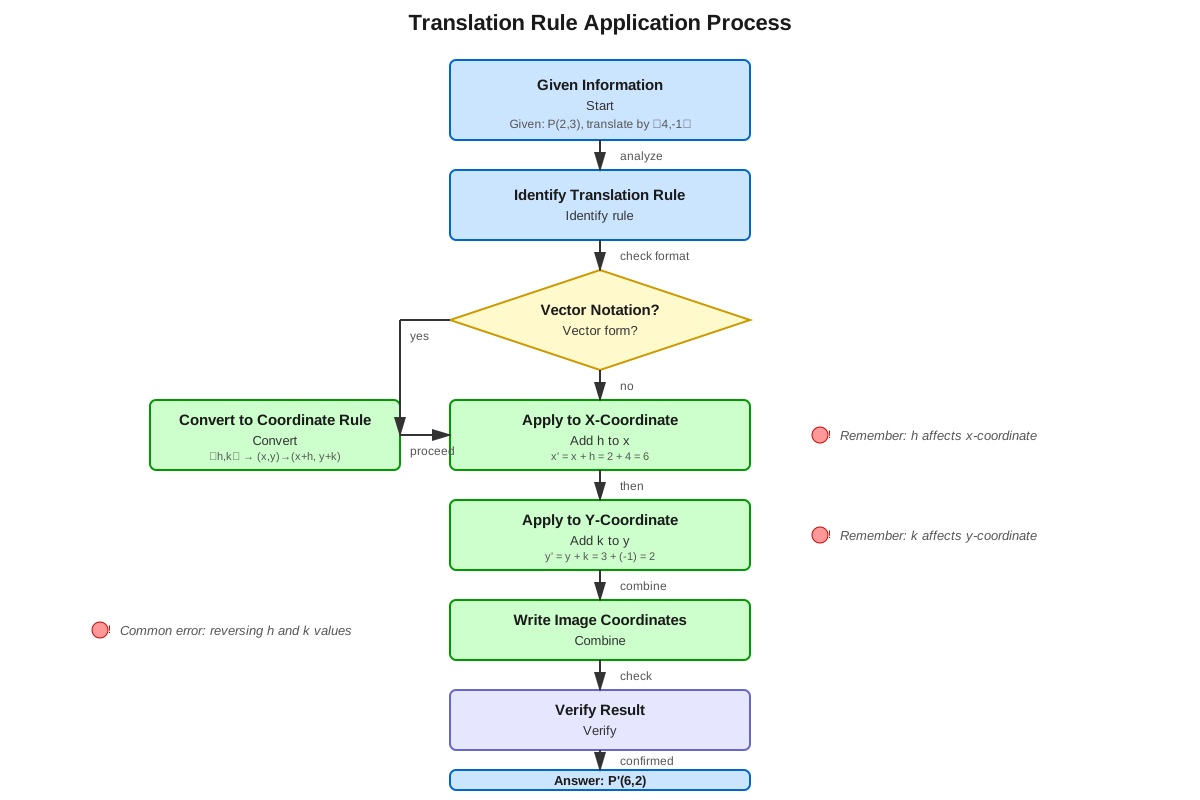
A translation is a transformation that slides every point of a figure the same distance in the same direction. Mathematically, a translation can be described using a translation vector or by specifying horizontal and vertical shifts. If a point P(x, y) undergoes a translation of h units horizontally and k units vertically, its image P'(x', y') has coordinates:
x' = x + h
y' = y + k
The values h and k define the translation rule. When h is positive, the translation moves right; when negative, it moves left. When k is positive, the translation moves up; when negative, it moves down. This rule applies uniformly to every point in the figure being translated.
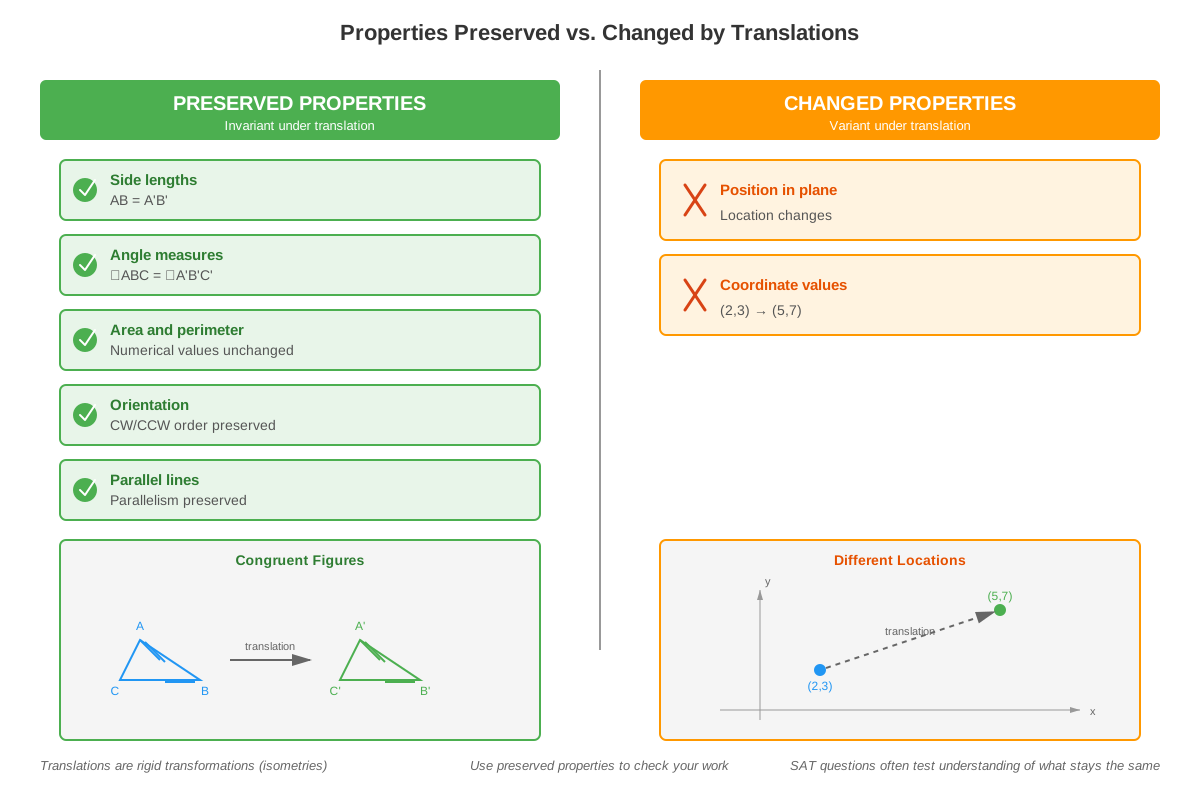
Translations are rigid transformations (also called isometries), meaning they preserve:
- Distance between points
- Angle measures
- Parallelism of lines
- Size and shape of figures
- Orientation (clockwise/counterclockwise order)
The only property that changes is position. This preservation of properties makes translations particularly useful for proving congruence and solving geometric problems.
Vector Notation
Translations can be expressed using vector notation, written as ⟨h, k⟩ or as a column vector. The vector ⟨3, -2⟩ indicates a translation 3 units right and 2 units down. This notation is compact and clearly shows both the horizontal and vertical components of the movement.
When applying a translation vector ⟨h, k⟩ to a point (x, y), the operation is:
(x, y) → (x + h, y + k)For example, translating point A(2, 5) by vector ⟨-4, 3⟩ yields:
A'(2 + (-4), 5 + 3) = A'(-2, 8)Translating Geometric Figures
When translating an entire figure, apply the translation rule to each vertex or key point. The translated figure (called the image) is congruent to the original figure (called the pre-image).
For a triangle with vertices A(1, 2), B(4, 2), and C(3, 5), a translation by ⟨2, -3⟩ produces:
- A'(3, -1)
- B'(6, -1)
- C'(5, 2)
The image triangle A'B'C' has the same side lengths, angle measures, and area as the original triangle ABC. The orientation remains unchanged—if vertices were labeled counterclockwise in the original, they remain counterclockwise in the image.
Translations and Function Transformations
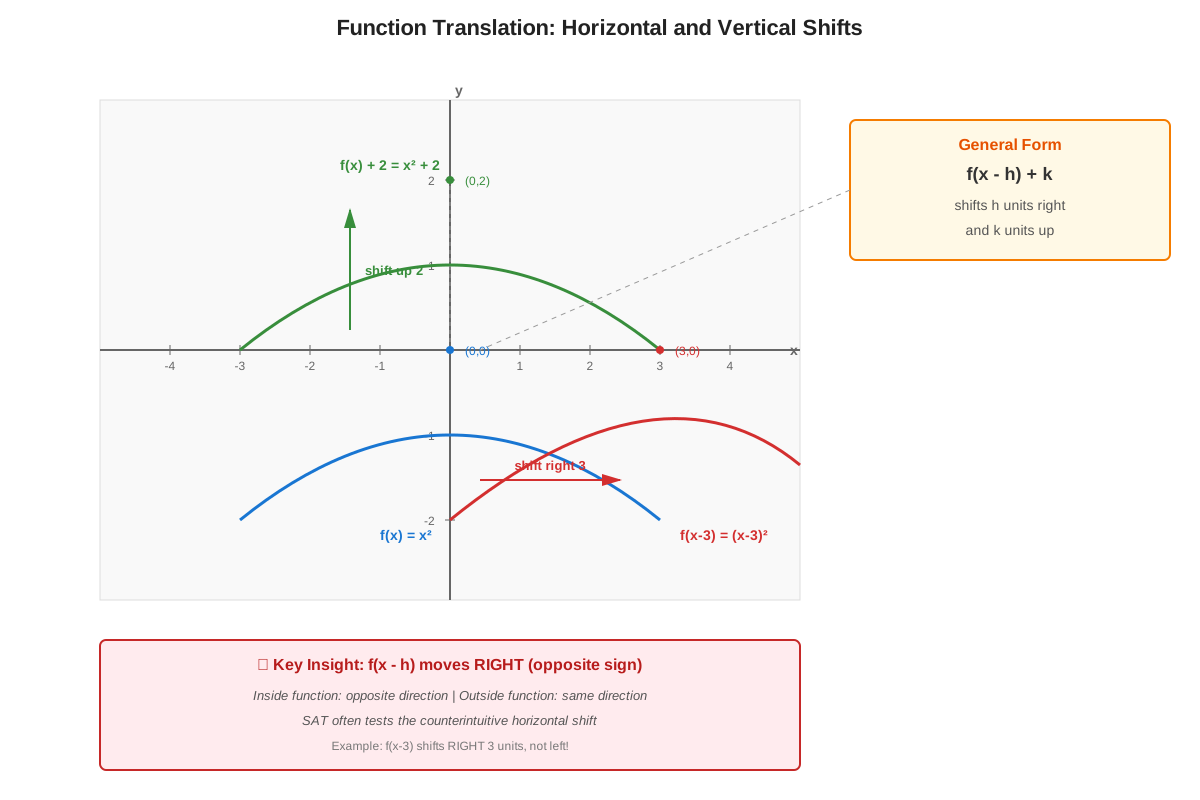
In function notation, translations appear as shifts of parent functions. For a function f(x):
- Vertical translation: f(x) + k shifts the graph k units vertically (up if k > 0, down if k < 0)
- Horizontal translation: f(x - h) shifts the graph h units horizontally (right if h > 0, left if h < 0)
Note the counterintuitive direction for horizontal shifts: f(x - 3) shifts RIGHT 3 units, while f(x + 3) shifts LEFT 3 units. This occurs because the input value must be adjusted to produce the same output.
Combined translations appear as f(x - h) + k, representing a shift of h units horizontally and k units vertically. This form is particularly common in SAT questions involving parabolas, absolute value functions, and other parent functions.
Inverse Translations
Every translation has an inverse translation that returns points to their original positions. If a translation is defined by ⟨h, k⟩, its inverse is ⟨-h, -k⟩. Applying a translation followed by its inverse (or vice versa) results in the identity transformation—no net change in position.
This property is useful for solving problems where you need to determine what translation occurred or to verify answers by checking if the reverse operation returns to the original position.
Composition of Translations
When two translations are performed in sequence, the result is equivalent to a single translation. If translation T₁ is ⟨h₁, k₁⟩ and translation T₂ is ⟨h₂, k₂⟩, then the composition T₂ ∘ T₁ equals the single translation ⟨h₁ + h₂, k₁ + k₂⟩.
This additive property means translations are commutative: T₁ ∘ T₂ = T₂ ∘ T₁. The order doesn't matter when combining multiple translations, unlike other transformations such as rotations or reflections.
Concept Relationships
Translations serve as the foundation for understanding all geometric transformations. The concept hierarchy flows as follows:
Coordinate Plane Basics → Translations → General Transformations → Composite Transformations
Within the topic itself, understanding the basic definition and properties of translations leads directly to applying translation rules to specific points. Once comfortable with individual points, students can extend this to translating entire figures by applying the rule to all vertices. This geometric understanding then connects to function transformations, where the same principles apply to graphs of equations.
Translations relate to prerequisite topics through:
- Coordinate geometry: Translations operate within the coordinate plane, requiring fluency with ordered pairs
- Vectors: Translation vectors provide an alternative representation using magnitude and direction
- Functions: Horizontal and vertical shifts of functions are translations of graphs
Translations connect forward to:
- Reflections and rotations: Other rigid transformations that preserve congruence
- Dilations: Non-rigid transformations that change size but can be combined with translations
- Symmetry: Translational symmetry occurs when a figure maps onto itself after translation
- Congruence proofs: Translations establish congruence between figures
The relationship map: Translation Rule → Apply to Coordinates → Generate Image → Verify Properties Preserved → Solve for Unknown Values
High-Yield Facts
⭐ A translation moves every point the same distance in the same direction, defined by horizontal shift h and vertical shift k
⭐ The translation rule (x, y) → (x + h, y + k) applies uniformly to all points in a figure
⭐ Translations preserve distance, angle measures, parallelism, size, shape, and orientation—only position changes
⭐ For functions, f(x - h) + k represents a horizontal shift of h units and vertical shift of k units
⭐ Horizontal translations are counterintuitive: f(x - 3) shifts RIGHT 3 units, f(x + 3) shifts LEFT 3 units
- Translation vectors ⟨h, k⟩ provide a compact notation for describing the horizontal and vertical components
- The inverse of translation ⟨h, k⟩ is ⟨-h, -k⟩, which returns all points to original positions
- Translations are commutative: performing T₁ then T₂ gives the same result as T₂ then T₁
- The composition of translations ⟨h₁, k₁⟩ and ⟨h₂, k₂⟩ equals the single translation ⟨h₁ + h₂, k₁ + k₂⟩
- Translations are rigid transformations (isometries), making translated figures congruent to originals
- In SAT problems, translations often appear combined with other transformations or embedded in function questions
- The image of a line segment under translation is parallel to the original segment and has equal length
- Midpoints are preserved under translation: if M is the midpoint of AB, then M' is the midpoint of A'B'
Quick check — test yourself on Translations so far.
Try Flashcards →Common Misconceptions
Misconception: Translations change the size or shape of figures → Correction: Translations are rigid transformations that preserve all measurements including distances, angles, and areas. Only the position changes; the figure remains congruent to its original.
Misconception: f(x + 3) shifts the graph right 3 units → Correction: f(x + 3) shifts the graph LEFT 3 units. The horizontal shift direction is opposite to the sign because the input must be adjusted. To get the same output at x = 0 that originally occurred at x = 3, you need f(x + 3).
Misconception: Different points in a figure can be translated by different amounts → Correction: By definition, a translation applies the same shift to every point. If different points move different amounts, the transformation is not a translation (it might be a dilation, shear, or other transformation).
Misconception: The order of translations matters when combining them → Correction: Unlike rotations or reflections, translations are commutative. Translating by ⟨2, 3⟩ then ⟨1, -2⟩ gives the same result as translating by ⟨1, -2⟩ then ⟨2, 3⟩—both equal ⟨3, 1⟩.
Misconception: A translation can change the orientation of a figure → Correction: Translations preserve orientation. If vertices are ordered clockwise in the original figure, they remain clockwise in the image. Only reflections change orientation.
Misconception: To find the translation rule, subtract the image coordinates from the pre-image coordinates → Correction: To find the translation rule, subtract the pre-image coordinates from the image coordinates: h = x' - x and k = y' - y. This gives the amount added to the original coordinates.
Worked Examples
Example 1: Translating a Triangle and Finding Area
Problem: Triangle ABC has vertices A(1, 2), B(5, 2), and C(3, 6). The triangle is translated by the vector ⟨-2, 4⟩ to create triangle A'B'C'. What are the coordinates of the image vertices, and does the area change?
Solution:
Step 1: Apply the translation rule to each vertex. The translation ⟨-2, 4⟩ means h = -2 and k = 4, so the rule is (x, y) → (x - 2, y + 4).
For vertex A(1, 2):
A'(1 + (-2), 2 + 4) = A'(-1, 6)For vertex B(5, 2):
B'(5 + (-2), 2 + 4) = B'(3, 6)For vertex C(3, 6):
C'(3 + (-2), 6 + 4) = C'(1, 10)Step 2: Determine if the area changes. Since translations are rigid transformations, they preserve all measurements including area. We can verify this by calculating both areas.
For triangle ABC, using the base AB and height:
- Base AB = 5 - 1 = 4 units (both points have y = 2)
- Height = 6 - 2 = 4 units (perpendicular distance from C to line AB)
- Area = ½ × 4 × 4 = 8 square units
For triangle A'B'C':
- Base A'B' = 3 - (-1) = 4 units (both points have y = 6)
- Height = 10 - 6 = 4 units (perpendicular distance from C' to line A'B')
- Area = ½ × 4 × 4 = 8 square units
Answer: The image vertices are A'(-1, 6), B'(3, 6), and C'(1, 10). The area remains 8 square units because translations preserve area.
Connection to Learning Objectives: This example demonstrates applying translations to multiple points, identifying that translations preserve geometric properties (area), and using the translation rule systematically.
Example 2: Function Translation and Graph Interpretation
Problem: The graph of y = f(x) passes through the point (4, -3). If g(x) = f(x + 2) - 5, what point must the graph of y = g(x) pass through?
Solution:
Step 1: Understand the transformation. The function g(x) = f(x + 2) - 5 represents two translations:
- f(x + 2): horizontal translation LEFT 2 units (counterintuitive but correct)
- The "- 5": vertical translation DOWN 5 units
Step 2: Apply the translation to the known point. The point (4, -3) on f(x) means f(4) = -3.
For the horizontal shift, we need to find where the same function value occurs on g(x). Since g(x) = f(x + 2), we need:
g(x) = f(x + 2) = -3This occurs when x + 2 = 4, so x = 2.
Step 3: Apply the vertical shift. At x = 2, before the vertical shift, the value would be -3. After subtracting 5:
g(2) = f(2 + 2) - 5 = f(4) - 5 = -3 - 5 = -8Alternatively, think of it as translating the point (4, -3):
- Horizontal shift: 4 + (-2) = 2 (left 2 units)
- Vertical shift: -3 + (-5) = -8 (down 5 units)
Answer: The graph of y = g(x) must pass through the point (2, -8).
Connection to Learning Objectives: This example shows how translations appear in function notation on the SAT, requires understanding the counterintuitive horizontal shift direction, and demonstrates applying translation rules to function values.
Exam Strategy
When approaching SAT translation questions, follow this systematic process:
1. Identify the transformation type: Look for keywords like "shift," "slide," "translate," or "move." Function notation with f(x ± h) ± k signals a translation. Confirm that no rotation, reflection, or size change is mentioned.
2. Determine the translation rule: Extract the horizontal and vertical shift values. Be especially careful with horizontal shifts in function notation—f(x - 3) means shift RIGHT, not left. Write out the rule explicitly: (x, y) → (x + h, y + k).
3. Apply systematically: For coordinate problems, apply the rule to each point individually. For function problems, adjust the input and output separately. Show your work to avoid sign errors.
4. Verify using properties: Check that distances are preserved if the problem involves multiple points. Confirm that the answer makes geometric sense—if translating right and up, coordinates should increase.
Exam Tip: When you see function notation like f(x - h) + k, immediately write "horizontal: opposite sign" to remind yourself that the horizontal shift direction is counterintuitive.
Trigger words and phrases to watch for:
- "Shifted," "translated," "moved," "slid"
- "Horizontal/vertical shift"
- "The graph of f(x) is transformed to..."
- Vector notation: ⟨h, k⟩ or column vectors
- "The image of point P..."
Process of elimination tips:
- Eliminate answers where the figure changes size or orientation (translations preserve both)
- Rule out options where different points move different amounts
- Discard answers with incorrect signs (if translating right, x-coordinates should increase)
- For function problems, eliminate choices that shift in the wrong direction
Time allocation: Translation problems typically require 45-90 seconds. Spend 15 seconds identifying the transformation type and rule, 30-45 seconds applying it, and 15-30 seconds verifying. If a problem takes longer, mark it and return after completing easier questions.
Memory Techniques
Mnemonic for horizontal function shifts: "Opposite Sign Horizontally" (OSH) - The sign in f(x - h) is opposite to the shift direction.
Visualization strategy: Picture sliding a piece of paper across a desk. The paper doesn't rotate, flip, or change size—it just moves. This physical analogy helps remember that translations only change position.
RUDE acronym for preserved properties:
- Rigid transformation
- Unchanged angles
- Distances preserved
- Equal areas
Sign convention memory aid: "Right is Positive" for horizontal shifts (h > 0 means right), "Up is Positive" for vertical shifts (k > 0 means up). The acronym "RPUP" (pronounced "are-pup") can help.
Function shift rhyme: "Inside affects the x, opposite is best; outside affects the y, same as the rest." This reminds you that changes inside the function notation (with x) work opposite to expectation, while changes outside work as expected.
Summary
Translations are fundamental geometric transformations that slide figures without changing their size, shape, or orientation. Defined by horizontal shift h and vertical shift k, translations follow the rule (x, y) → (x + h, y + k), which applies uniformly to every point in a figure. As rigid transformations, translations preserve all measurements including distances, angles, and areas—only position changes. On the SAT, translations appear in coordinate geometry problems, function transformation questions, and applied scenarios. The most critical concept is understanding that horizontal function shifts work counterintuitively: f(x - h) shifts right h units, while f(x + h) shifts left h units. Vertical shifts work as expected: f(x) + k shifts up k units. Mastering translations requires recognizing the transformation type, correctly applying the rule with attention to signs, and verifying that preserved properties remain unchanged. Success on SAT translation questions depends on systematic application of rules, careful attention to sign conventions, and understanding the relationship between coordinate transformations and function notation.
Key Takeaways
- Translations move every point the same distance in the same direction using the rule (x, y) → (x + h, y + k)
- Translations are rigid transformations that preserve distance, angles, size, shape, and orientation—only position changes
- For functions, f(x - h) + k represents a horizontal shift of h units (opposite sign direction) and vertical shift of k units
- The horizontal shift direction is counterintuitive: f(x - 3) shifts RIGHT 3, while f(x + 3) shifts LEFT 3
- Translation vectors ⟨h, k⟩ provide compact notation, and translations are commutative when combined
- To find a translation rule from pre-image to image, calculate h = x' - x and k = y' - y
- SAT questions test translations through coordinate problems, function transformations, and multi-step geometry scenarios
Related Topics
Reflections: Another type of rigid transformation that flips figures across a line, preserving size and shape but changing orientation. Mastering translations provides the foundation for understanding how reflections differ in their effect on orientation.
Rotations: Rigid transformations that turn figures around a point, preserving all measurements like translations do. Understanding translations helps distinguish between different transformation types and their properties.
Dilations: Non-rigid transformations that change the size of figures while preserving shape. Comparing dilations to translations clarifies which properties are preserved by rigid versus non-rigid transformations.
Function Transformations: A broader topic encompassing translations, reflections, stretches, and compressions of function graphs. Translation mastery is essential for understanding the complete family of function transformations.
Vectors: Mathematical objects representing magnitude and direction, used to describe translations and other movements. Translation vectors provide a bridge to more advanced vector concepts in precalculus and physics.
Congruence and Similarity: Geometric relationships between figures. Translations establish congruence, making this topic fundamental to proving figures are congruent through transformations.
Practice CTA
Now that you've mastered the core concepts of translations, it's time to solidify your understanding through practice! Work through the practice questions to apply translation rules to various SAT-style problems, from coordinate geometry to function transformations. Use the flashcards to reinforce key facts, especially the counterintuitive horizontal shift directions and preserved properties. Remember, translations appear on virtually every SAT, making this practice time a high-yield investment in your score. The more you practice identifying translation rules and applying them systematically, the faster and more accurate you'll become on test day. You've got this!
Sign up free to keep reading
Create a free AnvayaPrep account to finish this SAT guide on Translations — plus flashcards and practice questions.