Overview
The volume of prisms is a fundamental geometric concept that appears consistently on the SAT math section, making it a high-yield topic for test preparation. A prism is a three-dimensional solid with two parallel, congruent polygonal bases connected by rectangular lateral faces. Understanding how to calculate the volume of these shapes is essential not only for direct volume questions but also for complex multi-step problems involving spatial reasoning, optimization, and real-world applications.
On the SAT, volume of prisms questions typically appear 1-3 times per test, often integrated with other geometric concepts such as surface area, similar figures, or coordinate geometry. These questions may present straightforward calculations or require students to work backward from a given volume to find missing dimensions. The College Board frequently embeds volume problems within real-world contexts—such as calculating the capacity of containers, determining material requirements for construction, or analyzing storage spaces—making this topic both practically relevant and exam-critical.
Mastering the sat volume of prisms connects directly to broader mathematical concepts including area formulas, proportional reasoning, and algebraic manipulation. This topic serves as a foundation for understanding more complex three-dimensional geometry, including cylinders, pyramids, and composite figures. The ability to visualize three-dimensional objects from two-dimensional representations and apply systematic problem-solving approaches distinguishes high-scoring students from those who struggle with spatial reasoning questions.
Learning Objectives
- [ ] Identify key features of Volume of prisms, including bases, height, and lateral faces
- [ ] Explain how Volume of prisms appears on the SAT in various question formats and contexts
- [ ] Apply Volume of prisms to answer SAT-style questions efficiently and accurately
- [ ] Calculate the volume of rectangular, triangular, and other polygonal prisms using appropriate formulas
- [ ] Determine unknown dimensions of prisms when given volume and other measurements
- [ ] Solve multi-step problems involving volume combined with other geometric concepts
- [ ] Interpret three-dimensional figures from two-dimensional diagrams and verbal descriptions
Prerequisites
- Area formulas for polygons (rectangles, triangles, trapezoids): Volume calculations require finding the area of the prism's base, which can be any polygon
- Basic algebraic manipulation: Solving for unknown variables is essential when working backward from volume to find dimensions
- Unit conversion: SAT questions often require converting between cubic inches, cubic feet, cubic centimeters, and other volume units
- Spatial visualization: Understanding how two-dimensional diagrams represent three-dimensional objects helps interpret SAT geometry questions accurately
- Properties of parallel lines and perpendicular segments: Recognizing that prism height must be perpendicular to the base is crucial for correct calculations
Why This Topic Matters
Understanding the volume of prisms extends far beyond standardized testing into numerous real-world applications. Architects use volume calculations to determine building capacity and material requirements. Engineers apply these principles when designing storage tanks, shipping containers, and structural components. Environmental scientists calculate water volumes in reservoirs and aquifers. Even everyday decisions—such as determining whether furniture will fit in a moving truck or comparing product sizes at the grocery store—rely on volume reasoning.
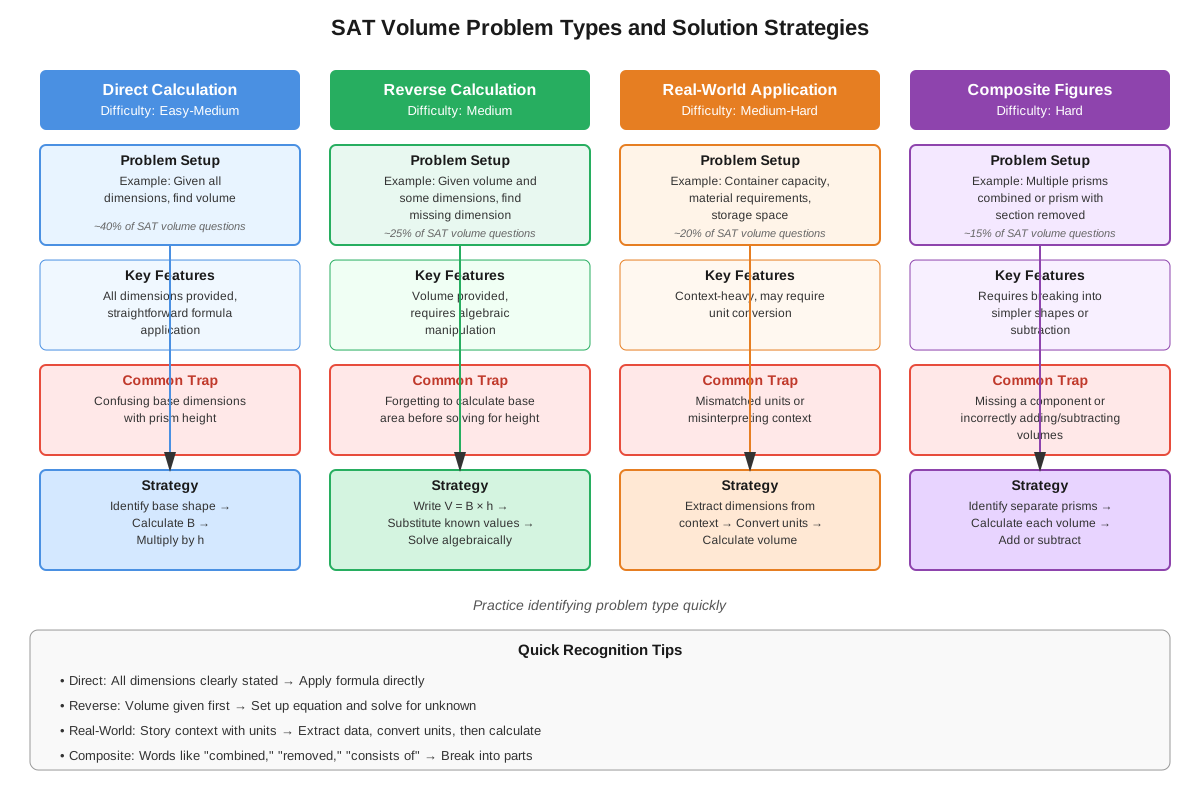
On the SAT, volume questions appear with notable frequency, typically comprising 2-4% of all math questions. These problems appear in both the calculator and no-calculator sections, with varying difficulty levels. The College Board particularly favors questions that combine volume with other concepts: finding volume when dimensions are given algebraically, determining how volume changes when dimensions are scaled, or calculating the volume of composite figures made from multiple prisms. According to test analysis data, approximately 60% of volume questions involve rectangular prisms, 25% involve triangular prisms, and 15% involve other polygonal prisms or composite figures.
The SAT presents volume problems in several characteristic formats: direct calculation questions that provide all dimensions, reverse-engineering problems that give volume and ask for a missing dimension, comparison questions that ask students to determine how volume changes with dimension changes, and word problems embedded in real-world contexts such as construction, packaging, or fluid capacity. Recognizing these patterns enables strategic, efficient problem-solving.
Core Concepts
Fundamental Definition of Prisms
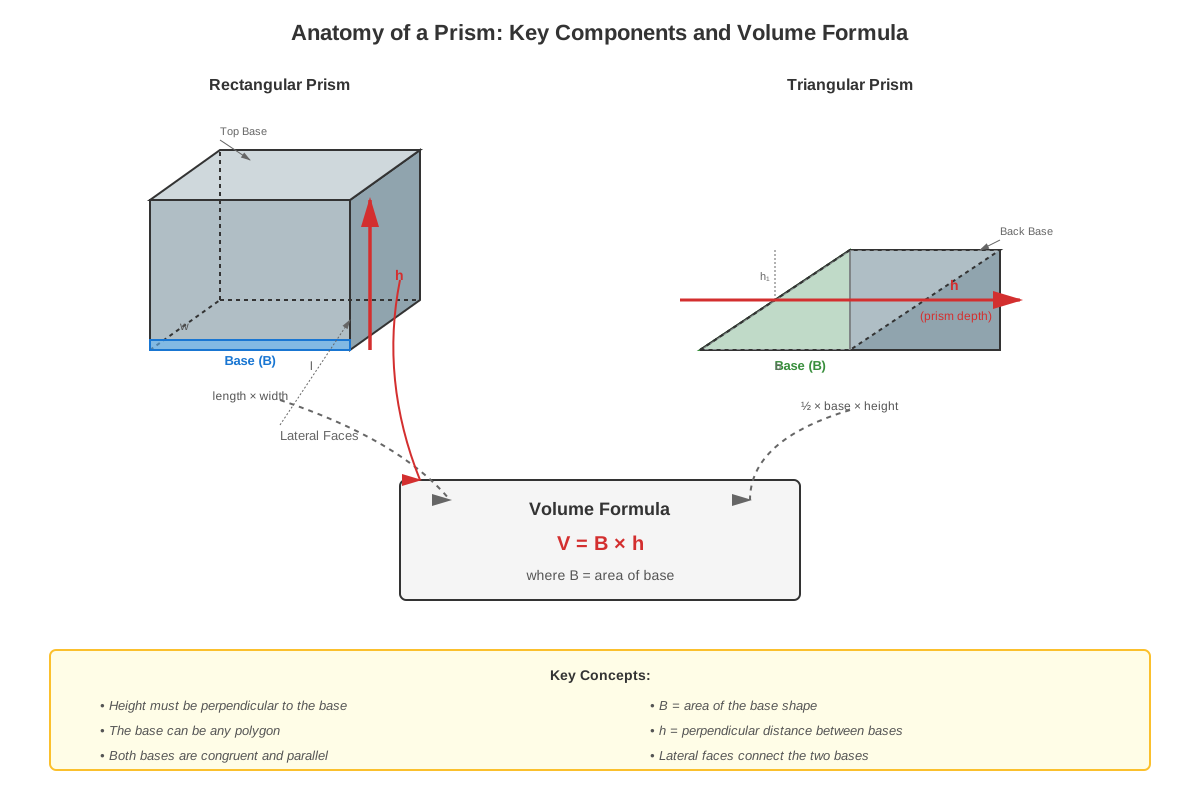
A prism is a three-dimensional polyhedron characterized by two parallel, congruent polygonal faces called bases, connected by rectangular lateral faces. The perpendicular distance between these bases is called the height (or altitude) of the prism. Prisms are classified by the shape of their bases: a prism with triangular bases is a triangular prism, one with rectangular bases is a rectangular prism, and so forth. The key distinguishing feature of all prisms is that their cross-sections parallel to the bases are congruent to the bases themselves throughout the entire height.
The Universal Volume Formula
The volume of prisms follows a single, elegant formula that applies to all prisms regardless of base shape:
V = B × hWhere:
- V = volume of the prism
- B = area of the base
- h = height (perpendicular distance between bases)
This formula embodies a fundamental principle: volume equals the amount of space occupied when the base area is "stacked" through the height of the prism. Understanding this conceptual foundation helps students apply the formula correctly even when problems present unfamiliar configurations.
Rectangular Prisms (Boxes)
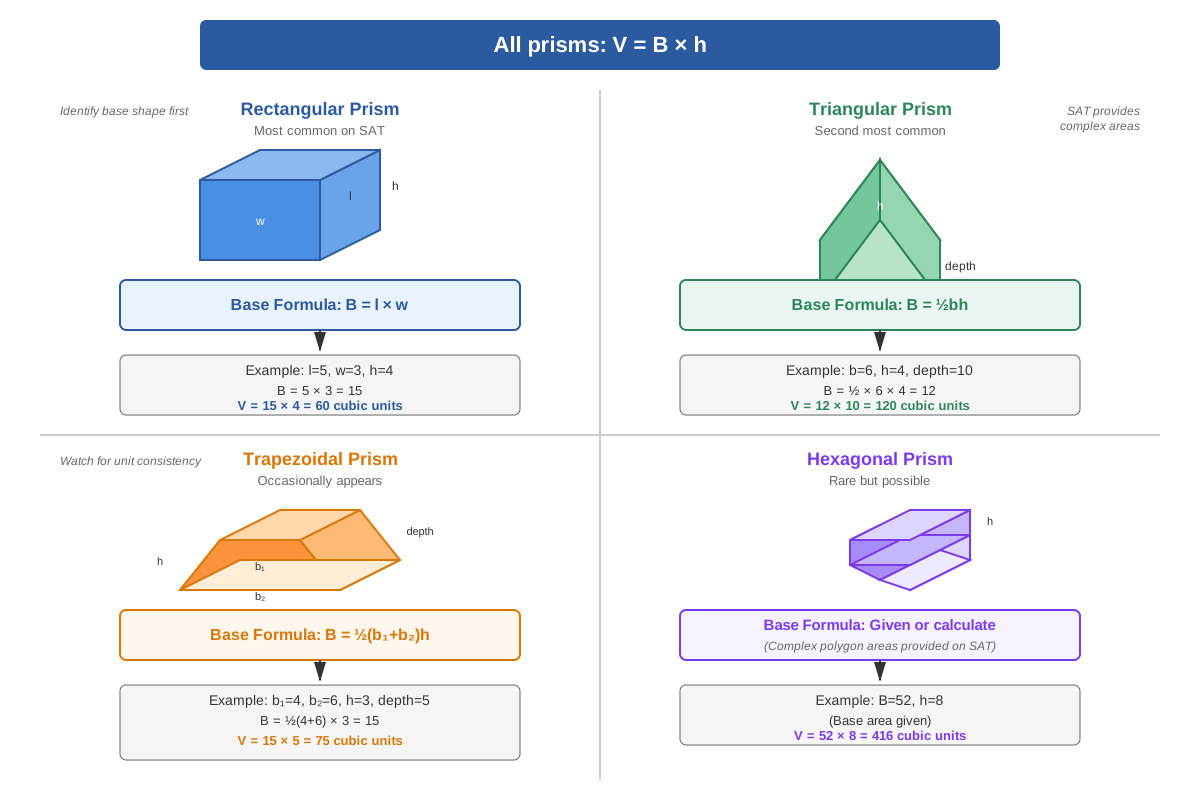
Rectangular prisms, also called rectangular solids or boxes, are the most common prism type on the SAT. These have rectangular bases and rectangular lateral faces. For a rectangular prism with length (l), width (w), and height (h), the volume formula becomes:
V = l × w × hThis is simply the base area formula (l × w) multiplied by the height. A special case is the cube, where all dimensions are equal (l = w = h = s), giving the formula:
V = s³SAT questions frequently involve rectangular prisms in contexts such as boxes, rooms, swimming pools, or storage containers. Students must identify which dimension represents the height and which dimensions define the base, though the formula works regardless of orientation.
Triangular Prisms
A triangular prism has triangular bases and three rectangular lateral faces. To find its volume, first calculate the area of the triangular base using the appropriate triangle area formula, then multiply by the height of the prism:
V = (½ × base of triangle × height of triangle) × height of prismThe SAT often tests whether students can distinguish between the triangle's height (used to find base area) and the prism's height (the distance between triangular bases). These are typically different measurements, and confusing them is a common error.
Other Polygonal Prisms
Prisms can have bases of any polygon: pentagons, hexagons, octagons, or irregular polygons. The volume formula V = B × h remains constant; only the method for calculating base area B changes. For regular polygons, the SAT may provide the base area directly or give sufficient information to calculate it. For irregular polygons, the base might be decomposed into simpler shapes (triangles, rectangles) whose areas can be summed.
Right vs. Oblique Prisms
A right prism has lateral edges perpendicular to the bases, making the lateral faces rectangles. An oblique prism has lateral edges that are not perpendicular to the bases, creating parallelogram lateral faces. Importantly, the volume formula V = B × h applies to both types, but h must always be the perpendicular distance between bases, not the length of a slanted edge. The SAT predominantly features right prisms, but understanding this distinction prevents errors when oblique prisms appear.
Dimension Relationships and Scaling
Understanding how volume changes when dimensions change is crucial for SAT success. Key relationships include:
| Dimension Change | Volume Change | Example |
|---|---|---|
| One dimension doubles | Volume doubles | If height doubles: V_new = 2V |
| All dimensions double | Volume multiplies by 8 (2³) | If l, w, h all double: V_new = 8V |
| All dimensions triple | Volume multiplies by 27 (3³) | If all dimensions × 3: V_new = 27V |
| Linear scale factor k | Volume multiplies by k³ | If all dimensions × k: V_new = k³V |
This cubic relationship between linear dimensions and volume is frequently tested through questions about similar figures or proportional reasoning.
Units and Conversions
Volume is always expressed in cubic units (cubic inches, cubic feet, cubic meters, etc.). When dimensions are given in different units, conversion is necessary before calculation. Common conversions include:
- 1 foot = 12 inches, so 1 cubic foot = 12³ = 1,728 cubic inches
- 1 meter = 100 centimeters, so 1 cubic meter = 100³ = 1,000,000 cubic centimeters
- 1 yard = 3 feet, so 1 cubic yard = 3³ = 27 cubic feet
The SAT may test unit conversion directly or embed it within volume problems, requiring students to recognize when conversion is necessary.
Concept Relationships
The volume of prisms concept builds directly upon area formulas for two-dimensional polygons. The relationship flows: polygon area formulas → base area calculation → volume formula application. Each type of prism requires mastery of the corresponding polygon area formula: rectangular prisms require rectangle area (l × w), triangular prisms require triangle area (½bh), and so forth.
Volume concepts connect forward to more advanced three-dimensional geometry. Understanding prisms enables learning about cylinders (which can be conceptualized as prisms with circular bases), pyramids (where volume equals ⅓Bh instead of Bh), and composite figures (combinations of multiple three-dimensional shapes). The proportional reasoning developed through scaling problems connects to similar figures and dimensional analysis throughout geometry and algebra.
Within the broader SAT math curriculum, volume problems often integrate with algebraic reasoning (setting up equations when dimensions are unknown), coordinate geometry (when prism vertices are given as coordinates), and word problem interpretation (translating real-world scenarios into mathematical models). The relationship map flows: Basic Geometry → Area Formulas → Volume of Prisms → Complex 3D Geometry → Applied Problem Solving.
Quick check — test yourself on Volume of prisms so far.
Try Flashcards →High-Yield Facts
⭐ The universal volume formula for all prisms is V = B × h, where B is the base area and h is the perpendicular height between bases
⭐ For rectangular prisms specifically, volume equals length × width × height (V = lwh)
⭐ When all dimensions of a prism are multiplied by a scale factor k, the volume is multiplied by k³
⭐ Volume is always measured in cubic units (in³, ft³, cm³, m³, etc.)
⭐ The height of a prism must be perpendicular to the base; slanted edge lengths are not the height
- A cube with side length s has volume V = s³
- For triangular prisms, the triangle's height and the prism's height are different measurements
- Doubling just one dimension of a prism doubles the volume; doubling all dimensions multiplies volume by 8
- 1 cubic foot equals 1,728 cubic inches (12³)
- The base of a prism can be any polygon; the formula V = B × h works for all
- Cross-sections parallel to the base of a prism are congruent to the base
- Right prisms have rectangular lateral faces; oblique prisms have parallelogram lateral faces
- Volume represents the three-dimensional space occupied by an object or the capacity of a container
Common Misconceptions
Misconception: The height of a triangular prism is the same as the height of the triangular base.
Correction: These are distinct measurements. The triangle's height is used to calculate the base area (B = ½bh_triangle), while the prism's height is the perpendicular distance between the two triangular bases. Both measurements are needed but serve different purposes in the volume calculation.
Misconception: When dimensions double, volume doubles.
Correction: Volume has a cubic relationship with linear dimensions. When all dimensions double, volume multiplies by 2³ = 8. When only one dimension doubles, then volume doubles. Students must carefully track which dimensions change.
Misconception: Any edge of a prism can be used as the height in the volume formula.
Correction: The height must specifically be the perpendicular distance between the two parallel bases. In oblique prisms, the slanted lateral edges are longer than the actual height. Using an incorrect measurement leads to wrong answers.
Misconception: Volume can be measured in square units like area.
Correction: Volume always uses cubic units (units³) because it measures three-dimensional space. Square units measure two-dimensional area. Confusing these indicates a fundamental misunderstanding of dimensional analysis.
Misconception: The formula V = lwh only works when the prism is oriented with a horizontal base.
Correction: The volume formula works regardless of orientation. Any face can be designated as the "base" as long as the height is measured perpendicular to that base. A rectangular prism has the same volume whether standing upright or lying on its side.
Misconception: Prisms must have rectangular bases.
Correction: Prisms can have bases of any polygon shape—triangles, pentagons, hexagons, or irregular polygons. The defining characteristic is two parallel, congruent bases connected by lateral faces, not the specific shape of those bases.
Worked Examples
Example 1: Direct Volume Calculation with a Triangular Prism
Problem: A triangular prism has a triangular base with a base length of 8 inches and a height of 6 inches. The prism's height (distance between triangular bases) is 15 inches. What is the volume of the prism in cubic inches?
Solution:
Step 1: Identify the given information.
- Base of triangle: b = 8 inches
- Height of triangle: h_triangle = 6 inches
- Height of prism: h_prism = 15 inches
Step 2: Calculate the area of the triangular base using the triangle area formula.
B = ½ × base × height
B = ½ × 8 × 6
B = ½ × 48
B = 24 square inches
Step 3: Apply the prism volume formula V = B × h.
V = B × h_prism
V = 24 × 15
V = 360 cubic inchesAnswer: The volume is 360 cubic inches.
Connection to Learning Objectives: This problem demonstrates the application of the volume formula to a triangular prism, requiring students to distinguish between the triangle's height (used for base area) and the prism's height (used in the volume formula). This addresses the objective of applying volume formulas to answer SAT-style questions.
Example 2: Working Backward from Volume
Problem: A rectangular storage container has a volume of 1,440 cubic feet. The length of the container is 12 feet and the width is 10 feet. What is the height of the container in feet?
Solution:
Step 1: Identify the given information and what we're solving for.
- Volume: V = 1,440 ft³
- Length: l = 12 ft
- Width: w = 10 ft
- Height: h = ?
Step 2: Write the volume formula for a rectangular prism.
V = l × w × hStep 3: Substitute the known values.
1,440 = 12 × 10 × h
1,440 = 120 × h
Step 4: Solve for h by dividing both sides by 120.
h = 1,440 ÷ 120
h = 12 feet
Step 5: Verify the answer by checking: 12 × 10 × 12 = 1,440 ✓
Answer: The height is 12 feet.
Connection to Learning Objectives: This problem requires algebraic manipulation to determine an unknown dimension when volume is given, demonstrating the objective of solving multi-step problems and working with volume formulas in reverse. This type of problem frequently appears on the SAT and tests both geometric understanding and algebraic reasoning.
Exam Strategy
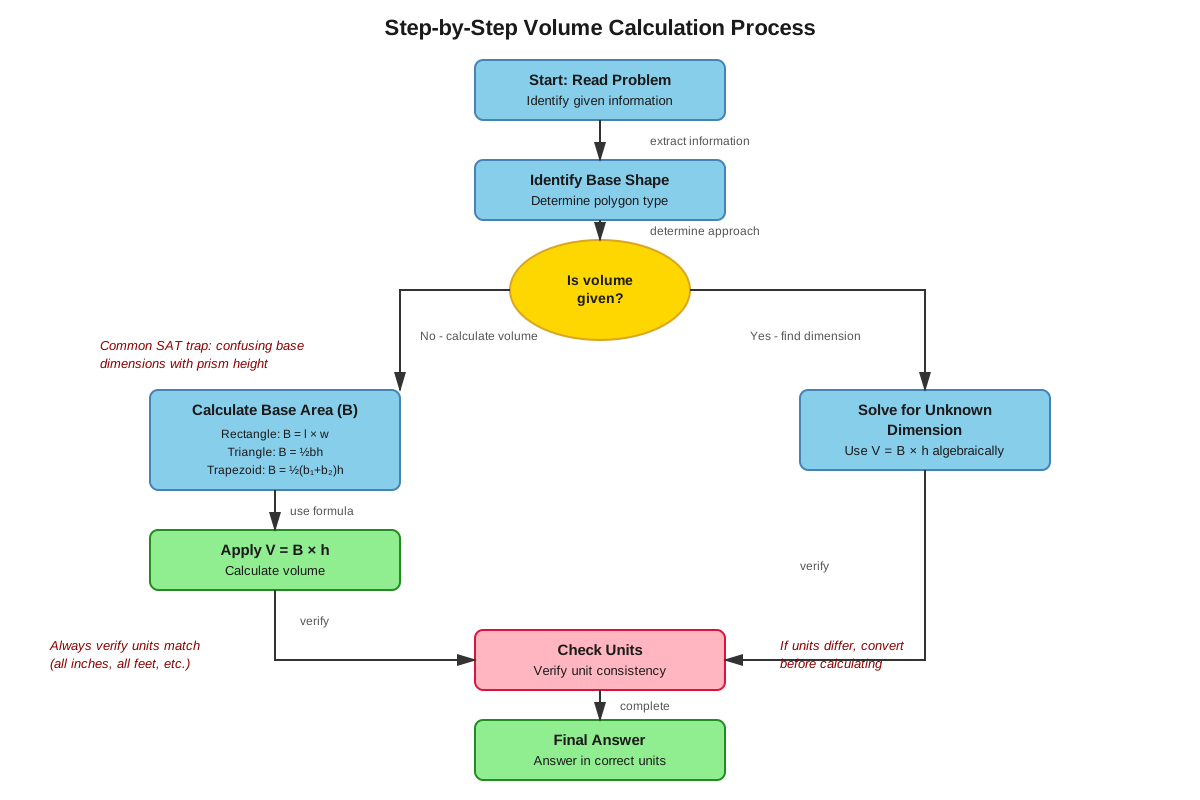
When approaching sat volume of prisms questions, begin by carefully identifying the shape of the prism and determining which face represents the base. Draw a quick sketch if one isn't provided, labeling all given dimensions clearly. This visualization step prevents confusion between different measurements, especially in triangular prisms where multiple "heights" exist.
Trigger words and phrases to watch for include: "capacity" (indicates volume), "holds" or "contains" (volume context), "dimensions," "length, width, and height," "cross-section" (relates to base shape), "between the bases" (indicates prism height), and "cubic units" (confirms volume calculation). When a problem mentions "similar figures" or "scale factor" with volume, immediately recall the k³ relationship.
For process-of-elimination, check answer choices for appropriate units (must be cubic for volume), reasonable magnitude (eliminate answers that are impossibly large or small given the dimensions), and dimensional consistency (if dimensions are in feet, volume should be in cubic feet unless conversion is specified). When multiple formulas could apply, eliminate choices that would result from using incorrect formulas (such as using perimeter instead of area for the base).
Time allocation for volume problems should typically be 60-90 seconds for straightforward calculations and up to 2 minutes for multi-step problems involving algebra or unit conversion. If a problem requires more than 2 minutes, mark it for review and move on—these questions are designed to be solvable within this timeframe, so extended struggle suggests a missed insight. Practice identifying the quickest path: sometimes working backward from answer choices is faster than setting up complex equations.
Exam Tip: Always verify that your final answer makes logical sense. If calculating the volume of a small box and getting 10,000 cubic feet, something went wrong. This reality check catches calculation errors and unit conversion mistakes.
Memory Techniques
The "BASE-HEIGHT" mnemonic: Remember that volume is always Base Area Stacked Everywhere through the HEIGHT. This reinforces that you multiply base area by height for any prism.
The "Triple-Triple" rule: When all three dimensions triple, volume becomes 3³ = 27 times larger. Visualize a Rubik's cube: a 3×3×3 cube contains 27 small cubes, each 1×1×1. This visual makes the cubic scaling relationship memorable.
The "Cubic Units" check: Create a habit of writing "³" immediately after calculating volume. This physical act reinforces that volume requires cubic units and serves as a self-check mechanism during problem-solving.
The "Two Heights" reminder for triangular prisms: Use the phrase "Triangle height for area, prism height for volume" to distinguish between the two different heights in triangular prism problems. Visualize the triangle lying flat (its height pointing up within the triangle) versus the prism standing tall (its height pointing between the two triangular ends).
The "1-2-8" conversion: Remember that 1 foot = 12 inches, so 1 cubic foot = 1,728 cubic inches (12³). The pattern 1-2-8 helps recall this frequently tested conversion.
Summary
The volume of prisms is a high-yield SAT math topic that requires understanding both the universal formula V = B × h and how to calculate base areas for different polygon shapes. All prisms—whether rectangular, triangular, or other polygonal bases—follow the same fundamental principle: volume equals the base area multiplied by the perpendicular height between bases. Rectangular prisms use the specific formula V = lwh, while triangular prisms require first calculating the triangular base area using ½bh before multiplying by the prism's height. Critical skills include distinguishing between different types of heights, working with cubic units and conversions, understanding how volume scales with dimension changes (particularly the k³ relationship), and applying algebraic reasoning to solve for unknown dimensions when volume is given. Success on SAT volume questions depends on careful diagram interpretation, systematic formula application, and recognition of common problem patterns such as reverse-engineering dimensions, comparing volumes of similar figures, and translating real-world contexts into mathematical models.
Key Takeaways
- The universal volume formula for all prisms is V = B × h, where B is the base area and h is the perpendicular height between parallel bases
- Rectangular prisms specifically use V = l × w × h, and cubes use V = s³
- When all dimensions scale by factor k, volume scales by k³ (cubic relationship)
- Volume always uses cubic units (in³, ft³, cm³, m³), never square units
- For triangular prisms, carefully distinguish between the triangle's height (for base area) and the prism's height (for volume)
- The height must be perpendicular to the base; slanted edges are not the height
- SAT problems frequently require working backward from volume to find missing dimensions using algebraic manipulation
Related Topics
Surface Area of Prisms: After mastering volume, students should explore surface area calculations, which involve finding the total area of all faces. This connects volume (three-dimensional space) with area (two-dimensional surfaces) and frequently appears alongside volume on the SAT.
Volume of Cylinders: Cylinders can be understood as prisms with circular bases, using the formula V = πr²h. Mastering prism volume provides the conceptual foundation for cylinder volume.
Volume of Pyramids and Cones: These shapes use the formula V = ⅓Bh, exactly one-third of the prism/cylinder volume formula. Understanding why this fraction appears deepens geometric reasoning.
Similar Figures and Scaling: The k³ relationship between linear dimensions and volume extends to all three-dimensional similar figures, making this a natural progression for advanced problem-solving.
Composite Three-Dimensional Figures: Real-world objects often combine multiple prisms, cylinders, or other shapes. Mastering individual volume formulas enables calculating volumes of complex composite figures by addition or subtraction.
Practice CTA
Now that you've mastered the core concepts of prism volume, it's time to solidify your understanding through active practice. Work through the practice questions to apply these formulas in various SAT-style contexts, and use the flashcards to reinforce key formulas and relationships. Remember, the difference between understanding a concept and mastering it for test day lies in deliberate practice. Each problem you solve strengthens your pattern recognition and builds the confidence needed to tackle any volume question the SAT presents. You've got this—let's put your knowledge to work!
Sign up free to keep reading
Create a free AnvayaPrep account to finish this SAT guide on Volume of prisms — plus flashcards and practice questions.