Overview
The volume of cylinders is a fundamental geometric concept that appears regularly on the SAT Math section, making it a high-priority topic for test preparation. Understanding how to calculate and manipulate cylindrical volumes requires spatial reasoning skills and the ability to apply formulas in various contexts. On the SAT, cylinder volume problems often appear as standalone geometry questions or as part of multi-step word problems involving real-world scenarios such as water tanks, pipes, food containers, or architectural structures.
Mastering this topic is essential because cylinder volume questions frequently integrate multiple mathematical concepts, including area calculations, unit conversions, proportional reasoning, and algebraic manipulation. The SAT volume of cylinders questions test not only formula recall but also conceptual understanding of how changing dimensions affects volume, how to work with composite shapes involving cylinders, and how to extract relevant information from complex problem scenarios. These questions typically appear 1-3 times per test, making them statistically significant for score improvement.
Within the broader context of math on the SAT, cylinder volume connects directly to circular area calculations, three-dimensional geometry, and coordinate geometry. The skills developed while studying cylinders transfer to understanding other three-dimensional shapes like cones, spheres, and prisms. Additionally, cylinder problems often require algebraic thinking when dimensions are expressed as variables or when solving for unknown measurements, bridging the gap between geometry and algebra that characterizes many medium-to-high difficulty SAT questions.
Learning Objectives
- [ ] Identify key features of Volume of cylinders
- [ ] Explain how Volume of cylinders appears on the SAT
- [ ] Apply Volume of cylinders to answer SAT-style questions
- [ ] Calculate cylinder volume when given radius and height in various units
- [ ] Determine how volume changes when dimensions are scaled by specific factors
- [ ] Solve for unknown dimensions (radius or height) when given volume
- [ ] Apply cylinder volume concepts to composite three-dimensional figures
- [ ] Interpret and solve word problems involving cylindrical containers and real-world applications
Prerequisites
- Area of circles (πr²): Cylinder volume is fundamentally the circular base area multiplied by height, making circle area calculations essential
- Basic algebraic manipulation: Solving for variables and working with formulas requires comfort with algebraic operations
- Unit conversion: Many cylinder problems involve converting between units (inches to feet, cubic centimeters to liters)
- Exponent rules: Understanding how squaring the radius affects calculations and how dimensional scaling works
- Pi (π) as a constant: Recognizing when to use π ≈ 3.14 versus leaving answers in terms of π
Why This Topic Matters
In real-world applications, cylindrical volumes are ubiquitous in engineering, manufacturing, construction, and everyday life. Calculating the capacity of water tanks, determining the amount of material needed to fill a pipe, estimating food storage requirements, or designing cylindrical containers all require understanding cylinder volume. Medical applications include calculating medication dosages in cylindrical syringes, while environmental science uses cylinder volume concepts for measuring rainfall in cylindrical gauges.
On the SAT, cylinder volume questions appear with notable frequency—typically 1-3 questions per test administration. These questions account for approximately 3-5% of the total Math section and often appear in both the calculator and no-calculator portions. The College Board considers three-dimensional geometry, including cylinders, a "Passport to Advanced Math" and "Additional Topics in Math" concept, placing it in the medium-to-high difficulty range. Questions may appear as multiple-choice or grid-in formats, with point values equivalent to any other question (making each one valuable for score optimization).
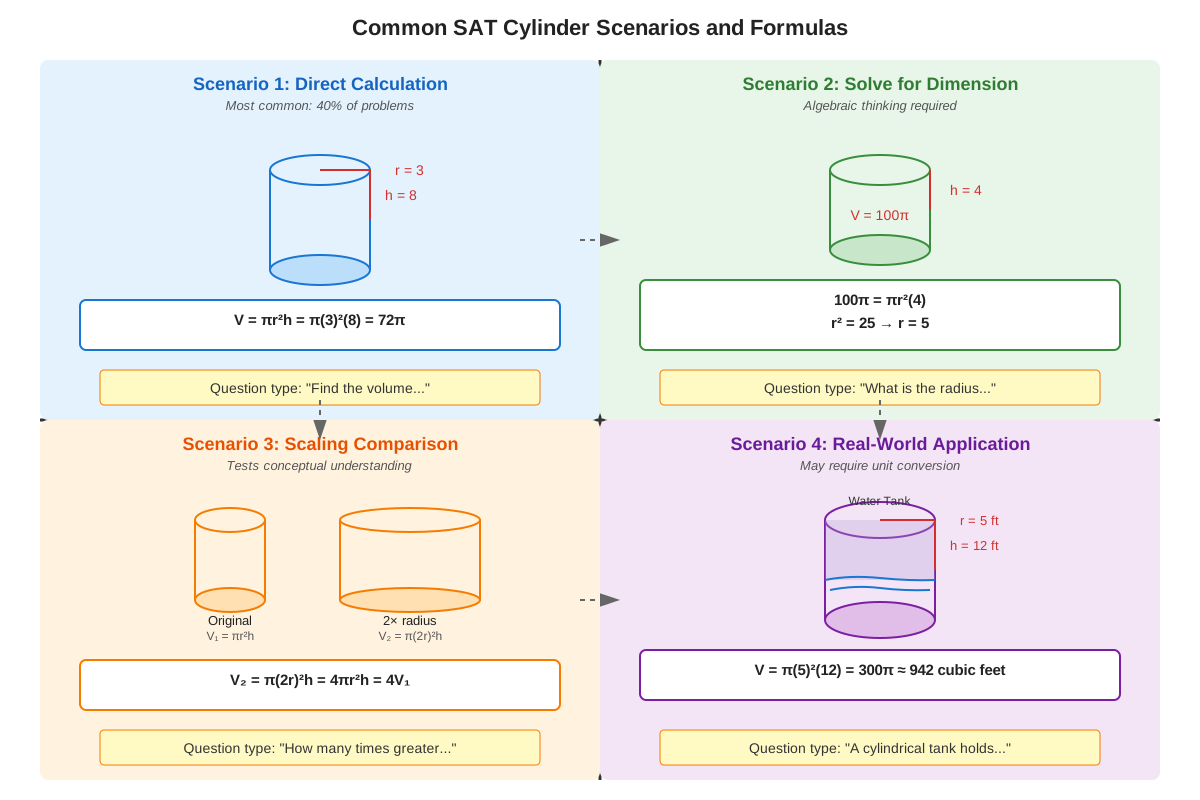
Common SAT question formats include: direct volume calculations given dimensions; finding unknown dimensions when volume is provided; comparing volumes of cylinders with different dimensions; solving word problems involving filling, emptying, or comparing cylindrical containers; and analyzing how volume changes when dimensions are scaled. Questions may also involve composite figures where cylinders are combined with other shapes, or scenarios requiring unit conversions before or after volume calculations.
Core Concepts
The Cylinder Volume Formula
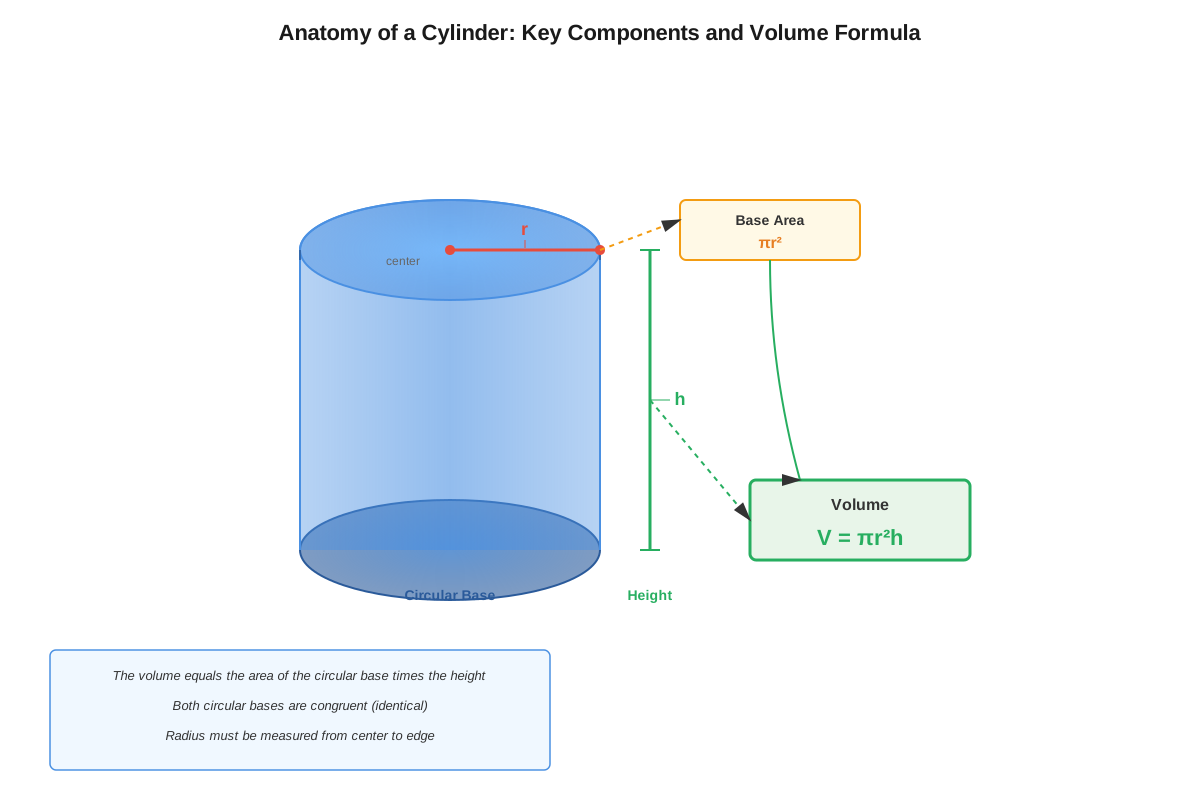
The volume of cylinders is calculated using the fundamental formula:
V = πr²hWhere:
- V = volume (in cubic units)
- π = pi (approximately 3.14159...)
- r = radius of the circular base
- h = height (or length) of the cylinder
This formula derives from the principle that volume equals base area multiplied by height. Since the base of a cylinder is a circle with area πr², multiplying by height h gives the total three-dimensional space enclosed. Understanding this derivation helps with conceptual problems where the formula must be adapted or applied creatively.
Key Components of a Cylinder
A cylinder consists of three essential features:
- Two parallel circular bases: These are congruent circles that form the top and bottom of the cylinder
- Radius (r): The distance from the center of either circular base to its edge
- Height (h): The perpendicular distance between the two circular bases
It's crucial to distinguish between radius and diameter. The diameter is twice the radius (d = 2r), and many SAT problems provide diameter instead of radius to test careful reading. Always verify which measurement is given and convert if necessary before applying the formula.
Right Cylinders vs. Oblique Cylinders
The SAT exclusively tests right cylinders, where the height is perpendicular to the bases. In oblique cylinders (where the sides slant), the volume formula remains the same, but these rarely appear on standardized tests. For SAT purposes, assume all cylinders are right cylinders unless explicitly stated otherwise.
Units and Dimensional Analysis
Volume is always expressed in cubic units (units³). If radius is measured in centimeters and height in centimeters, volume will be in cubic centimeters (cm³). Common unit conversions on the SAT include:
| Linear Measurement | Volume Measurement |
|---|---|
| 1 foot = 12 inches | 1 ft³ = 1,728 in³ |
| 1 meter = 100 cm | 1 m³ = 1,000,000 cm³ |
| 1 yard = 3 feet | 1 yd³ = 27 ft³ |
When dimensions are given in different units, convert all measurements to the same unit before calculating volume. For example, if radius is given in inches but height in feet, convert one measurement to match the other.
Scaling and Proportional Relationships
Understanding how volume changes when dimensions change is critical for SAT success:
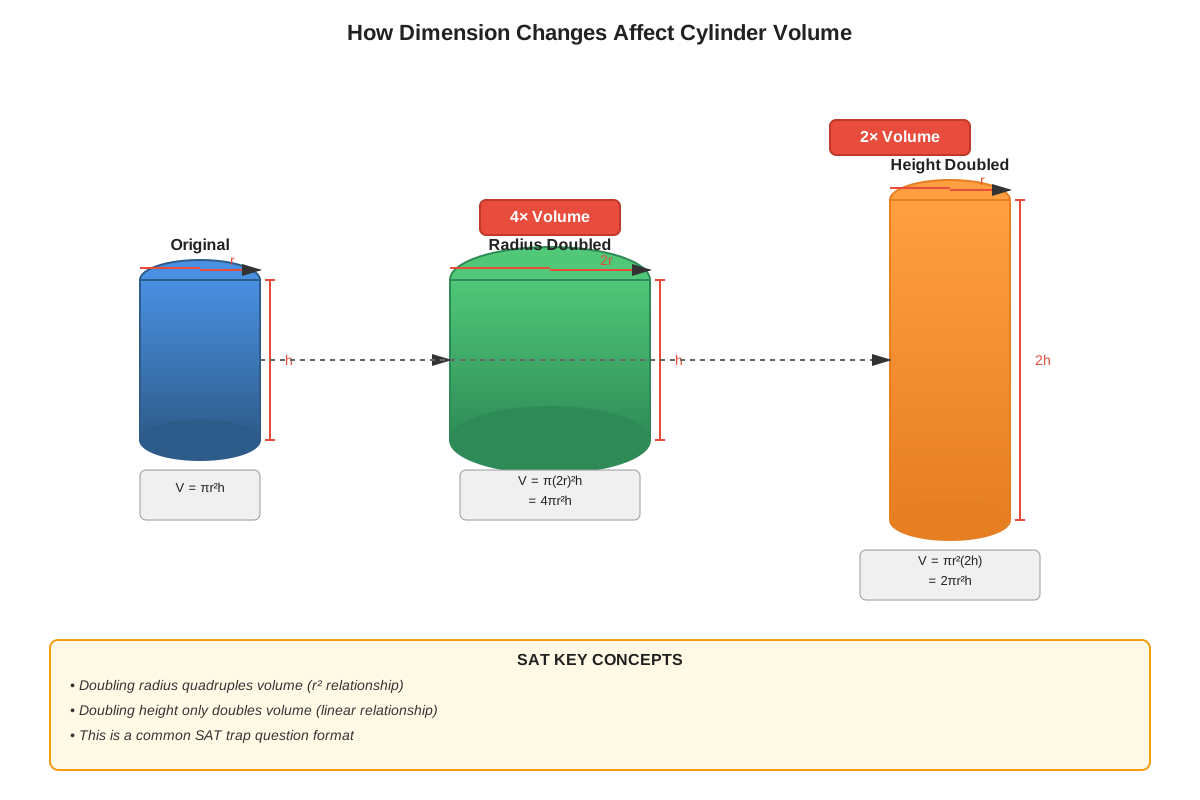
- If radius is doubled (and height stays constant): Volume increases by a factor of 4 (since radius is squared in the formula)
- If height is doubled (and radius stays constant): Volume doubles
- If both radius and height are doubled: Volume increases by a factor of 8 (2² × 2 = 8)
- General scaling rule: If all linear dimensions are multiplied by factor k, volume is multiplied by k³
This concept frequently appears in comparison problems where students must determine relative volumes without calculating exact values.
Solving for Unknown Dimensions
Many SAT problems provide the volume and one dimension, requiring students to solve for the unknown:
To find radius when volume and height are known:
r = √(V/(πh))To find height when volume and radius are known:
h = V/(πr²)These rearrangements require algebraic manipulation skills and comfort with square roots.
Composite Figures Involving Cylinders
Advanced SAT problems may involve:
- Cylinders with cylindrical holes: Subtract the volume of the inner cylinder from the outer cylinder
- Half-cylinders or cylinder sections: Multiply the full cylinder volume by the appropriate fraction
- Cylinders combined with other shapes: Calculate each volume separately and add or subtract as needed
Practical Problem-Solving Steps
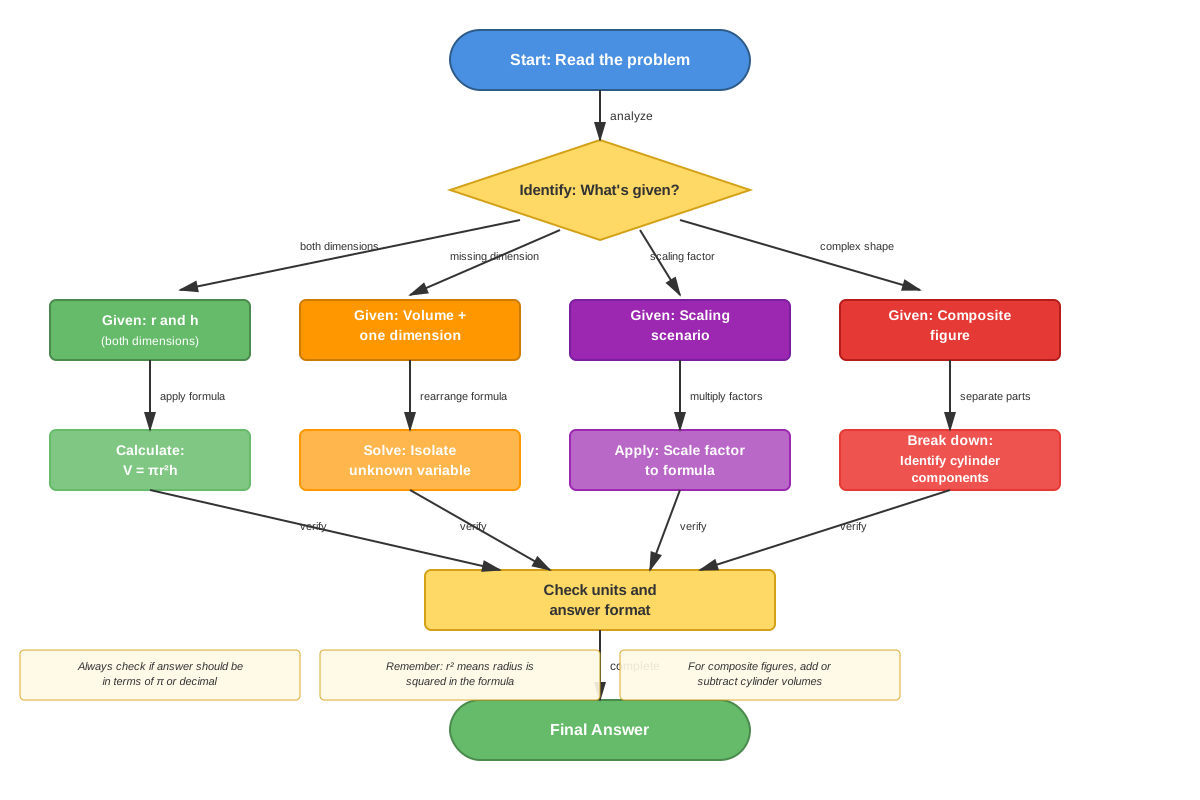
When approaching any cylinder volume problem:
- Identify what is given: radius or diameter, height, volume
- Identify what is being asked: volume, radius, height, or comparative relationship
- Convert units if necessary: ensure all measurements use the same unit
- Apply the appropriate formula: V = πr²h or its rearrangement
- Calculate carefully: pay attention to whether to use π or 3.14
- Check units: ensure the answer has appropriate cubic units
- Verify reasonableness: does the answer make sense in context?
Concept Relationships
The volume of cylinders concept builds directly on circular area (πr²), which forms the foundation of the cylinder volume formula. Without understanding how to calculate the area of a circle, cylinder volume calculations become mechanical rather than conceptual. This relationship can be expressed as: Circle Area → Extended through height → Cylinder Volume.
Within the topic itself, the relationships flow as follows: Basic Formula (V = πr²h) → Dimensional Scaling → Solving for Unknowns → Composite Figures. Each level builds on the previous, with basic formula application being prerequisite to understanding how changes in dimensions affect volume proportionally.
Cylinder volume connects to broader SAT math topics through multiple pathways. Algebraic manipulation skills enable solving for unknown variables within the volume formula. Ratio and proportion concepts explain how scaling dimensions affects volume. Unit conversion and dimensional analysis ensure correct interpretation of measurements. The topic also relates to coordinate geometry when cylinders are positioned in three-dimensional coordinate systems, though this appears less frequently on the SAT.
Looking forward, mastering cylinder volume prepares students for understanding cone volume (which is one-third of a cylinder with the same base and height) and sphere volume. The spatial reasoning developed through cylinder problems transfers to all three-dimensional geometry, making this a gateway topic for advanced geometric thinking.
Quick check — test yourself on Volume of cylinders so far.
Try Flashcards →High-Yield Facts
⭐ The cylinder volume formula is V = πr²h, where r is radius (not diameter) and h is height
⭐ If radius is doubled while height remains constant, volume increases by a factor of 4
⭐ Volume is always expressed in cubic units (cm³, in³, ft³, etc.)
⭐ Diameter equals twice the radius; always convert diameter to radius before using the formula
⭐ When all linear dimensions are scaled by factor k, volume is scaled by k³
- The bases of a cylinder are congruent circles that are parallel to each other
- Height is the perpendicular distance between the two circular bases
- If height is doubled while radius remains constant, volume exactly doubles
- To find radius when volume is known: r = √(V/(πh))
- To find height when volume is known: h = V/(πr²)
- A cylinder with radius r and height h has the same volume as a cylinder with radius h and height r only if r = h
- The volume of a cylinder with a cylindrical hole is found by subtracting the inner cylinder volume from the outer cylinder volume
- Converting from inches to feet requires dividing by 12; converting cubic inches to cubic feet requires dividing by 1,728 (12³)
- Half a cylinder has exactly half the volume of the complete cylinder
- On the SAT, answers involving π are often left in terms of π rather than using 3.14
Common Misconceptions
Misconception: Using diameter instead of radius in the formula without converting → Correction: The formula requires radius specifically. If diameter is given, always divide by 2 first: r = d/2. Using diameter directly will result in a volume that is 4 times too large.
Misconception: Believing that doubling the radius doubles the volume → Correction: Because radius is squared in the formula (πr²h), doubling the radius actually quadruples the volume (assuming height stays constant). This is a frequently tested concept on the SAT.
Misconception: Forgetting to square the radius and calculating V = πrh instead → Correction: The formula is V = πr²h, not V = πrh. The radius must be squared because it represents the area of the circular base. Always write out the formula completely to avoid this error.
Misconception: Assuming volume units match linear units (e.g., if radius is in inches, volume is in inches) → Correction: Volume is always in cubic units. If linear measurements are in inches, volume is in cubic inches (in³). If measurements are in centimeters, volume is in cubic centimeters (cm³).
Misconception: Thinking that scaling all dimensions by factor k scales volume by factor k → Correction: When all linear dimensions are scaled by factor k, volume is scaled by k³. For example, if radius and height are both tripled, volume increases by a factor of 27 (3³), not 3.
Misconception: Believing that a cylinder with radius 2 and height 3 has the same volume as one with radius 3 and height 2 → Correction: These cylinders have different volumes because radius is squared in the formula. The first has volume π(2²)(3) = 12π, while the second has volume π(3²)(2) = 18π.
Misconception: Adding volumes incorrectly when dealing with composite figures → Correction: When a cylinder has a cylindrical hole, subtract the inner volume from the outer volume. When cylinders are joined end-to-end, add their volumes. Carefully read whether the problem involves addition or subtraction.
Worked Examples
Example 1: Direct Volume Calculation with Unit Conversion
Problem: A cylindrical water tank has a diameter of 8 feet and a height of 15 feet. What is the volume of the tank in cubic feet? (Use π ≈ 3.14)
Solution:
Step 1: Identify given information
- Diameter = 8 feet
- Height = 15 feet
- Need to find volume
Step 2: Convert diameter to radius
- Radius = Diameter ÷ 2
- r = 8 ÷ 2 = 4 feet
Step 3: Apply the volume formula
- V = πr²h
- V = π(4)²(15)
- V = π(16)(15)
- V = 240π cubic feet
Step 4: Calculate numerical value
- V = 240 × 3.14
- V = 753.6 cubic feet
Answer: The volume is 240π cubic feet, or approximately 753.6 cubic feet.
Connection to Learning Objectives: This example demonstrates identifying key features (radius and height), applying the formula correctly, and handling the common challenge of being given diameter instead of radius—a frequent SAT trap.
Example 2: Solving for Unknown Dimension and Scaling
Problem: A cylindrical container has a volume of 500π cubic inches and a height of 20 inches. If a second container has the same height but twice the radius of the first container, what is the volume of the second container?
Solution:
Step 1: Find the radius of the first container
- V = πr²h
- 500π = πr²(20)
- 500π = 20πr²
- Divide both sides by 20π: 25 = r²
- r = 5 inches
Step 2: Determine the radius of the second container
- Second radius = 2 × first radius
- r₂ = 2 × 5 = 10 inches
Step 3: Calculate the volume of the second container
- V₂ = πr₂²h
- V₂ = π(10)²(20)
- V₂ = π(100)(20)
- V₂ = 2000π cubic inches
Step 4: Verify using scaling principle
- When radius doubles and height stays constant, volume increases by factor of 4
- Original volume × 4 = 500π × 4 = 2000π ✓
Answer: The volume of the second container is 2000π cubic inches.
Connection to Learning Objectives: This problem requires solving for an unknown dimension (radius) from given volume, then applying understanding of how scaling affects volume—both high-yield SAT skills. It also demonstrates the efficiency of using scaling relationships to verify answers.
Exam Strategy
When approaching SAT volume of cylinders questions, begin by carefully reading the problem to identify whether radius or diameter is provided—this is the most common trap. Circle or underline the given measurements and immediately convert diameter to radius if necessary. Write "r = " next to the radius value to reinforce that you're working with the correct measurement.
Trigger words and phrases to watch for include: "diameter" (requires conversion), "twice the radius" (scaling problem), "capacity" (another word for volume), "filled to" (may involve partial volume), "cylindrical tank/container/pipe" (signals cylinder problem), and "in terms of π" (leave π in the answer rather than calculating a decimal).
For process of elimination on multiple-choice questions, use dimensional analysis to eliminate answers with incorrect units. If the problem asks for volume, eliminate any answer not in cubic units. Check whether answer choices are in terms of π or as decimals—this tells you whether to calculate a numerical value or leave π in your answer. If you've doubled the radius, eliminate any answer choice that suggests the volume only doubled (it should quadruple).
Time allocation: Straightforward cylinder volume calculations should take 30-60 seconds. Problems requiring solving for unknown dimensions or involving composite figures may take 90-120 seconds. If a problem involves multiple steps or unit conversions, budget up to 2 minutes. If you're stuck after 90 seconds, mark the question and return to it—cylinder problems often become clearer on a second look.
Strategic approach sequence:
- Identify what's given and what's being asked (10 seconds)
- Convert diameter to radius if needed (5 seconds)
- Check units and convert if necessary (10 seconds)
- Write out the formula (5 seconds)
- Substitute values and calculate (30-60 seconds)
- Verify units and reasonableness (10 seconds)
For grid-in questions, be especially careful with decimal places and whether to include π in your answer. The SAT grid-in format cannot accommodate π, so these questions will always ask for a numerical approximation.
Memory Techniques
Formula Mnemonic: "Very Pretty Round Roses Have" → V = π r² h (Volume equals pi times radius squared times height)
Radius vs. Diameter: Remember "Diameter Divide by Deux (two)" or visualize a diameter as a line that goes through the center, cutting the circle in half—each half is a radius.
Scaling Visualization: Picture a cylinder made of blocks. If you double the radius, you need 4 times as many blocks to fill each circular layer (2² = 4). If you also double the height, you need twice as many layers, giving 8 times total volume (2³ = 8). This concrete visualization helps remember that volume scales by k³.
Unit Conversion Anchor: Remember "12-12-12" for feet and inches: 12 inches in a foot, so 12 × 12 × 12 = 1,728 cubic inches in a cubic foot. The three 12s represent the three dimensions.
Circular Base Connection: Think "Cylinder starts with Circle"—always calculate the circle area first (πr²), then multiply by height. This two-step mental model prevents formula confusion.
RADIUS Acronym for problem-solving steps:
- Read carefully for diameter vs. radius
- Assess what's given and what's needed
- Determine if unit conversion is required
- Insert values into V = πr²h
- Understand if answer should include π
- Solve and verify units
Summary
The volume of cylinders is a high-yield SAT Math topic that requires understanding the formula V = πr²h and its applications. Success depends on distinguishing between radius and diameter, recognizing that radius is squared in the formula, and understanding how scaling dimensions affects volume proportionally. The most critical skills include converting diameter to radius before calculation, maintaining proper cubic units throughout, solving for unknown dimensions by rearranging the formula, and applying scaling principles (doubling radius quadruples volume; doubling all dimensions multiplies volume by 8). SAT questions test these concepts through direct calculations, comparison problems, word problems involving real-world cylindrical containers, and composite figures. Mastery requires both formula fluency and conceptual understanding of how the circular base area extends through the height to create three-dimensional volume. Students must also develop careful reading habits to avoid common traps like using diameter instead of radius or forgetting to square the radius term.
Key Takeaways
- The cylinder volume formula V = πr²h requires radius (not diameter) and produces answers in cubic units
- Always convert diameter to radius by dividing by 2 before applying the formula
- Doubling the radius quadruples the volume (because radius is squared); doubling the height doubles the volume
- When all linear dimensions scale by factor k, volume scales by k³
- Solving for unknown dimensions requires algebraic rearrangement: r = √(V/(πh)) or h = V/(πr²)
- SAT problems often test careful reading (diameter vs. radius) and unit awareness more than complex calculations
- Leave answers in terms of π when answer choices include π; use 3.14 only when specified or for grid-in questions
Related Topics
Surface Area of Cylinders: After mastering volume, students should explore surface area calculations (2πr² + 2πrh), which combine circular area and rectangular lateral surface area concepts. This extends spatial reasoning to two-dimensional measurements of three-dimensional objects.
Volume of Cones: Cone volume (V = ⅓πr²h) directly builds on cylinder volume, as a cone is exactly one-third the volume of a cylinder with the same base and height. This relationship appears on SAT comparison questions.
Volume of Spheres: Spherical volume (V = ⁴⁄₃πr³) represents the next level of three-dimensional geometry, requiring similar spatial reasoning but with a different formula structure.
Density and Mass Calculations: Combining volume with density (mass = density × volume) creates interdisciplinary problems that appear in SAT Math word problems, particularly those with real-world contexts.
Optimization Problems: Advanced applications involve finding dimensions that maximize or minimize volume given constraints, connecting cylinder geometry to algebraic problem-solving and function analysis.
Practice CTA
Now that you've mastered the core concepts of cylinder volume, it's time to solidify your understanding through active practice. Complete the practice questions to test your ability to identify radius versus diameter, apply the volume formula in various contexts, and solve for unknown dimensions. Use the flashcards to reinforce the formula, scaling relationships, and common SAT traps. Remember: cylinder volume questions are high-yield on the SAT, and consistent practice with these concepts will directly translate to points on test day. Each practice problem you solve builds the pattern recognition and problem-solving speed that separates good scores from great scores. You've got this!
Sign up free to keep reading
Create a free AnvayaPrep account to finish this SAT guide on Volume of cylinders — plus flashcards and practice questions.