Overview
Coordinate circles represent one of the most frequently tested geometric concepts on the SAT math section, appearing in approximately 3-5 questions per exam. This topic bridges algebraic and geometric reasoning by expressing circles as equations in the coordinate plane, requiring students to translate between visual representations and algebraic formulas. Mastery of coordinate circles enables students to solve complex problems involving distances, tangent lines, intersections with other geometric figures, and optimization scenarios.
Understanding sat coordinate circles is essential because these questions often appear in the calculator and no-calculator sections, testing both computational fluency and conceptual understanding. The SAT frequently embeds circle problems within real-world contexts such as satellite coverage areas, wireless signal ranges, or architectural designs. Students who can quickly identify circle equations, extract key features like center and radius, and manipulate these equations gain a significant advantage in both time management and accuracy.
This topic connects fundamentally to the distance formula, the Pythagorean theorem, and systems of equations—all core SAT concepts. Circle problems frequently integrate with linear equations (finding tangent lines or chords), quadratic functions (determining intersection points), and even trigonometry in advanced applications. The ability to work fluently with coordinate circles also prepares students for more complex geometric transformations and provides a foundation for understanding conic sections in higher mathematics.
Learning Objectives
- [ ] Identify key features of coordinate circles including center coordinates and radius from standard and general form equations
- [ ] Explain how coordinate circles appears on the SAT in various question formats and difficulty levels
- [ ] Apply coordinate circles to answer SAT-style questions involving intersections, tangency, and geometric relationships
- [ ] Convert between standard form and general form of circle equations efficiently
- [ ] Determine whether a given point lies inside, on, or outside a circle using algebraic methods
- [ ] Calculate the equation of a circle given geometric information such as center and radius or diameter endpoints
- [ ] Solve systems involving circles and lines to find intersection points
Prerequisites
- Distance formula: Essential for deriving circle equations and calculating radius from center to any point on the circle
- Completing the square: Required to convert general form circle equations to standard form for easy identification of center and radius
- Coordinate plane fundamentals: Understanding ordered pairs, plotting points, and interpreting geometric relationships in the xy-plane
- Pythagorean theorem: Forms the geometric foundation for the circle equation as all points equidistant from a center
- Basic algebraic manipulation: Necessary for expanding, factoring, and simplifying circle equations
Why This Topic Matters
Coordinate circles appear with remarkable consistency on every SAT administration, making them one of the highest-yield geometry topics for test preparation. Statistical analysis of recent SAT exams reveals that circle-related questions account for approximately 8-12% of all math questions, with coordinate circles specifically appearing in 2-4 questions per test. These questions typically carry medium to high difficulty ratings and often serve as score differentiators between good and excellent performances.
In real-world applications, coordinate circles model countless phenomena: GPS systems use circular ranges to determine location accuracy, urban planners use circles to define service areas for emergency response, engineers employ circular equations in designing curved structures, and physicists use them to describe orbital mechanics and wave propagation. Understanding circles in the coordinate plane provides practical problem-solving tools that extend far beyond standardized testing.
On the SAT, coordinate circles commonly appear in several formats: direct identification questions asking for center or radius, word problems requiring equation setup from contextual information, intersection problems involving circles and lines or two circles, and optimization problems finding maximum or minimum distances. The College Board particularly favors questions that combine multiple concepts, such as finding the area of a region bounded by a circle and a line, or determining how many lattice points lie within a circular region.
Core Concepts
Standard Form of a Circle Equation
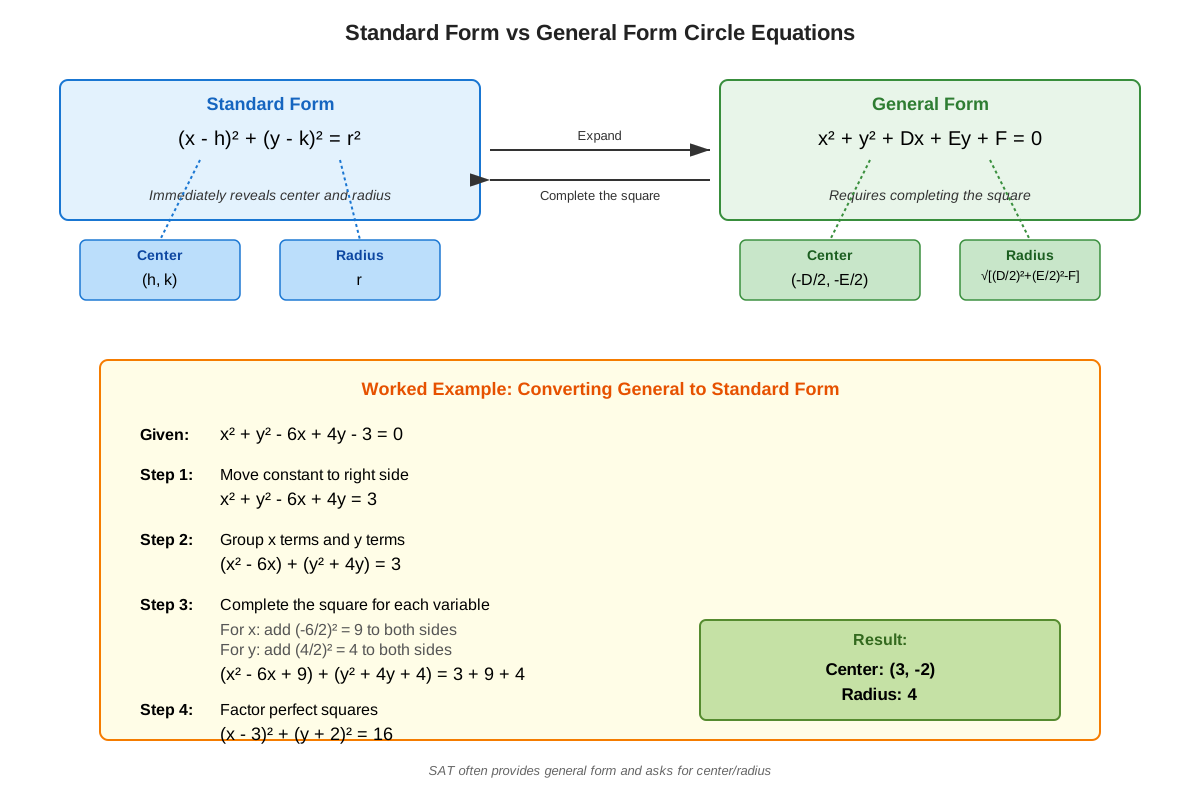
The standard form of a circle equation is the most useful representation for SAT problems:
(x - h)² + (y - k)² = r²Where:
- (h, k) represents the center of the circle
- r represents the radius of the circle
This form directly reveals the circle's key features. For example, the equation (x - 3)² + (y + 2)² = 25 immediately tells us the center is at (3, -2) and the radius is 5 (since r² = 25). Notice that the signs inside the parentheses are opposite to the actual coordinates: if the equation shows (x - 3), the x-coordinate of the center is positive 3; if it shows (y + 2), which is the same as (y - (-2)), the y-coordinate is -2.
General Form of a Circle Equation
The general form expands the standard form and appears as:
x² + y² + Dx + Ey + F = 0This form results from expanding the standard form and combining like terms. While less immediately useful for identifying features, the SAT often presents circles in general form to test whether students can convert to standard form through completing the square. The key characteristic distinguishing a circle equation in general form is that the coefficients of x² and y² are equal (and typically both equal to 1 after simplification).
Converting Between Forms
To convert from general form to standard form, use completing the square:
- Group x-terms and y-terms separately
- Move the constant to the right side
- Complete the square for x-terms: add (D/2)² to both sides
- Complete the square for y-terms: add (E/2)² to both sides
- Factor the perfect square trinomials
- Identify center as (h, k) = (-D/2, -E/2) and radius as r = √(right side)
Example: Convert x² + y² - 6x + 4y - 3 = 0 to standard form
- Group: (x² - 6x) + (y² + 4y) = 3
- Complete the square: (x² - 6x + 9) + (y² + 4y + 4) = 3 + 9 + 4
- Factor: (x - 3)² + (y + 2)² = 16
- Result: Center (3, -2), radius 4
Deriving Circle Equations from Geometric Information
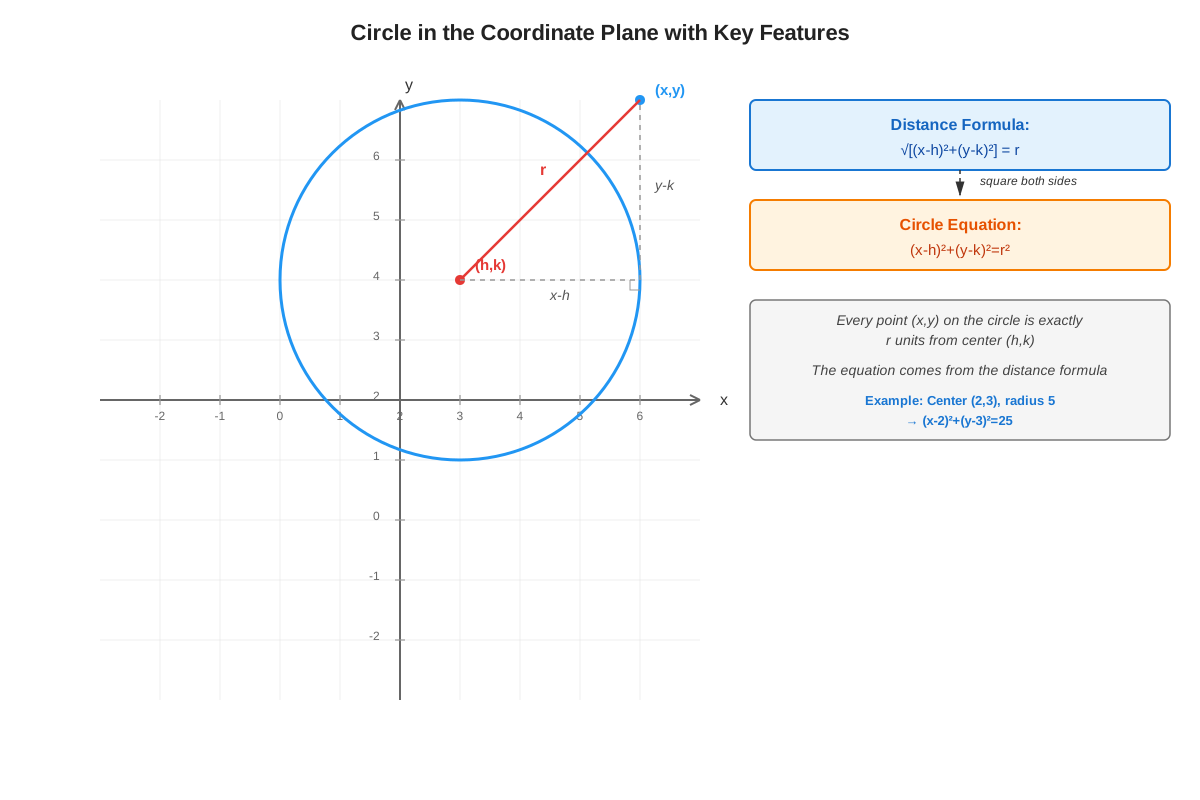
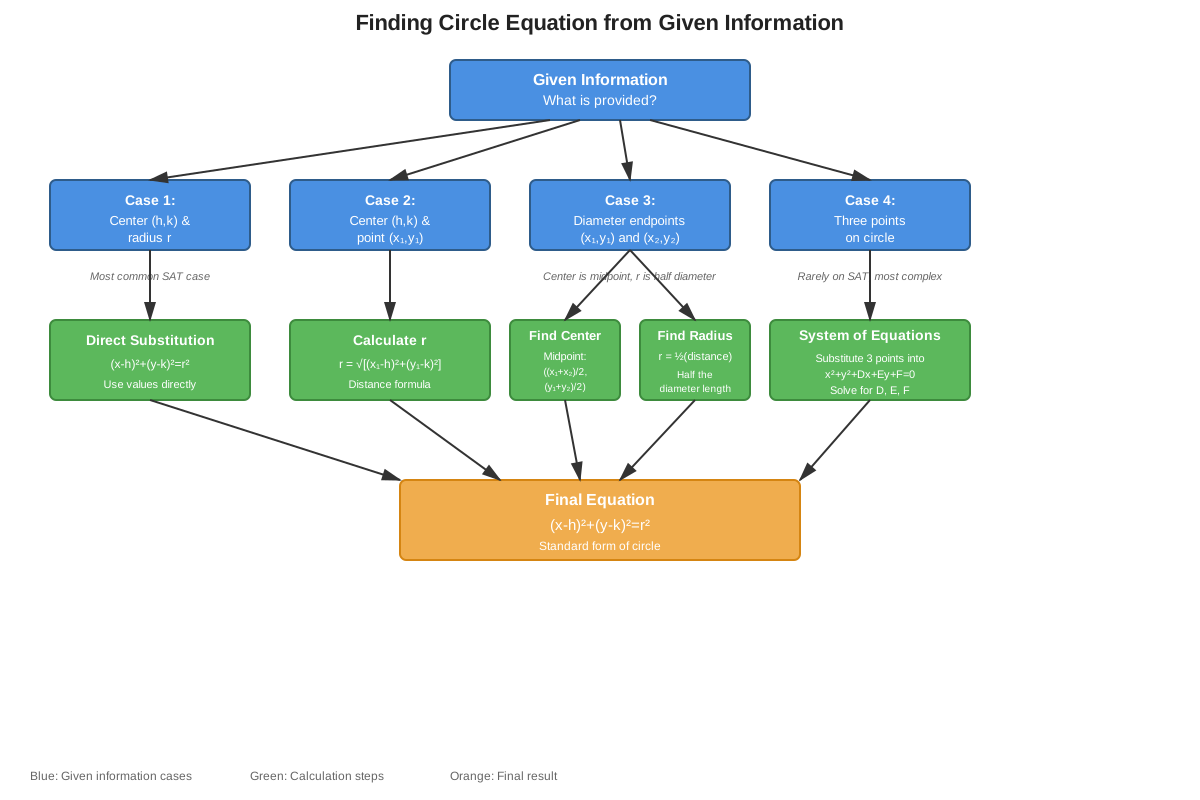
When given geometric information, use the distance formula to create the circle equation. If a circle has center (h, k) and a point (x, y) lies on the circle at distance r from the center:
√[(x - h)² + (y - k)²] = rSquaring both sides gives the standard form. Common SAT scenarios include:
- Given center and radius: Directly substitute into standard form
- Given diameter endpoints: Find the center using the midpoint formula, then calculate radius as half the distance between endpoints
- Given center and a point on the circle: Use the distance formula to find radius, then write the equation
Point-Circle Relationships
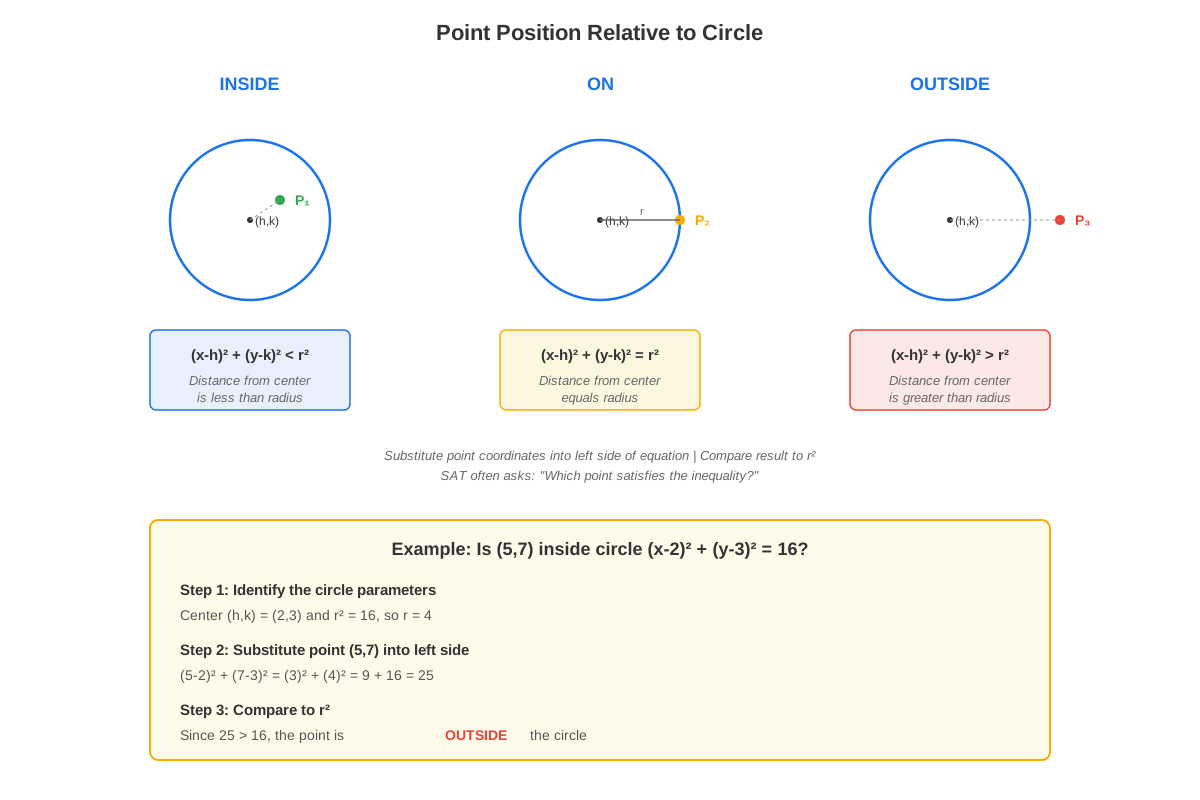
To determine whether a point (x₀, y₀) lies inside, on, or outside a circle with center (h, k) and radius r, calculate the distance d from the point to the center:
| Relationship | Condition | Interpretation |
|---|---|---|
| Point on circle | d = r | Distance equals radius |
| Point inside circle | d < r | Distance less than radius |
| Point outside circle | d > r | Distance greater than radius |
Algebraically, substitute the point's coordinates into the left side of the standard form equation and compare to r²:
- If (x₀ - h)² + (y₀ - k)² = r², the point is on the circle
- If (x₀ - h)² + (y₀ - k)² < r², the point is inside the circle
- If (x₀ - h)² + (y₀ - k)² > r², the point is outside the circle
Circle-Line Intersections
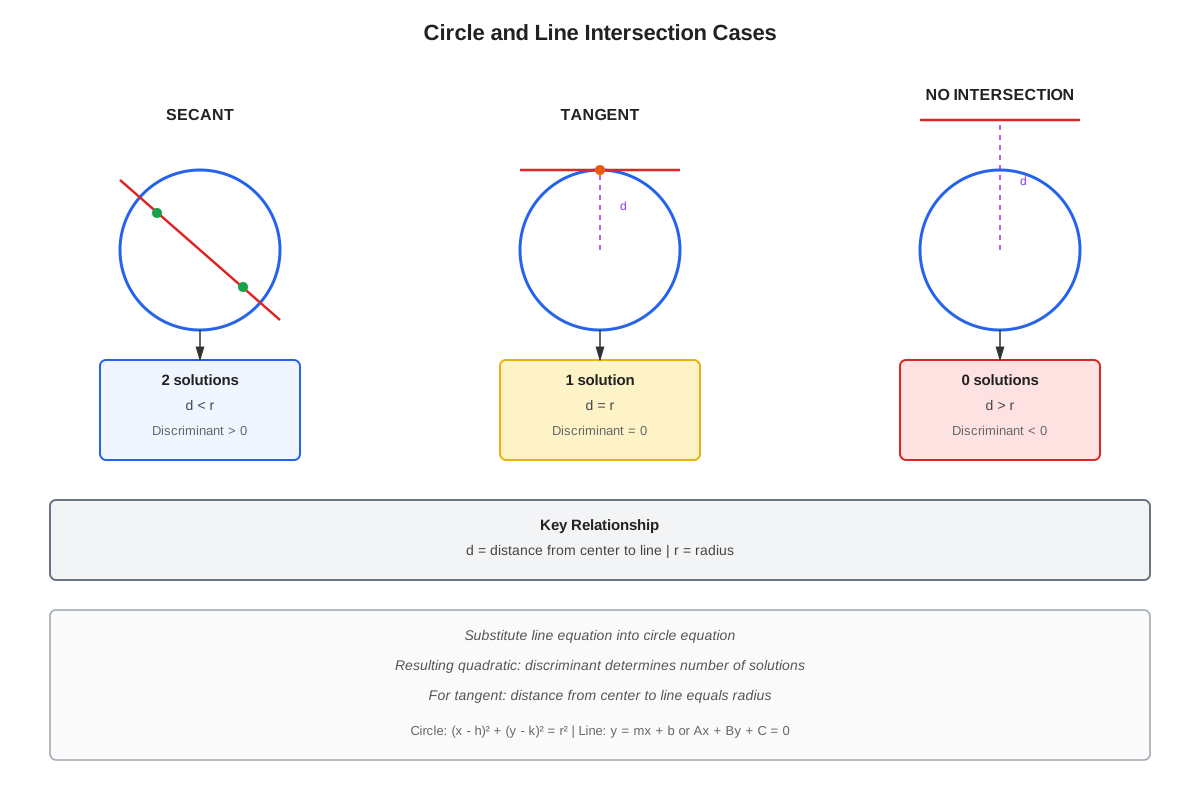
When a line intersects a circle, three scenarios are possible:
- Two intersection points (secant line): The line passes through the circle
- One intersection point (tangent line): The line touches the circle at exactly one point
- No intersection points: The line misses the circle entirely
To find intersection points algebraically, solve the system of equations by substituting the linear equation into the circle equation, resulting in a quadratic equation. The discriminant of this quadratic reveals the number of intersections:
- Discriminant > 0: Two intersection points
- Discriminant = 0: One intersection point (tangent)
- Discriminant < 0: No intersection points
Special Circle Cases
Circles centered at the origin have the simplified equation:
x² + y² = r²This special case appears frequently on the SAT because it simplifies calculations and allows for quick mental math. For example, x² + y² = 36 represents a circle centered at (0, 0) with radius 6.
Unit circles have radius 1 and equation x² + y² = 1, though these appear less frequently on the SAT compared to other standardized tests.
Concept Relationships
The foundation of coordinate circles begins with the distance formula, which directly generates the standard form equation by expressing that all points on a circle maintain constant distance (radius) from the center. This geometric definition → algebraic equation relationship is fundamental to understanding why the circle equation takes its particular form.
Completing the square serves as the bridge between general form and standard form, connecting algebraic manipulation skills to geometric interpretation. Without this technique, students cannot efficiently extract center and radius information from expanded equations, making it an essential prerequisite skill that enables circle analysis.
The relationship flows: Pythagorean theorem → distance formula → circle equation → geometric applications. Each concept builds upon the previous, with the Pythagorean theorem providing the underlying principle that distance in the coordinate plane follows the formula √[(x₂-x₁)² + (y₂-y₁)²].
Systems of equations connect to coordinate circles when finding intersections with lines or other circles. This relationship extends circle problems into multi-step problem-solving scenarios: circle equation + line equation → substitution → quadratic equation → solution interpretation.
Midpoint formula relates to circles when working with diameters, as the center of a circle is the midpoint of any diameter. This connection frequently appears in SAT problems that provide diameter endpoints rather than direct center coordinates.
The broader relationship map: Basic algebra → Coordinate geometry → Distance and midpoint → Circle equations → Systems and intersections → Optimization and area problems. Each level adds complexity while building on previous understanding.
High-Yield Facts
⭐ The standard form of a circle equation is (x - h)² + (y - k)² = r², where (h, k) is the center and r is the radius
⭐ In standard form, the signs of h and k are opposite to what appears in the equation: (x - 3) means h = 3, while (y + 2) means k = -2
⭐ To convert general form to standard form, complete the square for both x and y terms separately
⭐ A point (x₀, y₀) lies on a circle if substituting its coordinates into the equation makes the equation true
⭐ The radius of a circle can be found by taking the square root of the constant on the right side of the standard form equation
- In general form x² + y² + Dx + Ey + F = 0, the center is at (-D/2, -E/2)
- A circle equation must have equal coefficients for x² and y² terms (typically both equal to 1)
- The distance from the center to any point on the circle always equals the radius
- When a diameter's endpoints are given, the center is their midpoint and the radius is half the distance between them
- A line is tangent to a circle if the distance from the center to the line equals the radius
- The equation x² + y² = r² represents a circle centered at the origin with radius r
- To find circle-line intersections, substitute the linear equation into the circle equation and solve the resulting quadratic
- A circle with center (h, k) passing through point (a, b) has radius r = √[(a-h)² + (b-k)²]
Quick check — test yourself on Coordinate circles so far.
Try Flashcards →Common Misconceptions
Misconception: The center of the circle (x - 3)² + (y - 4)² = 16 is at (-3, -4).
Correction: The center is at (3, 4). The signs in the equation are opposite to the actual coordinates because the standard form is (x - h)² + (y - k)² = r². If you see (x - 3), then h = 3; if you see (y - 4), then k = 4.
Misconception: The radius of (x - 2)² + (y + 1)² = 9 is 9.
Correction: The radius is 3, not 9. The number on the right side of the equation represents r², not r. Always take the square root to find the actual radius: r = √9 = 3.
Misconception: Any equation with x² and y² terms represents a circle.
Correction: For an equation to represent a circle, the coefficients of x² and y² must be equal and have the same sign (typically both positive). The equation 2x² + 3y² = 12 represents an ellipse, not a circle, because the coefficients differ.
Misconception: When completing the square for x² - 6x, add 6 to both sides.
Correction: Add (6/2)² = 9 to both sides, not 6. The value to add is always (coefficient of linear term ÷ 2)², which creates a perfect square trinomial.
Misconception: If a point satisfies the circle equation, it must be the center.
Correction: If a point's coordinates satisfy the equation, the point lies ON the circle, not at the center. The center coordinates come from the values of h and k in standard form, and the center actually does NOT satisfy its own circle equation (unless the radius is zero, which isn't a true circle).
Misconception: A circle with equation x² + y² - 4x + 6y + 9 = 0 has radius √9 = 3.
Correction: You cannot determine the radius until converting to standard form. After completing the square, this equation becomes (x - 2)² + (y + 3)² = 4, giving radius 2, not 3. The constant in general form does not directly indicate the radius.
Misconception: Two circles intersect if their equations can be solved simultaneously.
Correction: Two circles may intersect at two points, one point (tangent), or no points. The ability to solve the system algebraically doesn't guarantee real intersection points—you must check whether the solutions are real numbers and interpret the geometric meaning.
Worked Examples
Example 1: Converting General Form to Standard Form and Identifying Features
Problem: A circle has equation x² + y² + 8x - 6y + 9 = 0. What is the center of the circle, and what is its radius?
Solution:
Step 1: Group x-terms and y-terms, move constant to the right side
- (x² + 8x) + (y² - 6y) = -9
Step 2: Complete the square for x-terms
- Coefficient of x is 8, so add (8/2)² = 16 to both sides
- (x² + 8x + 16) + (y² - 6y) = -9 + 16
Step 3: Complete the square for y-terms
- Coefficient of y is -6, so add (-6/2)² = 9 to both sides
- (x² + 8x + 16) + (y² - 6y + 9) = -9 + 16 + 9
Step 4: Factor perfect square trinomials and simplify
- (x + 4)² + (y - 3)² = 16
Step 5: Identify center and radius
- Standard form is (x - h)² + (y - k)² = r²
- Comparing: (x - (-4))² + (y - 3)² = 4²
- Center: (-4, 3)
- Radius: 4
Answer: The center is at (-4, 3) and the radius is 4.
This problem directly addresses the learning objective of identifying key features from equations and demonstrates the essential skill of converting between forms—one of the most common SAT question types for coordinate circles.
Example 2: Writing a Circle Equation from Geometric Information
Problem: A circle passes through the point (7, 3) and has its center at (3, 0). Write the equation of the circle in standard form. Then determine whether the point (6, 4) lies inside, on, or outside the circle.
Solution:
Step 1: Find the radius using the distance formula
- The radius is the distance from center (3, 0) to point (7, 3)
- r = √[(7-3)² + (3-0)²]
- r = √[4² + 3²]
- r = √[16 + 9]
- r = √25 = 5
Step 2: Write the equation in standard form
- Center (h, k) = (3, 0), radius r = 5
- (x - 3)² + (y - 0)² = 5²
- (x - 3)² + y² = 25
Step 3: Test whether point (6, 4) lies on, inside, or outside the circle
- Substitute (6, 4) into the left side of the equation
- (6 - 3)² + 4² = 3² + 16 = 9 + 16 = 25
- Since 25 = 25 (equals r²), the point lies ON the circle
Answer: The equation is (x - 3)² + y² = 25, and the point (6, 4) lies on the circle.
This example demonstrates applying coordinate circles to construct equations from geometric information and using algebraic methods to determine point-circle relationships—both high-yield SAT skills that appear frequently in medium-to-hard difficulty questions.
Exam Strategy
When approaching SAT questions on coordinate circles, immediately identify whether the equation is in standard or general form. If in general form, quickly assess whether you need to convert to standard form or whether the question can be answered without conversion. The SAT occasionally asks questions that can be solved more efficiently without full conversion, such as identifying that an equation represents a circle (equal coefficients of x² and y²) without finding the exact center.
Trigger words and phrases to watch for include:
- "center of the circle" → extract h and k from standard form
- "radius of the circle" → take the square root of r²
- "passes through" → use the distance formula or substitute coordinates
- "tangent to" → distance from center to line equals radius
- "intersects at" → solve system of equations
- "lies on the circle" → substitute and verify the equation is satisfied
For process of elimination, use these strategies:
- Eliminate answer choices where the center coordinates have incorrect signs (remember the sign flip in standard form)
- Eliminate radius values that aren't the square root of the constant term
- For point-location questions, eliminate answers that contradict a quick distance estimate
- When multiple equations are given, eliminate those with unequal coefficients for x² and y² (these aren't circles)
Time allocation: Standard circle identification questions should take 30-45 seconds. Conversion problems requiring completing the square should take 60-90 seconds. Complex problems involving intersections or systems may require 2-3 minutes. If a problem requires extensive algebraic manipulation and you're running short on time, mark it for review and move forward—circle problems often appear in clusters, and easier ones may follow.
Use the calculator strategically: While completing the square is typically faster by hand, use the calculator to verify arithmetic when computing distances, checking whether points satisfy equations, or evaluating discriminants for intersection problems. The calculator can also help visualize circles by graphing, though this is usually slower than algebraic methods.
Common SAT tricks to anticipate:
- Presenting circles in general form when standard form would make the problem trivial
- Using negative coordinates or negative signs in equations to test sign-flip understanding
- Asking for diameter instead of radius (or vice versa) to catch students who don't read carefully
- Providing excess information to test whether students can identify relevant data
- Embedding circle problems in word problems with real-world contexts requiring equation setup
Memory Techniques
Mnemonic for Standard Form: "Happy Kids Run" reminds you that standard form is (x - H)² + (y - K)² = R², with H and K representing the center coordinates and R the radius.
Sign Flip Memory Aid: Think "Opposite Day" when reading center coordinates from standard form. If you see minus in the equation, the coordinate is plus; if you see plus (or minus with a negative), the coordinate is minus. Visualize the equation as (x - h) meaning "x minus h," so h must be positive to make this work.
Completing the Square Acronym: "HALF-SQUARE-ADD"
- HALF: Take half of the linear coefficient
- SQUARE: Square that result
- ADD: Add to both sides of the equation
Visualization Strategy: When working with circles, quickly sketch a rough coordinate plane and plot the center. This visual reference helps verify that your algebraic answer makes geometric sense. If the problem states the circle is in the first quadrant but your center is at (-3, -5), you know something went wrong.
Radius vs. r² Memory: Remember "Square to Compare"—the equation uses r² (squared), but the radius itself is r (not squared). Always take the square root of the right side to find the actual radius distance.
Point Testing Shortcut: "Substitute and Compare"—substitute the point's coordinates into the left side of the standard form equation, then compare the result to r². Less than r² means inside, equal means on, greater means outside. Think of it as a number line: smaller values are "inside," the exact value is "on the boundary," and larger values are "outside."
Summary
Coordinate circles represent a high-yield SAT math topic that combines algebraic manipulation with geometric reasoning. The standard form equation (x - h)² + (y - k)² = r² directly reveals the center (h, k) and radius r, while the general form x² + y² + Dx + Ey + F = 0 requires completing the square for conversion. Success on SAT circle problems depends on recognizing the sign flip in standard form (the center coordinates are opposite to the signs appearing in the equation), efficiently converting between forms, and applying the distance formula to derive equations from geometric information. Students must be able to determine point-circle relationships by substituting coordinates and comparing to r², find intersection points by solving systems of equations, and interpret circle equations in real-world contexts. The most common SAT question types involve identifying centers and radii, writing equations from given information, and determining whether points lie inside, on, or outside circles. Mastery requires both computational accuracy in completing the square and conceptual understanding of how algebraic equations represent geometric objects in the coordinate plane.
Key Takeaways
- The standard form (x - h)² + (y - k)² = r² immediately reveals center (h, k) and radius r, with signs opposite to what appears in the equation
- Converting general form to standard form requires completing the square for both x and y terms separately
- The radius is the square root of the constant on the right side of standard form, not the constant itself
- A point lies on a circle if substituting its coordinates makes the equation true; inside if the result is less than r²; outside if greater than r²
- Circle equations must have equal coefficients for x² and y² terms to represent true circles
- Use the distance formula to find radius when given center and a point on the circle, or to write equations from geometric information
- SAT circle problems frequently test the ability to extract information from equations, convert between forms, and apply circles in real-world contexts
Related Topics
Systems of Equations with Circles: Building on coordinate circles, this topic explores finding intersection points between circles and lines or between two circles, requiring substitution and solving quadratic equations. Mastering coordinate circles provides the foundation for these more complex multi-step problems.
Tangent Lines to Circles: This advanced topic uses coordinate circles as a foundation to find equations of lines tangent to circles at specific points, involving perpendicular slopes and the relationship between radius and tangent lines.
Conic Sections: Circles represent one type of conic section, and understanding coordinate circles prepares students for studying ellipses, parabolas, and hyperbolas in advanced mathematics courses.
Geometric Transformations: Coordinate circles serve as excellent examples for studying translations, reflections, and dilations in the coordinate plane, as these transformations affect the center and radius in predictable ways.
Optimization Problems: Many SAT word problems involve finding maximum or minimum distances related to circles, building directly on the point-circle relationship concepts covered in this topic.
Practice CTA
Now that you've mastered the core concepts of coordinate circles, it's time to solidify your understanding through practice! Attempt the practice questions to test your ability to identify circle features, convert between forms, and solve SAT-style problems. Use the flashcards to reinforce key formulas and relationships until they become automatic. Remember, coordinate circles appear on every SAT, and the time you invest in practice now will translate directly into points on test day. Each problem you solve builds the pattern recognition and problem-solving speed that separates good scores from great ones. You've got this!
Sign up free to keep reading
Create a free AnvayaPrep account to finish this SAT guide on Coordinate circles — plus flashcards and practice questions.