Overview
The tangent function is one of the three fundamental trigonometric ratios that appears consistently on the SAT math section, particularly within problems involving right triangles, angles, and geometric relationships. Understanding tangent is essential for solving a variety of geometry and trigonometry questions that test spatial reasoning and the ability to connect angle measures with side lengths. On the SAT, tangent problems often appear in contexts requiring students to find missing side lengths, determine angle measures, or apply trigonometric relationships to real-world scenarios such as ramps, shadows, and architectural designs.
Mastering the tangent ratio provides students with a powerful tool for analyzing right triangles beyond the basic Pythagorean theorem. While the Pythagorean theorem relates the three sides of a right triangle to each other, tangent specifically connects an acute angle to the ratio of two particular sides. This relationship becomes especially valuable when angle information is provided or when the problem requires finding an angle from known side lengths. The tangent function bridges pure geometry with trigonometry, making it a high-yield topic that frequently appears in medium-to-difficult SAT questions.
The tangent ratio is intrinsically connected to other mathematical concepts tested on the SAT, including similar triangles, the unit circle, complementary angles, and the other trigonometric ratios (sine and cosine). Understanding how tangent relates to these broader concepts enables students to approach complex multi-step problems with confidence and select the most efficient solution pathway. Given that the SAT typically includes 2-4 questions directly or indirectly involving trigonometric ratios, and that tangent is among the most commonly tested of these ratios, dedicating focused study time to this topic yields significant score improvements.
Learning Objectives
- [ ] Identify key features of tangent, including its definition as the ratio of opposite to adjacent sides in a right triangle
- [ ] Explain how tangent appears on the SAT in various question formats and contexts
- [ ] Apply tangent to answer SAT-style questions involving right triangles and angle relationships
- [ ] Calculate tangent values for common angles (30°, 45°, 60°) without a calculator
- [ ] Use inverse tangent (arctan) to find angle measures when side lengths are known
- [ ] Recognize when tangent is the most efficient approach compared to other trigonometric ratios or geometric methods
Prerequisites
- Right triangle properties: Understanding that right triangles contain one 90° angle and that the sum of the other two angles equals 90° is fundamental to applying tangent correctly
- Basic angle measurement: Familiarity with degrees as units of angle measurement enables interpretation of tangent problems and verification of answers
- Ratio and proportion concepts: Since tangent is defined as a ratio, comfort with comparing quantities proportionally is essential for setup and calculation
- Special right triangles (30-60-90 and 45-45-90): Knowledge of these triangles provides quick reference points for common tangent values
- Calculator proficiency: Knowing how to use the TAN and TAN⁻¹ functions on an approved calculator ensures accurate computation during the exam
Why This Topic Matters
In real-world applications, the tangent function appears whenever professionals need to relate angles to distances or heights. Engineers use tangent to calculate slopes and grades of roads, architects apply it to determine roof pitches and staircase angles, surveyors employ it to measure inaccessible heights and distances, and navigation systems utilize it for determining bearings and trajectories. Understanding tangent provides practical problem-solving skills that extend far beyond the classroom, making it one of the most applicable mathematical concepts students will encounter.
On the SAT, tangent-related questions appear with notable frequency, typically comprising 1-3 questions per test administration. These questions most commonly appear in the calculator-permitted section, though basic tangent relationships may also appear in the no-calculator section when special angle values are involved. The College Board consistently includes tangent in questions testing students' ability to model real-world situations mathematically, particularly in word problems involving angles of elevation, angles of depression, and indirect measurement scenarios.
Tangent questions on the SAT typically manifest in several predictable formats: direct calculation problems where students must find a missing side using a given angle, inverse problems requiring angle determination from known sides, application problems embedded in real-world contexts (such as finding the height of a building from a distance and angle), and multi-step problems combining tangent with other geometric concepts. Recognizing these patterns enables strategic preparation and efficient problem-solving during the actual exam.
Core Concepts
Definition of Tangent
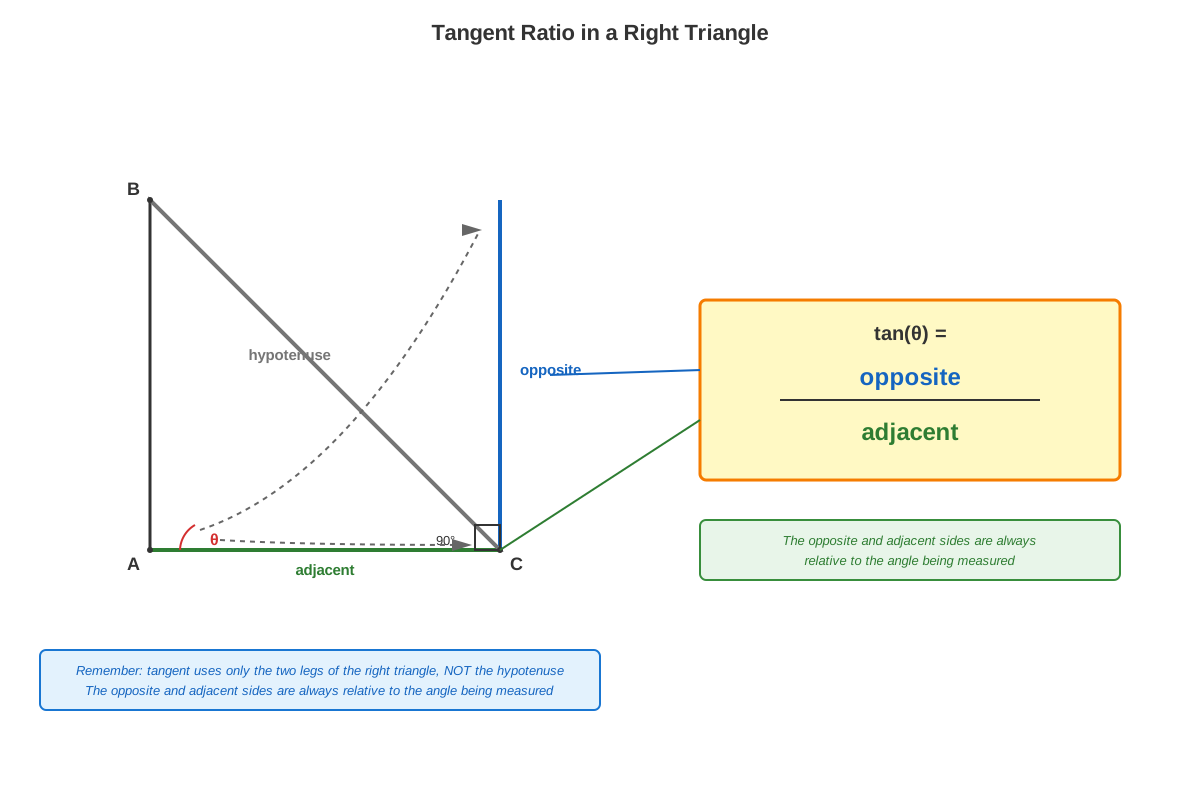
The tangent of an acute angle in a right triangle is defined as the ratio of the length of the side opposite the angle to the length of the side adjacent to the angle. This can be expressed as:
tan(θ) = opposite/adjacentWhere θ (theta) represents the angle measure. This definition is fundamental and must be memorized precisely, as confusing which side is opposite versus adjacent is one of the most common errors students make. The opposite side is the leg of the right triangle that does not touch the angle in question (excluding the hypotenuse), while the adjacent side is the leg that forms one side of the angle along with the hypotenuse.
To identify these sides correctly, students should follow this systematic approach:
- Locate the right angle (90°) in the triangle
- Identify the angle of interest (the angle for which you're finding or using the tangent)
- The side across from the angle of interest is the opposite side
- The side that touches the angle of interest (but is not the hypotenuse) is the adjacent side
- The hypotenuse is never used in the tangent ratio
The SOH-CAH-TOA Mnemonic
The most widely used memory device for trigonometric ratios is SOH-CAH-TOA, where the "TOA" portion specifically relates to tangent:
- Tangent
- Opposite
- Adjacent
This mnemonic reminds students that tangent equals opposite over adjacent. While this may seem simplistic, it provides a reliable reference point during high-pressure testing situations when precise recall is essential.
Tangent Values for Common Angles
Certain angle measures appear repeatedly on the SAT, and memorizing their tangent values enables rapid problem-solving without calculator dependence:
| Angle | Tangent Value | Exact Form | Decimal Approximation |
|---|---|---|---|
| 0° | 0 | 0 | 0 |
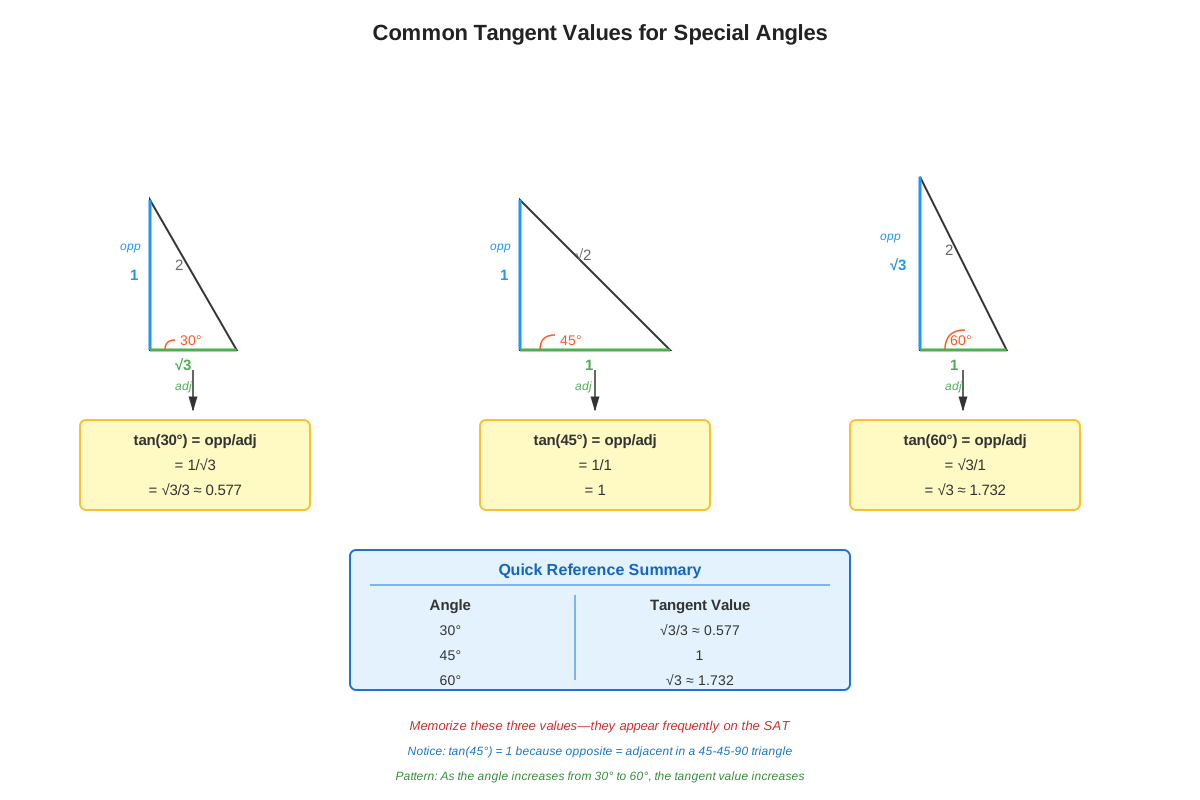
| 30° | √3/3 | 1/√3 | 0.577 |
| 45° | 1 | 1 | 1 |
| 60° | √3 | √3 | 1.732 |
| 90° | undefined | undefined | undefined |
These values derive from the special right triangles. In a 45-45-90 triangle, the two legs are equal, so the ratio of opposite to adjacent equals 1. In a 30-60-90 triangle, the sides are in the ratio 1:√3:2, which produces the tangent values shown above depending on which acute angle is considered.
Inverse Tangent (Arctangent)
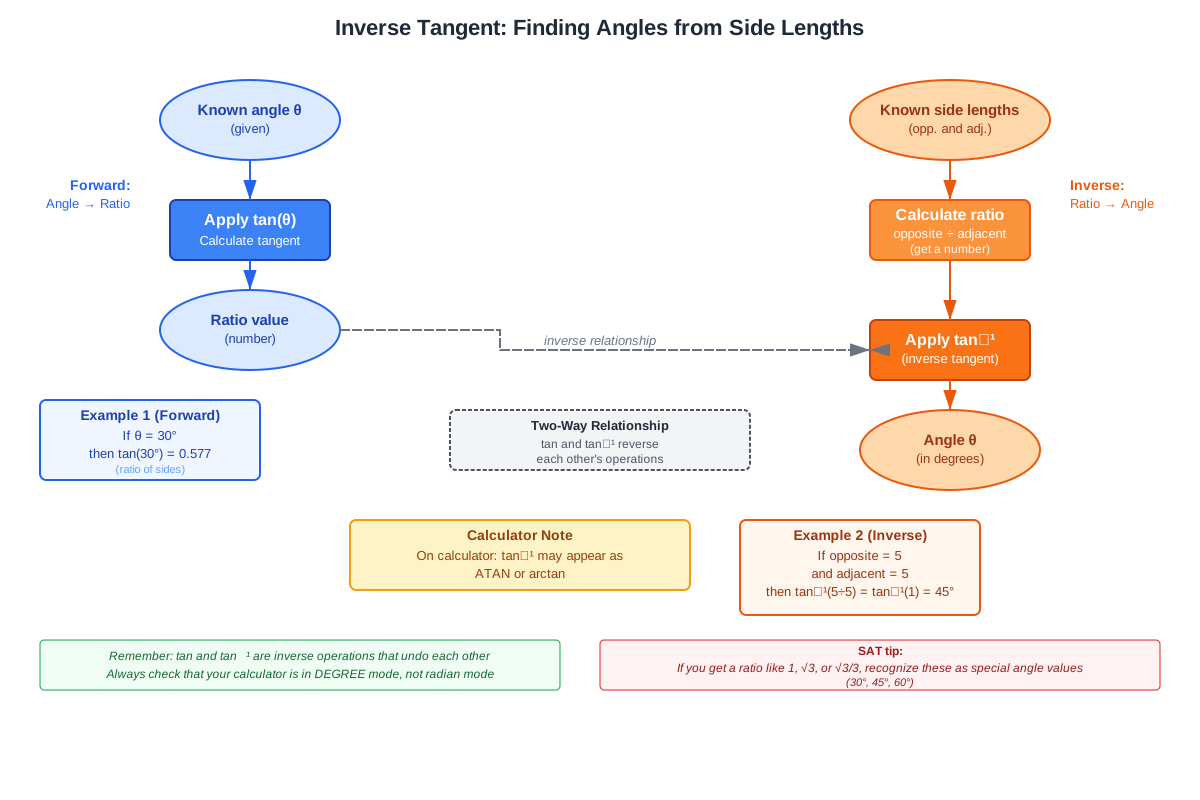
When a problem provides the lengths of the opposite and adjacent sides and asks for the angle measure, students must use the inverse tangent function, denoted as tan⁻¹ or arctan. This function answers the question: "What angle has this tangent value?"
If tan(θ) = x, then θ = tan⁻¹(x)On calculators, this function is typically accessed by pressing a "2nd" or "shift" key followed by the TAN button. Students must ensure their calculator is in degree mode (not radian mode) for SAT problems, as the exam uses degrees exclusively unless otherwise specified.
Tangent in Application Problems
The SAT frequently embeds tangent in real-world scenarios, most commonly:
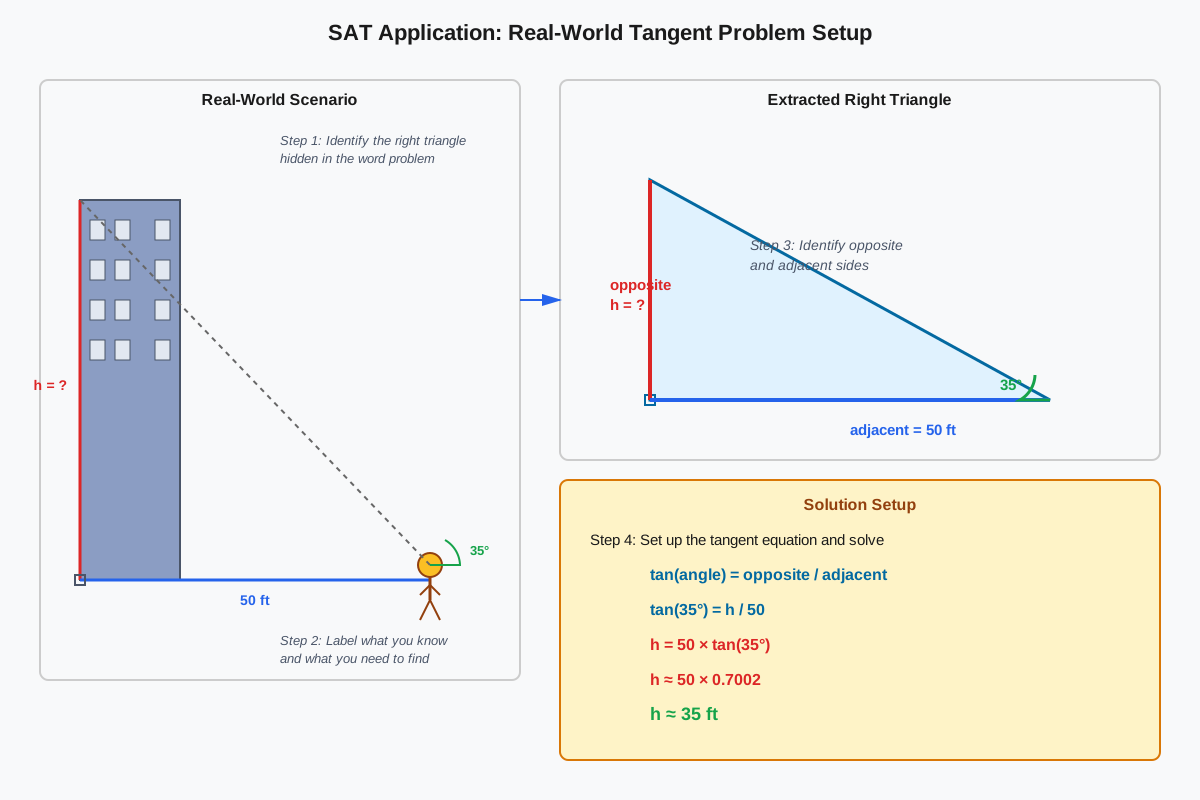
Angle of Elevation: The angle formed between a horizontal line and the line of sight when looking upward at an object. For example, standing 50 feet from a building and looking up at the top creates an angle of elevation from the observer's position.
Angle of Depression: The angle formed between a horizontal line and the line of sight when looking downward at an object. This angle is measured from the horizontal down to the object.
Slope and Grade: The tangent of an angle represents the slope of a line or surface. A road with a 10% grade has a tangent value of 0.10, meaning it rises 10 units for every 100 units of horizontal distance.
In these contexts, students must translate the word problem into a right triangle diagram, identify which sides are known or unknown, determine the relevant angle, and apply the tangent ratio appropriately.
Relationship Between Complementary Angles
In a right triangle, the two acute angles are complementary (they sum to 90°). An important property of tangent is that:
tan(θ) = 1/tan(90° - θ)This means the tangent of an angle equals the reciprocal of the tangent of its complement. More specifically, tan(30°) and tan(60°) are reciprocals, which can be verified from the table above: tan(30°) = √3/3 and tan(60°) = √3, and indeed √3 × (√3/3) = 1.
Tangent and Similar Triangles
Because tangent is defined as a ratio, all right triangles with the same acute angle have the same tangent value, regardless of their size. This property connects tangent to the concept of similar triangles: if two right triangles share an acute angle, they are similar, and the ratio of corresponding sides (which equals the tangent) remains constant. This principle allows tangent to be used for indirect measurement and scaling problems.
Concept Relationships
The tangent function exists within a network of interconnected mathematical concepts. At its foundation, tangent builds directly upon right triangle properties, specifically requiring the presence of a 90° angle to define opposite and adjacent sides meaningfully. The tangent ratio connects to proportional reasoning, as it expresses a constant relationship between two sides regardless of triangle size, which links it to similar triangles.
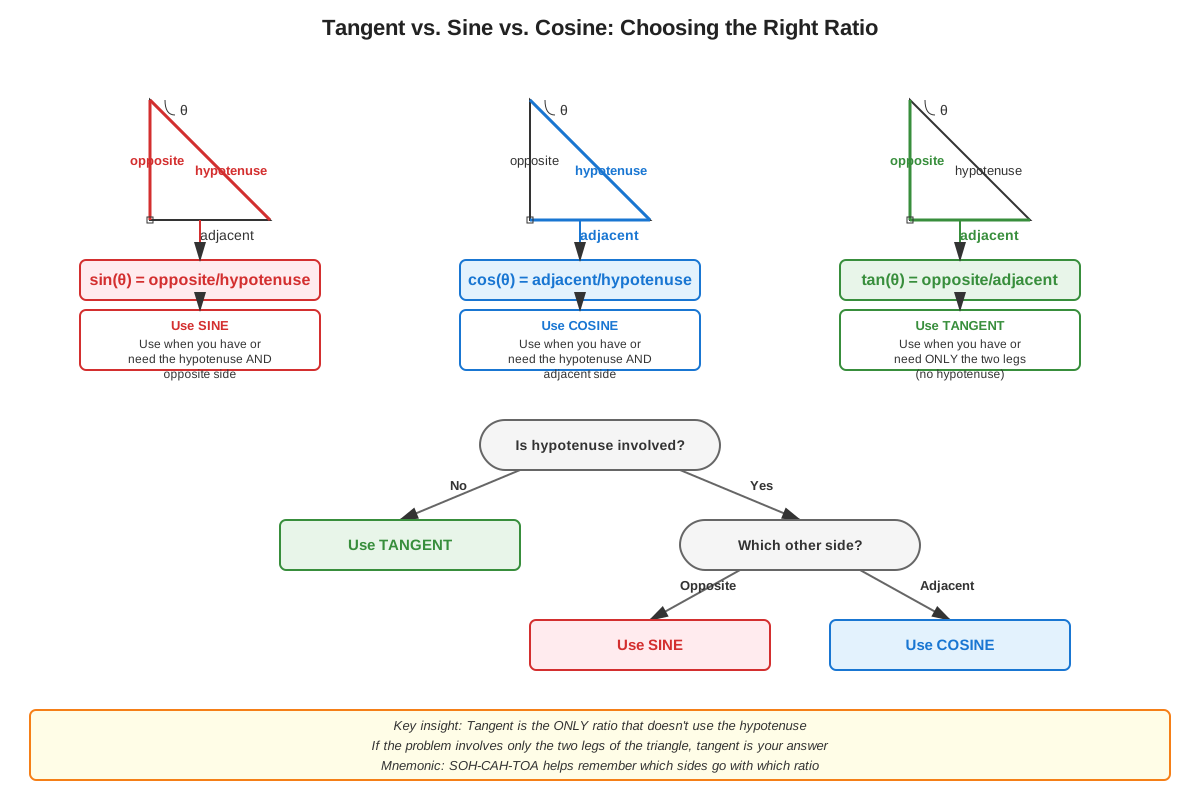
Tangent relates horizontally to the other trigonometric ratios: sine (opposite/hypotenuse) and cosine (adjacent/hypotenuse). In fact, tangent can be expressed as tan(θ) = sin(θ)/cos(θ), demonstrating that these three ratios are mathematically interdependent. Understanding this relationship helps students verify answers and choose the most efficient approach when multiple methods are available.
The concept flow can be visualized as: Angle Measurement → Right Triangle Identification → Side Classification (opposite/adjacent/hypotenuse) → Tangent Ratio Application → Solution (either side length or angle measure). For inverse problems, the flow reverses: Known Side Lengths → Ratio Calculation → Inverse Tangent Application → Angle Determination.
Tangent also connects forward to more advanced topics including the unit circle, where tangent represents the y-coordinate divided by the x-coordinate of a point on the circle, and graphing trigonometric functions, where the tangent function produces a periodic curve with vertical asymptotes. While these advanced topics rarely appear explicitly on the SAT, understanding these connections deepens conceptual mastery.
Quick check — test yourself on Tangent so far.
Try Flashcards →High-Yield Facts
⭐ Tangent is defined as opposite/adjacent in a right triangle, never involving the hypotenuse
⭐ tan(45°) = 1, which means in a 45-45-90 triangle, the two legs are equal
⭐ tan(30°) = √3/3 ≈ 0.577 and tan(60°) = √3 ≈ 1.732
⭐ To find an angle when sides are known, use inverse tangent: θ = tan⁻¹(opposite/adjacent)
⭐ Tangent is undefined at 90° because the adjacent side would be zero, creating division by zero
- The tangent of an angle increases as the angle increases from 0° to 90°
- Tangent values can be greater than 1, unlike sine and cosine which are always between -1 and 1
- In application problems, "angle of elevation" and "angle of depression" are key phrases indicating tangent usage
- Complementary angles in a right triangle have tangent values that are reciprocals of each other
- When a calculator is not permitted, the problem will involve special angles (30°, 45°, 60°) with known tangent values
- The tangent ratio remains constant for all similar right triangles with the same acute angle
- Slope of a line equals the tangent of the angle the line makes with the horizontal axis
Common Misconceptions
Misconception: Tangent always involves the hypotenuse in its calculation.
Correction: Tangent is the only basic trigonometric ratio that does not use the hypotenuse; it exclusively uses the two legs of the right triangle (opposite and adjacent sides).
Misconception: The opposite and adjacent sides are fixed for a given triangle.
Correction: Which side is "opposite" and which is "adjacent" depends entirely on which angle you are considering. The same side can be opposite to one acute angle and adjacent to the other acute angle in the same triangle.
Misconception: tan(30°) = 0.5 because 30° is half of 60°.
Correction: Tangent is not a linear function. tan(30°) = √3/3 ≈ 0.577, not 0.5. Trigonometric values do not scale proportionally with angles.
Misconception: When using inverse tangent, any calculator result is correct.
Correction: Calculators must be in degree mode for SAT problems. If in radian mode, the calculator will return values like 0.785 instead of 45, leading to incorrect answers.
Misconception: Tangent can only be used when an angle is explicitly given.
Correction: Tangent is equally useful when finding angles from known side lengths using inverse tangent, making it bidirectional in application.
Misconception: The tangent of an angle is always less than 1.
Correction: Tangent values exceed 1 for all angles greater than 45° (up to 90°). For example, tan(60°) = √3 ≈ 1.732.
Misconception: In word problems, the "height" is always the opposite side.
Correction: Whether height is opposite or adjacent depends on the angle being used. Students must draw a diagram and identify sides relative to the specific angle in question.
Worked Examples
Example 1: Finding a Side Length Using Tangent
Problem: A ladder leans against a wall, forming a 65° angle with the ground. If the base of the ladder is 8 feet from the wall, how high up the wall does the ladder reach? Round to the nearest tenth of a foot.
Solution:
Step 1: Draw and label a diagram. The situation forms a right triangle where:
- The ground distance (8 feet) is one leg
- The height up the wall is the other leg (unknown)
- The angle between the ladder and ground is 65°
Step 2: Identify which side is opposite and which is adjacent to the 65° angle.
- The height up the wall is opposite the 65° angle
- The ground distance (8 feet) is adjacent to the 65° angle
Step 3: Set up the tangent ratio:
tan(65°) = opposite/adjacent = height/8Step 4: Solve for height:
height = 8 × tan(65°)Step 5: Calculate using a calculator (in degree mode):
height = 8 × 2.1445 ≈ 17.2 feetAnswer: The ladder reaches approximately 17.2 feet up the wall.
Connection to Learning Objectives: This problem demonstrates applying tangent to answer SAT-style questions by translating a real-world scenario into a mathematical model, identifying the appropriate trigonometric ratio, and executing the calculation accurately.
Example 2: Finding an Angle Using Inverse Tangent
Problem: In right triangle ABC, the right angle is at C. If side AC = 12 and side BC = 9, what is the measure of angle A to the nearest degree?
Solution:
Step 1: Draw and label the triangle. Place the right angle at C, with angle A at one vertex.
Step 2: Identify which sides are opposite and adjacent to angle A.
- Side BC (length 9) is opposite angle A because it doesn't touch angle A
- Side AC (length 12) is adjacent to angle A because it forms one side of the angle
Step 3: Calculate the tangent ratio:
tan(A) = opposite/adjacent = 9/12 = 0.75Step 4: Use inverse tangent to find the angle:
A = tan⁻¹(0.75)Step 5: Calculate using a calculator:
A = 36.87° ≈ 37°Answer: Angle A measures approximately 37°.
Verification: We can check this makes sense because angle A is less than 45° (where tangent equals 1), and our tangent value of 0.75 is indeed less than 1, confirming our answer is reasonable.
Connection to Learning Objectives: This example illustrates using inverse tangent to find angle measures when side lengths are known, a key skill for SAT problems that provide dimensions and ask for angles.
Exam Strategy
When approaching tangent questions on the SAT, begin by quickly scanning for trigger words that indicate a tangent problem: "angle of elevation," "angle of depression," "slope," "grade," "ramp," or any scenario describing a right triangle with an angle and asking about the two legs. These phrases signal that tangent is likely the most efficient approach.
Step-by-step approach for SAT tangent problems:
- Draw a diagram if one isn't provided, even if it's rough. Visual representation prevents side identification errors.
- Mark the right angle clearly with a square symbol.
- Label all known values on your diagram, including side lengths and angle measures.
- Identify the angle of interest and mark it clearly.
- Classify sides as opposite, adjacent, or hypotenuse relative to your angle.
- Determine what you're solving for: a side length (use tan(θ) = opp/adj) or an angle (use θ = tan⁻¹(opp/adj)).
- Set up the equation before reaching for your calculator.
- Calculate carefully, ensuring your calculator is in degree mode.
- Check reasonableness: Is your angle between 0° and 90°? Is your side length positive and proportional to the given information?
Process of elimination tips: When tangent problems appear in multiple-choice format, you can often eliminate answers by:
- Rejecting any angle measure greater than 90° or less than 0° for acute angles in right triangles
- Eliminating answers that would make one leg longer than the hypotenuse
- Checking whether the answer makes sense with special angle values (if the angle is close to 45°, the opposite and adjacent sides should be nearly equal)
- Verifying that steeper angles produce larger tangent values
Time allocation: Most tangent problems should take 1.5-2 minutes. If you find yourself spending more than 2.5 minutes, mark the question and return to it after completing easier problems. Don't let a single tangent problem consume excessive time, especially if it's embedded in a complex word problem.
Exam Tip: If a problem can be solved using either tangent or the Pythagorean theorem, and you know one side length and one angle, tangent is almost always faster. Reserve the Pythagorean theorem for problems involving all three sides with no angle information.
Memory Techniques
SOH-CAH-TOA Mnemonic: The classic mnemonic remains the most reliable memory tool. Specifically for tangent, remember "TOA" as "Tangent: Opposite over Adjacent." Some students find it helpful to create a sentence: "The Old Astronaut" or "Take Off Again."
Special Angle Values Visualization: Picture an equilateral triangle split in half (creating 30-60-90 triangles) and a square split diagonally (creating 45-45-90 triangles). These visual references help recall that:
- 45° creates equal legs (tan = 1)
- 30° creates a small opposite side (tan < 1)
- 60° creates a large opposite side (tan > 1)
The "Climbing Ladder" Mental Model: Visualize tangent as describing how steeply a ladder climbs. A small angle (like 30°) means a gentle climb (small tangent value), while a large angle (like 60°) means a steep climb (large tangent value). This intuitive model helps verify whether calculated values make sense.
Opposite/Adjacent Identification: Use the phrase "Opposite is Across from the angle" to remember that the opposite side doesn't touch the angle of interest (except at the right angle vertex).
Inverse Function Reminder: Think of tan⁻¹ as "un-doing" tangent. If tangent takes an angle and gives you a ratio, inverse tangent takes a ratio and gives you back the angle. This conceptual understanding prevents confusion about when to use each function.
Summary
The tangent function represents the ratio of the opposite side to the adjacent side in a right triangle, providing a powerful tool for relating angles to side lengths. Mastery of tangent requires precise understanding of how to identify opposite and adjacent sides relative to a specific angle, memorization of common angle values (especially 30°, 45°, and 60°), and fluency with both direct tangent calculations and inverse tangent applications. On the SAT, tangent appears frequently in both pure geometry problems and real-world application contexts such as angles of elevation, slopes, and indirect measurement scenarios. Success with tangent questions depends on systematic problem-solving: drawing clear diagrams, correctly classifying triangle sides, setting up ratios accurately, and executing calculations with proper calculator settings. The bidirectional nature of tangent—using angles to find sides or using sides to find angles—makes it an exceptionally versatile tool that appears across multiple question types and difficulty levels on the exam.
Key Takeaways
- Tangent equals opposite/adjacent, never involving the hypotenuse, distinguishing it from sine and cosine
- SOH-CAH-TOA provides reliable recall, with TOA specifically representing Tangent: Opposite over Adjacent
- Special angle values (tan 30° = √3/3, tan 45° = 1, tan 60° = √3) enable quick solutions without calculators
- Inverse tangent (tan⁻¹) finds angle measures when side lengths are known, requiring degree mode on calculators
- Real-world applications including angles of elevation, depression, and slope problems are high-yield SAT question types
- Diagram drawing is essential for correctly identifying opposite and adjacent sides relative to the angle of interest
- Tangent increases as angles increase from 0° to 90°, providing a reasonableness check for calculated values
Related Topics
Sine and Cosine Ratios: The other two fundamental trigonometric ratios that, together with tangent, form a complete toolkit for solving right triangle problems. Mastering tangent provides the foundation for understanding these related ratios.
Pythagorean Theorem: While tangent relates angles to sides, the Pythagorean theorem relates the three sides to each other. Combined mastery enables solving virtually any right triangle problem.
Special Right Triangles (30-60-90 and 45-45-90): These triangles provide the basis for memorized tangent values and appear frequently alongside tangent problems on the SAT.
Similar Triangles: Understanding that tangent values remain constant across similar triangles deepens conceptual understanding and enables proportion-based problem solving.
Coordinate Geometry and Slope: The tangent of an angle equals the slope of a line, connecting trigonometry to algebra and graphing concepts tested on the SAT.
Practice CTA
Now that you've mastered the core concepts of tangent, it's time to solidify your understanding through active practice. Attempt the practice questions to apply these concepts in SAT-style scenarios, and use the flashcards to reinforce key definitions and values until they become automatic. Remember, tangent problems are highly predictable on the SAT—consistent practice with the systematic approach outlined in this guide will build the confidence and speed you need to excel. Every practice problem you solve strengthens your pattern recognition and reduces the likelihood of errors on test day. You've got this!
Sign up free to keep reading
Create a free AnvayaPrep account to finish this SAT guide on Tangent — plus flashcards and practice questions.