Overview
Secants are lines that intersect a circle at exactly two distinct points, forming one of the fundamental geometric relationships tested on the SAT. Understanding secants is crucial for solving a variety of circle-related problems that appear regularly on the math section of the exam. Unlike tangent lines that touch a circle at only one point, secants cut through the circle, creating segments both inside and outside the circle that follow specific mathematical relationships.
The SAT frequently tests secant properties through questions involving angle measurements, segment lengths, and the relationships between multiple secants or between secants and other circle elements like chords and tangents. These questions often appear in the Problem Solving and Data Analysis or Geometry sections, requiring students to apply theorems about secant-secant angles, secant-tangent angles, and the power of a point theorem. Mastering secants enables students to quickly identify geometric relationships and apply the appropriate formulas to solve complex problems efficiently.
Secants connect to broader circle geometry concepts including chords, tangents, arcs, and central angles. They serve as a bridge between basic circle properties and more advanced geometric reasoning, making them essential for achieving high scores on SAT math questions. The ability to recognize secant configurations and apply their properties can mean the difference between solving a problem in under a minute or struggling through trial-and-error approaches.
Learning Objectives
- [ ] Identify key features of secants and distinguish them from other circle elements
- [ ] Explain how secants appears on the SAT and recognize common question formats
- [ ] Apply secants to answer SAT-style questions involving angles and segments
- [ ] Calculate angles formed by two secants intersecting outside a circle
- [ ] Determine segment lengths using the secant-secant power theorem
- [ ] Solve problems involving secant-tangent combinations
- [ ] Recognize and apply the relationship between secants and intercepted arcs
Prerequisites
- Basic circle terminology: Understanding terms like radius, diameter, chord, and arc is essential for identifying where secants intersect and what they create within circle diagrams
- Angle measurement: Familiarity with degrees, arc measures, and angle relationships enables calculation of angles formed by secants
- Algebraic manipulation: Solving equations with variables is necessary for applying secant theorems to find unknown lengths or angle measures
- Properties of triangles: Many secant problems involve triangles formed by secants and radii, requiring knowledge of triangle angle sums and similar triangles
Why This Topic Matters
Secants represent a high-yield topic for SAT preparation because they appear in multiple question types across the math section. According to SAT question analysis, circle geometry problems constitute approximately 5-8% of all math questions, with secants featuring prominently in these problems. Students who master secant properties can quickly solve problems that might otherwise require lengthy algebraic work or coordinate geometry approaches.
In real-world applications, secant relationships model numerous practical scenarios. Architects use secant principles when designing curved structures and calculating sight lines. Engineers apply secant concepts in optics, satellite communications, and navigation systems where lines of sight intersect circular paths. Astronomers use secant relationships to calculate planetary positions and orbital mechanics. Understanding these geometric relationships develops spatial reasoning skills valuable across STEM fields.
On the SAT, secants typically appear in three common formats: (1) questions asking for angle measures when two secants intersect outside a circle, (2) problems requiring calculation of segment lengths using the power of a point theorem, and (3) mixed problems combining secants with tangents or chords. These questions often include diagrams with some measurements provided and others to be determined, testing both geometric reasoning and algebraic problem-solving skills. The College Board frequently embeds secant problems within multi-step questions that require identifying the correct theorem before performing calculations.
Core Concepts
Definition and Basic Properties
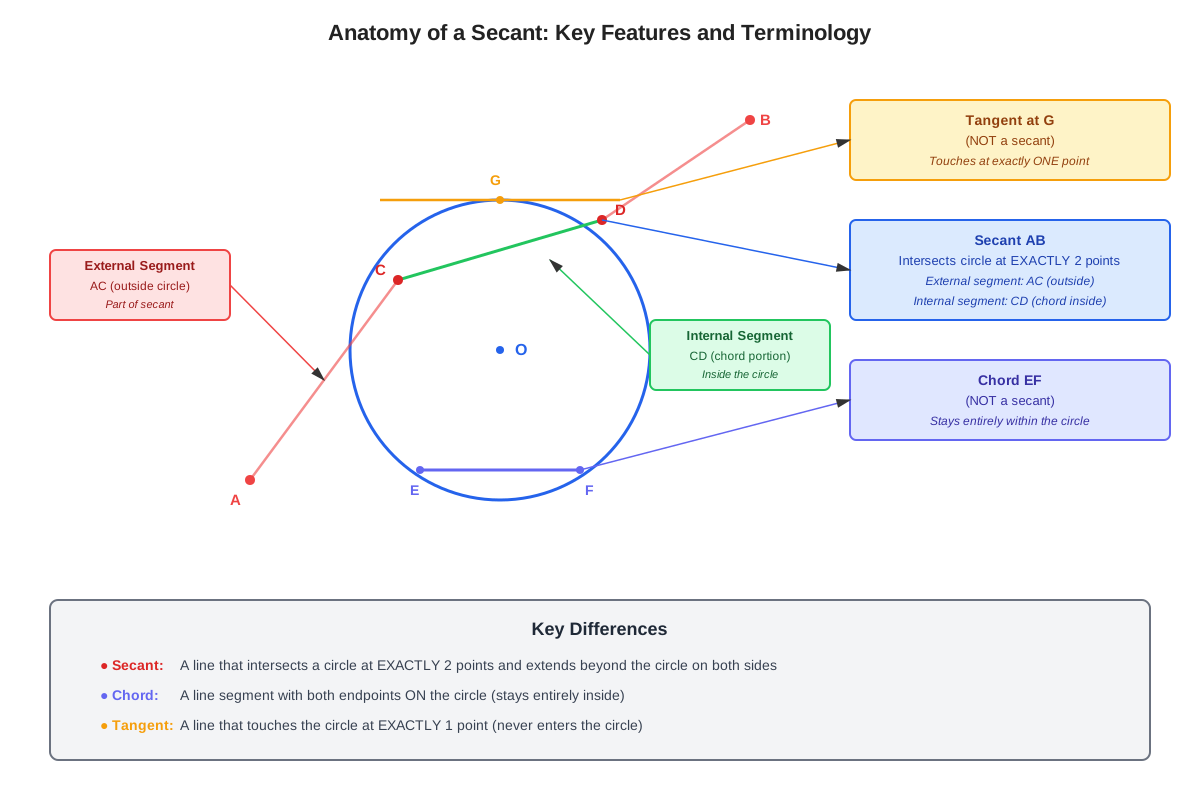
A secant is a line that intersects a circle at exactly two distinct points. Every secant can be thought of as an extension of a chord—while a chord is a line segment with both endpoints on the circle, a secant extends infinitely in both directions beyond these intersection points. The portion of a secant that lies inside the circle is actually a chord, while the portions extending outside the circle are called external segments.
When working with secants, several key components must be identified:
- Points of intersection: The two locations where the secant crosses the circle's circumference
- Internal segment: The chord portion between the two intersection points
- External segment: The portion of the secant from an external point to the nearest intersection point
- Whole segment: The entire length from an external point through both intersection points to the far end
Angles Formed by Two Secants
When two secants intersect outside a circle, they create an angle whose measure relates directly to the arcs they intercept. This relationship is one of the most frequently tested concepts on the SAT.
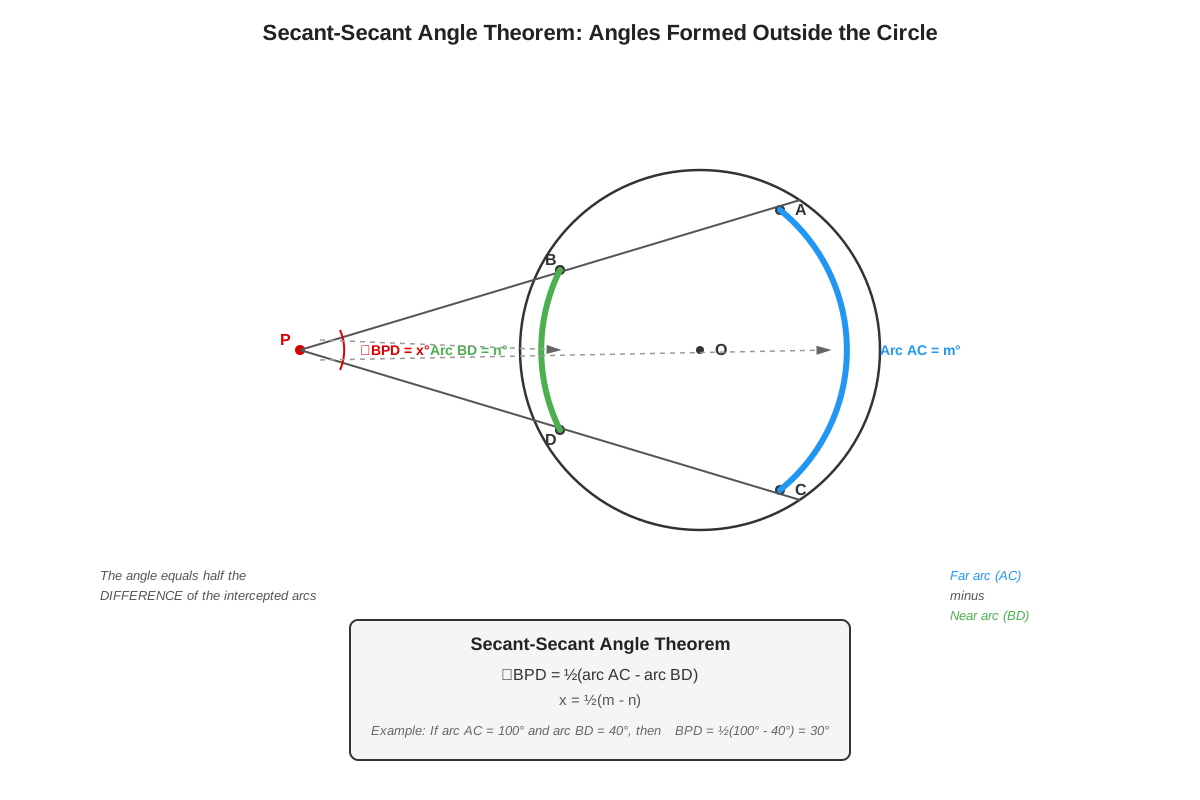
Secant-Secant Angle Theorem: When two secants intersect at a point outside a circle, the measure of the angle formed equals half the positive difference of the measures of the intercepted arcs.
Angle measure = (1/2)|arc₁ - arc₂|Where arc₁ is the larger intercepted arc and arc₂ is the smaller intercepted arc.
For example, if two secants intersect outside a circle and intercept arcs measuring 100° and 40°, the angle formed at their intersection point equals (1/2)(100° - 40°) = 30°.
This theorem applies regardless of where the secants intersect outside the circle, whether close to the circle or far away. The key is correctly identifying which arcs are intercepted by the angle in question.
Secant Segment Length Theorem (Power of a Point)
One of the most powerful and frequently tested relationships involves the lengths of secant segments. When two secants are drawn from the same external point, the products of their segments follow a specific pattern.
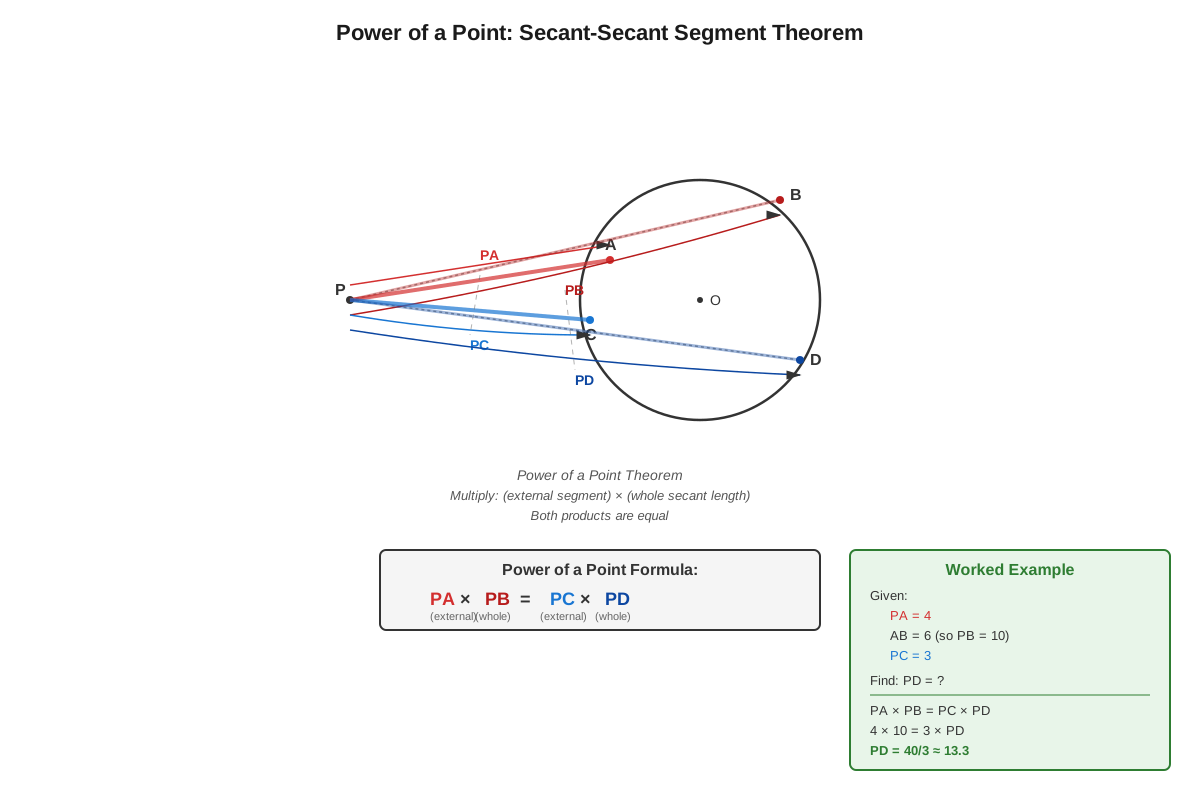
Power of a Point Theorem for Secants: If two secants are drawn to a circle from the same external point, then the product of one secant's external segment and its whole segment equals the product of the other secant's external segment and its whole segment.
(external₁) × (whole₁) = (external₂) × (whole₂)This can also be written as: a × (a + b) = c × (c + d), where a and c are external segments, and b and d are the internal chord portions.
This theorem enables solving for unknown segment lengths when three of the four key measurements are known. SAT questions frequently provide three values and ask students to calculate the fourth using this relationship.
Secant-Tangent Combinations
When a secant and a tangent are drawn from the same external point, they create a special relationship that combines properties of both elements.
Secant-Tangent Angle Theorem: When a secant and tangent intersect at an external point, the angle formed equals half the positive difference of the intercepted arcs.
Secant-Tangent Segment Theorem: When a secant and tangent are drawn from the same external point, the square of the tangent segment length equals the product of the secant's external segment and whole segment.
(tangent)² = (external segment) × (whole segment)This relationship is particularly useful for SAT problems involving right triangles and the Pythagorean theorem, as tangents are perpendicular to radii at their point of tangency.
Comparison of Circle Line Relationships
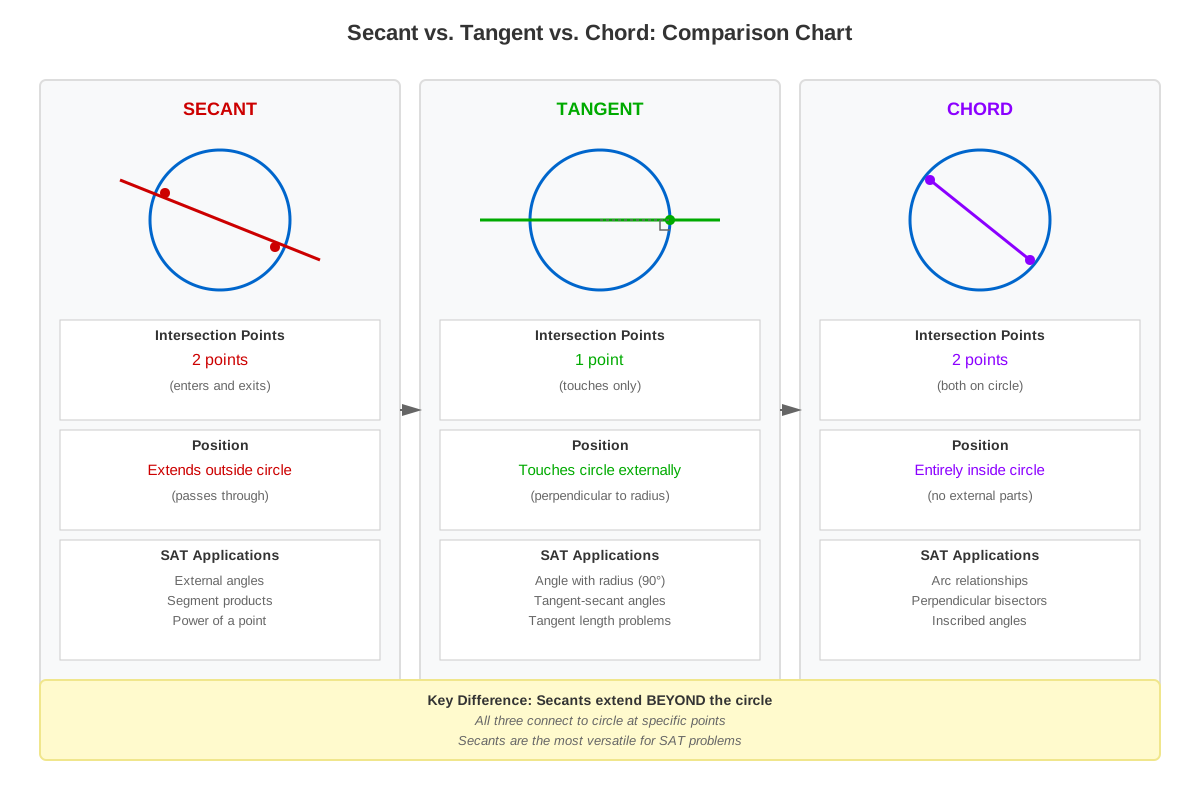
| Line Type | Intersection Points | Key Property | Common SAT Application |
|---|---|---|---|
| Secant | 2 points | Forms angles and segments with specific relationships | Angle calculations, segment length problems |
| Tangent | 1 point | Perpendicular to radius at point of tangency | Right triangle problems, combined with secants |
| Chord | 2 points (endpoints only) | Segment entirely inside circle | Intersecting chord problems, perpendicular bisectors |
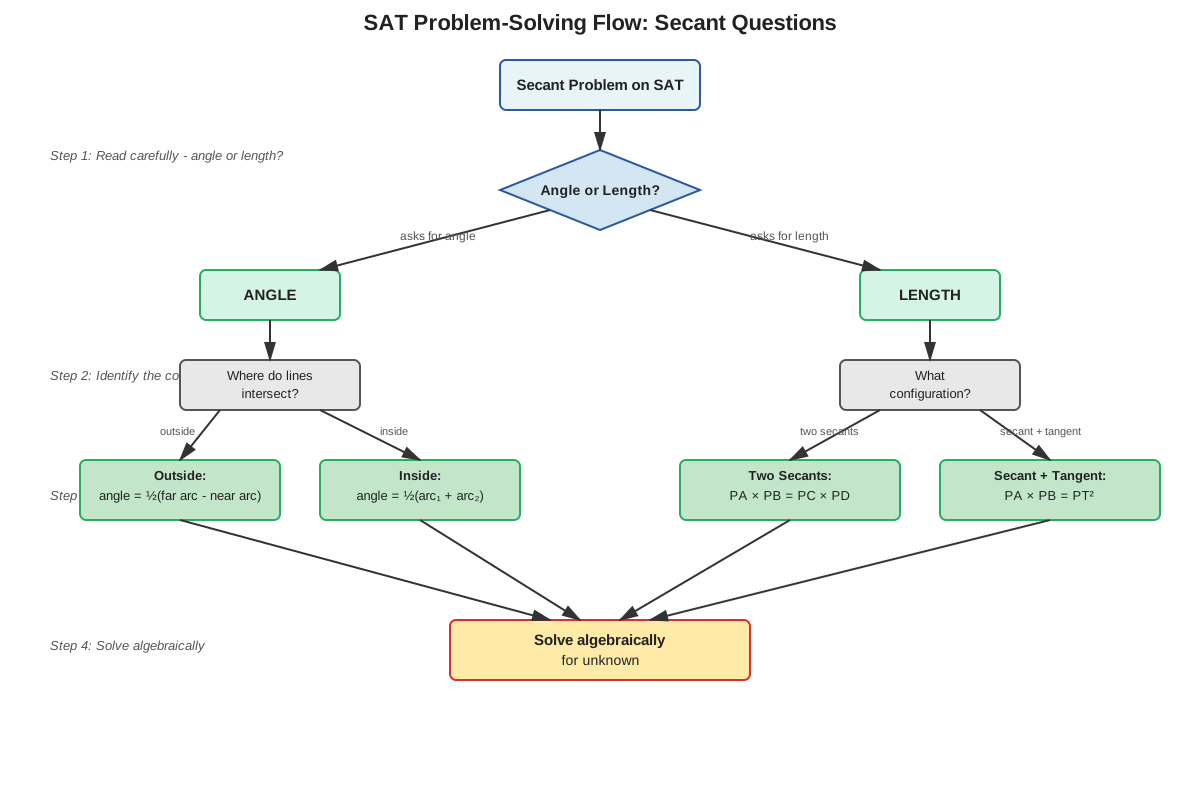
Steps for Solving Secant Problems
- Identify the configuration: Determine whether the problem involves two secants, a secant-tangent combination, or secants with other circle elements
- Label known values: Mark all given measurements on the diagram, including arc measures and segment lengths
- Identify what's being asked: Determine whether the question seeks an angle measure or a segment length
- Select the appropriate theorem: Choose between angle theorems or segment length theorems based on what's being asked
- Set up the equation: Write the mathematical relationship using the correct formula
- Solve algebraically: Use algebraic techniques to isolate the unknown variable
- Verify reasonableness: Check that the answer makes geometric sense given the diagram
Concept Relationships
The concepts within secants build upon each other in a logical progression. Understanding the basic definition of a secant → enables recognition of secant configurations in diagrams → which leads to identifying whether angle or segment relationships apply → allowing selection of the appropriate theorem → resulting in successful problem solving.
Secants connect directly to prerequisite knowledge of chords, as every secant contains a chord as its internal segment. The angle relationships for secants parallel those for tangents and chords, with all following the general principle that angles relate to arc measures through division by two and addition or subtraction operations. The power of a point theorem for secants extends to the secant-tangent case, where the tangent can be thought of as a limiting case where the two intersection points converge.
Within the broader circle geometry unit, secants serve as a bridge concept: simpler than problems involving multiple circles or three-dimensional geometry, but more complex than basic radius and diameter calculations. Mastering secants prepares students for advanced topics like circle equations in coordinate geometry and trigonometric applications involving circles.
Quick check — test yourself on Secants so far.
Try Flashcards →High-Yield Facts
⭐ A secant intersects a circle at exactly two distinct points, distinguishing it from tangents (one point) and lines that miss the circle entirely (zero points)
⭐ When two secants intersect outside a circle, the angle formed equals half the difference of the intercepted arcs: angle = (1/2)|larger arc - smaller arc|
⭐ The power of a point theorem states that for two secants from the same external point: (external₁)(whole₁) = (external₂)(whole₂)
⭐ For a secant and tangent from the same external point: (tangent)² = (external segment)(whole segment)
⭐ The portion of a secant inside the circle is actually a chord, connecting secant problems to chord properties
- When two secants intersect inside a circle (at the chord level), they follow the intersecting chords theorem instead of the external secant theorem
- Secant angles are always measured at the vertex where the lines intersect, not at the circle itself
- The "whole segment" in secant problems includes both the external segment and the internal chord portion
- Arc measures used in secant angle calculations are always positive values, and the difference is taken as an absolute value
- Multiple secants can be drawn from any external point, and all will satisfy the power of a point relationship with each other
Common Misconceptions
Misconception: A secant only refers to the segment between the two intersection points on the circle.
Correction: A secant is an entire line extending infinitely in both directions; the segment between intersection points is specifically called a chord. The secant includes portions outside the circle as well.
Misconception: The angle formed by two secants equals half the sum of the intercepted arcs.
Correction: The angle equals half the difference (not sum) of the intercepted arcs. This is a critical distinction that changes the calculation entirely. The formula is (1/2)|arc₁ - arc₂|, not (1/2)(arc₁ + arc₂).
Misconception: In the power of a point theorem, you multiply the two external segments together.
Correction: You multiply each external segment by its corresponding whole segment (external + internal). The formula is (external₁)(whole₁) = (external₂)(whole₂), not (external₁)(external₂) = (internal₁)(internal₂).
Misconception: Secant angle theorems apply when secants intersect inside the circle.
Correction: When secants intersect inside a circle, the intersecting chords theorem applies instead, where the angle equals half the sum of the intercepted arcs. The secant-secant angle theorem specifically applies to external intersection points.
Misconception: All lines that touch a circle are secants.
Correction: Lines that intersect a circle at exactly one point are tangents, not secants. Lines that don't intersect the circle at all are simply external lines. Only lines intersecting at exactly two points qualify as secants.
Misconception: The external segment is measured from the circle to the intersection point.
Correction: The external segment is measured from the external point (where secants meet) to the nearest intersection point on the circle. The direction matters for correctly applying the power of a point theorem.
Worked Examples
Example 1: Finding an Angle Formed by Two Secants
Problem: Two secants are drawn from point P outside a circle. One secant intersects the circle creating an arc of 110°, while the other creates an arc of 30°. What is the measure of the angle formed at point P?
Solution:
Step 1: Identify the configuration. We have two secants intersecting at an external point P, so we'll use the secant-secant angle theorem.
Step 2: Label known values. Arc₁ = 110° (larger arc), Arc₂ = 30° (smaller arc)
Step 3: Identify what's being asked. We need to find the angle measure at point P.
Step 4: Select the appropriate theorem. Use the secant-secant angle theorem: angle = (1/2)|arc₁ - arc₂|
Step 5: Set up the equation:
Angle at P = (1/2)|110° - 30°|Step 6: Solve:
Angle at P = (1/2)(80°)
Angle at P = 40°
Step 7: Verify reasonableness. The angle (40°) is less than either intercepted arc, which makes sense geometrically. The answer is 40°.
Connection to learning objectives: This example demonstrates identifying secant features (two lines intersecting outside the circle) and applying the secant-secant angle theorem to answer an SAT-style question.
Example 2: Finding Segment Lengths Using Power of a Point
Problem: From point Q outside a circle, two secants are drawn. The first secant has an external segment of 4 cm and passes through the circle with a total length of 12 cm. The second secant has an external segment of 3 cm. What is the total length of the second secant?
Solution:
Step 1: Identify the configuration. Two secants from the same external point Q, so we'll use the power of a point theorem.
Step 2: Label known values:
- First secant: external₁ = 4 cm, whole₁ = 12 cm
- Second secant: external₂ = 3 cm, whole₂ = unknown
Step 3: Identify what's being asked. We need to find the total length (whole segment) of the second secant.
Step 4: Select the appropriate theorem. Use the power of a point theorem: (external₁)(whole₁) = (external₂)(whole₂)
Step 5: Set up the equation:
(4)(12) = (3)(whole₂)Step 6: Solve:
48 = 3 × whole₂
whole₂ = 48 ÷ 3
whole₂ = 16 cm
Step 7: Verify reasonableness. The second secant has a smaller external segment (3 cm vs 4 cm) but a larger total length (16 cm vs 12 cm), which makes sense because the products must be equal. The internal chord portion of the second secant would be 16 - 3 = 13 cm, which is reasonable.
Connection to learning objectives: This example demonstrates applying the secant segment length theorem to solve for unknown measurements in an SAT-style problem, requiring both geometric understanding and algebraic manipulation.
Exam Strategy
When approaching SAT questions involving secants, begin by carefully examining the diagram to identify the configuration. Look for lines that clearly pass through the circle at two points, and determine whether they intersect inside the circle, outside the circle, or if one is a tangent. This initial classification determines which theorem applies.
Trigger words and phrases to watch for include:
- "intersects the circle at two points" → indicates a secant
- "drawn from an external point" → suggests power of a point theorem
- "the angle formed outside the circle" → signals secant-secant angle theorem
- "total length" or "whole segment" → refers to external plus internal portions
- "arc measures" → indicates an angle calculation problem
For process-of-elimination strategies, immediately eliminate answer choices that violate basic geometric principles. If calculating an angle formed by secants outside a circle, the answer must be less than either intercepted arc (since you're taking half the difference). If calculating segment lengths, the answer must be positive and geometrically reasonable—a 100 cm segment in a diagram showing a 5 cm radius doesn't make sense.
Time allocation: Secant problems typically require 60-90 seconds when you recognize the configuration immediately. If you don't recognize the setup within 15 seconds, mark the question and return to it later. Don't spend more than 2 minutes on any single secant problem—if you're stuck, make an educated guess and move on.
Create a mental checklist: (1) Identify secant vs. tangent vs. chord, (2) Locate the intersection point, (3) Determine if you need angle or length, (4) Apply the correct formula, (5) Solve and verify. Following this systematic approach prevents careless errors and ensures you don't confuse similar-looking theorems.
Memory Techniques
SIDE - Secant Intersection Difference Exterior: When secants intersect at an exterior point, use the difference of arcs divided by 2.
"Whole times External, Products are Equal" - For the power of a point theorem, remember that you multiply whole segment times external segment, and these products equal each other for different secants from the same point.
Visualization strategy: Picture a secant as a "sword" cutting through a circle at two points, while a tangent is an "arrow" that just grazes the edge at one point. This mental image helps distinguish between the two configurations quickly.
The "Two-Touch Rule": Secants always touch the circle at exactly two points—not one (tangent), not zero (miss), not more than two. When you see a line touching twice, think "secant" immediately.
Arc Difference vs. Arc Sum: Remember that external intersections use difference (secants outside), while internal intersections use sum (chords inside). Think "outside = subtract, inside = add."
T-squared equals E-times-W: For secant-tangent combinations, the Tangent squared equals External times Whole. This rhyming pattern helps recall the formula: T² = E × W.
Summary
Secants are lines that intersect circles at exactly two distinct points, creating geometric relationships that are frequently tested on the SAT math section. The two primary categories of secant problems involve angle calculations and segment length determinations. When two secants intersect outside a circle, the angle formed equals half the difference of the intercepted arcs. When two secants are drawn from the same external point, the power of a point theorem states that the product of each secant's external segment and whole segment are equal. These relationships extend to secant-tangent combinations, where the tangent squared equals the product of the secant's external and whole segments. Mastering secant properties requires recognizing configurations in diagrams, selecting the appropriate theorem, and applying algebraic skills to solve for unknown values. Success on SAT secant questions depends on distinguishing secants from tangents and chords, correctly identifying which segments to multiply or which arcs to subtract, and systematically working through problems using established formulas.
Key Takeaways
- Secants intersect circles at exactly two points, with the internal portion forming a chord and external portions extending beyond the circle
- The secant-secant angle theorem states that angles formed outside a circle equal half the difference of intercepted arcs: (1/2)|arc₁ - arc₂|
- The power of a point theorem for secants establishes that (external₁)(whole₁) = (external₂)(whole₂) for secants from the same external point
- Secant-tangent combinations follow the relationship (tangent)² = (external)(whole)
- Always identify whether the problem asks for an angle measure or segment length before selecting the appropriate theorem
- Distinguish between external intersections (use difference of arcs) and internal intersections (use sum of arcs)
- Verify that calculated answers make geometric sense within the context of the diagram
Related Topics
Tangent Lines and Circles: Understanding tangent properties complements secant knowledge, particularly for problems involving secant-tangent combinations. Tangents are perpendicular to radii at their point of contact, creating right triangle opportunities.
Chord Properties: Since the internal portion of every secant is a chord, mastering chord theorems (including intersecting chords and perpendicular bisectors) extends secant problem-solving capabilities.
Arc Measures and Central Angles: Secant angle calculations depend on arc measures, making strong understanding of arc-angle relationships essential for advanced circle geometry.
Power of a Point (General): The secant segment theorem is one application of the broader power of a point concept, which extends to tangent-tangent and chord-chord configurations.
Coordinate Geometry of Circles: Secants can be represented as linear equations intersecting circle equations, connecting algebraic and geometric approaches to circle problems.
Practice CTA
Now that you've mastered the core concepts of secants, it's time to solidify your understanding through practice. Attempt the practice questions to test your ability to identify secant configurations, apply the appropriate theorems, and solve problems efficiently under timed conditions. Use the flashcards to reinforce key formulas and relationships until they become automatic. Remember, the difference between knowing these concepts and scoring points on test day is consistent practice. Each problem you solve builds the pattern recognition and confidence needed to tackle any secant question the SAT presents. You've got this—start practicing now!
Sign up free to keep reading
Create a free AnvayaPrep account to finish this SAT guide on Secants — plus flashcards and practice questions.