Overview
Central angles are fundamental geometric concepts that appear consistently on the SAT math section, particularly within questions involving circles, arcs, and sectors. A central angle is formed when two radii of a circle extend from the center point to two distinct points on the circumference, creating an angle whose vertex sits at the circle's center. Understanding central angles is crucial because they establish direct relationships between angular measures and arc lengths, sector areas, and other circular properties that the SAT frequently tests.
The importance of mastering central angles for the SAT cannot be overstated. These concepts appear in approximately 2-4 questions per test administration, often integrated with coordinate geometry, trigonometry, or real-world application problems. Questions involving central angles may ask students to calculate arc lengths, determine sector areas, find missing angle measures, or work with proportional relationships between angles and their corresponding arcs. The College Board consistently includes these problems because they assess multiple mathematical reasoning skills simultaneously: geometric visualization, proportional thinking, and algebraic manipulation.
Central angles serve as a bridge between basic circle properties and more advanced topics in geometry and trigonometry. They connect directly to concepts such as inscribed angles, arc measures, sector areas, and even radian measure (though radians are less commonly tested on the SAT). A solid understanding of central angles enables students to tackle complex multi-step problems that combine circle geometry with algebra, coordinate geometry, and data analysis. This topic exemplifies the SAT's emphasis on mathematical connections and real-world applications, making it essential for achieving a competitive score.
Learning Objectives
- [ ] Identify key features of central angles, including vertex location, relationship to radii, and angle measurement
- [ ] Explain how central angles appears on the SAT, including common question formats and integration with other topics
- [ ] Apply central angles to answer SAT-style questions involving arc length, sector area, and proportional relationships
- [ ] Calculate arc lengths using the relationship between central angles and circle circumference
- [ ] Determine sector areas by applying the proportional relationship between central angles and total circle area
- [ ] Solve multi-step problems that combine central angles with algebraic equations and coordinate geometry
Prerequisites
- Basic circle vocabulary (radius, diameter, circumference, area): Essential for understanding where central angles fit within circle geometry and for applying formulas correctly
- Angle measurement in degrees: Necessary for calculating central angle measures and understanding the 360° total of a complete circle
- Proportional reasoning: Critical for establishing relationships between central angles and their corresponding arcs or sectors
- Basic algebraic manipulation: Required for solving equations involving central angles, arc lengths, and sector areas
- Circle formulas (C = 2πr, A = πr²): Foundational for deriving arc length and sector area formulas from central angle measures
Why This Topic Matters
Central angles represent one of the most practical applications of circle geometry in real-world contexts. Engineers use central angles when designing circular components, from gears and wheels to architectural features like domes and arches. Urban planners apply these concepts when designing roundabouts and curved roadways. Even in everyday life, understanding central angles helps explain phenomena like the apparent motion of celestial objects, the coverage area of rotating sprinklers, or the division of circular pizzas into equal slices.
On the SAT, central angles appear with remarkable consistency, typically in 2-4 questions per test. These questions span multiple difficulty levels and often appear in both the calculator and no-calculator sections. The College Board favors central angle problems because they efficiently assess multiple mathematical competencies: geometric reasoning, proportional thinking, formula application, and algebraic problem-solving. Questions may present central angles in pure geometric contexts, embed them within coordinate plane scenarios, or frame them as real-world application problems involving circular motion, design, or measurement.
SAT central angles questions commonly appear in several formats: direct calculation problems asking for arc length or sector area given a central angle; reverse problems providing arc length or sector area and asking for the central angle measure; multi-step problems combining central angles with other circle properties; and word problems requiring students to translate real-world scenarios into geometric relationships. The topic frequently integrates with coordinate geometry (circles on the xy-plane), algebraic equations (solving for unknown angle measures), and data interpretation (reading angle measures from diagrams or tables).
Core Concepts
Definition and Properties of Central Angles
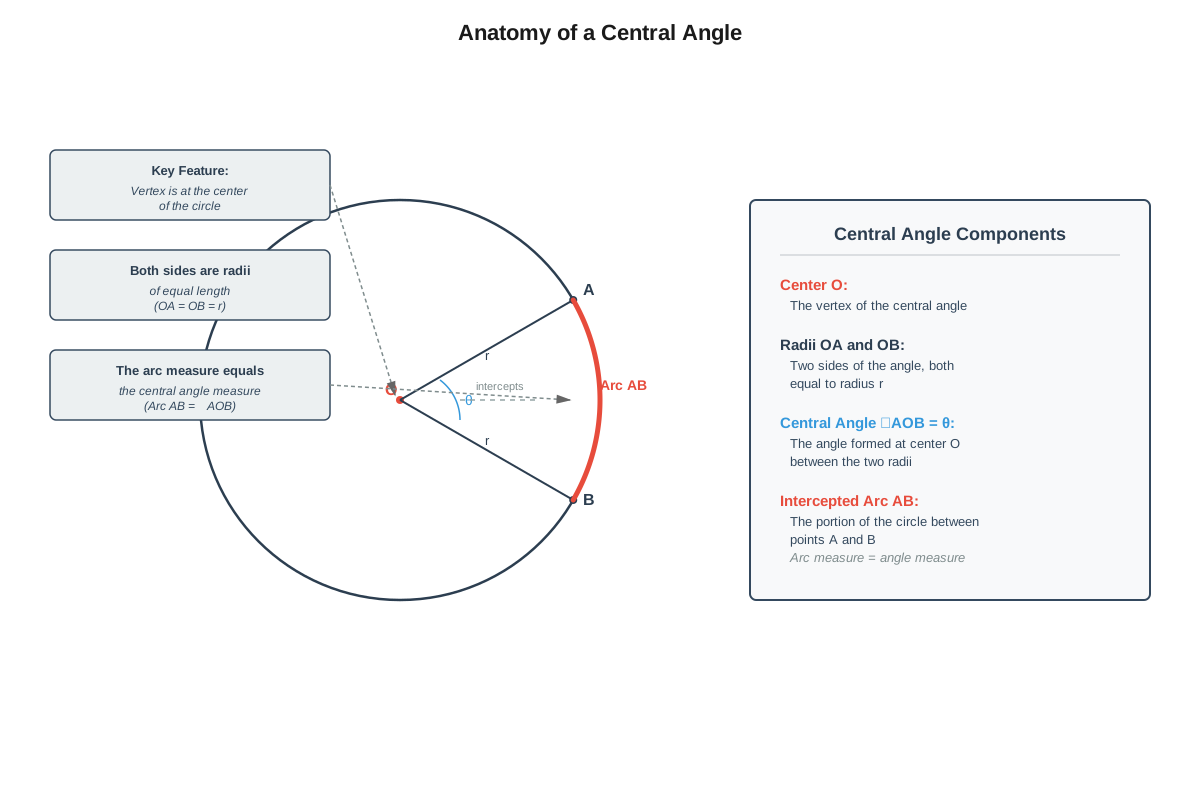
A central angle is an angle whose vertex is located at the center of a circle, with both sides of the angle formed by radii extending to points on the circle's circumference. This positioning is what distinguishes central angles from other angle types in circle geometry, such as inscribed angles (vertex on the circumference) or exterior angles (vertex outside the circle).
Key properties of central angles include:
- The vertex must be at the circle's center point
- Both sides of the angle are radii of equal length
- The angle measure can range from 0° to 360°
- The angle intercepts an arc on the circle's circumference
- The measure of a central angle equals the measure of its intercepted arc (in degrees)
The last property is particularly important for SAT problems: a central angle and its intercepted arc have the same degree measure. If a central angle measures 60°, the arc it intercepts also measures 60°. This one-to-one correspondence simplifies many calculations and forms the basis for proportional relationships.
Central Angles and Arc Length
The relationship between central angles and arc length is one of the most frequently tested concepts on the SAT. An arc is a portion of a circle's circumference, and its length depends on both the circle's radius and the central angle that intercepts it.
The arc length formula is:
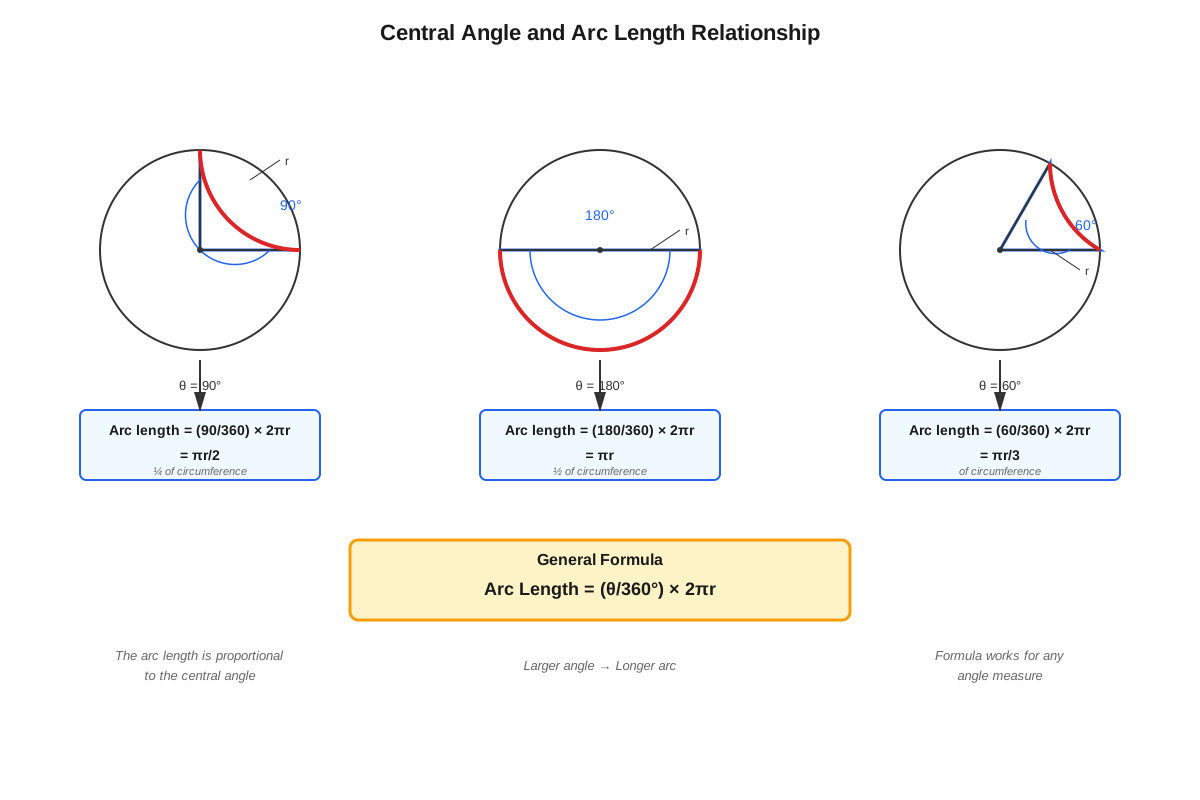
Arc Length = (θ/360°) × 2πrWhere:
- θ (theta) represents the central angle measure in degrees
- r represents the radius of the circle
- 2πr is the complete circumference of the circle
This formula expresses a proportional relationship: the arc length is the same fraction of the total circumference as the central angle is of 360°. For example, a 90° central angle represents 90/360 = 1/4 of the complete circle, so its arc length is 1/4 of the circumference.
Alternative forms of this formula include:
- Arc Length = (θ/360°) × πd (using diameter instead of radius)
- Arc Length = (θ/180°) × πr (simplified fraction)
Central Angles and Sector Area
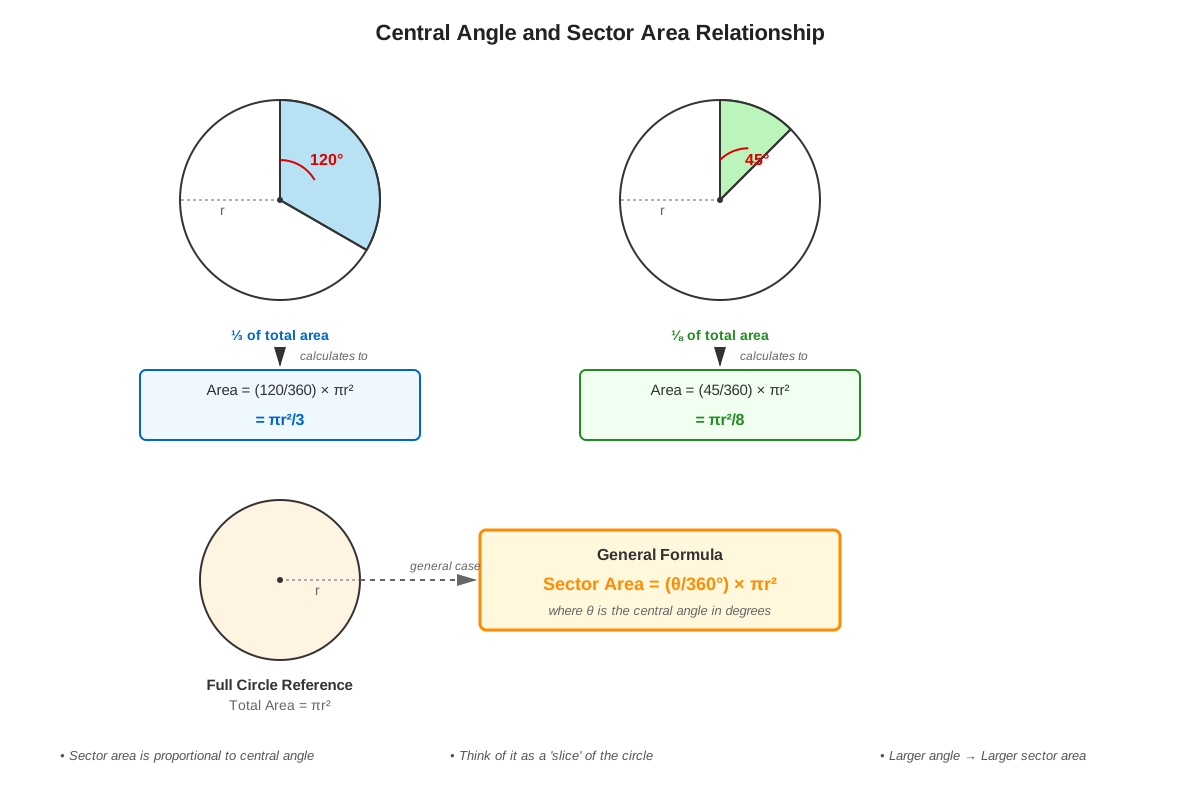
A sector is a "slice" of a circle bounded by two radii and the arc between them—essentially a pie-shaped region. The area of a sector depends on the central angle, just as arc length does.
The sector area formula is:
Sector Area = (θ/360°) × πr²Where:
- θ represents the central angle measure in degrees
- r represents the radius of the circle
- πr² is the total area of the circle
This formula follows the same proportional logic as arc length: the sector area is the same fraction of the total circle area as the central angle is of 360°. A 120° central angle creates a sector with area equal to 120/360 = 1/3 of the entire circle's area.
Multiple Central Angles in One Circle
SAT problems frequently involve circles divided into multiple sectors by several central angles. In these situations, several key principles apply:
- The sum of all central angles in a complete circle equals 360°
- Adjacent central angles can be added to find combined angle measures
- If a circle is divided into n equal sectors, each central angle measures 360°/n
- Proportional relationships hold for each individual sector
When working with multiple central angles, creating equations based on the 360° total often provides the key to solving for unknown angle measures.
Comparison Table: Central Angles vs. Other Circle Angles
| Feature | Central Angle | Inscribed Angle | Exterior Angle |
|---|---|---|---|
| Vertex Location | Center of circle | On the circumference | Outside the circle |
| Relationship to Arc | Equals arc measure | Half the arc measure | Varies by configuration |
| SAT Frequency | Very High | High | Low |
| Typical Applications | Arc length, sector area | Angle relationships | Advanced geometry |
Central Angles in Coordinate Geometry
On the SAT, central angles often appear in coordinate plane contexts. When a circle is graphed with center at point (h, k), central angles can be analyzed using:
- The distance formula to verify radii lengths
- Angle relationships with the x and y axes
- Trigonometric ratios (though less common on SAT)
- Symmetry properties of the circle
These problems typically require students to integrate multiple skills: identifying the circle's center and radius from an equation, plotting or visualizing points on the circumference, and calculating angle measures or arc properties.
Concept Relationships
Central angles serve as the foundational concept that connects to virtually all other circle properties tested on the SAT. The relationship flow works as follows:
Circle Definition → Radius → Central Angles → Arc Measures → Arc Lengths and Sector Areas
The radius establishes the circle's size, while central angles determine how the circle is divided. Arc measures directly equal central angle measures, which then enable calculations of arc lengths (using circumference) and sector areas (using total area).
Central angles also connect to prerequisite knowledge in specific ways:
- Proportional reasoning enables the fractional relationships (θ/360°) that appear in all arc and sector formulas
- Basic circle formulas (circumference and area) provide the "whole" values from which arc lengths and sector areas are calculated as fractional parts
- Angle measurement establishes the 360° framework within which all central angles must fit
The topic extends forward to more advanced concepts:
- Inscribed angles (which measure half their intercepted arc, compared to central angles that equal their arc)
- Radian measure (an alternative angle measurement system where central angles relate directly to arc length)
- Circular motion and angular velocity (physics applications that build on central angle concepts)
Within multi-step SAT problems, central angles often appear as the middle step: students must first use algebra or geometry to find a central angle measure, then use that angle to calculate an arc length or sector area as the final answer.
Quick check — test yourself on Central angles so far.
Try Flashcards →High-Yield Facts
⭐ A central angle has its vertex at the center of the circle and is formed by two radii
⭐ The measure of a central angle equals the measure of its intercepted arc in degrees
⭐ Arc length formula: Arc Length = (θ/360°) × 2πr, where θ is the central angle in degrees
⭐ Sector area formula: Sector Area = (θ/360°) × πr², where θ is the central angle in degrees
⭐ All central angles in a complete circle sum to 360°
- A 180° central angle creates a semicircle with arc length equal to half the circumference
- A 90° central angle creates a quarter-circle sector with area equal to one-fourth the total area
- When a circle is divided into n equal sectors, each central angle measures 360°/n degrees
- The ratio of two central angles equals the ratio of their corresponding arc lengths (when in the same circle)
- The ratio of two central angles equals the ratio of their corresponding sector areas (when in the same circle)
- Central angles can be found by setting up equations based on the 360° total when multiple angles are present
- In coordinate geometry, the center of the circle is the vertex of all central angles
- Arc length is always measured in linear units (inches, centimeters, etc.), while central angles are measured in degrees
Common Misconceptions
Misconception: Central angles and inscribed angles have the same measure as their intercepted arcs.
Correction: Only central angles equal their intercepted arc measures. Inscribed angles (vertex on the circumference) measure exactly half their intercepted arc. This distinction is crucial for SAT problems that mix angle types.
Misconception: The arc length formula can be used without converting the central angle to a fraction of 360°.
Correction: The formula Arc Length = (θ/360°) × 2πr requires the fraction θ/360° to determine what portion of the circumference to calculate. Simply multiplying θ × 2πr produces an incorrect result. The fraction is essential to the proportional relationship.
Misconception: A larger central angle always means a longer arc length, regardless of the circle size.
Correction: Arc length depends on both the central angle AND the radius. A 30° angle in a circle with radius 10 creates a longer arc than a 60° angle in a circle with radius 2. Both factors must be considered.
Misconception: The sector area formula uses diameter instead of radius.
Correction: The sector area formula uses radius (r), not diameter, because it derives from the circle area formula A = πr². Using diameter would require the formula A = π(d/2)², which is less common. Always identify whether a problem provides radius or diameter.
Misconception: When multiple central angles are given, they must all be different measures.
Correction: A circle can contain multiple central angles of equal measure, creating equal sectors. SAT problems often involve circles divided into equal parts, where all central angles are identical. Don't assume variation without evidence.
Misconception: Central angles can exceed 360°.
Correction: In standard circle geometry, central angles range from 0° to 360°. While reflex angles (greater than 180°) are valid central angles, any angle of 360° or more represents multiple complete rotations, which is not typically how SAT problems frame central angles. If calculations yield an angle greater than 360°, check for errors.
Worked Examples
Example 1: Finding Arc Length from a Central Angle
Problem: A circle has a radius of 12 inches. A central angle of 150° intercepts an arc on this circle. What is the length of the arc, in inches?
Solution:
Step 1: Identify the given information.
- Radius r = 12 inches
- Central angle θ = 150°
Step 2: Recall the arc length formula.
Arc Length = (θ/360°) × 2πr
Step 3: Substitute the known values.
Arc Length = (150°/360°) × 2π(12)
Step 4: Simplify the fraction.
150/360 = 5/12 (dividing both numerator and denominator by 30)
Step 5: Complete the calculation.
Arc Length = (5/12) × 24π = (5 × 24π)/12 = 120π/12 = 10π inches
Step 6: If needed, approximate using π ≈ 3.14.
Arc Length ≈ 10(3.14) = 31.4 inches
Answer: The arc length is 10π inches (exact) or approximately 31.4 inches.
Connection to Learning Objectives: This problem directly applies the central angle concept to calculate arc length, demonstrating the proportional relationship between the angle measure and the circumference portion.
Example 2: Multi-Step Problem with Multiple Central Angles
Problem: A circular garden is divided into three sectors for planting different vegetables. The first sector has a central angle of 80°, and the second sector has a central angle that is twice the measure of the third sector. If the garden has a radius of 15 feet, what is the area of the second sector?
Solution:
Step 1: Set up an equation using the 360° total.
Let x = the measure of the third sector's central angle
Then 2x = the measure of the second sector's central angle
80° + 2x + x = 360°
Step 2: Solve for x.
80° + 3x = 360°
3x = 280°
x = 93.33° (or 280°/3)
Step 3: Find the second sector's central angle.
Second sector angle = 2x = 2(280°/3) = 560°/3 ≈ 186.67°
Step 4: Use the sector area formula.
Sector Area = (θ/360°) × πr²
Sector Area = (560°/3)/360° × π(15)²
Step 5: Simplify the calculation.
= (560/3) × (1/360) × 225π
= (560 × 225π)/(3 × 360)
= 126,000π/1,080
= 116.67π square feet
Step 6: Approximate if needed.
≈ 116.67(3.14) ≈ 366.5 square feet
Answer: The area of the second sector is 116.67π square feet (or approximately 366.5 square feet).
Connection to Learning Objectives: This problem requires identifying relationships between multiple central angles, applying algebraic reasoning to find unknown angle measures, and then using the sector area formula—demonstrating integration of multiple skills that appear on SAT questions.
Exam Strategy
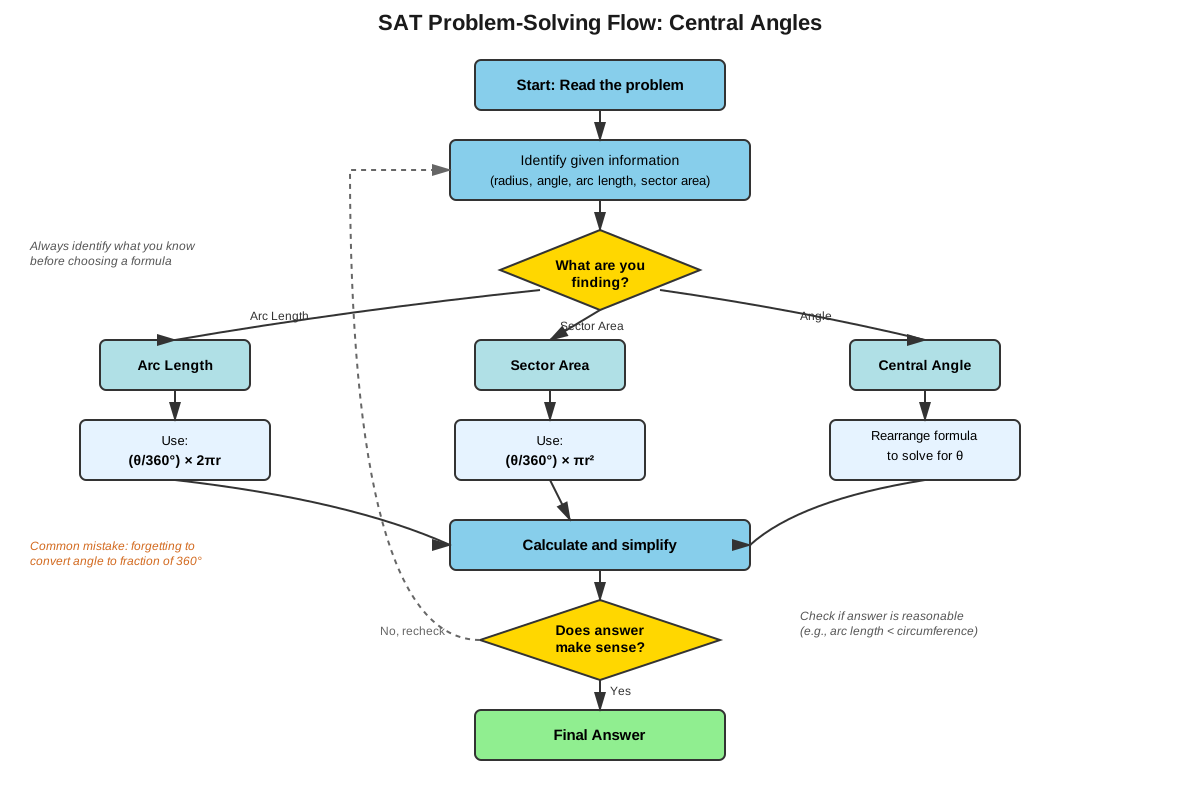
When approaching SAT central angles questions, follow this systematic process:
Step 1: Identify what the question asks for—arc length, sector area, angle measure, or a related quantity. This determines which formula to apply.
Step 2: Extract all given information from the problem and diagram. Look for radius, diameter, central angle measures, arc lengths, or sector areas. Convert diameter to radius if necessary (r = d/2).
Step 3: Determine if multiple angles are involved. If the problem mentions several sectors or angles, set up an equation using the 360° total to find unknown angle measures first.
Step 4: Apply the appropriate formula:
- For arc length: (θ/360°) × 2πr
- For sector area: (θ/360°) × πr²
- For finding θ: Rearrange these formulas algebraically
Step 5: Simplify fractions before multiplying to make calculations easier and reduce errors. For example, simplify 90/360 to 1/4 before multiplying by other values.
Exam Tip: Watch for trigger words like "portion of the circumference" (arc length), "slice of the circle" (sector area), "angle at the center" (central angle), and "fraction of the circle" (proportional relationship).
Process of Elimination Strategies:
- Eliminate answers that exceed the total circumference (for arc length) or total area (for sector area)
- If the central angle is less than 180°, the arc length must be less than half the circumference
- If the central angle is 90°, the sector area should be exactly one-quarter of the total area—use this to check reasonableness
- Answers with π are often exact; decimal approximations may be rounded
Time Management: Central angle problems typically require 1-2 minutes. If a problem involves multiple steps (finding an angle, then using it to calculate area), allocate up to 2.5 minutes. Don't spend excessive time on complex calculations—if you're stuck, mark the question and return to it.
Common Trap: The SAT may provide diameter instead of radius. Always check which measurement is given and convert if necessary before applying formulas. This simple oversight causes many avoidable errors.
Memory Techniques
Mnemonic for Arc Length Formula: "Angle Over Total Times Circumference" (AOTTC)
- Angle (θ) Over Total (360°) Times Circumference (2πr)
- This reminds you: (θ/360°) × 2πr
Mnemonic for Sector Area Formula: "Angle Over Total Times Area" (AOTTA)
- Angle (θ) Over Total (360°) Times Area (πr²)
- This reminds you: (θ/360°) × πr²
Visualization Strategy: Picture a pizza divided into slices. Each slice represents a sector, and the crust edge of each slice is an arc. The angle at the pizza's center (where all slices meet) is the central angle. This concrete image helps remember that:
- Bigger angles = bigger slices (larger sector areas)
- Bigger angles = longer crust edges (longer arc lengths)
- All angles together = complete pizza (360°)
The "360 Rule": Whenever you see multiple central angles in a problem, immediately write "= 360°" and set up an equation. This automatic response prevents forgetting this crucial relationship.
Radius vs. Diameter Reminder: "Radius is Really what you need" for formulas. Both arc length and sector area formulas use radius, not diameter. If given diameter, divide by 2 immediately.
Summary
Central angles are fundamental to circle geometry on the SAT, representing angles formed by two radii with vertices at the circle's center. The defining property—that a central angle's measure equals its intercepted arc's measure—establishes the foundation for all related calculations. Arc length and sector area both depend on proportional relationships: the fraction of the circle represented by a central angle (θ/360°) determines the corresponding fraction of circumference or area. The formulas Arc Length = (θ/360°) × 2πr and Sector Area = (θ/360°) × πr² appear frequently on the SAT, often within multi-step problems that combine geometric reasoning with algebraic manipulation. Success with central angles requires recognizing that all central angles in a complete circle sum to 360°, understanding how to set up equations when multiple angles are present, and accurately applying formulas while attending to details like using radius rather than diameter. These concepts integrate with coordinate geometry, proportional reasoning, and real-world applications, making them high-yield topics for SAT preparation.
Key Takeaways
- Central angles have vertices at the circle's center and are formed by two radii; their measure equals their intercepted arc's measure in degrees
- The arc length formula (θ/360°) × 2πr and sector area formula (θ/360°) × πr² both express proportional relationships between the central angle and the complete circle
- All central angles in a complete circle sum to 360°, enabling algebraic solutions when multiple angles are present
- Always verify whether a problem provides radius or diameter, and convert to radius before applying formulas
- Central angle problems appear in 2-4 questions per SAT test, often integrated with coordinate geometry, algebra, or real-world contexts
- Simplifying the fraction θ/360° before multiplying reduces calculation errors and saves time
- The relationship between central angles and their arcs/sectors is proportional: doubling the angle doubles the arc length and sector area (within the same circle)
Related Topics
Inscribed Angles: Angles with vertices on the circle's circumference that measure half their intercepted arc, contrasting with central angles that equal their arc. Mastering central angles provides the foundation for understanding this important relationship.
Circle Equations in Coordinate Geometry: The standard form (x - h)² + (y - k)² = r² and general form of circle equations, where central angles help analyze points on the circle and sector regions within the coordinate plane.
Radian Measure: An alternative angle measurement system where 2π radians equal 360°, and arc length equals the central angle (in radians) times the radius. Understanding central angles in degrees prepares students for this more advanced concept.
Arc Measures and Arc Addition: The principle that arc measures can be added and subtracted, directly related to adding and subtracting central angles, enabling solutions to complex multi-arc problems.
Sector Area and Segment Area: While sectors are bounded by two radii and an arc, segments are bounded by a chord and an arc. Central angle mastery is essential for calculating both regions.
Practice CTA
Now that you've mastered the core concepts of central angles, it's time to solidify your understanding through practice! Attempt the practice questions to apply these formulas and strategies to SAT-style problems. Work through the flashcards to reinforce key definitions and relationships. Remember, central angles appear consistently on the SAT, so investing time in practice now will directly translate to points on test day. Each problem you solve strengthens your geometric reasoning and builds the confidence you need to tackle any circle geometry question the SAT presents. You've got this!
Sign up free to keep reading
Create a free AnvayaPrep account to finish this SAT guide on Central angles — plus flashcards and practice questions.