Overview
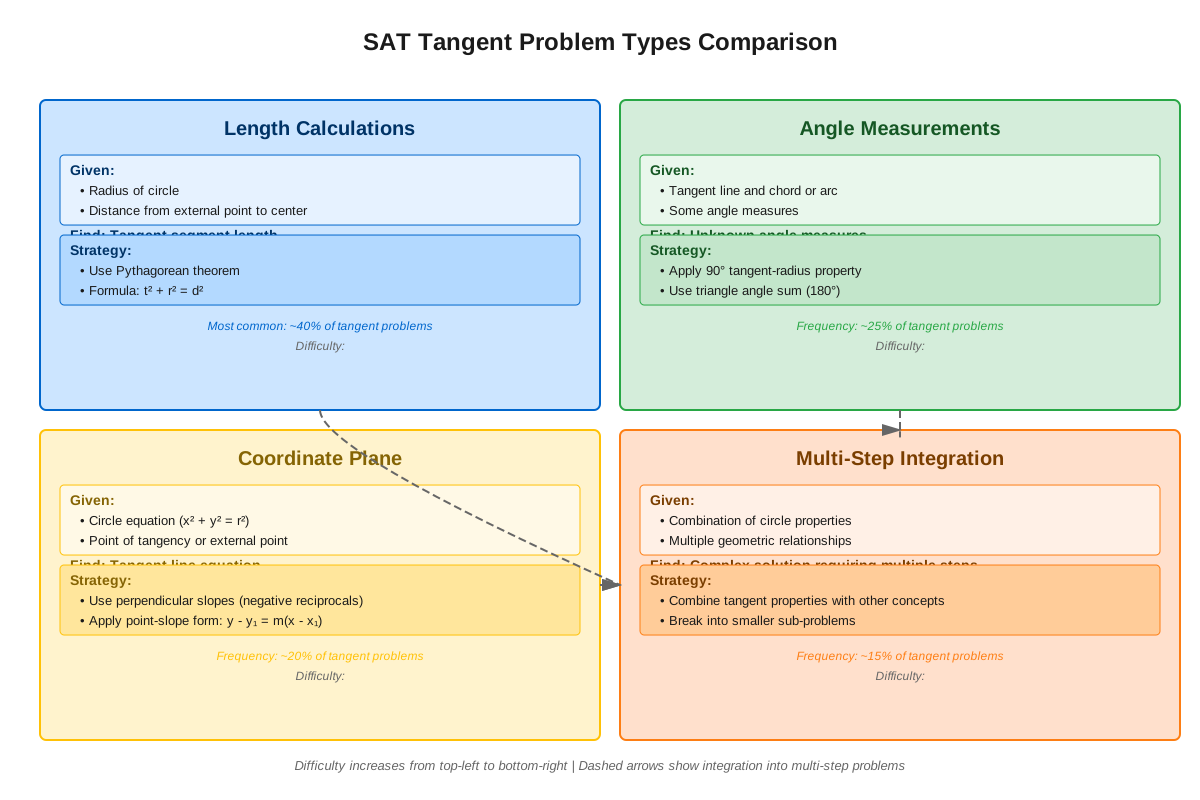
Tangents represent one of the most frequently tested circle concepts on the SAT math section, appearing in approximately 2-4 questions per exam. A tangent is a line that touches a circle at exactly one point, creating a unique geometric relationship that forms the basis for numerous problem types. Understanding tangents requires synthesizing knowledge of circles, right triangles, and coordinate geometry—making it a high-yield topic that connects multiple mathematical domains.
The power of tangent problems lies in their predictability: they almost always involve the fundamental property that a tangent line is perpendicular to the radius at the point of tangency. This single relationship unlocks solutions to problems involving distance calculations, angle measurements, and coordinate plane applications. Mastering tangents provides students with a reliable framework for solving complex-looking geometry problems that frequently appear in both the calculator and no-calculator sections of the SAT.
Beyond isolated circle problems, tangent concepts integrate with broader mathematical reasoning tested on the SAT. Questions may combine tangents with the Pythagorean theorem, similar triangles, or algebraic equations. The topic also appears in real-world context problems involving circular motion, engineering designs, and optimization scenarios. Students who develop fluency with tangent properties gain a significant advantage in the geometry and problem-solving domains that constitute roughly 30% of SAT math questions.
Learning Objectives
- [ ] Identify key features of tangents, including the point of tangency and perpendicular relationship with radii
- [ ] Explain how tangents appears on the SAT in various question formats and difficulty levels
- [ ] Apply tangents to answer SAT-style questions involving distance, angles, and coordinate geometry
- [ ] Calculate the length of tangent segments using the Pythagorean theorem and circle properties
- [ ] Determine equations of tangent lines on the coordinate plane given circle equations
- [ ] Solve multi-step problems combining tangent properties with other geometric concepts
- [ ] Recognize and apply the two-tangent theorem for segments drawn from external points
Prerequisites
- Circle basics: Understanding radius, diameter, center, and circumference is essential because tangent problems always reference these fundamental circle components
- Pythagorean theorem: The perpendicular relationship between tangents and radii creates right triangles, making this theorem the primary computational tool
- Coordinate plane fundamentals: Many SAT tangent questions involve circles centered at the origin or other points, requiring coordinate geometry skills
- Perpendicular lines: Recognizing perpendicular relationships and their properties (including negative reciprocal slopes) is crucial for tangent identification
- Basic algebraic manipulation: Solving for unknown variables in equations involving tangents requires comfort with algebraic techniques
Why This Topic Matters
Tangent problems appear with remarkable consistency on the SAT, typically featuring in 2-4 questions per administration. These questions span difficulty levels from medium to hard, making them critical for students aiming for scores above 650 in the math section. The College Board frequently uses tangents to test multiple skills simultaneously—geometric reasoning, algebraic manipulation, and spatial visualization—making them efficient assessment tools that distinguish high-performing students.
In real-world applications, tangent concepts model countless practical scenarios. Engineers use tangent lines to design smooth transitions in roadways and roller coasters. Astronomers calculate tangent lines to determine visibility horizons on planetary bodies. Computer graphics programmers employ tangent calculations to render realistic lighting and shadows on curved surfaces. GPS systems use tangent principles to calculate line-of-sight distances and signal paths around Earth's curvature.
On the SAT, tangent questions commonly appear in several formats: pure geometry problems asking for segment lengths or angle measures, coordinate geometry questions requiring tangent line equations, and word problems embedding tangent relationships in real-world contexts. Questions may present diagrams with tangent lines drawn to circles, ask students to identify whether a line is tangent to a circle, or require calculating distances from external points. The topic frequently combines with other high-yield concepts like the distance formula, special right triangles, and systems of equations, making it a nexus point for integrated mathematical reasoning.
Core Concepts
Definition and Fundamental Property
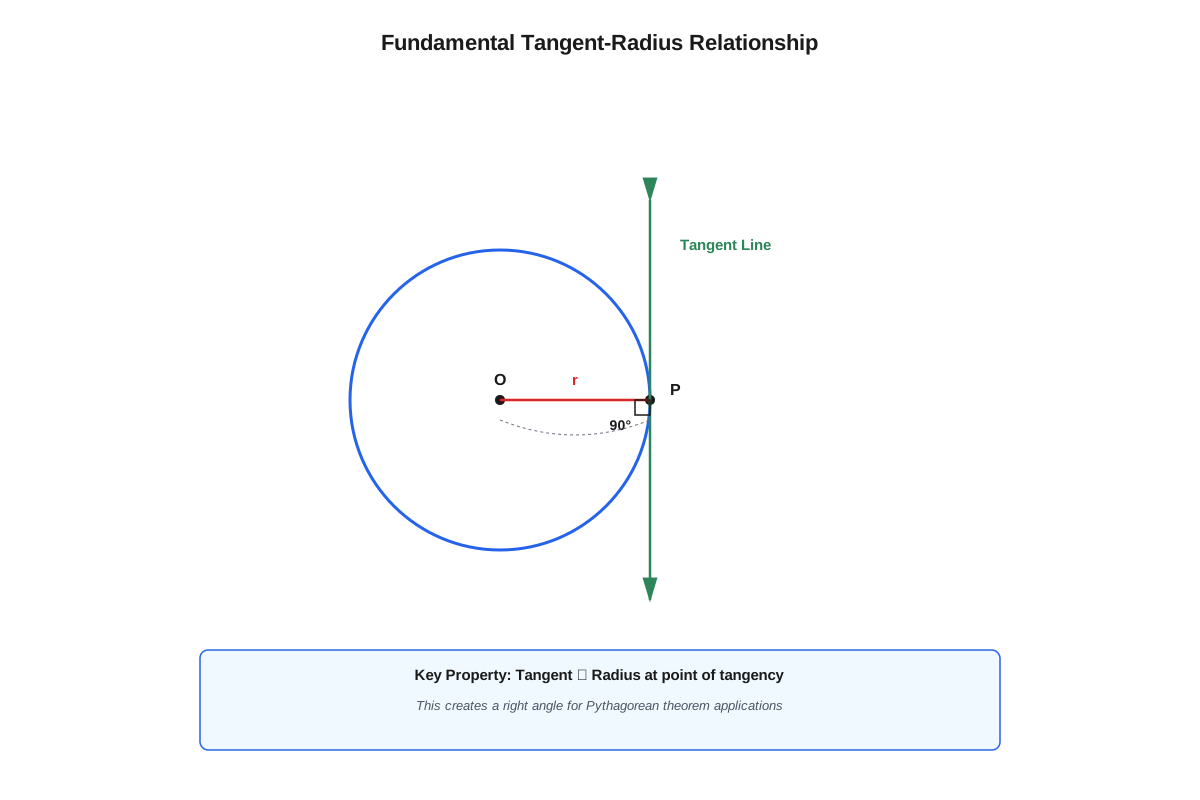
A tangent to a circle is a line that intersects the circle at exactly one point, called the point of tangency. This single-point intersection distinguishes tangents from secants (which intersect at two points) and from lines that miss the circle entirely. The defining property that makes tangent problems solvable is the perpendicular tangent theorem: a tangent line is always perpendicular to the radius drawn to the point of tangency.
This perpendicular relationship creates a 90-degree angle at the point of tangency, which immediately suggests the formation of right triangles in most tangent problems. When you see a tangent line in an SAT problem, your first instinct should be to identify or draw the radius to the point of tangency, creating the right angle that enables application of the Pythagorean theorem.
Tangent Segments from External Points
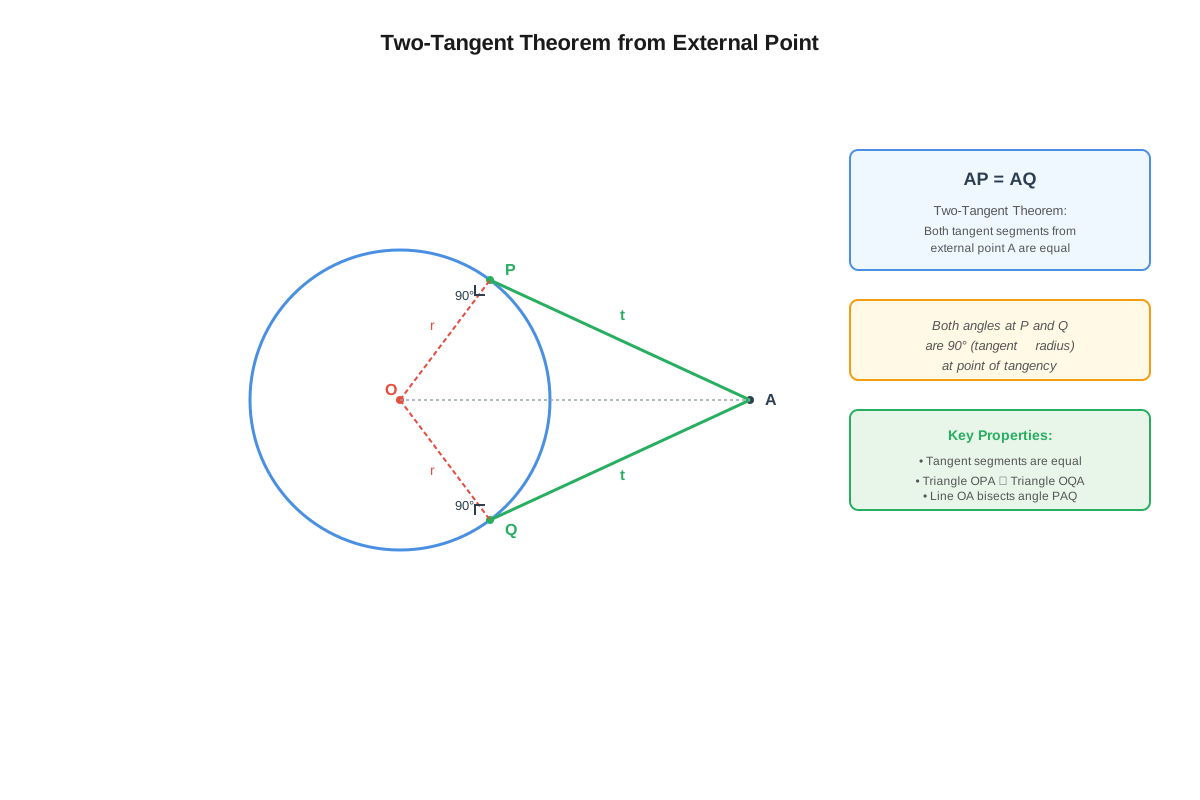
When two tangent segments are drawn from the same external point to a circle, these segments have equal length. This two-tangent theorem is a high-yield property that appears frequently on the SAT. If point P lies outside a circle and tangent segments PA and PB touch the circle at points A and B respectively, then PA = PB.
This property proves useful in problems involving perimeters, algebraic equations with unknown lengths, and geometric proofs. The equal-length property stems from the congruence of the two right triangles formed by the radii to the tangency points, the tangent segments, and the line connecting the external point to the circle's center.
Calculating Tangent Segment Length
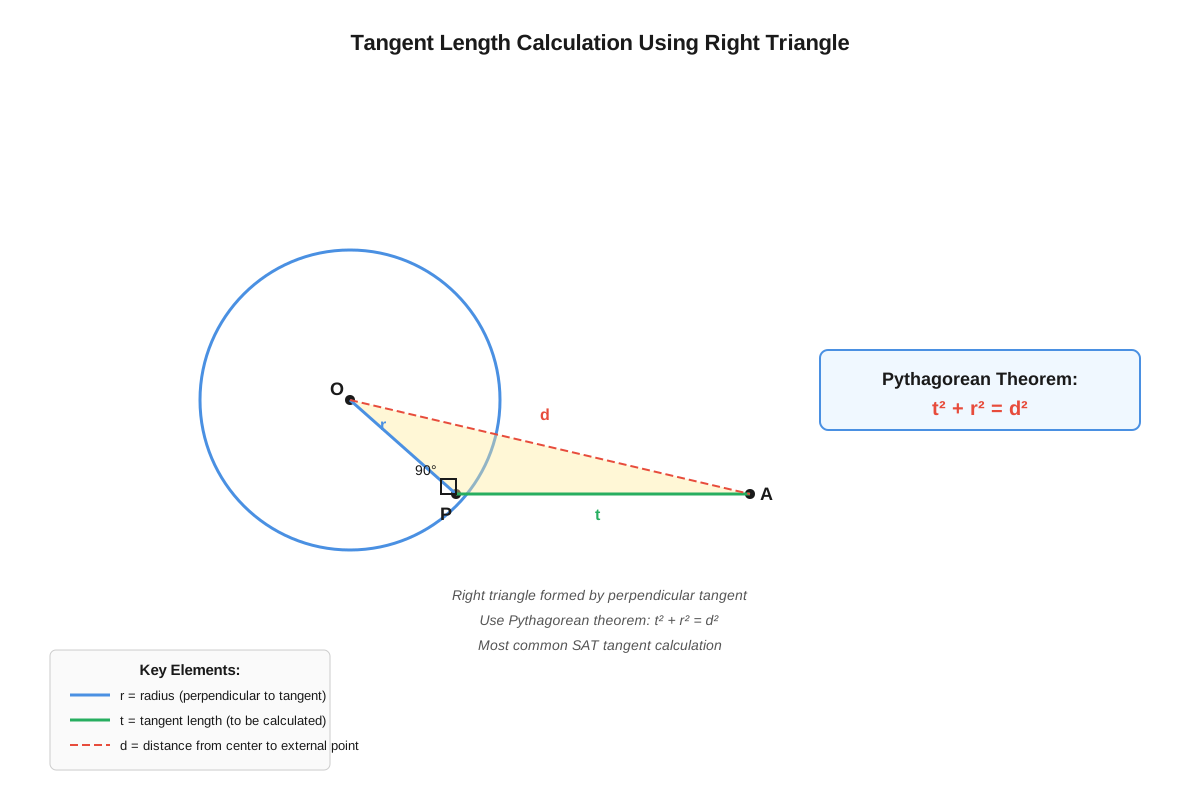
The most common computational task involving tangents requires finding the length of a tangent segment from an external point to a circle. This calculation always employs the Pythagorean theorem because of the perpendicular relationship between the tangent and radius.
Standard setup: Given a circle with center O and radius r, and an external point P at distance d from the center, the length of the tangent segment PT (where T is the point of tangency) can be found using:
PT² + r² = d²
PT = √(d² - r²)
The key steps are:
- Identify the radius length (r)
- Find the distance from the external point to the center (d)
- Recognize the right triangle formed by the radius, tangent segment, and line from center to external point
- Apply the Pythagorean theorem with the tangent segment as one leg, radius as the other leg, and center-to-external-point distance as the hypotenuse
Tangent Lines on the Coordinate Plane
SAT questions frequently present circles on the coordinate plane and ask about tangent lines. A circle with center (h, k) and radius r has the equation:
(x - h)² + (y - k)² = r²To determine if a line is tangent to this circle, check whether the perpendicular distance from the center to the line equals the radius. If the distance equals r, the line is tangent; if less than r, the line intersects the circle at two points; if greater than r, the line misses the circle entirely.
For a line with equation Ax + By + C = 0, the distance from point (h, k) to the line is:
distance = |Ah + Bk + C| / √(A² + B²)Finding Tangent Line Equations
When asked to find the equation of a tangent line at a specific point on a circle, use these steps:
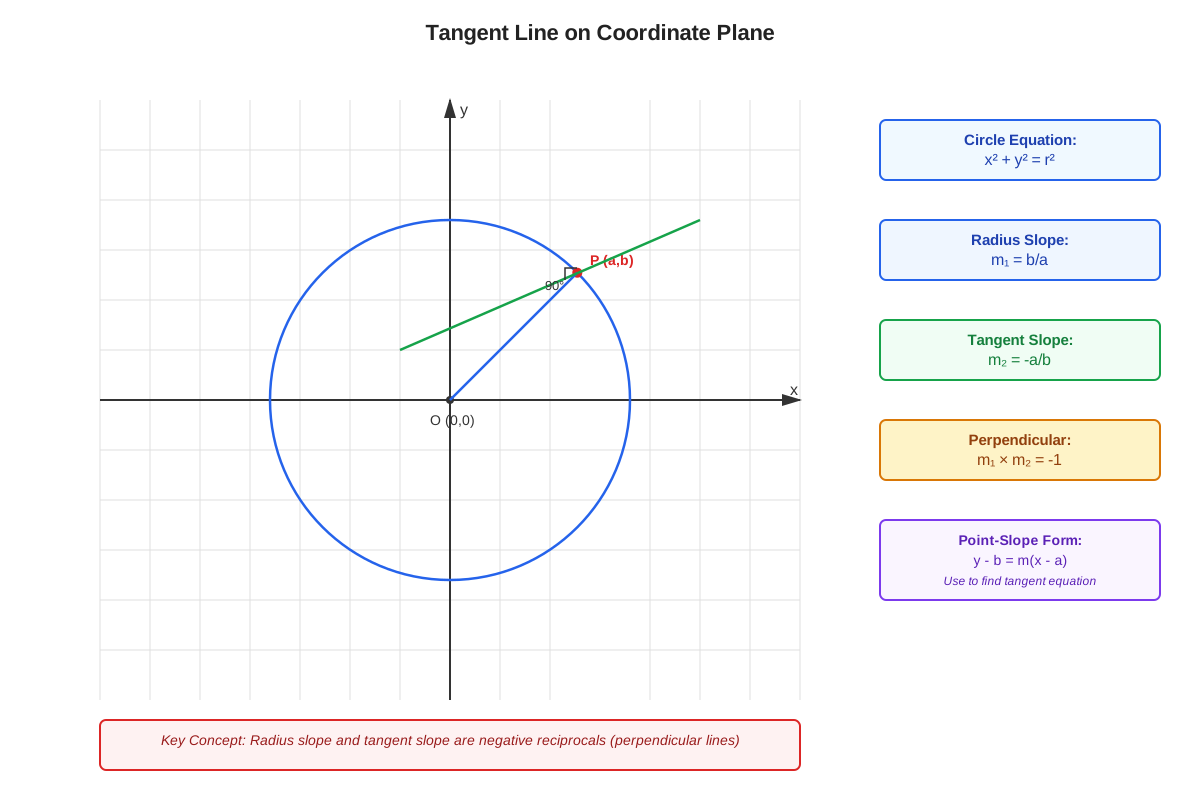
- Find the slope of the radius to the tangency point
- Calculate the negative reciprocal to get the tangent line's slope (perpendicular lines have negative reciprocal slopes)
- Use point-slope form with the tangency point and calculated slope
For a circle centered at the origin, if the tangency point is (a, b), the radius has slope b/a, so the tangent line has slope -a/b. The tangent line equation becomes:
y - b = (-a/b)(x - a)Common Tangent Configurations
| Configuration | Description | Key Property |
|---|---|---|
| External tangent | Tangent line touching two circles, not passing between them | Length can be calculated using the difference of radii |
| Internal tangent | Tangent line touching two circles, passing between them | Length involves the sum of radii |
| Tangent from external point | Single line from a point outside the circle | Forms right triangle with radius |
| Tangent at a point | Line touching circle at one specific point | Perpendicular to radius at that point |
Angles Formed by Tangents
When two tangents are drawn from an external point, they form an angle at that point. The measure of this angle relates to the arc intercepted between the two tangency points. Specifically, if the angle between the tangents is θ, and the arc between tangency points (measured from the center) is α, then:
θ = 180° - αThis relationship occasionally appears in more complex SAT problems combining angle measurement with tangent properties.
Concept Relationships
The tangent concepts form a hierarchical structure where the fundamental perpendicular property serves as the foundation for all other relationships. Perpendicular tangent theorem → enables → right triangle formation → enables → Pythagorean theorem applications → enables → tangent segment length calculations.
The two-tangent theorem connects to the perpendicular property through triangle congruence: perpendicular radii to tangency points → create → congruent right triangles → prove → equal tangent segment lengths.
Coordinate plane applications build on basic tangent properties: perpendicular relationship → translates to → negative reciprocal slopes → enables → tangent line equation determination. Similarly, distance from center to line → compared with → radius length → determines → tangent status of line.
Tangent concepts connect backward to prerequisite topics: they require circle fundamentals (radius, center) as the geometric objects being studied, Pythagorean theorem as the computational engine, and coordinate geometry as the algebraic framework. They connect forward to more advanced topics like conic sections (where tangent lines to parabolas, ellipses, and hyperbolas follow similar principles) and calculus (where tangent lines represent instantaneous rates of change).
The integration of tangents with other SAT topics creates multi-step problems: tangents + similar triangles in problems with multiple circles, tangents + systems of equations when finding intersection points, tangents + special right triangles (30-60-90 or 45-45-90) when specific angle measures appear.
High-Yield Facts
⭐ A tangent line is perpendicular to the radius at the point of tangency—this creates a 90° angle that enables use of the Pythagorean theorem
⭐ Two tangent segments drawn from the same external point to a circle have equal length
⭐ The length of a tangent segment from an external point equals √(d² - r²), where d is the distance from the point to the center and r is the radius
⭐ On the coordinate plane, a line is tangent to a circle if the perpendicular distance from the center to the line exactly equals the radius
⭐ The slope of a tangent line is the negative reciprocal of the slope of the radius to the tangency point
- A tangent line intersects a circle at exactly one point, distinguishing it from secants (two points) and non-intersecting lines (zero points)
- When a tangent and radius meet at the point of tangency, they form a right angle, creating right triangles in virtually all tangent problems
- For circles centered at the origin (0, 0), if the tangency point is (a, b), the tangent line has slope -a/b
- The distance formula d = √[(x₂-x₁)² + (y₂-y₁)²] frequently appears in tangent problems to find the distance from an external point to the circle's center
- Common tangents to two circles can be external (not passing between circles) or internal (passing between circles), with different length formulas
- In problems with multiple tangent segments from one external point, setting up equations using the equal-length property often leads to algebraic solutions
- The angle formed by two tangents from an external point and the central angle of the intercepted arc are supplementary (sum to 180°)
- Tangent problems often combine with inscribed or circumscribed polygons, where sides or extensions are tangent to circles
Quick check — test yourself on Tangents so far.
Try Flashcards →Common Misconceptions
Misconception: A tangent line can touch a circle at multiple points if it's long enough → Correction: By definition, a tangent touches a circle at exactly one point. If a line intersects a circle at two points, it's a secant, not a tangent, regardless of the line's length.
Misconception: The tangent line is perpendicular to the circle → Correction: A tangent line is perpendicular to the radius at the point of tangency, not to the circle itself. The circle is a curve, not a line, so "perpendicular to the circle" is meaningless. Always identify the radius to establish the perpendicular relationship.
Misconception: When calculating tangent segment length, the radius is the hypotenuse of the right triangle → Correction: The radius is actually one leg of the right triangle. The hypotenuse is the distance from the external point to the circle's center. The tangent segment is the other leg. This error leads to using the wrong formula: PT² = d² + r² (wrong) instead of PT² + r² = d² (correct).
Misconception: Two tangent segments from an external point are equal only if the circle is centered at the origin → Correction: The two-tangent theorem applies to all circles regardless of their position. The equal-length property depends only on the geometric relationship between the external point and the circle, not on the coordinate system or circle's location.
Misconception: To find a tangent line equation, you need calculus or derivatives → Correction: On the SAT, tangent line equations are found using algebra and the perpendicular slope relationship. Find the radius slope, take its negative reciprocal for the tangent slope, then use point-slope form. No calculus is required or expected.
Misconception: If a line passes close to a circle without intersecting it, it's "almost tangent" and can be treated as tangent for approximation → Correction: A line either is or isn't tangent—there's no "almost tangent" category. The perpendicular distance from center to line must exactly equal the radius. Even a tiny deviation means the line is not tangent, and using tangent properties will yield incorrect answers.
Worked Examples
Example 1: Finding Tangent Segment Length
Problem: A circle has center O at the origin and radius 5. Point P is located at coordinates (13, 0). A line segment from P is tangent to the circle at point T. What is the length of segment PT?
Solution:
Step 1: Identify the given information
- Circle center O at (0, 0)
- Radius r = 5
- External point P at (13, 0)
Step 2: Find the distance from P to center O
Since both points lie on the x-axis, the distance is simply:
d = 13 - 0 = 13
Step 3: Recognize the right triangle
The tangent segment PT, radius OT, and segment OP form a right triangle with the right angle at T (because tangent ⊥ radius).
Step 4: Apply the Pythagorean theorem
- OT = 5 (radius, one leg)
- OP = 13 (hypotenuse)
- PT = ? (other leg)
PT² + OT² = OP²
PT² + 5² = 13²
PT² + 25 = 169
PT² = 144
PT = 12
Answer: The length of tangent segment PT is 12.
Connection to learning objectives: This problem demonstrates applying tangent properties (perpendicular relationship) to answer SAT-style questions using the Pythagorean theorem, addressing objectives about identifying key features and applying tangents to solve problems.
Example 2: Determining if a Line is Tangent
Problem: A circle has equation (x - 3)² + (y + 2)² = 25. Is the line 3x + 4y = 0 tangent to this circle?
Solution:
Step 1: Identify circle properties from the equation
- Center: (3, -2) [from (x - h)² + (y - k)² = r²]
- Radius: r = 5 [from r² = 25]
Step 2: Find the perpendicular distance from center to line
For line Ax + By + C = 0, rewrite 3x + 4y = 0 as 3x + 4y + 0 = 0
So A = 3, B = 4, C = 0
Distance formula: d = |Ah + Bk + C| / √(A² + B²)
d = |3(3) + 4(-2) + 0| / √(3² + 4²)
d = |9 - 8 + 0| / √(9 + 16)
d = |1| / √25
d = 1/5
Step 3: Compare distance to radius
- Distance from center to line: 1/5 = 0.2
- Radius: 5
Since 0.2 ≠ 5, the distance does not equal the radius.
Answer: No, the line is not tangent to the circle. The line actually passes through the interior of the circle (since distance < radius), intersecting it at two points.
Connection to learning objectives: This example shows how tangents appear on the SAT in coordinate geometry format, requiring students to explain the relationship between distance and tangency while applying the distance formula—a key SAT skill.
Example 3: Finding Tangent Line Equation
Problem: A circle centered at the origin has radius 5. Find the equation of the tangent line at the point (3, 4) on the circle.
Solution:
Step 1: Verify the point is on the circle
3² + 4² = 9 + 16 = 25 = 5² ✓
Step 2: Find the slope of the radius to point (3, 4)
Slope of radius = (4 - 0)/(3 - 0) = 4/3
Step 3: Find the slope of the tangent line
Since tangent ⊥ radius, the tangent slope is the negative reciprocal:
Tangent slope = -3/4
Step 4: Use point-slope form
y - y₁ = m(x - x₁)
y - 4 = (-3/4)(x - 3)
y - 4 = (-3/4)x + 9/4
y = (-3/4)x + 9/4 + 4
y = (-3/4)x + 9/4 + 16/4
y = (-3/4)x + 25/4
Or in standard form: 3x + 4y = 25
Answer: The tangent line equation is y = (-3/4)x + 25/4 or 3x + 4y = 25.
Connection to learning objectives: This problem integrates multiple tangent concepts—identifying the perpendicular relationship, calculating slopes, and determining equations—demonstrating how tangents appear in coordinate geometry questions on the SAT.
Exam Strategy
When approaching SAT tangent questions, immediately scan for the presence of a radius and tangent line meeting at a point. This visual cue signals that a right angle exists, making the Pythagorean theorem your primary tool. If the diagram doesn't show the radius to the tangency point, draw it yourself—this simple addition transforms abstract problems into solvable right triangle calculations.
Trigger words and phrases that indicate tangent problems include: "touches the circle at one point," "tangent to the circle," "perpendicular to the radius," "external point," and "line segment from outside the circle." When you see these phrases, activate your tangent problem-solving protocol: identify the center, locate the radius, find the right angle, and apply the Pythagorean theorem.
For coordinate plane tangent questions, the distance formula becomes your verification tool. Calculate the distance from the center to any point on the supposed tangent line—if this distance equals the radius, the line is tangent. This method works faster than algebraic substitution for multiple-choice questions where you're testing whether given lines are tangent.
Process-of-elimination strategies specific to tangents:
- If a problem asks for tangent segment length and you've calculated using the Pythagorean theorem, eliminate any answer choice larger than the distance from the external point to the center (the hypotenuse sets the upper limit)
- For questions about whether lines are tangent, eliminate choices that would require the line to intersect the circle at two points or miss it entirely
- When finding tangent line equations, eliminate any slope that isn't the negative reciprocal of the radius slope
- In problems with two tangent segments from one external point, eliminate answers that give different lengths for the two segments
Time allocation: Simple tangent length problems should take 45-60 seconds once you recognize the setup. Coordinate plane tangent questions requiring distance calculations may need 90-120 seconds. Multi-step problems combining tangents with other concepts deserve up to 2 minutes. If you're spending more than 2 minutes on a tangent problem, you've likely missed the key insight (usually the perpendicular relationship or the two-tangent theorem)—mark it and return later.
Always check reasonableness: tangent segment length must be positive and less than the distance from the external point to the center. Tangent line slopes must be negative reciprocals of radius slopes. These quick sanity checks catch calculation errors before you bubble in wrong answers.
Memory Techniques
"TRAP" for tangent problem setup:
- Tangent line identified
- Radius drawn to tangency point
- Angle is 90° where they meet
- Pythagorean theorem applied
"Two from One = Equal Fun" reminds you that two tangent segments from one external point are equal in length.
Visualization strategy: Picture a bicycle wheel with a stick touching it at one point. The stick (tangent) can't pass through the wheel, and if you imagine the spoke (radius) going to where the stick touches, they form a perfect corner (90°). This concrete image helps recall the perpendicular relationship.
Slope reciprocal mnemonic: "Flip and Nip" (flip the fraction, nip/change the sign) for finding perpendicular slopes. If radius slope is 3/4, flip to 4/3, then nip the sign to get -4/3 for the tangent slope.
Distance formula acronym "DREAD" for remembering when to use it in tangent problems:
- Distance from center to external point
- Radius length known
- External tangent segment needed
- Apply Pythagorean theorem
- Difference of squares: d² - r² = tangent²
For coordinate plane tangent verification, remember "DER": Distance from center to line Equals Radius means the line is tangent.
Summary
Tangents represent a high-yield SAT math topic centered on one fundamental property: a tangent line is perpendicular to the radius at the point of tangency. This perpendicular relationship creates right triangles that enable application of the Pythagorean theorem to calculate tangent segment lengths. The formula PT = √(d² - r²) captures this relationship, where d is the distance from an external point to the circle's center and r is the radius. Two tangent segments from the same external point always have equal length, a property frequently tested in algebraic and geometric contexts. On the coordinate plane, tangent problems require calculating perpendicular distances from centers to lines and comparing these distances to radii, or finding tangent line equations using negative reciprocal slopes. Mastery of tangents involves recognizing the standard problem setups, drawing appropriate radii to create right triangles, and fluently applying the Pythagorean theorem and slope relationships. These skills integrate with broader SAT math concepts including coordinate geometry, triangle properties, and algebraic manipulation, making tangents a nexus topic that appears in 2-4 questions per exam across various difficulty levels.
Key Takeaways
- A tangent line touches a circle at exactly one point and is always perpendicular to the radius at that point, creating a 90° angle
- The perpendicular relationship enables the Pythagorean theorem: tangent segment length = √(d² - r²), where d is the distance from external point to center
- Two tangent segments drawn from the same external point to a circle have equal length—use this property to set up equations
- On the coordinate plane, a line is tangent to a circle when the perpendicular distance from center to line exactly equals the radius
- The tangent line slope is the negative reciprocal of the radius slope at the tangency point
- Always draw the radius to the tangency point if it's not shown—this reveals the right triangle structure
- Tangent problems frequently combine with other SAT topics like the distance formula, special right triangles, and coordinate geometry
Related Topics
Secants and Chords: Lines that intersect circles at two points, with related theorems about segment lengths and angle measures. Mastering tangents provides the foundation for understanding these more complex circle-line relationships.
Inscribed and Circumscribed Polygons: Figures where sides are tangent to circles (inscribed circles) or vertices lie on circles (circumscribed circles). Tangent properties determine side lengths and angle relationships in these configurations.
Circle Equations and Transformations: Advanced work with circle equations in various forms, including completing the square and applying transformations. Tangent concepts extend to finding tangent lines to transformed circles.
Power of a Point: A theorem relating lengths of segments from an external point to a circle, generalizing tangent segment relationships. The tangent case (PT² = PA · PB for secant through A and B) represents a special application.
Trigonometry with Circles: Angles formed by tangents, radii, and chords connect to trigonometric ratios. Understanding tangent geometry provides the foundation for unit circle concepts in precalculus.
Practice CTA
Now that you've mastered the core concepts of tangents, it's time to solidify your understanding through active practice. Attempt the practice questions to test your ability to recognize tangent setups, apply the perpendicular property, and execute calculations accurately under timed conditions. Use the flashcards to drill the high-yield facts until they become automatic—on test day, you won't have time to derive these relationships from scratch. Remember, tangent problems reward pattern recognition: the more problems you solve, the faster you'll identify the right triangle structure that unlocks each solution. Your investment in practice now translates directly to points on the SAT!
Sign up free to keep reading
Create a free AnvayaPrep account to finish this SAT guide on Tangents — plus flashcards and practice questions.