Overview
Bias in statistics refers to systematic errors that skew data collection, analysis, or interpretation in a particular direction, leading to results that do not accurately represent the population being studied. On the SAT, understanding bias is crucial for the Data Analysis and Statistics questions that appear in the math section. These questions test whether students can identify flawed study designs, recognize sampling problems, and determine when conclusions drawn from data are invalid or overgeneralized.
The SAT frequently presents scenarios involving surveys, experiments, and observational studies where students must evaluate the validity of conclusions based on how data was collected. Questions about sat bias typically ask students to identify which sampling method introduces bias, explain why a particular conclusion cannot be drawn from given data, or recognize when a study's design prevents generalization to a broader population. These questions assess critical thinking about statistical methodology rather than computational skills.
Understanding bias connects directly to broader mathematical concepts including probability, sampling methods, and data interpretation. It also reinforces logical reasoning skills that appear throughout the SAT math section. Mastering bias helps students approach data-driven questions with appropriate skepticism, evaluate the strength of statistical claims, and distinguish between correlation and causation—all essential skills for achieving a high score on the exam.
Learning Objectives
- [ ] Identify key features of bias in statistical studies and surveys
- [ ] Explain how bias appears on the SAT in various question formats
- [ ] Apply bias concepts to answer SAT-style questions accurately
- [ ] Distinguish between different types of bias (selection, response, non-response, measurement)
- [ ] Evaluate whether a sampling method produces representative data
- [ ] Determine when conclusions from a study can be generalized to a larger population
- [ ] Recognize the difference between biased and unbiased sampling techniques
Prerequisites
- Basic understanding of populations and samples: Necessary to understand when a sample accurately represents a larger group
- Familiarity with percentages and proportions: Required to interpret survey results and understand representation
- Knowledge of basic experimental design: Helps distinguish between different study types and their limitations
- Understanding of random selection: Essential for recognizing when sampling methods are fair versus biased
Why This Topic Matters
In real-world applications, bias affects everything from political polling and medical research to product reviews and social media algorithms. Understanding bias enables informed citizenship—helping individuals evaluate news reports, scientific studies, and marketing claims critically. Professionals in fields ranging from medicine to business rely on unbiased data to make decisions affecting millions of people.
On the SAT, bias questions appear with high frequency in the Problem Solving and Data Analysis domain, which comprises approximately 29% of the math section (about 8 questions on the digital SAT). These questions typically appear as word problems describing surveys, experiments, or studies, asking students to identify flaws in methodology or limitations in conclusions. The College Board emphasizes these questions because they assess real-world reasoning skills that colleges value.
Common SAT question formats include: identifying which sampling method introduces bias; determining whether a conclusion is justified based on the sample; recognizing when a study's results cannot be generalized; and selecting the most appropriate sampling method to avoid bias. These questions often appear in the medium-to-hard difficulty range and can significantly impact scores because they require conceptual understanding rather than formula memorization.
Core Concepts
What is Statistical Bias?
Bias in statistics occurs when a systematic error causes data to consistently favor certain outcomes over others, resulting in measurements or conclusions that do not accurately reflect reality. Unlike random errors that average out over many observations, bias pushes results consistently in one direction. A biased sample fails to represent the population it claims to describe, making any conclusions drawn from it unreliable or misleading.
For example, if a school wants to determine average student satisfaction but only surveys students in advanced classes, the sample is biased because it excludes perspectives from students in regular or remedial courses. The resulting data will systematically overrepresent the views of high-achieving students.
Types of Bias
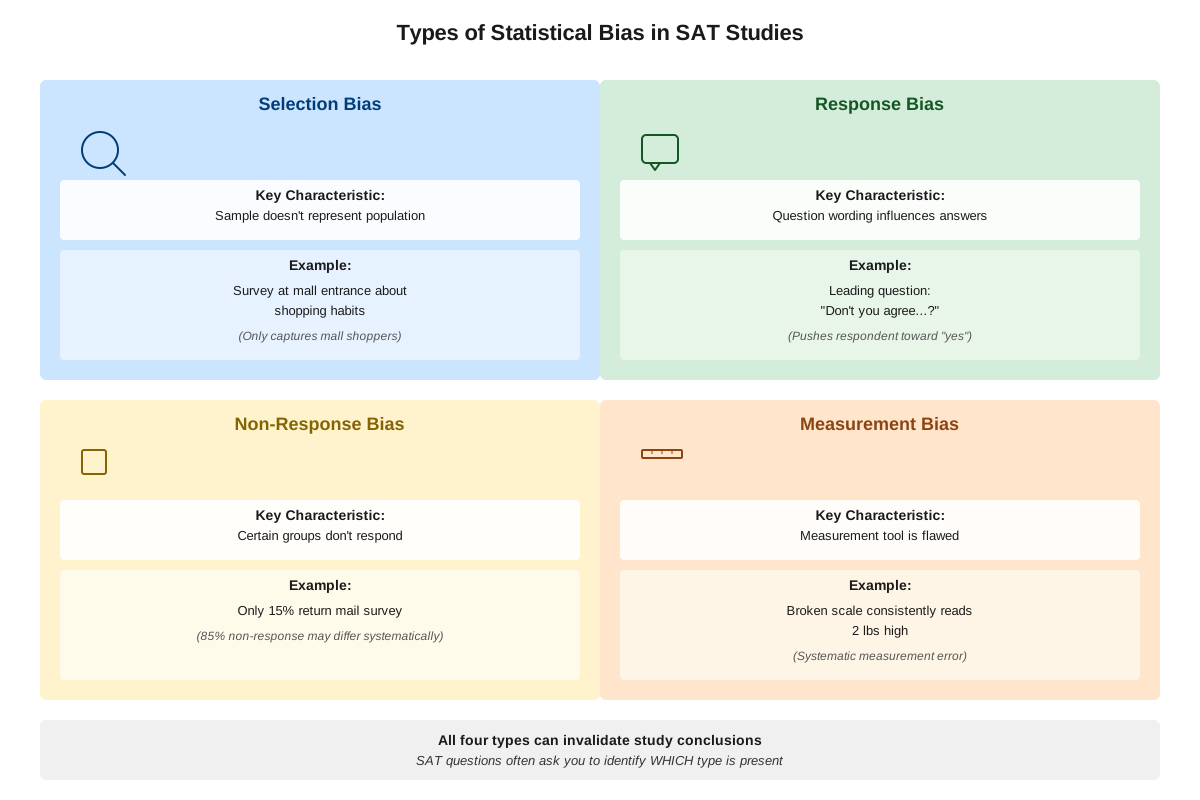
Selection Bias (Sampling Bias)
Selection bias occurs when the method of choosing participants systematically excludes or underrepresents certain groups within the population. This is the most common type of bias tested on the SAT. Selection bias happens when the sampling method itself creates a non-representative sample.
Examples of selection bias include:
- Surveying only people who volunteer to participate (volunteers may differ systematically from non-volunteers)
- Conducting phone surveys during business hours (excludes working people)
- Sampling only from one location when the population is geographically diverse
- Using convenience sampling (surveying whoever is easiest to reach)
Response Bias
Response bias occurs when the way questions are asked, the survey format, or the survey context influences how people answer, causing responses to differ from their true opinions or behaviors. This includes:
- Leading questions that suggest a "correct" answer
- Social desirability bias where respondents give answers they think are more acceptable
- Question order effects where earlier questions influence later responses
- Interviewer bias where the presence or characteristics of an interviewer affects responses
Non-Response Bias
Non-response bias occurs when people who choose not to participate in a survey differ systematically from those who do participate. If only 20% of people return a mailed survey, those who responded may have stronger opinions or different characteristics than the 80% who didn't respond, making the results unrepresentative.
Measurement Bias
Measurement bias occurs when the instrument or method used to collect data consistently produces inaccurate measurements in a particular direction. This might involve faulty equipment, poorly worded questions, or inconsistent data collection procedures.
Random Sampling vs. Biased Sampling
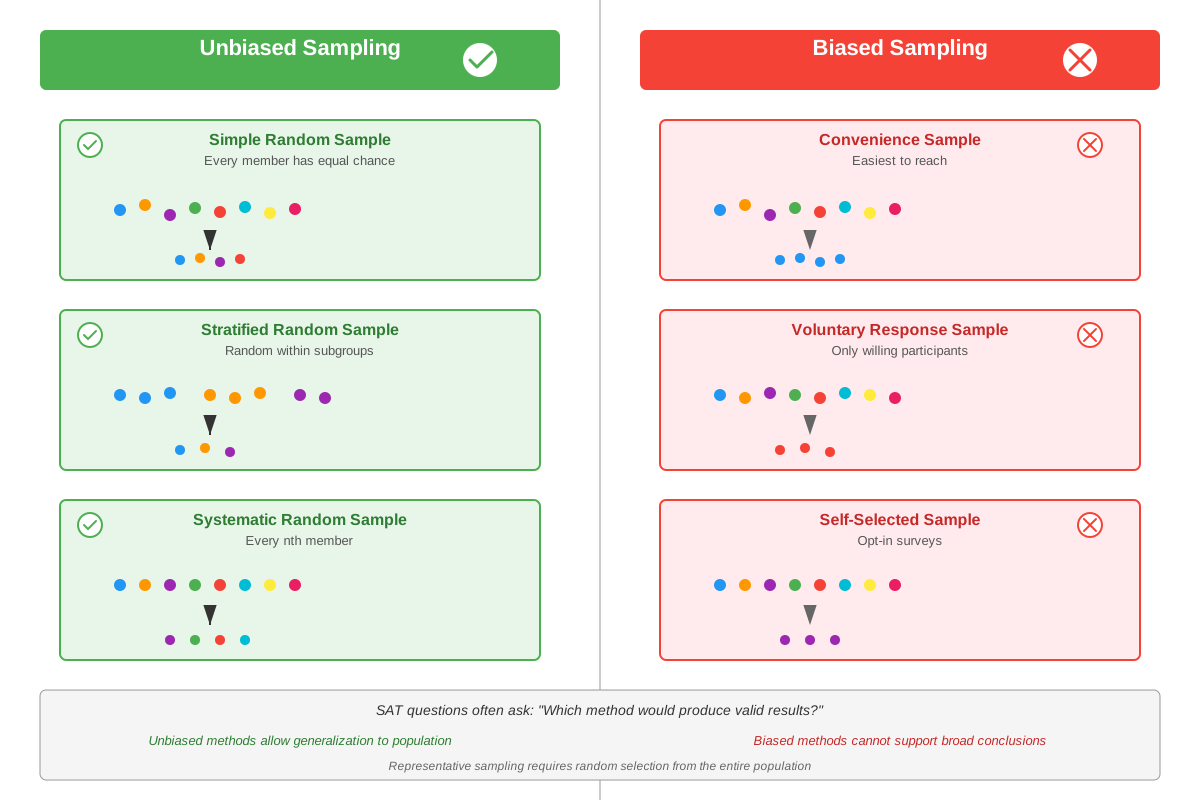
| Sampling Method | Description | Bias Status | SAT Relevance |
|---|---|---|---|
| Simple Random Sample | Every member of the population has equal chance of selection | Unbiased | Gold standard for comparison |
| Stratified Random Sample | Population divided into groups; random samples from each group | Unbiased | Ensures representation of subgroups |
| Systematic Random Sample | Select every nth member after random start | Generally unbiased | Acceptable if no hidden patterns |
| Convenience Sample | Survey whoever is easiest to reach | Biased | Common wrong answer choice |
| Voluntary Response Sample | Only people who choose to participate | Biased | Frequently tested on SAT |
| Self-Selected Sample | Participants opt in themselves | Biased | Similar to voluntary response |
Generalizability and Valid Conclusions
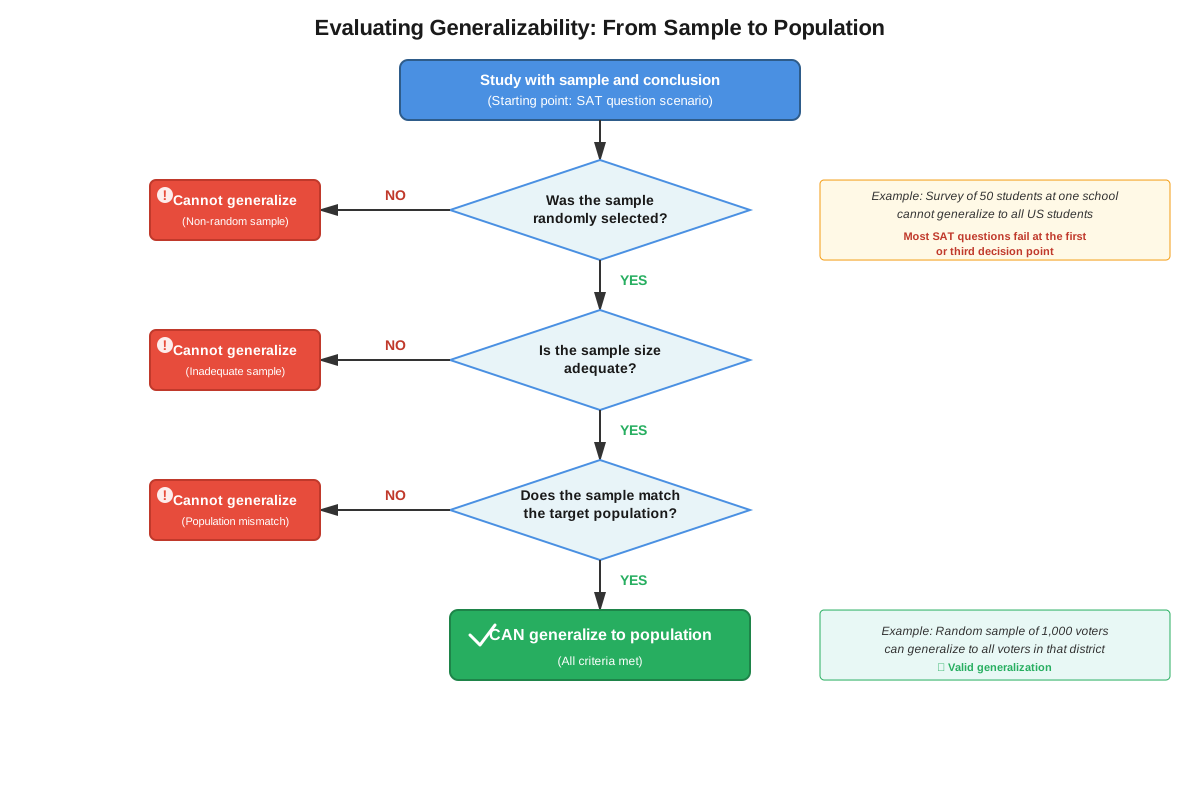
A critical concept for the SAT is understanding when conclusions can be generalized from a sample to a larger population. Valid generalization requires:
- Representative sample: The sample must accurately reflect the population's characteristics
- Adequate sample size: Larger samples generally provide more reliable results
- Random selection: Randomization helps ensure representativeness
- Appropriate population definition: Conclusions apply only to the population from which the sample was drawn
For example, if researchers survey 500 randomly selected students at one high school about study habits, they can generalize to all students at that school, but NOT to all high school students nationwide, because students at different schools may have different characteristics.
Identifying Bias in SAT Questions
SAT questions about bias typically present a scenario and ask students to:
- Identify the flaw in the sampling method
- Determine what population the results represent
- Recognize limitations in the conclusions
- Select an improved sampling method
Key indicators of bias in SAT scenarios:
- Voluntary participation ("students who chose to respond")
- Convenience sampling ("surveyed people at the mall")
- Limited location ("only surveyed one neighborhood")
- Specific time constraints ("surveyed during morning hours")
- Self-selection ("posted survey on website")
- Non-random selection ("surveyed every student in advanced classes")
Concept Relationships
The concepts within bias are hierarchically connected: Statistical bias (the overarching concept) → manifests as different types → Selection bias, Response bias, Non-response bias, and Measurement bias → each type affects → Generalizability of conclusions.
Selection bias connects directly to sampling methods: random sampling methods avoid selection bias, while convenience and voluntary response sampling create selection bias. Response bias relates to survey design and question wording, showing how the data collection instrument itself can introduce systematic errors.
All types of bias ultimately affect generalizability—the ability to apply sample results to the broader population. This connects to prerequisite knowledge of populations versus samples and extends to more advanced concepts like confidence intervals and margin of error (though these specific calculations are less emphasized on the SAT).
The relationship between bias and experimental design is also crucial: even with perfect sampling, poor experimental design (like lack of control groups or confounding variables) can bias results. This connects bias to broader statistical reasoning skills tested throughout the SAT math section.
Understanding bias also reinforces logical reasoning: recognizing that correlation doesn't imply causation, identifying when evidence supports a claim, and evaluating the strength of arguments—skills that appear in both math and reading sections of the SAT.
High-Yield Facts
⭐ Voluntary response samples are always biased because people who choose to respond typically have stronger opinions than those who don't respond.
⭐ Convenience samples introduce selection bias because they systematically exclude people who are not easily accessible to the surveyor.
⭐ Results can only be generalized to the population from which the sample was drawn, not to broader populations with different characteristics.
⭐ Random sampling is the key to avoiding selection bias—every member of the population must have an equal chance of being selected.
⭐ Sample size alone cannot fix bias—a large biased sample is still biased and produces unreliable results.
- Leading questions introduce response bias by suggesting a preferred answer to respondents.
- Non-response bias occurs when the people who don't respond differ systematically from those who do respond.
- Surveying only one location when the population is geographically diverse creates selection bias.
- Self-selected samples (like online polls where people choose to participate) are inherently biased.
- Stratified random sampling can be unbiased if random selection occurs within each stratum (subgroup).
- The presence of bias in a study means conclusions drawn from that study are not reliable for the stated population.
- Time-of-day restrictions in sampling (like surveying only during business hours) can introduce selection bias by excluding certain groups.
Quick check — test yourself on Bias so far.
Try Flashcards →Common Misconceptions
Misconception: A larger sample size automatically makes a study unbiased and reliable.
Correction: Sample size and bias are independent issues. A sample of 10,000 people selected through voluntary response is still biased, while a random sample of 100 might be unbiased. Bias is about HOW the sample is selected, not how large it is.
Misconception: If a sample includes people from different groups, it must be representative and unbiased.
Correction: Simply including diverse participants doesn't eliminate bias if the selection method itself is flawed. A convenience sample that happens to include various demographics is still biased because it wasn't randomly selected.
Misconception: Bias only affects surveys and doesn't apply to experiments or observational studies.
Correction: Bias can affect any type of study. Experiments can have selection bias in how participants are recruited, measurement bias in how outcomes are recorded, and response bias in how participants report symptoms or behaviors.
Misconception: If most people in a sample agree on something, the result must be valid for the population.
Correction: Strong agreement within a biased sample doesn't make the results valid. If 95% of voluntary respondents support a policy, this doesn't mean 95% of the population supports it—those who chose to respond may be systematically different from non-respondents.
Misconception: Random sampling means surveying random people you encounter.
Correction: True random sampling requires a systematic process where every member of the defined population has a known, equal probability of selection. Surveying "random" people you happen to meet is actually convenience sampling, which is biased.
Misconception: Bias can be corrected after data collection through statistical adjustments.
Correction: While some statistical techniques can partially adjust for known biases, fundamentally biased data collection cannot be fully corrected after the fact. Prevention through proper study design is essential.
Worked Examples
Example 1: Identifying Selection Bias
Question: A researcher wants to determine the average amount of time high school students in a district spend on homework each night. She surveys 200 students who attend an after-school tutoring program. Based on this sample, she concludes that students in the district spend an average of 3.5 hours per night on homework. Which of the following best explains why this conclusion may not be valid?
A) The sample size is too small to draw reliable conclusions.
B) Students who attend tutoring programs may spend more time on homework than typical students.
C) The survey should have asked about homework time per week instead of per night.
D) Random sampling would have produced a different average.
Solution:
Step 1: Identify the population and sample.
- Population: All high school students in the district
- Sample: 200 students who attend an after-school tutoring program
Step 2: Evaluate the sampling method.
The researcher used convenience sampling by surveying students at a tutoring program. This is not a random sample of all students in the district.
Step 3: Identify the type of bias.
This introduces selection bias because students who attend tutoring programs likely differ systematically from the general student population. They may be more academically motivated, struggling with coursework (requiring more homework time), or have different study habits than students who don't attend tutoring.
Step 4: Evaluate each answer choice.
- A) Incorrect: 200 is a reasonable sample size; the problem is HOW they were selected, not how many.
- B) Correct: This directly identifies the selection bias—tutoring students are not representative of all students.
- C) Incorrect: The time unit doesn't address the fundamental sampling problem.
- D) Incorrect: While true, this doesn't explain WHY the conclusion is invalid.
Answer: B
Connection to learning objectives: This example demonstrates identifying selection bias and explaining why conclusions cannot be generalized from a biased sample to the broader population.
Example 2: Evaluating Sampling Methods
Question: A city council wants to determine residents' opinions about a proposed park renovation. Which of the following sampling methods would be LEAST likely to introduce bias?
A) Posting a survey on the city's website and analyzing responses from residents who choose to participate
B) Surveying people who visit the park on Saturday morning
C) Randomly selecting 500 residential addresses from city records and mailing surveys to those addresses
D) Surveying residents who attend a city council meeting about the park renovation
Solution:
Step 1: Analyze each sampling method for potential bias.
Option A: Posting online and accepting voluntary responses
- Creates voluntary response bias and self-selection bias
- Only people with strong opinions or internet access will respond
- Not representative of all residents
Option B: Surveying park visitors on Saturday morning
- Creates selection bias through convenience sampling
- Excludes people who don't visit the park, visit at other times, or work on Saturdays
- Park users likely have different opinions than non-users
Option C: Random selection from city residential addresses
- Uses random sampling from the complete population
- Every resident has equal chance of selection
- Most likely to produce representative sample
- Note: Non-response could still be an issue, but the selection method itself is unbiased
Option D: Surveying city council meeting attendees
- Creates selection bias through convenience sampling
- Only includes people motivated enough to attend meetings
- These residents likely have stronger opinions than typical residents
Step 2: Identify the least biased method.
Option C uses random selection from a complete list of the population, making it the least likely to introduce bias.
Answer: C
Connection to learning objectives: This example requires applying knowledge of different bias types to evaluate sampling methods and select the most appropriate approach for obtaining representative data.
Exam Strategy
Approaching SAT Bias Questions
Step 1: Identify the population and sample
Always start by determining what population the study claims to represent and what sample was actually used. Look for mismatches between these two groups.
Step 2: Evaluate the sampling method
Ask yourself: "Did every member of the population have an equal chance of being selected?" If not, selection bias exists.
Step 3: Look for trigger words indicating bias
- "Volunteered" or "chose to participate" → voluntary response bias
- "Convenient" or "available" → convenience sampling bias
- "Posted online" or "website survey" → self-selection bias
- "At one location" or specific time → selection bias
- "Leading question" or "suggested" → response bias
Step 4: Check the scope of conclusions
Determine whether the conclusion overgeneralizes beyond the actual sample population. Even an unbiased sample of one school cannot represent all schools nationwide.
Process of Elimination Tips
Eliminate answers that:
- Confuse sample size with bias (large biased samples are still biased)
- Suggest bias exists when random sampling was used
- Claim results can be generalized beyond the sampled population
- Focus on irrelevant details rather than sampling methodology
Keep answers that:
- Identify specific types of bias (selection, response, non-response)
- Recognize limitations in generalizability
- Suggest random sampling as an improvement
- Acknowledge that voluntary participation creates bias
Time Allocation
Bias questions typically require 60-90 seconds. Spend:
- 20 seconds reading and identifying population/sample
- 20 seconds evaluating the sampling method
- 20 seconds eliminating wrong answers
- 10 seconds confirming your choice
Exam Tip: If a question describes a sampling method and asks about validity of conclusions, the answer almost always involves identifying bias or limitations in generalizability. Don't overthink—look for the obvious flaw in how participants were selected.
Memory Techniques
VCRM Mnemonic for Bias Types
Voluntary response bias (people choose to participate)
Convenience sampling bias (easiest people to reach)
Response bias (how questions are asked affects answers)
Measurement bias (faulty instruments or procedures)
The "Equal Chance" Rule
Remember: "Random means EQUAL chance"—if every member of the population doesn't have an equal probability of selection, the sampling method introduces bias.
Generalization Visualization
Picture a target with concentric circles:
- Bullseye = the actual sample
- First ring = the population from which the sample was drawn (valid generalization)
- Outer rings = broader populations (invalid generalization)
Results can only be generalized to the first ring, not the outer rings.
The "Volunteer Problem" Phrase
Remember: "Volunteers are different"—people who choose to participate systematically differ from those who don't, making voluntary response samples always biased.
RANDOM Acronym for Unbiased Sampling
Representative of population
All members have equal chance
No self-selection
Defined population clearly
Objective selection process
Method is systematic
Summary
Bias in statistics refers to systematic errors in data collection or analysis that cause results to consistently misrepresent the population being studied. On the SAT, understanding bias is essential for evaluating the validity of surveys, experiments, and observational studies. The most important types of bias are selection bias (when the sampling method excludes or underrepresents certain groups), response bias (when question wording or survey format influences answers), and non-response bias (when non-respondents differ from respondents). Random sampling—where every population member has equal selection probability—is the key to avoiding selection bias. Students must recognize that sample size alone cannot fix bias, that voluntary response samples are inherently biased, and that conclusions can only be generalized to the population from which the sample was actually drawn. SAT questions typically present scenarios requiring students to identify flawed sampling methods, recognize limitations in conclusions, or select appropriate unbiased sampling techniques. Mastering bias requires understanding both the technical definitions and the practical ability to spot red flags like convenience sampling, voluntary participation, and overgeneralization in question stems.
Key Takeaways
- Bias is systematic error that consistently skews results in one direction, making them unrepresentative of the true population
- Random sampling prevents selection bias by giving every population member an equal chance of selection
- Voluntary response and convenience samples are always biased because they systematically exclude certain types of people
- Large sample size does not eliminate bias—a huge biased sample is still biased and produces unreliable results
- Conclusions can only be generalized to the population from which the sample was drawn, not to broader or different populations
- Look for trigger words like "volunteered," "convenient," "posted online," or "at one location" to identify bias in SAT questions
- The sampling method matters more than the sample size when evaluating whether a study's conclusions are valid
Related Topics
Experimental Design and Causation: Understanding bias in observational studies connects to recognizing when experiments can establish causation versus mere correlation. Proper experimental design with control groups and randomization helps eliminate bias.
Confidence Intervals and Margin of Error: While the SAT focuses less on calculations, understanding that these statistical measures assume unbiased sampling helps contextualize why bias matters for data interpretation.
Probability and Expected Value: Random sampling relies on probability principles—each selection is an independent event with known probability, connecting bias concepts to fundamental probability theory.
Data Interpretation and Graph Analysis: Recognizing bias helps students critically evaluate data presented in tables, charts, and graphs, questioning whether the underlying data collection was sound.
Mastering bias provides the foundation for advanced statistical reasoning and critical evaluation of quantitative claims—skills valuable far beyond the SAT.
Practice CTA
Now that you understand the key concepts of bias and how to identify it in statistical studies, it's time to reinforce your learning through practice. Attempt the practice questions to test your ability to recognize different types of bias, evaluate sampling methods, and determine when conclusions are valid. Use the flashcards to memorize key definitions and trigger words that signal bias on the SAT. Remember: recognizing bias is a skill that improves with practice, and these questions mirror exactly what you'll see on test day. Each practice problem you complete builds your confidence and speed for the real exam. You've got this!
Sign up free to keep reading
Create a free AnvayaPrep account to finish this SAT guide on Bias — plus flashcards and practice questions.