Overview
The margin of error is a fundamental statistical concept that quantifies the uncertainty inherent in survey results, polls, and sample-based estimates. On the SAT, this topic appears regularly in the Problem Solving and Data Analysis domain, where students must interpret confidence intervals, understand sampling variability, and make informed conclusions about population parameters based on sample data. The margin of error represents the range within which the true population value is likely to fall, typically expressed as "plus or minus" a certain amount from the sample statistic.
Understanding margin of error is essential for SAT success because it bridges theoretical statistics with practical interpretation—a skill the College Board emphasizes heavily. Questions involving margin of error test whether students can read statistical claims critically, distinguish between sample statistics and population parameters, and recognize the limitations of data-based conclusions. This topic frequently appears in context-rich problems that require students to analyze survey results, polling data, or scientific studies presented in tables or graphs.
The margin of error concept connects directly to broader math principles including percentages, inequalities, and interval notation. It also relates to probability concepts and the normal distribution, though the SAT typically focuses on the practical application rather than the theoretical derivation. Mastering this topic strengthens overall data literacy—a skill increasingly valued not just on standardized tests but in college coursework and professional contexts where evidence-based reasoning is paramount.
Learning Objectives
- [ ] Identify key features of margin of error including its definition, components, and standard notation
- [ ] Explain how margin of error appears on the SAT in various question formats and contexts
- [ ] Apply margin of error to answer SAT-style questions involving confidence intervals and data interpretation
- [ ] Calculate the range of plausible values for a population parameter given a sample statistic and margin of error
- [ ] Distinguish between statements that are supported versus not supported by data with a given margin of error
- [ ] Interpret the practical meaning of margin of error in real-world survey and polling contexts
Prerequisites
- Basic percentage calculations: Margin of error is often expressed as a percentage of the sample statistic, requiring fluency with percent operations
- Understanding of samples versus populations: The entire concept rests on distinguishing between data collected from a subset (sample) and the entire group of interest (population)
- Inequality notation and interval representation: Confidence intervals are expressed using inequalities (e.g., 45% ≤ p ≤ 55%) or plus-minus notation
- Reading and interpreting tables and graphs: SAT questions embed margin of error information within data displays that must be parsed accurately
Why This Topic Matters
In the real world, margin of error appears constantly in news reports, political polling, scientific research, and business analytics. When a news outlet reports that "52% of voters support the candidate, with a margin of error of ±3%," understanding this concept allows critical evaluation of whether the lead is statistically meaningful. Medical studies, economic forecasts, and quality control processes all rely on margin of error to communicate the reliability of their findings. This statistical literacy is increasingly essential for informed citizenship and professional competence across virtually all fields.
On the SAT, margin of error questions appear with moderate to high frequency, typically 1-2 questions per test administration. These questions most commonly appear in the Problem Solving and Data Analysis category and are worth approximately 3-5% of the total math score. The College Board considers this a high-yield topic because it assesses multiple competencies simultaneously: numerical reasoning, critical thinking, and the ability to draw appropriate conclusions from quantitative evidence.
SAT margin of error questions typically present themselves in several formats: (1) interpreting survey results with stated margins of error, (2) determining whether two sample proportions are significantly different given their margins of error, (3) identifying which conclusions are supported by data within the margin of error, and (4) calculating the range of plausible population values. Questions often include real-world contexts such as political polls, customer satisfaction surveys, scientific experiments, or quality assurance testing, requiring students to translate between mathematical notation and practical interpretation.
Core Concepts
Definition and Fundamental Understanding
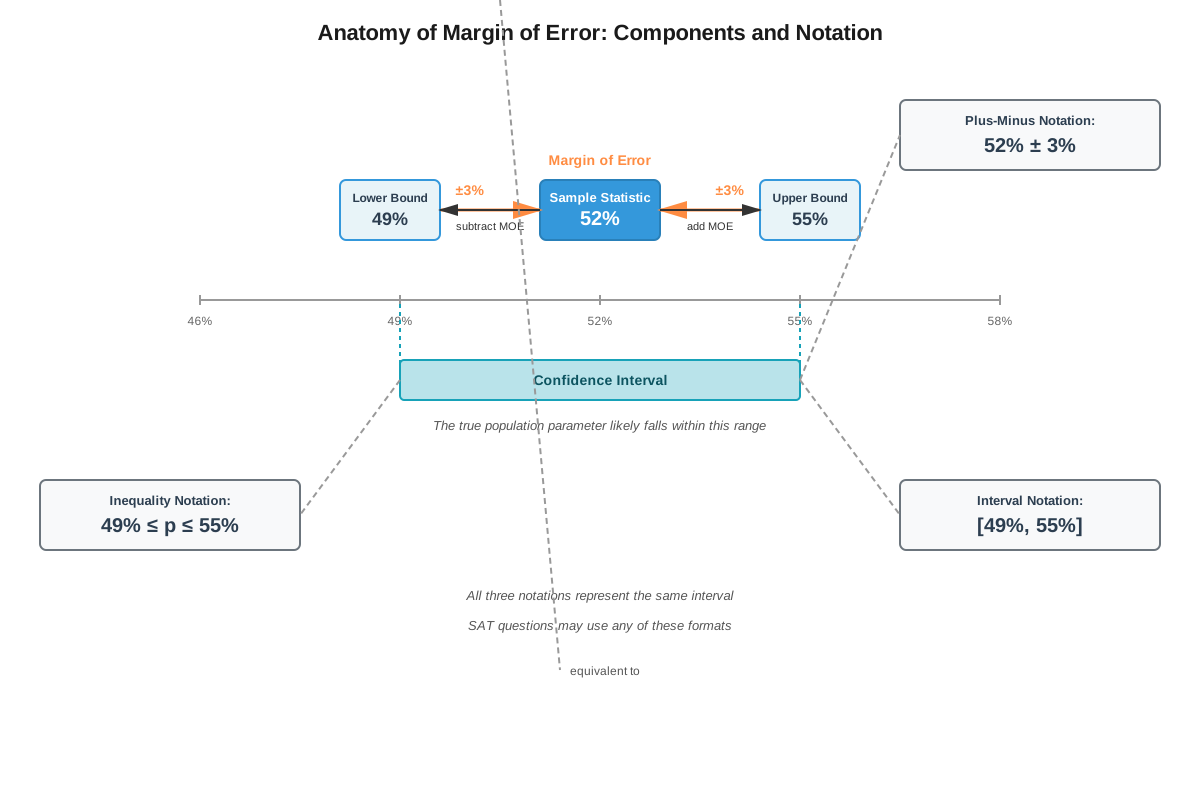
The margin of error is a statistical measure that expresses the amount of random sampling error in a survey's results. It represents the radius of the confidence interval—the range of values above and below the sample statistic within which the true population parameter is likely to fall with a specified level of confidence (typically 95% on the SAT).
Mathematically, if a sample proportion is p̂ (read as "p-hat") and the margin of error is E, then the confidence interval for the true population proportion p is:
p̂ - E ≤ p ≤ p̂ + EThis can also be written as: p̂ ± E
For example, if a survey finds that 60% of students prefer online learning (p̂ = 0.60) with a margin of error of 4 percentage points (E = 0.04), the confidence interval is 56% to 64%, meaning we can be reasonably confident (typically 95% confident) that the true percentage of all students who prefer online learning falls within this range.
Components and Notation
Understanding the standard notation is crucial for SAT success:
- Sample statistic (often denoted p̂ for proportions or x̄ for means): The value calculated from the sample data
- Margin of error (E or MOE): The "plus or minus" amount that defines the interval width
- Confidence interval: The range [sample statistic - E, sample statistic + E]
- Confidence level: The probability that the interval contains the true population parameter (usually 95%, though the SAT rarely requires you to calculate this)
The SAT typically presents margin of error in one of three ways:
- Explicitly stated: "with a margin of error of ±3 percentage points"
- As a confidence interval: "between 47% and 53%"
- In a table or graph caption: "Error bars represent margin of error"
Interpreting Margin of Error
The correct interpretation of margin of error is critical for SAT questions. When a survey reports 45% ± 3%, this means:
✓ Correct interpretation: "We are 95% confident that the true population percentage is between 42% and 48%"
✗ Incorrect interpretation: "45% is the exact value, give or take a little"
The margin of error accounts for sampling variability—the natural fluctuation that occurs because we're examining a sample rather than the entire population. A larger margin of error indicates greater uncertainty, while a smaller margin of error suggests more precise estimates.
Comparing Two Proportions
A common SAT application involves determining whether two sample proportions are meaningfully different. The key principle: if the confidence intervals overlap, we cannot conclude that the population proportions are different.
| Scenario | Sample 1 | MOE 1 | Sample 2 | MOE 2 | Conclusion |
|---|---|---|---|---|---|
| Clear difference | 60% | ±3% | 45% | ±3% | Intervals don't overlap (57-63% vs 42-48%); populations likely differ |
| Overlapping intervals | 52% | ±4% | 49% | ±4% | Intervals overlap (48-56% vs 45-53%); cannot conclude difference |
| Identical within error | 50% | ±5% | 51% | ±5% | Substantial overlap (45-55% vs 46-56%); no evidence of difference |
Factors Affecting Margin of Error
While the SAT rarely asks students to calculate margin of error from scratch, understanding what influences it helps with conceptual questions:
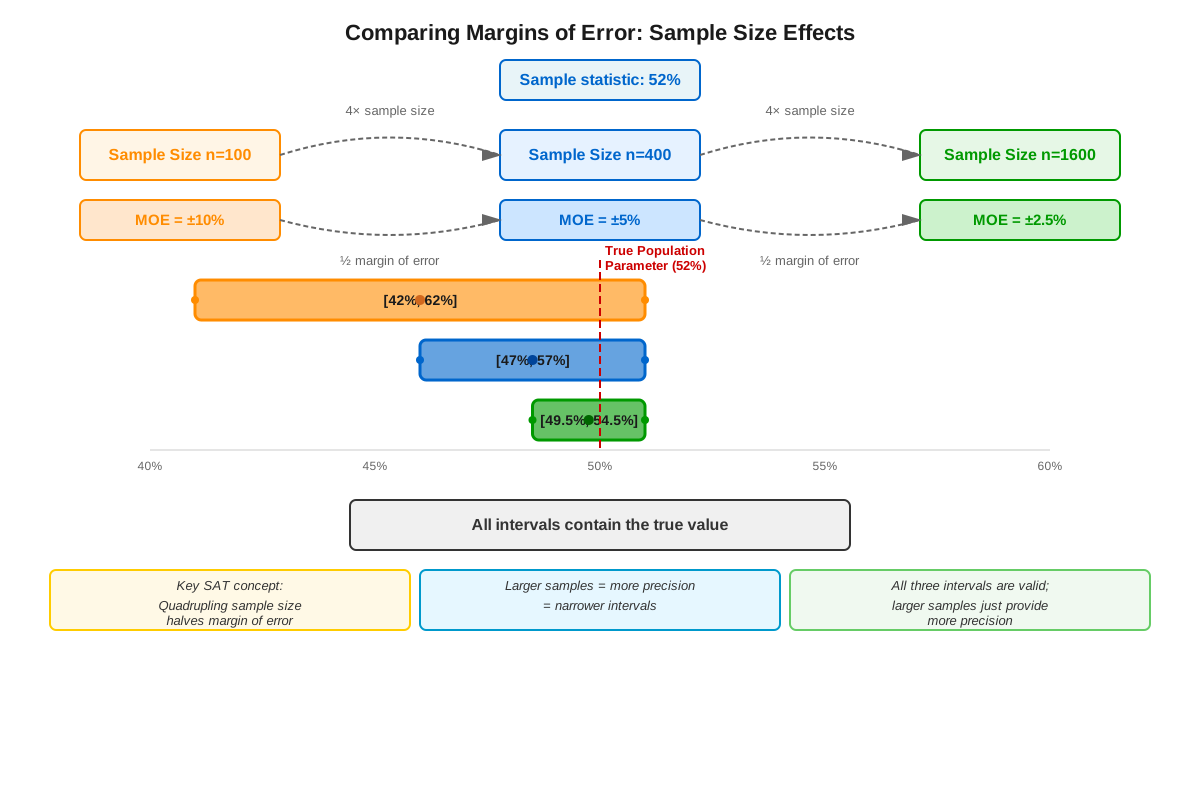
- Sample size: Larger samples produce smaller margins of error (inverse relationship)
- Population variability: More diverse populations lead to larger margins of error
- Confidence level: Higher confidence (e.g., 99% vs 95%) requires larger margins of error
The most testable relationship is sample size: doubling the sample size does not halve the margin of error; rather, you must quadruple the sample size to halve the margin of error (due to the square root relationship in the formula).
Practical Application Steps
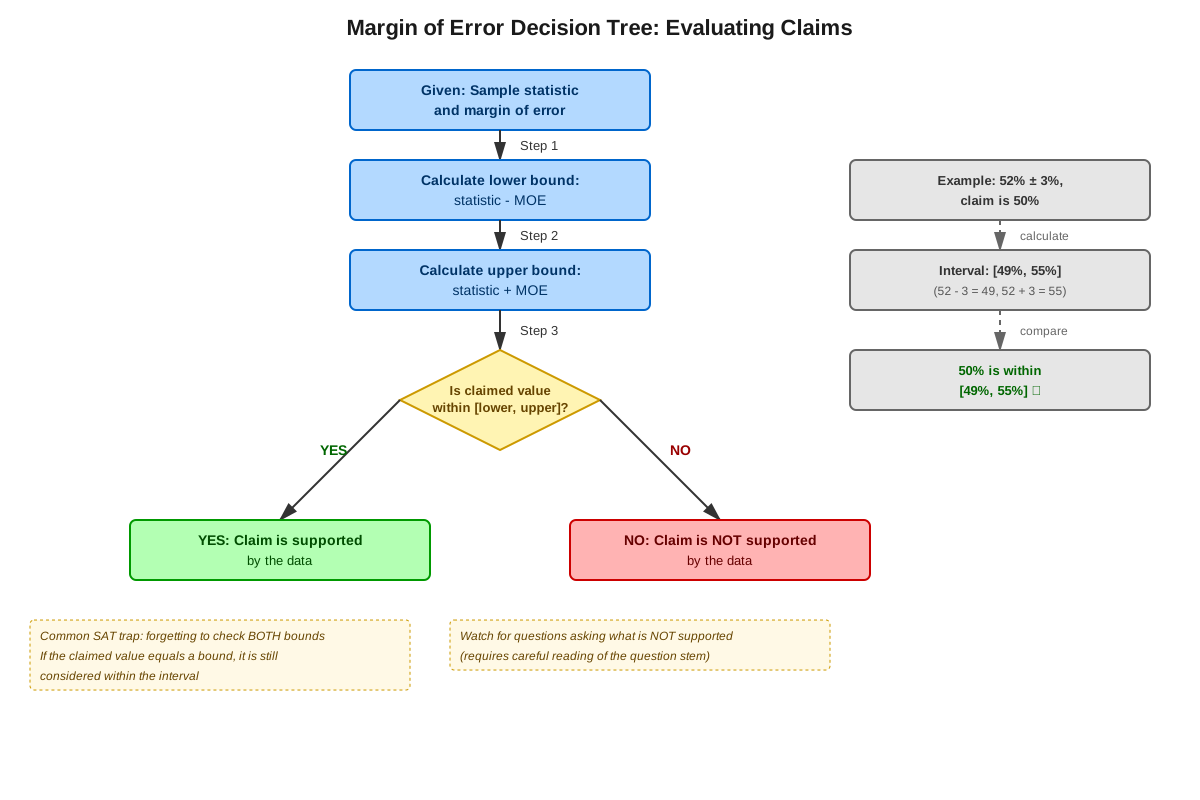
When encountering an SAT question involving margin of error, follow this systematic approach:
- Identify the sample statistic: What percentage or value was found in the survey?
- Locate the margin of error: Is it stated explicitly or must it be inferred from an interval?
- Calculate the confidence interval: Add and subtract the margin of error from the sample statistic
- Evaluate the question's claim: Does the claim fall within the confidence interval? Do intervals overlap if comparing two groups?
- Select the appropriately cautious conclusion: Choose answers that acknowledge uncertainty rather than claiming certainty
Concept Relationships
The margin of error concept sits at the intersection of several mathematical domains. It fundamentally relies on percentage calculations because margins of error are typically expressed as percentages or percentage points. Students must convert between decimal and percentage forms (e.g., 0.03 = 3 percentage points) and perform addition/subtraction with percentages.
The concept connects directly to inequality reasoning: a confidence interval is essentially a compound inequality (a ≤ x ≤ b), and comparing whether values fall within or outside intervals requires inequality manipulation. This links to the broader SAT skill of working with ranges and constraints.
Within statistics, margin of error bridges descriptive statistics (what we observe in our sample) and inferential statistics (what we can conclude about the population). It operationalizes the abstract concept of sampling variability into a concrete numerical range. This relationship can be mapped as:
Sample data → Calculate sample statistic → Apply margin of error → Construct confidence interval → Make inference about population
The concept also relates to probability and confidence levels, though the SAT typically treats the confidence level (usually 95%) as given rather than requiring its calculation. Understanding that "95% confident" means "if we repeated this survey many times, 95% of the resulting intervals would contain the true population value" provides deeper insight, though this level of detail is rarely tested directly.
Finally, margin of error connects to experimental design and data collection: questions may ask students to recognize that larger samples, random sampling, or other methodological improvements would reduce the margin of error, linking statistical concepts to research methodology.
High-Yield Facts
⭐ The margin of error defines a range around the sample statistic within which the true population parameter likely falls
⭐ To find the confidence interval, add and subtract the margin of error from the sample statistic: [statistic - MOE, statistic + MOE]
⭐ If two confidence intervals overlap, you cannot conclude that the population values are different
⭐ A larger sample size produces a smaller margin of error (more precision)
⭐ Margin of error is typically associated with 95% confidence on the SAT unless otherwise specified
- The margin of error applies to the population parameter, not to individual observations in the sample
- Doubling the sample size does not halve the margin of error; you must quadruple the sample size to halve the MOE
- A margin of error of ±3 percentage points means the interval extends 3 points in each direction (total width of 6 points)
- When comparing two groups, look for whether their confidence intervals overlap to determine if differences are meaningful
- The phrase "statistically significant difference" implies that confidence intervals do not overlap
- Margin of error accounts for random sampling error but not for bias or systematic errors in data collection
- A confidence interval that includes 50% for a yes/no question suggests the population could be evenly split
Quick check — test yourself on Margin of error so far.
Try Flashcards →Common Misconceptions
Misconception: The margin of error means the survey could be wrong by that amount in either direction, so the true value could be anywhere.
Correction: The margin of error defines a specific interval with a known confidence level (typically 95%). It's not about being "wrong" but about quantifying uncertainty. The true value is likely (95% probability) within the interval, not equally likely to be anywhere.
Misconception: If a poll shows 52% ± 3%, then 52% is the "real" answer and the ±3% is just a small adjustment.
Correction: The sample statistic (52%) is our best estimate, but the margin of error indicates that any value from 49% to 55% is plausible for the true population parameter. We cannot claim 52% is more likely than 53% or 51% within that interval.
Misconception: A margin of error of ±4% means the survey is 4% accurate.
Correction: Margin of error measures precision (the width of the confidence interval), not accuracy (how close to the true value). A survey could have a small margin of error but still be inaccurate due to bias in sampling or question wording.
Misconception: If two samples have overlapping confidence intervals, they must have the same population value.
Correction: Overlapping intervals mean we cannot conclude the populations are different, but they might still differ. The overlap indicates insufficient evidence to claim a difference, not proof of equality.
Misconception: Margin of error applies to every individual response in the survey.
Correction: Margin of error applies to the aggregate statistic (the overall percentage or mean), not to individual responses. It describes uncertainty about the population parameter, not variability among individuals.
Misconception: A 95% confidence level means 95% of the sample falls within the margin of error.
Correction: The 95% confidence level means that if we repeated the sampling process many times, 95% of the resulting confidence intervals would contain the true population parameter. It's about the reliability of the method, not the distribution of sample data.
Worked Examples
Example 1: Interpreting Survey Results with Margin of Error
Question: A survey of 800 randomly selected voters found that 58% support Proposition A. The margin of error for this survey is ±3.5 percentage points at a 95% confidence level. Which of the following statements is supported by the survey results?
A) Exactly 58% of all voters support Proposition A.
B) More than half of all voters support Proposition A.
C) Between 464 and 496 voters in the sample supported Proposition A.
D) The survey proves that Proposition A will pass.
Solution:
Step 1: Identify the sample statistic and margin of error.
- Sample statistic: 58%
- Margin of error: ±3.5 percentage points
Step 2: Calculate the confidence interval.
- Lower bound: 58% - 3.5% = 54.5%
- Upper bound: 58% + 3.5% = 61.5%
- Confidence interval: [54.5%, 61.5%]
Step 3: Evaluate each answer choice.
Choice A: "Exactly 58%" - Incorrect. The margin of error indicates uncertainty; we cannot claim an exact value.
Choice B: "More than half" - Correct. Since the entire confidence interval (54.5% to 61.5%) lies above 50%, we can confidently conclude that more than half of all voters support Proposition A.
Choice C: "Between 464 and 496 voters in the sample" - Incorrect. This confuses sample data with population inference. The margin of error applies to estimates about the population, not the sample itself. We know exactly how many in the sample supported it: 58% of 800 = 464 voters.
Choice D: "Proves that Proposition A will pass" - Incorrect. Statistical surveys provide evidence but never "prove" outcomes, especially for future events. Additionally, the confidence interval allows for values below a passing threshold depending on what percentage is required.
Answer: B
Connection to learning objectives: This example demonstrates how to identify key features of margin of error (the ±3.5%), apply it to calculate a confidence interval, and evaluate which conclusions are supported by the data—all core SAT skills.
Example 2: Comparing Two Groups with Margins of Error
Question: A researcher surveyed students at two different schools about their study habits. At School A, 62% of students reported studying more than 2 hours per night, with a margin of error of ±5 percentage points. At School B, 55% of students reported studying more than 2 hours per night, with a margin of error of ±4 percentage points. Based on these results, which conclusion is most appropriate?
A) Students at School A definitely study more than students at School B.
B) There is no difference in study habits between the two schools.
C) The data do not provide convincing evidence of a difference in the proportion of students who study more than 2 hours per night.
D) School A has exactly 7% more students who study more than 2 hours per night.
Solution:
Step 1: Calculate confidence intervals for both schools.
School A:
- Sample statistic: 62%
- Margin of error: ±5%
- Confidence interval: [57%, 67%]
School B:
- Sample statistic: 55%
- Margin of error: ±4%
- Confidence interval: [51%, 59%]
Step 2: Check for overlap.
- School A interval: 57% to 67%
- School B interval: 51% to 59%
- Overlap region: 57% to 59%
The intervals overlap, meaning values between 57% and 59% are plausible for both schools' true population proportions.
Step 3: Evaluate answer choices.
Choice A: "Definitely study more" - Incorrect. The word "definitely" is too strong given the overlapping intervals. While School A's sample percentage is higher, the overlap means we cannot rule out that the true population proportions are similar or even equal.
Choice B: "No difference" - Incorrect. We cannot conclude there is no difference; we simply lack sufficient evidence to conclude there IS a difference. These are not the same thing statistically.
Choice C: "Do not provide convincing evidence of a difference" - Correct. This appropriately cautious language acknowledges that while the sample percentages differ, the overlapping confidence intervals mean we cannot confidently conclude the population proportions differ.
Choice D: "Exactly 7% more" - Incorrect. This refers only to the sample statistics (62% - 55% = 7%) and ignores the margins of error entirely. We cannot make claims about exact differences when dealing with sample data and margins of error.
Answer: C
Connection to learning objectives: This example illustrates the critical SAT skill of comparing two proportions using margins of error, recognizing when intervals overlap, and selecting appropriately cautious conclusions—a frequent question type on the exam.
Exam Strategy
When approaching SAT margin of error questions, begin by quickly identifying whether the question asks you to (1) interpret a single confidence interval, (2) compare two groups, or (3) evaluate which conclusions are supported. This categorization immediately narrows your strategic approach.
Trigger words and phrases to watch for include:
- "margin of error of ±X%" or "plus or minus"
- "confidence interval" or "between X% and Y%"
- "statistically significant difference"
- "the data support" or "the survey suggests"
- "convincing evidence"
- "plausible" or "likely"
These phrases signal that you need to consider the range of values, not just the point estimate.
For process of elimination, immediately eliminate answer choices that:
- Claim certainty or use absolute language ("definitely," "proves," "exactly") when dealing with sample data
- Ignore the margin of error and treat the sample statistic as the exact population value
- Confuse sample data with population parameters
- Make claims about values outside the confidence interval
Time allocation: Most margin of error questions can be solved in 60-90 seconds. Spend 15-20 seconds reading and identifying the question type, 30-40 seconds calculating confidence intervals or checking for overlap, and 20-30 seconds evaluating answer choices. If a question requires more complex reasoning, mark it and return if time permits—these questions are designed to be solved efficiently with the right approach.
Exam Tip: When comparing two groups, draw a quick number line and mark both confidence intervals visually. Overlap becomes immediately obvious, saving time and reducing errors.
Common trap answers include choices that state the sample statistic as if it were the exact population value, or choices that claim "no difference" when the correct conclusion is "insufficient evidence of a difference." The SAT rewards precise statistical language.
For questions asking "which statement is supported by the data," work through each choice systematically, checking whether the claimed value falls within the confidence interval. Any value outside the interval is not supported; any value inside is plausible.
Memory Techniques
MOE Mnemonic: Minus and Or Extra
- Minus: Subtract the margin of error from the sample statistic for the lower bound
- Or: The true value could be the sample statistic
- Extra: Add the margin of error to the sample statistic for the upper bound
Visualization Strategy: Picture a target with the sample statistic at the center and the margin of error as the radius. The confidence interval is the diameter of the circle. Any point within the circle is a "plausible hit" for the true population value.
Overlap Rule Acronym: COIN
- Confidence intervals
- Overlap means
- Insufficient evidence to claim
- Notable difference
The 95% Rule: Remember "95 = alive" to recall that 95% confidence is the standard level. The interval is "alive with possibilities"—any value within it is plausible.
Sample vs. Population: Use the phrase "Sample Suggests, Population Possibilities" to remember that the sample statistic suggests a value, but the margin of error defines the range of population possibilities.
Summary
Margin of error is a critical statistical concept that quantifies the uncertainty in sample-based estimates, expressing the range within which the true population parameter likely falls. On the SAT, students must interpret margins of error to construct confidence intervals, compare groups to determine if differences are meaningful, and evaluate which conclusions are supported by data. The fundamental skill involves adding and subtracting the margin of error from the sample statistic to create an interval, then reasoning about whether specific values or claims fall within that interval. When comparing two groups, overlapping confidence intervals indicate insufficient evidence to conclude the populations differ, while non-overlapping intervals suggest a meaningful difference. Success on SAT margin of error questions requires careful attention to language—distinguishing between certainty and plausibility, between sample statistics and population parameters, and between "no evidence of difference" and "evidence of no difference." The concept connects percentage calculations, inequality reasoning, and statistical inference, making it a high-yield topic that appears regularly on the exam in various real-world contexts.
Key Takeaways
- Margin of error defines a range [sample statistic - MOE, sample statistic + MOE] within which the true population parameter likely falls with 95% confidence
- Calculate confidence intervals by adding and subtracting the margin of error from the sample statistic
- Overlapping confidence intervals mean insufficient evidence to conclude population proportions differ
- Larger sample sizes produce smaller margins of error, increasing precision
- Eliminate answer choices that claim certainty, ignore the margin of error, or confuse sample data with population parameters
- The SAT rewards appropriately cautious language: "suggests," "plausible," "insufficient evidence" rather than "proves," "definitely," "exactly"
- Always check whether claimed values fall within the confidence interval before selecting an answer
Related Topics
Sampling Methods and Bias: Understanding how samples are selected affects interpretation of margin of error. Random sampling produces reliable margins of error, while biased sampling methods make the margin of error less meaningful. Mastering margin of error provides the foundation for evaluating study design quality.
Hypothesis Testing: The logic of comparing confidence intervals extends to formal hypothesis testing, where you determine whether observed differences are statistically significant. Margin of error concepts prepare students for more advanced statistical inference.
Standard Deviation and Variability: Margin of error relates to the spread of data in the population. Understanding measures of variability deepens comprehension of why margins of error exist and what influences their size.
Probability and Confidence Levels: The 95% confidence level underlying most SAT margin of error questions connects to probability concepts. Exploring this relationship enhances understanding of what confidence intervals actually mean.
Data Collection and Experimental Design: Recognizing how sample size, randomization, and other design features affect margin of error connects statistical calculations to practical research methodology, a broader SAT data analysis skill.
Practice CTA
Now that you've mastered the core concepts of margin of error, it's time to solidify your understanding through practice. Work through the practice questions to apply these concepts to SAT-style problems, and use the flashcards to reinforce key definitions and relationships. Remember, margin of error questions reward careful reading and systematic thinking—skills that improve rapidly with focused practice. Each question you work through builds the pattern recognition and confidence you need to tackle these high-yield problems efficiently on test day. You've got this!
Sign up free to keep reading
Create a free AnvayaPrep account to finish this SAT guide on Margin of error — plus flashcards and practice questions.