Overview
Causation is a critical concept in data analysis and statistics that appears regularly on the SAT math section. Understanding causation means recognizing when one variable directly causes changes in another variable, as opposed to merely being associated or correlated with it. This distinction between correlation and causation represents one of the most important analytical skills tested on the SAT, as it requires students to think critically about data relationships rather than simply performing calculations.
On the SAT, sat causation questions typically appear in the context of interpreting study results, analyzing experimental designs, or evaluating claims made from statistical data. These questions assess whether students can distinguish between observational studies and controlled experiments, identify confounding variables, and determine when researchers can legitimately claim that one factor causes another. The College Board emphasizes this topic because it reflects real-world analytical thinking—the ability to evaluate scientific claims, news reports, and research findings critically.
Causation connects to broader mathematical concepts including correlation, experimental design, sampling methods, and statistical inference. While correlation measures the strength of association between variables, causation goes further by establishing a cause-and-effect relationship. This topic bridges pure mathematics with practical reasoning, making it essential not only for SAT success but also for informed citizenship in an increasingly data-driven world.
Learning Objectives
- [ ] Identify key features of causation in statistical contexts
- [ ] Explain how causation appears on the SAT and distinguish it from correlation
- [ ] Apply causation principles to answer SAT-style questions accurately
- [ ] Differentiate between observational studies and controlled experiments
- [ ] Recognize confounding variables that prevent causal conclusions
- [ ] Evaluate whether study designs support causal claims
- [ ] Analyze data presentations to determine appropriate conclusions
Prerequisites
- Basic understanding of variables: Students must know what independent and dependent variables are, as causation describes how one variable affects another
- Familiarity with correlation: Understanding that two variables can move together without one causing the other provides the foundation for distinguishing correlation from causation
- Reading comprehension of data contexts: The ability to interpret word problems and study descriptions is essential since causation questions are embedded in real-world scenarios
- Basic statistical terminology: Terms like "sample," "population," and "relationship" appear frequently in causation questions
Why This Topic Matters
Causation appears on virtually every SAT administration, typically in 1-3 questions per test. These questions often appear in the Problem Solving and Data Analysis domain, which comprises approximately 29% of the SAT Math section (17 out of 58 questions). Understanding causation is particularly high-yield because these questions frequently combine multiple concepts—students must interpret study designs, analyze data relationships, and apply logical reasoning simultaneously.
In real-world applications, distinguishing causation from correlation prevents costly errors in medicine, public policy, business, and personal decision-making. When a news headline claims "Coffee causes heart disease" or "Exercise prevents dementia," critical thinkers must evaluate whether the underlying research actually supports causal claims or merely shows correlation. This skill protects against manipulation by misleading statistics and enables informed evaluation of scientific research.
On the SAT, causation questions commonly appear as:
- Questions asking what conclusions can be drawn from a study
- Scenarios requiring students to identify why a causal claim is or isn't justified
- Comparisons between different study designs (observational vs. experimental)
- Questions about confounding variables or alternative explanations
- Evaluation of whether randomization was properly implemented
Core Concepts
Understanding Causation vs. Correlation
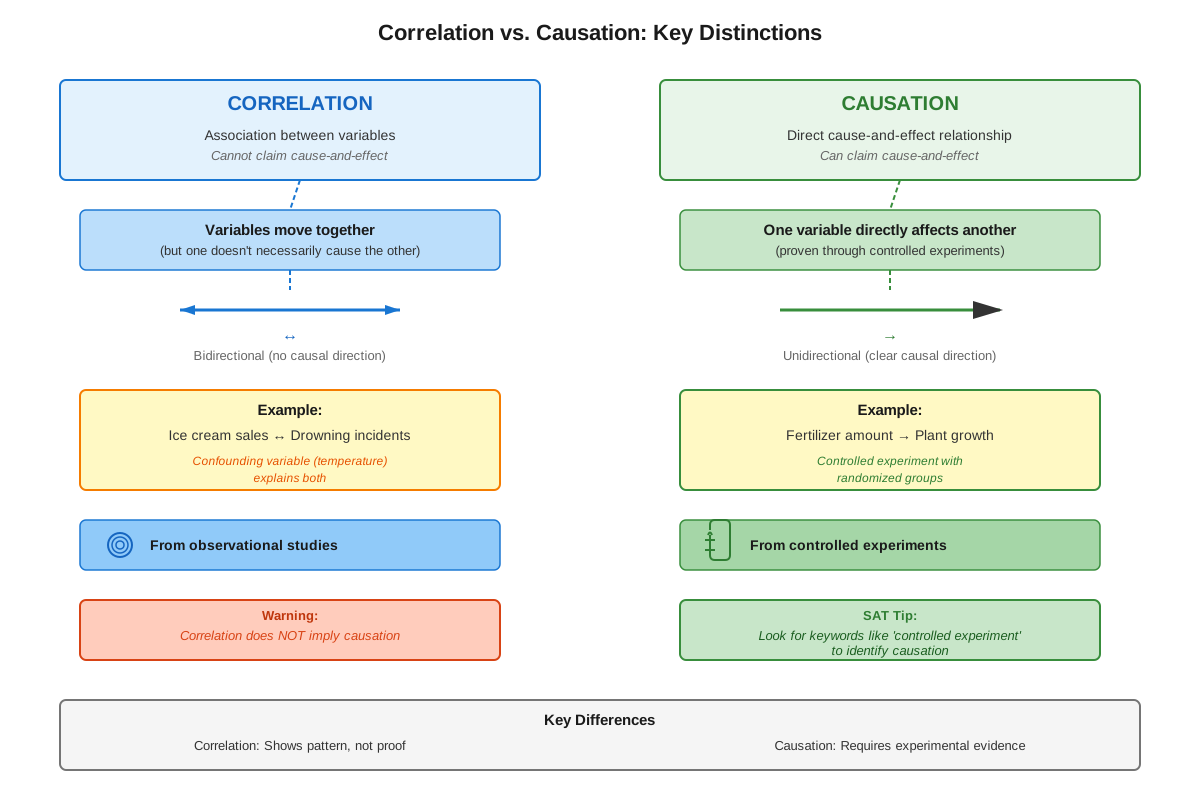
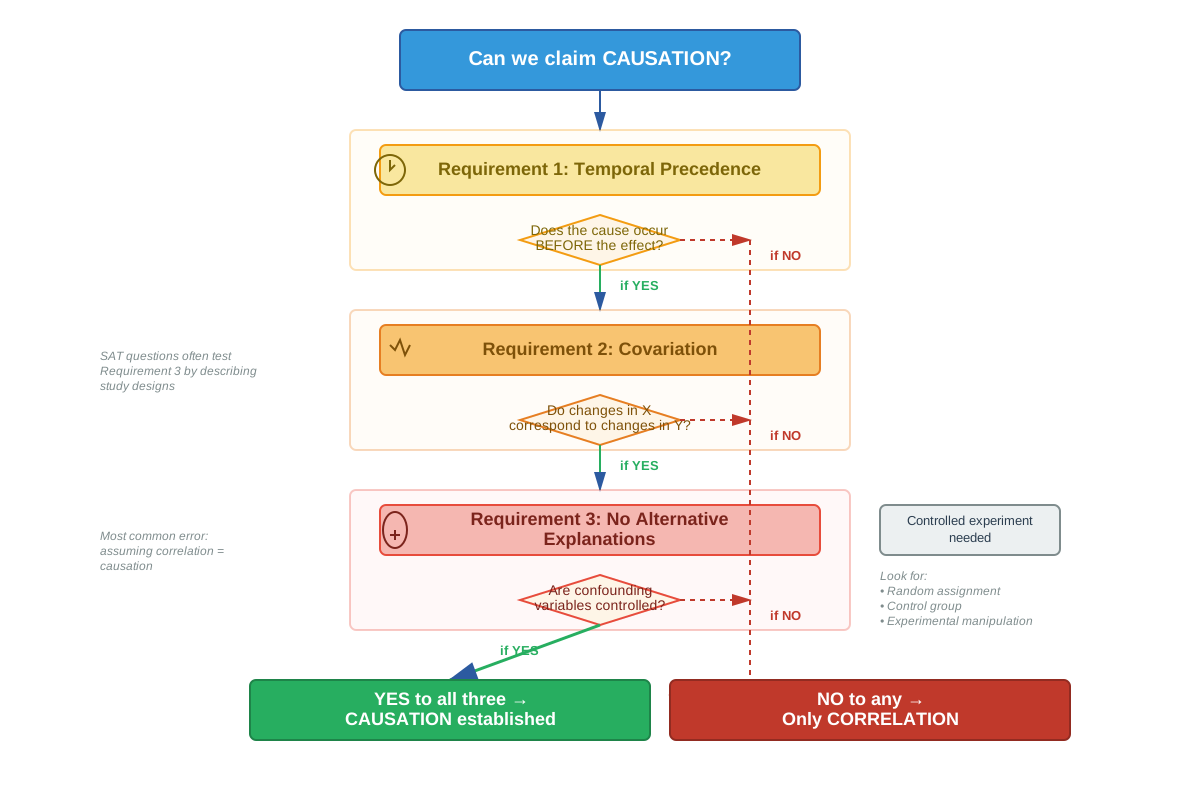
Causation exists when changes in one variable directly produce changes in another variable. For a causal relationship to exist, three conditions must be met: (1) the cause must precede the effect in time, (2) the cause and effect must be correlated, and (3) no alternative explanations (confounding variables) can account for the relationship.
Correlation, by contrast, simply means two variables are associated—they tend to change together in a predictable pattern. Correlation can be positive (both variables increase together), negative (one increases as the other decreases), or nonexistent. The crucial insight is that correlation does not imply causation. Two variables might correlate because:
- Variable A causes Variable B (causation)
- Variable B causes Variable A (reverse causation)
- Variable C causes both A and B (confounding)
- The relationship is coincidental (spurious correlation)
| Feature | Correlation | Causation |
|---|---|---|
| Definition | Variables change together | One variable directly produces changes in another |
| Requirements | Statistical association | Association + temporal order + no confounding |
| Study type needed | Any study can show correlation | Typically requires controlled experiment |
| Conclusion strength | "Associated with" or "related to" | "Causes" or "produces" |
Observational Studies
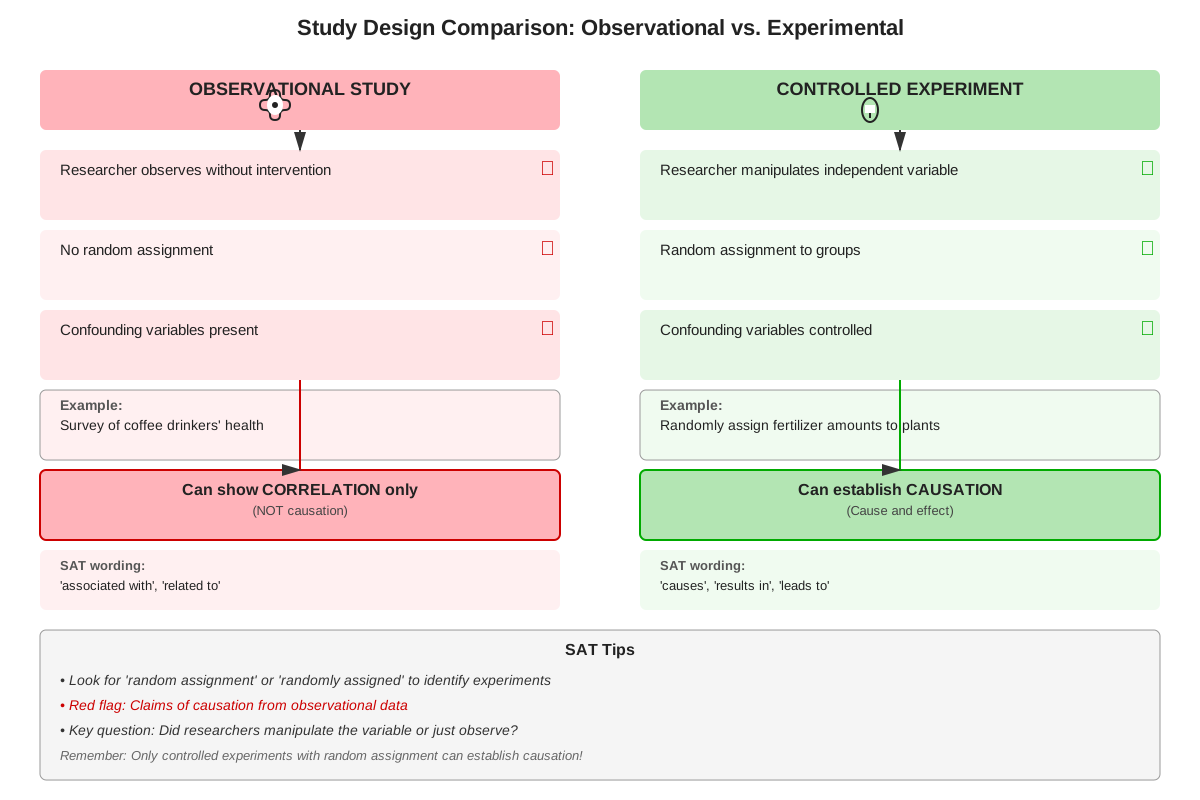
An observational study involves collecting data without manipulating any variables. Researchers observe subjects in their natural state or existing conditions. For example, surveying people about their coffee consumption and heart health represents an observational study. These studies can establish correlation but generally cannot prove causation because researchers don't control for confounding variables.
The fundamental limitation of observational studies is that subjects differ in countless ways beyond the variable of interest. Coffee drinkers might also exercise less, sleep differently, experience different stress levels, or have different genetic predispositions—any of which could explain observed health differences. Without controlling these variables, researchers cannot isolate coffee as the cause.
Controlled Experiments
A controlled experiment involves randomly assigning subjects to different treatment groups and manipulating the independent variable while controlling other factors. Randomization is the key feature that enables causal conclusions. When subjects are randomly assigned, confounding variables are distributed equally across groups on average, allowing researchers to isolate the effect of the treatment.
For example, randomly assigning participants to drink coffee or avoid coffee, while keeping all other factors constant, would allow researchers to determine whether coffee causes health changes. The control group receives no treatment (or a placebo), while the treatment group receives the intervention being tested.
Confounding Variables
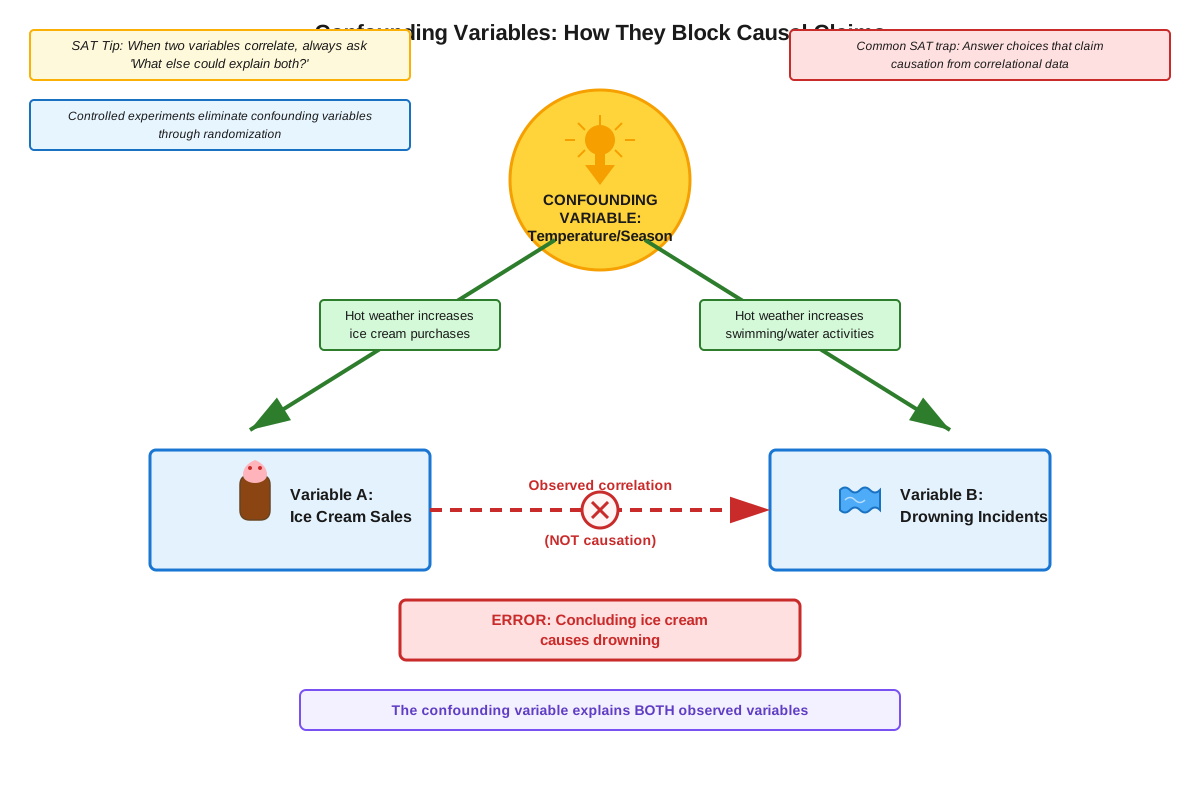
A confounding variable (or confounder) is an outside factor that influences both the independent and dependent variables, creating a spurious association between them. Confounders are the primary reason observational studies cannot establish causation.
Classic example: Ice cream sales and drowning deaths are strongly correlated. However, ice cream doesn't cause drowning. Instead, hot weather (the confounder) causes both increased ice cream consumption and more swimming, which leads to more drowning incidents.
On the SAT, identifying potential confounders is crucial for evaluating whether a study supports causal claims. Questions often present a correlation and ask students to identify why a causal conclusion isn't justified—the answer typically involves recognizing a confounding variable.
Randomization and Its Importance
Randomization means using a random process (like a coin flip or random number generator) to assign subjects to treatment groups. This technique is the gold standard for establishing causation because it ensures that known and unknown confounding variables are distributed equally across groups on average.
Without randomization, systematic differences between groups might explain observed effects. For instance, if researchers let participants choose whether to take a new medication, healthier or more motivated individuals might disproportionately choose the treatment, making the medication appear more effective than it actually is.
Appropriate Conclusions from Different Study Types
The study design determines what conclusions researchers can legitimately draw:
From observational studies: Researchers can conclude that variables are "associated," "correlated," or "related." They can say one variable "predicts" another. They cannot conclude causation.
From controlled experiments with randomization: Researchers can conclude that the treatment "causes," "produces," or "results in" changes in the outcome variable. They can make causal claims.
From experiments without randomization: Conclusions are limited, similar to observational studies, because confounding variables haven't been controlled.
Concept Relationships
The concepts within causation form a logical hierarchy. Understanding correlation provides the foundation—students must first recognize that variables can be associated. This leads to the critical question: does this association represent causation? Answering this question requires examining the study design.
Observational studies → can establish correlation → cannot establish causation → because confounding variables aren't controlled
Controlled experiments → use randomization → control confounding variables → can establish causation
This topic connects to prerequisite knowledge of variables and statistical relationships. It also relates to sampling methods (random sampling vs. random assignment), experimental design principles, and statistical inference. Understanding causation enables progression to more advanced topics like regression analysis, where distinguishing predictive relationships from causal relationships becomes crucial.
The relationship between correlation and causation also connects to logical reasoning skills tested throughout the SAT. Students must evaluate evidence, identify logical flaws, and distinguish between strong and weak arguments—skills that appear in both the Math and Evidence-Based Reading and Writing sections.
High-Yield Facts
⭐ Correlation does not imply causation—two variables can be strongly associated without one causing the other
⭐ Only controlled experiments with randomization can establish causation—observational studies can only show correlation
⭐ Confounding variables are outside factors that influence both the independent and dependent variables, creating spurious associations
⭐ Random assignment (randomization) distributes confounding variables equally across groups, enabling causal conclusions
⭐ Observational studies can conclude that variables are "associated" or "correlated" but not that one "causes" the other
- Causation requires three conditions: temporal precedence (cause before effect), correlation, and no plausible alternative explanations
- The control group in an experiment receives no treatment or a placebo, providing a baseline for comparison
- Random sampling (for selecting participants) is different from random assignment (for placing participants in groups)—only random assignment enables causal conclusions
- Reverse causation occurs when the presumed effect actually causes the presumed cause
- Spurious correlations are associations between variables that have no meaningful connection, often due to coincidence or a hidden third variable
Quick check — test yourself on Causation so far.
Try Flashcards →Common Misconceptions
Misconception: If two variables are strongly correlated, one must cause the other.
Correction: Strong correlation indicates association but doesn't establish causation. The variables might be related through a confounding variable, reverse causation, or coincidence. Only properly designed experiments can establish causation.
Misconception: Large sample sizes in observational studies can prove causation.
Correction: Sample size affects statistical power and precision but doesn't address confounding variables. Even a massive observational study cannot establish causation because it lacks the control and randomization necessary to isolate causal effects.
Misconception: If researchers control for some confounding variables in an observational study, they can claim causation.
Correction: While controlling for known confounders strengthens observational studies, unknown or unmeasured confounders may still exist. Only randomization controls for both known and unknown confounders, which is why experiments are needed for causal claims.
Misconception: Random sampling and random assignment are the same thing.
Correction: Random sampling involves randomly selecting participants from a population (important for generalizability), while random assignment involves randomly placing participants into treatment groups (necessary for causation). A study can have one, both, or neither.
Misconception: If A causes B, then A and B must always occur together.
Correction: Causation doesn't require a perfect relationship. Smoking causes lung cancer, but not all smokers develop lung cancer, and some non-smokers do. Causation means one variable increases the probability or magnitude of another, not that it guarantees the outcome.
Misconception: Experiments always prove causation while observational studies never provide useful information.
Correction: Poorly designed experiments (without proper randomization or controls) may not establish causation, while well-designed observational studies provide valuable correlational evidence that can guide future research and policy. The study design determines the strength of conclusions, not just the label "experiment" or "observational study."
Worked Examples
Example 1: Evaluating Study Design
Question: A researcher wants to determine whether a new study technique improves test scores. She surveys 500 students, asking whether they use the new technique and recording their test scores. She finds that students using the new technique score 12 points higher on average. Can the researcher conclude that the new technique causes higher test scores?
Solution:
Step 1: Identify the study type. The researcher surveyed existing students and observed their natural behavior without manipulating variables. This is an observational study.
Step 2: Recall that observational studies can establish correlation but not causation because they don't control for confounding variables.
Step 3: Identify potential confounding variables. Students who choose to use the new study technique might differ systematically from those who don't. Possible confounders include:
- Motivation level (more motivated students might both use new techniques and study more overall)
- Prior academic ability (stronger students might be more likely to try new methods)
- Time available for studying
- Quality of instruction received
Step 4: Determine the appropriate conclusion. The researcher can conclude that using the new technique is associated with or correlated with higher test scores. She cannot conclude that the technique causes higher scores because confounding variables haven't been controlled.
Step 5: Identify what would enable a causal conclusion. To establish causation, the researcher would need to conduct a controlled experiment: randomly assign students to either use the new technique or continue with their usual methods, then compare test scores between groups.
Answer: No, the researcher cannot conclude causation. This observational study can only establish correlation because confounding variables (like motivation or prior ability) might explain the score differences.
Example 2: Identifying Proper Experimental Design
Question: A pharmaceutical company wants to test whether a new medication reduces blood pressure. They recruit 200 volunteers with high blood pressure. Which study design would allow them to conclude that the medication causes blood pressure reduction?
A) Give all 200 volunteers the medication and measure whether their blood pressure decreases
B) Let volunteers choose whether to take the medication, then compare blood pressure between groups
C) Randomly assign 100 volunteers to take the medication and 100 to take a placebo, then compare blood pressure between groups
D) Give the medication to volunteers with the highest blood pressure and compare them to volunteers with lower initial blood pressure
Solution:
Step 1: Recall that establishing causation requires a controlled experiment with randomization.
Step 2: Evaluate each option:
Option A: No control group exists for comparison. Blood pressure might decrease due to other factors (lifestyle changes, regression to the mean, placebo effect). This design cannot establish causation.
Option B: Self-selection introduces confounding. Volunteers who choose the medication might differ systematically from those who don't (perhaps more motivated, healthier lifestyle, better medical care). This is essentially an observational study and cannot establish causation.
Option C: This design includes both key elements: randomization (randomly assigning volunteers to groups) and a control group (placebo group). Randomization distributes confounding variables equally across groups, and the control group provides a baseline for comparison. This design can establish causation.
Option D: No randomization occurs—groups are formed based on initial blood pressure levels. Volunteers with higher initial blood pressure might differ in other ways (age, medication history, underlying health conditions). Additionally, regression to the mean might cause the high-blood-pressure group's readings to decrease naturally. This design cannot establish causation.
Step 3: Confirm that Option C is the only design meeting the requirements for causal conclusions.
Answer: C. Only random assignment to treatment and control groups, with all other factors held constant, allows researchers to conclude that the medication causes blood pressure reduction.
Exam Strategy
When approaching SAT causation questions, follow this systematic process:
Step 1: Identify the study type. Look for keywords indicating whether the study is observational (survey, observe, compare existing groups) or experimental (randomly assign, treatment group, control group). This immediately tells you whether causal conclusions are possible.
Step 2: Check for randomization. If the question describes an experiment, verify that participants were randomly assigned to groups. Without randomization, causal conclusions aren't justified even in experiments.
Step 3: Watch for conclusion language. The SAT tests whether students recognize appropriate vs. inappropriate conclusion language:
- Causal language (requires controlled experiment): "causes," "produces," "results in," "leads to," "is responsible for"
- Correlational language (appropriate for observational studies): "is associated with," "is related to," "correlates with," "predicts," "is linked to"
Step 4: Consider confounding variables. If a question asks why a causal conclusion isn't justified, the answer typically involves identifying a potential confounding variable that offers an alternative explanation.
Step 5: Eliminate answer choices systematically:
- Eliminate choices claiming causation from observational studies
- Eliminate choices claiming only correlation from properly randomized experiments
- Eliminate choices that confuse random sampling with random assignment
- Eliminate choices that ignore obvious confounding variables
Exam Tip: The SAT often presents a correlation and asks what can be concluded. The correct answer almost always uses correlational language unless the study description explicitly mentions random assignment to treatment groups.
Trigger phrases to watch for:
- "The researcher surveyed..." → observational study → correlation only
- "Participants were randomly assigned..." → experiment → causation possible
- "Students who chose to..." → self-selection → confounding likely
- "Can the researcher conclude that X causes Y?" → check for randomization
Time allocation: Causation questions typically require 60-90 seconds. Spend time carefully reading the study description, as the details determine the correct answer. Don't rush through the setup—missing "randomly assigned" vs. "chose to participate" changes the entire answer.
Memory Techniques
CORE Mnemonic for Causation Requirements:
- Controlled experiment
- Other variables held constant
- Randomization used
- Effect follows cause in time
"Random Assignment = Causation Permission": Remember this phrase to recall that only random assignment to groups enables causal conclusions.
The Three C's of Confounding:
- Confounders Create Correlation without causation
Visualization Strategy: Picture a fork in the road. The confounding variable is at the base of the fork, with two paths leading to the independent and dependent variables. This "fork" image helps remember that confounders influence both variables, creating a spurious association.
OBSERVE vs. EXPERIMENT:
- OBSERVE: Only Brings Suggestions, Evidence of Relationships, Very Exploratory (observational studies suggest relationships)
- EXPERIMENT: Establishes Xact (exact) Proof, Evidence of Real Impact, Meaningful Evidence, Not Tentative (experiments provide strong causal evidence)
Summary
Causation represents one of the most important analytical concepts tested on the SAT Math section, requiring students to distinguish between mere association and true cause-and-effect relationships. The fundamental principle is that correlation does not imply causation—two variables can be strongly related without one causing the other. Establishing causation requires controlled experiments with random assignment, which distributes confounding variables equally across groups and allows researchers to isolate the effect of the treatment. Observational studies, while valuable for identifying correlations and generating hypotheses, cannot prove causation because they don't control for confounding variables that might offer alternative explanations. On the SAT, students must carefully read study descriptions to identify whether randomization occurred, recognize appropriate conclusion language (causal vs. correlational), and identify potential confounders that prevent causal claims. Mastering this topic requires understanding not just the definitions but also the logical reasoning behind why different study designs support different types of conclusions.
Key Takeaways
- Correlation shows that variables are associated; causation means one variable directly produces changes in another—these are fundamentally different concepts
- Only controlled experiments with random assignment can establish causation because randomization controls for confounding variables
- Observational studies can demonstrate correlation but cannot prove causation, regardless of sample size or statistical strength
- Confounding variables are outside factors that influence both the independent and dependent variables, creating spurious associations
- On the SAT, carefully distinguish between causal language ("causes," "produces") and correlational language ("is associated with," "is related to")
- Random assignment (placing participants in groups) differs from random sampling (selecting participants from a population)—only random assignment enables causal conclusions
- When evaluating study conclusions, always ask: Was there randomization? Are there potential confounders? Does the conclusion language match the study design?
Related Topics
Correlation and Scatterplots: Understanding correlation coefficients and interpreting scatterplots provides the quantitative foundation for recognizing associations between variables, which is the first step before considering causation.
Experimental Design: Deeper study of experimental principles including control groups, blinding, placebo effects, and replication builds on causation concepts and appears in more complex SAT questions.
Sampling Methods: Understanding random sampling, stratified sampling, and sampling bias connects to causation because both topics involve distinguishing between different types of randomness and their implications for conclusions.
Statistical Inference: Once causation is established through proper experimental design, statistical inference techniques determine whether observed effects are statistically significant or might have occurred by chance.
Regression Analysis: Advanced statistics courses use regression to model relationships between variables, where distinguishing predictive relationships from causal relationships becomes crucial for proper interpretation.
Practice CTA
Now that you've mastered the core concepts of causation, it's time to solidify your understanding through practice. Attempt the practice questions to test your ability to identify study types, recognize appropriate conclusions, and spot confounding variables. Use the flashcards to reinforce key definitions and principles until they become automatic. Remember, causation questions reward careful reading and logical thinking—skills that improve dramatically with focused practice. Every question you work through strengthens your ability to think critically about data, a skill that will serve you not only on test day but throughout your academic and professional career. You've got this!
Sign up free to keep reading
Create a free AnvayaPrep account to finish this SAT guide on Causation — plus flashcards and practice questions.