Overview
Conditional percentages represent one of the most frequently tested concepts in the SAT math section, appearing in data analysis questions that require students to interpret relationships within two-way tables, surveys, and statistical datasets. Unlike simple percentages that describe a part of a whole, conditional percentages describe the proportion of a subset within a specific category or condition. For example, rather than asking "what percentage of all students play sports," a conditional percentage question might ask "what percentage of female students play sports" or "among students who play sports, what percentage are female." This distinction is crucial for SAT success.
The SAT consistently includes 2-4 questions per test that directly assess conditional percentage reasoning, making this a high-yield topic that can significantly impact overall scores. These questions typically present data in two-way frequency tables (also called contingency tables) and ask students to calculate percentages based on specific row or column conditions. The College Board deliberately designs these questions to test whether students can distinguish between different reference groups—a skill that separates high scorers from average performers.
Mastering conditional percentages builds directly on foundational percentage concepts while connecting to broader statistical reasoning skills tested throughout the SAT. This topic integrates with probability, data interpretation, and proportional reasoning, forming a critical component of the Problem Solving and Data Analysis domain. Students who develop fluency with conditional percentages gain a significant advantage not only on direct calculation questions but also on more complex multi-step problems involving survey analysis and experimental data interpretation.
Learning Objectives
- [ ] Identify key features of conditional percentages in two-way tables and data sets
- [ ] Explain how conditional percentages appears on the SAT and distinguish it from unconditional percentages
- [ ] Apply conditional percentages to answer SAT-style questions involving survey data and frequency tables
- [ ] Calculate conditional percentages accurately by identifying the correct denominator for each condition
- [ ] Distinguish between row percentages, column percentages, and overall percentages in two-way tables
- [ ] Interpret conditional percentage results in context and select appropriate answer choices
Prerequisites
- Basic percentage calculations: Understanding how to convert fractions to percentages and calculate parts of wholes is essential for computing conditional percentages
- Fraction operations: Conditional percentages require creating and simplifying fractions before converting to percentage form
- Two-way table interpretation: Reading and extracting values from rows, columns, and cells in data tables forms the foundation for all conditional percentage problems
- Ratio and proportion reasoning: Conditional percentages fundamentally represent proportional relationships within specific subgroups
Why This Topic Matters
Conditional percentages appear extensively in real-world contexts, from medical studies (what percentage of patients who received treatment improved?) to business analytics (what percentage of customers who viewed a product made a purchase?) to social science research (what percentage of survey respondents in a specific demographic hold a particular view?). This type of reasoning is fundamental to data literacy in modern society, where understanding conditional relationships helps people make informed decisions about health, finance, and policy.
On the SAT, conditional percentage questions appear with remarkable consistency. Data from recent test administrations shows that approximately 15-20% of Problem Solving and Data Analysis questions involve conditional reasoning with percentages. These questions typically appear in both the calculator and no-calculator sections, though they're more common in the calculator-permitted portion. The College Board favors these questions because they efficiently test multiple skills simultaneously: data interpretation, percentage calculation, and logical reasoning about subgroups.
Common SAT presentations include survey results displayed in two-way tables, experimental data comparing treatment and control groups, demographic breakdowns of populations, and consumer behavior studies. Questions might ask students to calculate a specific conditional percentage, compare conditional percentages across different groups, or identify which statement correctly interprets conditional data. The SAT deliberately includes answer choices that represent common calculation errors, such as using the wrong denominator or confusing conditional with unconditional percentages.
Core Concepts
Understanding Conditional Percentages
A conditional percentage expresses what proportion of a specific subgroup possesses a particular characteristic. The key word "conditional" indicates that the calculation is restricted to a subset of the total population rather than the entire dataset. The condition defines which subset serves as the denominator in the percentage calculation.
The fundamental formula for conditional percentages is:
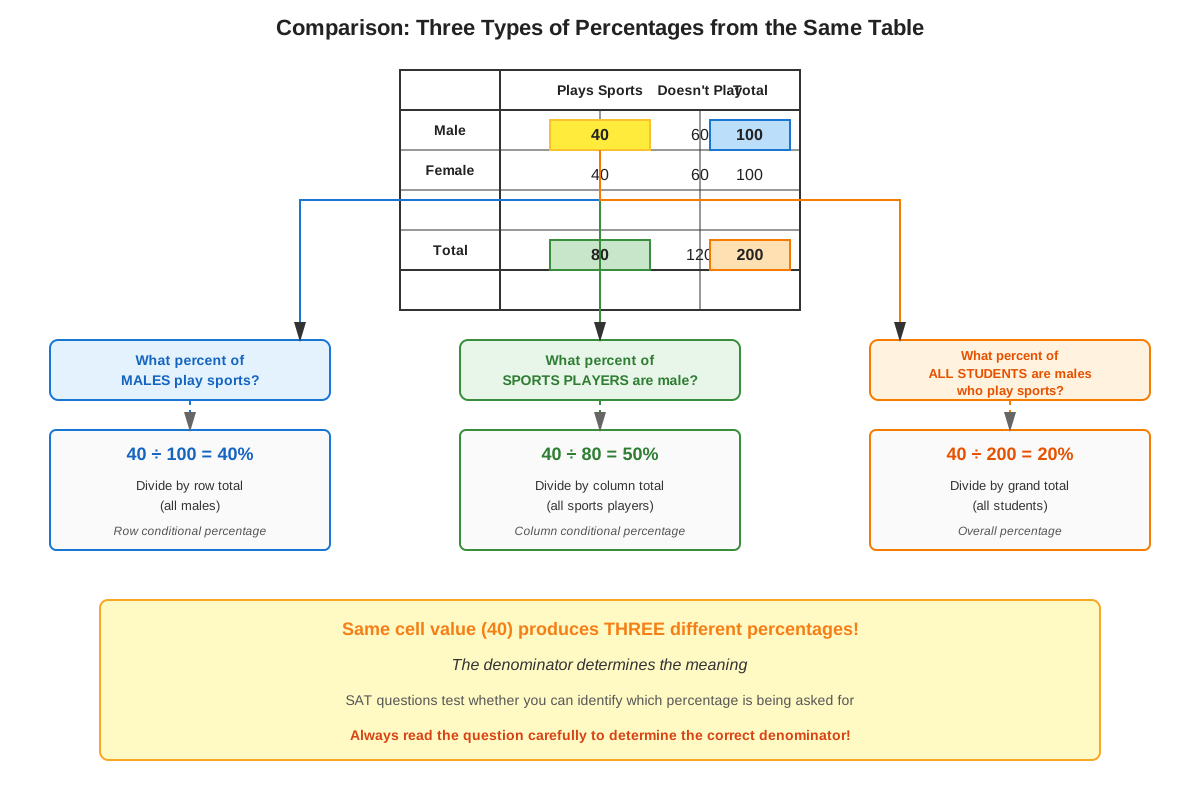
Conditional Percentage = (Number meeting both condition and characteristic / Number meeting the condition) × 100%For example, if 40 out of 100 female students play sports, the conditional percentage of female students who play sports is (40/100) × 100% = 40%. The condition here is "female students," which becomes the denominator, and the characteristic is "plays sports."
Two-Way Tables and Conditional Percentages
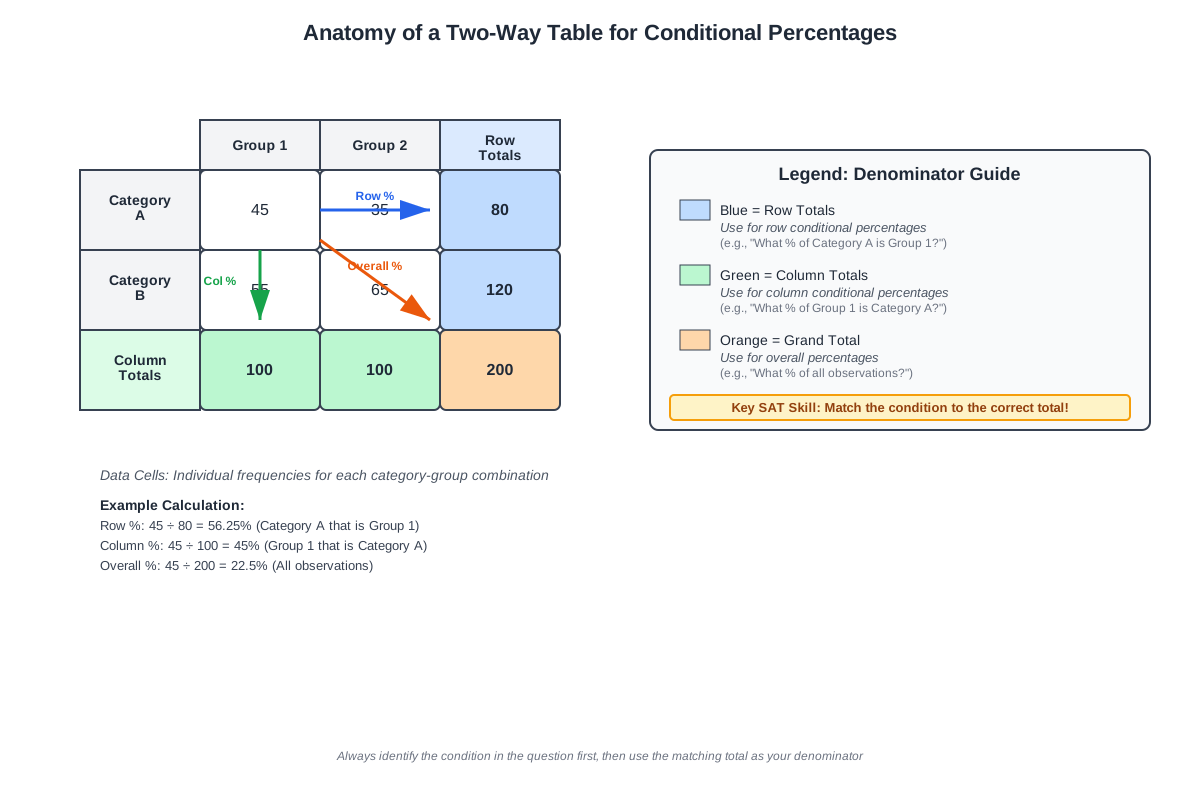
Two-way tables (also called contingency tables or cross-tabulation tables) organize data by two categorical variables, creating a grid where each cell represents the count of observations meeting both row and column criteria. These tables are the primary vehicle for sat conditional percentages questions.
Consider this example table:
| Plays Sports | Doesn't Play Sports | Total | |
|---|---|---|---|
| Male | 60 | 40 | 100 |
| Female | 40 | 60 | 100 |
| Total | 100 | 100 | 200 |
From this table, multiple conditional percentages can be calculated depending on which condition is specified:
- Row conditional percentages: Percentages calculated within each row (e.g., "What percentage of males play sports?" = 60/100 = 60%)
- Column conditional percentages: Percentages calculated within each column (e.g., "What percentage of students who play sports are male?" = 60/100 = 60%)
- Overall percentages: Percentages calculated from the grand total (e.g., "What percentage of all students are males who play sports?" = 60/200 = 30%)
Identifying the Correct Denominator
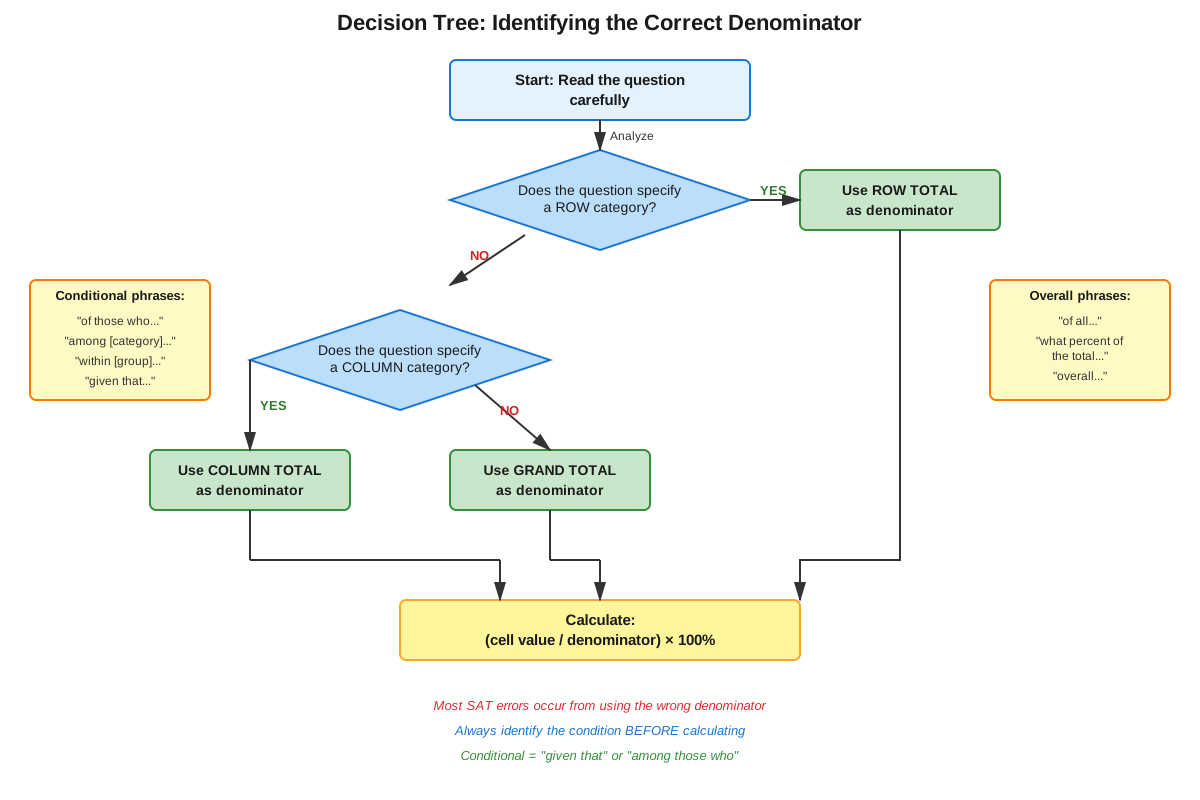
The most critical skill in conditional percentage problems is identifying the correct denominator—the reference group that defines the condition. The denominator is determined by the specific condition stated in the question.
Key principle: The condition in the question tells you which total to use as the denominator.
Question patterns and their corresponding denominators:
- "What percentage of [Group A] are [Characteristic B]?" → Denominator = Total of Group A
- "Among [Group A], what percentage have [Characteristic B]?" → Denominator = Total of Group A
- "What percentage of [Characteristic B] are [Group A]?" → Denominator = Total with Characteristic B
- "Of those with [Characteristic B], what percentage are [Group A]?" → Denominator = Total with Characteristic B
Conditional vs. Unconditional Percentages
Understanding the distinction between conditional and unconditional percentages is essential for SAT success:
| Type | Definition | Denominator | Example Question |
|---|---|---|---|
| Unconditional | Percentage of entire dataset | Grand total | "What percentage of all students play sports?" |
| Conditional | Percentage of specific subgroup | Subgroup total | "What percentage of female students play sports?" |
The SAT frequently includes answer choices that represent the unconditional percentage when the question asks for a conditional percentage, or vice versa. This deliberate trap tests whether students carefully identify the reference group.
Multi-Step Conditional Reasoning
Some SAT questions require calculating multiple conditional percentages or using conditional percentages in subsequent calculations. These problems test deeper understanding by combining conditional reasoning with other mathematical operations.
For example, a question might provide conditional percentages and ask students to work backward to find actual counts, or it might require comparing two different conditional percentages to determine which group has a higher rate of a particular characteristic.
Concept Relationships
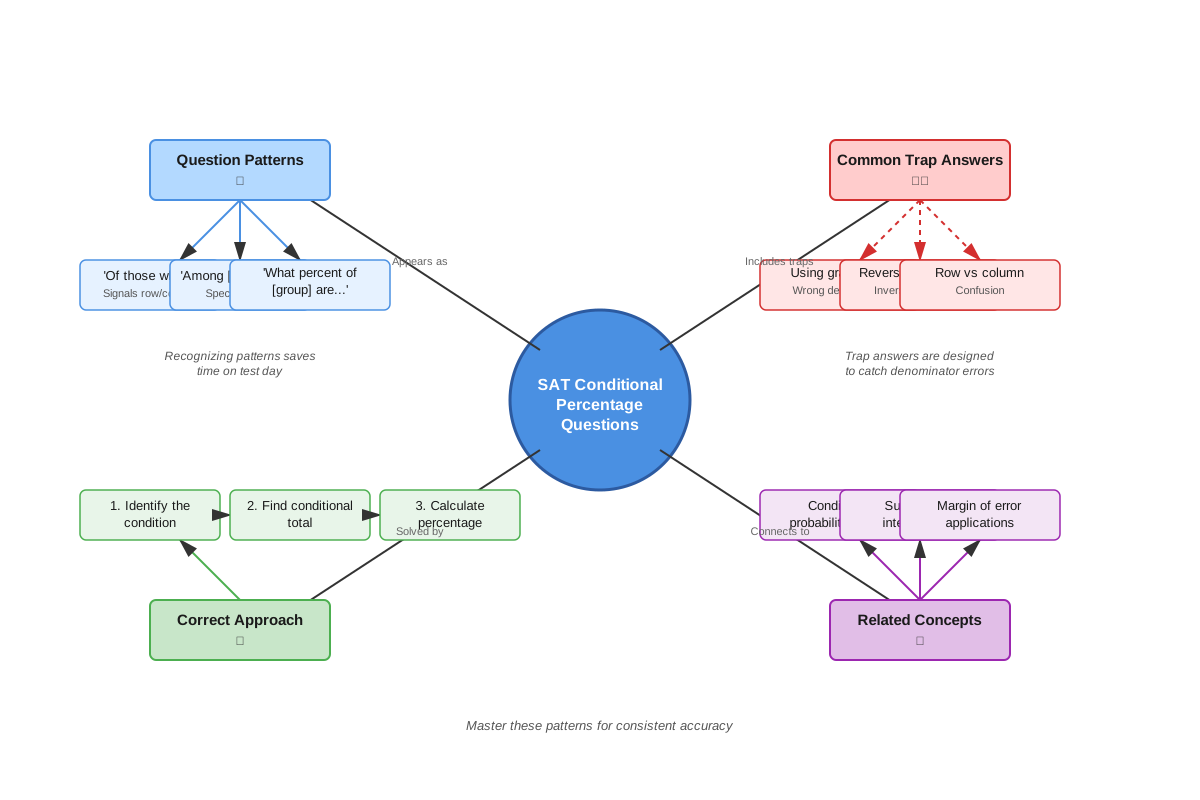
The concepts within conditional percentages form a logical hierarchy: understanding basic percentages → interpreting two-way tables → identifying conditions and reference groups → calculating conditional percentages → distinguishing between different types of conditional percentages → applying conditional reasoning to complex scenarios.
Two-way tables serve as the foundation that enables all conditional percentage calculations. The table structure creates the conditions (rows and columns) and provides the numerical data needed for calculations. Identifying the correct denominator depends entirely on correctly interpreting which condition the question specifies, which in turn requires careful reading of how the question references the table structure.
The relationship between conditional and unconditional percentages represents a part-whole relationship: unconditional percentages consider the entire dataset as the whole, while conditional percentages consider only a subset as the whole. This connects to the prerequisite concept of ratio and proportion reasoning, where the same numerical relationship can be expressed differently depending on the chosen reference point.
Conditional percentages also connect forward to more advanced topics like conditional probability, where the same logical structure applies but with probability notation and terminology. The reasoning pattern "given condition X, what is the likelihood of Y" appears in both contexts, making conditional percentages excellent preparation for probability concepts.
High-Yield Facts
⭐ The denominator in a conditional percentage is always the total of the specified condition, not the grand total
⭐ "What percentage of A are B" and "What percentage of B are A" typically yield different answers
⭐ Row percentages use row totals as denominators; column percentages use column totals as denominators
⭐ The SAT frequently includes the unconditional percentage as a distractor when asking for a conditional percentage
⭐ Conditional percentages can exceed 100% only if there's an error in calculation or problem setup
- Two-way tables always have row totals, column totals, and a grand total that equals the sum of all cells
- The sum of all conditional percentages within a single condition (e.g., all row percentages for one row) equals 100%
- Conditional percentages require identifying both the numerator (those meeting both criteria) and denominator (those meeting the condition)
- The phrase "among those who" or "of those who" signals a conditional percentage question
- Converting between counts and percentages requires knowing or calculating the appropriate total
- Conditional percentages are independent of the grand total size—they describe relationships within subgroups
Quick check — test yourself on Conditional percentages so far.
Try Flashcards →Common Misconceptions
Misconception: All percentages in a two-way table use the grand total as the denominator → Correction: Conditional percentages use the specific subgroup total (row or column total) as the denominator, not the grand total. Only unconditional percentages use the grand total.
Misconception: "What percentage of A are B" means the same as "What percentage of B are A" → Correction: These questions ask for different conditional percentages with different denominators. The first uses the total of A as the denominator; the second uses the total of B as the denominator.
Misconception: If 30% of males prefer option X and 40% of females prefer option X, then 70% of all people prefer option X → Correction: Conditional percentages cannot be added directly unless the groups are the same size. The overall percentage depends on the relative sizes of the male and female groups.
Misconception: The largest number in a two-way table always represents the highest conditional percentage → Correction: Conditional percentages depend on the ratio of a cell value to its row or column total. A smaller absolute number can represent a higher percentage if its reference group is also smaller.
Misconception: Conditional percentages are always less than 50% → Correction: Conditional percentages can range from 0% to 100%. If more than half of a subgroup has a characteristic, the conditional percentage exceeds 50%.
Misconception: The condition in "What percentage of students who play sports are female" is "female" → Correction: The condition is "students who play sports," making the total number of students who play sports the denominator. The question asks what portion of that group is female.
Worked Examples
Example 1: Basic Conditional Percentage Calculation
Problem: A survey of 200 high school students asked about their preferred study location. The results are shown in the table below:
| Library | Home | Coffee Shop | Total | |
|---|---|---|---|---|
| Juniors | 25 | 35 | 15 | 75 |
| Seniors | 40 | 50 | 35 | 125 |
| Total | 65 | 85 | 50 | 200 |
What percentage of seniors prefer studying at the library?
Solution:
Step 1: Identify the condition. The question asks about "seniors," so we're calculating a conditional percentage for the senior subgroup.
Step 2: Identify the denominator. The denominator is the total number of seniors = 125.
Step 3: Identify the numerator. The numerator is the number of seniors who prefer the library = 40.
Step 4: Calculate the conditional percentage:
(40 / 125) × 100% = 0.32 × 100% = 32%Answer: 32% of seniors prefer studying at the library.
Connection to learning objectives: This problem demonstrates identifying the key feature of conditional percentages (the specific subgroup denominator) and applying the calculation method to answer an SAT-style question.
Example 2: Distinguishing Between Different Conditional Percentages
Problem: Using the same table from Example 1, answer both questions:
A) What percentage of students who prefer the library are seniors?
B) What percentage of seniors prefer the library?
Solution:
Question A: "What percentage of students who prefer the library are seniors?"
Step 1: Identify the condition. The condition is "students who prefer the library."
Step 2: Identify the denominator. The denominator is the total number of students who prefer the library = 65.
Step 3: Identify the numerator. The numerator is the number of seniors who prefer the library = 40.
Step 4: Calculate:
(40 / 65) × 100% ≈ 61.5%Question B: "What percentage of seniors prefer the library?"
Step 1: Identify the condition. The condition is "seniors."
Step 2: Identify the denominator. The denominator is the total number of seniors = 125.
Step 3: Identify the numerator. The numerator is the number of seniors who prefer the library = 40.
Step 4: Calculate:
(40 / 125) × 100% = 32%Answers: A) Approximately 61.5% of library-preferring students are seniors. B) 32% of seniors prefer the library.
Key insight: These two questions use the same cell value (40) but different denominators, yielding very different percentages. This demonstrates why carefully identifying the condition is crucial. The SAT frequently tests this distinction by including both percentages as answer choices.
Connection to learning objectives: This example shows how to distinguish between row and column conditional percentages and explains how conditional percentages appears on the SAT through questions designed to test careful reading and denominator identification.
Exam Strategy
When approaching sat conditional percentages questions, follow this systematic process:
Step 1: Read the question carefully and identify the condition. Look for phrases like "of those who," "among," "what percentage of [group]," or "given that." The condition determines your denominator.
Step 2: Locate the relevant total in the table. Find the row total, column total, or cell value that represents the total number meeting the condition. This becomes your denominator.
Step 3: Identify the numerator. Find the cell value or sum of cells representing those who meet both the condition and the characteristic being asked about.
Step 4: Calculate and verify. Perform the division and multiply by 100%. Check that your answer makes logical sense (e.g., it should be between 0% and 100%, and it should align with visual inspection of the table).
Exam Tip: Before calculating, ask yourself: "Percentage of what?" The answer to this question is your denominator.
Trigger words and phrases to watch for:
- "What percentage of [Group A]..." → Group A total is the denominator
- "Among those who..." → The group described after "those who" is the denominator
- "Of the students who [condition]..." → Students meeting the condition form the denominator
- "Given that..." → The given condition determines the denominator
Process-of-elimination tips:
- Eliminate any answer choice greater than 100% (unless the question involves percentage increase/decrease, which is different)
- Calculate the unconditional percentage (using grand total) and eliminate it if the question clearly asks for a conditional percentage
- If two answer choices are very close, double-check your denominator—you may have used a row total instead of a column total or vice versa
- Eliminate answers that would require more people in a cell than exist in the entire row or column
Time allocation advice: Conditional percentage questions typically require 60-90 seconds. Spend 15-20 seconds carefully reading and identifying the condition, 20-30 seconds locating values in the table, and 25-40 seconds calculating and verifying. If a question requires multiple conditional percentage calculations, allocate up to 2 minutes.
Memory Techniques
Mnemonic for identifying denominators: "CONDITION = DENOMINATOR"
When you see the condition stated in the question, that's your denominator. If the question says "of seniors," seniors is your denominator. If it says "of those who prefer the library," library-preferrers is your denominator.
Visualization strategy: The "Zoom In" technique
Imagine the two-way table as a map. When a question specifies a condition, visualize zooming in on just that row or column until it fills your entire view. Now that subset is your "whole" (100%), and you're calculating what percentage of this new whole has the characteristic in question.
Acronym: FIND the answer
- Find the condition in the question
- Identify the denominator (total of the condition)
- Note the numerator (those meeting both criteria)
- Divide and multiply by 100%
Pattern recognition: Question structure determines denominator
- "What percentage of [BOLD PHRASE] are/have/prefer..." → [BOLD PHRASE] = denominator
- "Of those who [BOLD PHRASE], what percentage..." → [BOLD PHRASE] = denominator
Summary
Conditional percentages represent proportions within specific subgroups rather than entire datasets, making them essential for interpreting survey data, experimental results, and demographic information on the SAT. The fundamental skill is identifying which condition defines the reference group, as this condition determines the denominator in the percentage calculation. Two-way tables organize data to enable multiple conditional percentage calculations, with row percentages using row totals as denominators and column percentages using column totals. The SAT tests whether students can distinguish between conditional and unconditional percentages, recognize that "percentage of A that are B" differs from "percentage of B that are A," and accurately calculate percentages using the appropriate reference group. Success requires careful reading to identify the condition, systematic location of the correct denominator in the table, and verification that the calculated percentage makes logical sense in context. Mastering conditional percentages provides a significant advantage on 15-20% of Problem Solving and Data Analysis questions.
Key Takeaways
- Conditional percentages use the subgroup total as the denominator, not the grand total—the condition specified in the question determines which total to use
- "What percentage of A are B" and "What percentage of B are A" are different questions with different answers because they have different denominators
- Two-way tables enable multiple conditional percentage calculations depending on whether you're calculating row percentages, column percentages, or overall percentages
- The phrase "of those who" or "among" signals a conditional percentage and identifies the reference group that becomes the denominator
- SAT answer choices deliberately include common errors such as using the grand total instead of the conditional total or confusing row and column percentages
- Systematic question analysis prevents errors: identify the condition, locate the denominator, find the numerator, calculate, and verify
- Conditional percentage reasoning connects to probability and statistical inference, making it foundational for advanced quantitative reasoning
Related Topics
Probability and Conditional Probability: Conditional percentages provide the conceptual foundation for conditional probability, where the same logic of restricting to a subset applies but with probability notation (P(A|B)). Mastering conditional percentages makes conditional probability significantly more accessible.
Scatter Plots and Trend Analysis: While conditional percentages deal with categorical data in tables, scatter plots present continuous data where conditional reasoning appears in questions about specific ranges or subgroups within the data.
Statistical Inference and Margin of Error: Understanding conditional percentages is essential for interpreting survey results with margins of error, where confidence intervals apply to specific subgroups.
Ratio and Proportion Word Problems: Conditional percentages are a specific application of proportional reasoning, and the skills transfer directly to more complex ratio problems involving multiple steps.
Practice CTA
Now that you've mastered the core concepts of conditional percentages, it's time to solidify your understanding through practice. Attempt the practice questions to test your ability to identify conditions, select appropriate denominators, and calculate accurately under timed conditions. Use the flashcards to reinforce the key distinctions between conditional and unconditional percentages and to memorize trigger phrases that signal specific calculation approaches. Remember: conditional percentage questions are highly predictable on the SAT, and consistent practice with this question type translates directly into points on test day. Each practice problem you complete builds the pattern recognition and calculation fluency that separates good scores from great scores!
Sign up free to keep reading
Create a free AnvayaPrep account to finish this SAT guide on Conditional percentages — plus flashcards and practice questions.