Overview
Dot plots are one of the fundamental data visualization tools tested on the SAT math section, appearing regularly in questions that assess statistical reasoning and data interpretation skills. A dot plot is a simple yet powerful graphical display that shows the frequency of data values along a number line, with each dot representing one occurrence of a particular value. This visualization method allows students to quickly identify patterns, central tendencies, and the distribution of data sets—skills that are essential for success on the SAT's Problem Solving and Data Analysis questions.
Understanding dot plots is crucial for SAT success because they frequently appear in questions testing measures of center (mean, median, mode), measures of spread (range, interquartile range), and data distribution characteristics. The College Board favors dot plots because they provide a clear, intuitive representation of small to medium-sized data sets while requiring students to demonstrate both computational skills and conceptual understanding. Questions involving dot plots often integrate multiple statistical concepts, making them high-yield topics that can appear in both calculator and no-calculator sections.
Dot plots serve as a bridge between raw numerical data and more complex statistical representations like histograms, box plots, and frequency tables. Mastering dot plots builds foundational skills in data literacy that extend to interpreting other graphical displays and understanding how data characteristics influence statistical measures. This topic connects directly to concepts of central tendency, variability, and data distribution—all of which are heavily weighted in the SAT's Data Analysis and Statistics domain.
Learning Objectives
- [ ] Identify key features of dot plots including individual data points, clusters, gaps, and outliers
- [ ] Explain how dot plots appears on the SAT in various question formats and contexts
- [ ] Apply dot plots to answer SAT-style questions involving statistical calculations and interpretations
- [ ] Calculate measures of center (mean, median, mode) directly from dot plot representations
- [ ] Determine measures of spread (range, interquartile range) using dot plot data
- [ ] Compare and contrast data distributions represented in different dot plots
- [ ] Identify how changes in data values affect the shape and statistical properties of dot plots
Prerequisites
- Basic arithmetic operations: Essential for calculating sums, differences, and averages when working with data values shown in dot plots
- Understanding of fractions and decimals: Necessary for computing means and other statistical measures that may result in non-integer values
- Number line comprehension: Fundamental for reading the horizontal axis and identifying the position of data points
- Basic counting skills: Required to determine frequencies and total number of observations in a data set
- Concept of ordering numbers: Important for identifying minimum, maximum, and median values from dot plot displays
Why This Topic Matters
Dot plots represent a critical intersection of data literacy and mathematical reasoning that extends far beyond standardized testing. In real-world applications, professionals across fields—from healthcare to business analytics—use dot plots to visualize small data sets, identify trends, and communicate findings efficiently. Scientists use them to display experimental results, educators employ them to track student performance, and economists utilize them to show economic indicators over time. The ability to read and interpret dot plots is a fundamental skill in an increasingly data-driven world.
On the SAT, dot plots appear with notable frequency, typically showing up in 2-4 questions per test administration. These questions most commonly appear in the Problem Solving and Data Analysis domain, which comprises approximately 29% of the SAT Math section (17 out of 58 questions). Dot plot questions can appear in both multiple-choice and student-produced response (grid-in) formats, and they often require multi-step reasoning that combines data interpretation with statistical calculation.
The College Board strategically includes dot plots in various contexts: comparing two data sets, analyzing the effect of adding or removing data points, calculating statistical measures, and identifying data characteristics. Questions may present dot plots alongside other representations (tables, bar graphs) or ask students to translate between different formats. The versatility of dot plot questions makes them particularly valuable for the exam, as they can assess multiple competencies simultaneously—from basic data reading to sophisticated statistical reasoning.
Core Concepts
Structure and Components of Dot Plots
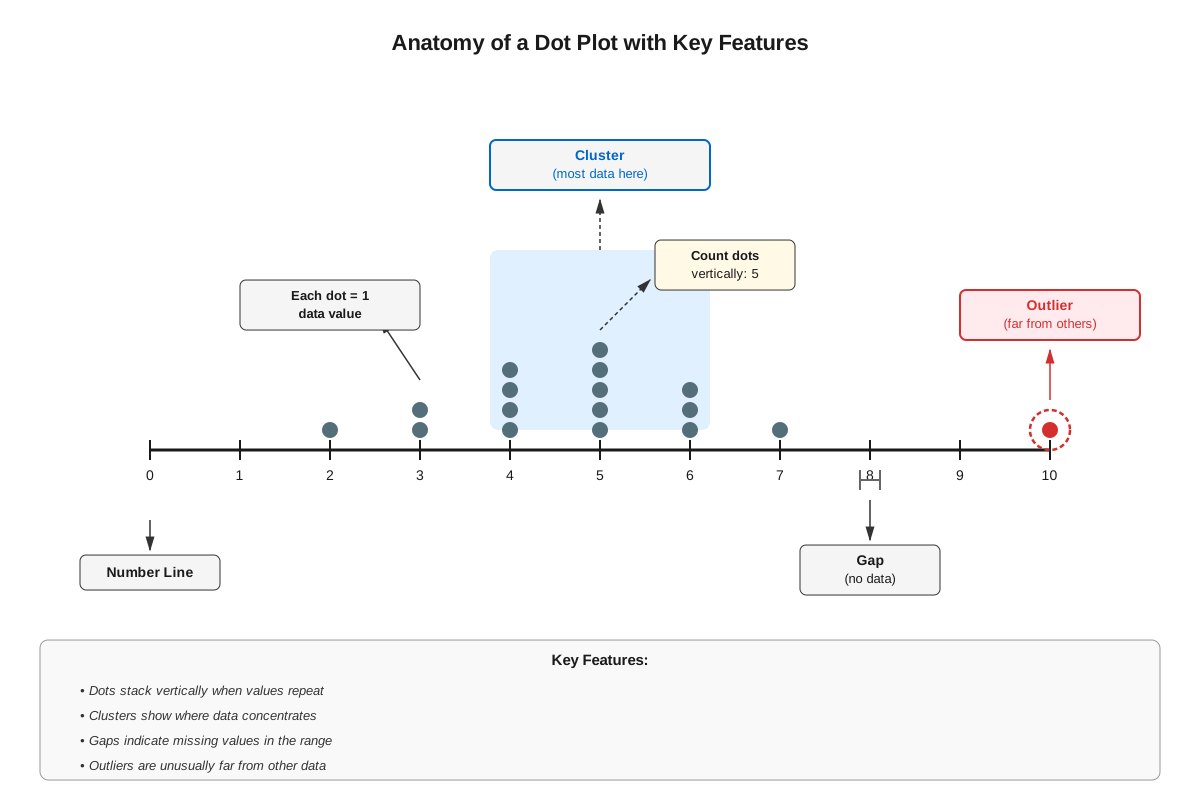
A dot plot (also called a dot chart or dot graph) consists of a horizontal number line with dots placed above corresponding values to represent the frequency of each data point. Each dot represents exactly one occurrence of that value in the data set. The fundamental components include:
- Horizontal axis: A number line showing the scale of possible values, typically marked with regular intervals
- Dots: Individual markers (usually circular) stacked vertically above their corresponding values
- Labels: Axis titles and numerical markers that provide context and scale information
The construction of a dot plot follows a systematic process: first, establish an appropriate scale on the horizontal axis that encompasses all data values; second, place one dot above the number line for each occurrence of each value; third, stack dots vertically when multiple occurrences of the same value exist. This stacking creates columns of dots that visually represent frequency, making patterns immediately apparent.
Reading and Interpreting Dot Plots
Extracting information from sat dot plots requires systematic observation and counting. To determine the total number of data points, count every dot in the display. To find the frequency of a specific value, count the dots stacked above that value on the number line. The distribution shape becomes visible through the pattern of dot columns—symmetric distributions show balanced patterns around a center, while skewed distributions show longer tails on one side.
Key features to identify when analyzing dot plots include:
- Clusters: Groups of data points concentrated in particular regions, indicating common values
- Gaps: Intervals on the number line with no data points, showing values that don't appear in the data set
- Outliers: Data points that are notably separated from the main body of data, potentially indicating unusual observations
- Range: The span from the minimum value (leftmost dot) to the maximum value (rightmost dot)
- Mode: The value(s) with the tallest column of dots, representing the most frequent observation(s)
Calculating Statistical Measures from Dot Plots
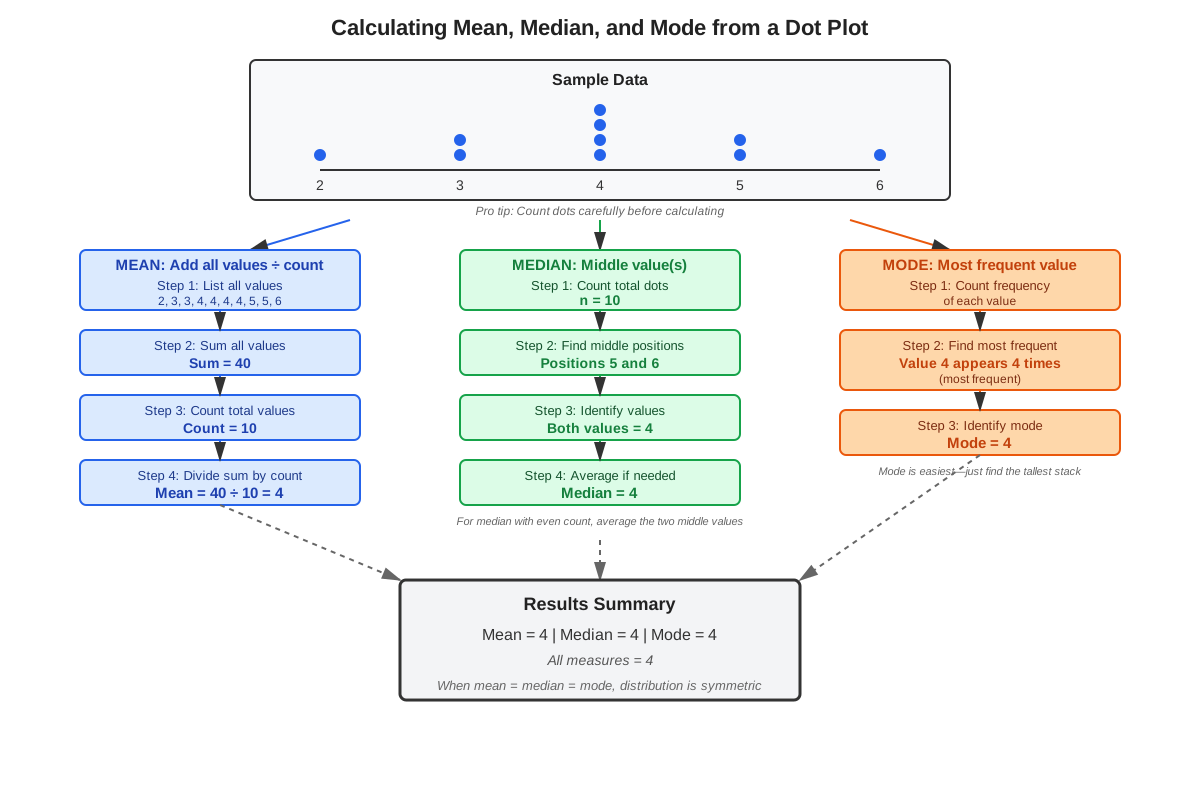
Computing the mean from a dot plot requires multiplying each unique value by its frequency (number of dots), summing these products, and dividing by the total number of data points. For example, if a dot plot shows three dots at 5, two dots at 7, and one dot at 9, the mean equals (3×5 + 2×7 + 1×9) ÷ 6 = (15 + 14 + 9) ÷ 6 = 38 ÷ 6 ≈ 6.33.
Finding the median involves identifying the middle value when data points are arranged in order. Since dot plots already display data in numerical order from left to right, locate the middle position by counting dots. For an odd number of data points, the median is the value of the middle dot; for an even number, the median is the average of the two middle values.
The mode is the easiest measure to identify visually—it's the value with the tallest stack of dots. A data set can have one mode (unimodal), two modes (bimodal), or more (multimodal), or no mode if all values appear with equal frequency.
Comparing Distributions Using Dot Plots
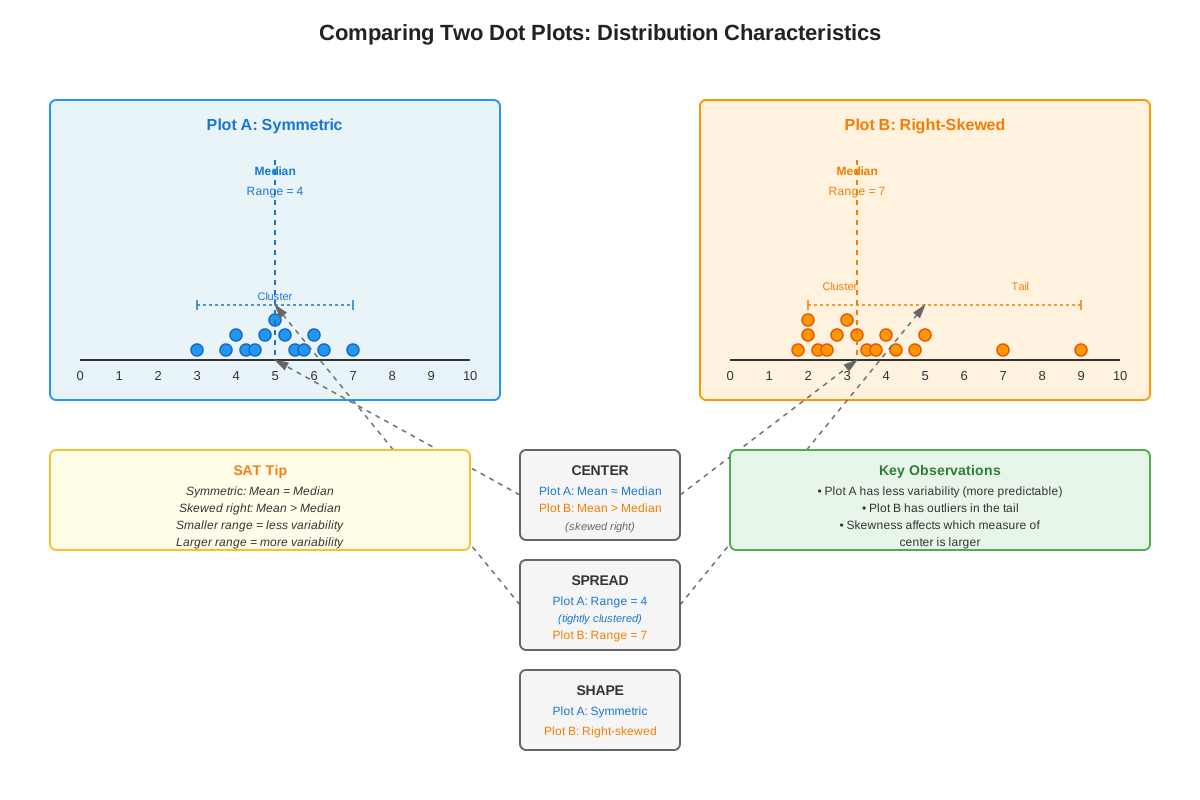
SAT questions frequently present two dot plots side-by-side and ask students to compare their characteristics. When comparing distributions, examine:
| Comparison Aspect | What to Analyze |
|---|---|
| Center | Which distribution has a higher mean or median? |
| Spread | Which distribution shows greater variability (wider range or larger standard deviation)? |
| Shape | Are distributions symmetric, skewed left, or skewed right? |
| Outliers | Does either distribution contain extreme values? |
| Overlap | Do the distributions share common values or ranges? |
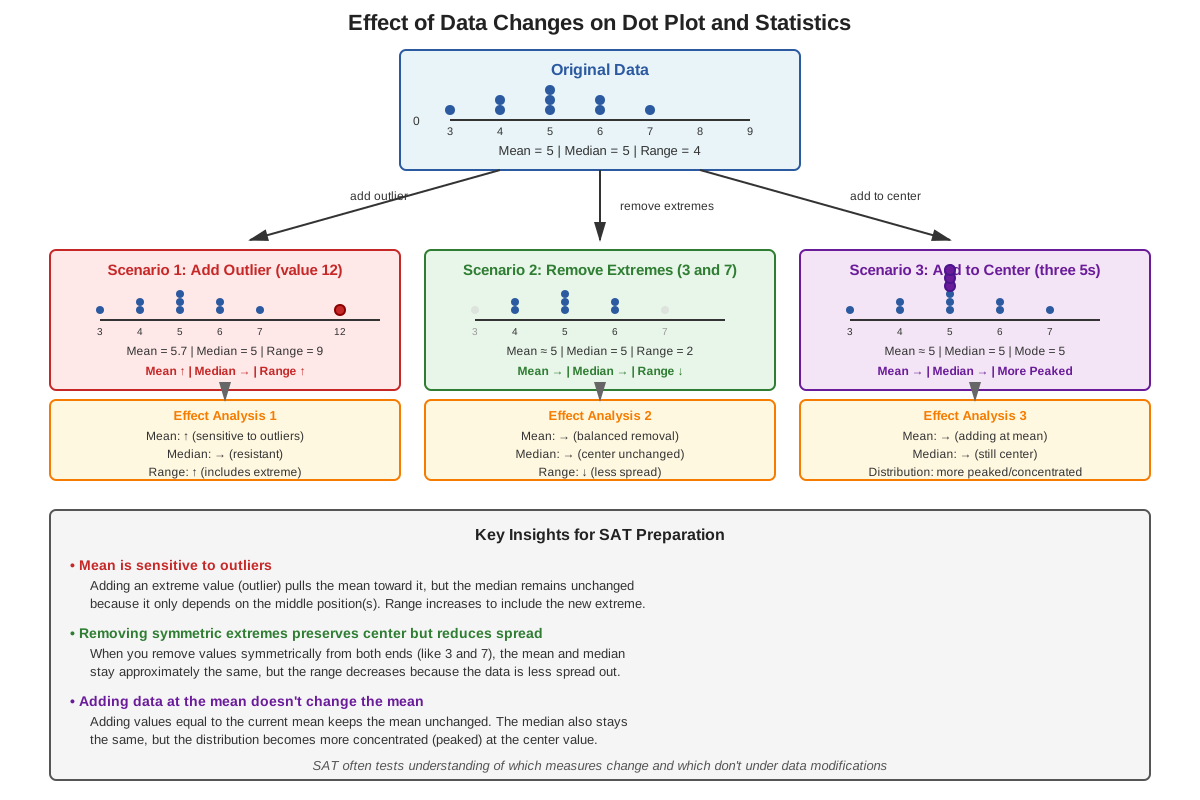
Understanding how changes affect dot plots is crucial for SAT success. Adding a data point creates an additional dot and may shift the mean, potentially change the median, and always increases the total count. Removing a data point has the opposite effect. Adding an extreme value (outlier) typically pulls the mean toward that value more dramatically than it affects the median, demonstrating why the median is considered more "resistant" to outliers.
Distribution Characteristics and Patterns
The shape of a dot plot reveals important information about data distribution. A symmetric distribution shows a balanced pattern where the left and right sides mirror each other around a central value. A right-skewed (positively skewed) distribution has a longer tail extending toward higher values, with most data concentrated on the left. A left-skewed (negatively skewed) distribution shows the opposite pattern, with a tail extending toward lower values.
The relationship between mean and median provides clues about distribution shape: in symmetric distributions, mean and median are approximately equal; in right-skewed distributions, the mean exceeds the median because extreme high values pull the mean upward; in left-skewed distributions, the mean is less than the median because extreme low values pull the mean downward.
Concept Relationships
The concepts within dot plots form an interconnected system where understanding one element enhances comprehension of others. The structure of dot plots (number line with stacked dots) → enables visual identification of frequency patterns → which facilitates calculation of statistical measures → leading to interpretation of distribution characteristics.
Reading dot plots connects directly to calculating statistical measures: identifying individual data points and their frequencies is the prerequisite for computing means, medians, and modes. These measures of center then relate to distribution shape—the relationship between mean and median reveals skewness, while the mode identifies peaks in the distribution.
Dot plots serve as a foundation for understanding more complex statistical representations. The skills developed in reading dot plots → transfer directly to interpreting histograms (which group data into bins rather than showing individual values) → and connect to box plots (which summarize the five-number summary derived from ordered data) → ultimately supporting comprehensive statistical analysis across multiple representation types.
The concept of variability in dot plots (observed through spread and clustering) → links to measures of spread like range and interquartile range → which connect to the broader statistical concept of standard deviation → enabling sophisticated comparisons between data sets. Understanding how outliers appear in dot plots → relates to their disproportionate effect on the mean versus median → demonstrating the concept of resistant measures in statistics.
High-Yield Facts
⭐ Each dot in a dot plot represents exactly one data point or observation in the data set
⭐ The mode is the value with the tallest stack of dots (highest frequency)
⭐ To find the total number of data points, count all dots in the entire plot
⭐ The range equals the rightmost value minus the leftmost value
⭐ The median is found by locating the middle position when counting dots from left to right
- The mean is calculated by summing all values (accounting for frequency) and dividing by the total number of data points
- Outliers appear as dots separated from the main cluster of data
- In a symmetric distribution, the mean and median are approximately equal
- Adding an extreme value affects the mean more than the median
- Gaps in a dot plot indicate values that do not appear in the data set
- A right-skewed distribution has mean > median, while a left-skewed distribution has mean < median
- The interquartile range (IQR) can be determined by finding Q3 (75th percentile) minus Q1 (25th percentile)
- Dot plots are most effective for displaying small to medium-sized data sets (typically fewer than 50 observations)
- Multiple modes (bimodal or multimodal distributions) appear as multiple peaks in the dot plot
- The frequency of any value equals the number of dots stacked above that value
Quick check — test yourself on Dot plots so far.
Try Flashcards →Common Misconceptions
Misconception: Each dot represents a frequency count rather than an individual data point → Correction: Each dot represents exactly one occurrence of a value. If there are five dots above the number 7, this means the value 7 appears five times in the data set, not that there are five different values.
Misconception: The mode is always the middle value in a dot plot → Correction: The mode is the most frequently occurring value (the tallest stack of dots), which may appear anywhere along the number line. The middle value when data is ordered is the median, not the mode.
Misconception: The mean can be found by simply identifying the middle of the number line scale → Correction: The mean must be calculated by summing all data values (accounting for their frequencies) and dividing by the total count. The mean's position depends on the actual data values, not the scale of the axis.
Misconception: Dot plots can only display whole number values → Correction: Dot plots can display any numerical values including decimals and fractions. The horizontal axis scale determines what values can be represented, and dots can be placed above any point on that scale.
Misconception: A gap in the dot plot means there's missing data or an error → Correction: Gaps simply indicate that no observations in the data set have values in that range. Gaps are normal features of many data sets and provide important information about the distribution.
Misconception: Adding a data point at the mean won't change the mean → Correction: Adding any data point, even one equal to the current mean, changes the calculation because it increases the total count of observations. The new mean must be recalculated with the additional value included.
Misconception: The range is the number of different values shown in the dot plot → Correction: The range is the difference between the maximum and minimum values (rightmost minus leftmost), not the count of distinct values. A data set with values from 2 to 10 has a range of 8, regardless of how many different values appear between them.
Worked Examples
Example 1: Calculating Statistical Measures
Problem: The dot plot below shows the number of books read by 15 students during summer vacation. Calculate the mean, median, and mode.
Number of Books Read:
    •
    •  •
    •  •  •
    •  •  •  •
    •  •  •  •  •
————————————————————
2 3 4 5 6 7Solution:
Step 1: Count the dots at each value to determine frequencies:
- 2 books: 1 student
- 3 books: 2 students
- 4 books: 3 students
- 5 books: 4 students
- 6 books: 5 students
- Total: 1 + 2 + 3 + 4 + 5 = 15 students ✓
Step 2: Calculate the mean:
Mean = (sum of all values) ÷ (total count)
Sum = (1×2) + (2×3) + (3×4) + (4×5) + (5×6)
Sum = 2 + 6 + 12 + 20 + 30 = 70
Mean = 70 ÷ 15 = 4.67 books (approximately)
Step 3: Find the median:
With 15 data points, the median is the 8th value when counting from left to right.
Counting dots: positions 1 (at 2), positions 2-3 (at 3), positions 4-6 (at 4), positions 7-10 (at 5)
The 8th position falls at 5 books.
Median = 5 books
Step 4: Identify the mode:
The tallest stack has 5 dots at the value 6.
Mode = 6 books
Connection to Learning Objectives: This example demonstrates how to identify key features of dot plots (frequencies at each value) and apply computational procedures to calculate all three measures of center, skills essential for SAT success.
Example 2: Analyzing the Effect of Data Changes
Problem: A dot plot shows test scores for 8 students: 72, 75, 75, 78, 78, 78, 82, 85. The current mean is 77.875. If the student who scored 72 retakes the test and scores 88, how does this change affect the mean and median?
Solution:
Step 1: Visualize the original dot plot:
    •
    •  •
•  •  •  •  •
————————————————————
72 75 78 82 85
Step 2: Calculate the original median:
With 8 values, the median is the average of the 4th and 5th values.
Ordered: 72, 75, 75, 78, 78, 78, 82, 85
Median = (78 + 78) ÷ 2 = 78
Step 3: Determine the new data set:
Remove 72, add 88: 75, 75, 78, 78, 78, 82, 85, 88
Step 4: Calculate the new mean:
New sum = (original sum) - 72 + 88 = (77.875 × 8) - 72 + 88
New sum = 623 - 72 + 88 = 639
New mean = 639 ÷ 8 = 79.875
Change in mean = 79.875 - 77.875 = 2 points (increase)
Step 5: Calculate the new median:
New ordered data: 75, 75, 78, 78, 78, 82, 85, 88
New median = (78 + 78) ÷ 2 = 78
Change in median = 78 - 78 = 0 points (no change)
Analysis: Replacing a low value (72) with a high value (88) increased the mean by 2 points but did not affect the median. This demonstrates that the median is more resistant to extreme values than the mean—a key concept frequently tested on the SAT.
Connection to Learning Objectives: This example shows how to apply dot plot concepts to analyze the effects of data changes on statistical measures, a common SAT question type that tests deeper understanding of distribution properties.
Exam Strategy
When approaching sat dot plots questions, begin by quickly scanning the entire plot to understand the scale, range, and general distribution shape before reading the question. This preview helps activate relevant statistical concepts and prevents misreading individual values. Count the total number of dots immediately—this information is needed for most calculations and helps verify answers.
Trigger words and phrases that signal specific approaches:
- "How many" → Count dots (either total or at specific values)
- "Mean" or "average" → Multiply each value by its frequency, sum, and divide by total count
- "Median" → Find the middle position(s) by counting dots from left to right
- "Mode" or "most common" → Identify the tallest stack of dots
- "Range" → Subtract leftmost value from rightmost value
- "If a data point is added/removed" → Recalculate the specified measure with the modified data set
- "Compare" → Analyze both distributions for center, spread, and shape differences
For process-of-elimination strategies, use these dot plot-specific techniques:
- Eliminate answers that violate basic properties: If a question asks for the mean and an answer choice is larger than the maximum value or smaller than the minimum value shown in the plot, eliminate it immediately.
- Use estimation before calculating: Visually estimate where the mean should fall based on the distribution's balance point. Eliminate answers that are far from this estimate before performing exact calculations.
- Check answer reasonableness: If calculating the median, ensure your answer is actually a value (or average of values) that appears in the data set. If finding the mode, verify it's the value with the most dots.
- Verify total counts: If an answer choice implies a different total number of data points than shown in the plot, it's incorrect.
Time allocation advice: Simple dot plot questions (counting dots, identifying mode) should take 30-45 seconds. Questions requiring mean or median calculations typically need 60-90 seconds. Complex questions involving comparisons or data changes may require up to 2 minutes. If a calculation becomes lengthy, double-check that you're using the most efficient method—sometimes estimation or elimination can save valuable time.
Exam Tip: Always write down the frequencies of each value before calculating the mean. This organized approach prevents counting errors and makes it easy to verify your work if time permits.
Memory Techniques
MMMR Mnemonic for statistical measures:
- Mode = Most (tallest stack)
- Median = Middle (middle position)
- Mean = Math (requires calculation)
- Range = Rightmost minus leftmost
Visualization Strategy: Picture dot plots as "data mountains" where peaks represent common values and valleys represent gaps. The "summit" is the mode, the "center of mass" is the mean, and the "midpoint of the trail" is the median. This geographic metaphor helps remember that the mean can be "pulled" toward outliers like a center of mass shifts with weight distribution.
"Count Every Dot" Acronym (CED):
- Check the scale first
- Enumerate all dots for total count
- Determine frequencies at each value
Skewness Memory Aid: "The mean follows the tail"—in a right-skewed distribution, the tail extends right and the mean is pulled right of the median; in a left-skewed distribution, the tail extends left and the mean is pulled left of the median.
Median Position Formula: For n data points, the median position is (n+1)÷2. For 15 points, position 8; for 20 points, position 10.5 (average of 10th and 11th values). This formula works for both odd and even counts.
Summary
Dot plots are essential data visualization tools on the SAT that display individual data points as dots stacked above their corresponding values on a number line. Mastery requires the ability to read the plot structure, count frequencies accurately, and calculate statistical measures including mean (sum of all values divided by count), median (middle value when ordered), mode (most frequent value), and range (maximum minus minimum). Success on SAT dot plot questions depends on recognizing distribution characteristics such as symmetry, skewness, clusters, gaps, and outliers, as well as understanding how changes to data sets affect these measures. The median proves more resistant to outliers than the mean, a relationship frequently tested through questions about adding or removing extreme values. Efficient problem-solving requires systematic approaches: counting all dots first, organizing frequencies before calculations, and using estimation to verify answer reasonableness. Students must also develop the ability to compare distributions across multiple dot plots and translate between different statistical representations.
Key Takeaways
- Each dot represents exactly one data point; count all dots to determine the total number of observations in the data set
- The mode (most frequent value) is identified visually as the tallest stack of dots, while the median requires counting to the middle position
- Calculate the mean by multiplying each value by its frequency, summing these products, and dividing by the total count
- The relationship between mean and median reveals distribution shape: mean > median indicates right skew, mean < median indicates left skew
- Adding or removing data points, especially outliers, affects the mean more dramatically than the median
- Range (maximum - minimum) and gaps provide information about data spread and distribution characteristics
- Systematic approaches—counting dots, organizing frequencies, and estimating before calculating—improve accuracy and efficiency on SAT questions
Related Topics
Histograms: Building on dot plot skills, histograms group continuous data into intervals (bins) and display frequencies as bars. Mastering dot plots provides the foundation for understanding how data is aggregated and represented in histogram form, a common SAT visualization.
Box Plots (Box-and-Whisker Plots): These displays summarize data using the five-number summary (minimum, Q1, median, Q3, maximum) derived from ordered data. Skills in finding medians and identifying outliers in dot plots transfer directly to interpreting box plots.
Measures of Spread: Understanding variability in dot plots leads naturally to studying standard deviation, variance, and interquartile range—quantitative measures that describe how data points differ from central values.
Frequency Tables: The connection between dot plots and frequency tables is direct—both organize data by value and frequency. Learning to translate between these representations strengthens data literacy skills.
Scatter Plots and Correlation: While dot plots show univariate data (one variable), scatter plots extend these skills to bivariate data (two variables), introducing concepts of association and correlation that appear frequently on the SAT.
Practice CTA
Now that you've mastered the core concepts of dot plots, it's time to solidify your understanding through active practice. Work through the practice questions to apply these strategies to authentic SAT-style problems, and use the flashcards to reinforce key definitions and procedures. Remember that statistical reasoning improves with repetition—each problem you solve strengthens your ability to quickly recognize patterns and execute calculations accurately. The skills you've developed with dot plots form the foundation for success across the entire Data Analysis and Statistics domain. Approach each practice question systematically, and you'll build the confidence needed to excel on test day!
Sign up free to keep reading
Create a free AnvayaPrep account to finish this SAT guide on Dot plots — plus flashcards and practice questions.