Overview
The mean, commonly known as the average, stands as one of the most fundamental concepts in data analysis and statistics tested on the SAT. This measure of central tendency appears consistently across multiple question types in the SAT math section, making it a high-yield topic that students must master to achieve competitive scores. Understanding the mean goes beyond simple calculation—it requires recognizing how data points interact, how changes to datasets affect the average, and how to manipulate algebraic expressions involving means.
On the SAT, mean-related questions test both computational skills and conceptual understanding. Students encounter problems requiring them to calculate means from datasets, work backward from a given mean to find missing values, understand how adding or removing data points affects the average, and interpret means in real-world contexts. The College Board frequently embeds mean calculations within word problems, data interpretation scenarios, and multi-step algebraic challenges, making this topic essential for success across various question formats.
The mean connects intimately with other statistical measures like median and mode, forming the foundation of data analysis. It also bridges to algebraic thinking, as many SAT problems require students to set up and solve equations involving means. Furthermore, understanding the mean prepares students for more advanced statistical concepts including standard deviation, data distribution, and probability—topics that occasionally appear in higher-difficulty SAT questions. Mastery of the mean provides the analytical framework necessary for interpreting graphs, tables, and data sets that appear throughout the exam.
Learning Objectives
- [ ] Identify key features of Mean
- [ ] Explain how Mean appears on the SAT
- [ ] Apply Mean to answer SAT-style questions
- [ ] Calculate the mean of a dataset using the standard formula
- [ ] Determine missing values in a dataset when the mean is provided
- [ ] Analyze how adding, removing, or changing data points affects the mean
- [ ] Solve multi-step problems involving weighted averages and combined datasets
Prerequisites
- Basic arithmetic operations: Addition, subtraction, multiplication, and division are essential for calculating means and manipulating equations involving averages
- Algebraic equation solving: Setting up and solving linear equations is necessary when working backward from a given mean to find unknown values
- Understanding of variables: Recognizing that letters can represent unknown quantities helps in formulating mean-based equations
- Fraction and decimal operations: Many mean calculations result in non-integer values requiring comfort with rational numbers
Why This Topic Matters
The mean serves as the most widely used measure of central tendency in real-world applications, from calculating grade point averages to analyzing economic indicators, sports statistics, and scientific data. Understanding means enables informed decision-making in everyday life, whether evaluating product ratings, comparing salary data, or interpreting news reports containing statistical information. This practical relevance makes the mean an indispensable mathematical tool beyond the classroom.
On the SAT, mean-related questions appear with remarkable consistency, typically comprising 2-4 questions per exam across both the calculator and no-calculator sections. These questions span difficulty levels from straightforward calculations worth quick points to complex multi-step problems that challenge even high-scoring students. The College Board tests the mean through various formats: direct calculation problems, word problems requiring equation setup, data interpretation from tables and graphs, and conceptual questions about how changes affect averages.
Common SAT question types include: finding the mean of a listed dataset, determining a missing value when the mean and other values are given, calculating how many data points satisfy certain conditions given a mean, understanding the effect of outliers on the mean, and solving problems involving combined groups with different means (weighted averages). The mean also appears integrated with other topics like ratios, percentages, and linear functions, making it a connector concept that enhances overall mathematical reasoning skills.
Core Concepts
Definition and Basic Formula
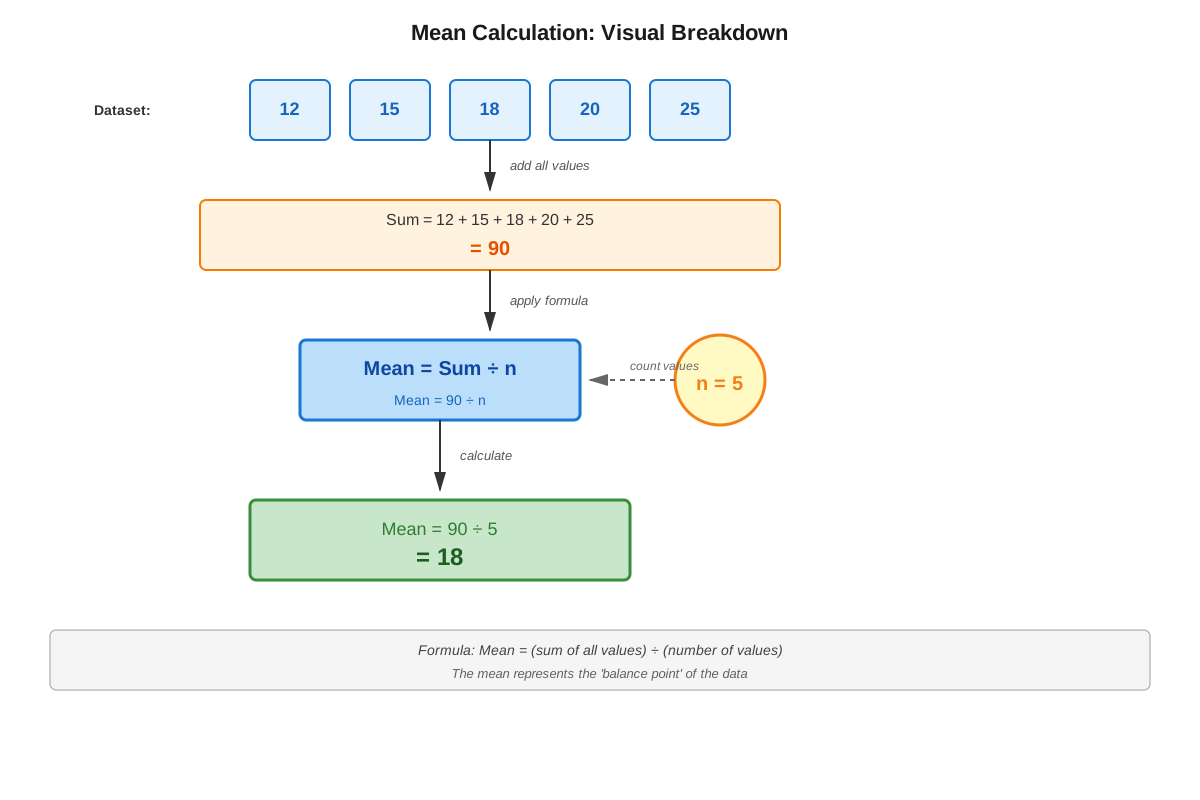
The mean represents the arithmetic average of a dataset, calculated by summing all values and dividing by the number of values. Mathematically, the mean formula is expressed as:
Mean = (Sum of all values) / (Number of values)Or using mathematical notation:
x̄ = (x₁ + x₂ + x₃ + ... + xₙ) / nWhere x̄ (read as "x-bar") represents the mean, x₁ through xₙ are the individual data values, and n is the total count of values. This formula applies universally to any numerical dataset, regardless of size or context.
For example, to find the mean of the test scores 85, 92, 78, 95, and 90:
- Sum: 85 + 92 + 78 + 95 + 90 = 440
- Count: 5 scores
- Mean: 440 ÷ 5 = 88
Working Backward from the Mean
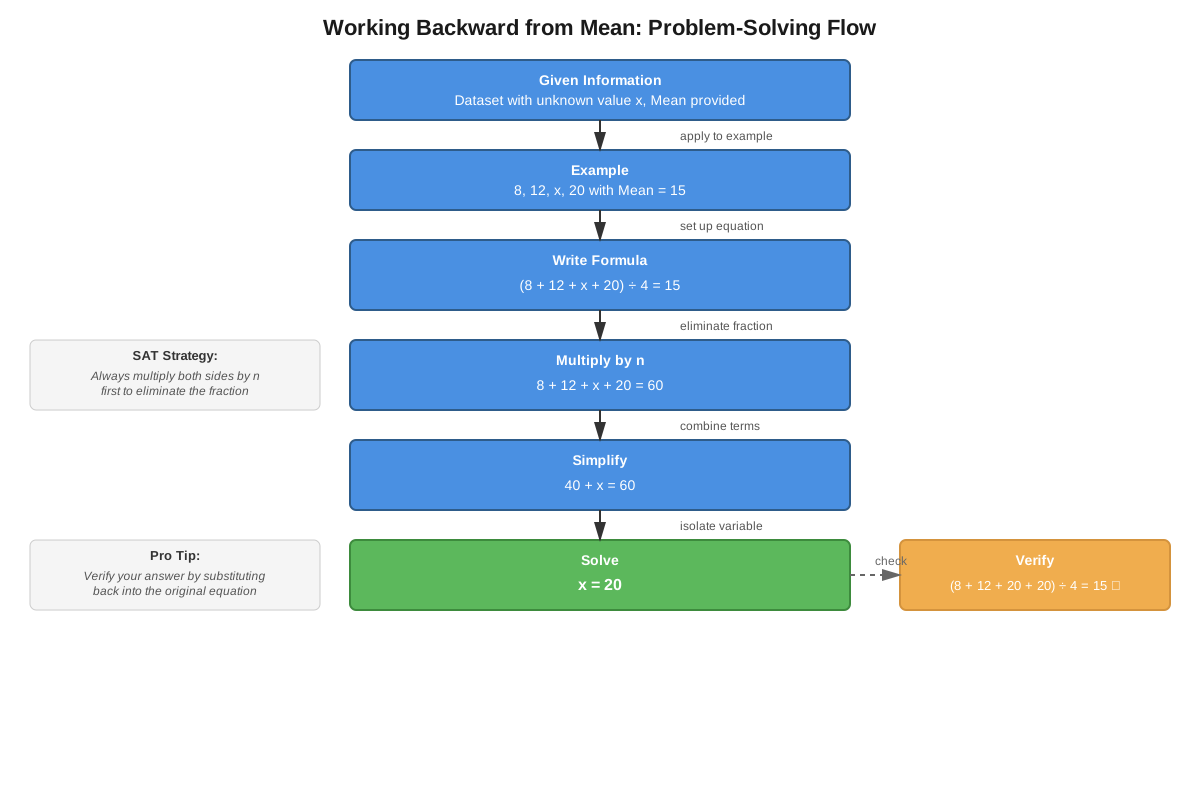
A critical SAT skill involves reversing the mean calculation to find unknown values. When given the mean and most data values, students can determine missing values by setting up an equation. This approach uses the fundamental relationship:
Sum of all values = Mean × Number of valuesIf a dataset has n values with mean M, and all values except one unknown value x are known, the equation becomes:
(Known values + x) / n = MSolving for x yields: x = (M × n) - Sum of known values
Example: If five test scores have a mean of 84, and four scores are 78, 82, 88, and 91, find the fifth score.
- Total sum needed: 84 × 5 = 420
- Sum of known scores: 78 + 82 + 88 + 91 = 339
- Missing score: 420 - 339 = 81
Effect of Adding or Removing Data Points
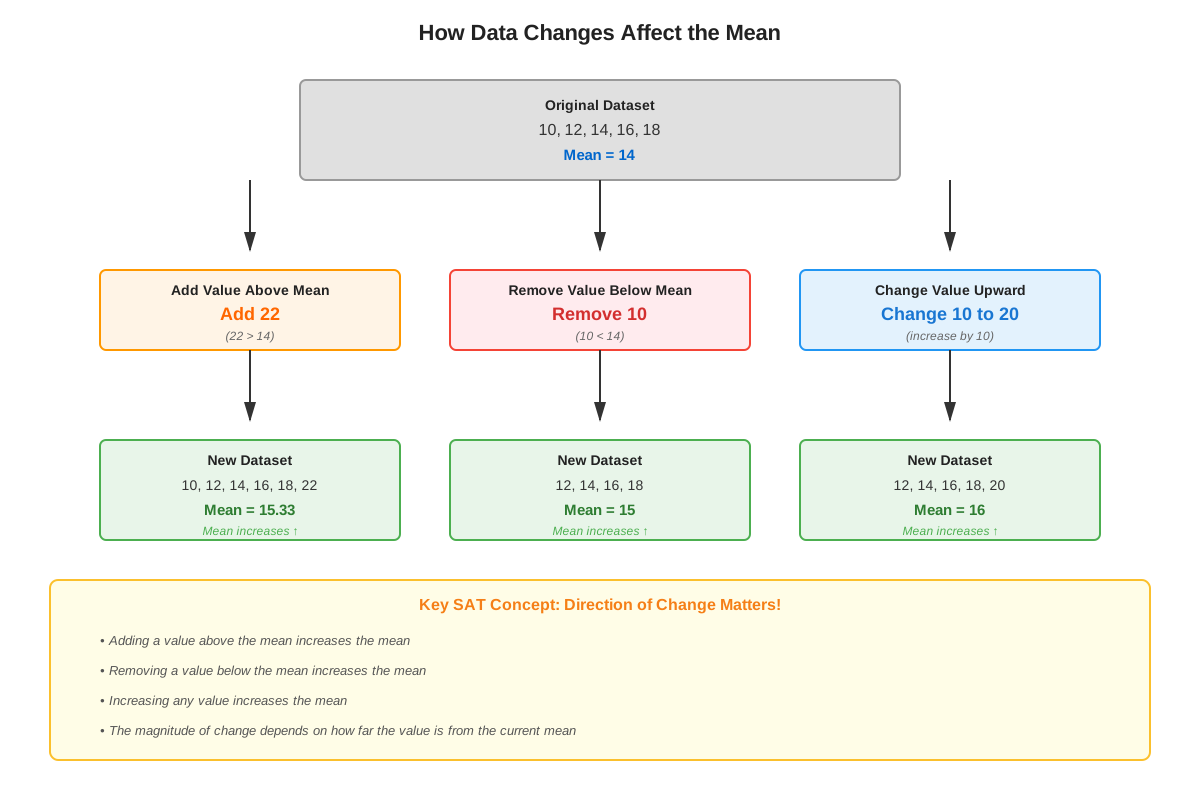
Understanding how the mean changes when data points are added or removed is essential for SAT success. When a new value is added to a dataset:
- If the new value equals the current mean, the mean remains unchanged
- If the new value is greater than the current mean, the mean increases
- If the new value is less than the current mean, the mean decreases
The magnitude of change depends on both the difference between the new value and the current mean, and the size of the dataset. Larger datasets experience smaller changes when single values are added.
Example: A dataset of 4 values has a mean of 50. If a fifth value of 70 is added:
- Original sum: 50 × 4 = 200
- New sum: 200 + 70 = 270
- New mean: 270 ÷ 5 = 54
The mean increased by 4 because the added value (70) exceeded the original mean (50).
Weighted Averages
Weighted averages occur when different data points or groups contribute unequally to the overall mean. This situation arises when combining datasets of different sizes or when certain values carry more importance. The weighted average formula is:
Weighted Mean = (w₁x₁ + w₂x₂ + ... + wₙxₙ) / (w₁ + w₂ + ... + wₙ)Where w represents the weight (often the count or importance factor) of each value x.
Example: A class of 20 students has a mean score of 75, while another class of 30 students has a mean score of 82. The combined mean is:
- Class 1 total: 20 × 75 = 1,500
- Class 2 total: 30 × 82 = 2,460
- Combined total: 1,500 + 2,460 = 3,960
- Combined count: 20 + 30 = 50
- Combined mean: 3,960 ÷ 50 = 79.2
Note that the combined mean (79.2) is closer to 82 than to 75 because the larger class "weights" the average toward its mean.
Mean in Context of Data Distribution
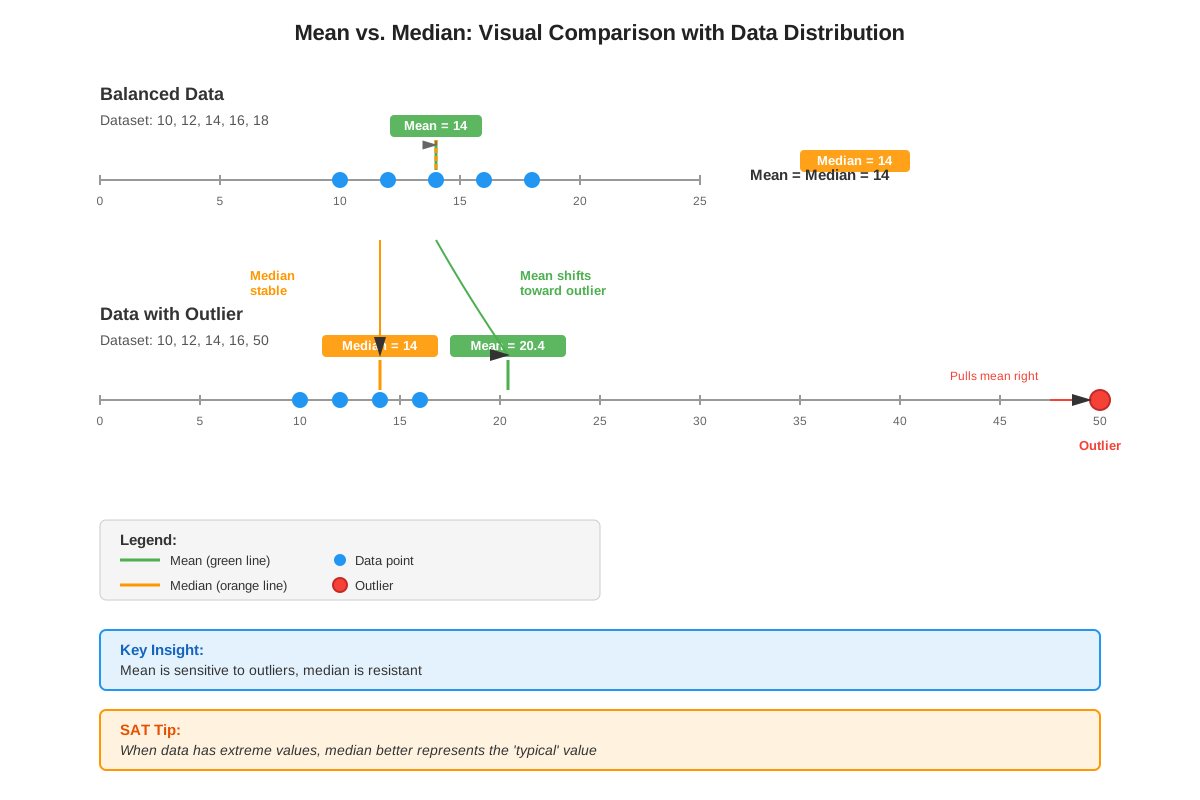
The mean serves as a balance point for a dataset, where the sum of deviations above the mean equals the sum of deviations below it. This property makes the mean sensitive to outliers—extreme values that differ significantly from other data points. A single outlier can dramatically shift the mean, especially in small datasets.
| Dataset Type | Effect on Mean | Example |
|---|---|---|
| Symmetric distribution | Mean ≈ center of data | 10, 12, 14, 16, 18 (mean = 14) |
| Right-skewed (high outliers) | Mean > typical values | 10, 12, 14, 16, 50 (mean = 20.4) |
| Left-skewed (low outliers) | Mean < typical values | 2, 10, 12, 14, 16 (mean = 10.8) |
Understanding this sensitivity helps students recognize when the mean accurately represents "typical" values versus when it may be misleading due to extreme data points.
Algebraic Manipulation with Means
SAT problems frequently require translating word problems into algebraic equations involving means. Key strategies include:
- Defining variables clearly: Let x represent the unknown quantity
- Expressing the sum: Use the relationship Sum = Mean × Count
- Setting up equations: Translate verbal conditions into mathematical statements
- Solving systematically: Use algebraic techniques to isolate the variable
Example: The mean of three consecutive integers is 15. Find the largest integer.
- Let the integers be x, x+1, and x+2
- Mean equation: (x + x+1 + x+2) / 3 = 15
- Simplify: (3x + 3) / 3 = 15
- Solve: 3x + 3 = 45, so 3x = 42, thus x = 14
- The largest integer is x+2 = 16
Concept Relationships
The mean functions as a central hub connecting multiple mathematical concepts. At its foundation, the mean relies on basic arithmetic operations—addition for summing values and division for distributing that sum across the count. This connection to fundamental operations makes the mean accessible while still allowing for sophisticated applications.
The mean directly relates to algebraic thinking through equation formulation and manipulation. When working backward from a given mean, students essentially solve linear equations, demonstrating how statistical concepts and algebra intertwine. This relationship flows both ways: algebraic skills enable mean calculations, while mean problems provide authentic contexts for practicing algebra.
Within statistics, the mean connects to other measures of central tendency (median and mode), forming a trio of tools for describing datasets. Understanding how these three measures differ and when each is most appropriate requires comparing their properties. The mean also serves as the foundation for measures of spread like range and standard deviation, which describe how data points deviate from the average.
The concept of weighted averages bridges the mean to proportional reasoning and ratios. When combining groups with different means, students must consider how the relative sizes of groups affect the overall average, connecting to concepts of part-to-whole relationships and proportional thinking.
Relationship Map:
Basic Arithmetic → enables → Mean Calculation → extends to → Weighted Averages → connects to → Proportional Reasoning
Mean Calculation → requires → Algebraic Equation Setup → develops → Problem-Solving Skills
Mean → compares with → Median and Mode → forms → Complete Statistical Analysis
Mean → serves as basis for → Standard Deviation → enables → Advanced Data Analysis
High-Yield Facts
⭐ The mean equals the sum of all values divided by the number of values: Mean = Sum ÷ Count
⭐ To find a missing value when the mean is known: Missing Value = (Mean × Count) - Sum of Known Values
⭐ Adding a value equal to the current mean does not change the mean
⭐ Adding a value greater than the current mean increases the mean; adding a value less than the current mean decreases it
⭐ When combining two groups with different means, the combined mean falls between the two original means, weighted toward the larger group
- The mean is sensitive to outliers and can be pulled significantly by extreme values
- In a symmetric distribution, the mean, median, and mode are approximately equal
- Multiplying every value in a dataset by a constant k multiplies the mean by k
- Adding a constant c to every value in a dataset adds c to the mean
- The sum of deviations from the mean always equals zero: Σ(x - x̄) = 0
- For consecutive integers, the mean equals the middle value (or average of two middle values)
- The mean of a dataset can be a non-integer even when all data values are integers
- Removing the highest or lowest value from a dataset moves the mean toward the opposite end
- The mean of means from different groups does NOT equal the overall mean unless all groups have equal size
- In SAT problems, "average" and "mean" are used interchangeably
Quick check — test yourself on Mean so far.
Try Flashcards →Common Misconceptions
Misconception: The mean is always one of the values in the dataset.
Correction: The mean is calculated from the data values but need not equal any actual data point. For example, the mean of 3, 4, and 5 is 4 (which happens to be in the set), but the mean of 3, 4, and 6 is 4.33 (which is not in the set).
Misconception: To find the combined mean of two groups, simply average their individual means.
Correction: The combined mean must account for group sizes through weighted averaging. If Group A (20 people, mean 80) combines with Group B (30 people, mean 90), the combined mean is NOT (80+90)/2 = 85, but rather (20×80 + 30×90)/(20+30) = 86.
Misconception: Adding the same value to a dataset multiple times doesn't significantly affect the mean.
Correction: Adding any value, even if repeated, changes the mean unless that value exactly equals the current mean. Adding a value multiple times amplifies its effect on the mean proportionally.
Misconception: The mean always represents a "typical" value in the dataset.
Correction: Outliers can make the mean unrepresentative of typical values. In the dataset 10, 12, 14, 16, 100, the mean is 30.4, but four of five values are below 20, making the mean misleading as a typical value.
Misconception: If you know the mean and the number of values, you can determine all individual values.
Correction: The mean and count only determine the sum of values, not the individual values themselves. Infinitely many different datasets can have the same mean and count. For example, {2, 4, 6} and {1, 4, 7} both have mean 4 and count 3.
Misconception: Removing a value from a dataset always changes the mean.
Correction: Removing a value that equals the current mean leaves the mean unchanged. If a dataset has mean 50 and you remove a value of 50, the remaining values still average to 50.
Misconception: The mean of a set of fractions is found by averaging the numerators and denominators separately.
Correction: Fractions must be converted to decimal form (or common denominators) before calculating the mean. The mean of 1/2 and 1/4 is (0.5 + 0.25)/2 = 0.375, NOT (1+1)/(2+4) = 1/3.
Worked Examples
Example 1: Finding a Missing Value
Problem: Sarah took five math tests this semester. Her scores on the first four tests were 88, 92, 85, and 90. If her mean score for all five tests is 89, what did she score on the fifth test?
Solution:
Step 1: Identify what we know and what we need to find.
- Known: Four test scores (88, 92, 85, 90) and the mean of all five tests (89)
- Unknown: The fifth test score
Step 2: Use the relationship between mean, sum, and count.
The mean formula tells us: Mean = Sum ÷ Count
Rearranging: Sum = Mean × Count
Step 3: Calculate the required total sum for all five tests.
Sum of all five tests = 89 × 5 = 445
Step 4: Calculate the sum of the known four tests.
Sum of known tests = 88 + 92 + 85 + 90 = 355
Step 5: Find the missing fifth test score.
Fifth test score = Total sum - Sum of known tests
Fifth test score = 445 - 355 = 90
Answer: Sarah scored 90 on her fifth test.
Connection to Learning Objectives: This problem demonstrates applying the mean to solve SAT-style questions by working backward from a given mean to find an unknown value—a high-frequency question type on the exam.
Example 2: Weighted Average with Combined Groups
Problem: A company has two departments. The Marketing department has 15 employees with a mean salary of $65,000, while the Sales department has 25 employees with a mean salary of $58,000. What is the mean salary for all employees in both departments combined?
Solution:
Step 1: Recognize this as a weighted average problem.
The departments have different sizes, so we cannot simply average $65,000 and $58,000.
Step 2: Calculate the total salary for each department.
Marketing total = 15 employees × $65,000 = $975,000
Sales total = 25 employees × $58,000 = $1,450,000
Step 3: Find the combined total salary.
Combined total = $975,000 + $1,450,000 = $2,425,000
Step 4: Find the total number of employees.
Total employees = 15 + 25 = 40
Step 5: Calculate the combined mean salary.
Combined mean = $2,425,000 ÷ 40 = $60,625
Answer: The mean salary for all employees is $60,625.
Verification: Notice that $60,625 falls between $58,000 and $65,000, and is closer to $58,000 because the Sales department (with the lower mean) has more employees, weighting the overall average toward that value.
Connection to Learning Objectives: This problem illustrates how the mean appears in real-world SAT contexts and requires understanding how combining datasets with different sizes affects the overall mean—a conceptual understanding that distinguishes high-scoring students.
Example 3: Effect of Adding a Value
Problem: The mean of six numbers is 24. If a seventh number is added to the set and the new mean becomes 26, what is the value of the seventh number?
Solution:
Step 1: Find the sum of the original six numbers.
Sum of six numbers = 24 × 6 = 144
Step 2: Find the sum of all seven numbers.
Sum of seven numbers = 26 × 7 = 182
Step 3: Determine the seventh number.
Seventh number = Sum of seven - Sum of six
Seventh number = 182 - 144 = 38
Answer: The seventh number is 38.
Analysis: The seventh number (38) is greater than both the original mean (24) and the new mean (26), which explains why adding it increased the mean. The increase from 24 to 26 represents a 2-point rise, which makes sense given that 38 is 14 points above the new mean of 26, and this excess is distributed across all seven values.
Connection to Learning Objectives: This demonstrates analyzing how adding data points affects the mean, a key conceptual understanding tested on the SAT.
Exam Strategy
When approaching SAT questions involving the mean, begin by identifying the question type: Are you calculating a mean directly, finding a missing value, or analyzing how changes affect the mean? This classification determines your solution strategy and helps avoid common traps.
Trigger words and phrases to watch for include:
- "average" (always means mean on the SAT)
- "mean"
- "what is the average of..."
- "the mean of x numbers is..."
- "if the average increases/decreases..."
- "combined average"
- "overall mean"
Exam Tip: When you see "average" on the SAT, immediately write down the formula: Mean = Sum ÷ Count. This simple act triggers the correct problem-solving pathway.
For direct calculation problems, list all values, sum them carefully (especially in no-calculator sections), and divide by the count. Double-check that you've counted all values correctly—a common error is miscounting when values are presented in paragraph form rather than lists.
For missing value problems, use the equation setup: (Sum of known values + Unknown) ÷ Total count = Given mean. Solve algebraically for the unknown. Always verify your answer makes sense: if the unknown value is supposed to raise the mean, it should be greater than the current mean.
For weighted average problems, resist the temptation to simply average the given means. Instead, calculate total sums for each group, combine them, and divide by the total count. A quick reasonableness check: the combined mean should fall between the individual means, weighted toward the larger group.
Process of elimination strategies:
- Eliminate answers that fall outside the range of given values when the question asks for a mean of those values
- For missing value problems, eliminate answers that would make the mean impossible (e.g., if adding a value should increase the mean, eliminate values below the current mean)
- For combined means, eliminate the simple average of the two means unless the groups are equal in size
Time allocation: Simple mean calculations should take 30-45 seconds. Missing value problems typically require 60-90 seconds. Complex weighted average or multi-step problems may need 2-3 minutes. If a mean problem is taking longer, mark it and return after completing quicker questions.
Calculator usage: For calculator-allowed sections, use your calculator for all arithmetic to avoid careless errors, but set up the problem on paper first. For no-calculator sections, look for opportunities to simplify before calculating—sometimes values cancel or factor nicely.
Memory Techniques
MEAN Mnemonic:
- Multiply mean by count to get sum
- Equations help find missing values
- Adding values changes the mean
- New groups need weighted averaging
The Balance Point Visualization: Picture the mean as a physical balance point on a seesaw. Values above the mean pull it up; values below pull it down. The mean settles where these forces balance. This mental image helps understand why outliers affect the mean and why adding values above/below the mean shifts it.
The "Sum-Count-Mean Triangle": Visualize a triangle with "Sum" at the top, "Count" at bottom left, and "Mean" at bottom right. Cover any one vertex to see the formula for finding it:
- Cover "Sum": Sum = Mean × Count
- Cover "Mean": Mean = Sum ÷ Count
- Cover "Count": Count = Sum ÷ Mean
Weighted Average Acronym - CAST:
- Calculate each group's total (mean × count)
- Add all group totals together
- Sum the counts from all groups
- Total divided by sum gives weighted mean
The "Same-Up-Down" Rule: When adding a value to a dataset:
- Same as mean → mean stays same
- Up from mean → mean goes up
- Down from mean → mean goes down
Summary
The mean represents the arithmetic average of a dataset, calculated by dividing the sum of all values by the count of values. This fundamental measure of central tendency appears consistently throughout the SAT math section in various forms, from straightforward calculations to complex multi-step problems involving missing values, weighted averages, and conceptual understanding of how changes affect the mean. Success requires both computational proficiency and conceptual insight: students must calculate means accurately, work backward to find unknown values using algebraic equation setup, understand how adding or removing data points shifts the mean, and recognize that combining groups of different sizes requires weighted averaging rather than simple averaging. The mean's sensitivity to outliers and its role as a balance point for data distributions make it essential for interpreting real-world data. Mastery involves recognizing the interchangeable use of "mean" and "average" on the SAT, applying the fundamental relationship between sum, count, and mean, and strategically approaching different question types with appropriate solution methods.
Key Takeaways
- The mean equals the sum of all values divided by the number of values; this formula is the foundation for all mean-related problems
- To find missing values when the mean is known, use the equation: Sum = Mean × Count, then solve for the unknown
- Adding a value equal to the mean keeps the mean unchanged; adding above increases it, adding below decreases it
- Weighted averages require calculating total sums for each group, combining them, and dividing by the total count—never simply average the means
- The mean is sensitive to outliers and may not represent typical values in skewed distributions
- On the SAT, "average" and "mean" are synonymous and appear in multiple question formats across difficulty levels
- Setting up clear algebraic equations is essential for solving complex mean problems efficiently and accurately
Related Topics
Median and Mode: These alternative measures of central tendency complement the mean, with the median being less sensitive to outliers and the mode identifying the most frequent value. Understanding when each measure is most appropriate enhances data interpretation skills.
Standard Deviation: This measure of spread quantifies how data points deviate from the mean, building directly on mean calculations to describe data variability—a concept that occasionally appears in advanced SAT questions.
Data Interpretation from Tables and Graphs: Many SAT questions present data visually, requiring students to extract values and calculate means from bar graphs, line graphs, scatter plots, and tables.
Probability and Expected Value: The concept of expected value in probability represents a weighted average of outcomes, directly applying mean calculations to probabilistic scenarios.
Linear Functions and Slope: Understanding how changes to data affect the mean connects to linear thinking, as the relationship between added values and mean changes follows predictable patterns.
Practice CTA
Now that you've mastered the core concepts of mean, it's time to solidify your understanding through active practice. Work through the practice questions to apply these strategies to authentic SAT-style problems, and use the flashcards to reinforce high-yield facts and formulas. Remember, understanding the mean isn't just about memorizing a formula—it's about developing the analytical skills to approach data confidently and efficiently. Each practice problem you solve strengthens your pattern recognition and builds the automaticity you need to excel on test day. You've got this!
Sign up free to keep reading
Create a free AnvayaPrep account to finish this SAT guide on Mean — plus flashcards and practice questions.