Overview
The median is one of the most fundamental measures of central tendency in statistics and a critical concept for success on the SAT Math section. Unlike the mean (average), which can be heavily influenced by extreme values, the median represents the middle value in an ordered dataset, providing a robust measure of what is "typical" in a distribution. Understanding the median is essential not only for direct calculation questions but also for interpreting data displays, comparing distributions, and solving complex word problems that appear throughout the SAT.
On the SAT, median questions appear with remarkable frequency in the Data Analysis and Statistics domain, which comprises approximately 15% of the Math section. Students encounter median problems in various formats: straightforward calculations from lists of numbers, interpretations from box plots and histograms, and challenging algebraic problems where the median must be determined from incomplete information. The College Board consistently tests whether students can identify the median position, handle datasets with even versus odd numbers of values, and understand how adding or removing data points affects the median.
Mastery of the median concept connects directly to broader mathematical reasoning skills tested on the SAT. The median relates closely to percentiles, quartiles, and measures of spread like the interquartile range. It also appears in conjunction with mean calculations, requiring students to understand when each measure is more appropriate. Furthermore, median problems often integrate algebraic thinking, as students may need to set up equations to find unknown values that produce a specific median. This intersection of statistics and algebra makes median questions particularly high-yield for SAT preparation.
Learning Objectives
- [ ] Identify key features of Median
- [ ] Explain how Median appears on the SAT
- [ ] Apply Median to answer SAT-style questions
- [ ] Calculate the median for both odd and even-numbered datasets with complete accuracy
- [ ] Determine how changes to a dataset (adding, removing, or modifying values) affect the median
- [ ] Solve algebraic problems involving unknown values when the median is specified
- [ ] Interpret median values from various data representations including box plots, dot plots, and frequency tables
Prerequisites
- Ordering numbers: The ability to arrange numbers from least to greatest is fundamental, as finding the median requires working with ordered data
- Basic arithmetic operations: Addition and division are necessary for calculating the median when the dataset contains an even number of values
- Understanding of fractions and decimals: Median values often result in non-integer answers that must be expressed correctly
- Algebraic equation solving: Many SAT median problems require setting up and solving equations to find unknown values
Why This Topic Matters
The median serves as a cornerstone concept in data literacy, a skill increasingly valued in our data-driven world. In real-world applications, the median is often more informative than the mean when dealing with skewed distributions. For example, median household income provides a better representation of typical earnings than mean income because extremely high incomes can distort the average. Similarly, median home prices, median test scores, and median wait times all offer practical insights that resist distortion from outliers. Understanding the median enables critical evaluation of statistical claims in news reports, research studies, and policy discussions.
On the SAT, median questions appear in approximately 2-4 questions per test, making this a high-frequency topic that directly impacts scores. The College Board tests median concepts through multiple question types: direct calculation problems (30% of median questions), interpretation from graphs and charts (40%), and complex multi-step problems combining median with other statistical measures (30%). Questions range from straightforward 30-second calculations to challenging 2-3 minute problems requiring algebraic reasoning. The median also appears as a distractor in questions primarily testing other concepts, so recognizing when median is relevant versus when mean or mode is more appropriate becomes crucial.
Common SAT question formats include: finding the median from a list of numbers; determining what value must be added to a dataset to achieve a specific median; interpreting the median from a box plot or histogram; comparing median and mean to describe distribution shape; and solving for unknown variables when the median is given. The test frequently presents median problems in real-world contexts such as test scores, temperatures, prices, or survey results, requiring students to extract relevant data before performing calculations.
Core Concepts
Definition and Basic Calculation
The median is the middle value in a dataset when all values are arranged in order from least to greatest (or greatest to least). This measure of central tendency divides a distribution exactly in half: 50% of values fall at or below the median, and 50% fall at or above it. The median provides a measure of the "center" of data that is resistant to extreme values, making it particularly useful for skewed distributions.
To find the median, follow this systematic process:
- Arrange all values in numerical order (ascending or descending)
- Count the total number of values (n)
- Apply the appropriate formula based on whether n is odd or even
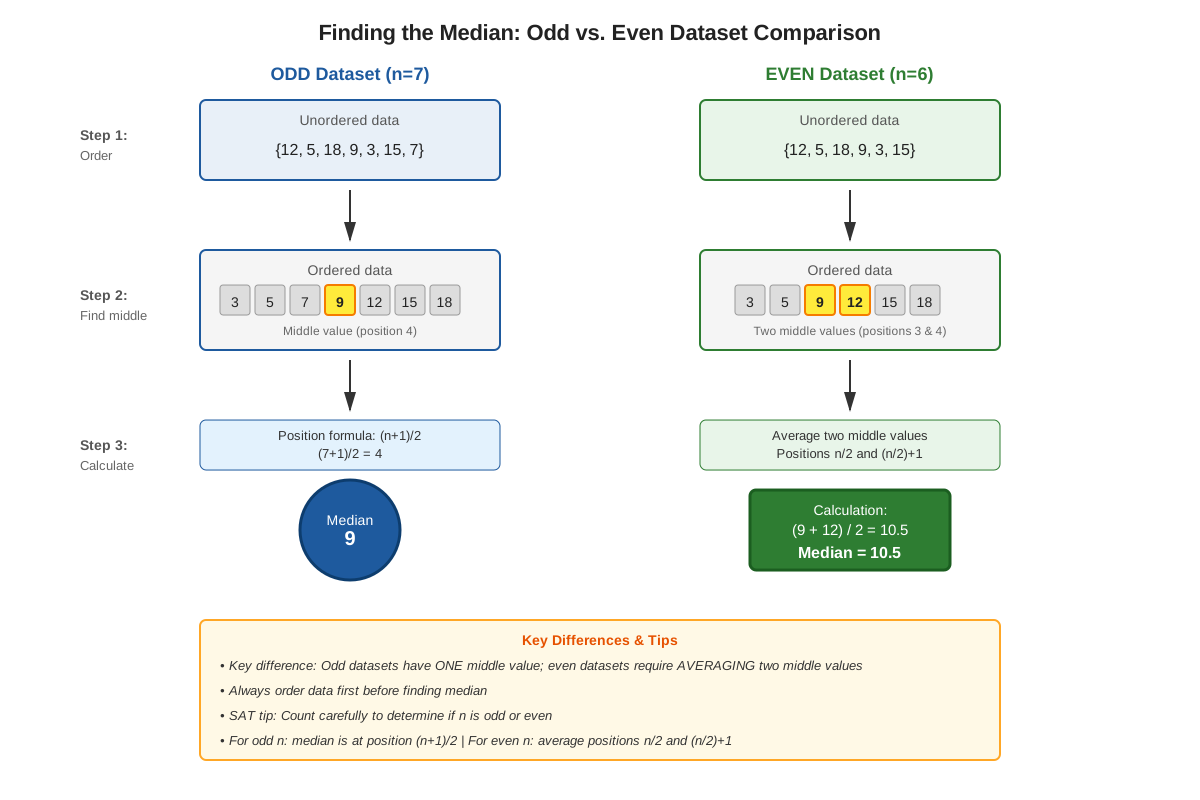
For datasets with an odd number of values, the median is the single middle value located at position (n+1)/2. For datasets with an even number of values, the median is the arithmetic mean (average) of the two middle values located at positions n/2 and (n/2)+1.
Odd-Numbered Datasets
When working with an odd number of data points, the median calculation is straightforward because there exists exactly one middle value. Consider the dataset: 3, 7, 2, 9, 5.
First, order the values: 2, 3, 5, 7, 9
With n = 5 values, the median position is (5+1)/2 = 3. The third value in the ordered list is 5, so the median is 5.
This principle holds regardless of how large the dataset becomes. In a dataset of 101 values, the median would be the 51st value when ordered. The key insight is that an odd-numbered dataset always produces a median that is an actual value from the dataset itself.
Even-Numbered Datasets
Even-numbered datasets require an additional calculation step because no single middle value exists. Instead, the median falls between two values. Consider the dataset: 4, 8, 2, 6, 10, 3.
First, order the values: 2, 3, 4, 6, 8, 10
With n = 6 values, the two middle positions are 6/2 = 3 and 4. The third value is 4, and the fourth value is 6. The median is the average of these two middle values: (4+6)/2 = 5.
Notice that the median (5) does not actually appear in the original dataset. This is perfectly acceptable and frequently occurs with even-numbered datasets. The median represents the midpoint between the two central values.
Position Formula and Notation
Understanding the mathematical notation for median position prevents errors on complex SAT problems. For any ordered dataset with n values:
- If n is odd: median position = (n+1)/2
- If n is even: median = average of values at positions n/2 and (n/2)+1
| Dataset Size (n) | Median Position(s) | Calculation Method |
|---|---|---|
| 5 | 3rd value | Single middle value |
| 6 | 3rd and 4th values | Average of two middle values |
| 7 | 4th value | Single middle value |
| 8 | 4th and 5th values | Average of two middle values |
| 9 | 5th value | Single middle value |
| 10 | 5th and 6th values | Average of two middle values |
Effect of Data Changes on Median
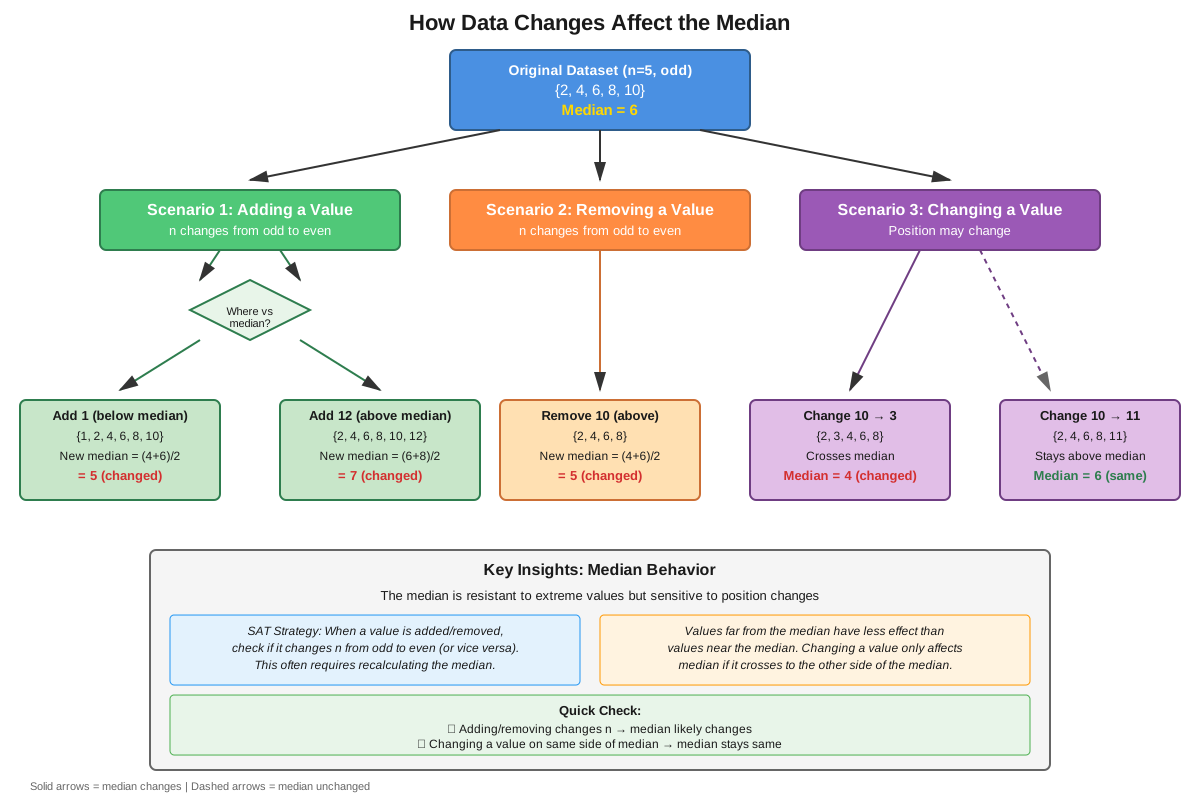
The SAT frequently tests understanding of how the median responds to changes in the dataset. Unlike the mean, which is affected by every value in the dataset, the median is only affected by changes that alter the middle position(s).
Adding values: When adding a value to a dataset, the median may change or remain the same depending on where the new value falls relative to the current median. If the new value is added above the current median and the dataset has an odd number of values, the median will shift upward. If added below, it shifts downward. If added exactly at the median, the effect depends on the specific configuration.
Removing values: Removing values follows similar logic. The median changes only if the removal affects the middle position(s). Removing extreme values (very high or very low) from a dataset typically does not change the median.
Modifying values: Changing a value that is not at a middle position will not affect the median as long as the change doesn't cause that value to "cross" the median. For example, increasing the highest value in a dataset never changes the median.
Median in Different Data Representations
SAT questions present data in various formats, and students must extract median information from each:
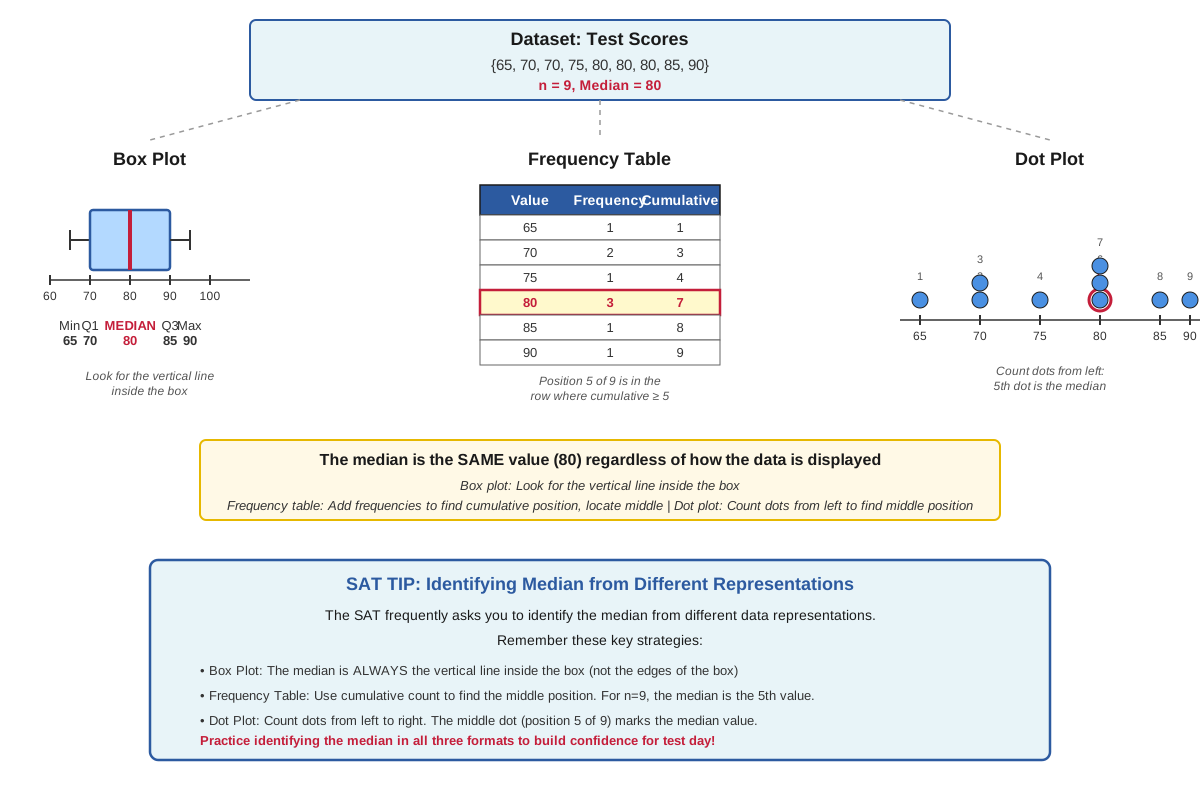
Box plots: The median is represented by the vertical line inside the box. This is one of the five key values shown in a box plot (minimum, first quartile, median, third quartile, maximum).
Dot plots: Count the total number of dots, then identify the middle value(s) by counting from either end toward the center.
Frequency tables: Calculate the cumulative frequency to determine which value corresponds to the middle position. This requires adding frequencies until reaching the median position.
Histograms: Identify the interval containing the median by finding where the cumulative frequency reaches n/2. Note that histograms typically only allow identification of the interval, not the exact median value.
Median vs. Mean
Understanding when to use median versus mean is crucial for SAT success. The median is preferred when:
- The distribution is skewed (not symmetric)
- Outliers are present that would distort the mean
- Working with ordinal data (rankings, ratings)
- Describing "typical" values in real-world contexts like income or home prices
The mean is preferred when:
- The distribution is symmetric
- All values contribute meaningfully to the center
- Further statistical calculations will be performed
- Working with interval or ratio data in controlled conditions
A key relationship: In a perfectly symmetric distribution, the mean and median are equal. When the mean exceeds the median, the distribution is right-skewed (positively skewed). When the median exceeds the mean, the distribution is left-skewed (negatively skewed).
Concept Relationships
The median concept connects to multiple statistical and mathematical ideas tested on the SAT. Understanding these relationships deepens comprehension and enables solving complex multi-concept problems.
Median → Quartiles: The median serves as the foundation for quartile calculations. The first quartile (Q1) is the median of the lower half of the data, and the third quartile (Q3) is the median of the upper half. This relationship means that finding quartiles requires first understanding median calculation.
Median → Interquartile Range (IQR): The IQR, calculated as Q3 - Q1, measures spread around the median. Together, median and IQR provide a complete picture of center and spread for skewed distributions, just as mean and standard deviation do for symmetric distributions.
Median → Percentiles: The median is equivalent to the 50th percentile, the value below which 50% of data falls. This connection helps students understand that the median is part of a broader system for describing data position.
Ordering → Median → Box Plots: The logical flow begins with ordering data (prerequisite skill), enables median calculation (core concept), and culminates in interpreting box plots (application). Each step builds on the previous one.
Median ↔ Mean: These two measures of central tendency are often compared on the SAT. Questions may ask students to determine which is larger, explain why they differ, or calculate one given the other and additional information. Understanding their relationship reveals distribution shape.
Algebraic Thinking → Median Problems: Many challenging SAT median questions require setting up equations where the median is known but one or more data values are unknown. This connects statistical reasoning with algebraic problem-solving skills.
High-Yield Facts
⭐ The median is the middle value in an ordered dataset, dividing the data exactly in half
⭐ For odd-numbered datasets, the median is the value at position (n+1)/2; for even-numbered datasets, it's the average of the two middle values
⭐ The median is resistant to outliers and extreme values, unlike the mean
⭐ In a box plot, the median is represented by the vertical line inside the box
⭐ When mean > median, the distribution is right-skewed; when median > mean, the distribution is left-skewed
- The median always exists for any dataset with at least one value
- Changing values above or below the median (without crossing it) does not affect the median
- The median of a dataset with an even number of values may not be an actual data point
- Adding the same value to every data point increases the median by that amount
- The median is equivalent to the 50th percentile
- For symmetric distributions, the mean and median are approximately equal
- The median can be found from cumulative frequency tables by identifying the value at position n/2
- Multiplying every value in a dataset by a constant multiplies the median by that same constant
Quick check — test yourself on Median so far.
Try Flashcards →Common Misconceptions
Misconception: The median is always a value that appears in the dataset.
Correction: For even-numbered datasets, the median is the average of the two middle values and may not appear in the original data. For example, the median of {1, 2, 3, 4} is 2.5, which is not in the dataset.
Misconception: The median is calculated by adding all values and dividing by the number of values.
Correction: This describes the mean (average), not the median. The median is found by ordering values and identifying the middle position, not by summing and averaging all values.
Misconception: Changing any value in the dataset will change the median.
Correction: The median only changes if the modification affects the middle position(s). Changing extreme values (highest or lowest) typically does not affect the median. For example, in {1, 2, 3, 4, 5}, changing 1 to 0 or 5 to 100 does not change the median of 3.
Misconception: The median must be calculated from the original order of data as presented.
Correction: Data must always be ordered (sorted) before finding the median. The original presentation order is irrelevant. Failing to sort data first is one of the most common errors on SAT median questions.
Misconception: The median and mean are interchangeable terms for the same concept.
Correction: Median and mean are distinct measures of central tendency with different calculation methods and properties. The median is the middle value when ordered; the mean is the arithmetic average. They are equal only in perfectly symmetric distributions.
Misconception: When a dataset has an even number of values, you should round the median to the nearest integer.
Correction: The median should be expressed as the exact average of the two middle values, even if this results in a decimal or fraction. For {2, 4, 6, 8}, the median is exactly 5, but for {2, 4, 7, 8}, the median is 5.5, not 5 or 6.
Misconception: The median is always located at the physical center of a number line representation.
Correction: The median represents the middle value by count (50% of values on each side), not by numerical distance. In a skewed distribution, the median may appear off-center on a number line because values are not evenly distributed.
Worked Examples
Example 1: Finding Median with Algebraic Unknown
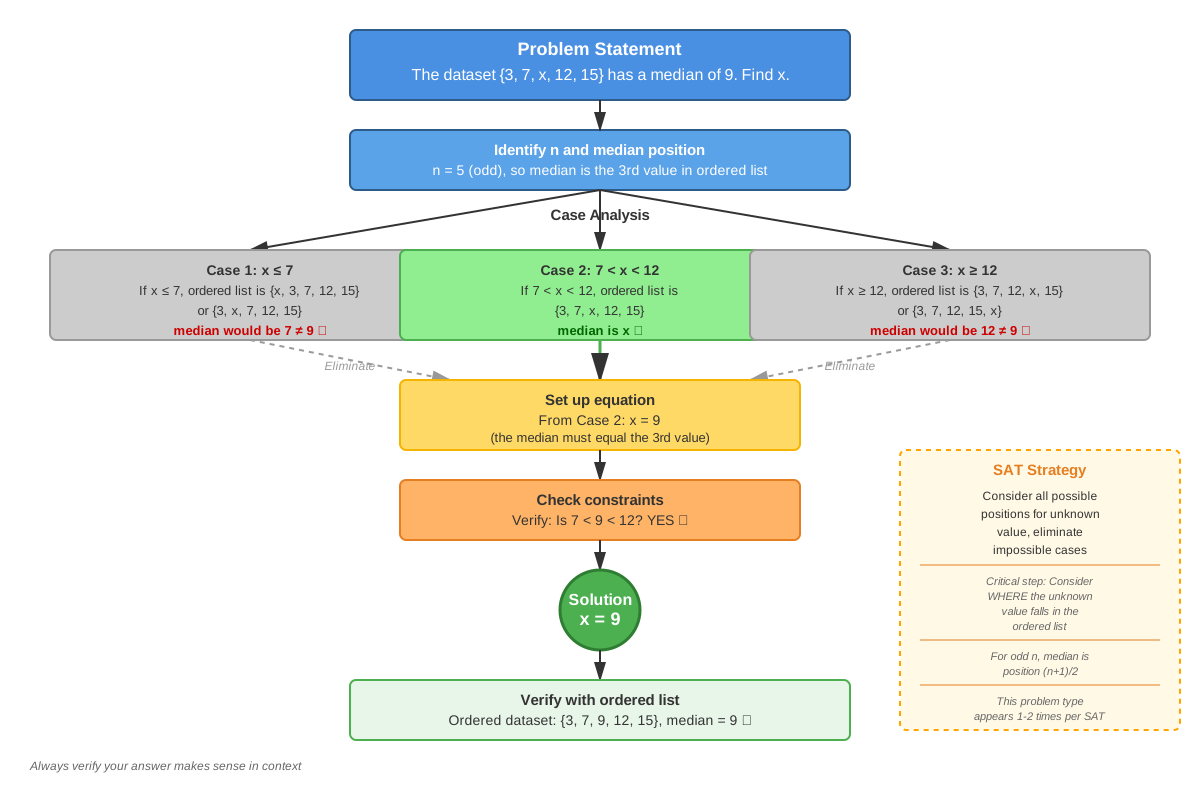
Problem: The median of the five numbers {3, 7, x, 12, 15} is 9. What is the value of x?
Solution:
Step 1: Understand what we know. We have five values (odd number), so the median will be the single middle value at position (5+1)/2 = 3. The median is given as 9.
Step 2: Consider where x must fall in the ordered list. We have three known values: 3, 7, 12, and 15. We need to determine where x fits to make the third value equal to 9.
Step 3: Test possible orderings. If x < 3, the ordered list would be {x, 3, 7, 12, 15}, making the median 7, not 9. If 3 < x < 7, the ordered list would be {3, x, 7, 12, 15}, making the median 7, not 9.
Step 4: If 7 < x < 12, the ordered list would be {3, 7, x, 12, 15}, making the median x. Since we need the median to be 9, we have x = 9. Let's verify: 7 < 9 < 12 ✓
Step 5: Check if other positions work. If x > 12, the ordered list would be {3, 7, 12, x, 15} or {3, 7, 12, 15, x}, making the median 12, not 9.
Answer: x = 9
Key Insight: This problem connects the learning objectives of identifying median features and applying algebraic reasoning. The critical step is recognizing that for the median to be 9 in a five-number dataset, 9 must be the third value when ordered, which means x = 9 and must fall between 7 and 12.
Example 2: Effect of Adding Values
Problem: The median of six test scores is 84. If a seventh score of 96 is added to the dataset, what can be determined about the new median?
Solution:
Step 1: Understand the original situation. With six scores (even number), the median of 84 is the average of the 3rd and 4th scores when ordered. This means: (score₃ + score₄)/2 = 84, so score₃ + score₄ = 168.
Step 2: Analyze what we know about the ordered scores. We can represent them as: score₁ ≤ score₂ ≤ score₃ ≤ score₄ ≤ score₅ ≤ score₆. We know that score₃ + score₄ = 168, but we don't know the individual values.
Step 3: Consider where 96 fits. Since 96 is being added, we need to determine its position in the ordered list. We know the median is 84, which means at least half the scores are ≤ 84 and at least half are ≥ 84.
Step 4: Determine the new median position. With seven scores (odd number), the new median will be the 4th score in the ordered list.
Step 5: Analyze possible scenarios. If 96 is greater than or equal to score₄, then score₄ remains in the 4th position, and the new median equals score₄. Since score₃ + score₄ = 168 and both are ≥ 84 (they're at or above the median), we know score₄ ≥ 84.
If score₄ < 96 (which is likely since 96 is relatively high), then the ordered list becomes: score₁, score₂, score₃, score₄, score₅, score₆, 96. The new median is score₄.
Step 6: Determine what we can conclude. The new median will be score₄, which is at least 84 (since the original median was 84). However, without knowing the exact values, we cannot determine the precise new median. We can only say: new median ≥ 84.
Answer: The new median will be at least 84, but the exact value cannot be determined without additional information about the individual scores.
Key Insight: This problem demonstrates how adding values affects median position and tests understanding of median properties. The critical reasoning involves recognizing that with limited information, we can establish bounds on the new median but cannot calculate an exact value. This type of "what can be determined" question is common on the SAT.
Exam Strategy
When approaching SAT median questions, employ these strategic techniques to maximize accuracy and efficiency:
Trigger Words and Phrases: Watch for "middle value," "50th percentile," "divides the data in half," and direct mentions of "median." Questions asking about "typical" values in skewed contexts often require median rather than mean. Box plot questions almost always involve median interpretation.
Immediate First Step: Before any calculation, verify that data is ordered. If presented in random order, immediately rewrite the values from least to greatest. This single step prevents the most common error on median questions. Even if the problem seems complex, starting with ordered data provides clarity.
Odd vs. Even Recognition: Quickly count the number of values and identify whether n is odd or even. This determines your calculation method. For odd n, you're finding one value; for even n, you're averaging two values. Write "odd → position (n+1)/2" or "even → average of positions n/2 and (n/2)+1" as a reminder.
Process of Elimination for Multiple Choice: If calculating the exact median seems time-consuming, use elimination strategies. Values that are too extreme (highest or lowest in the dataset) cannot be the median. If you know the median must fall between two specific values, eliminate choices outside that range. For even-numbered datasets, the median must fall between the two middle values, which can eliminate several choices immediately.
Algebraic Median Problems: When the median is given and you must find an unknown value, set up the problem systematically. Determine the median position, write an equation representing that position, and solve for the unknown. These problems often require considering multiple cases based on where the unknown value falls in the ordered list.
Time Allocation: Simple median calculations (ordered list provided, straightforward counting) should take 30-45 seconds. Problems requiring ordering first take 60-90 seconds. Complex algebraic median problems may require 2-3 minutes. If a median problem is taking longer than 3 minutes, mark it for review and move on—you may be missing a simpler approach.
Calculator Usage: For datasets with many values, use your calculator to verify ordering and perform averaging calculations for even-numbered datasets. However, for small datasets (5-7 values), mental calculation is often faster than calculator input.
Box Plot Strategy: When median is shown in a box plot, you can immediately read it without calculation. Focus on comparing it to other features (quartiles, extremes) or using it in conjunction with other given information. Don't waste time trying to calculate what's already displayed.
Check Your Answer: After finding the median, verify that approximately half the values fall at or below it and half fall at or above it. This quick check catches ordering errors and miscounts. For even-numbered datasets, verify that your median falls between the two middle values.
Memory Techniques
MEDIAN Mnemonic: Middle Exactly Divides In Any Number-set
This reminds you that the median is the middle value that divides the dataset exactly in half.
ODD-EVEN Rule Visualization: Picture a line of people arranged by height. For an odd number of people, one person stands exactly in the middle (odd → one value). For an even number, two people share the middle position, and the median is halfway between them (even → average of two).
The "Sort First" Mantra: Before every median problem, mentally say "Sort first, then find middle." This prevents the most common error. Make it an automatic habit that you cannot skip.
Position Formula Memory: Remember "Add one for odd" → (n+1)/2 gives you the position for odd-numbered datasets. For even datasets, think "Split the count" → n/2 and n/2+1 are the two positions you need.
Median vs. Mean Distinction: MEDIAN has an "I" in the middle (like finding the middle value). MEAN sounds like "between" (averaging between all values). This helps distinguish the two concepts.
Box Plot Visualization: Remember "The line inside the box is the median line." Visualize a box with a vertical line through it—that line is always the median in a box plot.
Resistance to Outliers: Think of the median as "stubborn"—it doesn't move much when extreme values change. The mean is "sensitive"—it responds to every value. This helps remember which measure is resistant to outliers.
Summary
The median represents the middle value in an ordered dataset and serves as a robust measure of central tendency that is resistant to extreme values and outliers. Calculating the median requires first ordering all values from least to greatest, then identifying the middle position: for odd-numbered datasets, the median is the single value at position (n+1)/2; for even-numbered datasets, it is the average of the two middle values at positions n/2 and (n/2)+1. On the SAT, median questions appear frequently across multiple formats including direct calculations, interpretations from graphs (especially box plots), and algebraic problems involving unknown values. Understanding how the median responds to data changes—remaining stable when extreme values change but shifting when middle values are affected—is crucial for success. The median differs fundamentally from the mean and is preferred for skewed distributions or when outliers are present. Mastery requires recognizing that the median divides data by count (50% on each side) rather than by numerical distance, and that it may or may not be an actual value from the dataset. Success on SAT median questions depends on systematic ordering, careful position identification, and understanding the conceptual meaning rather than just mechanical calculation.
Key Takeaways
- The median is the middle value in an ordered dataset; always sort data before calculating
- For odd n, median is one value at position (n+1)/2; for even n, median is the average of two middle values
- The median is resistant to outliers and extreme values, making it more appropriate than mean for skewed distributions
- In box plots, the median is the vertical line inside the box—one of the five key summary statistics
- Changing values above or below the median (without crossing it) does not affect the median value
- When mean > median, the distribution is right-skewed; when median > mean, it's left-skewed
- SAT median questions often combine statistical reasoning with algebraic problem-solving, requiring equations to find unknown values
Related Topics
Quartiles and Interquartile Range (IQR): Building directly on median concepts, quartiles divide data into four equal parts, with Q1 being the median of the lower half and Q3 the median of the upper half. The IQR (Q3-Q1) measures spread around the median and is essential for box plot interpretation.
Box Plots and Five-Number Summary: These visual representations display minimum, Q1, median, Q3, and maximum values. Mastering median enables full interpretation of box plots, which appear frequently on the SAT.
Mean and Standard Deviation: Understanding the relationship between median and mean reveals distribution shape. Standard deviation measures spread around the mean, complementing how IQR measures spread around the median.
Percentiles and Data Position: The median is the 50th percentile, connecting to broader concepts of data position and ranking that appear in SAT statistics questions.
Skewness and Distribution Shape: Comparing median to mean reveals whether distributions are symmetric, right-skewed, or left-skewed, a key skill for interpreting real-world data contexts on the SAT.
Practice CTA
Now that you've mastered the core concepts of median, it's time to solidify your understanding through active practice. Attempt the practice questions to apply these concepts to SAT-style problems, testing your ability to calculate medians, handle algebraic unknowns, and interpret data representations. Use the flashcards to reinforce key definitions and properties until they become automatic. Remember: understanding the concept is the first step, but achieving test-day confidence requires repeated application. Each practice problem you solve strengthens your pattern recognition and builds the speed you need for SAT success. You've got this—let's turn this knowledge into points!
Sign up free to keep reading
Create a free AnvayaPrep account to finish this SAT guide on Median — plus flashcards and practice questions.