Overview
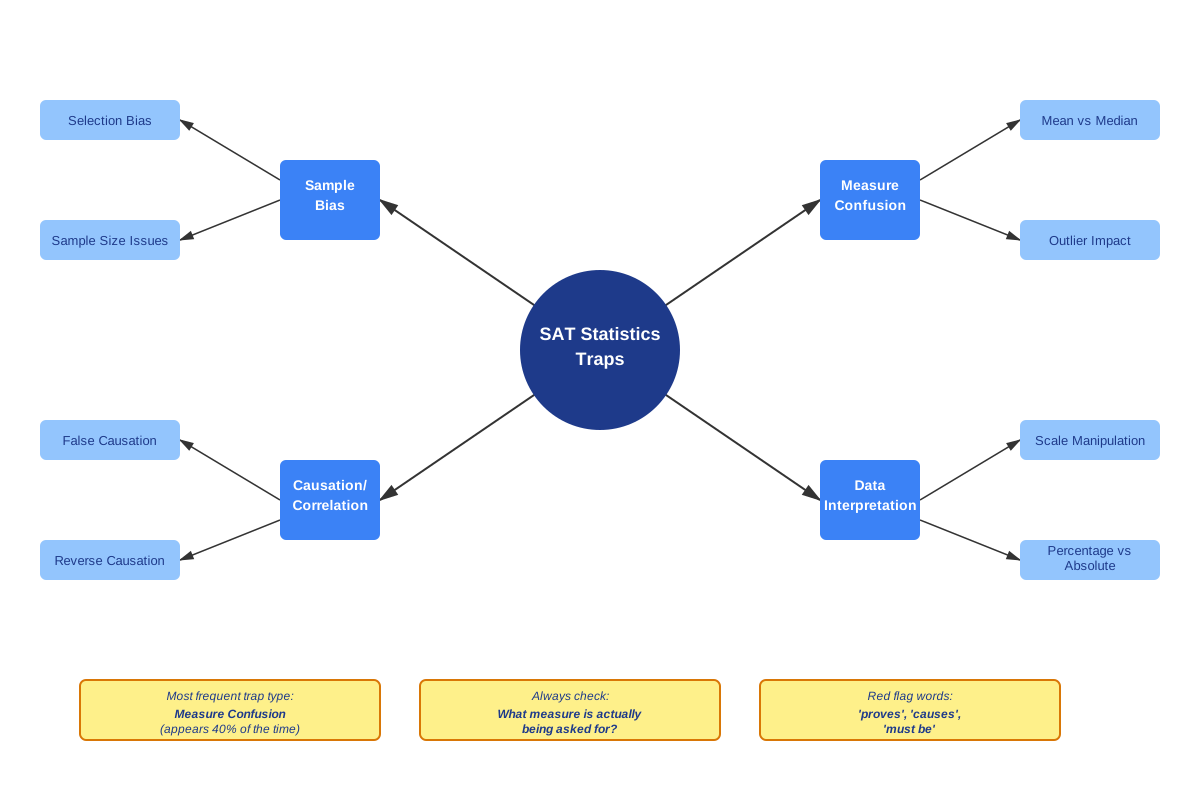
SAT statistics traps represent one of the most challenging and high-yield areas of the SAT math section. These are carefully designed question types that exploit common reasoning errors, misinterpretations of data, and hasty conclusions about statistical measures. Unlike straightforward calculation problems, statistics traps test whether students can think critically about data representation, understand the limitations of statistical measures, and avoid jumping to unwarranted conclusions.
The College Board deliberately includes these trap questions to differentiate between students who merely memorize formulas and those who genuinely understand statistical reasoning. These questions often appear deceptively simple, presenting familiar concepts like mean, median, and range in contexts designed to trigger predictable errors. Students who rush through these problems or rely on surface-level pattern recognition frequently fall into these traps, even when they possess the necessary mathematical knowledge.
Mastering SAT statistics traps is essential not only for achieving a competitive score but also for developing the analytical thinking skills that underpin success in college-level quantitative courses. This topic connects directly to data analysis, probability, and problem-solving strategies across the entire math section. Understanding these traps enhances performance on approximately 15-20% of SAT math questions and builds the critical thinking framework necessary for tackling complex multi-step problems throughout the exam.
Learning Objectives
- [ ] Identify key features of SAT statistics traps
- [ ] Explain how SAT statistics traps appears on the SAT
- [ ] Apply SAT statistics traps to answer SAT-style questions
- [ ] Distinguish between correlation and causation in data presentations
- [ ] Recognize when sample size or selection bias invalidates statistical conclusions
- [ ] Evaluate whether given data supports or contradicts specific statistical claims
- [ ] Identify misleading visual representations of statistical information
Prerequisites
- Basic statistical measures (mean, median, mode, range): Understanding these fundamental concepts is essential because statistics traps often exploit confusion between these measures or their appropriate applications.
- Data interpretation from tables and graphs: Students must be able to extract accurate information from visual data representations, as traps frequently involve misreading or misinterpreting displayed data.
- Algebraic manipulation: Many statistics trap questions require setting up and solving equations based on statistical relationships.
- Ratio and proportion reasoning: Understanding proportional relationships helps identify when percentages or rates are being misapplied in statistical contexts.
Why This Topic Matters
Statistics traps appear with remarkable frequency on the SAT, typically comprising 3-5 questions per test across both the calculator and no-calculator sections. These questions carry the same point value as simpler computational problems, making them high-value targets for score improvement. The College Board consistently includes these questions because they assess genuine mathematical reasoning rather than rote memorization.
In real-world applications, the ability to identify statistical traps protects against manipulation by misleading advertisements, biased news reporting, and flawed research claims. Understanding these concepts enables students to evaluate medical studies, economic reports, and social science research with appropriate skepticism. This critical thinking skill extends far beyond test preparation into informed citizenship and professional decision-making.
On the SAT, statistics traps commonly appear as word problems involving survey results, experimental data, or comparative statistics. They frequently present scenarios where students must determine what conclusions can or cannot be drawn from given information. Questions may involve identifying appropriate sampling methods, recognizing confounding variables, or understanding the difference between descriptive and inferential statistics. The exam also tests whether students can identify when visual representations (like graphs with manipulated scales) create misleading impressions.
Core Concepts
Mean vs. Median Confusion
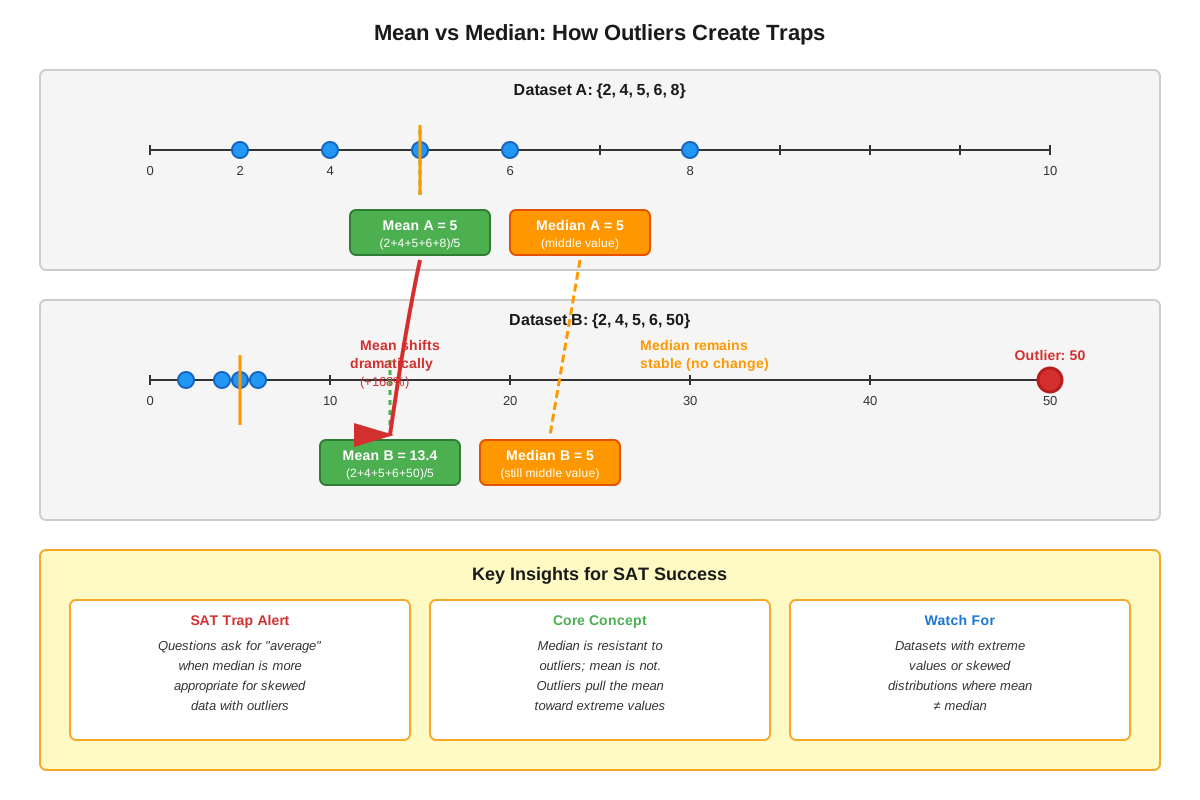
The mean (arithmetic average) and median (middle value) are distinct measures of central tendency that can differ dramatically depending on data distribution. SAT statistics traps frequently exploit students' tendency to assume these values are similar or interchangeable. The mean is calculated by summing all values and dividing by the count, making it highly sensitive to outliers. The median, found by ordering values and selecting the middle position, remains stable even when extreme values are present.
Consider a dataset: {2, 3, 4, 5, 100}. The mean is 22.8, while the median is 4. Questions may present scenarios where students must recognize which measure better represents "typical" values, or they may ask students to determine how adding or removing specific values affects each measure differently. A common trap involves stating that "the average increased" and asking students to draw conclusions about the median, which may not have changed at all.
Sample Size and Representativeness
Sample size refers to the number of observations in a dataset, while representativeness describes how well a sample reflects the characteristics of the larger population. SAT questions frequently present scenarios where conclusions are drawn from inadequate or biased samples. A sample of 10 students from an honors class cannot support valid conclusions about all students in a school, yet trap questions often present such scenarios with authoritative language that encourages hasty acceptance.
The relationship between sample size and reliability is not linear—doubling sample size does not double reliability. However, extremely small samples (n < 30) are generally insufficient for drawing population-level conclusions. Questions may present survey results from self-selected respondents (those who chose to participate), which introduces selection bias that invalidates generalization to broader populations.
Correlation vs. Causation
Perhaps the most frequently tested statistics trap involves the distinction between correlation (two variables changing together) and causation (one variable directly causing changes in another). The SAT regularly presents scenarios where two variables show a relationship and asks whether one causes the other. The correct answer almost always requires recognizing that correlation alone cannot establish causation.
Common scenarios include:
- Confounding variables (a third factor causes both observed variables)
- Reverse causation (the assumed effect actually causes the supposed cause)
- Coincidental correlation (random chance produces apparent relationships)
- Common cause (both variables result from the same underlying factor)
For example, ice cream sales and drowning deaths are correlated, but ice cream doesn't cause drowning—both increase during summer. SAT questions test whether students can identify such relationships and resist the temptation to infer causation from correlation.
Misleading Visual Representations
Graphical manipulation involves presenting data in ways that create false impressions while remaining technically accurate. The SAT includes questions where students must identify how visual representations distort perception. Common techniques include:
| Manipulation Type | How It Misleads | What to Check |
|---|---|---|
| Truncated y-axis | Makes small differences appear dramatic | Does the axis start at zero? |
| Inconsistent scales | Prevents valid comparisons between graphs | Are intervals uniform? |
| Cherry-picked ranges | Shows only data supporting desired conclusion | What time period is displayed? |
| Area distortions | Uses 2D/3D representations for 1D data | Are visual sizes proportional to values? |
Percentage vs. Absolute Change
A critical distinction that appears frequently involves understanding the difference between percentage change and absolute change. A 50% increase from 2 to 3 represents the same percentage change as a 50% increase from 200 to 300, but the absolute changes (1 vs. 100) differ dramatically. SAT questions exploit this by presenting percentage changes and asking about absolute values, or vice versa.
Questions may state that "Group A increased by 20% while Group B increased by 10%" and ask which group had a larger absolute increase. Without knowing the starting values, this question cannot be answered—yet the presentation encourages students to assume Group A had the larger increase. This trap tests whether students recognize that percentage changes depend on base values.
Range and Outliers
The range (difference between maximum and minimum values) is extremely sensitive to outliers—single extreme values that differ substantially from other data points. SAT questions frequently present scenarios where students must recognize that range provides limited information about data distribution. A dataset with range 100 could have all values clustered at the extremes or evenly distributed throughout.
Questions may ask students to determine what can be concluded from knowing only the range and one other measure. The answer typically involves recognizing the severe limitations of such information. For example, knowing the range is 50 and the mean is 25 does not determine the median, mode, or distribution shape.
Experimental Design Flaws
The SAT tests understanding of basic experimental design principles, particularly the concepts of control groups, random assignment, and blinding. Questions present study descriptions and ask students to identify flaws that prevent valid conclusions. Common flaws include:
- Lack of control group (no comparison baseline)
- Non-random assignment (systematic differences between groups)
- Lack of blinding (participants or researchers know group assignments)
- Confounding variables (multiple factors vary simultaneously)
Students must recognize that even with large sample sizes, these design flaws invalidate causal conclusions. A study of 10,000 people who chose their own treatment group cannot establish causation, regardless of sample size.
Concept Relationships
The core concepts within SAT statistics traps form an interconnected web of statistical reasoning principles. Mean vs. median confusion connects directly to outlier sensitivity, as outliers dramatically affect means while leaving medians unchanged. This relationship extends to range calculations, where outliers define the range but may not represent typical data patterns.
Sample size and representativeness form the foundation for all inferential reasoning—without adequate, unbiased samples, no other statistical analysis produces valid conclusions. This concept connects to experimental design flaws, as poor sampling represents one category of design problems. Both concepts ultimately relate to the correlation vs. causation distinction, since even perfect correlations in unrepresentative samples cannot support causal claims about broader populations.
Misleading visual representations exploit the same cognitive shortcuts that make percentage vs. absolute change confusing. Both involve presentation formats that encourage System 1 thinking (fast, intuitive) rather than System 2 thinking (slow, analytical). Recognizing these traps requires the same fundamental skill: pausing to question initial impressions and examining underlying data carefully.
Relationship Map:
Sample Quality (size + representativeness) → Enables Valid Statistical Analysis → Supports Appropriate Measures (mean, median, range) → Allows Correlation Assessment → May Support (with proper design) Causal Claims
Visual Representation Quality ↔ Accurate Interpretation ↔ Avoiding Percentage/Absolute Confusion
Quick check — test yourself on SAT statistics traps so far.
Try Flashcards →High-Yield Facts
⭐ The mean is affected by outliers; the median is not. Adding or removing extreme values changes the mean substantially but may not change the median at all.
⭐ Correlation never proves causation. Even perfect correlation (r = 1.0) cannot establish that one variable causes another without experimental evidence.
⭐ Sample size alone does not ensure representativeness. A biased sample of 10,000 is less useful than a random sample of 100.
⭐ Percentage change requires knowing the base value. A 50% increase means different absolute amounts depending on the starting value.
⭐ Range only tells you about extreme values. Knowing the range provides no information about how data is distributed between the minimum and maximum.
- Self-selected samples (voluntary response) are inherently biased and cannot support population-level conclusions.
- A truncated y-axis (not starting at zero) exaggerates the visual appearance of differences between values.
- The median is the better measure of central tendency for skewed distributions or data with outliers.
- Random assignment to groups is necessary (but not sufficient) for establishing causation in experiments.
- Increasing every value in a dataset by the same amount increases both the mean and median by that amount but does not change the range.
- The mode (most frequent value) can be very different from both mean and median and may not be near the center of the distribution.
- Observational studies can establish correlation but never causation, regardless of sample size or statistical significance.
Common Misconceptions
Misconception: If the mean increases, the median must also increase. → Correction: The mean and median are independent measures. Adding a large outlier increases the mean substantially while potentially leaving the median unchanged. For example, adding 1000 to the dataset {1, 2, 3, 4, 5} changes the mean from 3 to 169.5 but leaves the median at 3.
Misconception: A larger sample size always produces more accurate results. → Correction: Sample size matters only when the sample is representative. A biased sample of 10,000 people (like surveying only people at a gym about exercise habits) produces less valid conclusions than a random sample of 100 people from the general population.
Misconception: If two variables are strongly correlated, one must cause the other. → Correction: Correlation can result from coincidence, confounding variables, reverse causation, or common causes. Ice cream sales correlate with shark attacks because both increase in summer, not because one causes the other.
Misconception: Percentage changes can be directly compared without knowing base values. → Correction: A 10% increase for one group and a 5% increase for another does not mean the first group had a larger absolute increase. If the first group started at 10 (increasing to 11) and the second started at 1000 (increasing to 1050), the second group's absolute increase is much larger.
Misconception: The range provides good information about data distribution. → Correction: Range only describes the spread between extreme values. A dataset with range 100 could have all values at 0 and 100 (bimodal) or evenly distributed throughout (uniform), or clustered in the middle with two outliers.
Misconception: If a study shows a relationship between two variables, the study proves that relationship exists in the real world. → Correction: Statistical significance in a study indicates the relationship is unlikely due to chance in that specific sample, but does not prove the relationship exists in the broader population, especially if the sample was biased or the study design was flawed.
Worked Examples
Example 1: Mean vs. Median with Outliers
Problem: A small company has 5 employees with annual salaries of $40,000, $42,000, $45,000, $47,000, and $250,000. The company advertises that the "average" salary is $84,800. A job applicant assumes this means a typical employee earns about $85,000. What is the median salary, and why is it a better representation of typical earnings?
Solution:
Step 1: Verify the mean calculation.
Mean = (40,000 + 42,000 + 45,000 + 47,000 + 250,000) ÷ 5 = 424,000 ÷ 5 = $84,800 ✓
Step 2: Find the median by ordering the values (already ordered) and selecting the middle value.
The salaries in order: $40,000, $42,000, $45,000, $47,000, $250,000
With 5 values, the median is the 3rd value: $45,000
Step 3: Analyze why the median better represents typical earnings.
Four of the five employees (80%) earn between $40,000-$47,000, while one outlier earns $250,000. The mean of $84,800 is higher than what 80% of employees actually earn because it's heavily influenced by the single high salary. The median of $45,000 represents what a typical employee actually earns.
Connection to Learning Objectives: This example demonstrates identifying the key feature of statistics traps (using mean when median is more appropriate) and applying this knowledge to evaluate misleading claims.
Example 2: Correlation, Causation, and Confounding Variables
Problem: A researcher finds that students who eat breakfast score an average of 15 points higher on the SAT than students who skip breakfast. The researcher concludes that eating breakfast causes higher SAT scores and recommends that all students eat breakfast to improve their scores. A student reads this study and asks: "Can we conclude that eating breakfast causes higher scores? What other factors might explain this relationship?"
Solution:
Step 1: Identify what the study actually shows.
The study demonstrates a correlation: breakfast-eating and higher scores occur together. The study shows an association, not causation.
Step 2: Determine what would be needed to establish causation.
To establish causation, researchers would need:
- Random assignment of students to "eat breakfast" or "skip breakfast" groups
- Control for confounding variables
- Experimental manipulation (not just observation)
This study appears to be observational (comparing existing groups), not experimental.
Step 3: Identify potential confounding variables.
Several factors might cause both breakfast-eating and higher scores:
- Family income: Wealthier families may provide breakfast and SAT preparation
- Time management skills: Organized students may both eat breakfast and study effectively
- Sleep patterns: Students with healthy sleep habits may wake early enough for breakfast and perform better cognitively
- Parental involvement: Engaged parents may ensure breakfast and support academic achievement
Step 4: State the appropriate conclusion.
We cannot conclude that eating breakfast causes higher scores. The correlation might result from any of the confounding variables above, or breakfast and scores might both result from a common underlying factor. The researcher's recommendation is not supported by the evidence.
Connection to Learning Objectives: This example shows how to identify the correlation-causation trap, explain how it appears on the SAT (through observational study descriptions), and apply critical thinking to evaluate statistical claims.
Exam Strategy
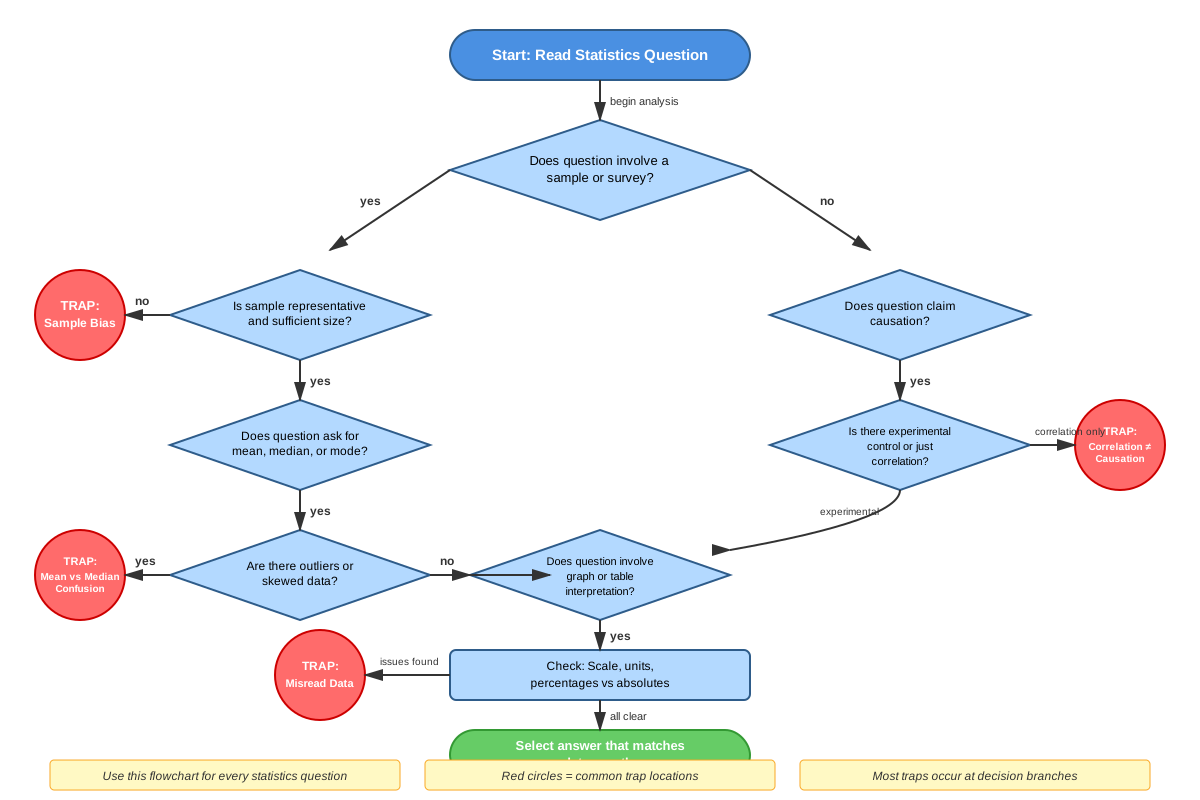
When approaching SAT statistics questions, implement a systematic verification process before selecting answers. First, identify what type of statistical measure or claim the question involves (mean, median, correlation, sample quality, etc.). Second, check whether the question asks what "must be true," "could be true," or "cannot be determined"—these phrases signal different levels of certainty required.
Trigger words and phrases to watch for:
- "The average" (check whether mean or median is more appropriate)
- "The study shows that" (evaluate whether conclusions are supported)
- "Based on this data" (verify that data actually supports the claim)
- "A survey of [specific group]" (assess representativeness)
- "This proves" or "This causes" (check for causation claims)
- "Increased by X%" (distinguish percentage from absolute change)
Process of elimination strategies:
Eliminate answers that:
- Claim causation from correlational data
- Generalize from biased or small samples to entire populations
- Confuse mean and median
- Make definitive claims when data is insufficient
- Ignore confounding variables or alternative explanations
Time allocation advice:
Statistics trap questions typically require 60-90 seconds of careful analysis. Resist the urge to select the first answer that seems reasonable—these questions are designed to make incorrect answers appear correct. Budget an extra 15-30 seconds to verify your reasoning, particularly checking whether you've confused correlation with causation or mean with median. If a question seems too easy, it's probably a trap; pause to identify what you might be missing.
Exam Tip: When a question presents a study or survey, immediately ask three questions: (1) How was the sample selected? (2) What is the sample size? (3) What conclusions does the question claim are supported? Most trap answers involve inappropriate generalizations from flawed samples.
Memory Techniques
MOMS - Remember the measures of central tendency and their outlier sensitivity:
- Mean: Moves with outliers
- Outliers: Only affect mean and range
- Median: Maintains position despite outliers
- Stable: The median is stable
CANS - For evaluating causation claims:
- Correlation is not causation
- Alternative explanations exist
- Need experimental design
- Sample must be representative
RSVP - For checking sample quality:
- Random selection
- Size adequate (typically n ≥ 30)
- Voluntary response is biased
- Population must match sample characteristics
Visualization Strategy: Picture a number line with data points. When considering mean vs. median, visualize how adding an extreme value far to the right pulls the mean toward it like a magnet, while the median (the physical middle point) stays put. This mental image helps remember that means are "pulled" by outliers while medians resist movement.
The "Prove It" Technique: When evaluating statistical claims, mentally add the phrase "prove it" after each conclusion. If you can't prove the claim using only the given information, the answer is likely "cannot be determined" or involves recognizing a trap.
Summary
SAT statistics traps represent a high-yield category of questions that test critical thinking about data rather than computational skills. These questions exploit common reasoning errors involving mean vs. median confusion, correlation-causation fallacies, sample quality issues, and misleading visual representations. Success requires recognizing that the SAT deliberately presents information in ways that encourage hasty, incorrect conclusions. The key to mastering these questions lies in systematic verification: checking sample representativeness, distinguishing correlation from causation, recognizing when outliers affect different measures differently, and understanding that percentage changes depend on base values. Students must resist the temptation to accept authoritative-sounding claims without verification and instead evaluate whether given data actually supports stated conclusions. By identifying trigger words, implementing process-of-elimination strategies, and applying the memory techniques provided, students can transform these trap questions from score-killers into opportunities for demonstrating genuine statistical reasoning.
Key Takeaways
- Mean and median respond differently to outliers; mean is sensitive while median remains stable, making median more appropriate for skewed distributions
- Correlation never establishes causation regardless of strength; experimental design with random assignment is required for causal claims
- Sample size matters only when samples are representative; biased samples of any size cannot support valid population-level conclusions
- Percentage changes cannot be compared without knowing base values; a larger percentage change may represent a smaller absolute change
- Visual representations can mislead through truncated axes, inconsistent scales, and area distortions while remaining technically accurate
- Range provides minimal information about data distribution, revealing only the spread between extreme values
- The phrase "cannot be determined" is often correct when questions provide insufficient information to support definitive conclusions
Related Topics
Probability and Expected Value: Understanding statistics traps provides the foundation for evaluating probabilistic claims and recognizing when expected value calculations are being misapplied or misinterpreted. Mastering statistical reasoning enables students to identify similar traps in probability contexts.
Data Analysis from Tables and Graphs: The skills developed in recognizing misleading visual representations directly transfer to more complex data interpretation questions involving multi-variable tables, scatterplots, and comparative graphs.
Linear Regression and Line of Best Fit: The correlation-causation distinction becomes even more critical when analyzing trend lines and making predictions from linear models, as students must evaluate whether observed relationships support predictive claims.
Experimental Design and Scientific Method: Advanced understanding of how sample quality and experimental design affect valid conclusions prepares students for science passages and data-driven questions across all SAT sections.
Practice CTA
Now that you understand the key features of SAT statistics traps and the strategies for avoiding them, it's time to apply this knowledge to authentic practice questions. The concepts covered here appear on every SAT administration, making practice with these question types one of the highest-yield uses of your study time. Challenge yourself with the practice questions and flashcards to reinforce these critical thinking skills. Remember: recognizing these traps becomes automatic with practice, transforming questions that once seemed confusing into straightforward opportunities to demonstrate your analytical reasoning. Each practice question you complete strengthens your ability to spot trigger words, evaluate claims critically, and avoid the common errors that trap unprepared students.
Sign up free to keep reading
Create a free AnvayaPrep account to finish this SAT guide on SAT statistics traps — plus flashcards and practice questions.