Overview
Survey interpretation is a critical skill tested on the SAT Math section that requires students to analyze data collection methods, understand sampling techniques, and draw valid conclusions from survey results. This topic bridges statistical reasoning with real-world applications, asking students to evaluate the quality of survey designs, identify potential biases, and determine whether conclusions are justified based on the data presented. Unlike pure computational problems, sat survey interpretation questions assess critical thinking about how data is gathered and what it actually represents.
The SAT frequently presents scenarios where researchers conduct surveys on specific populations, and students must determine whether the survey methodology supports the conclusions drawn. These questions test understanding of representative samples, random selection, margin of error, and the scope of valid inferences. Students must distinguish between correlation and causation, recognize when generalizations are appropriate, and identify flaws in survey design that might compromise results.
This topic connects directly to broader math concepts including probability, statistics, and logical reasoning. Survey interpretation questions often appear alongside data analysis problems involving charts, graphs, and statistical measures. Mastering this topic strengthens overall statistical literacy and prepares students for the increasingly data-driven questions that appear throughout the SAT Math section, particularly in the Problem Solving and Data Analysis domain where these questions carry significant weight.
Learning Objectives
- [ ] Identify key features of survey interpretation including sample selection, population definition, and data collection methods
- [ ] Explain how survey interpretation appears on the SAT through question formats and common scenarios
- [ ] Apply survey interpretation principles to answer SAT-style questions accurately and efficiently
- [ ] Evaluate whether a survey's sample is representative of its target population
- [ ] Determine the appropriate scope of conclusions based on survey methodology
- [ ] Recognize sources of bias in survey design and administration
- [ ] Distinguish between observational studies and experiments in data collection contexts
Prerequisites
- Basic statistical terminology: Understanding terms like population, sample, mean, and median provides the foundation for analyzing survey data and interpreting results
- Proportional reasoning: The ability to work with ratios and percentages is essential for understanding sample sizes and extrapolating survey results to larger populations
- Reading comprehension: Survey interpretation questions require careful reading of scenarios to identify key details about methodology and population characteristics
- Logical reasoning: Students must evaluate whether conclusions logically follow from premises, a skill fundamental to assessing survey validity
Why This Topic Matters
Survey interpretation skills extend far beyond standardized testing into everyday life. Citizens encounter survey results in news reports, political polls, medical studies, and consumer research. Understanding how to critically evaluate these surveys enables informed decision-making about health choices, voting, and evaluating claims made by advertisers and media outlets. Professionals in fields ranging from business to public health rely on survey data to make evidence-based decisions affecting millions of people.
On the SAT, survey interpretation questions appear with high frequency, typically comprising 2-4 questions per test administration. These questions fall primarily within the Problem Solving and Data Analysis domain, which accounts for approximately 29% of the Math section. Survey questions often appear as multi-part scenarios where understanding the survey design is crucial for answering subsequent questions about the data. The College Board has increasingly emphasized these questions in recent years, reflecting the growing importance of data literacy in college and career readiness.
Common SAT presentations include: scenarios describing how researchers selected participants for a study; questions asking whether conclusions can be generalized from a sample to a population; problems requiring students to identify which population a survey result applies to; and questions about whether a survey design introduces bias. These questions typically provide 3-5 sentences describing a survey methodology, followed by a question asking what conclusion is supported or what population the results represent.
Core Concepts
Population vs. Sample
The population represents the entire group about which researchers want to draw conclusions, while a sample is the subset of that population actually surveyed. Understanding this distinction is fundamental to survey interpretation. For example, if researchers want to know about all high school students in California (population), they might survey 1,000 students from various schools (sample). The key question is whether the sample accurately represents the population.
A representative sample mirrors the characteristics of the population in relevant ways. If the population is 52% female and 48% male, a representative sample should approximate these proportions. The SAT frequently tests whether students can identify when a sample is or isn't representative. For instance, surveying only students in advanced placement classes would not represent all high school students because AP students differ systematically from the general student population.
Random Selection and Random Assignment
Random selection refers to how participants are chosen from a population, while random assignment refers to how participants in an experiment are divided into groups. These concepts are distinct but often confused. Random selection helps ensure a sample is representative and allows generalization to the broader population. Random assignment helps establish cause-and-effect relationships in experiments by minimizing confounding variables.
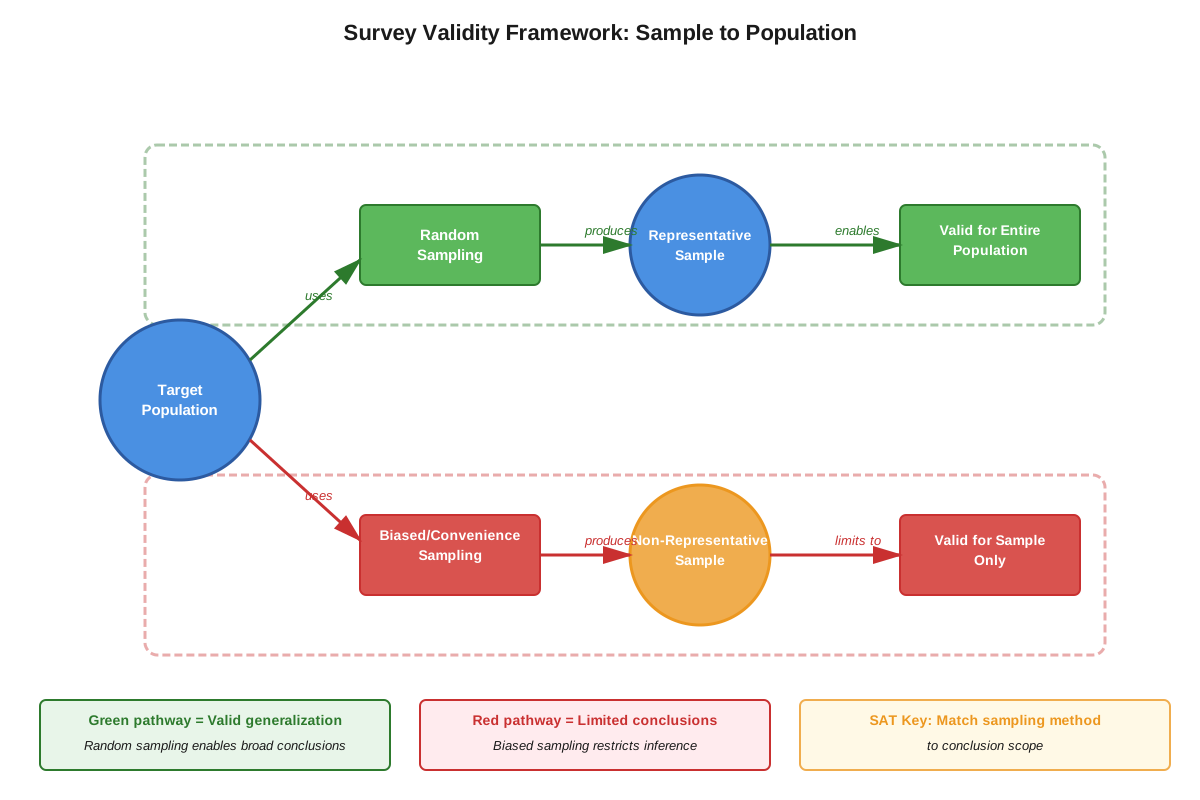
When a survey uses random selection, every member of the population has an equal chance of being chosen. This method reduces selection bias and increases the likelihood that the sample represents the population. The SAT often presents scenarios where selection was not random—such as surveying only volunteers or only people at a specific location—and asks students to recognize that conclusions cannot be generalized to the entire population.
Scope of Inference
The scope of inference defines what population the survey results can legitimately describe. This scope depends entirely on how the sample was selected. A survey of students at one high school can only draw conclusions about that specific school, not all high schools nationally. Similarly, a survey conducted only online can only represent people with internet access who choose to respond.
SAT questions frequently present a survey methodology and ask which of four populations the results can be generalized to. The correct answer matches the actual population from which the sample was drawn. For example:
| Sample Description | Valid Inference Population | Invalid Inference Population |
|---|---|---|
| Random sample of 500 students at Lincoln High School | All students at Lincoln High School | All high school students in the district |
| Random sample of 1,000 registered voters in Ohio | All registered voters in Ohio | All adults in Ohio |
| Survey of people visiting a gym | People who visit that gym | All people in the community |
Bias in Surveys
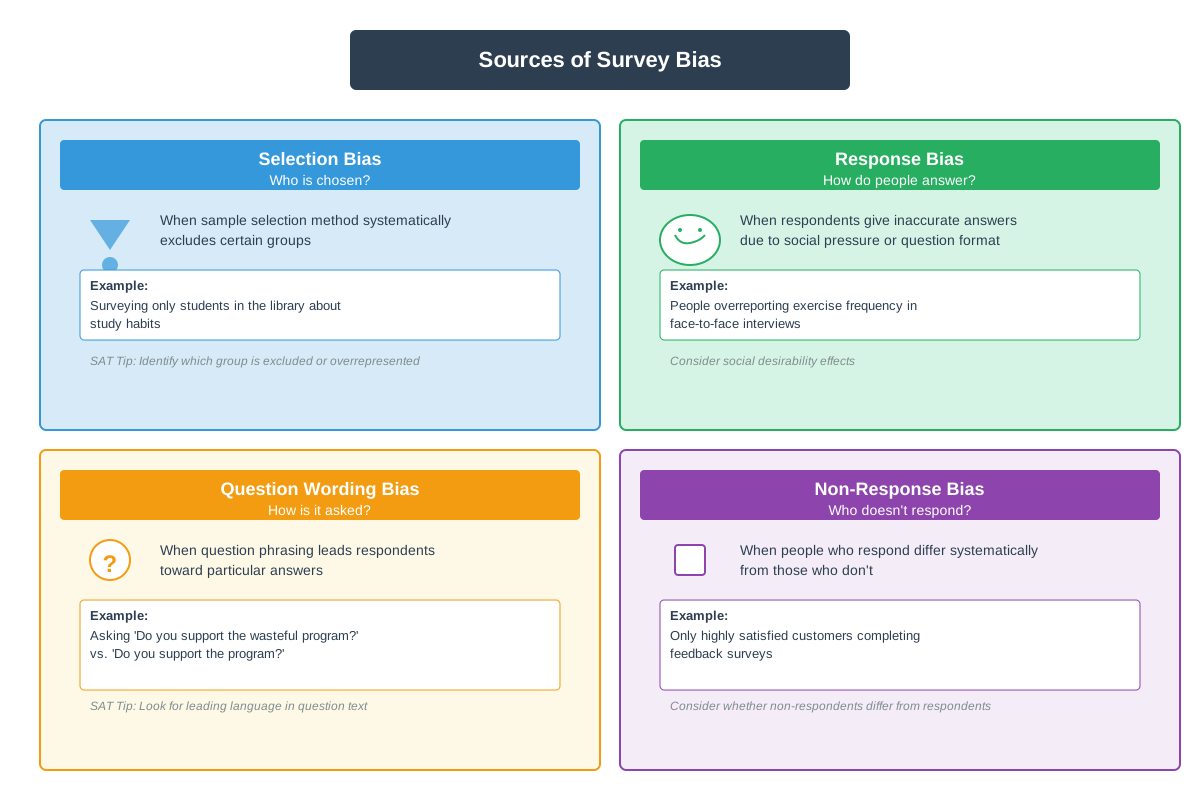
Bias occurs when the survey design systematically favors certain outcomes or excludes certain perspectives. Several types of bias commonly appear on the SAT:
Sampling bias occurs when the method of selecting participants makes some individuals more likely to be included than others. Surveying only people who answer their phones during business hours creates sampling bias because it excludes people who work during those hours.
Response bias happens when the way questions are asked influences how people answer. Leading questions like "Don't you agree that the new policy is terrible?" create response bias by suggesting a desired answer.
Non-response bias arises when people who choose not to participate differ systematically from those who do participate. If only highly motivated individuals complete a voluntary survey, their responses may not represent the broader population.
Convenience sampling involves surveying whoever is easily accessible rather than using random selection. While convenient, this method almost always introduces bias because easily accessible people may share characteristics that make them unrepresentative.
Margin of Error and Confidence
The margin of error indicates the range within which the true population value likely falls. If a survey reports that 55% of voters support a candidate with a margin of error of ±3%, the true support level is likely between 52% and 58%. Larger samples generally produce smaller margins of error, increasing precision.
Confidence level (typically 95% on the SAT) indicates how certain researchers are that the true population value falls within the margin of error. A 95% confidence level means that if the survey were repeated 100 times, approximately 95 of those surveys would produce results within the stated margin of error of the true population value.
Observational Studies vs. Experiments
Observational studies involve collecting data without manipulating variables. Surveys are observational studies—researchers ask questions but don't intervene or assign treatments. Observational studies can identify associations between variables but cannot establish causation because confounding variables might explain the relationship.
Experiments involve researchers actively manipulating one variable (the independent variable) to observe effects on another variable (the dependent variable). Only experiments with proper random assignment can establish cause-and-effect relationships. The SAT tests whether students recognize that survey data alone cannot prove causation.
Extrapolation and Generalization
Extrapolation involves extending survey findings beyond the surveyed sample to make predictions about the population. Valid extrapolation requires a representative sample obtained through random selection. The SAT often asks students to calculate expected values for a larger population based on sample proportions.
For example, if 120 out of 400 randomly selected students prefer online learning, and the school has 2,000 students total, we can extrapolate: (120/400) × 2,000 = 600 students likely prefer online learning. This extrapolation is valid only because the sample was randomly selected from the school population.
Concept Relationships
Survey interpretation concepts form an interconnected framework where each element depends on others. The relationship begins with defining the population of interest, which determines what sample should be drawn. The sampling method (random vs. non-random) directly affects whether the sample is representative, which in turn determines the valid scope of inference.
Bias can enter at multiple points: through sampling bias in how participants are selected, response bias in how questions are asked, or non-response bias in who chooses to participate. Any form of bias compromises the sample's representativeness and limits the scope of valid conclusions.
The distinction between observational studies and experiments affects what types of conclusions can be drawn. Surveys (observational) can identify associations but not causation, while experiments with random assignment can establish cause-and-effect relationships.
Margin of error and confidence level quantify the precision and reliability of survey results, connecting to the sample size—larger samples generally produce more precise estimates with smaller margins of error.
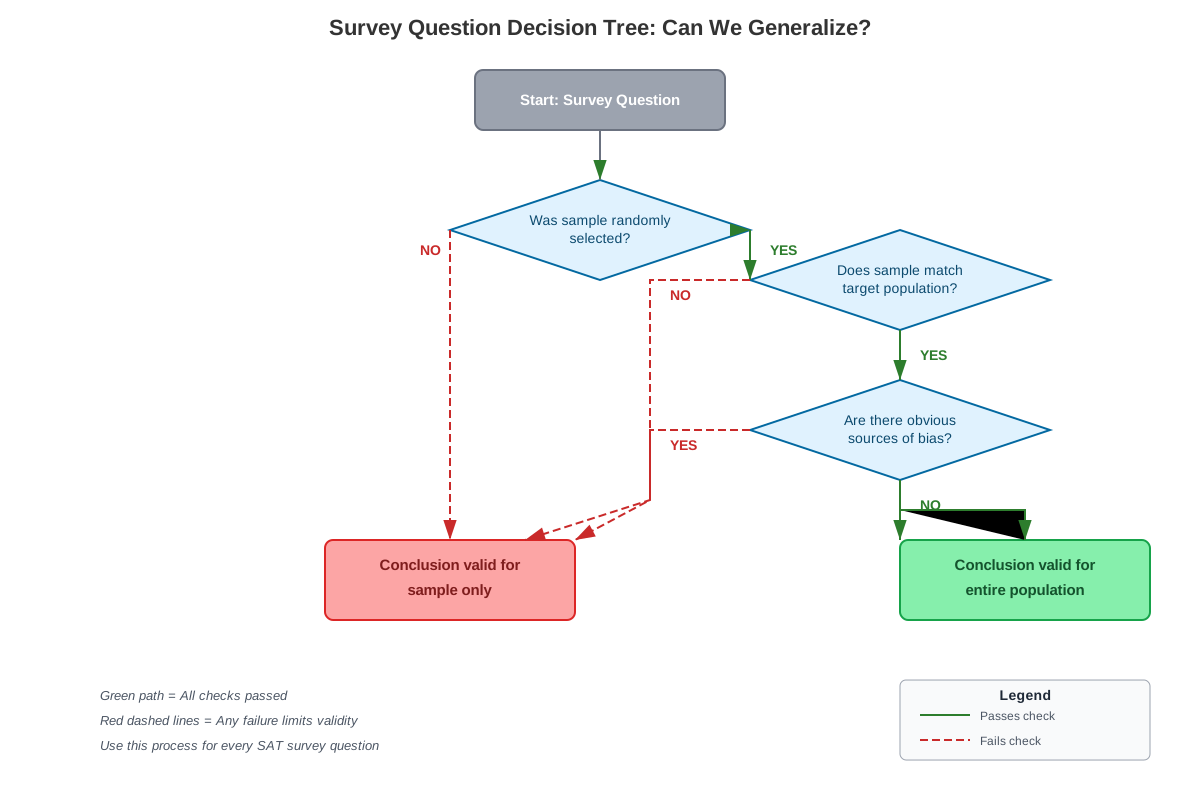
The conceptual flow: Population → Sampling Method → Sample Quality → Bias Assessment → Scope of Inference → Margin of Error → Valid Conclusions. Each step must be evaluated to determine whether survey results support specific claims.
Quick check — test yourself on Survey interpretation so far.
Try Flashcards →High-Yield Facts
- ⭐ A survey can only be generalized to the population from which the sample was randomly selected
- ⭐ Random selection allows generalization to a population; random assignment allows causal conclusions in experiments
- ⭐ Convenience sampling (surveying whoever is easily accessible) introduces bias and prevents generalization
- ⭐ Surveys are observational studies and cannot establish causation, only association
- ⭐ The scope of inference must match the population actually sampled, not a broader or different population
- A representative sample mirrors the relevant characteristics of the target population
- Larger sample sizes generally produce smaller margins of error and more precise estimates
- Voluntary response surveys typically suffer from non-response bias because respondents differ from non-respondents
- Leading questions create response bias by suggesting desired answers
- A 95% confidence level means that if the survey were repeated many times, approximately 95% of results would fall within the margin of error
- Sampling bias occurs when the selection method makes some population members more likely to be included than others
- Extrapolating survey results to calculate expected values requires proportional reasoning
- A survey of one specific group (like gym members) cannot represent people who don't belong to that group
- The margin of error applies to the entire population estimate, not to individual responses
Common Misconceptions
Misconception: A large sample size automatically makes a survey valid and generalizable to any population.
Correction: Sample size affects precision (margin of error) but not representativeness. A survey of 10,000 college students is still only representative of college students, not all adults, regardless of size. The sampling method and population sampled determine generalizability, not sample size alone.
Misconception: Random assignment and random selection are the same thing and serve the same purpose.
Correction: Random selection chooses participants from a population and enables generalization; random assignment divides participants into experimental groups and enables causal conclusions. Surveys typically involve selection, not assignment, since they don't manipulate variables.
Misconception: If a survey shows that two variables are related, one must cause the other.
Correction: Surveys are observational studies that can only demonstrate association or correlation, never causation. Confounding variables might explain the relationship. Only controlled experiments with random assignment can establish cause-and-effect relationships.
Misconception: Surveying people at a specific location (like a mall or gym) is acceptable as long as you survey many people.
Correction: This convenience sampling introduces systematic bias because people at that location share characteristics that make them unrepresentative of the broader population. The survey can only represent people who visit that specific location, not the general population.
Misconception: If 60% of a sample supports something, exactly 60% of the population supports it.
Correction: The sample proportion is an estimate of the population proportion. The true population value likely falls within the margin of error of the sample result. For example, with a ±3% margin of error, the true population support is likely between 57% and 63%.
Misconception: Non-response bias isn't a problem as long as many people do respond.
Correction: Non-response bias occurs when people who don't respond differ systematically from those who do respond. Even if thousands respond, if non-respondents have different characteristics or opinions, the results are biased and don't represent the full population.
Worked Examples
Example 1: Evaluating Survey Validity and Scope
Problem: A researcher wants to determine what percentage of adults in Texas support a new education policy. She surveys 500 people who attend a town hall meeting about education in Austin. Of those surveyed, 340 support the policy. The researcher concludes that approximately 68% of all adults in Texas support the policy. Is this conclusion valid? Why or why not?
Solution:
Step 1: Identify the target population and the actual sample.
- Target population: All adults in Texas
- Sample: 500 people who attended a town hall meeting in Austin
Step 2: Evaluate the sampling method.
- The sample was not randomly selected from all Texas adults
- Only people who attended a specific meeting were surveyed (convenience sampling)
- People who attend town hall meetings about education likely have stronger opinions and different characteristics than the general population
Step 3: Assess representativeness.
- The sample is not representative of all Texas adults
- It only represents people interested enough in education to attend a town hall meeting
- Geographic limitation: only Austin residents who could attend that meeting
Step 4: Determine valid scope of inference.
- The results can only describe people who attended that specific town hall meeting
- Cannot be generalized to all Austin adults, much less all Texas adults
Step 5: Evaluate the conclusion.
- The conclusion is NOT valid
- The sampling method (convenience sampling of meeting attendees) introduces severe sampling bias
- Valid conclusion: "Approximately 68% of people who attended this town hall meeting support the policy"
Key Takeaway: This example demonstrates that the scope of inference must match the population actually sampled. Convenience sampling prevents generalization to broader populations.
Example 2: Extrapolating Survey Results
Problem: A high school has 1,800 students. The principal randomly selects 150 students and surveys them about whether they would use a new study room if it were built. Of the 150 students surveyed, 45 said they would use the study room. Based on these results, approximately how many of the school's 1,800 students would be expected to use the study room?
Solution:
Step 1: Verify that extrapolation is appropriate.
- The sample was randomly selected from the school population ✓
- The survey asks about the same population (students at this school) ✓
- Extrapolation is valid
Step 2: Calculate the sample proportion.
- Students who would use the room: 45 out of 150
- Proportion: 45/150 = 0.30 or 30%
Step 3: Apply the proportion to the full population.
- Total students: 1,800
- Expected users: 0.30 × 1,800 = 540 students
Step 4: Express the answer appropriately.
- "Approximately 540 students would be expected to use the study room"
- Use "approximately" or "expected" because this is an estimate based on sample data
Alternative calculation method:
Set up a proportion: 45/150 = x/1,800
Cross-multiply: 150x = 45 × 1,800
150x = 81,000
x = 540
Key Takeaway: This example shows how to extrapolate from a representative sample to a larger population using proportional reasoning. The random selection makes this extrapolation valid.
Exam Strategy
When approaching SAT survey interpretation questions, begin by carefully reading the scenario to identify three critical elements: the target population (who the researchers want to know about), the actual sample (who was surveyed), and the sampling method (how participants were selected). Underline or circle these elements as you read.
Trigger words and phrases that signal survey interpretation questions include:
- "randomly selected," "random sample" (indicates valid generalization is possible)
- "volunteers," "chose to participate" (signals potential non-response bias)
- "surveyed people at/in [specific location]" (indicates convenience sampling)
- "can the researcher conclude," "what population do these results represent" (asking about scope of inference)
- "based on this survey" (requires evaluating what the survey actually supports)
For questions asking what population results can be generalized to, use process of elimination by crossing out any answer choice that describes a population broader than or different from the one actually sampled. If the survey sampled students at one school, eliminate choices mentioning "all students in the district" or "all high school students." The correct answer will match the population from which the sample was drawn.
When questions present multiple survey designs and ask which is best, look for random selection from the target population. Eliminate designs using convenience sampling, voluntary response, or sampling from a different population than the one of interest.
For questions about whether a conclusion is supported, check whether:
- The sample was randomly selected from the relevant population
- The conclusion matches the scope of the sample
- The conclusion claims causation (surveys cannot establish causation)
Time allocation: Survey interpretation questions typically require 60-90 seconds. Spend 30 seconds carefully reading and analyzing the scenario, then 30-60 seconds evaluating answer choices. Don't rush the initial reading—misunderstanding the sampling method leads to wrong answers even if your reasoning is sound.
Exam Tip: If a question asks whether a survey supports a causal claim (X causes Y), the answer is almost always "no" because surveys are observational studies. Only controlled experiments can establish causation.
Memory Techniques
RANDOM acronym for valid survey generalization:
- Representative sample needed
- Actual population sampled determines scope
- No causation from surveys alone
- Don't generalize beyond sampled population
- Observational studies show association only
- Margin of error indicates precision
The "Who, How, What" Framework:
- Who was actually surveyed? (defines scope)
- How were they selected? (determines validity)
- What can we conclude? (must match who and how)
Visualization strategy: Picture a target with concentric circles. The bullseye represents the sample, the next ring represents the population from which the sample was drawn, and outer rings represent broader populations. Valid conclusions stay within the ring from which the sample was drawn; invalid conclusions jump to outer rings.
Bias memory aid: "CVN" for the three main bias types:
- Convenience sampling bias
- Voluntary response (non-response) bias
- Nudging questions (response bias)
Selection vs. Assignment: Remember "Selection = Scope, Assignment = Cause." Random selection determines what population you can generalize to (scope), while random assignment determines whether you can claim causation.
Summary
Survey interpretation on the SAT requires students to critically evaluate how data is collected and what conclusions are justified. The fundamental principle is that valid generalization depends on random selection from the target population—a survey can only represent the population from which the sample was actually drawn. Students must distinguish between population (the entire group of interest) and sample (the subset surveyed), recognize various forms of bias that compromise survey validity, and understand that surveys are observational studies capable of showing association but never causation. The scope of inference must match the sampling method: convenience samples, voluntary responses, and location-based surveys cannot represent broader populations regardless of sample size. Successful SAT performance requires identifying the sampling method, assessing whether the sample is representative, determining the valid scope of conclusions, and recognizing when extrapolation is appropriate. These questions test critical thinking about research methodology rather than computational skills, making careful reading and logical analysis essential.
Key Takeaways
- A survey's results can only be generalized to the population from which the sample was randomly selected, never to broader or different populations
- Random selection enables generalization to a population; random assignment (used in experiments, not surveys) enables causal conclusions
- Convenience sampling, voluntary response, and location-based sampling all introduce bias and prevent valid generalization
- Surveys are observational studies that can demonstrate association between variables but never prove causation
- The scope of valid inference must match the actual population sampled, regardless of what population the researcher wanted to study
- Margin of error indicates the range within which the true population value likely falls, with larger samples producing smaller margins of error
- Extrapolating survey results to larger populations requires proportional reasoning and is only valid when the sample was randomly selected
Related Topics
Experimental Design: Building on survey interpretation, experimental design explores controlled studies with random assignment, treatment and control groups, and establishing cause-and-effect relationships. Mastering survey interpretation provides the foundation for understanding why experiments differ from observational studies.
Statistical Inference: This advanced topic extends survey interpretation into hypothesis testing, confidence intervals, and statistical significance. Understanding survey validity and margin of error prepares students for more sophisticated statistical reasoning.
Data Representation: Survey results are often presented in tables, charts, and graphs. Combining survey interpretation skills with data visualization analysis enables students to evaluate both how data was collected and how it's presented.
Probability and Sampling Distributions: Deeper exploration of why random sampling produces representative samples and how sample statistics relate to population parameters. Survey interpretation provides practical context for theoretical probability concepts.
Practice CTA
Now that you've mastered the core concepts of survey interpretation, it's time to apply your knowledge! Work through the practice questions to test your ability to evaluate survey designs, identify bias, and determine valid conclusions. The flashcards will help reinforce key terminology and concepts. Remember, survey interpretation questions reward careful reading and logical thinking—skills that improve with deliberate practice. Each practice question you complete strengthens your ability to quickly identify sampling methods and scope of inference, building the confidence and speed you need for test day success. You've got this!
Sign up free to keep reading
Create a free AnvayaPrep account to finish this SAT guide on Survey interpretation — plus flashcards and practice questions.