Overview
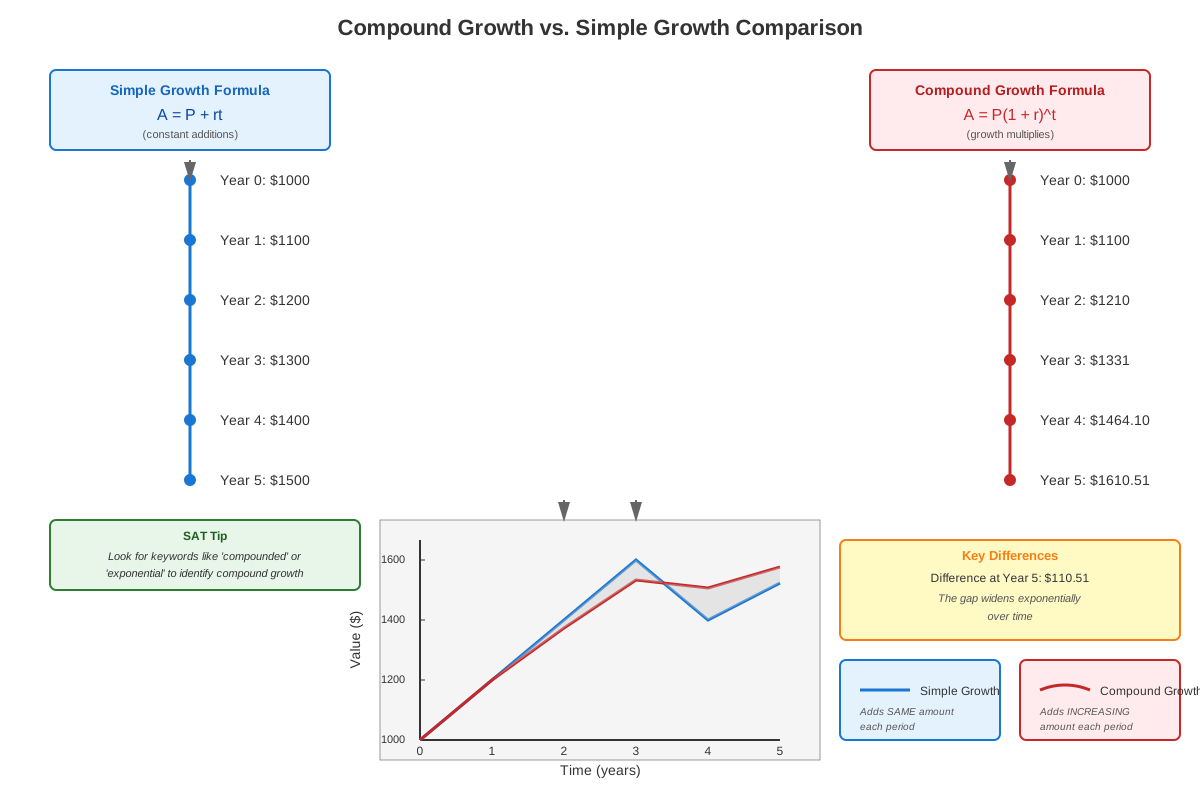
Compound growth is one of the most powerful mathematical concepts tested on the SAT, appearing regularly in both the calculator and no-calculator sections. This topic involves understanding how quantities increase exponentially over time when growth is applied repeatedly to an ever-increasing base. Unlike simple linear growth where the same amount is added each period, compound growth multiplies the current value by a growth factor, creating an accelerating pattern that appears throughout math and real-world applications.
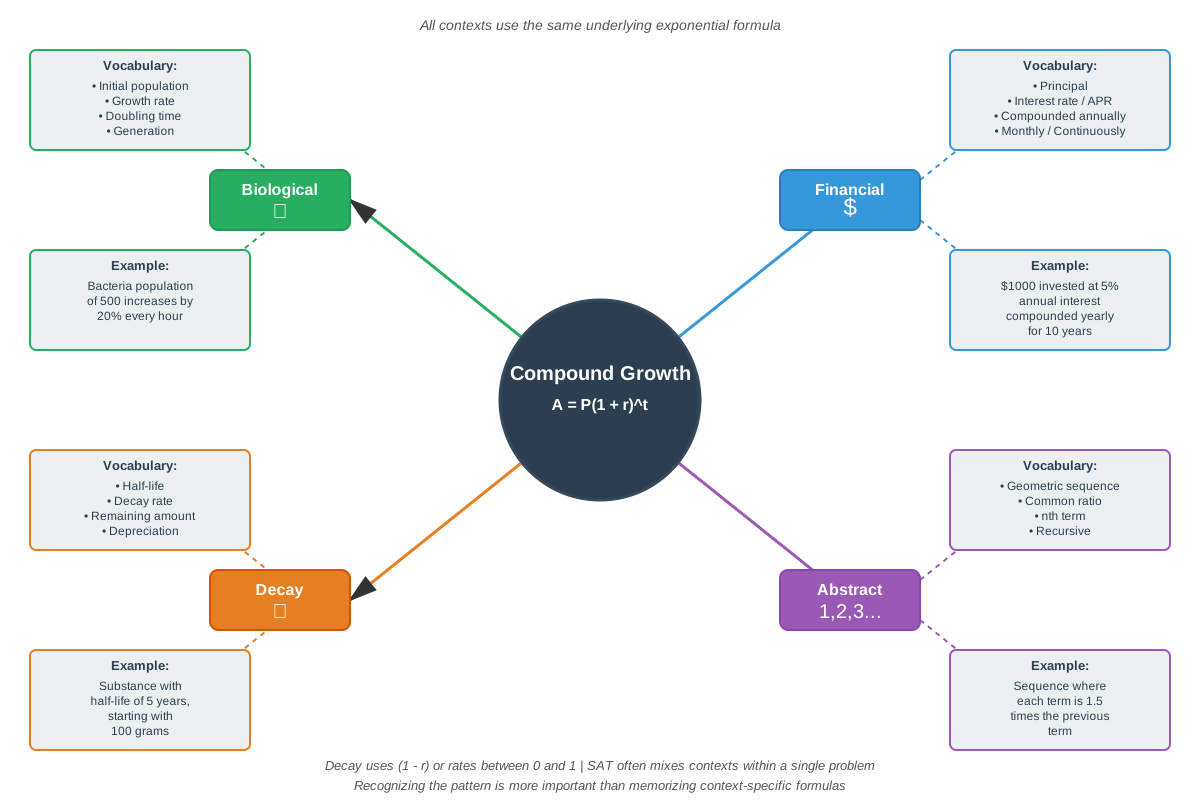
On the SAT, compound growth questions typically involve financial scenarios (interest calculations, investment growth), population dynamics, radioactive decay (negative compound growth), and abstract mathematical sequences. These problems test whether students can identify exponential patterns, construct appropriate equations, manipulate exponential expressions, and interpret results in context. The College Board frequently embeds compound growth within word problems that require translating verbal descriptions into mathematical models, making this a high-yield topic that bridges algebraic manipulation with practical reasoning.
Understanding compound growth is foundational for mastering the broader "Exponents and Radicals" unit because it provides concrete applications for exponential functions, demonstrates why exponential expressions behave differently from linear ones, and reinforces skills in working with bases and exponents. This topic connects directly to function notation, percentage calculations, and equation solving—all critical SAT competencies. Students who master compound growth gain both the computational skills to solve these problems quickly and the conceptual understanding to avoid common traps that test-makers deliberately include.
Learning Objectives
- [ ] Identify key features of compound growth including initial value, growth rate, time periods, and final value
- [ ] Explain how compound growth appears on the SAT in various contexts including finance, population, and decay scenarios
- [ ] Apply compound growth formulas to answer SAT-style questions accurately and efficiently
- [ ] Distinguish between compound growth and simple linear growth in problem contexts
- [ ] Construct exponential equations from verbal descriptions of compound growth situations
- [ ] Interpret the meaning of variables and constants within compound growth formulas in real-world contexts
- [ ] Calculate growth rates, time periods, or final values when given partial information
Prerequisites
- Exponent rules and properties: Understanding how to manipulate expressions with exponents is essential for working with compound growth formulas where the time variable appears as an exponent
- Percentage calculations: Converting between percentages and decimals is necessary since growth rates are typically expressed as percentages but must be converted for calculations
- Basic algebraic equation solving: Students must solve for various variables within exponential equations, requiring comfort with algebraic manipulation
- Function notation: Compound growth problems often use function notation like f(t) or A(n) to represent values at different times
- Order of operations: Correctly evaluating compound growth expressions requires careful attention to the sequence of operations, especially with exponents
Why This Topic Matters
Compound growth represents one of the most practically significant mathematical concepts students will encounter. In real life, compound interest determines how savings accounts, retirement funds, and student loans grow over time. Understanding the mathematics behind compounding helps individuals make informed financial decisions, from choosing between investment options to understanding the true cost of debt. Population growth, viral spread of information or disease, and even the acceleration of technological advancement all follow compound growth patterns.
On the SAT, compound growth appears in approximately 3-5 questions per test, making it a high-frequency topic that can significantly impact scores. These questions typically appear as medium to hard difficulty problems worth the same points as easier questions, so mastering this topic provides excellent return on study time investment. The College Board tests compound growth through multiple question formats: direct calculation problems, equation construction from word problems, interpretation questions asking about the meaning of variables or constants, and comparison questions contrasting different growth scenarios.
Common SAT presentations include: savings account problems asking for final balance after compound interest; population growth scenarios requiring students to find population at a future time; radioactive decay or medication elimination problems (negative growth); and abstract scenarios about bacteria growth, social media followers, or other quantities that increase exponentially. Questions may ask students to identify which equation correctly models a situation, solve for an unknown variable, or interpret what a specific number in an equation represents within the context.
Core Concepts
The Compound Growth Formula
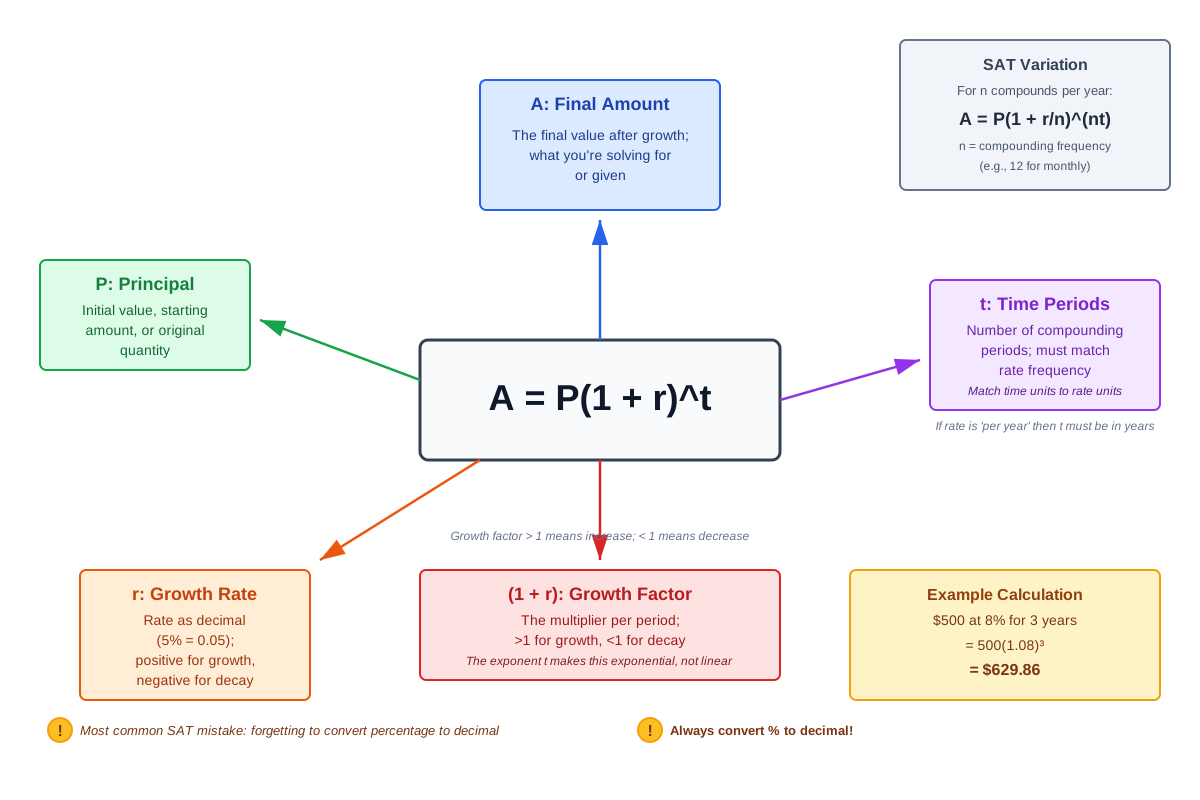
The fundamental compound growth formula is:
A = P(1 + r)^tWhere:
- A = final amount (the value after growth has occurred)
- P = principal or initial amount (the starting value)
- r = growth rate per period (expressed as a decimal)
- t = number of time periods (how many times growth is applied)
This formula captures the essence of exponential growth: each period, the quantity is multiplied by the factor (1 + r). The "+1" represents keeping the original amount, while "r" represents the additional growth. For example, 5% growth means multiplying by 1.05, which keeps 100% of the original and adds 5% more.
Understanding the Growth Factor
The expression (1 + r) is called the growth factor or multiplier. This single number encapsulates how the quantity changes each period:
- If r = 0.05 (5% growth), the growth factor is 1.05
- If r = 0.20 (20% growth), the growth factor is 1.20
- If r = -0.03 (3% decay), the growth factor is 0.97
The growth factor being raised to the power of t means it's applied repeatedly. With a growth factor of 1.05 over 3 years, the calculation is: P × 1.05 × 1.05 × 1.05 = P × (1.05)³. This repeated multiplication creates the exponential curve characteristic of compound growth.
Compound Interest with Multiple Compounding Periods
When interest compounds more frequently than annually, the formula expands to:
A = P(1 + r/n)^(nt)Where:
- n = number of compounding periods per year
- r = annual interest rate (as a decimal)
- t = number of years
This formula accounts for situations where interest is calculated quarterly (n=4), monthly (n=12), or daily (n=365). The rate r/n represents the interest rate per compounding period, and nt represents the total number of compounding periods. For example, 6% annual interest compounded monthly means 0.5% interest applied 12 times per year.
| Compounding Frequency | n value | Example: 12% annual rate |
|---|---|---|
| Annually | 1 | 12% once per year |
| Semi-annually | 2 | 6% twice per year |
| Quarterly | 4 | 3% four times per year |
| Monthly | 12 | 1% twelve times per year |
| Daily | 365 | 0.0329% daily |
Exponential Decay
Exponential decay is compound growth with a negative rate. The formula remains the same, but r is negative:
A = P(1 - r)^tThe growth factor (1 - r) is less than 1, causing the quantity to decrease each period. Common SAT scenarios include:
- Radioactive decay (half-life problems)
- Medication elimination from the bloodstream
- Depreciation of asset values
- Population decline
For a 15% decay rate, the growth factor is 0.85, meaning 85% remains each period while 15% is lost.
Identifying Compound Growth in Word Problems
SAT questions rarely present the formula directly. Instead, they describe situations verbally. Key phrases that signal compound growth include:
- "increases by X% each year/period"
- "grows at a rate of"
- "compounds annually/monthly/quarterly"
- "doubles every X years"
- "decreases by X% per"
- "half-life of X hours"
The critical distinction is whether the growth applies to the current value (compound) or the original value (simple). "The population increases by 100 people each year" is linear growth. "The population increases by 5% each year" is compound growth because 5% of a larger population is more people than 5% of a smaller population.
Solving for Different Variables
SAT questions may ask students to find any variable in the compound growth equation:
- Finding final amount (A): Direct substitution and calculation
- Finding initial amount (P): Divide both sides by (1+r)^t
- Finding growth rate (r): Divide both sides by P, take the t-th root, subtract 1
- Finding time (t): Requires logarithms (rarely tested at this level) or trial-and-error with answer choices
Most SAT questions focus on the first two scenarios, though occasionally students must work backward from a final amount to determine what initial amount would produce it.
Interpreting Components in Context
A crucial SAT skill is explaining what each part of an equation represents within a specific scenario. Given an equation like A = 5000(1.03)^t modeling a savings account:
- 5000 represents the initial deposit in dollars
- 1.03 represents the growth factor (3% annual interest)
- 0.03 represents the interest rate
- t represents the number of years
- A represents the account balance in dollars after t years
Questions might ask: "What does the number 5000 represent in this equation?" or "What does 1.03 represent?" Understanding the contextual meaning, not just the mathematical role, is essential.
Concept Relationships
The concepts within compound growth build upon each other in a logical progression. The basic compound growth formula serves as the foundation, from which the growth factor concept emerges as the key mechanism driving exponential change. Understanding growth factors enables students to distinguish between compound interest with multiple compounding periods, which simply applies the growth factor more frequently with a proportionally smaller rate. Exponential decay represents the same mathematical structure with a growth factor less than 1, demonstrating that compound growth is actually a broader category encompassing both increase and decrease.
The skill of identifying compound growth in word problems connects all these concepts to SAT question formats, requiring students to translate verbal descriptions into the appropriate formula. Solving for different variables extends the basic formula into a flexible tool that can answer various question types. Finally, interpreting components in context bridges pure mathematics with real-world meaning, a connection the SAT emphasizes heavily.
This topic connects to prerequisite knowledge through its reliance on exponent rules (the t in the exponent position), percentage calculations (converting growth rates), and algebraic manipulation (solving for various variables). It relates to other topics in the Exponents and Radicals unit by providing concrete applications for abstract exponential expressions and demonstrating why exponential functions grow faster than linear or polynomial functions. Compound growth also connects forward to more advanced topics like logarithms (used to solve for t algebraically) and exponential functions in coordinate geometry.
Relationship Map:
Basic Formula → Growth Factor Concept → Multiple Compounding Periods (parallel to) → Exponential Decay → Word Problem Translation → Variable Solving → Contextual Interpretation → SAT Application
High-Yield Facts
⭐ The compound growth formula is A = P(1 + r)^t where A is final amount, P is initial amount, r is growth rate as a decimal, and t is number of periods
⭐ The growth factor (1 + r) is the number by which the quantity is multiplied each period; for 7% growth, the growth factor is 1.07
⭐ Compound growth means the growth rate applies to the current value, not the original value, creating exponential rather than linear increase
⭐ When interest compounds n times per year, use A = P(1 + r/n)^(nt) where r is the annual rate and t is years
⭐ Exponential decay uses the same formula with a negative rate: A = P(1 - r)^t, resulting in a growth factor less than 1
- For a quantity that doubles every period, the growth factor is 2, meaning r = 1 or 100% growth per period
- The initial amount P is the coefficient in front of the exponential expression in standard form
- More frequent compounding (larger n) results in slightly larger final amounts for the same annual rate
- To find what percentage of the original remains after decay, calculate (1 - r)^t and convert to a percentage
- If a quantity grows by different percentages in consecutive periods, multiply the growth factors: P × 1.05 × 1.08 for 5% then 8% growth
- The exponent t must match the time unit of the growth rate; if r is annual, t must be in years
- Doubling time and half-life problems are special cases where the final amount is 2P or 0.5P respectively
Quick check — test yourself on Compound growth so far.
Try Flashcards →Common Misconceptions
Misconception: Adding the growth rate t times instead of using exponents (calculating P + rt instead of P(1+r)^t)
Correction: Compound growth requires repeated multiplication, not addition. Each period multiplies by the growth factor, which is fundamentally different from adding the same amount repeatedly. The formula P(1+r)^t captures this repeated multiplication through exponentiation.
Misconception: Using the growth rate r directly as the multiplier instead of (1 + r)
Correction: The growth factor must include the original amount (the "1") plus the additional growth (the "r"). A 10% growth rate means the new amount is 110% of the original, or 1.10 times the original, not 0.10 times the original.
Misconception: Forgetting to convert percentages to decimals before calculating
Correction: Growth rates given as percentages must be divided by 100 before substituting into formulas. A 5% rate means r = 0.05, not r = 5. Using r = 5 would represent 500% growth, producing wildly incorrect answers.
Misconception: Believing that more frequent compounding dramatically increases returns
Correction: While more frequent compounding does increase the final amount, the effect is relatively modest. The difference between annual and monthly compounding at 6% over 10 years is significant but not enormous—the formula structure limits how much additional compounding can add.
Misconception: Thinking exponential decay means the quantity reaches zero in finite time
Correction: With exponential decay, the quantity approaches zero but never actually reaches it (mathematically). Each period removes a percentage of what remains, so there's always something left. Half-life problems illustrate this: after one half-life, 50% remains; after two, 25%; after three, 12.5%, and so on, never reaching exactly zero.
Misconception: Confusing the number of compounding periods n with the number of years t
Correction: In the formula A = P(1 + r/n)^(nt), n represents how many times per year interest compounds (4 for quarterly, 12 for monthly), while t represents the total number of years. The exponent nt gives the total number of compounding periods across all years.
Misconception: Assuming compound growth and exponential growth are different concepts
Correction: These terms describe the same mathematical phenomenon. Compound growth emphasizes the repeated application of growth to an increasing base, while exponential growth emphasizes the mathematical form with a variable exponent. Both refer to the same pattern modeled by A = P(1+r)^t.
Worked Examples
Example 1: Compound Interest Calculation
Problem: Maria deposits $3,000 into a savings account that earns 4% annual interest compounded quarterly. How much money will be in the account after 5 years?
Solution:
Step 1: Identify the given information and what we're solving for.
- P (initial amount) = $3,000
- r (annual interest rate) = 4% = 0.04
- n (compounding periods per year) = 4 (quarterly)
- t (time in years) = 5
- We need to find A (final amount)
Step 2: Choose the appropriate formula.
Since interest compounds more than once per year, we use: A = P(1 + r/n)^(nt)
Step 3: Substitute the values.
A = 3000(1 + 0.04/4)^(4×5)
A = 3000(1 + 0.01)^(20)
A = 3000(1.01)^20
Step 4: Calculate the result.
(1.01)^20 ≈ 1.22019
A = 3000 × 1.22019
A ≈ $3,660.57
Step 5: Interpret in context.
After 5 years, Maria will have approximately $3,660.57 in her account. This represents about $660.57 in earned interest.
Connection to Learning Objectives: This problem demonstrates applying the compound growth formula to a financial context, identifying key features (initial deposit, interest rate, compounding frequency, time period), and calculating a final value—core SAT skills.
Example 2: Working Backward to Find Initial Amount
Problem: A population of bacteria triples every 2 hours. If there are 7,290 bacteria after 6 hours, how many bacteria were present initially?
Solution:
Step 1: Understand the growth pattern.
"Triples every 2 hours" means the growth factor is 3 per 2-hour period.
Step 2: Determine how many growth periods occurred.
6 hours ÷ 2 hours per period = 3 periods
Step 3: Set up the equation.
A = P × (growth factor)^(number of periods)
7,290 = P × 3^3
7,290 = P × 27
Step 4: Solve for P.
P = 7,290 ÷ 27
P = 270
Step 5: Verify the answer.
Starting with 270 bacteria:
- After 2 hours: 270 × 3 = 810
- After 4 hours: 810 × 3 = 2,430
- After 6 hours: 2,430 × 3 = 7,290 ✓
Answer: There were 270 bacteria initially.
Connection to Learning Objectives: This problem requires identifying compound growth from a verbal description ("triples every 2 hours"), constructing the appropriate equation, and solving for the initial value rather than the final value—demonstrating flexibility with the compound growth formula.
Example 3: Interpreting Equation Components
Problem: The value of a car is modeled by the equation V = 28,000(0.88)^t, where V is the value in dollars and t is the age of the car in years. What does the number 0.88 represent in this equation?
Solution:
Step 1: Recognize the equation structure.
This follows the form A = P(1 + r)^t, where:
- 28,000 is the initial value (P)
- 0.88 is the growth factor (1 + r)
- t is time in years
Step 2: Interpret the growth factor.
Since 0.88 < 1, this represents decay (the car is depreciating).
The growth factor is 0.88 = 1 - 0.12
Step 3: Determine what 0.88 means contextually.
0.88 represents the portion of value retained each year.
Each year, the car keeps 88% of its value from the previous year.
Step 4: Alternative interpretation.
Since 0.88 = 1 - 0.12, the car loses 12% of its value each year.
So 0.88 represents the annual decay factor, or the multiplier applied each year.
Answer: The number 0.88 represents the factor by which the car's value is multiplied each year, meaning the car retains 88% of its value annually (or depreciates by 12% per year).
Connection to Learning Objectives: This problem tests the ability to interpret components of a compound growth equation in context, a high-yield SAT skill that appears frequently in both multiple-choice and grid-in questions.
Exam Strategy
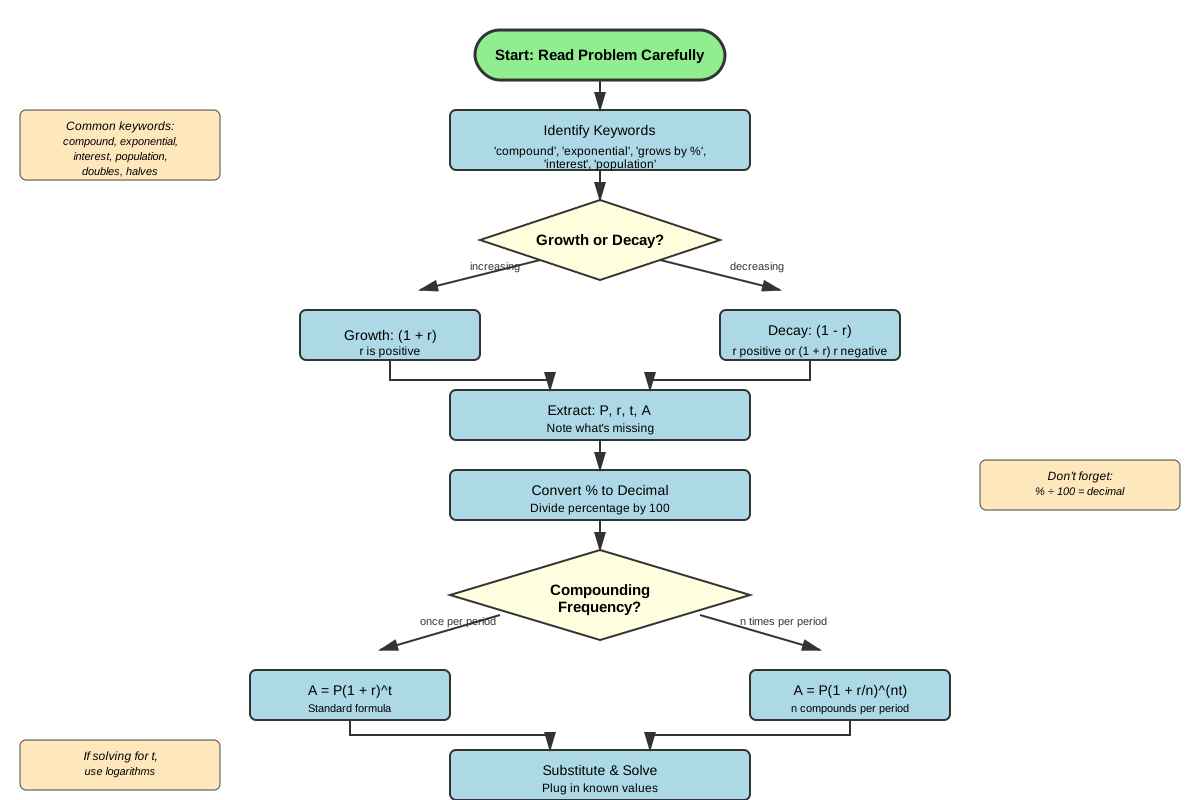
When approaching sat compound growth questions on the SAT, begin by carefully reading the problem to identify whether it describes compound or linear growth. Look for trigger phrases like "increases by X% each period" (compound) versus "increases by X units each period" (linear). Circle or underline the key numerical values and what they represent—initial amount, growth rate, time period, and what the question asks for.
Trigger words and phrases to watch for:
- "compounds," "compounded," "compounding"
- "grows by X% per"
- "increases/decreases by a factor of"
- "doubles every," "triples every," "half-life"
- "at a rate of X% annually/monthly/quarterly"
- "what does [number] represent" (interpretation questions)
For equation construction problems, write down the general formula A = P(1 + r)^t first, then systematically identify each component from the problem statement. Pay special attention to matching time units—if the rate is annual, time must be in years; if the rate is monthly, time must be in months. Convert percentages to decimals immediately to avoid errors.
When solving for the final amount, use your calculator efficiently. Calculate the growth factor first, then raise it to the power, then multiply by the initial amount. For problems with answer choices, consider whether you can eliminate options through estimation. If an account starts with $1,000 and grows at 5% for 10 years, the answer must be more than $1,000 but less than $2,000 (since 5% annual growth won't double money in 10 years), allowing you to eliminate unreasonable choices.
For interpretation questions asking what a number represents, identify its position in the equation structure. The coefficient before the exponential expression is always the initial amount. The base of the exponent is the growth factor. The exponent itself is time. The growth rate is the growth factor minus 1 (for growth) or 1 minus the growth factor (for decay).
Time allocation: Compound growth problems typically require 1-2 minutes. Don't spend excessive time on complex calculations—if a problem seems to require very difficult arithmetic, check whether you've set up the equation correctly or whether estimation might suffice. The SAT rarely requires calculations beyond what a standard calculator can handle efficiently.
Process of elimination tips:
- Eliminate answers where the final amount is less than the initial amount for growth problems (or greater for decay problems)
- For interpretation questions, eliminate answers that confuse growth rate with growth factor
- Check units—eliminate answers with incorrect units (years vs. dollars, for example)
- For "which equation models this situation" questions, verify that the growth factor matches the described percentage
Memory Techniques
Mnemonic for the compound growth formula components: "A Pretty Rabbit Took"
- A = Amount (final)
- P = Principal (initial)
- R = Rate (as decimal)
- T = Time (number of periods)
Visualization strategy: Picture compound growth as a snowball rolling down a hill. Each rotation (time period) adds a layer of snow (growth) to an increasingly larger snowball. The bigger it gets, the more snow it picks up with each rotation, just as compound growth applies the rate to an ever-increasing base. This contrasts with simple growth, which would be like adding the same-sized snowball to a pile each time—linear accumulation rather than exponential expansion.
Growth factor quick check: Remember "One Plus" for growth, "One Minus" for decay. The growth factor always starts with 1 (representing keeping the original amount), then adds the rate for growth or subtracts it for decay. This prevents the common error of using just the rate as the multiplier.
Acronym for problem-solving steps: "WRITE"
- What are you solving for? (Identify the unknown)
- Recognize the formula needed
- Identify all given values
- Translate into the equation
- Evaluate and check reasonableness
Percentage-to-decimal conversion reminder: "Percent means per hundred" — divide by 100 or move the decimal two places left. Visualize the percent sign (%) as a tiny "÷100" reminder.
Summary
Compound growth represents exponential change where a quantity increases or decreases by a fixed percentage each period, with the growth applying to the current value rather than the original value. The fundamental formula A = P(1 + r)^t captures this relationship, where the initial amount P is multiplied by the growth factor (1 + r) raised to the power of the number of time periods t. The growth factor exceeds 1 for growth and falls below 1 for decay. When interest compounds multiple times per year, the formula expands to A = P(1 + r/n)^(nt), dividing the annual rate by the compounding frequency and multiplying the time by that frequency. SAT questions test compound growth through direct calculations, equation construction from word problems, interpretation of equation components in context, and solving for various unknowns. Success requires recognizing compound growth situations from verbal descriptions, correctly converting percentages to decimals, matching time units between rate and duration, and understanding what each formula component represents both mathematically and contextually. The exponential nature of compound growth means small changes in rate or time can produce significant differences in final amounts, making precise calculation and careful attention to detail essential for SAT success.
Key Takeaways
- The compound growth formula A = P(1 + r)^t models situations where a percentage change applies repeatedly to an increasing or decreasing base value
- The growth factor (1 + r) is the multiplier applied each period; it exceeds 1 for growth and is less than 1 for decay
- Converting percentages to decimals and matching time units between rate and duration are critical steps that prevent common errors
- SAT questions frequently ask students to interpret what specific numbers represent within compound growth equations in real-world contexts
- Compound growth produces exponential curves that increase or decrease much faster than linear patterns, making it essential to distinguish between "increases by X%" (compound) and "increases by X units" (linear)
- More frequent compounding (quarterly vs. annually) increases returns but the effect is modest compared to changes in rate or time
- Working backward from a final amount to find the initial amount requires dividing by the growth factor raised to the appropriate power
Related Topics
Exponential Functions and Graphs: Compound growth equations are exponential functions, and understanding how to graph them, identify asymptotes, and analyze their behavior extends the concepts learned here. Mastering compound growth provides the foundation for working with exponential functions in coordinate geometry.
Logarithms: When solving for time in compound growth problems algebraically (rather than through trial and error), logarithms are required. Understanding compound growth first makes logarithms more intuitive as the inverse operation of exponentiation.
Sequences and Series: Compound growth relates to geometric sequences where each term is found by multiplying the previous term by a constant ratio. The connection between discrete geometric sequences and continuous exponential growth deepens understanding of both topics.
Rational Exponents and Radicals: Problems involving doubling time or half-life often require working with fractional exponents, connecting compound growth to the broader unit on exponents and radicals.
Linear vs. Exponential Models: Comparing compound growth (exponential) with simple interest or constant change (linear) helps students choose appropriate models for different situations, a key skill for SAT data analysis questions.
Practice CTA
Now that you've mastered the core concepts of compound growth, it's time to solidify your understanding through practice. Attempt the practice questions to test your ability to identify compound growth situations, construct appropriate equations, perform calculations accurately, and interpret results in context. The flashcards will help you memorize key formulas and definitions while building the quick recall necessary for SAT success. Remember, compound growth appears on virtually every SAT, so investing time in practice now will pay exponential dividends on test day. You've built the foundation—now strengthen it through application!
Sign up free to keep reading
Create a free AnvayaPrep account to finish this SAT guide on Compound growth — plus flashcards and practice questions.