Overview
Cube roots represent one of the fundamental operations in algebra and appear regularly on the SAT as part of the broader category of exponents and radicals. A cube root asks the question: "What number, when multiplied by itself three times, produces the given value?" Understanding cube roots is essential not only for direct computational questions but also for solving equations, simplifying expressions, and working with volume-related geometry problems that frequently appear on the exam.
The SAT tests cube roots in multiple contexts: as standalone simplification problems, within algebraic equations that require solving for variables, and embedded in word problems involving three-dimensional geometry. Unlike square roots, which students encounter more frequently in everyday math courses, cube roots have unique properties that can trip up unprepared test-takers—particularly the fact that cube roots of negative numbers yield real (negative) results, whereas square roots of negative numbers are undefined in the real number system.
Mastering cube roots strengthens overall mathematical fluency and connects directly to understanding rational exponents, polynomial factoring, and function transformations. This topic serves as a bridge between basic arithmetic operations and more advanced algebraic manipulation, making it a high-yield area for SAT preparation. Students who can quickly recognize cube root patterns and apply inverse operations will gain significant advantages in both the calculator and no-calculator sections of the exam.
Learning Objectives
- [ ] Identify key features of cube roots, including their notation, domain, and range
- [ ] Explain how cube roots appears on the SAT in various question formats and contexts
- [ ] Apply cube roots to answer SAT-style questions involving simplification and equation solving
- [ ] Evaluate cube roots of both positive and negative numbers without a calculator
- [ ] Convert between radical notation and exponential notation for cube roots
- [ ] Simplify expressions containing cube roots by factoring perfect cubes
- [ ] Solve equations involving cube roots using inverse operations
Prerequisites
- Integer operations and negative numbers: Cube roots extend to negative values, requiring comfort with signed number arithmetic
- Exponent rules: Cube roots are intimately connected to fractional exponents (specifically, the 1/3 power)
- Prime factorization: Simplifying cube roots requires breaking numbers into prime factors to identify perfect cubes
- Basic algebraic manipulation: Isolating variables and applying inverse operations are essential for solving cube root equations
- Square roots: Understanding the parallel structure between square roots and cube roots aids conceptual transfer
Why This Topic Matters
In real-world applications, cube roots appear whenever three-dimensional relationships are involved. Engineers use cube roots to calculate dimensions from volumes, physicists apply them in inverse-cube laws for gravitational and electromagnetic forces, and financial analysts employ them in compound interest calculations involving three periods. The ability to work with cube roots demonstrates mathematical maturity and spatial reasoning skills valued across STEM fields.
On the SAT, cube root questions appear approximately 1-3 times per exam, typically in the Heart of Algebra or Passport to Advanced Math domains. These questions often carry medium to high difficulty ratings, making them excellent opportunities for students to distinguish themselves from average test-takers. The College Board frequently embeds cube roots within multi-step problems where recognizing the cube root relationship is the key insight that unlocks the solution.
Common SAT presentations include: direct evaluation questions ("What is ∛(-64)?"), algebraic equations requiring cube root isolation ("If x³ = 125, what is x?"), simplification problems involving cube root expressions, and application problems where students must recognize that a volume-to-dimension relationship requires taking a cube root. Questions may also test whether students understand that cube roots, unlike square roots, are defined for all real numbers including negatives.
Core Concepts
Definition and Notation
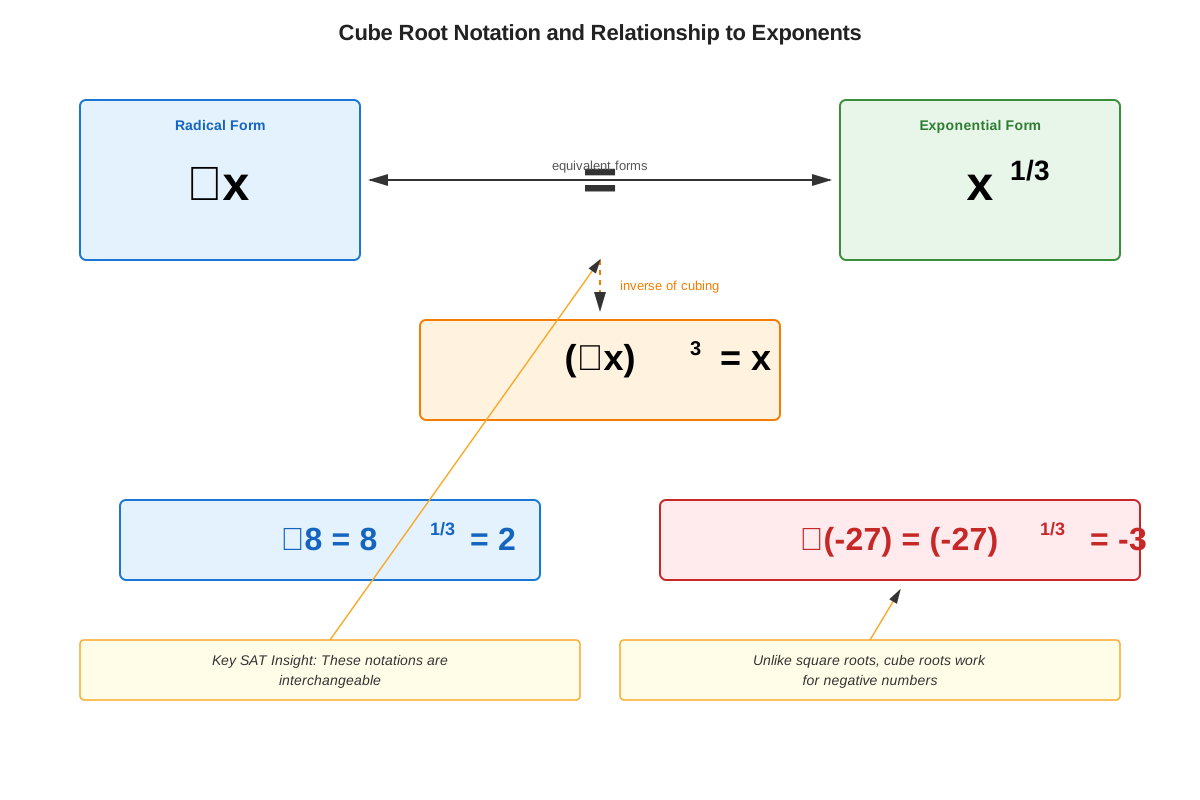
A cube root of a number a is a value that, when raised to the third power (cubed), equals a. The cube root is denoted by the radical symbol with an index of 3: ∛a. In exponential notation, this is equivalent to raising the number to the 1/3 power: a^(1/3).
Mathematically: If ∛a = b, then b³ = a
For example, ∛8 = 2 because 2³ = 2 × 2 × 2 = 8. Similarly, ∛27 = 3 because 3³ = 27.
The cube root function is the inverse operation of cubing a number, just as square roots are the inverse of squaring. This inverse relationship is crucial for solving equations on the SAT.
Domain and Range Properties
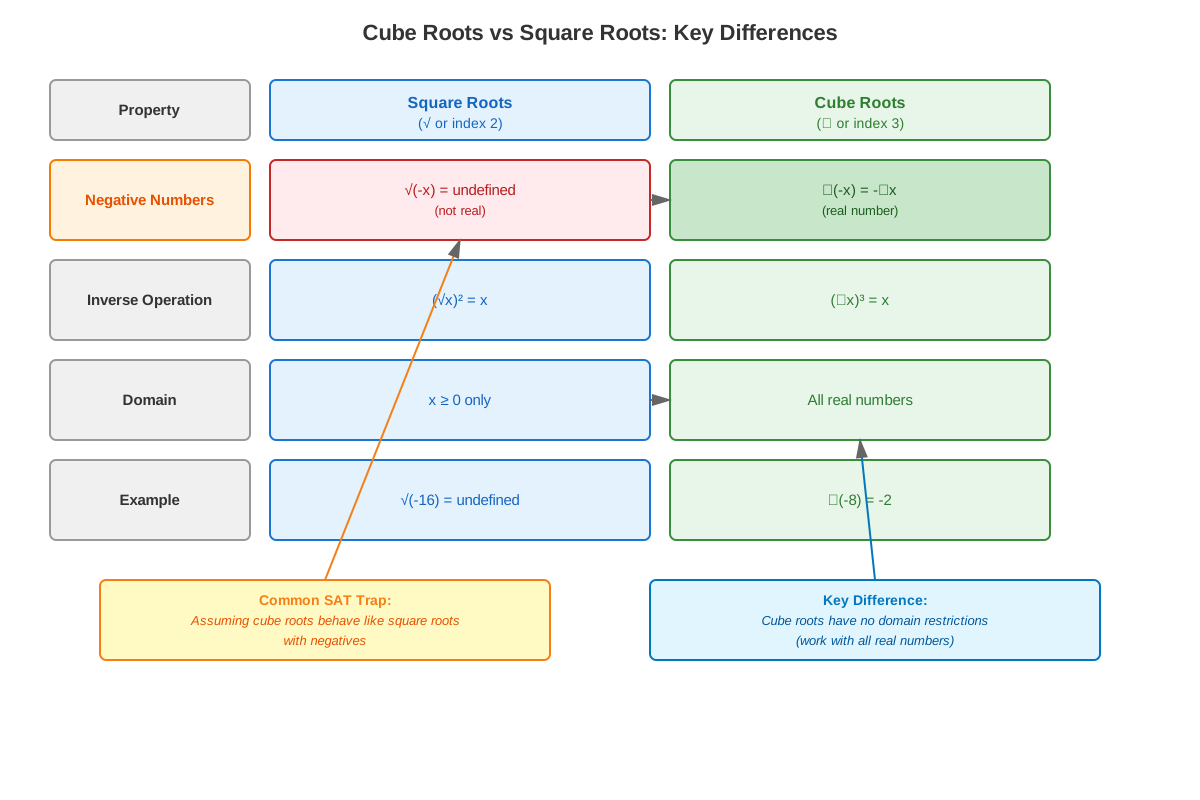
Unlike square roots, which are only defined for non-negative real numbers (in the real number system), cube roots are defined for all real numbers—both positive and negative. This is a critical distinction that the SAT frequently tests.
The cube root of a positive number is positive: ∛8 = 2
The cube root of zero is zero: ∛0 = 0
The cube root of a negative number is negative: ∛(-8) = -2
This occurs because multiplying three negative numbers together yields a negative result: (-2) × (-2) × (-2) = -8.
The range of the cube root function is also all real numbers, making it a one-to-one function with no restrictions on input or output values.
Perfect Cubes
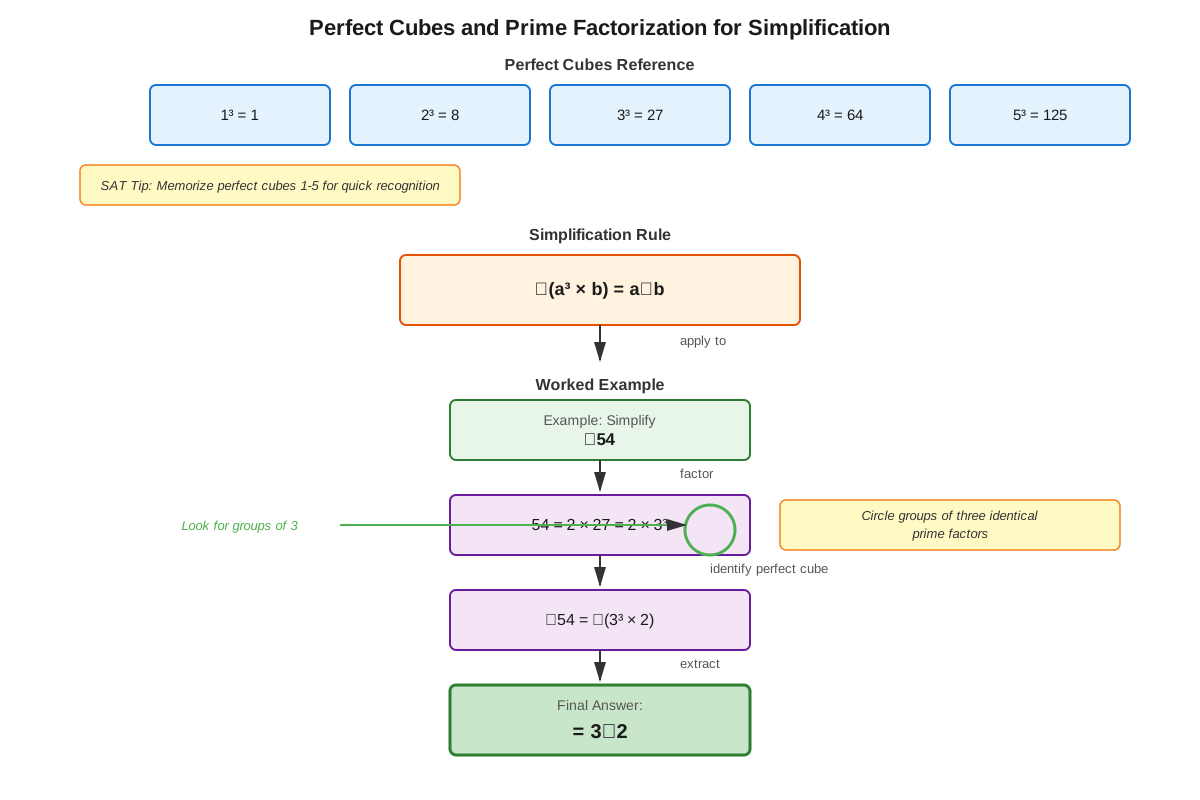
A perfect cube is an integer that can be expressed as another integer raised to the third power. Recognizing perfect cubes allows for quick mental calculation of cube roots without a calculator—an essential skill for the SAT's no-calculator section.
| Number | Cube Root | Calculation |
|---|---|---|
| 1 | 1 | 1³ = 1 |
| 8 | 2 | 2³ = 8 |
| 27 | 3 | 3³ = 27 |
| 64 | 4 | 4³ = 64 |
| 125 | 5 | 5³ = 125 |
| 216 | 6 | 6³ = 216 |
| 343 | 7 | 7³ = 343 |
| 512 | 8 | 8³ = 512 |
| 729 | 9 | 9³ = 729 |
| 1000 | 10 | 10³ = 1000 |
Memorizing at least the first five perfect cubes (1, 8, 27, 64, 125) provides significant advantages on test day. Students should also recognize that these patterns extend to negative perfect cubes: ∛(-27) = -3, ∛(-64) = -4, etc.
Simplifying Cube Roots
When a number is not a perfect cube, the cube root can sometimes be simplified by factoring out perfect cube factors. The process involves:
- Factor the number under the radical into prime factors
- Group the prime factors into sets of three identical factors
- Extract each group of three as a single factor outside the radical
- Leave any remaining factors inside the radical
For example, to simplify ∛(54):
- Factor: 54 = 2 × 27 = 2 × 3³
- Extract the perfect cube: ∛(54) = ∛(2 × 3³) = 3∛2
Similarly, ∛(128):
- Factor: 128 = 2⁷ = 2⁶ × 2 = (2²)³ × 2
- Extract: ∛(128) = ∛(2⁶ × 2) = 2²∛2 = 4∛2
Exponential Form and Fractional Exponents
Cube roots can be expressed using rational exponents, where ∛a = a^(1/3). This notation is particularly useful for applying exponent rules and simplifying complex expressions.
Key relationships:
- ∛(a³) = a^(3 × 1/3) = a¹ = a
- (∛a)³ = (a^(1/3))³ = a^(3/3) = a
- ∛(a²) = a^(2/3)
- ∛(ab) = ∛a × ∛b = a^(1/3) × b^(1/3)
The SAT may present cube roots in either radical or exponential notation, and students must be comfortable converting between forms and applying appropriate algebraic rules.
Solving Equations with Cube Roots
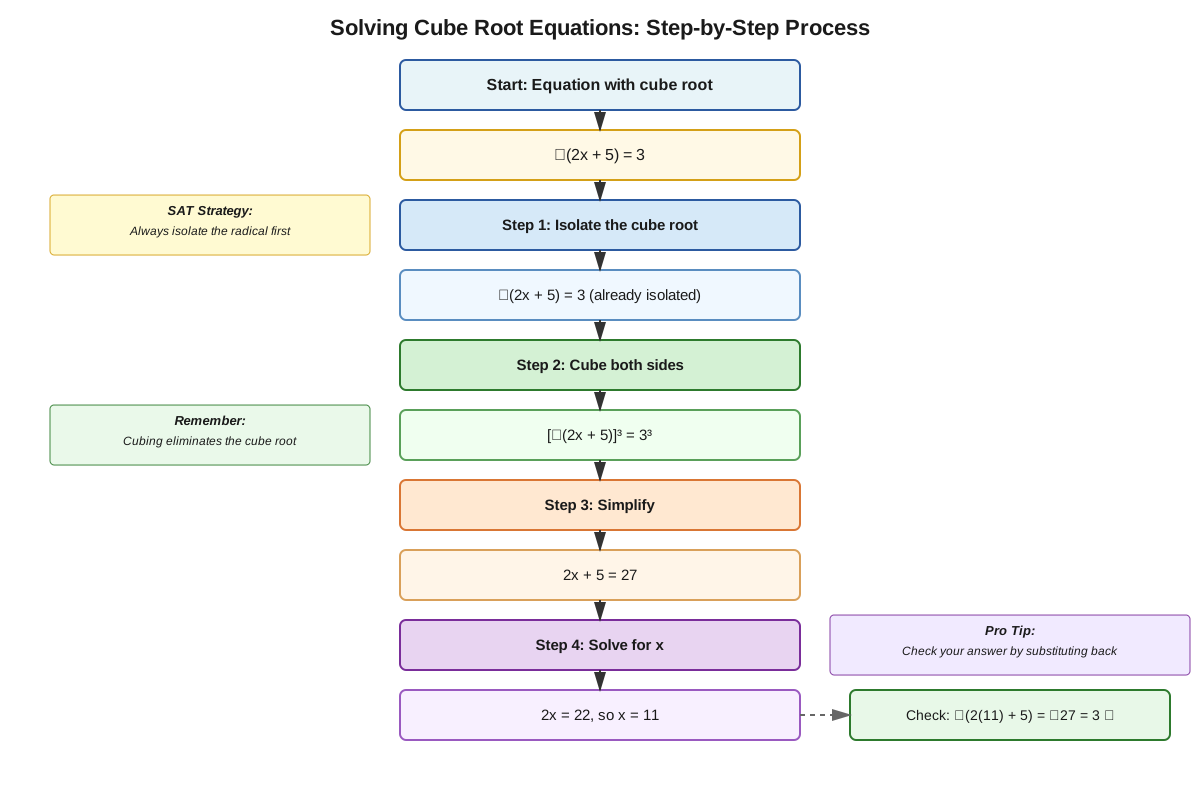
To solve an equation containing a cube root, apply the inverse operation—cubing both sides. This eliminates the radical and allows standard algebraic techniques.
For an equation in the form ∛x = a:
- Cube both sides: (∛x)³ = a³
- Simplify: x = a³
For example, if ∛x = 5, then x = 5³ = 125.
When the cube root is part of a more complex expression, isolate the radical term first before cubing:
If 2∛x + 3 = 11:
- Subtract 3: 2∛x = 8
- Divide by 2: ∛x = 4
- Cube both sides: x = 4³ = 64
Unlike square root equations, which require checking for extraneous solutions, cube root equations do not typically introduce extraneous solutions because the cube root function is one-to-one across all real numbers.
Concept Relationships
The cube root concept connects directly to exponent rules through the relationship ∛a = a^(1/3), allowing students to apply power rules, product rules, and quotient rules to radical expressions. This connection enables simplification of complex expressions by converting to exponential form, manipulating using exponent laws, and converting back to radical form if needed.
Cube roots relate to polynomial factoring through the sum and difference of cubes formulas: a³ + b³ = (a + b)(a² - ab + b²) and a³ - b³ = (a - b)(a² + ab + b²). Recognizing when an expression represents a perfect cube allows factoring that might otherwise seem impossible.
The relationship to three-dimensional geometry is direct: finding the side length of a cube given its volume requires taking the cube root (s = ∛V). This connects cube roots to practical problem-solving and spatial reasoning questions on the SAT.
Within the broader topic of radicals, cube roots parallel square roots but with crucial differences: domain (all reals vs. non-negative reals), the index value (3 vs. 2), and the inverse operation (cubing vs. squaring). Understanding these parallels and distinctions prevents confusion when mixed radical problems appear.
Relationship map: Prime Factorization → enables → Simplifying Cube Roots → connects to → Exponential Notation → allows → Application of Exponent Rules → facilitates → Solving Equations → applies to → Geometric Volume Problems
Quick check — test yourself on Cube roots so far.
Try Flashcards →High-Yield Facts
⭐ The cube root of a negative number is negative and real: ∛(-8) = -2, not undefined
⭐ Cube roots can be expressed as fractional exponents: ∛a = a^(1/3)
⭐ Perfect cubes to memorize: 1, 8, 27, 64, 125, 216, 343, 512, 729, 1000
⭐ To solve ∛x = a, cube both sides: x = a³
⭐ Cube roots do not require absolute value signs: ∛(x³) = x for all real x
- The cube root function is defined for all real numbers (domain: all reals)
- The cube root function is one-to-one, meaning each input has exactly one output
- ∛(ab) = ∛a × ∛b (product property of cube roots)
- ∛(a/b) = ∛a / ∛b (quotient property of cube roots)
- Simplifying cube roots requires factoring out perfect cube factors
- The graph of y = ∛x passes through the origin and extends through all four quadrants
- Cube root equations typically do not produce extraneous solutions
- The cube root of a fraction can be found by taking cube roots of numerator and denominator separately
Common Misconceptions
Misconception: Cube roots of negative numbers are undefined or imaginary.
Correction: Unlike square roots, cube roots of negative numbers are real and negative. Since (-2)³ = -8, we have ∛(-8) = -2. The cube root function is defined for all real numbers.
Misconception: ∛(x³) = |x| (requiring absolute value).
Correction: ∛(x³) = x without absolute value signs. The cube root function preserves sign, so if x is negative, ∛(x³) is also negative. This differs from square roots where √(x²) = |x|.
Misconception: ∛(a + b) = ∛a + ∛b (distributing the radical over addition).
Correction: Cube roots do not distribute over addition or subtraction. ∛(8 + 27) = ∛35 ≈ 3.27, which does not equal ∛8 + ∛27 = 2 + 3 = 5. Only multiplication and division distribute: ∛(ab) = ∛a × ∛b.
Misconception: All cube root equations require checking for extraneous solutions.
Correction: Because the cube root function is one-to-one across all real numbers, cubing both sides of an equation does not typically introduce extraneous solutions. This differs from square root equations where squaring can introduce false solutions.
Misconception: Cube roots can only be simplified if the number is a perfect cube.
Correction: Even non-perfect cubes can often be simplified by factoring out perfect cube factors. For example, ∛(54) = ∛(27 × 2) = 3∛2, which is simpler than leaving it as ∛54.
Misconception: The notation ³√a means 3 times the square root of a.
Correction: The small 3 (called the index) indicates cube root, not multiplication. ∛a means "the number that, when cubed, equals a," not 3√a.
Worked Examples
Example 1: Simplifying and Evaluating Cube Roots
Problem: Simplify ∛(-216) and express ∛(128) in simplest radical form.
Solution:
Part 1: ∛(-216)
Step 1: Recognize that we're finding the cube root of a negative number, which will yield a negative result.
Step 2: Find the cube root of the absolute value: What number cubed equals 216?
- Try small integers: 5³ = 125 (too small), 6³ = 216 ✓
Step 3: Apply the negative sign: ∛(-216) = -6
Verification: (-6)³ = (-6) × (-6) × (-6) = -216 ✓
Part 2: ∛(128)
Step 1: Factor 128 into prime factors:
- 128 = 2⁷
Step 2: Rewrite to identify perfect cube factors:
- 2⁷ = 2⁶ × 2¹ = (2²)³ × 2
Step 3: Apply the product property of cube roots:
- ∛(128) = ∛(2⁶ × 2) = ∛(2⁶) × ∛2
Step 4: Simplify the perfect cube:
- ∛(2⁶) = 2² = 4
Step 5: Write final answer:
- ∛(128) = 4∛2
Connection to learning objectives: This example demonstrates identifying key features of cube roots (negative values yield negative results) and applying simplification techniques using perfect cube factorization.
Example 2: Solving a Cube Root Equation
Problem: If 3∛(2x - 1) + 5 = 14, what is the value of x?
Solution:
Step 1: Isolate the cube root term by subtracting 5 from both sides:
- 3∛(2x - 1) = 9
Step 2: Divide both sides by 3:
- ∛(2x - 1) = 3
Step 3: Cube both sides to eliminate the cube root:
- [∛(2x - 1)]³ = 3³
- 2x - 1 = 27
Step 4: Solve the resulting linear equation:
- 2x = 28
- x = 14
Step 5: Verify the solution by substituting back:
- 3∛(2(14) - 1) + 5 = 3∛(27) + 5 = 3(3) + 5 = 9 + 5 = 14 ✓
Answer: x = 14
Connection to learning objectives: This example applies cube root concepts to solve an SAT-style equation using inverse operations, demonstrating the systematic approach needed for test success.
Exam Strategy
When approaching sat cube roots questions on the exam, first identify whether the problem requires evaluation, simplification, or equation solving. Scan for perfect cubes (1, 8, 27, 64, 125) that allow mental calculation without a calculator.
Trigger words and phrases to watch for:
- "What is the cube root of..." (direct evaluation)
- "If x³ = ..." (requires taking cube root of both sides)
- "Simplify the expression..." (may require factoring perfect cubes)
- "The volume of a cube is..." (geometric application requiring cube root)
- "Express in simplest radical form" (factor out perfect cubes)
For multiple-choice questions, process of elimination strategies include:
- Eliminate answers with incorrect signs (remember: cube roots preserve sign)
- Cube the answer choices to verify which produces the original value
- Estimate the answer by identifying nearby perfect cubes (e.g., if finding ∛50, note that 3³ = 27 and 4³ = 64, so the answer is between 3 and 4)
- Check whether simplified forms are equivalent by cubing or converting to decimal approximations
Time allocation: Straightforward cube root evaluation should take 30-45 seconds. Simplification problems may require 60-90 seconds for factoring. Equation-solving problems typically need 90-120 seconds for isolation, cubing, and verification. If a problem requires more than 2 minutes, mark it for review and move on to maintain pacing.
Exam Tip: On no-calculator sections, memorizing perfect cubes 1³ through 10³ saves valuable time and reduces computational errors. Practice mental cube root evaluation until it becomes automatic.
Memory Techniques
Perfect Cubes Mnemonic: "1 Ate 27 Candy 125 Bars" helps recall the first five perfect cubes (1, 8, 27, 64, 125). The numbers themselves don't appear in the phrase, but the rhythm and structure aid memorization when paired with practice.
Visualization Strategy: Picture a physical cube (like a Rubik's cube or dice) when working with cube roots. If the volume is 64 cubic units, visualize a 4×4×4 cube to reinforce that ∛64 = 4. This spatial reasoning helps distinguish cube roots from square roots.
Sign Rule Acronym: "CNN - Cube Negatives are Negative" reminds students that cube roots of negative numbers yield negative results, unlike square roots which are undefined for negatives in the real number system.
Exponential Conversion: Remember "1/3 for cube, 1/2 for square" to quickly convert between radical and exponential notation. The denominator of the fractional exponent matches the index of the radical.
Simplification Process: "FGE - Factor, Group, Extract" provides a three-step framework for simplifying cube roots: Factor into primes, Group into sets of three, Extract the groups outside the radical.
Summary
Cube roots represent the inverse operation of cubing and are defined for all real numbers, including negatives—a crucial distinction from square roots. The SAT tests cube roots through direct evaluation, simplification, equation solving, and geometric applications. Mastery requires memorizing perfect cubes (especially 1 through 125), understanding the equivalence between radical notation (∛a) and exponential notation (a^(1/3)), and applying systematic problem-solving approaches. Unlike square roots, cube roots preserve the sign of the original number, meaning ∛(-8) = -2, not undefined. Simplification involves factoring out perfect cube factors using prime factorization. Solving cube root equations requires isolating the radical term and cubing both sides, which typically does not introduce extraneous solutions. Success on SAT cube root questions depends on recognizing patterns, applying inverse operations correctly, and understanding the unique properties that distinguish cube roots from other radical expressions.
Key Takeaways
- Cube roots are defined for all real numbers; ∛(-a) = -∛a for any positive number a
- Perfect cubes to memorize: 1, 8, 27, 64, 125, 216, 343, 512, 729, 1000
- Cube roots equal fractional exponents with denominator 3: ∛a = a^(1/3)
- To solve ∛x = a, cube both sides to get x = a³; no extraneous solutions typically occur
- Simplify cube roots by factoring out perfect cube factors using prime factorization
- Cube roots do not require absolute value signs: ∛(x³) = x for all real x
- The product and quotient properties apply: ∛(ab) = ∛a × ∛b and ∛(a/b) = ∛a / ∛b
Related Topics
Rational Exponents: Extends cube root understanding to expressions like a^(2/3) and a^(4/3), combining roots and powers in a single notation. Mastering cube roots provides the foundation for manipulating all fractional exponents.
Higher-Order Roots: Fourth roots, fifth roots, and nth roots follow similar patterns to cube roots. Understanding the index value and how it relates to the inverse operation generalizes to all radical expressions.
Polynomial Factoring: The sum and difference of cubes formulas (a³ ± b³) connect directly to cube root concepts and appear in advanced SAT algebra questions.
Three-Dimensional Geometry: Volume formulas for cubes, spheres, and other solids often require cube root operations to find dimensions from given volumes.
Radical Equations: More complex equations involving multiple radicals or mixed square and cube roots build on the foundational techniques learned here.
Practice CTA
Now that you've mastered the core concepts of cube roots, it's time to solidify your understanding through active practice. Attempt the practice questions to test your ability to evaluate, simplify, and solve cube root problems under timed conditions. Use the flashcards to drill perfect cube recognition until it becomes automatic—this mental math fluency will give you a significant speed advantage on test day. Remember, cube roots appear on nearly every SAT, and confident mastery of this topic translates directly into points. You've built the knowledge foundation; now build the execution skills that lead to your target score!
Sign up free to keep reading
Create a free AnvayaPrep account to finish this SAT guide on Cube roots — plus flashcards and practice questions.