Overview
Equivalent exponent forms represent one of the most fundamental and frequently tested concepts in SAT math. This topic involves recognizing that exponential expressions can be written in multiple ways while maintaining the same mathematical value. Mastering this skill enables students to simplify complex expressions, solve equations efficiently, and identify relationships between seemingly different mathematical statements. On the SAT, questions involving equivalent exponent forms appear in both calculator and no-calculator sections, often embedded within algebra problems, function questions, and data interpretation scenarios.
Understanding equivalent exponent forms is essential because the SAT frequently presents answer choices that look different but are mathematically identical. Students who can quickly recognize and manipulate these forms gain a significant advantage in both accuracy and speed. This topic serves as a bridge between basic arithmetic operations and more advanced algebraic concepts, making it a cornerstone of mathematical literacy at the high school level.
The relationship between equivalent exponent forms and other math concepts is extensive. This topic directly connects to polynomial operations, rational expressions, radical equations, and exponential functions. Additionally, it provides the foundation for understanding logarithms, scientific notation, and growth/decay models. Students who master sat equivalent exponent forms develop pattern recognition skills that transfer to virtually every quantitative section of the exam, making this one of the highest-yield topics for focused study.
Learning Objectives
- [ ] Identify key features of equivalent exponent forms
- [ ] Explain how equivalent exponent forms appears on the SAT
- [ ] Apply equivalent exponent forms to answer SAT-style questions
- [ ] Convert between exponential and radical notation fluently
- [ ] Simplify complex expressions using exponent rules to create equivalent forms
- [ ] Recognize when two different-looking expressions are mathematically equivalent
- [ ] Determine which equivalent form is most useful for solving a particular problem
Prerequisites
- Basic exponent rules: Understanding properties like x^a · x^b = x^(a+b) is essential for recognizing equivalent forms
- Order of operations: Correctly evaluating expressions ensures accurate transformation between forms
- Fraction operations: Many equivalent forms involve fractional exponents requiring comfort with fraction arithmetic
- Radical notation: Familiarity with square roots, cube roots, and higher-order roots enables conversion between radical and exponential forms
- Negative numbers: Understanding how negative bases and negative exponents behave prevents common errors
Why This Topic Matters
In real-world applications, equivalent exponent forms appear in compound interest calculations, population growth models, radioactive decay problems, and computer science algorithms. Scientists and engineers regularly convert between different exponential representations to simplify calculations or reveal underlying patterns in data. The ability to recognize equivalent forms allows professionals to choose the most efficient computational approach for their specific context.
On the SAT, equivalent exponent forms appear in approximately 10-15% of all math questions, making it one of the most frequently tested topics. These questions appear across multiple question types: multiple-choice problems requiring simplification, grid-in questions asking for specific numerical values, and multi-step word problems where recognizing equivalent forms is a crucial intermediate step. The College Board particularly favors questions that combine exponent manipulation with equation solving or function analysis.
Common SAT question formats include: presenting an expression and asking which answer choice is equivalent; providing an equation with exponential terms and asking students to solve for a variable; giving a function in one form and asking about its behavior using a different equivalent form; and word problems involving exponential growth or decay where students must convert between forms to extract meaningful information. Questions often deliberately use unfamiliar-looking forms to test whether students truly understand the underlying principles rather than just memorizing procedures.
Core Concepts
Fundamental Exponent Properties
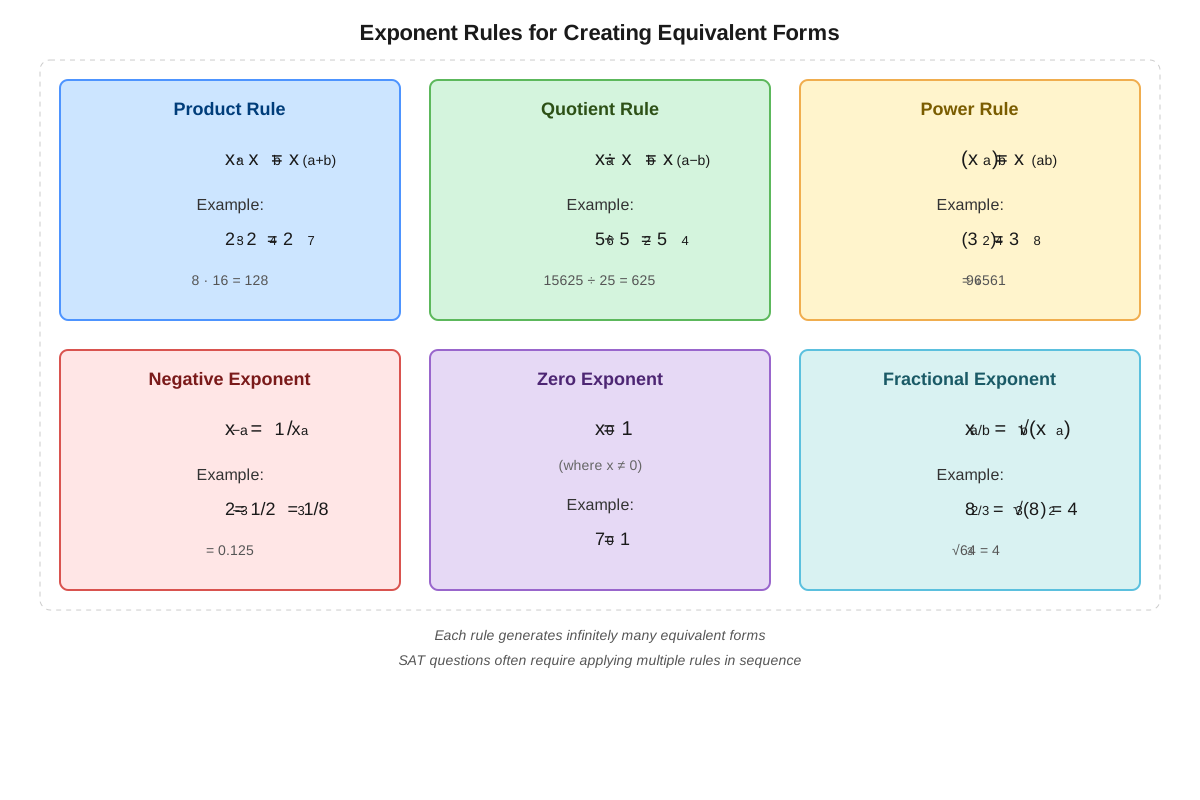
The foundation of equivalent exponent forms rests on five fundamental properties that allow transformation between different representations. The product rule states that when multiplying terms with the same base, exponents add: x^a · x^b = x^(a+b). The quotient rule indicates that when dividing terms with the same base, exponents subtract: x^a ÷ x^b = x^(a-b). The power rule shows that when raising a power to another power, exponents multiply: (x^a)^b = x^(ab).
Two additional critical properties complete the foundation. The power of a product rule demonstrates that (xy)^a = x^a · y^a, allowing distribution of exponents across multiplication. The power of a quotient rule shows that (x/y)^a = x^a / y^a, enabling similar distribution across division. These five properties form the toolkit for creating equivalent exponent forms.
Zero and Negative Exponents
Understanding special exponent values is crucial for SAT success. Any non-zero base raised to the zero power equals one: x^0 = 1 (where x ≠ 0). This seemingly counterintuitive rule follows logically from the quotient rule: x^a ÷ x^a = x^(a-a) = x^0, and since any number divided by itself equals 1, x^0 must equal 1.
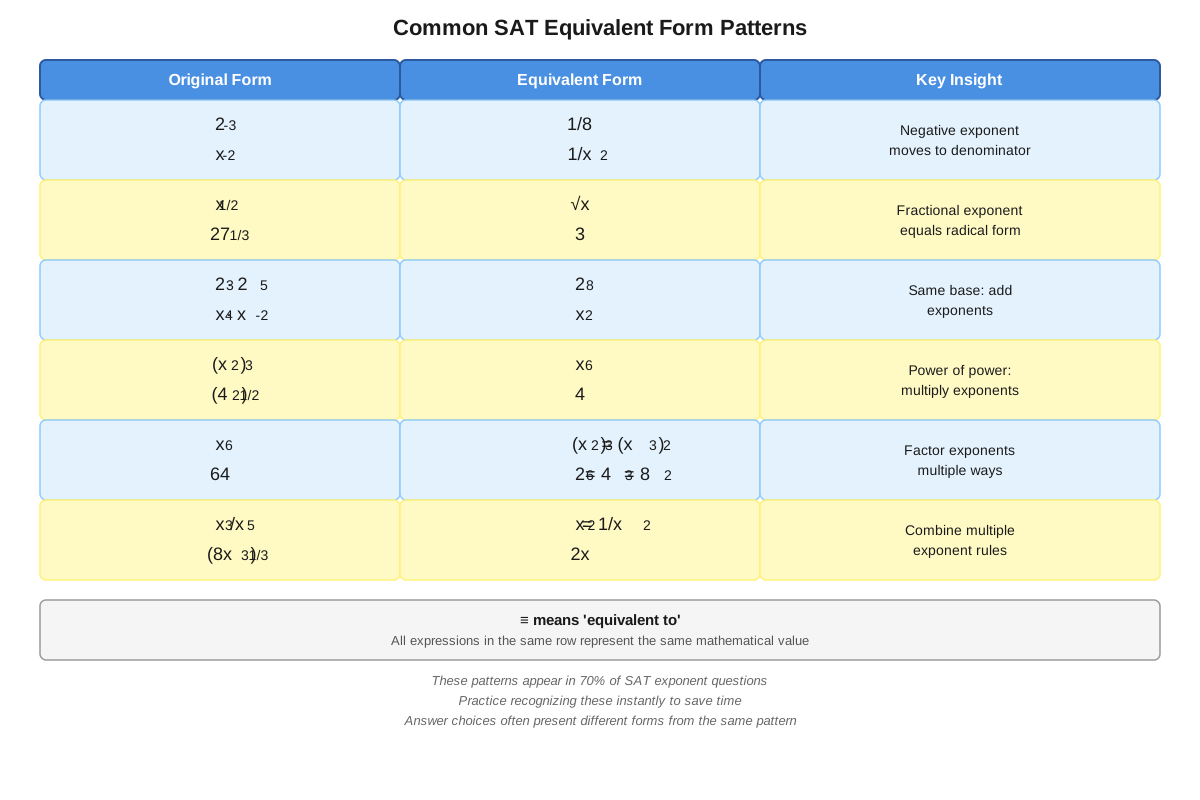
Negative exponents indicate reciprocals: x^(-a) = 1/x^a. This relationship allows conversion between expressions with negative exponents and fractional forms. For example, 2^(-3) = 1/2^3 = 1/8. The SAT frequently tests whether students can recognize that expressions like 1/x^2 and x^(-2) are equivalent. Additionally, negative exponents in denominators move to numerators as positive exponents: 1/x^(-a) = x^a.
Fractional Exponents and Radicals
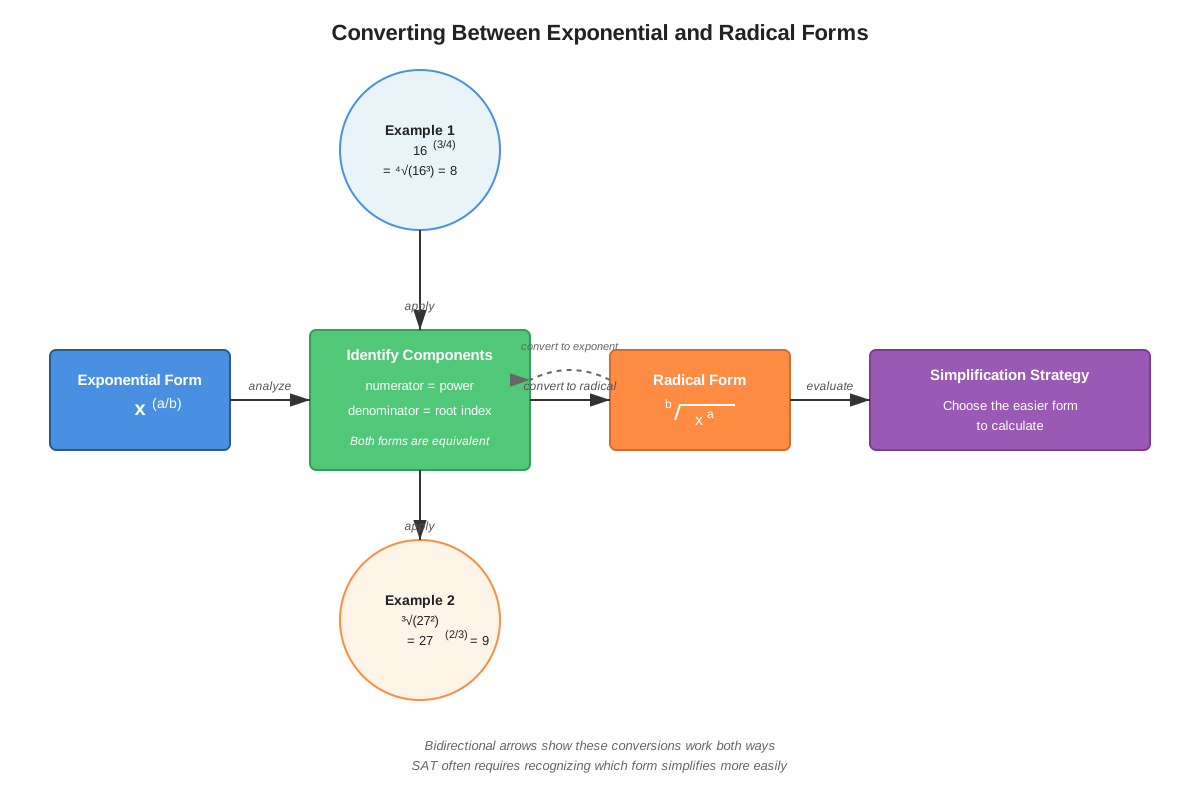
Fractional exponents provide an alternative notation for radicals, creating one of the most important categories of equivalent forms. The general relationship is x^(1/n) = ⁿ√x, where n represents the index of the root. For example, x^(1/2) = √x and x^(1/3) = ³√x. This conversion allows students to work with radicals using exponent rules, often simplifying complex problems.
When the fractional exponent has a numerator other than 1, the expression combines both a power and a root: x^(m/n) = ⁿ√(x^m) = (ⁿ√x)^m. These two forms are equivalent, though one may be more convenient depending on the context. For instance, 8^(2/3) can be evaluated as ³√(8^2) = ³√64 = 4, or as (³√8)^2 = 2^2 = 4. The SAT often requires students to recognize these equivalent representations.
Simplification Strategies
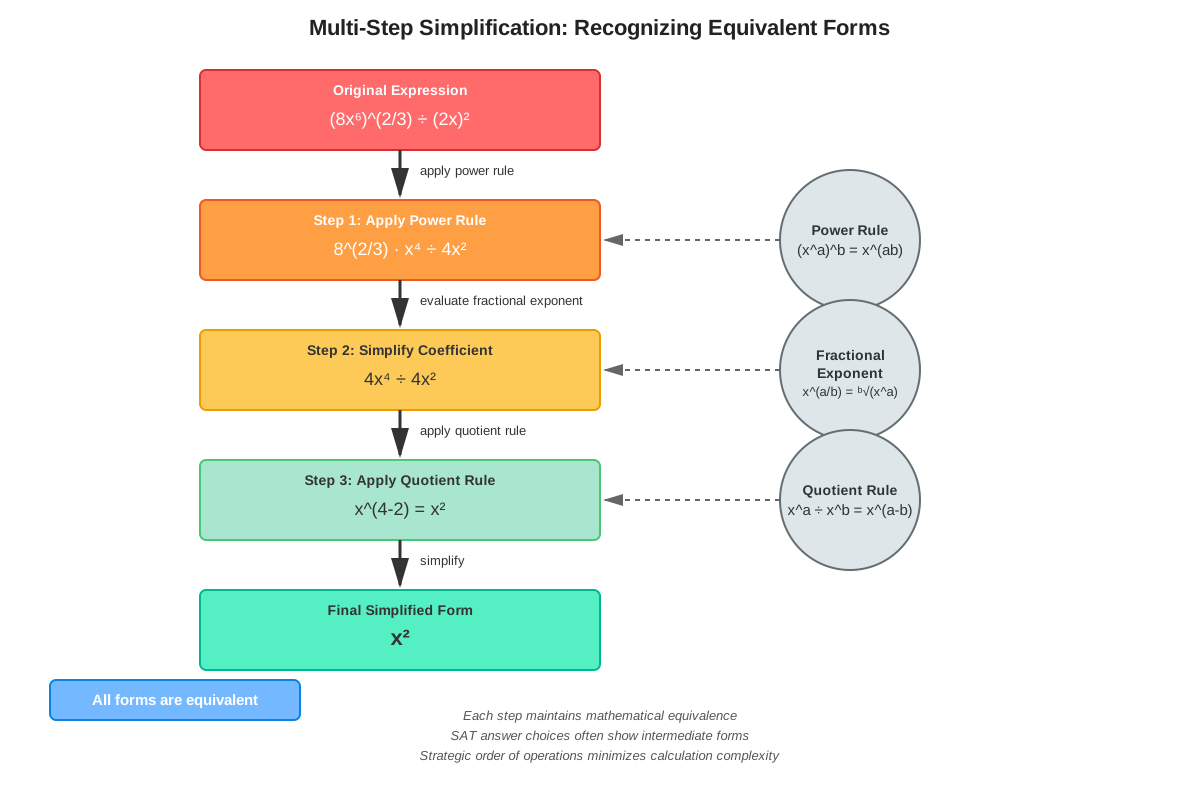
Creating equivalent forms often involves strategic simplification. Combining like terms with the same base using the product and quotient rules reduces expression complexity. For example, (2x^3)(4x^5) = 8x^8 by multiplying coefficients and adding exponents. Similarly, 12x^7 ÷ 3x^2 = 4x^5.
Factoring out common exponential terms reveals equivalent forms that may not be immediately obvious. The expression x^5 + x^3 can be written as x^3(x^2 + 1), which is equivalent but emphasizes different structural features. The SAT uses this technique to create answer choices that test conceptual understanding rather than mere computation.
Exponential Equations and Equivalent Bases
Solving exponential equations often requires expressing both sides using equivalent forms with the same base. If 2^x = 8, recognizing that 8 = 2^3 allows rewriting as 2^x = 2^3, from which x = 3 follows immediately. This strategy extends to more complex scenarios: if 4^x = 32, expressing both sides as powers of 2 gives (2^2)^x = 2^5, which simplifies to 2^(2x) = 2^5, yielding 2x = 5 and x = 2.5.
The SAT frequently presents equations where recognizing equivalent exponential forms is the key to efficient solution. Questions might involve expressions like 9^x = 27^(x-1), which requires recognizing both as powers of 3: (3^2)^x = (3^3)^(x-1), leading to 3^(2x) = 3^(3x-3), then 2x = 3x - 3, and finally x = 3.
Scientific Notation as Equivalent Forms
Scientific notation represents another category of equivalent exponent forms. The number 3,500 can be written as 3.5 × 10^3, which is equivalent but emphasizes magnitude through the power of 10. The SAT tests whether students can convert between standard and scientific notation, and whether they can perform operations while maintaining proper form.
Operations with scientific notation require understanding equivalent exponent forms. Multiplying (2 × 10^3)(4 × 10^5) = 8 × 10^8 uses the product rule. Dividing (6 × 10^7) ÷ (3 × 10^4) = 2 × 10^3 applies the quotient rule. These calculations appear in SAT word problems involving very large or very small quantities.
Concept Relationships
The core concepts within equivalent exponent forms build upon each other in a logical progression. Fundamental exponent properties serve as the foundation → enabling understanding of zero and negative exponents → which then extend to fractional exponents and radicals → all of which support simplification strategies → that ultimately enable solving exponential equations and working with scientific notation.
Connections to prerequisite topics are essential. Basic exponent rules directly enable recognition of equivalent forms through systematic application. Fraction operations become critical when working with fractional exponents, as students must add, subtract, multiply, and divide fractions to manipulate these expressions. Radical notation knowledge allows bidirectional conversion between radical and exponential forms.
This topic connects forward to numerous advanced concepts. Mastering equivalent exponent forms prepares students for exponential functions, where different forms reveal different characteristics (growth rate, initial value, etc.). It supports logarithms, which are inverse operations to exponentiation. It enables work with polynomial operations, where exponent rules govern term combination. Understanding equivalent forms also facilitates rational expressions, where negative exponents frequently appear in simplified forms.
Quick check — test yourself on Equivalent exponent forms so far.
Try Flashcards →High-Yield Facts
⭐ Any non-zero number raised to the zero power equals 1: x^0 = 1 (x ≠ 0)
⭐ Negative exponents indicate reciprocals: x^(-a) = 1/x^a
⭐ Fractional exponents represent roots: x^(1/n) = ⁿ√x
⭐ When multiplying same bases, add exponents: x^a · x^b = x^(a+b)
⭐ When dividing same bases, subtract exponents: x^a ÷ x^b = x^(a-b)
- When raising a power to a power, multiply exponents: (x^a)^b = x^(ab)
- Exponents distribute over multiplication: (xy)^a = x^a · y^a
- Exponents distribute over division: (x/y)^a = x^a / y^a
- Combined fractional exponents: x^(m/n) = ⁿ√(x^m) = (ⁿ√x)^m
- Moving terms between numerator and denominator changes exponent sign: 1/x^a = x^(-a)
- The number 1 can be expressed as any base to the zero power: 1 = 2^0 = 10^0 = x^0
- Negative bases with even exponents yield positive results: (-2)^4 = 16
- Negative bases with odd exponents yield negative results: (-2)^3 = -8
Common Misconceptions
Misconception: x^a · x^b = x^(ab) → Correction: When multiplying terms with the same base, exponents add, not multiply. The correct rule is x^a · x^b = x^(a+b). For example, x^2 · x^3 = x^5, not x^6.
Misconception: (x + y)^2 = x^2 + y^2 → Correction: Exponents do not distribute over addition. The correct expansion is (x + y)^2 = x^2 + 2xy + y^2. Exponents only distribute over multiplication and division, not addition or subtraction.
Misconception: x^(-2) is negative → Correction: A negative exponent indicates a reciprocal, not a negative value. x^(-2) = 1/x^2, which is positive when x is real and non-zero. The negative sign affects the exponent's position, not the expression's sign.
Misconception: x^(1/2) · x^(1/2) = x → Correction: This is actually correct, but students often doubt it. Since x^(1/2) = √x, multiplying √x · √x = x. Using exponent rules: x^(1/2) · x^(1/2) = x^(1/2 + 1/2) = x^1 = x.
Misconception: 2x^3 means (2x)^3 → Correction: Without parentheses, exponents apply only to the immediately preceding term. 2x^3 = 2 · x^3, not (2x)^3 = 8x^3. Order of operations requires evaluating exponents before multiplication.
Misconception: x^(2/3) = x^2/3 → Correction: The fractional exponent x^(2/3) means (³√x)^2 or ³√(x^2), not x^2 divided by 3. Parentheses around fractional exponents are crucial for correct interpretation.
Misconception: √(x^2) always equals x → Correction: √(x^2) = |x|, the absolute value of x. If x is negative, √(x^2) equals -x (which is positive). For example, if x = -3, then √((-3)^2) = √9 = 3 = |-3|, not -3.
Worked Examples
Example 1: Simplifying Complex Exponential Expressions
Problem: Simplify the expression (8x^6y^3)^(2/3) and write it without fractional exponents.
Solution:
Step 1: Apply the power of a product rule to distribute the exponent (2/3) to each factor.
(8x^6y^3)^(2/3) = 8^(2/3) · (x^6)^(2/3) · (y^3)^(2/3)
Step 2: Apply the power rule to each term by multiplying exponents.
= 8^(2/3) · x^(6·2/3) · y^(3·2/3)
= 8^(2/3) · x^4 · y^2
Step 3: Evaluate 8^(2/3) by recognizing it as (³√8)^2.
³√8 = 2 (since 2^3 = 8)
Therefore, 8^(2/3) = 2^2 = 4
Step 4: Combine all terms.
= 4x^4y^2
Connection to Learning Objectives: This example demonstrates applying equivalent exponent forms to simplify expressions, identifying the key feature that fractional exponents can be converted to radical form, and using multiple exponent rules in combination—all essential skills for SAT questions.
Example 2: Solving Exponential Equations Using Equivalent Forms
Problem: Solve for x: 27^(x+1) = 9^(2x-3)
Solution:
Step 1: Express both sides using the same base. Both 27 and 9 are powers of 3.
27 = 3^3 and 9 = 3^2
Step 2: Rewrite the equation using base 3.
(3^3)^(x+1) = (3^2)^(2x-3)
Step 3: Apply the power rule to simplify both sides.
3^(3(x+1)) = 3^(2(2x-3))
3^(3x+3) = 3^(4x-6)
Step 4: Since the bases are equal, the exponents must be equal.
3x + 3 = 4x - 6
Step 5: Solve the linear equation.
3 + 6 = 4x - 3x
9 = x
Step 6: Verify by substituting x = 9 back into the original equation.
Left side: 27^(9+1) = 27^10 = (3^3)^10 = 3^30
Right side: 9^(2(9)-3) = 9^15 = (3^2)^15 = 3^30 ✓
Connection to Learning Objectives: This example shows how recognizing equivalent exponent forms (expressing 27 and 9 as powers of 3) is essential for solving exponential equations on the SAT. It demonstrates the strategic application of exponent rules to transform complex equations into solvable forms.
Exam Strategy
When approaching SAT questions on equivalent exponent forms, begin by identifying what form the question presents and what form the answer choices use. If the question gives a radical expression but answer choices use fractional exponents (or vice versa), immediate conversion is likely necessary. Look for opportunities to express all terms using a common base, as this often reveals the path to solution.
Trigger words and phrases to watch for include: "which of the following is equivalent," "can be expressed as," "simplified form," "rewritten as," and "equal to." These phrases signal that the question tests recognition of equivalent forms rather than computation. When you see "for all positive values of x" or "where x > 0," the question likely involves fractional or negative exponents where domain restrictions matter.
For process-of-elimination, test answer choices by substituting simple values like x = 1, x = 2, or x = 4 (perfect squares and cubes make evaluation easier). If an answer choice yields a different numerical result than the original expression, eliminate it immediately. Be cautious with x = 0 or x = 1, as these can make different expressions appear equivalent when they're not (since 0^n = 0 and 1^n = 1 for most n).
Time allocation for equivalent exponent form questions should be approximately 45-60 seconds for straightforward simplification problems and 90-120 seconds for multi-step problems involving equation solving. If a problem requires more than two minutes, consider marking it for review and moving forward. Often, returning with fresh eyes reveals a simpler approach that wasn't initially apparent.
Develop a systematic approach: (1) Identify all bases and exponents, (2) Look for common bases or opportunities to create them, (3) Apply exponent rules methodically, (4) Simplify step-by-step rather than attempting multiple operations simultaneously, (5) Check your answer by substituting a test value if time permits. This structured approach reduces errors and builds confidence.
Memory Techniques
MADSPM helps remember the six core exponent rules: Multiply (add exponents), Any base to zero equals one, Divide (subtract exponents), Same base (required for adding/subtracting exponents), Power to power (multiply exponents), Move (negative exponents move between numerator/denominator).
For remembering that fractional exponents represent roots, visualize the fraction as "power over root": x^(m/n) has the power (m) on top and the root (n) on bottom, so it's the nth root of x to the mth power. The denominator "digs down" to find the root, while the numerator "powers up."
"Negative means flip" captures the essence of negative exponents. Whenever you see a negative exponent, flip the term between numerator and denominator and make the exponent positive. This simple phrase prevents the common error of thinking negative exponents create negative values.
The "Zero makes One" rule can be remembered through the pattern: x^3 = x·x·x, x^2 = x·x, x^1 = x, x^0 = 1. Each time the exponent decreases by 1, we divide by x. Following this pattern, x^0 = x^1 ÷ x = x/x = 1.
For distributing exponents, remember "MULTIPLY yes, ADD no." Exponents distribute over multiplication and division (xy)^a = x^a·y^a, but NOT over addition and subtraction. Visualizing this distinction prevents one of the most common algebraic errors.
Summary
Equivalent exponent forms represent different mathematical expressions that have identical values, created through systematic application of exponent rules. Mastery requires understanding five fundamental properties (product, quotient, power, power of product, and power of quotient rules), recognizing special cases (zero and negative exponents), and converting fluently between exponential and radical notation. The SAT tests this topic extensively because it reveals whether students understand underlying mathematical relationships rather than just memorizing procedures. Success requires recognizing when different-looking expressions are equivalent, choosing the most useful form for a given problem context, and applying transformation rules accurately. Students must be comfortable with fractional exponents, negative exponents, and the strategic use of common bases to solve exponential equations. The ability to move flexibly between equivalent forms—whether simplifying complex expressions, solving equations, or working with scientific notation—is essential for achieving high scores on the math section.
Key Takeaways
- Equivalent exponent forms are different expressions with identical mathematical values, created through systematic application of exponent rules
- The five fundamental properties (product, quotient, power, power of product, power of quotient) enable all transformations between equivalent forms
- Negative exponents indicate reciprocals (x^(-a) = 1/x^a), not negative values
- Fractional exponents represent roots (x^(1/n) = ⁿ√x), providing an alternative to radical notation
- Any non-zero base raised to the zero power equals one (x^0 = 1)
- Expressing exponential equations using a common base is the key strategy for solving them efficiently
- The SAT frequently tests whether students can recognize equivalent forms in different notations, making this a high-yield topic for focused study
Related Topics
Exponential Functions and Growth Models: Understanding equivalent exponent forms enables analysis of exponential functions in different forms (standard, vertex, factored), each revealing different characteristics about growth rate, initial value, and asymptotic behavior.
Logarithms: As inverse operations to exponentiation, logarithms require fluency with exponent manipulation. Converting between exponential and logarithmic forms relies on the same principles as creating equivalent exponent forms.
Polynomial Operations: Advanced polynomial work involves extensive exponent manipulation, particularly when multiplying, dividing, and factoring expressions with multiple variables and powers.
Rational Expressions: Simplifying complex fractions often requires recognizing equivalent exponent forms, particularly when negative exponents appear in numerators and denominators.
Sequences and Series: Geometric sequences and series involve exponential patterns where recognizing equivalent forms helps identify common ratios and sum formulas.
Practice CTA
Now that you've mastered the core concepts of equivalent exponent forms, it's time to solidify your understanding through active practice. Attempt the practice questions to test your ability to recognize, manipulate, and apply these forms in SAT-style contexts. Use the flashcards to reinforce the fundamental rules and special cases until they become automatic. Remember, the difference between knowing these concepts and scoring points on test day is practice—the more problems you work through, the faster and more confident you'll become at recognizing equivalent forms in any context. You've built the foundation; now build the speed and accuracy that will maximize your SAT math score!
Sign up free to keep reading
Create a free AnvayaPrep account to finish this SAT guide on Equivalent exponent forms — plus flashcards and practice questions.